• Sydney: The State Library of New South Wales

    Members of Aboriginal and Torres Strait Islander communities are respectfully advised that this blog post contains the name and image of someone who has passed away.

    I had a wonderful afternoon exploring The State Library of New South Wales and visiting the newly opened Michael Crouch Family Galleries. I was particularly interested to see the exhibition, UNESCO Six, a display of six significant collections that form part of Australia’s collective memory. I was lucky enough to be joined by a good friend which made the visit even more thought-provoking and enjoyable.

    I don’t want to delve into this too much, but, I must begin by commenting on the problems of collective memory. Deeming certain things significant to a collective memory is absolutely riddled with exclusiveness and, potentially, alienation. What is deemed significant? Who makes these decisions and how much input is sought from the community? According to the exhibition, more collections from New South Wales will be added in years to come and these six collections only represent a segment of what is inscribed on the Memory of the World Register. Rather than solving the problem of who is in this collective memory and why, adding more to the mix might just exacerbate things.

    img_1343 2
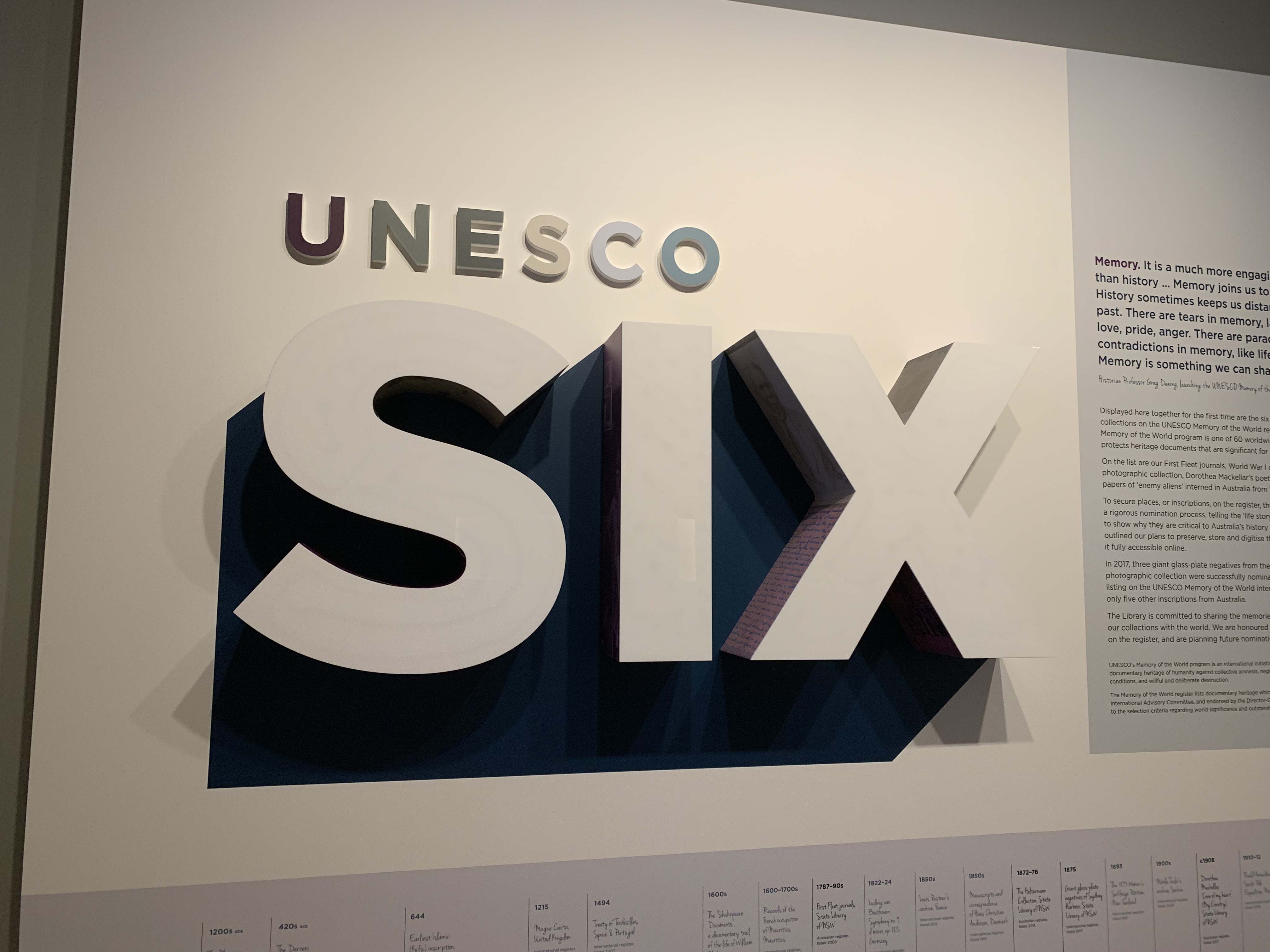
    UNESCO Six Sign

    I spent the entire year of my honours degree pulling apart this notion of collective memory. There is always going to be a group that has their memory represented and those who are marginalised. That is why I am mentioning it here, because I think we have to take a step back and question what’s on display.

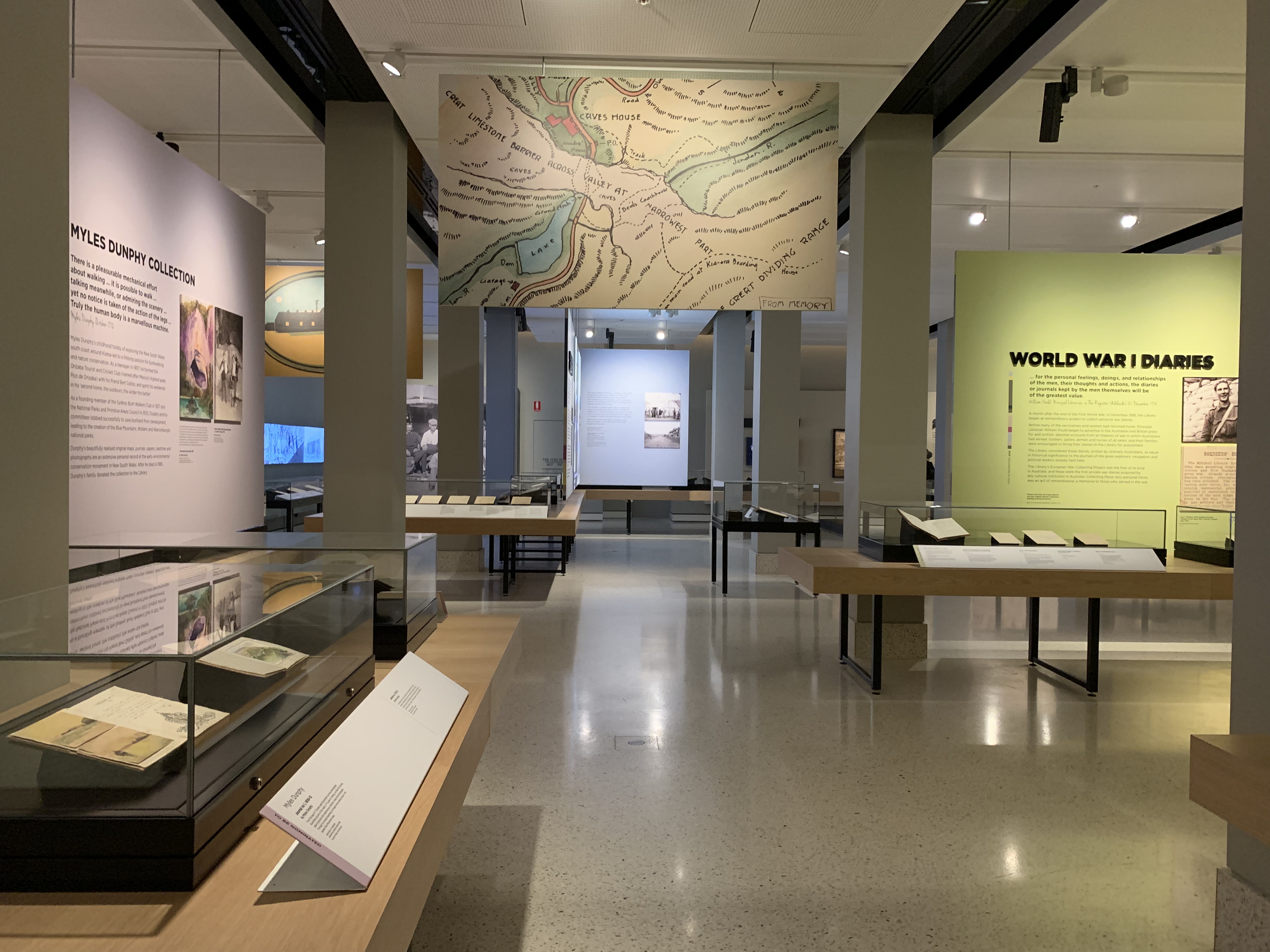
    In saying that, if you are looking for an exhibition that is beautifully designed, clearly labelled/sign-posted, and contains fascinating material, you have come to the right place. It is a really contemporary exhibition with a sleek design that complements the materials on display. Enlarged photographs and splashes of colour on the walls serve to distinguish and separate the six collections. Not only is this a nice design feature, but also, a great way to help visitors navigate the exhibition. It strikes a balance between too much and too little, in terms of design. In addition to this, the display cases are all seamlessly integrated into the exhibition space and aesthetically pleasing.

    I’ve included a couple of photographs below that, hopefully, highlight the layout. Even the use of soft pastel colours help to make the space feel welcoming and calming.

    img_1382
    Layout
    img_1367
    Layout

    Before writing a little something on each of the six collections, I also want to mention the catalogues. I thought it was a really nice idea to have well-produced catalogues available for a small donation. A great way to generate some funding without forcing people to pay a ridiculous amount for the catalogue.

    img_1424
    Exhibition Guide

    Ok, time for an overview of the six collections. The layout of each collection in the exhibition space is very similar – an introductory panel that is short and to the point, and a selection of objects each with their own individual label. The panels do a fantastic job of explaining everything you need to know about the collection on display. For the first time in a long time I didn’t leave feeling like I was suffering from visitor fatigue. You aren’t bombarded with too much information – just an overview panel and the opportunity to read any of the object labels that spark interest.

    1. First Fleet Journals

    The State Library holds 10 of the 15 known journals from the First Fleet. For those reading who are not aware, the First Fleet comprised of 11 ships that sailed from England to Australia carrying convicts. The history after their arrival is, of course, one of great sadness and loss for the Indigenous population of Australia.

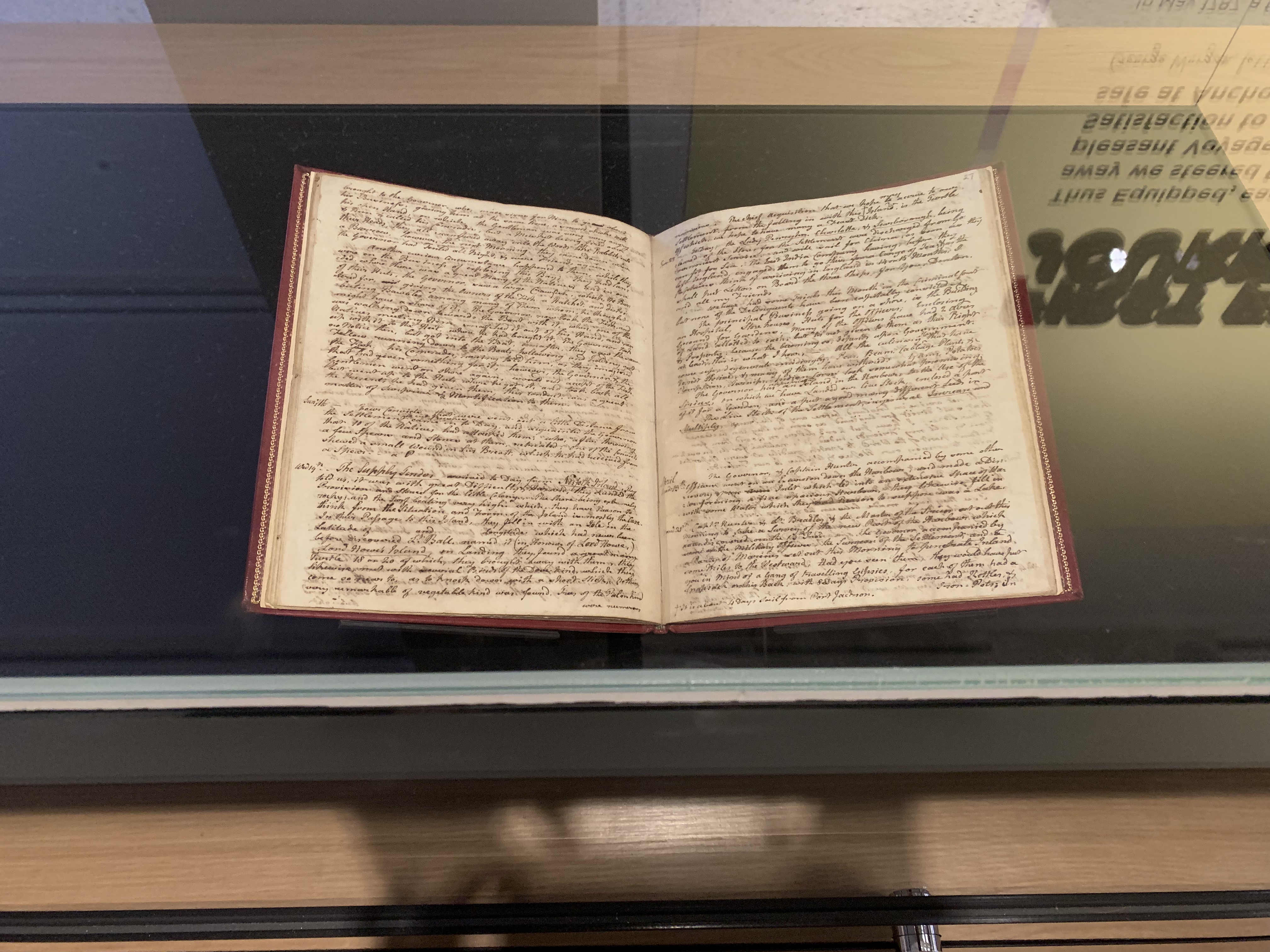
    The journals on display were written by men of varying ranks and describe not only the eight month voyage to Australia, but also, life in the settlement.

    img_1347
    Diary of John Hunter.

    One of the journals belonged to George Worgan, an appointed surgeon on the HMS Sirius. The extract on display was written a week before arriving at, then termed, Sydney cove. It evokes a sense of enthusiasm for the future of the colony. His handwriting is also neat enough to be quite mesmerising.

    img_1352
    Diary of George Worgan.

    2. Core of My Heart Dorothea Mackellar

    In the collection of the State Library is a notebook that belonged to Dorothea Mackellar containing the final draft of the poem Core of My Heart. Now, I must confess that the title of this poem did not ring any bells. However, while we were standing in this particular section, you can hear the poem being read aloud. As soon as it got to the line “I love a sunburnt country” I immediately recognised it. I thought it was a wonderful idea to have the poem read aloud, as it added another layer to the display.

    img_1358
    Core of My Heart Dorothea Mackellar

    Mckellar wrote the poem while she was living in London and feeling quite homesick for Australia. Throughout her life, she would revisit and refine her words.

    3 & 4. Holtermann Collection and Giant Glass-Plate Negative

    It’s amazing what you can find hiding in someone’s house or shed. In 1951, over 3 000 glass-plate negatives were discovered in a garden shed in Chatswood, Sydney. These were captured by Henry Beaufoy Merlin and his assistant Charles Bayliss between 1870 and 1876. The images are of the New South Wales gold rush and were used to promote Australia to the world at various displays and fairs. One of the individuals they photographed was Bernhardt Otto Holtermann who discovered the largest piece of reef gold in the world.

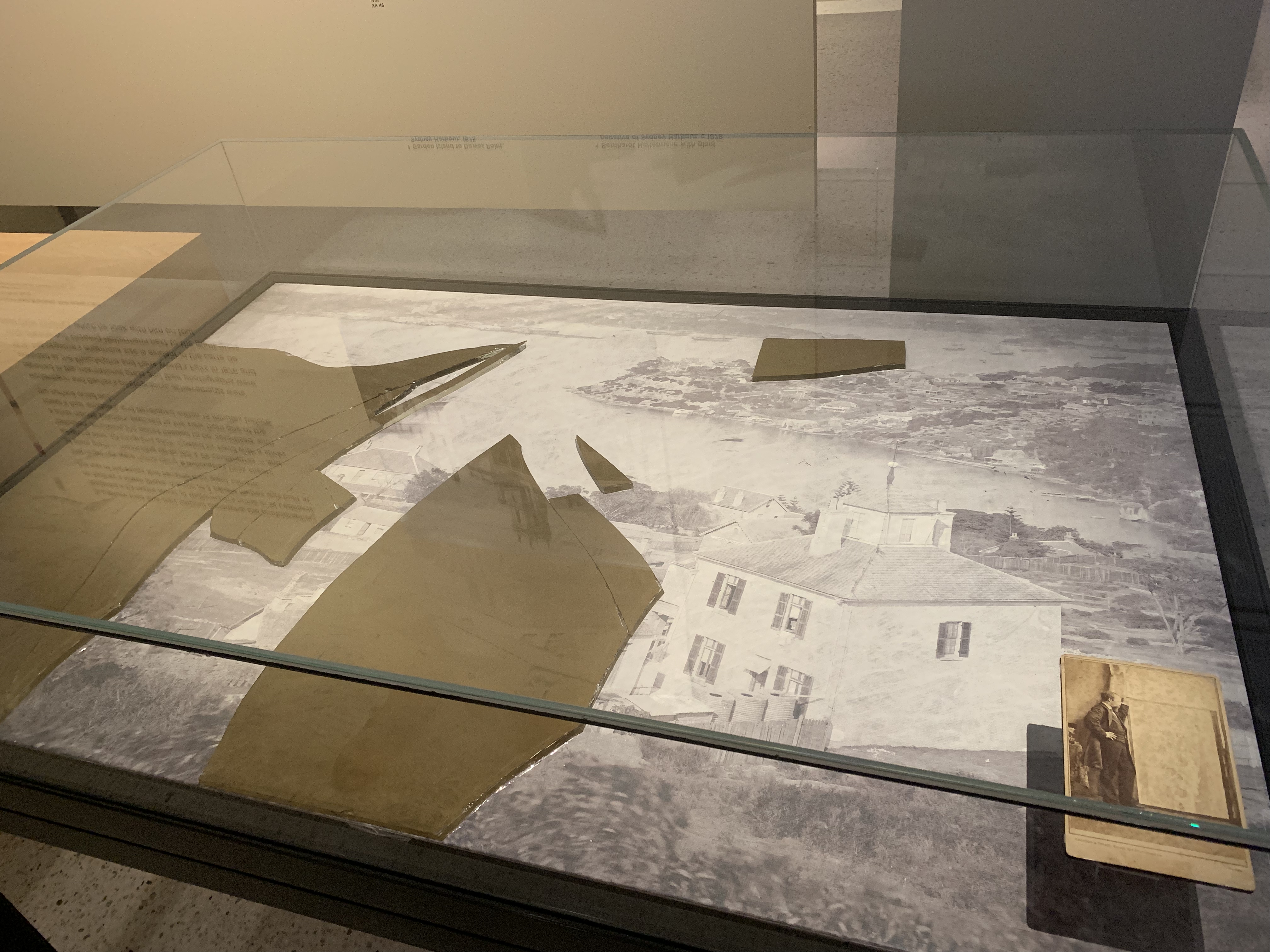
    Holtermann and Bayliss went on to create some giant glass-plate negatives depicting Sydney in 1875. They wanted to create the biggest photograph in the world. Holtermann transformed the tower in his mansion into one giant camera that overlooked Sydney Harbour, as well as the entire city. They developed some glass-plate negatives and toured these images hoping to encourage emigration to Australia.

    IMG_1365.jpg
    Holtermann Collection

    When the panels were uncovered, the largest was found to be broken. Through painstaking work, it has eventually been pieced back together with help from a life-size contact print of the image made in the 1950s. Cue a lot of technical talk about Photoshop and overlaying digital images of the glass shards eventually leading to a greater understanding of where to place the physical shards.

    img_1361
    Holtermann Collection

    5. Internee Papers

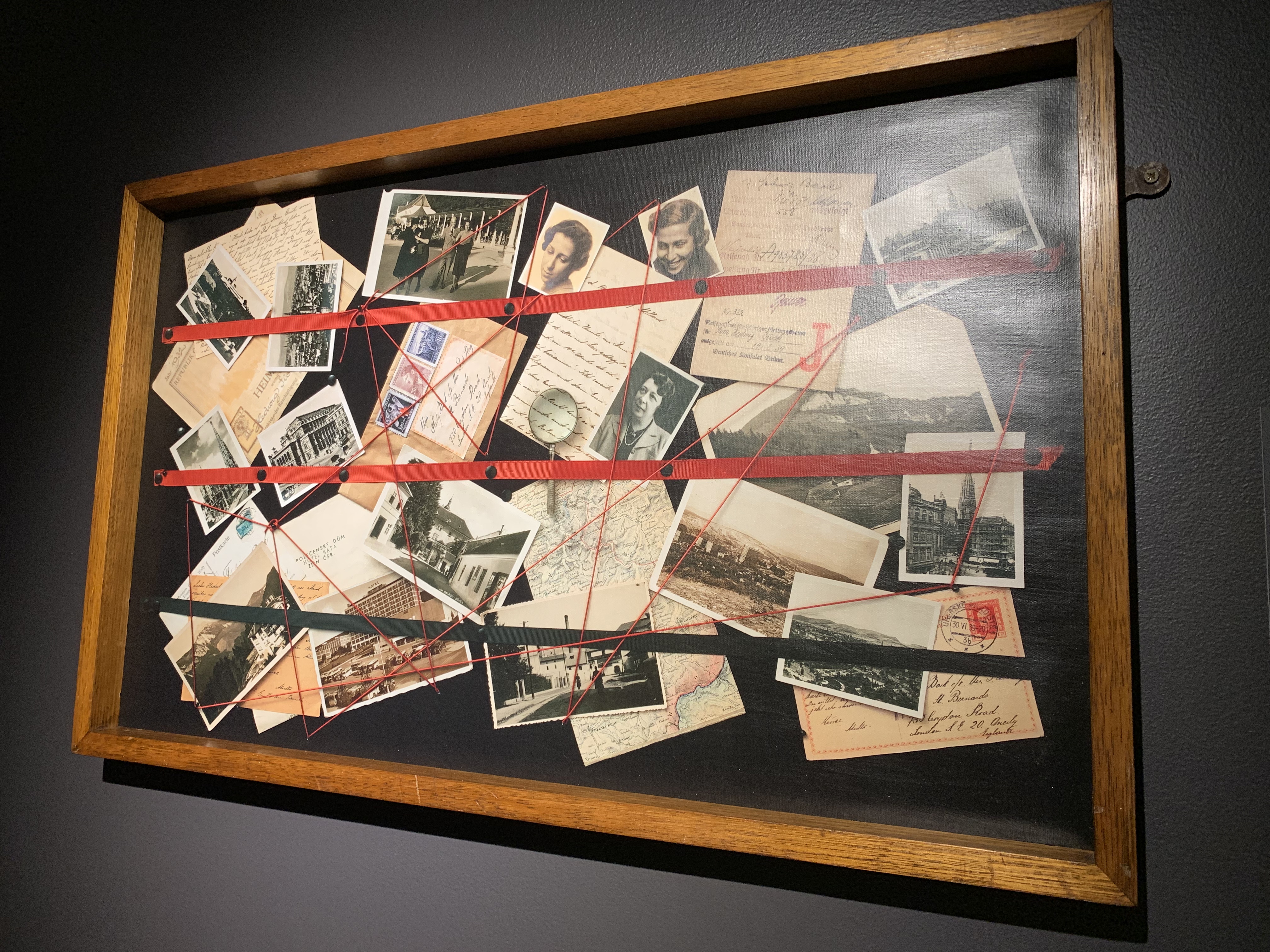
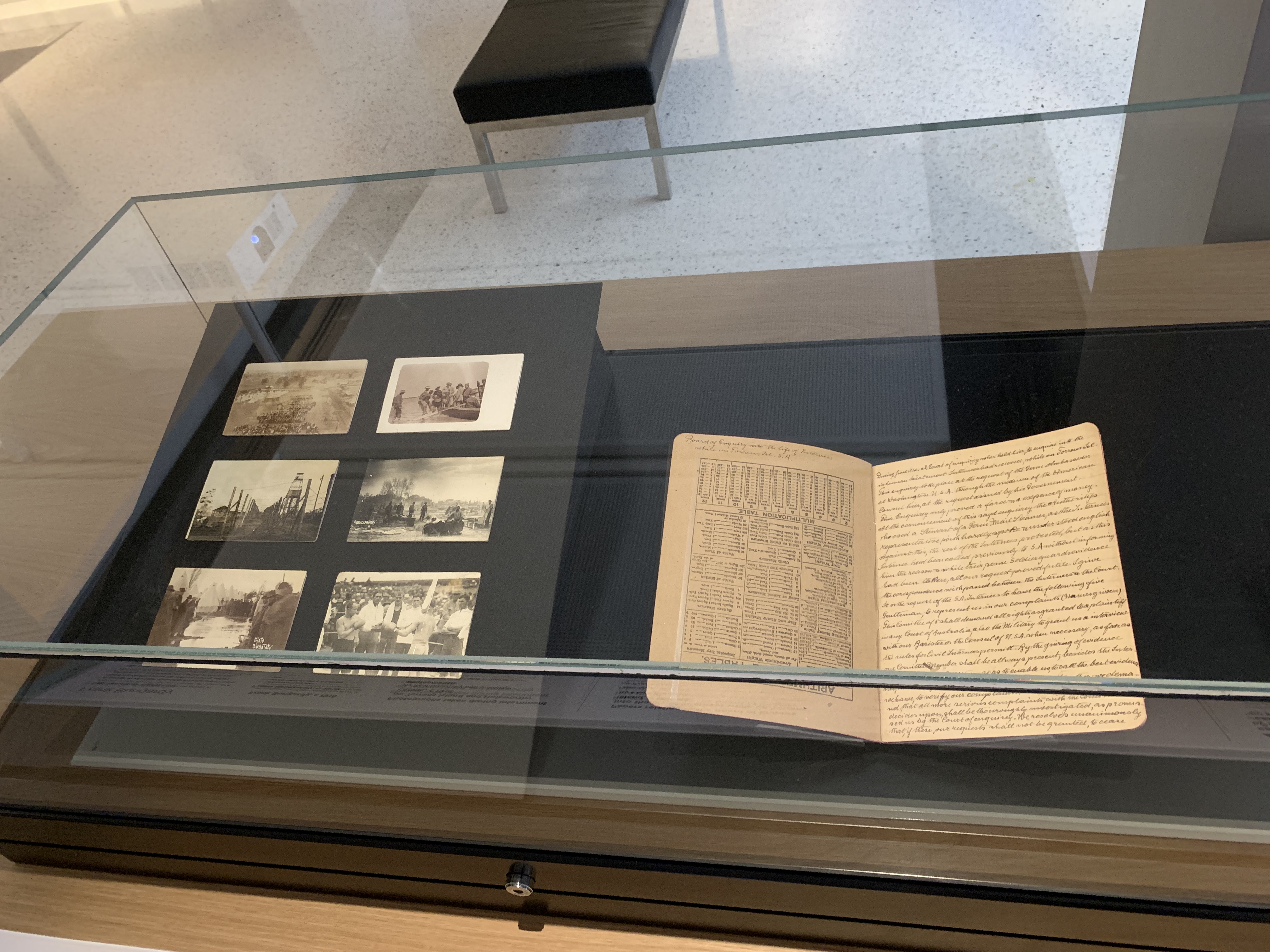
    In my opinion, these were some of the most fascinating objects on display. During World War I, almost 7 000 German and Austro-Hungarian ‘enemy aliens’ were interned in Australian camps. The State Library has a remarkable collection of letters, diaries and concert programs depicting life inside the camps from the perspective of the prisoners.

    img_1407
    Photographs and diary of Frank Bungardy.

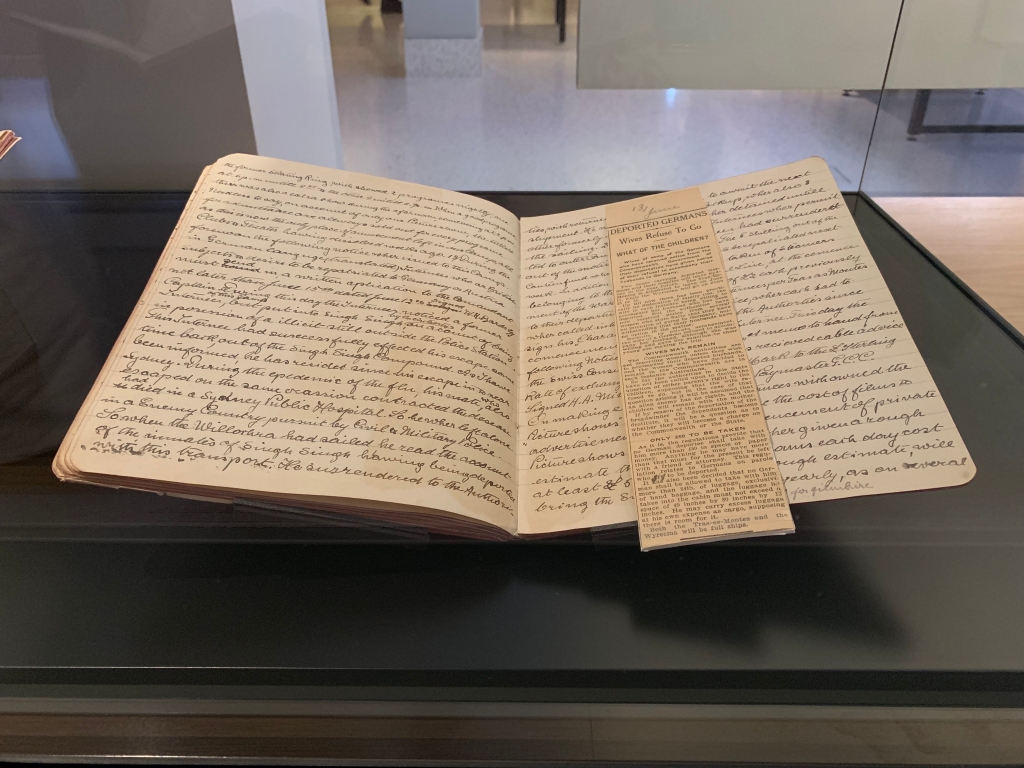
    There are a few diaries and letters belonging to Frank Bungardy, a German immigrant who was separated from his wife and children in Australia, interned, then deported to Germany. He was sent to Holsworthy Internment camp near Liverpool in Sydney.

    At the end of the War, the decision was made to forcibly repatriate prisoners to their ‘homeland’, one they often did not identify with. In one particular diary entry, Bungardy has attached a newspaper clipping about the deportations and writes about his frustrations caused by being separated from his family.

    img_1404
    Internee Papers

    6. World War I Diaries

    The State Library has a significant collection of diaries belonging to soldiers who fought in World War I. There are 236 in total along with maps, artworks, and photographs. It was incredible to learn that drives to collect these diaries started as early as 1918. Principal Librarian, William Ifould, was behind a significant push to collect. Ifould wanted diaries that reflected the day-to-day lives of soldiers.

    It is quite harrowing to read some of their words.

    img_1391
    Diary of Archie Barwick.
    img_1374
    World War I Diaries

    One object that I want to highlight is a ‘Souvenir of the Great War’ scrap album by Lewis G Pimblett. As you can see in the image, Pimblett collected German coins, French railway tickets and a badge worn by the Portuguse (his spelling) Red Cross, amongst other things.

    img_1377
    Souvenir of the Great War

    I really liked the sign that stated the transcriptions accompanying some of the objects were properly transcribed, i.e. using the original writer’s grammar, spelling and punctuation.

    img_1402
    Transcription Note

    As well as these six collections there are three that have been selected for nomination in the future.

    1. William Bligh’s Bounty logbook – documenting the mutiny in 1789.

    img_1412
    William Bligh’s Bounty Logbook

    2. Myles Dunphy collection – Dunphy was the founding member of Sydney Bush Walkers Club and lobbied to make areas such as the Blue Mountains national parks.

    img_1385
    Myles Dunphy Collection

    3. David Unaipon papers – Unaipon is celebrated as Australia’s first published Indigenous author collating works on Aboriginal culture.

    img_1394
    David Unaipon Papers

    I was quite surprised that these three collections aren’t actually inscribed, but, are being nominated. In fact, I only found out about this while reading the catalogue in preparation for writing this blog post. This wasn’t really made clear in the exhibition and I think the layout could have made it a little more obvious.

    UNESCO Six is on display at The State Library of New South Wales until 5 May 2019. The exhibition is open every day and you can find opening hours each day published on their website. The entire exhibition is accessible. Entry is free and a catalogue can be purchased with a small donation.

  • GLAM Blog Club: What I Learned in 2018 & What I Want to Learn in 2019…

    To prepare for writing this blog post I went back and read my post from last year on the same topic. Obviously it was reflecting on 2017 and looking forward to 2018. Very similar to 2017, you can pretty much slice my 2018 right down the middle into two equal segments. Up until July, I was working at Gladstone Regional Art Gallery & Museum. Then, I managed to secure my actual dream role at the Integrated Pathology Learning Centre at the University of Queensland. It was yet another year of moving around the place and learning new skills.

    What I Learned in 2018…

    2018 was one of those years that I don’t feel was overwhelmingly good or bad. It was filled with such extremes that, on balance, it turned out to be a pretty neutral year. What it did achieve, however, was setting me up for what will hopefully be a stable year in 2019.

    Unlike last year’s post, I’m not going to separate it into the two different geographical locations. I feel that I cannot confine what I learnt to this format. Instead, I’m just going to dot point a few key lessons I learnt in 2018. I’m trying to keep things simple in 2019.

    • It’s ok to put yourself first especially when it comes to new opportunities
    • How to boss-up (i.e. how to start being an effective manager in my new role)
    • Asking a lot of questions and/or for advice is not bad
    • It’s so much better writing emails that are direct than spending countless lines explaining how sorry you are to be bothering the recipient
    • How to be assertive
    • I can feasibly fit my possessions into the back of a 2009 Toyota Corolla

    Apart from the last point, the others are all work-related or were things I learnt in my personal life that I then applied to my work life and feel as though I have benefited greatly from doing so.

    What I hope to learn in 2019….

    Above everything else, I want 2019 to be a year of stability. I feel that this is the year to have that goal. Especially considering I find myself in a role I have wanted and been working towards for five years. I want to get to the end of 2019 and feel as though it was a year of in-depth, relevant learning and not one that was filled with an overwhelming amount of change.

    Here are some things I want to learn in 2019:

    • Expand my knowledge of creating multimedia displays
    • How to dismiss negative unsolicited advice (I have struggled with this a lot in the past because I take things to heart way too easily. I’m making a very conscious decision in 2019 to coat myself in some Teflon and let things slide.)
    • So much more about the specimens in our collection
    • How to create and communicate meaningful change
    • How to better manage my blog (on platforms such as Instagram).

    Even if I can tick one of those things off my list at the end of 2019 I know it will have been a good year.

    There is quite a lot to look forward to in 2019 and I hope to share a lot of it on the blog. In April I’ll be going back to America to visit Las Vegas and Chicago. I am beyond excited to visit all the incredible museums in Chicago and finally get to the Mob Museum in Las Vegas! In May, I’ll be attending the 2019 Museums Galleries Australia Conference in Alice Springs. No doubt I will be learning a lot at the conference. I am also really excited to travel more to Sydney and Melbourne.

    As for the latter half of the year, it is still under construction.

    To summarise it all, I hope 2019 is a stable year filled with meaningful growth and opportunities for me to personally and professionally thrive.

    To finish, here are some of my favourite museum and heritage moments from 2018 (in no chronological order because my media library is all mixed up).

    img_0808
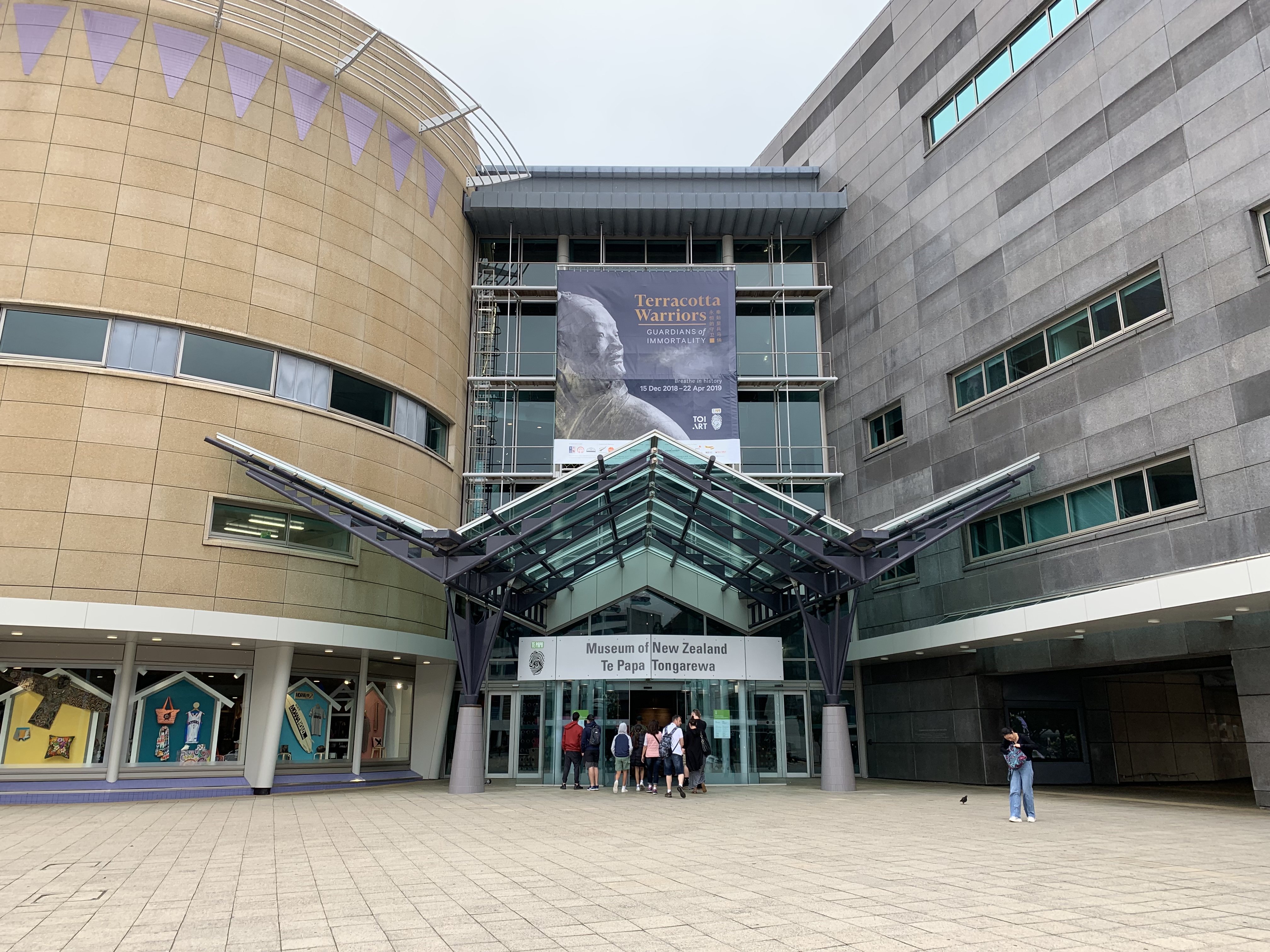
    Te Papa Museum (Museum of New Zealand) in Wellington, New Zealand.
    IMG_8222
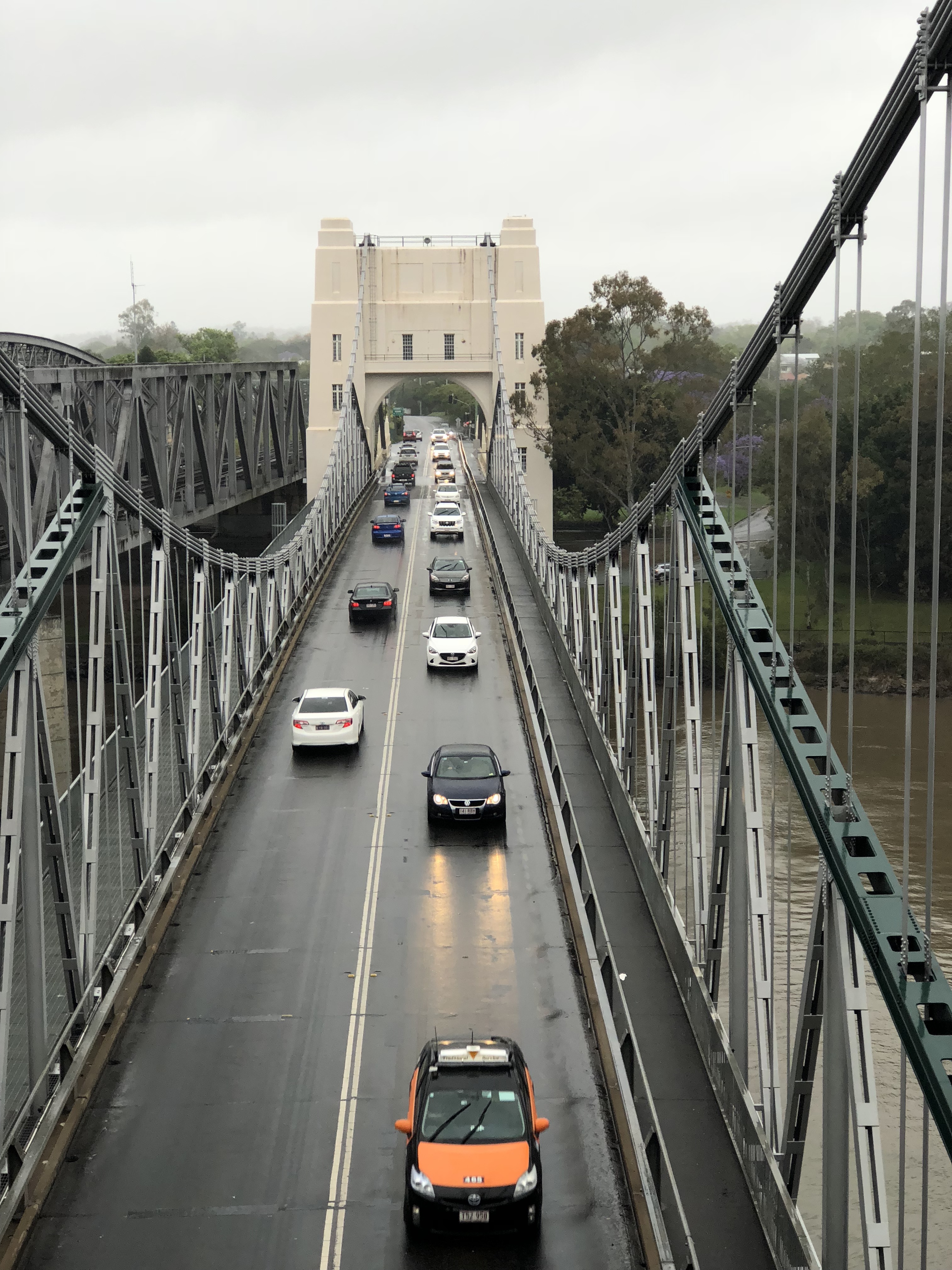
    Exploring my favourite heritage bridge in Brisbane, Walter Taylor Bridge.
    IMG_8061
    Volunteering for Brisbane Open House at the incredible Eisenmenger House.
    IMG_6948
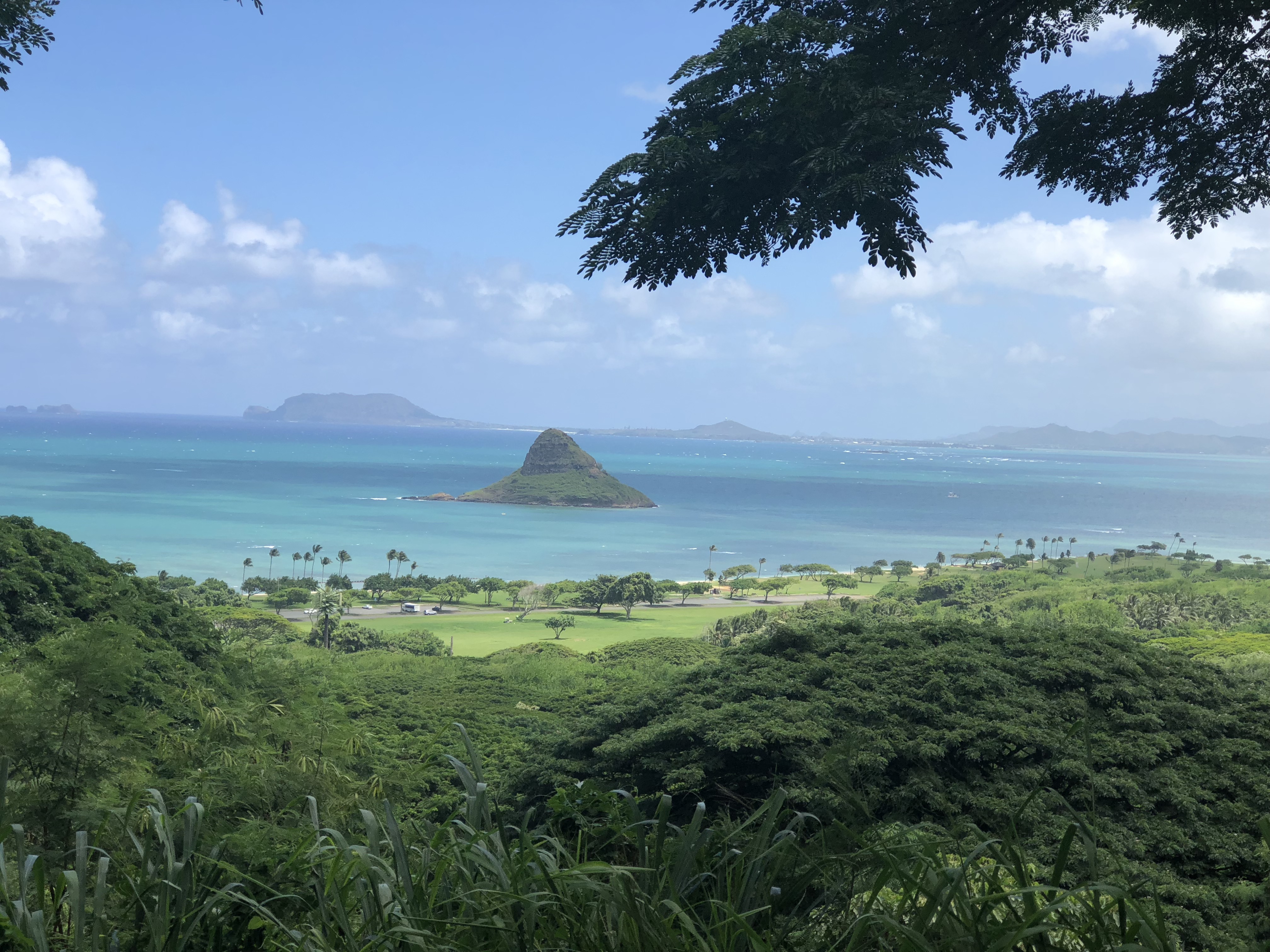
    Visiting Kualoa Ranch in Hawaii.
    IMG_6196
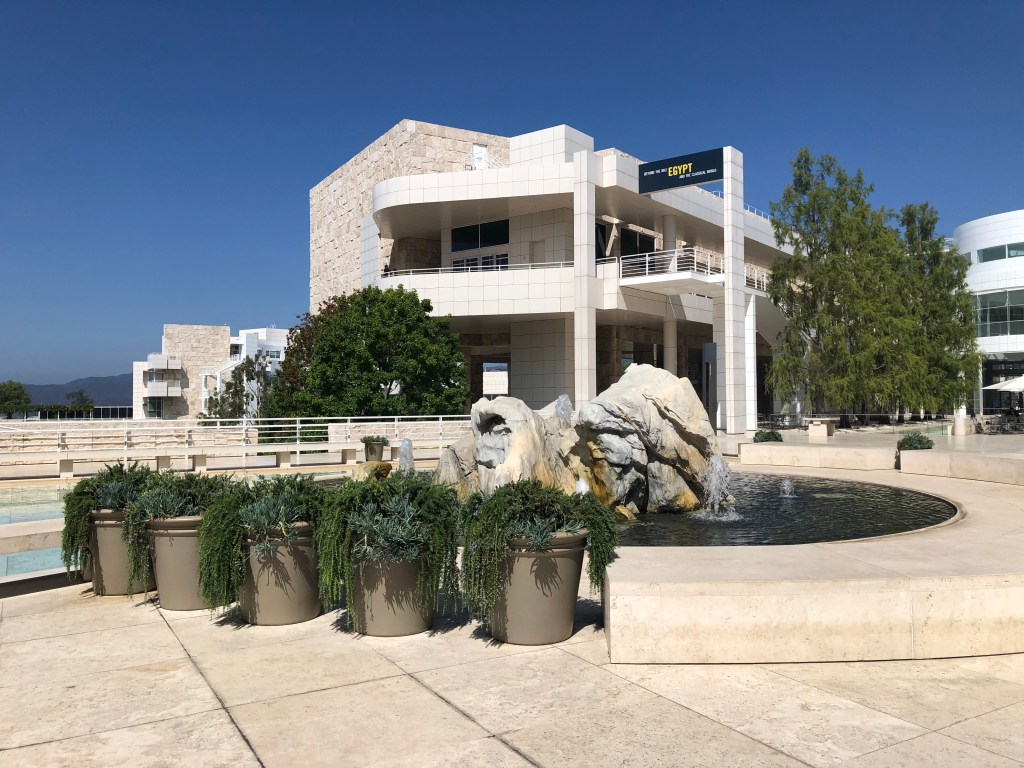
    THE GETTY!
    IMG_6210
    Another photograph of The Getty.
    IMG_6667
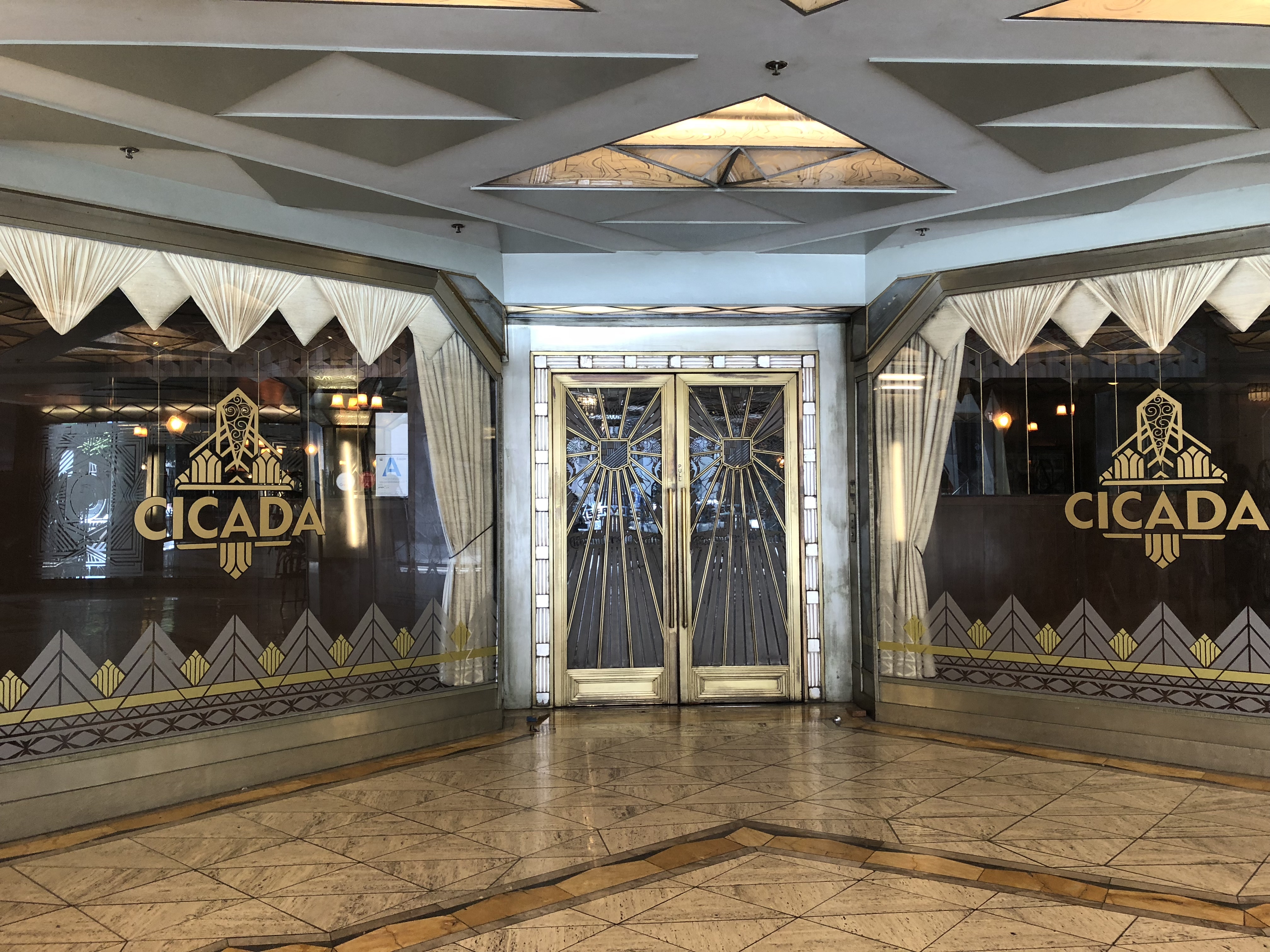
    Art Deco tour of downtown Los Angeles.
    IMG_6779
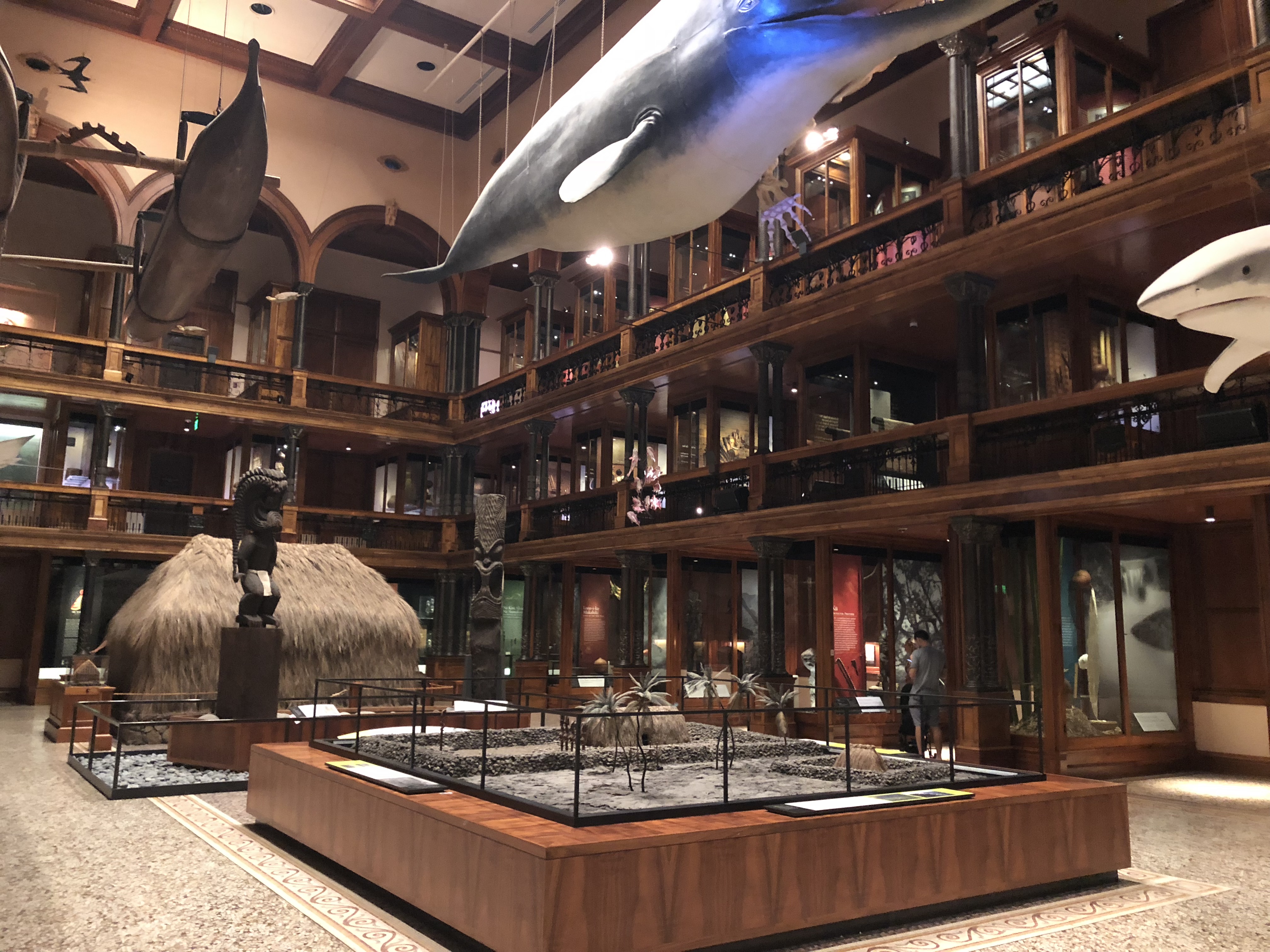
    Bishop Museum in Hawaii.
    img_7048
    Iolani Palace in Hawaii.
    IMG_7574
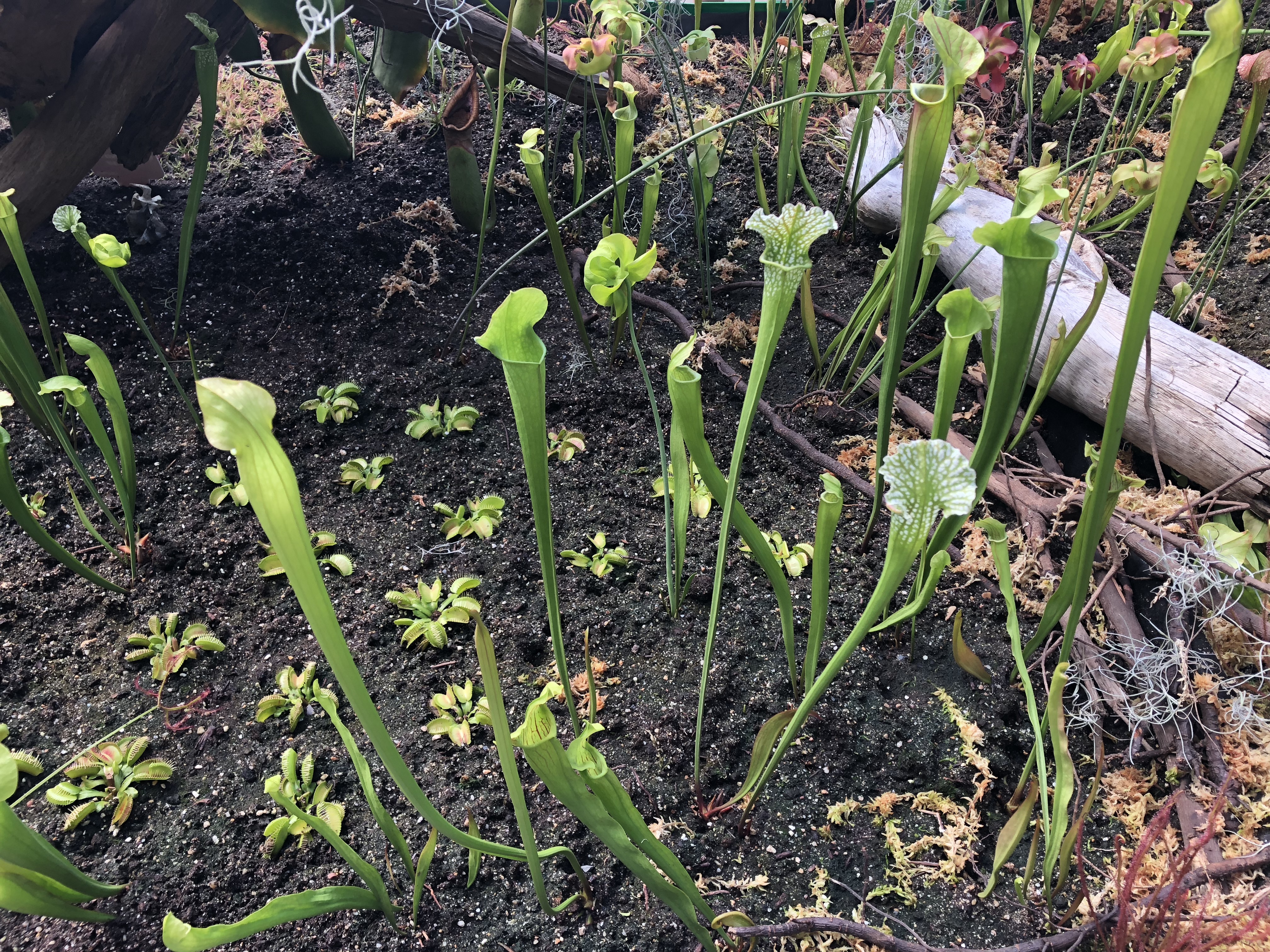
    Carnivorous plants at The Calyx in Sydney.
    img_7454
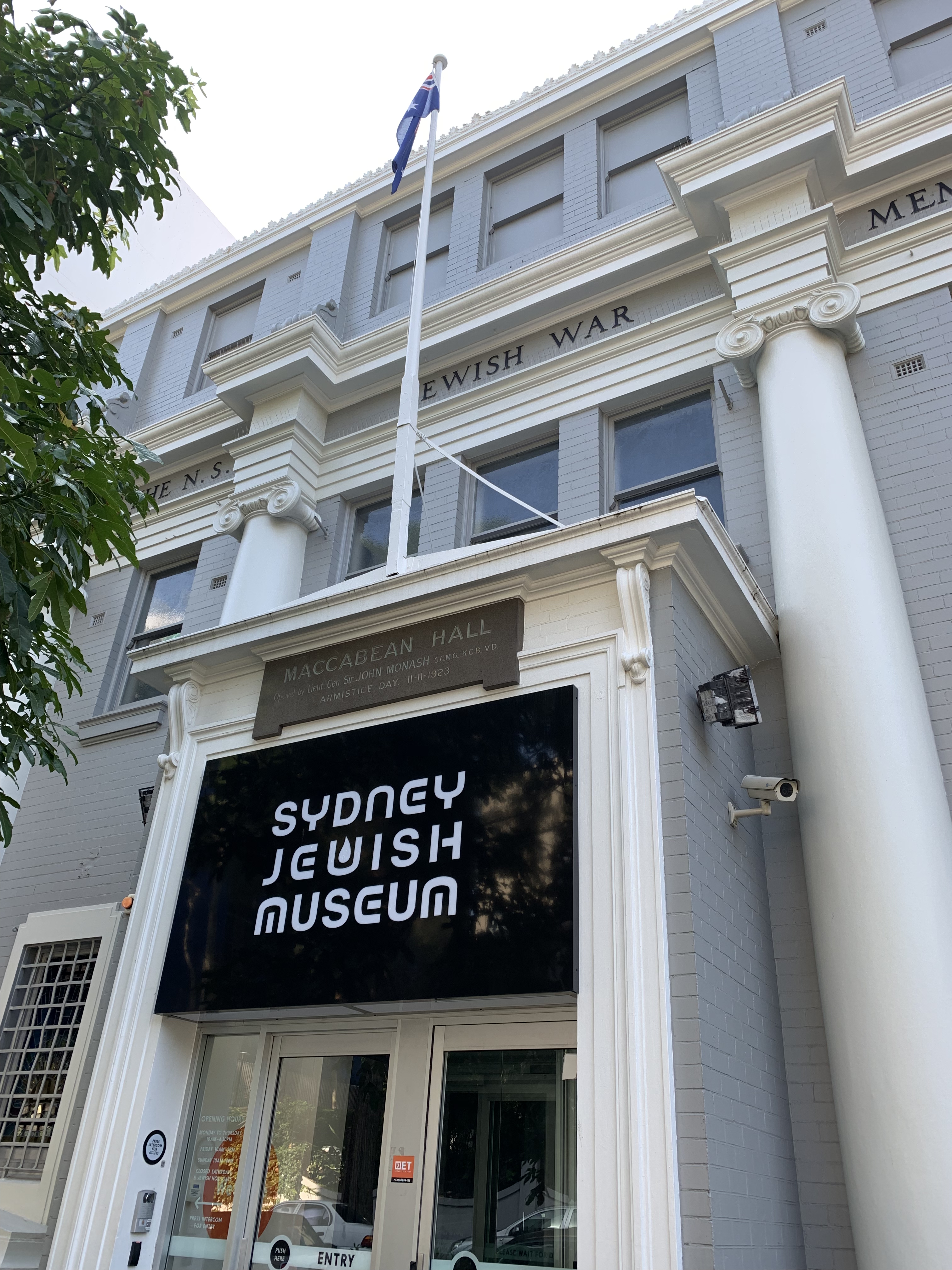
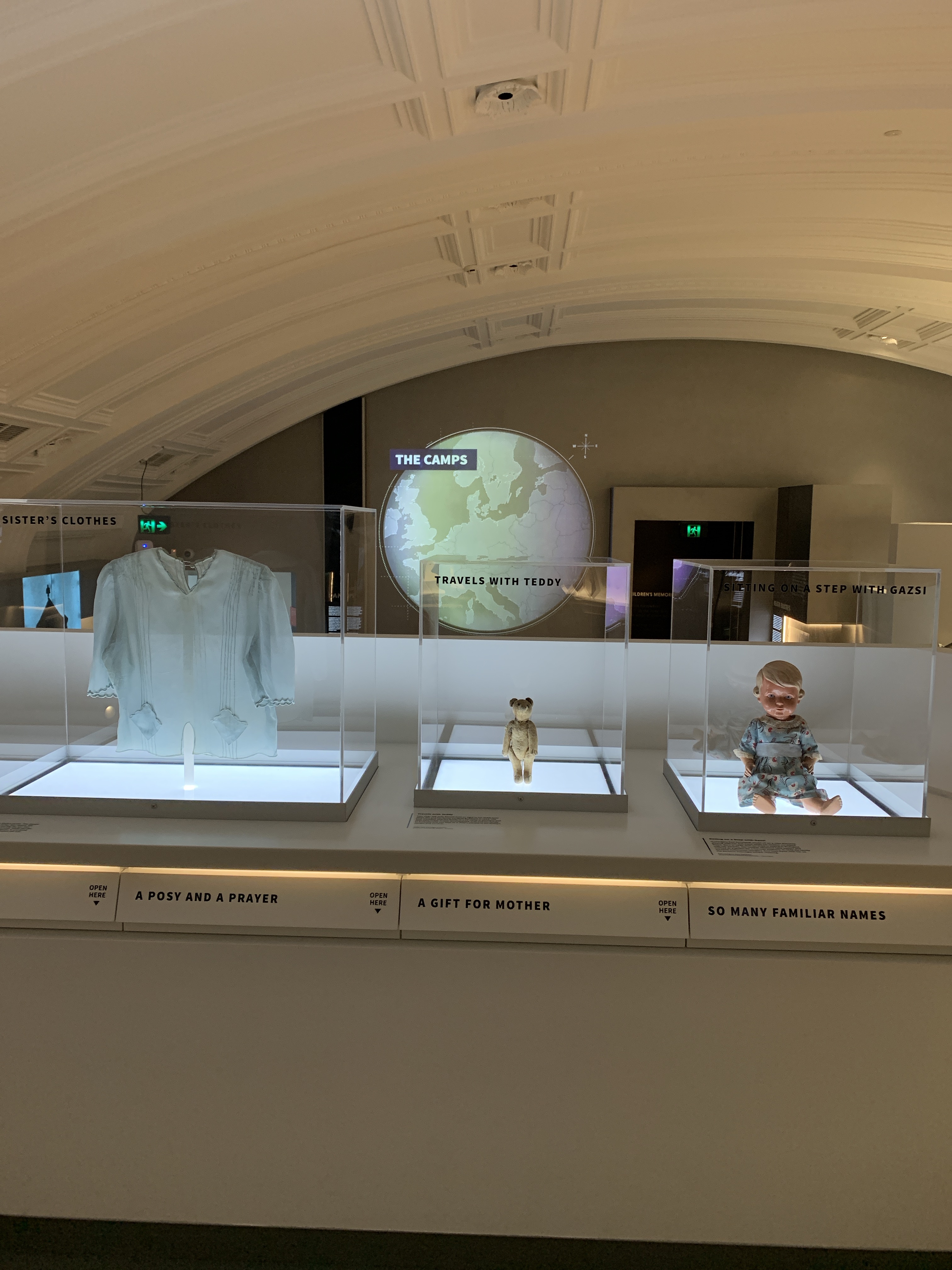
    Newly renovated Jewish Museum in Sydney.
    img_5941
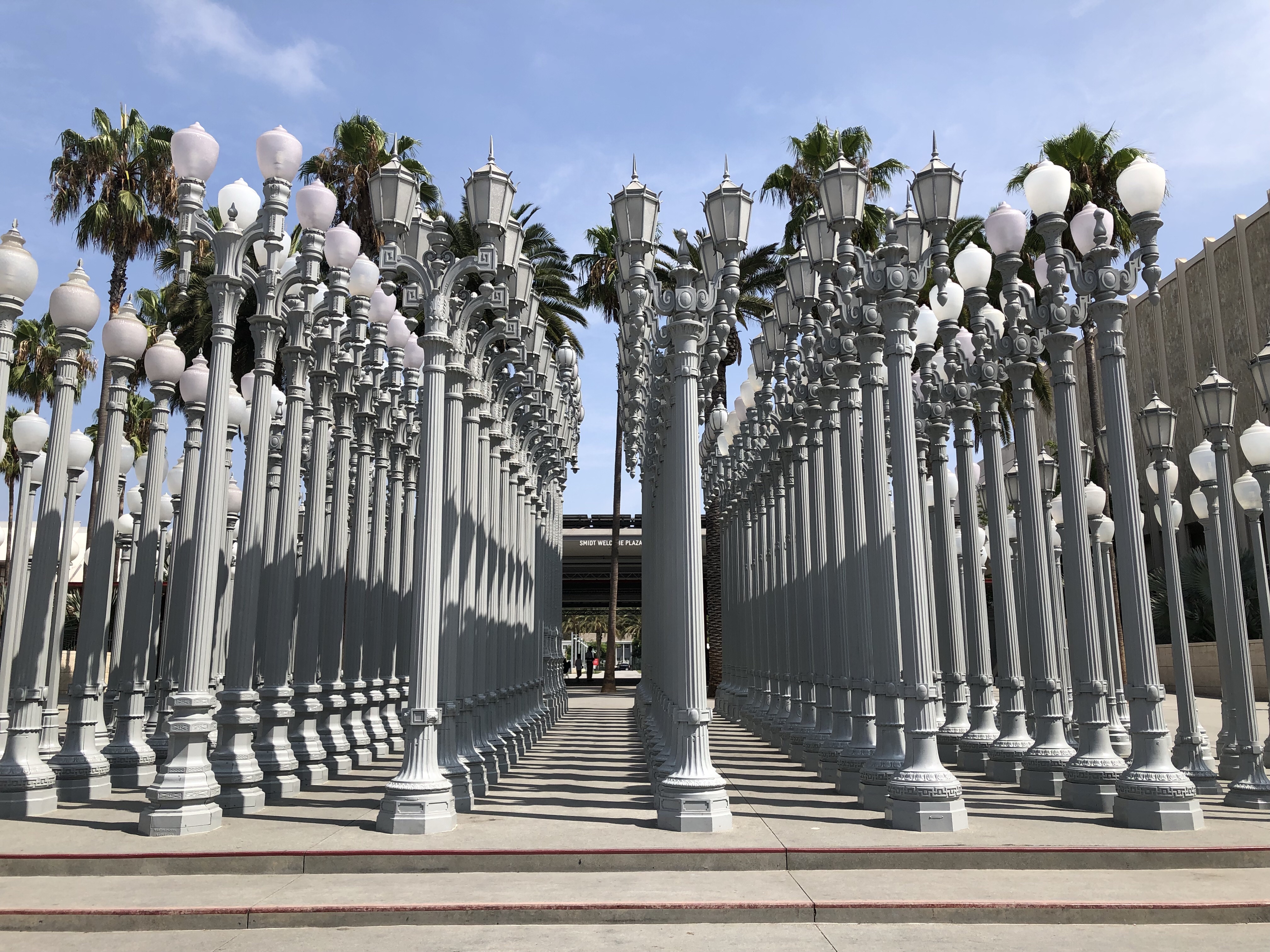
    Los Angeles County Museum of Art.
    IMG_5225
    Tattoo talk at the Museum of Brisbane.
    img_5493
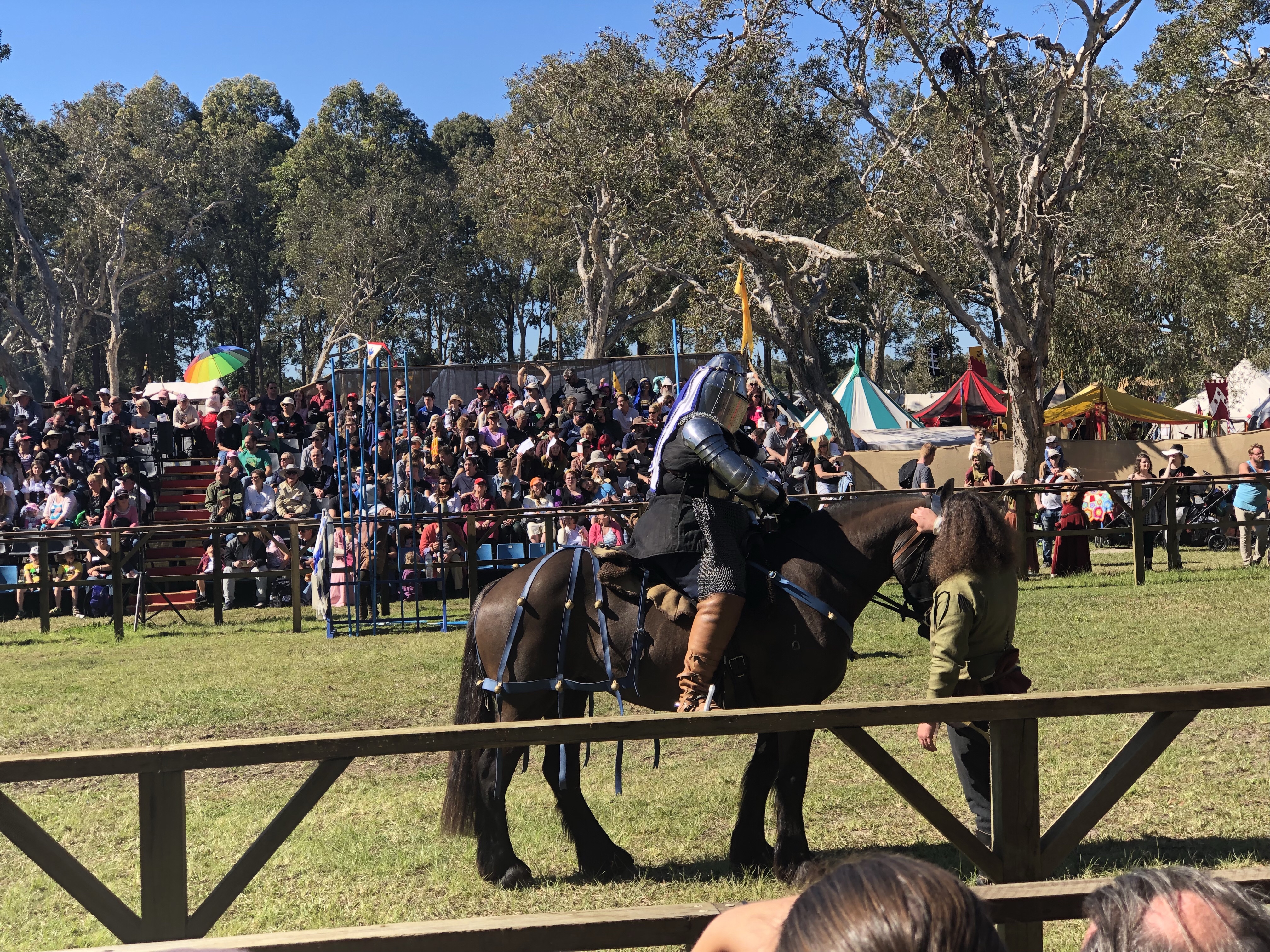
    The Abbey Medieval Festival in Caboolture.
    img_4907
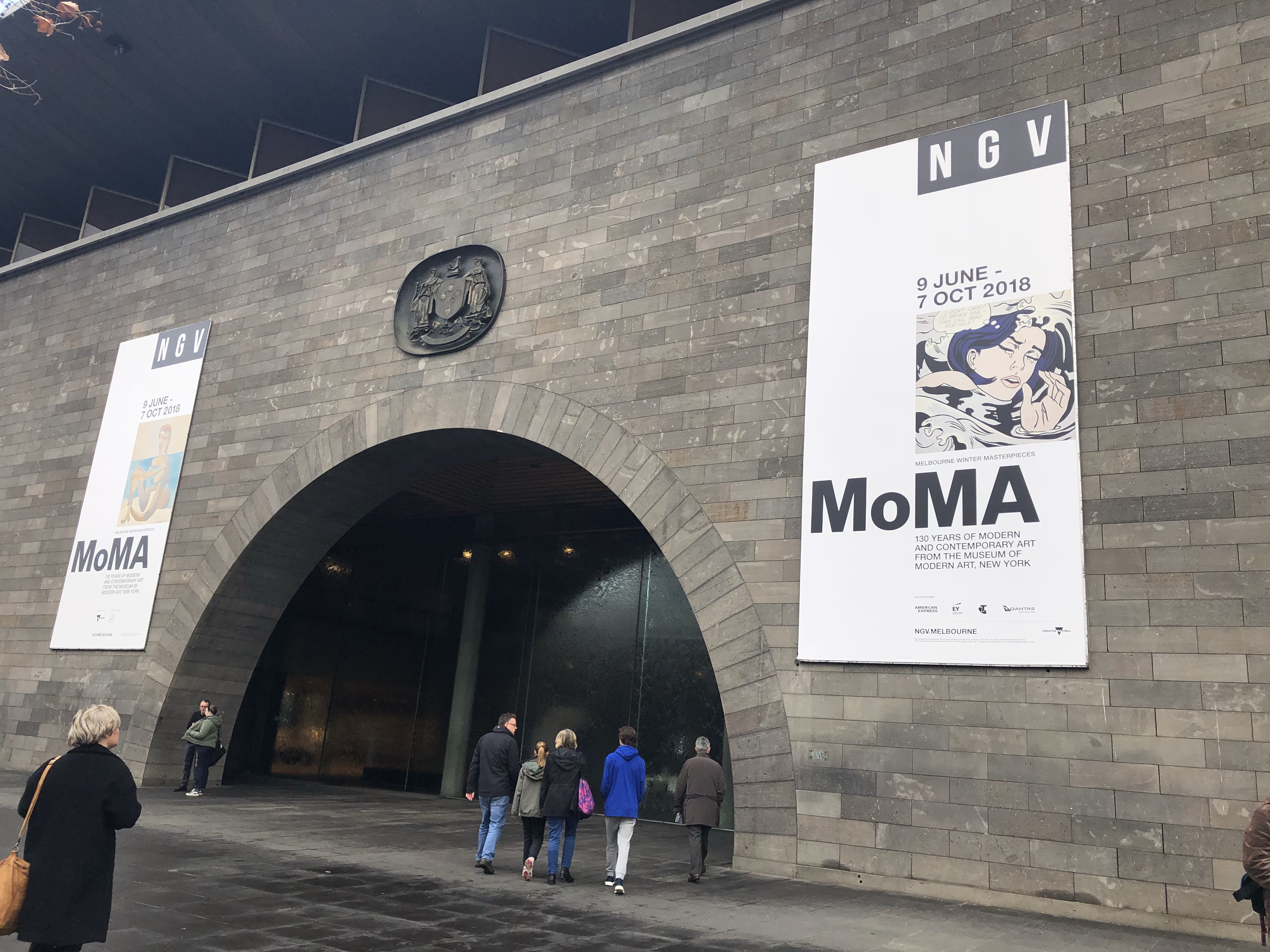
    MoMa at the National Gallery of Victoria.
    IMG_2309
    Alice in Wonderland exhibition at the Australian Centre for the Moving Image.
    De53SfoV4AASKWI.jpg large
    Museums Galleries Australia National Conference in Melbourne (next photograph as well).
  • Wellington: Botanic Garden

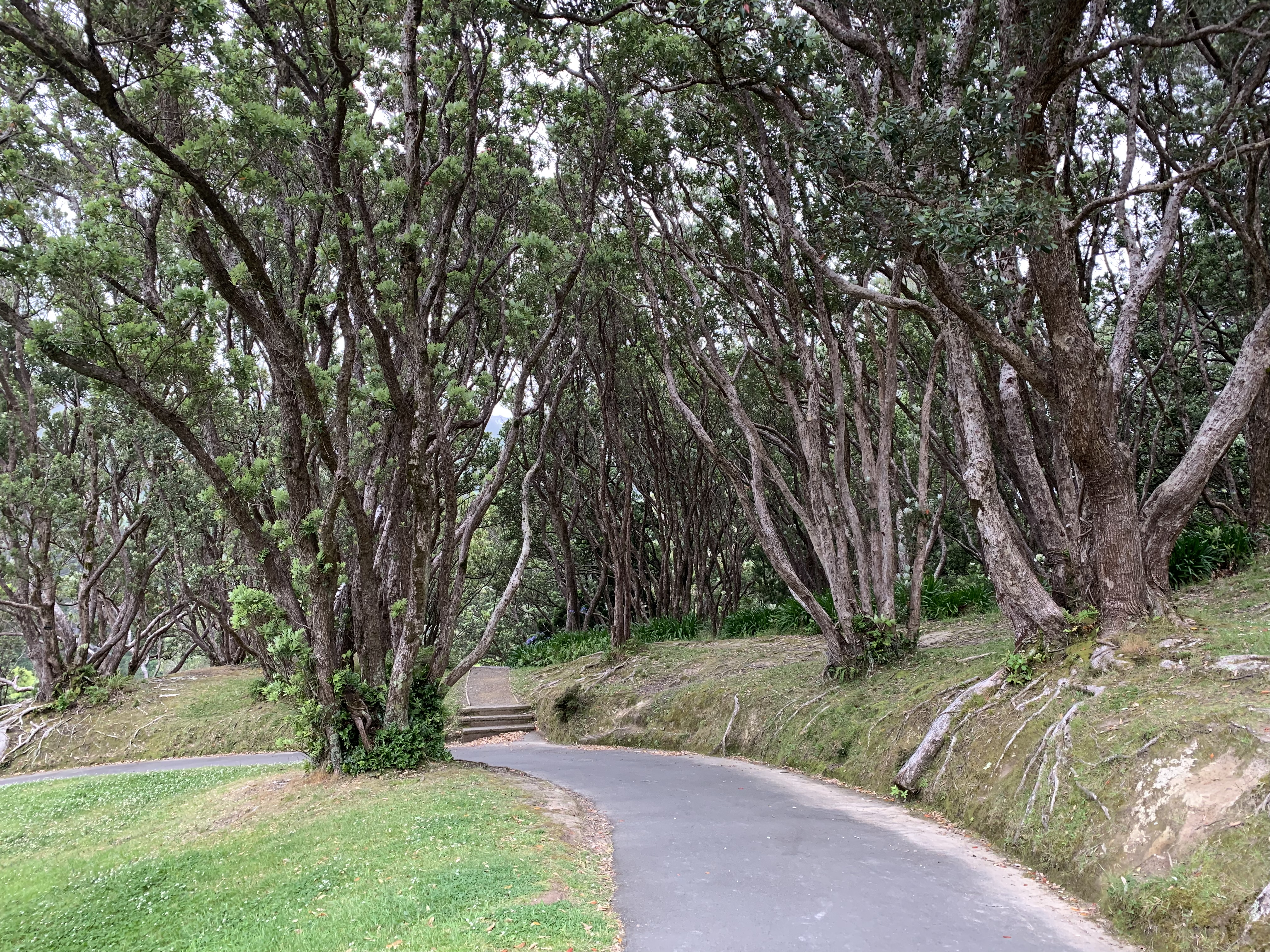
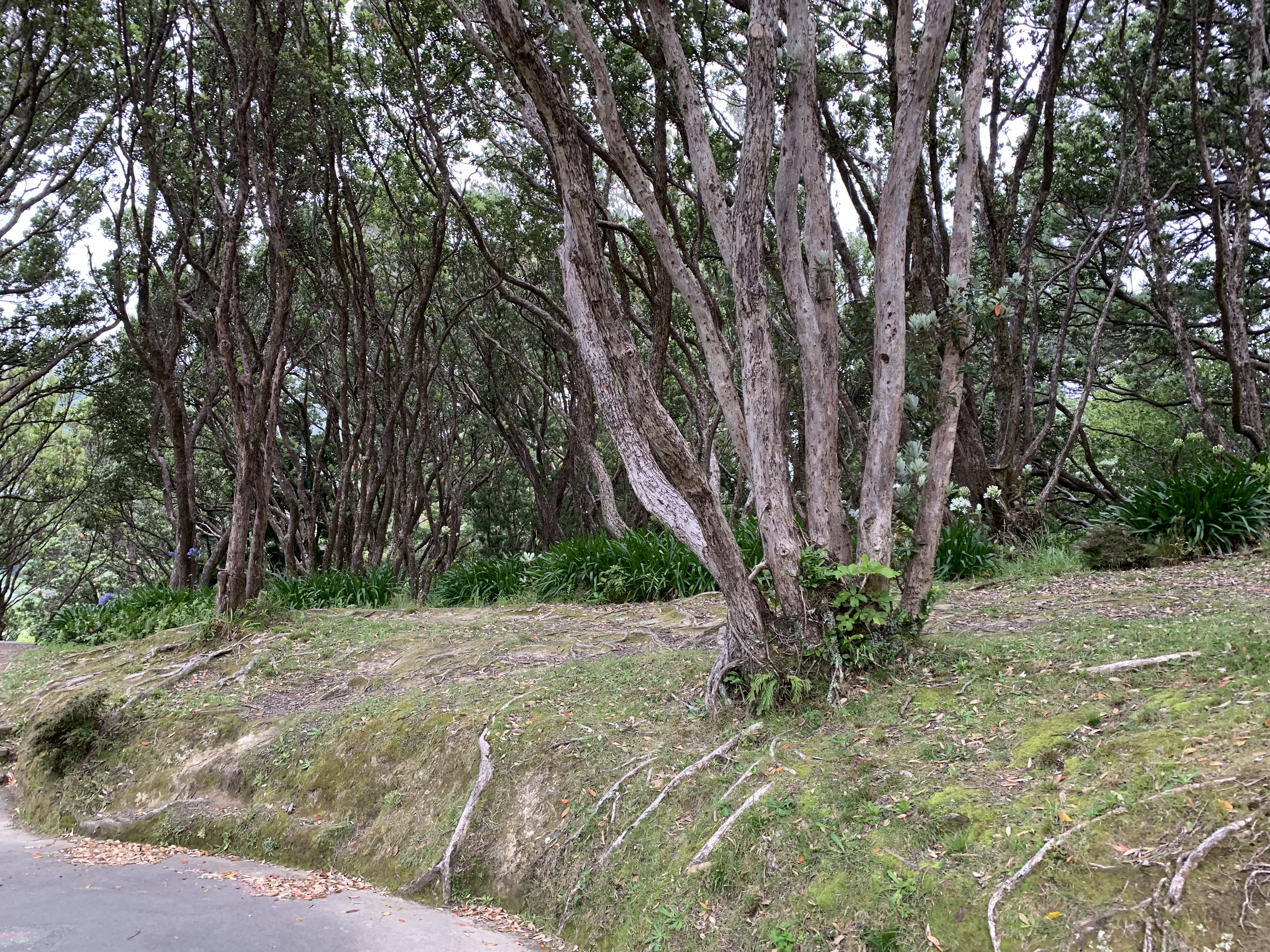
    On our final day in Wellington we visited the Wellington Botanic Gardens, right at the entry/exit of the Wellington Cable Car. I mention the Cable Car because it is a very convenient and interesting way to get from the city centre to the garden. If you don’t like heights then it’s probably best to avoid. The garden is open from dawn to dusk with some exceptions, i.e. the cafe in the rose garden and tree top information centre. If you are visiting, I strongly recommend going on the website to check when everything is open.

    Botanic Gardens

    About Wellington Botanic Garden

    The garden is huge – covering 25 hectares. It is a mix of pre-European forest, mixed decorative gardens, and buildings of architectural significance. The garden aims to promote conservation and an appreciation of New Zealand’s natural heritage.

    Wellington Botanic Garden was officially established by an Act of Parliament in 1869, making it one of the earliest public gardens in New Zealand. The original purpose of the garden was to act as a depot for acclimatizing purposes, benefitting the Colony that had moved into the area surrounding Wellington. It also served to act as a native plant research centre and as a location for contemplation and learning.

    Over the past 150 years, the garden has developed and responded to changes in climate, horticultural taste, and increasing demands for use. It now serves to protect the diverse natural and cultural heritage found within its walls and continues to educate visitors to the site.
    Heritage Listing

    On 10th September 2004, Wellington Botanic Garden was inscribed on the list of Heritage New Zealand as a historic area. The following is basically going to summarise the reasons for its inscription. All of the information has been sourced from here.

    Historical Significance

    Wellington Botanic Garden is one of the earliest public gardens in New Zealand, becoming part of the development of Wellington City in 1844. Although the garden was not built until 1869, the land was acquired in 1844. The area was determined fit to meet three needs of the Colony – act as a trial ground for examining the potential of various plants, a place for scientific study, and a public garden. It was developed by scientist Doctor James Hector who championed the garden as a crucial scientific institution.

    The garden has adapted over time and is the longest serving public garden in New Zealand.

    Scientific Significance

    According to its entry on Heritage New Zealand, the Wellington Botanic Garden is partly inscribed for its scientific importance. The garden was influenced by the Royal Botanic Garden at Kew and was used in a similar way, to test the economic potential of different plants. It is also listed for not removing native plants or trees and for celebrating their uniqueness in New Zealand’s ecosystem.

    Aesthetic Significance

    I now know from first-hand experience that the garden is beautiful and aesthetically very pleasing. It is a stunning location for displays and public events. Aesthetic significance also concerns the fact that the garden reflects changing taste in botany with some planting displays originally completed 135-150 years ago.

    It is interesting to note that the listing for aesthetic significance covers other senses besides sight. Smells and even feel are included to show how the garden has been made appealing in a small and defined area.

    Architectural Significance

    While walking through the garden, we came across a number of buildings and decorative pieces from various stages of New Zealand’s past. The Lady Norwood Rose Garden Fountain from the 1870s is just around the corner from a Centennial Sundial Sculpture installed in the 1980s.

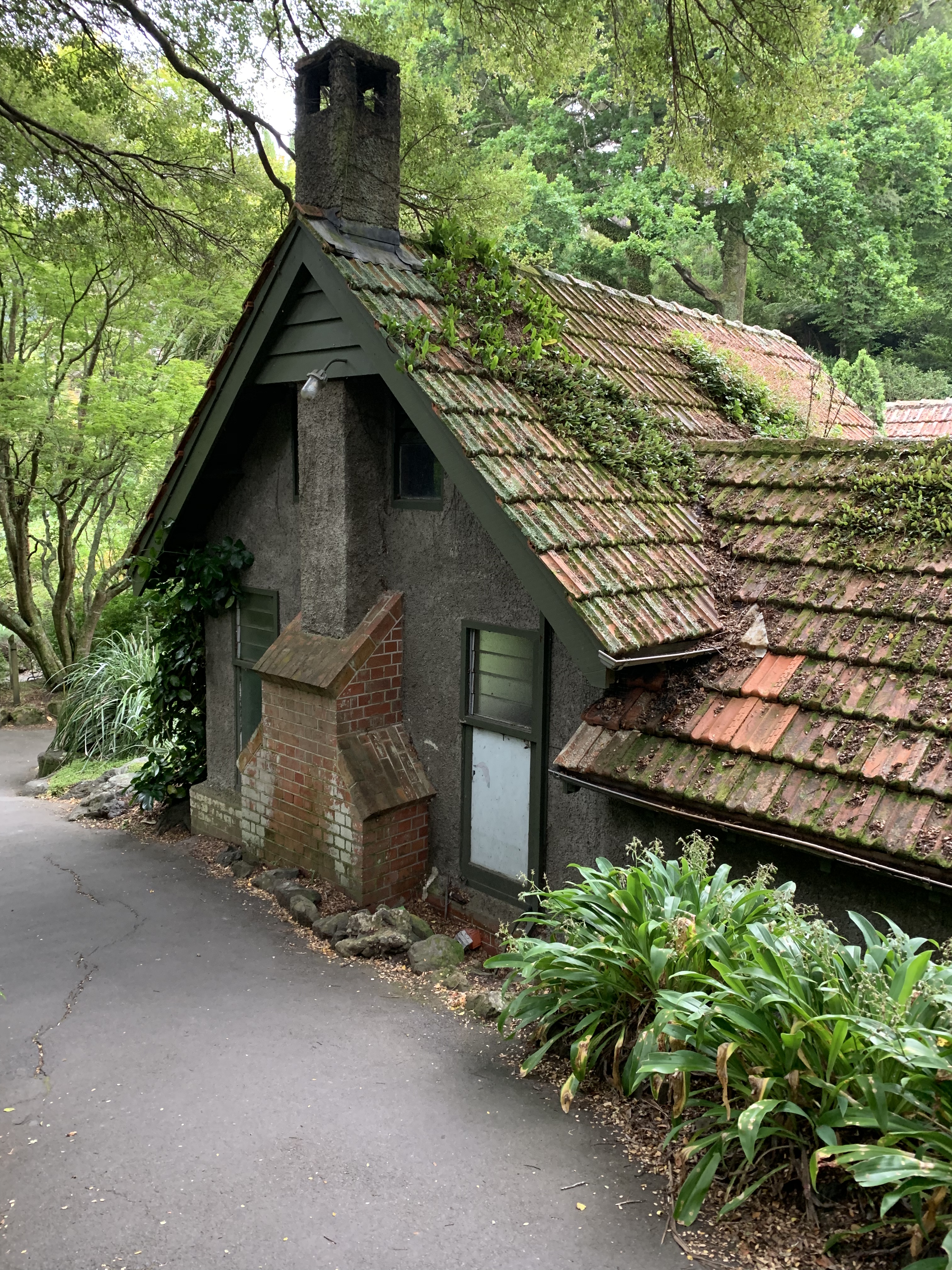
    Our favourite building was this Overseer’s cottage, built in the early twentieth century.

    Overseer’s Cottage

    Cultural Significance

    Wellington Botanic Garden, as mentioned previously, is home to many garden fashions and styles. There is evidence of Edwardian garden styles with gothic architecture and serpentine paths, Gardenseque styles which included partnering native and non-traditional plants, Italian gardens as seen in the Lady Norwood Rose Garden, and Romanticism with rustic seats and fences dotted around.

    Social Significance

    The garden is an important tourist attraction with a strong educational focus. The team who work at the garden must determine what will best serve public interest while promoting excellence in botany. Included in this are public tours, signage and contribution to both formal and information education.

    Our Experience

    With all that in mind, our visit most definitely confirmed what the heritage listing has highlighted. For example, there was strong evidence of public education with multiple interpretation boards. We really enjoyed seeing all the different garden styles in the one place.

    The only frustrating part of our visit was the signage that could have been clearer in some locations. In others, the signage was perfect even offering two alternative paths to the same destination and marking them as easy or difficult. If this type of information was implemented park-wide, it would be incredible.

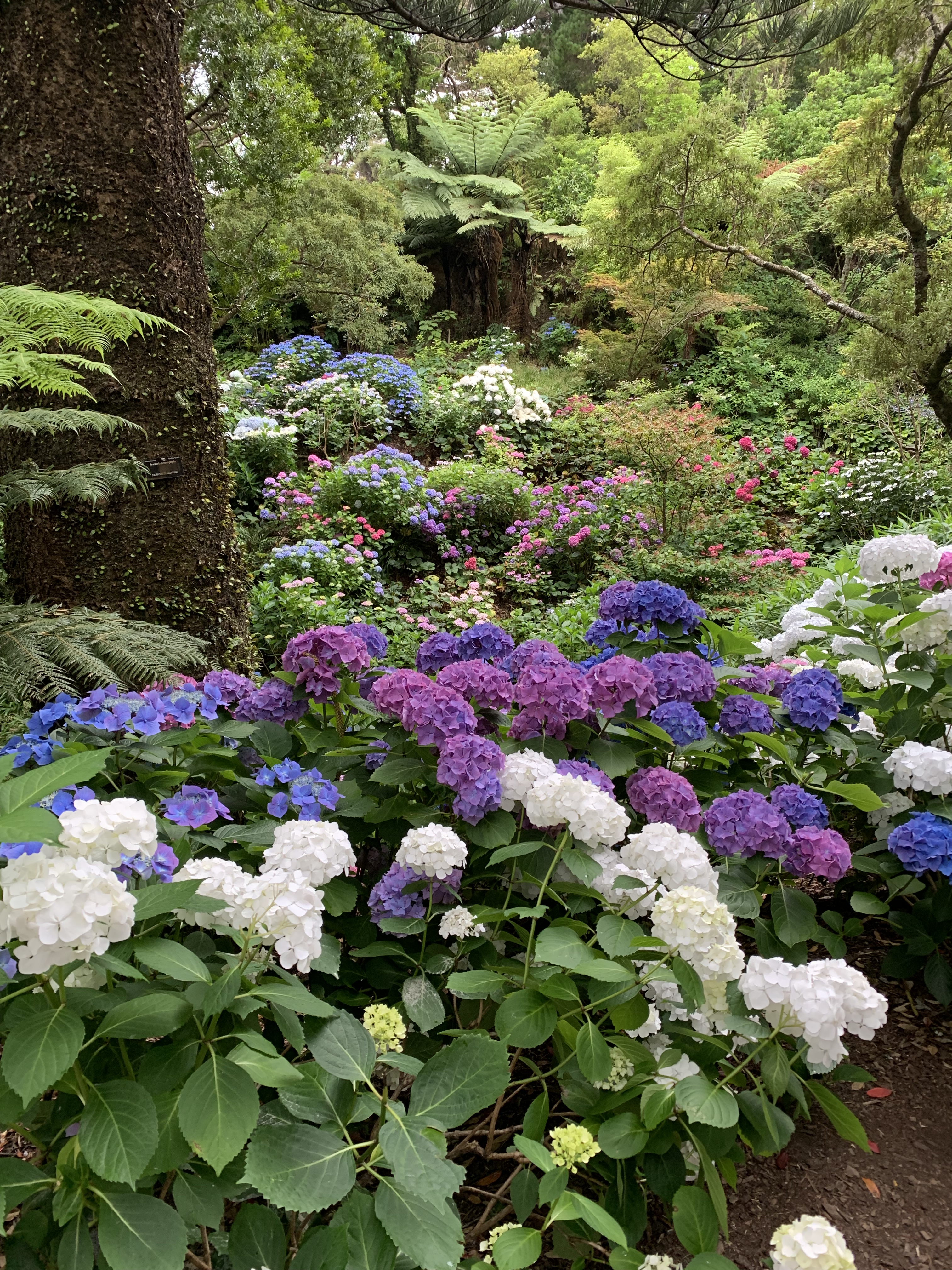
    Below is a gallery of images from our visit that will hopefully encourage you to visit if you’re ever in Wellington and looking for a relaxing way to spend a morning or day.

  • Wellington: Te Papa Tongarewa

    Today was the day we visited Te Papa Tongarewa (Te Papa), the Museum of New Zealand. I had incredibly high expectations as I’ve heard nothing but amazing things. I am happy to say that Te Papa definitely lived up to these expectations and in some areas, exceeded them. We spent most of the day exploring the museum and its numerous fascinating exhibitions that are spread over five levels. The day included a highlights tour, a walk through most permanent exhibition spaces, and a visit to the travelling exhibition Terracotta Warriors: Guardians of Immortality. Similar to the Getty Museum in Los Angeles, I am going to provide an overview of how we spent our day.

    10.00 am

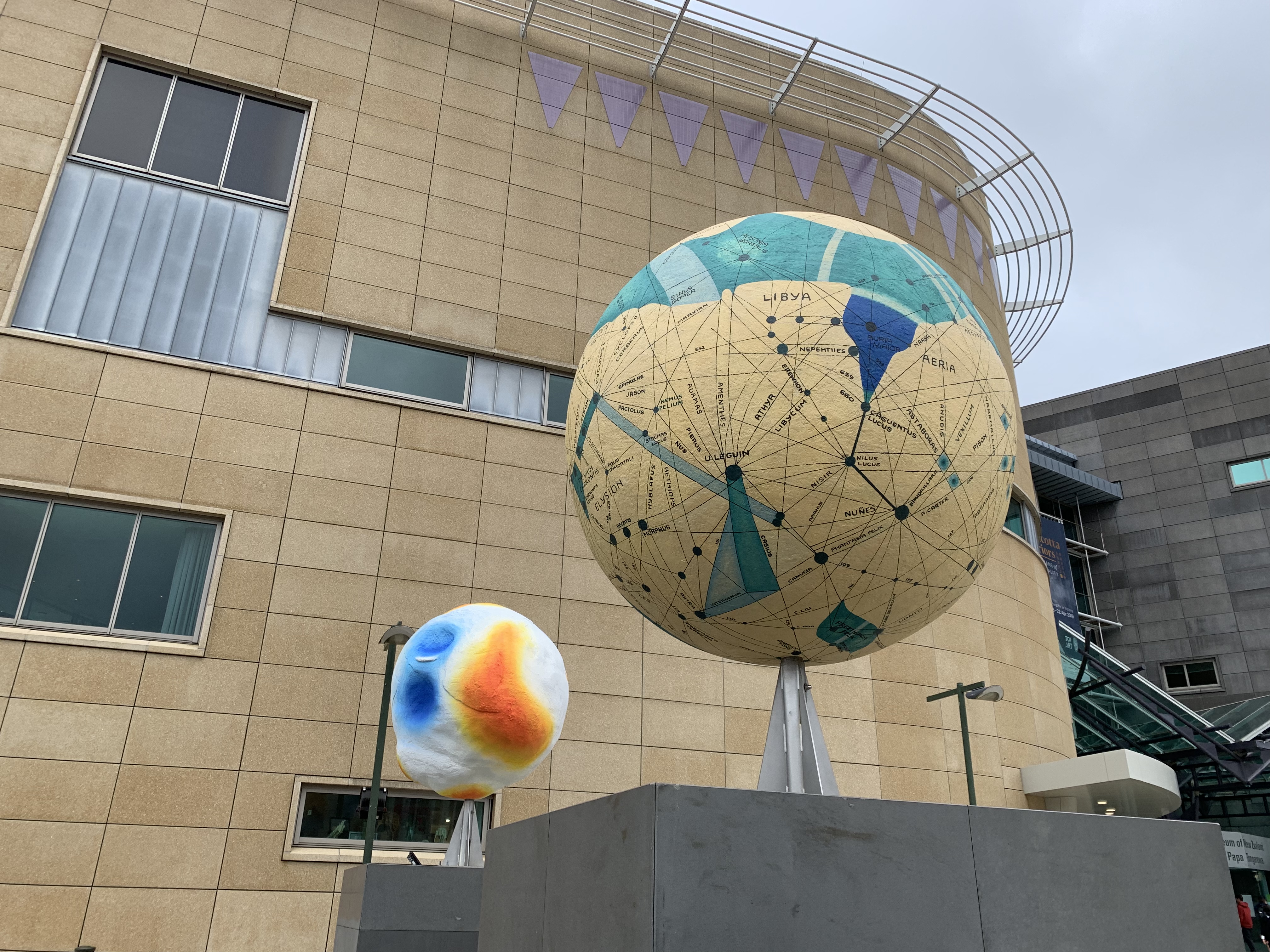
    Te Papa doesn’t technically open until 10.00 am (everyday except Christmas Day). We arrived at 9.50 am so that I could take a few photographs of the exterior. We were surprised to discover that the museum had already opened – well not all of it. The cloakroom and ticket desks were open, but, the exhibitions were still roped off. Still, this is a great idea to ease crowd congestion building up outside before the museum officially opens and stagger the groups of people arriving wanting to cloak/buy tickets.

    Te Papa Tongarewa
    Te Papa Tongarewa
    Te Papa Tongarewa

    Although this was only something minor, I really appreciated that the museum opened some of its areas early to accommodate those wanting to get a head start on their day. I will note here that the museum has free admission which is pretty unbelievable. The tickets were for visiting the Terracotta Warriors exhibition.

    10.15 am

    If you are visiting for the first time, I strongly recommend starting your day with an “Introducing Te Papa Tour”. Our guide, Sam, did a great job walking us around all levels of the museum pointing out a few highlights.

    On the second floor we learnt all about the ecosystem of New Zealand and its native flora and fauna. One of the more unusual objects in the exhibition Blood Earth Fire was a large stuffed Jersey cow. This cow represented how New Zealand was presented to the world as a major agricultural and farming nation in the 1950s. The stuffed cow would have milk poured through its mouth, down a series of pipes, and into the udders where someone could pretend to milk it.

    Blood Earth Fire

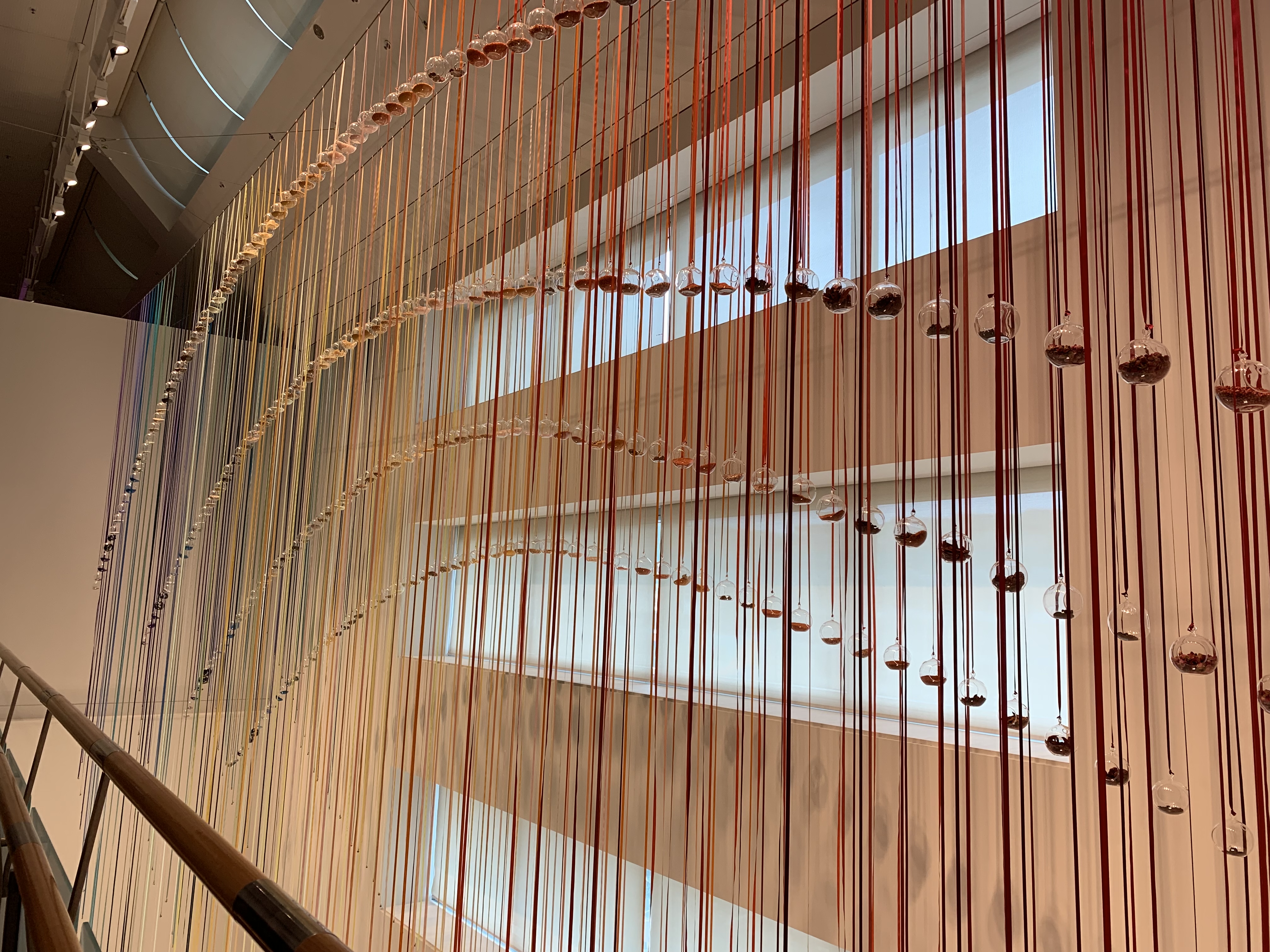
    We then went to the fifth floor to view some contemporary art. We would have skipped this level if it hadn’t have been for the tour. I’m glad we had the chance to see a stunning contemporary art piece by Tiffany Singh titled Indra’s Bow. Hundreds of spices, herbs and gemstones were arranged into a rainbow to show the spectrum of colour we come into contact with in our day-to-day lives. It was such a beautiful installation and even had a colour coordinated exhibition label.

    Indra’s Bow
    Indra’s Bow

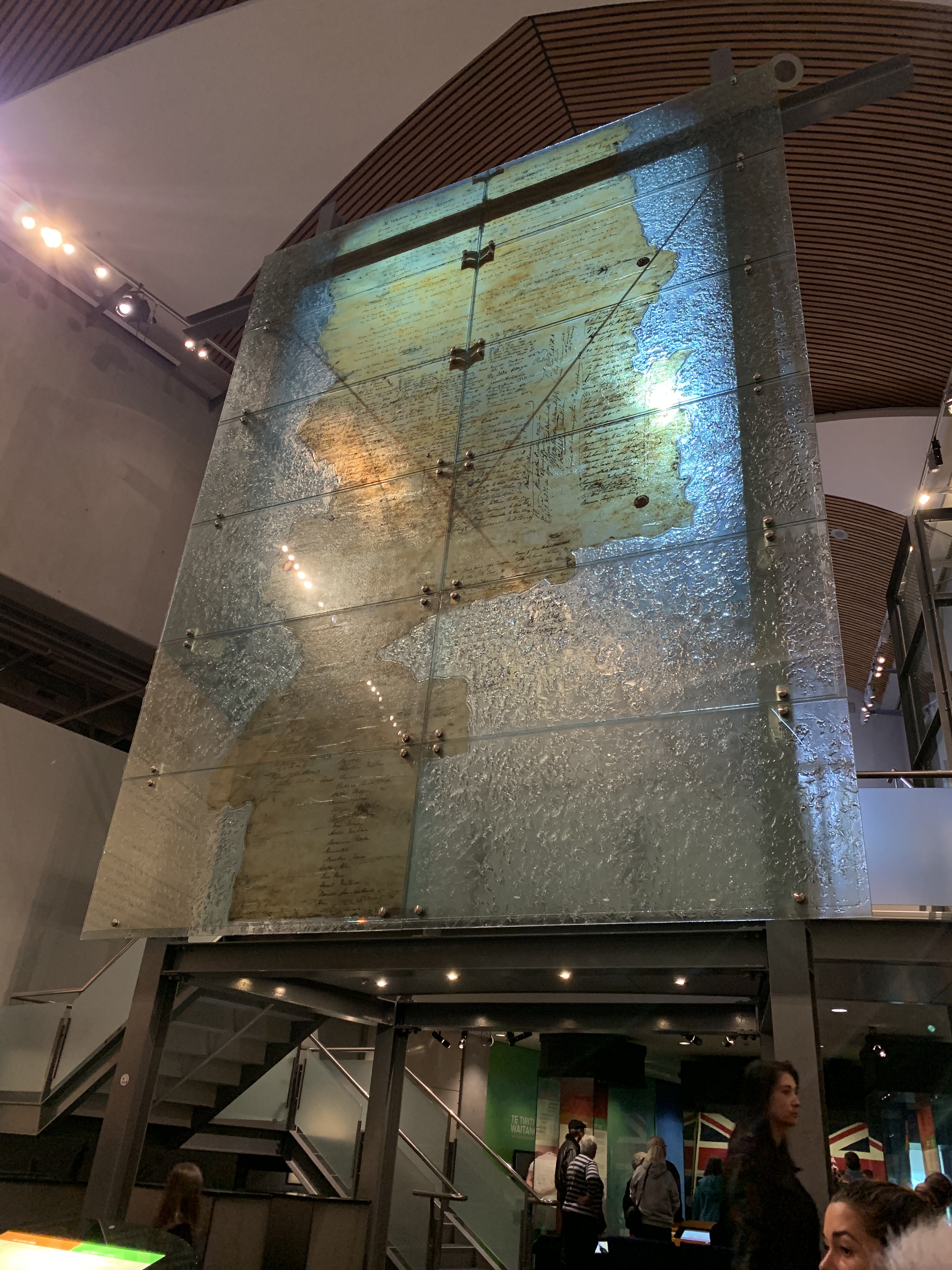
    After a brisk walk through the gallery we made our way to see the exhibition Ko Rongowhakaata: The Story of Light and Shadow co-curated with the Rongowhakaata peoples. This was followed by a short stop at the Treaty of Waitangi to learn about the Maori and European relationship.

    Treaty of Waitangi art installation

    11.30 am

    Our first break of the day spent in the Te Papa Espresso cafe.

    11.45 am

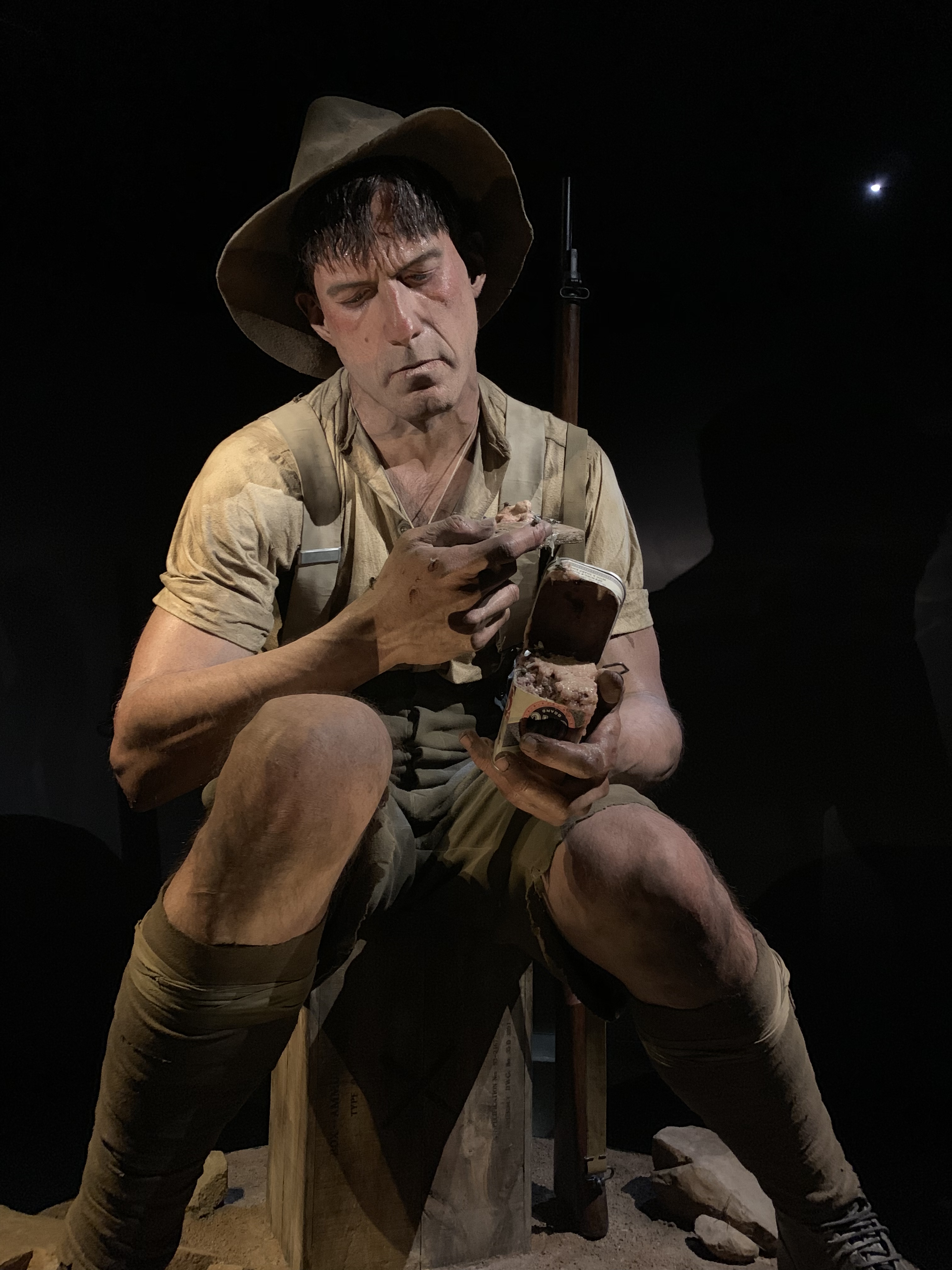
    Although the line was ridiculously long, we decided to see Gallipoli the Scale of our War before our 2 pm scheduled Terracotta Warriors visit. Luckily the line moved quite quickly. This exhibition is a collaboration between Te Papa and Weta Cave, the special effects and movie studio of New Zealand. I was a little hesitant to see the display as I thought it might glorify war and not offer a new narrative or interpretation.

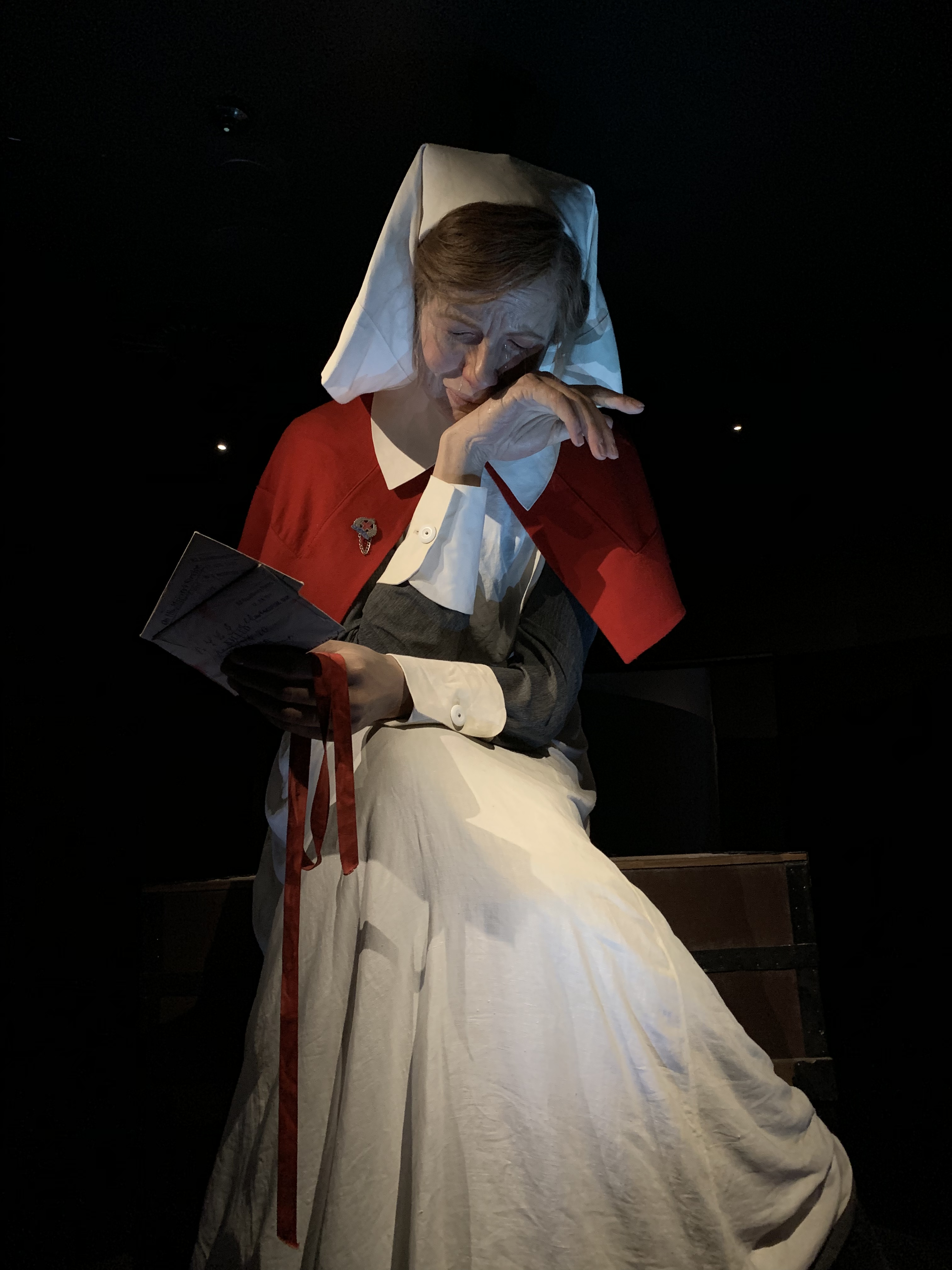
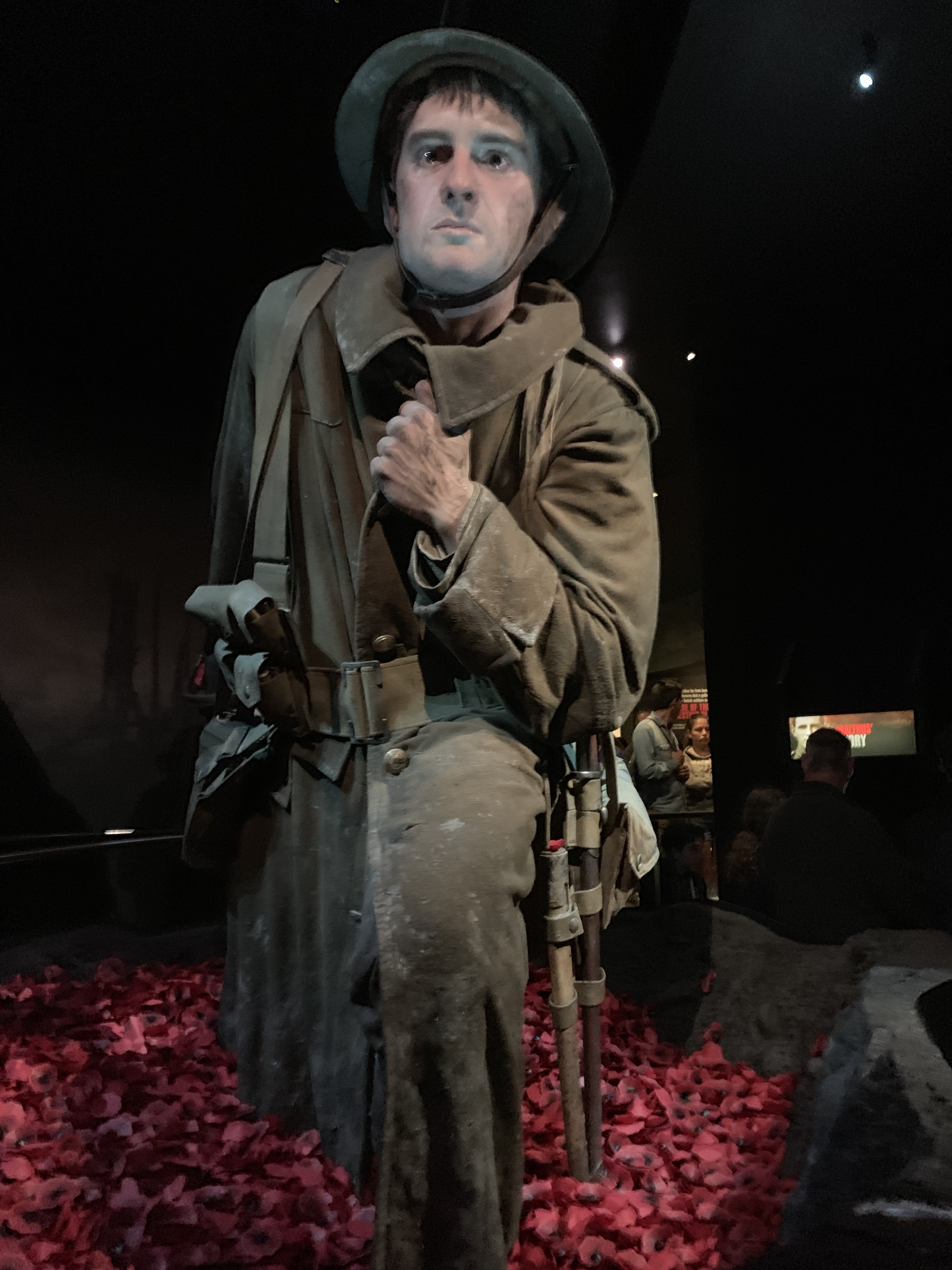
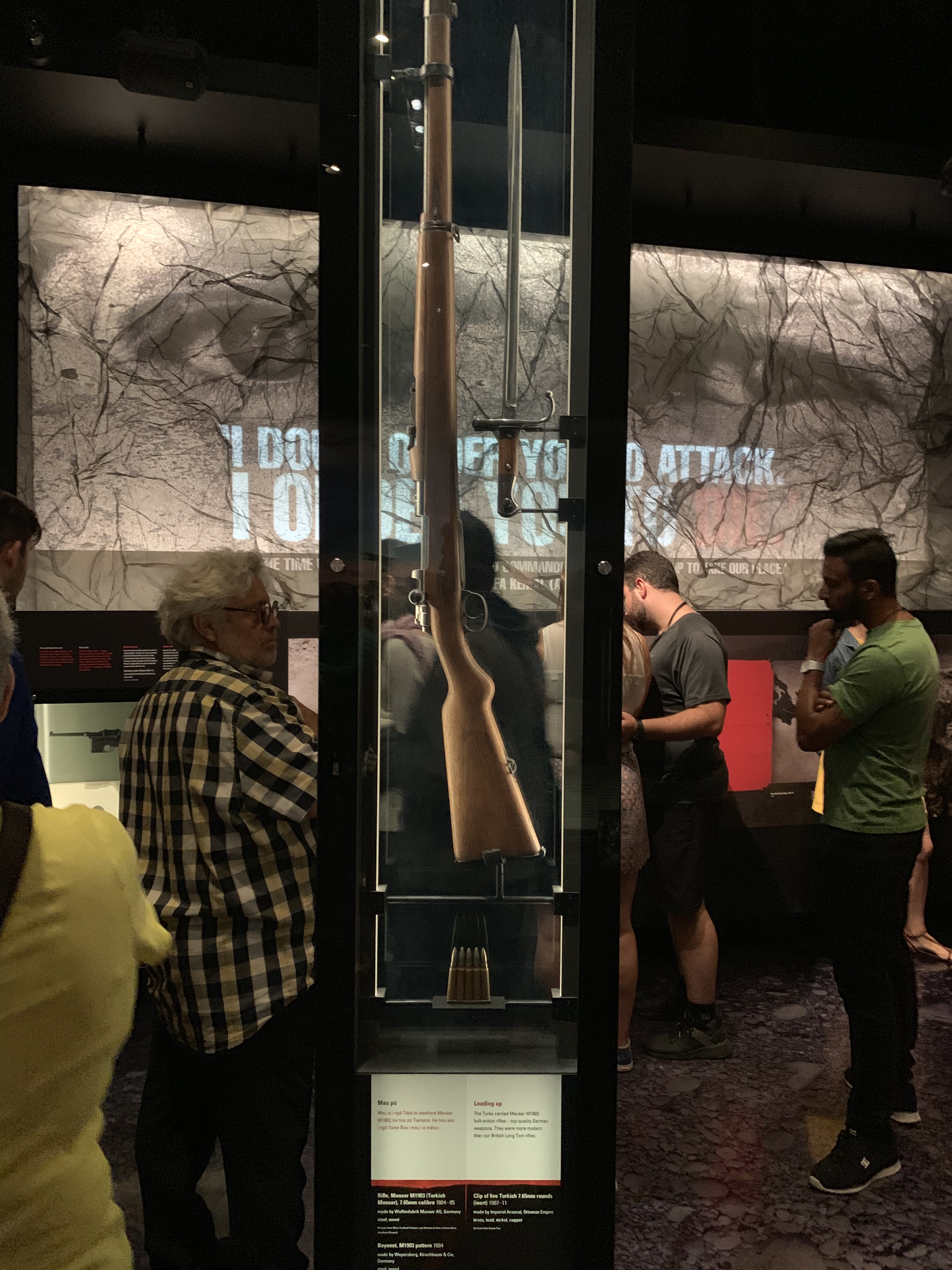
    Overall, it was aesthetically a really powerful display. The huge models of eight individual New Zealand soldiers/one nurse had incredible impact in the space and were accompanied by recorded readings of their journals/letters. After each model, the exhibition continued with a timeline of the War, thematic panels (both static and digital), various objects and some interactive elements. The display cases in the middle of the various rooms were so sleek. I have no shame in admiring exhibition cases.

    Gallipoli the Scale of our War
    Gallipoli the Scale of our War

    One of the more interesting displays was an interactive digital board that showed the four main weapons used in the War and how they could harm the human body. For example, you could select grenade. A video displaying the x-ray of an individual started playing showing the impact of the grenade exploding nearby. Then, the file of a soldier who suffered an injury or even death from the selected weapon was revealed. The other three weapons were bullets, shrapnel and artillery shells.

    There were two main issues I had with the exhibition overall. Firstly, the design created intense bottlenecks and resulted in people becoming quite frustrated and missing large chunks of the exhibition. These bottlenecks were primarily at the exits from the eight large models as long thematic panels explaining who the individual was were placed in terrible locations.

    The second issue I had with the exhibition was its representation of females. Out of the eight large models, one was female. I wouldn’t have had too much of an issue with this if it wasn’t for the fact that the female nurse was sitting on a crate crying, not, for example, engaged in work. Female nurses during World War I played such a crucial role it was disappointing to not see this highlighted.

    It is estimated that visitors will spend approximately an hour in this exhibition. This flew by as we spent quite a bit of time stuck in bottlenecks and trying to read some of the labels.

    12.45 pm

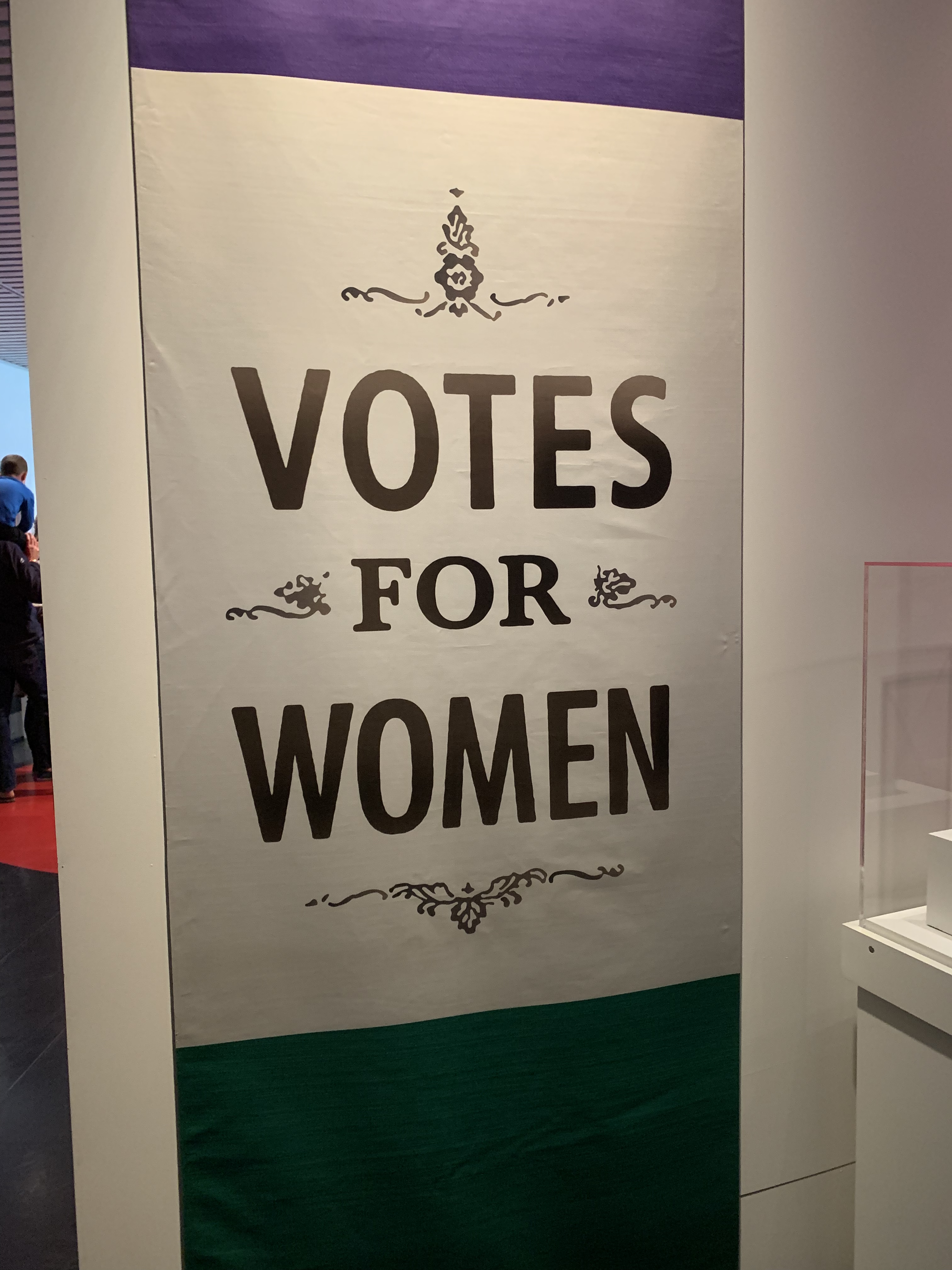
    There was still some time before our 2 pm booking so we visited the exhibition Doing it for Themselves: Women Fight for Equality on the third level. The introductory panel stated the aim of the exhibition – “to honour the women who fought, and continue to fight, for gender equality.” Although it was only a small exhibition, it was filled with some important stories concerning the freedom that came with the contraceptive pill and how New Zealand was the first country in the world to allow women the vote.

    Doing it for Themselves: Women Fight for Equality

    I enjoyed reading the story of Kate Sheppard who appears on the $10 banknotes of New Zealand. Sheppard was a suffrage campaigner who lobbied for the vote. Banknotes were displayed alongside a tiny woollen hat belonging to Neve Gayford, the daughter of Jacinta Ardern (New Zealand’s Prime Minister). The point of this was to show that Neve Gayford will grow up with the right to vote because of the efforts of those that came before her. The board asked “what inequities will she (Neve) be fighting to change?” A lot, I thought.

    1.30 pm

    Another short break.

    2.00 pm

    To finish our day, we visited the travelling exhibition Terracotta Warriors: Guardians of Immortality.

    I just want to take a moment to talk about one of the most impressive things about Te Papa – their commitment to integration of Indigenous language into their displays. This wasn’t just in the permanent exhibition spaces, but, even in the travelling exhibition the labels were in English as well as in Maori. At no stage in our visit did I feel anything was tokenistic or simply added on to appease different groups. Every aspect of the museum was well-integrated and seamless. I have never experienced this level of Indigenous integration before.

    Back to the Terracotta Warriors. We were getting a little tired so we didn’t stop to read a lot in this space. We walked through the initial part of the display quite quickly to get to the eight warriors. I was so glad to see they were all on display together. If they had have been separated, it wouldn’t have had as much impact. Instead, the display replicated how they can be found in their original location at Xi’an. Each of the warriors had its own object label sitting to the side so not to obstruct the view.

    Terracotta Warriors
    Terracotta Warriors

    There were also some great labels in the space with, for example, ten fast facts about the terracotta army. Great for those not wanting to spend their time in the exhibition reading a lot of information.

    Terracotta Warriors

    3.00 pm

    To finish our day, we visited the gift shop. It had a great selection of goods made in New Zealand as well as some more niche products including museum wax. Had to buy a tub.

    Visiting Te Papa was such a wonderful opportunity and confirmed all the good things I had heard. If you are creating a museum bucket list (not that I have been, but, I have been) make sure you add it to the list!


  • Wellington: Wellington Museum

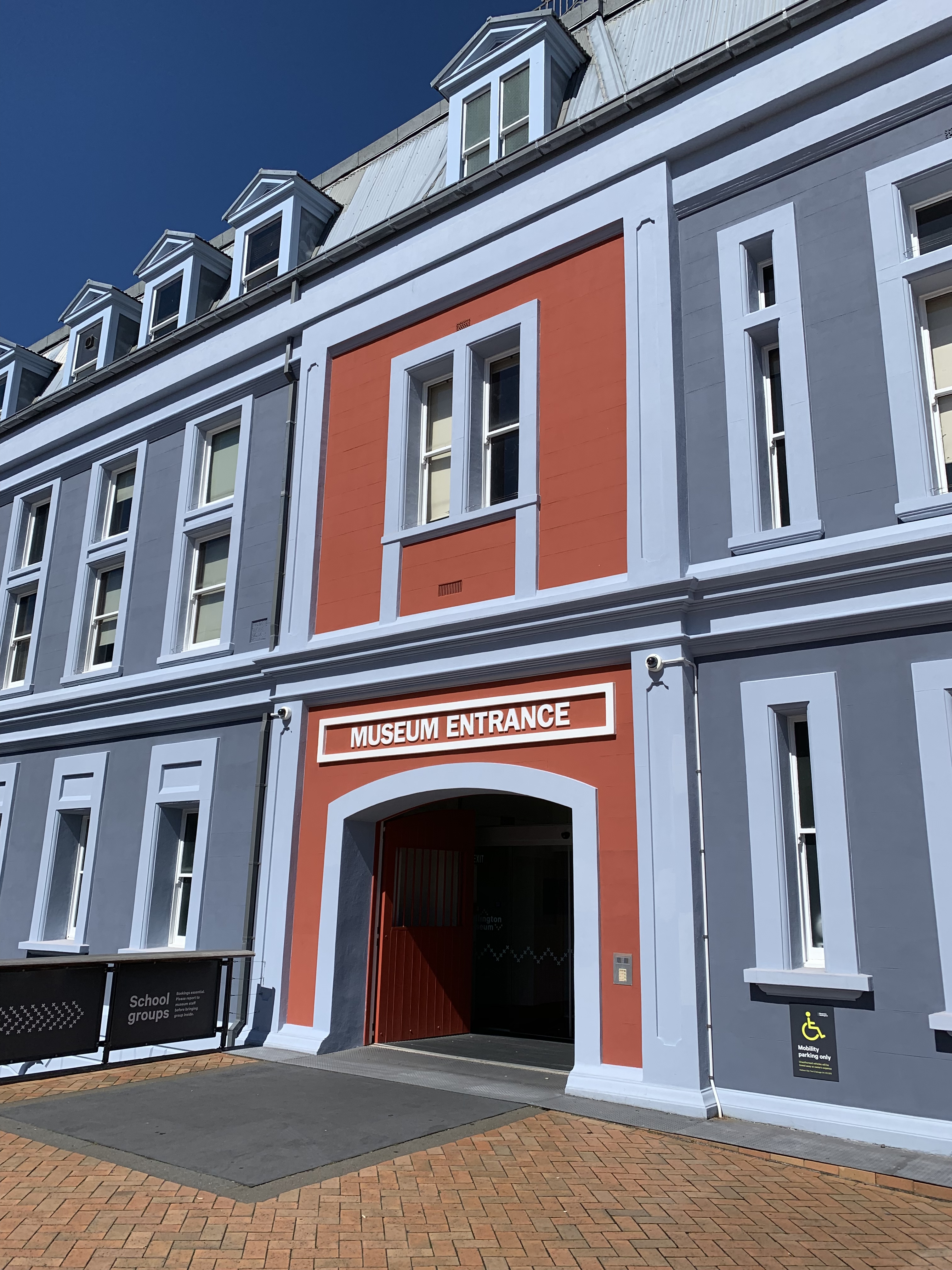
    I have absolutely fallen in love with Wellington. And I’m saying this before having visited Te Papa, aka the main reason why we’ve come here. I literally select my next holiday destination based on what museums I am really wanting to visit. As well as Te Papa, I was looking forward to visiting the Wellington Museum which is located in the old Bond Store on Wellington’s waterfront. Originally, the building housed a small maritime collection. Over time, however, it has been transformed into a museum that tells the story of Wellington.

    Wellington Museum

    Overall Highlight

    Not to pick a favourite, but, I’m going to pick a favourite. When you first walk into the museum there are a few maps on offer. There were two quite traditional ones – a highlights tour and a kid’s tour. There was also a map for those wanting to engage multiple senses and one specifically focusing on Māori culture and mythology.

    Level 3 – The Attic

    This was by far my favourite level. It reminded me of a cabinet of curiosities, but, actually done properly for a modern audience. This is also where I really loved the labels. Each object was accompanied by what looked like an old noticeboard with a number at the top. This gave the visit some structure as we could go through number-by-number logically seeing everything on display. The labels were long, but, each revealed quite a captivating story. They got right to the point and were genuinely interesting to read. I would also argue that they were accessible to a wide range of ages as they sat a little lower than standard adult height and were straight-forward with their interpretation.

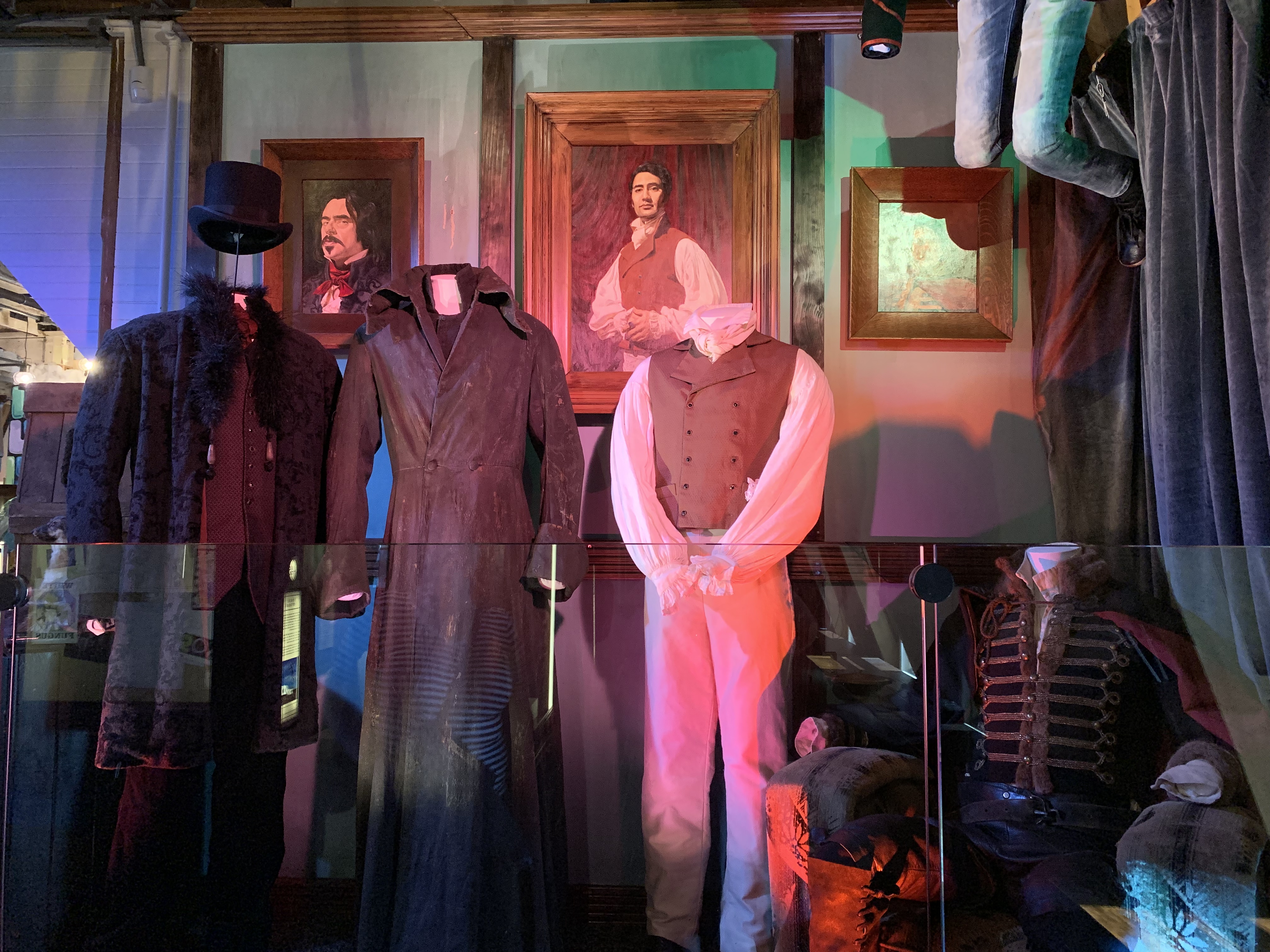
    One of the object highlights for me on this level was seeing costumes from the film What We Do in the Shadows by Taika Waititi and Jermaine Clement. I adore this film and it was fantastic to see the costumes on display. A lot of thought went into the display with the mannequins posing like the characters and one even positioned to look as though it was jumping off the side wall.

    What we do in the Shadows

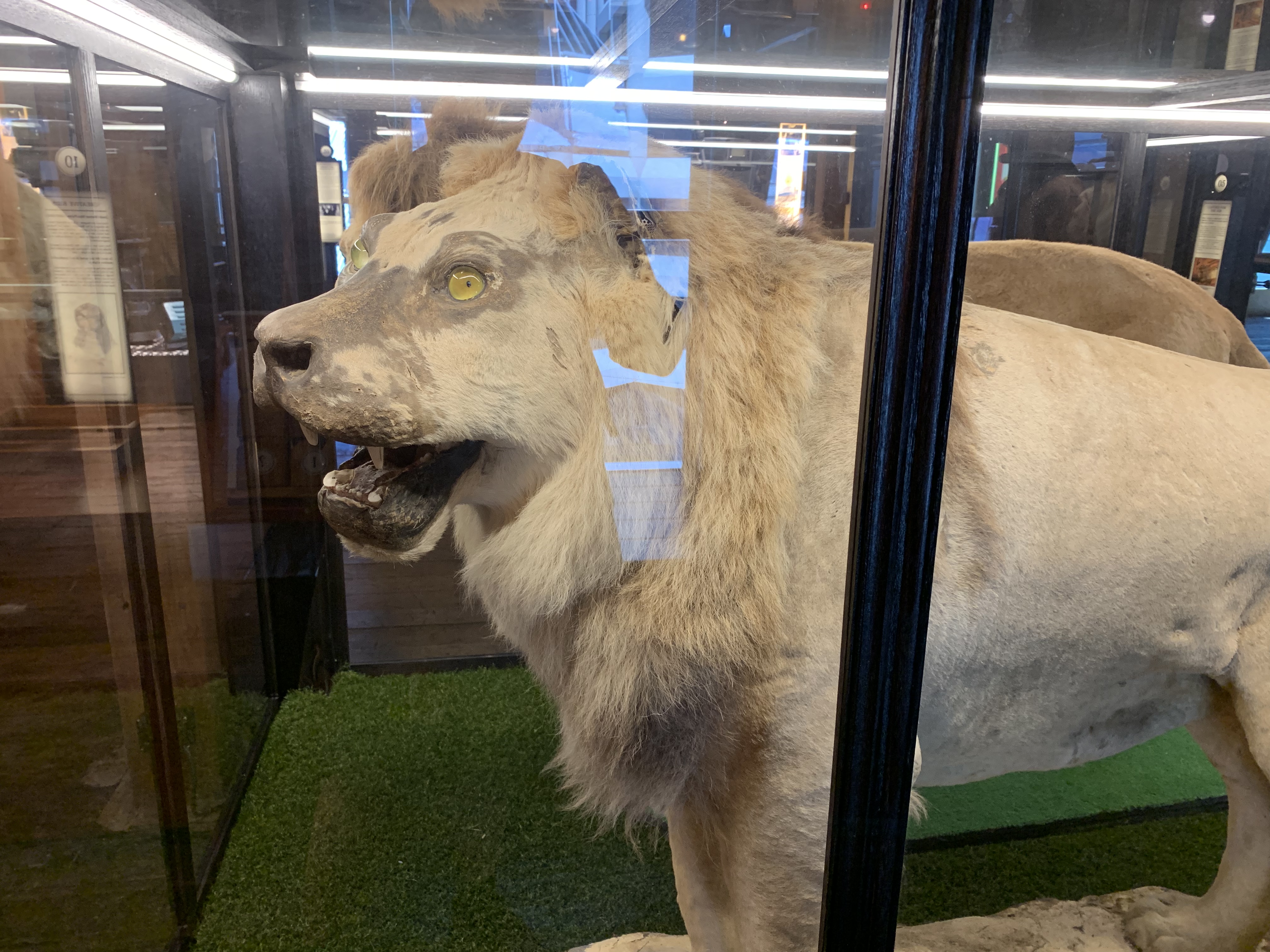
    Other objects on this level included beads made by patients of Porirua Mental Hospital and a taxidermy lion. There was a button next to the lion which I assumed was to trigger a light. Instead, it played a lion’s roar and scared me right into 2019. The label for the lion explored the popularity of natural history collections in the Victorian era and what it can reveal about our relationship to animals.

    Taxidermy Lion
  • Brisbane: State Library of Queensland

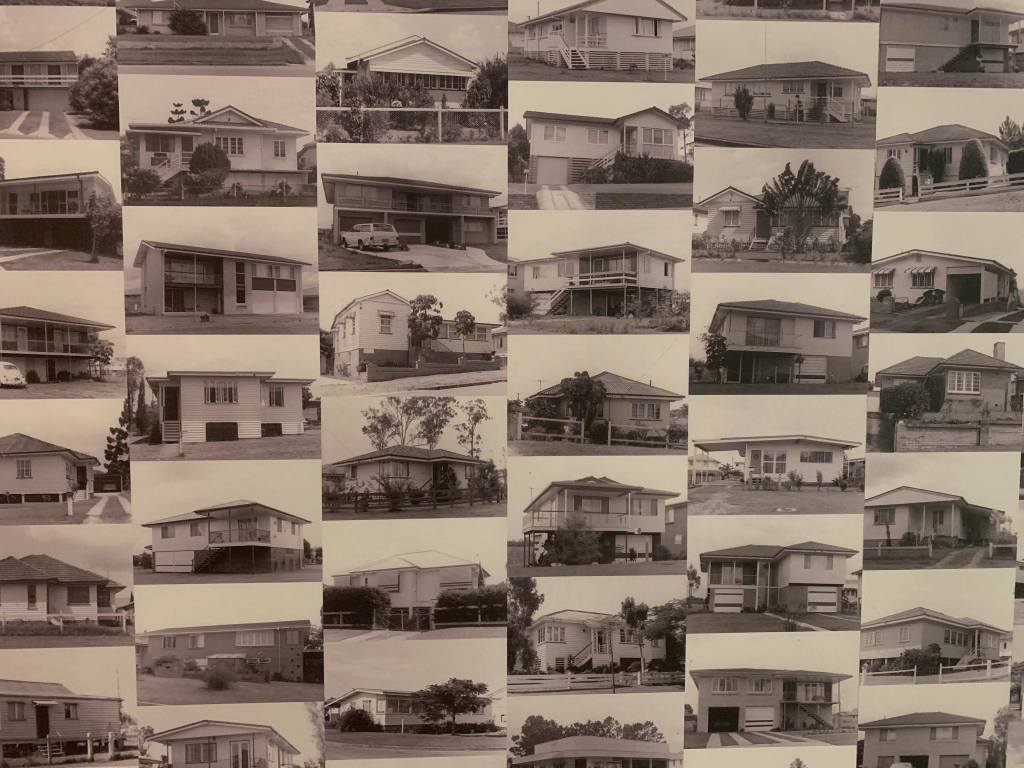
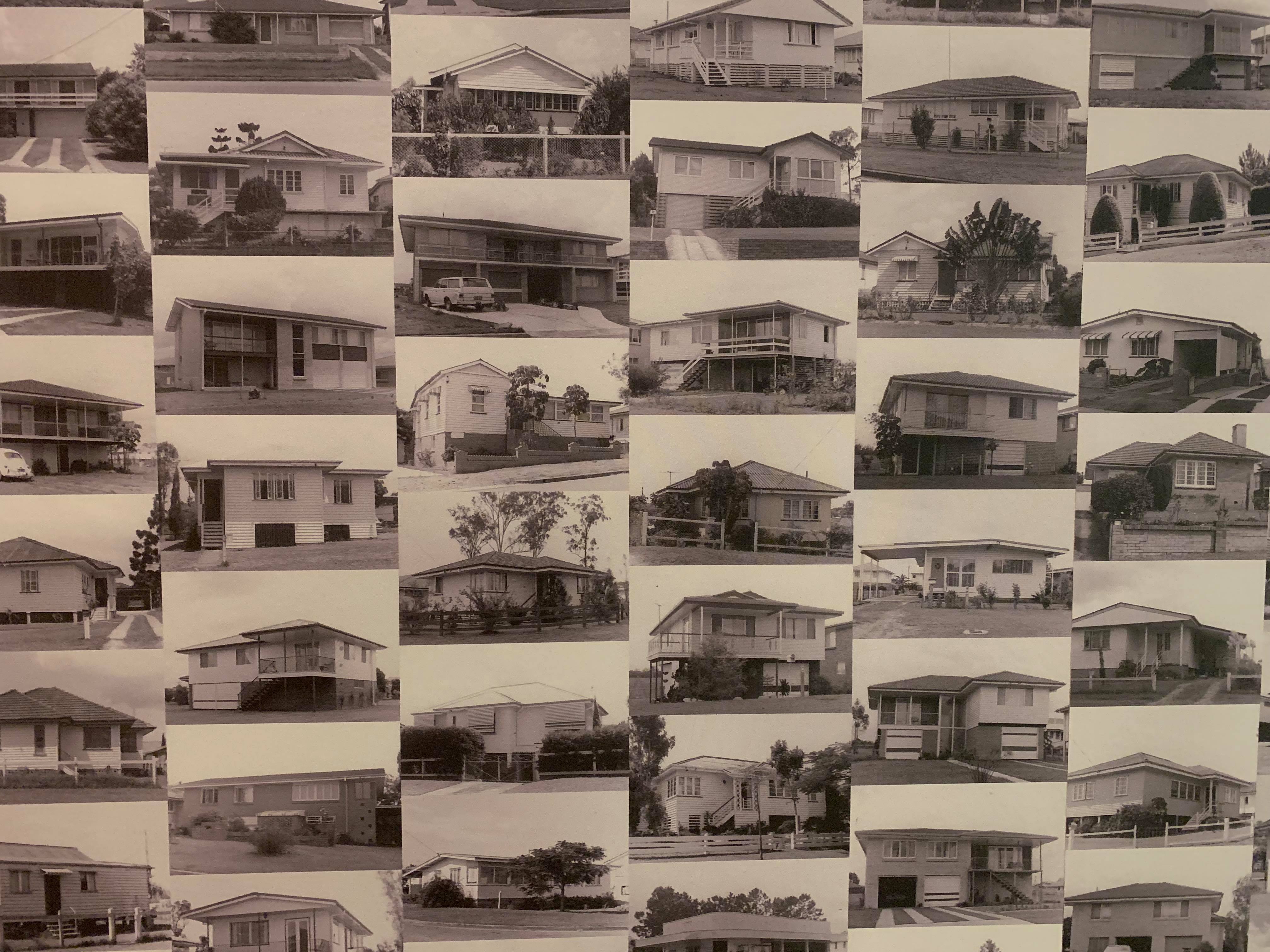
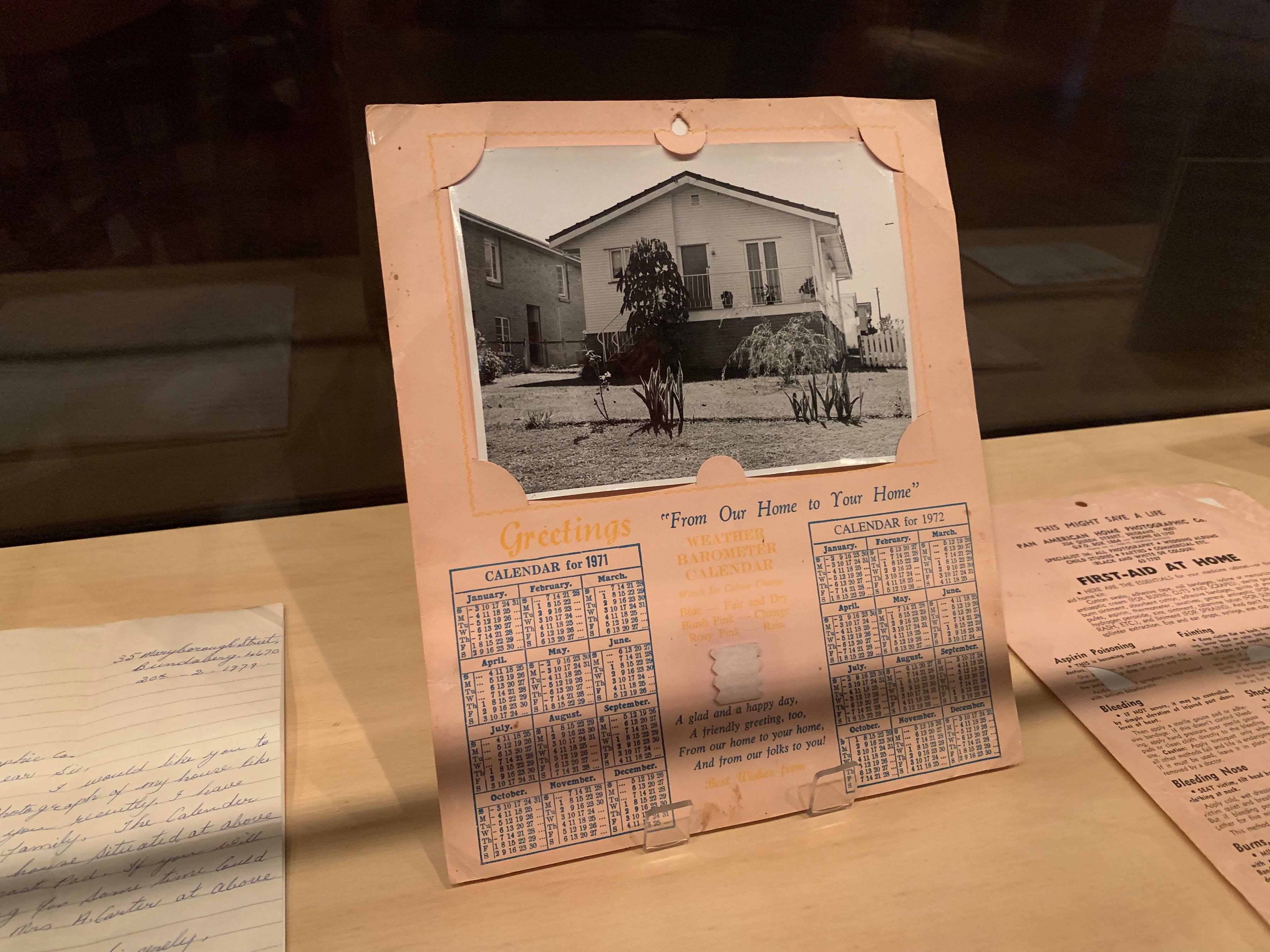
    In the late 1960s to early 1970s, Frank Corley drove around almost every suburb in Brisbane taking photographs of as many houses as he could. Eunice Corley, his wife, developed these photographs in a makeshift darkroom. The photographs were then handed to salespeople who would try and sell homeowners a special photograph of their home packaged in a cardboard calendar for 85 cents. It is estimated, in today’s money, that this could have been a million dollar enterprise. The photographs that were not purchased, approximately 60 000, were kept by Frank until his passing then donated to the State Library of Queensland.

    The photographs have been sitting in archival boxes for years, used occasionally by history groups and for specific research purposes. It wasn’t until a couple of years ago that the decision was made to make these images public and curate an exhibition to showcase what is in the collection.

    This unbelievably rich photographic archive of Brisbane is, I’d argue, a significant cultural heritage collection. Think about the history these photographs captured, the stories they can tell. Now imagine uploading these images to an online platform and capturing hundreds of stories from people who once lived in a particular house or who had a special connection to a neighbourhood.

    I mention this because accompanying the physical exhibition, Home: a suburban obsession, is an online platform where people can identify houses and add their stories or personal photographs. As soon as I heard about this, I jumped online and tried to find my house. Unfortunately, it wasn’t there. But, I spent quite a bit of time going through some of the photographs and reading their associated stories. People are genuinely placing their heart and soul into this project.

    47238336_555775501517125_1129509066645700608_n
    Home: a suburban obsession

    The Exhibition

    So visiting this exhibition I was immediately emotionally attached. For me, it was wonderful to see images from the past in suburbs that I frequently visit today. I couldn’t stop myself from seeing the exhibition with all this personal baggage.

    Even if you’re not from Brisbane, there is plenty to appreciate in this exhibition. There were a few features of the exhibition that I thought would appeal to a wider audience than simply those visiting to discover more about their home city. There were also a few positives regarding exhibition design and layout which I’ll include in the list.

    1. Scope of the photographs

    Just the concept itself is fascinating – someone drove around before Google was a thing and basically Google mapped huge parts of Brisbane. It’s remarkable to see the volume of photographs captured and what they can reveal outside of simply what architectural styles were popular (I’ll touch on this later). Whether you like architecture, history, cars, streetscapes or art, there is really something for everyone in this exhibition.

    2. Virtual reality

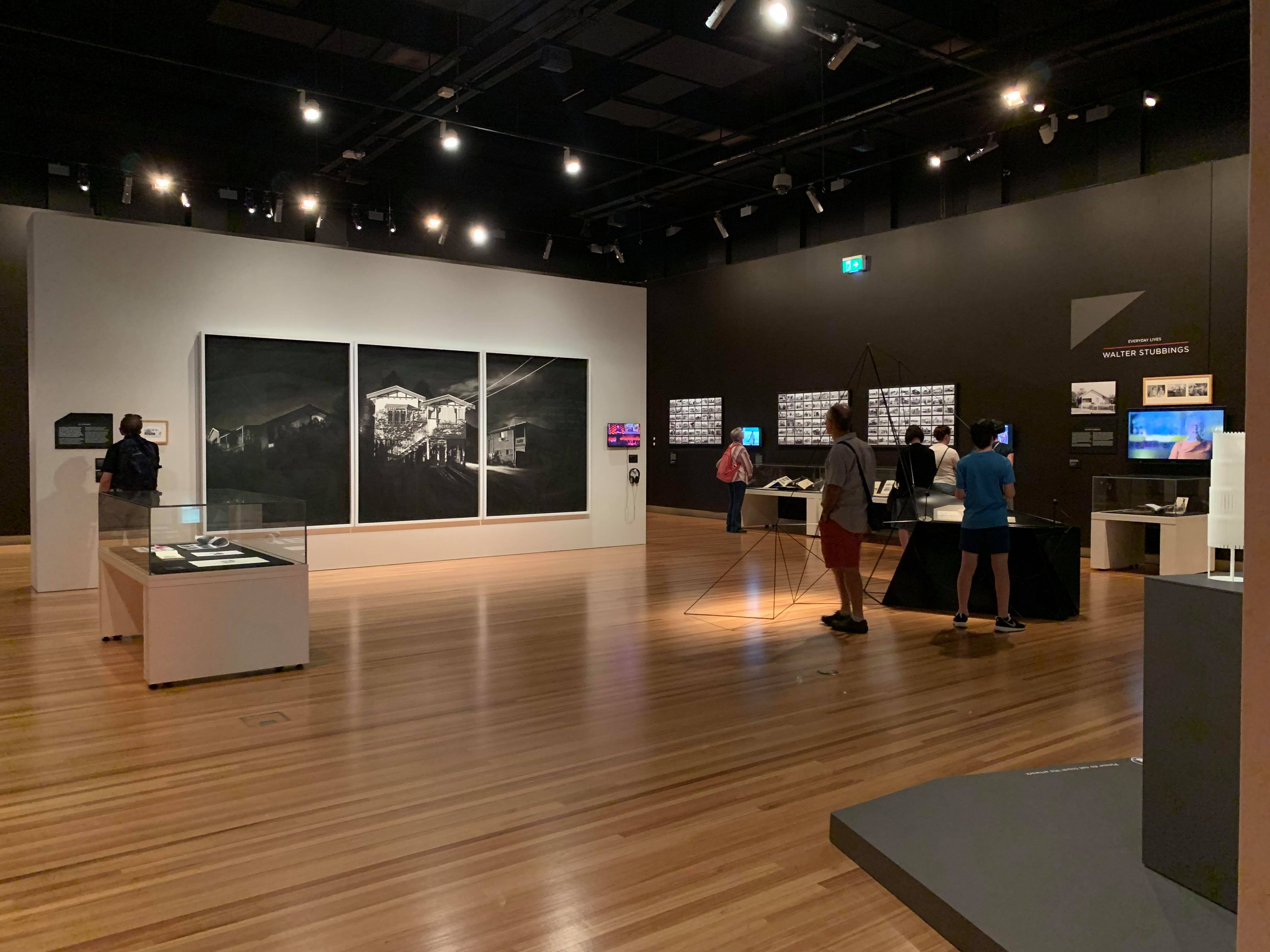
    In the middle of the exhibition space is a virtual reality installation. Wearing a headset, visitors are guided down a street in Brisbane with an image of the street today overlaid with photographs from the Corley collection. It is a nice way to actually show the pairing of the past with the present. Hopefully, down the track, the State Library may consider a project that allows visitors to download an app and take this experience outside.

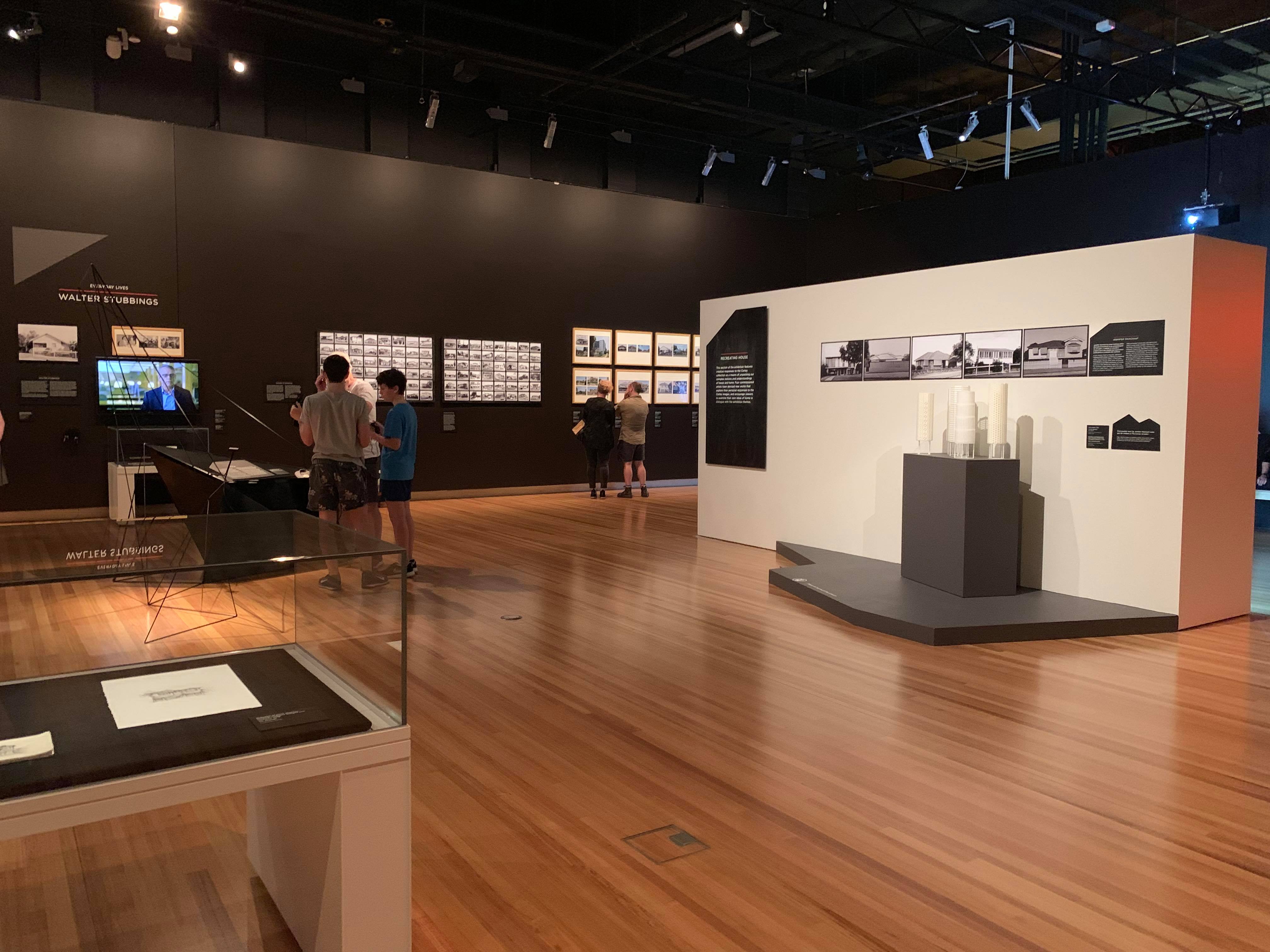
    3. Exhibition layout – spacious

    The exhibition was held in quite a large room with content covering all walls. In the middle, there were a few bits and pieces including a large wall projecting new additions to the online platform and the virtual reality experience. Having this space in the middle allowed the exhibition to not feel so cluttered. It was a great move considering the walls were absolutely filled. I like to think you always need some breathing space in an exhibition. It would have been nice to have some seating in here but I’ll get to that later.

    47682975_376281066462009_5848377613147439104_n
    Home: a suburban obsession
    47580793_607541639727727_8237125482722623488_n
    Home: a suburban obsession

    4. Exhibition design – photograph presentation

    When you first walk into the space there is a huge wall covered in approximately 10 000 photographs. As the Curator stated in the talk we attended, this should make you feel how he did when he first saw all the photographs, overwhelmed. I was wondering how exactly these images were going to be displayed in the remaining exhibition space. For obvious reasons, it would be problematic displaying all 60 000 images on the walls.

    47680208_2152045808367769_6396879000232263680_n
    Home: a suburban obsession
    48275557_2211240125553356_6405255217251614720_n
    Home: a suburban obsession

    Instead, I really enjoyed how they decided to display some of the photographs. Alongside objects in cases (including one of the photographs in a calendar) and interviews that played on television screens, were photographs grouped in sets of 48. Each group had a theme. For example, my favourite was “Open Windows”. All 48 photographs showed houses photographed with open windows (surprise, surprise). What I loved about this was the interpretative label alongside that highlighted issues of climate, home occupation and security.

    47685946_281929305843274_3946667606030680064_n
    Home Calendars
    48278057_207810466772715_7769880221133570048_n
    Home: a suburban obsession

    While there was quite a lot that I enjoyed about the exhibition, there were a couple of points I have to make.

    1. No white writing on black walls

    This may not bother some as much as it does me, but, I cannot stand white writing on a black background. It is eye-straining. I get what they were trying to do – replicate the black and white theme from the photographs. It was, however, difficult to read.

    2. Long videos with no chairs

    There was one video in particular that showed Brisbane during the 1950s. It went for approximately 10 minutes. Considering this exhibition is appealing to a broad audience, it would have been nice to consider seating options for movies that run for this length of time.

    48098294_345828992816164_2991788843033690112_n
    People watching the video on a tiny television.

    Apart from these design issues, I thought that the exhibition was well-curated. I really hope that the technology doesn’t fail because it does have a lot to add.

    The Talk

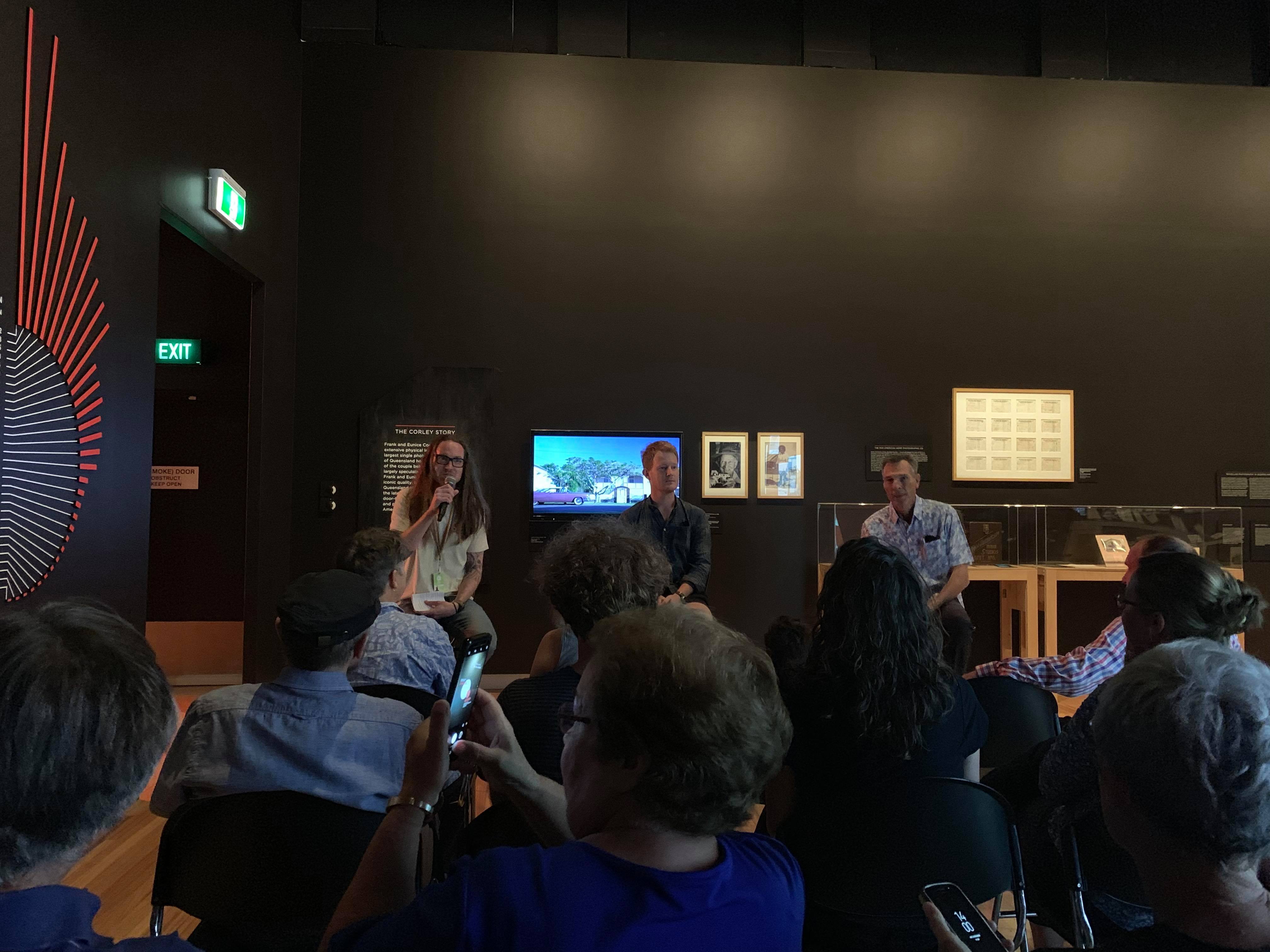
    I mentioned before that we attended a talk attached to the exhibition. This was basically an introduction to the exhibition featuring Denis Peel (Annerley-Stephens History Group Inc.), Gavin Bannerman (Director of Queensland Memory) and Adam Jefford (Curator).

    47682092_1796867637106069_8337907607582801920_n
    Annerley-Stephens History Society

    Overall it was a pretty good discussion mainly relying on audience member questions which can be a little risky. It would have been great to hear more from Denis Peel about how the Annerley-Stephens history group contributed to the exhibition and organised some of the information and interviews.

    Still, it was interesting to hear about the background of the exhibition and online project and how they’d like the exhibition to develop, i.e. creating a repository of stories on the online platform.

    There are a few other workshops and talks associated with the exhibition that I hope to attend. I cannot fault the range of public programs that are accompanying this exhibition – they’re fantastic.

    Home: a suburban obsession is on display until 14 July 2019. To access the online platform click on the link here.

  • GLAM Blog Club: Change

    The theme for this month’s GLAM Blog Club is…. Change! I have been considering what angle to take on this theme. Rather than just write about the changes I’ve experienced in my life, e.g. moving to work in a regional museum, I wanted to dig a little deeper. I love it when I visit a museum and leave feeling a little bit like I have, dare I say, changed. This could be on a real fundamental level, making me question my beliefs and values, or on a less intense level, making me stop and go wow that has had an impact. The following is a list of four museums/exhibitions that I feel have changed me in some way shape or form.

    1. Road Through Midnight: A Civil Rights Memorial – a photographic exhibition by Jessica Ingram (temporary display at the Tennessee State Museum, 2016)

      I’m going to start with a pretty intense exhibition that changed the way I think about documenting trauma and displaying it in a museum space. I stumbled across this exhibition while visiting Nashville in 2016. The Tennessee State Museum was on my must-see list. I had no idea that the museum was going to be so absolutely massive. Visitor fatigue set in quite quickly so I walked over to their temporary exhibition space to try and re-focus. It was here that I saw what has continued to be the most powerful exhibition I have ever seen.

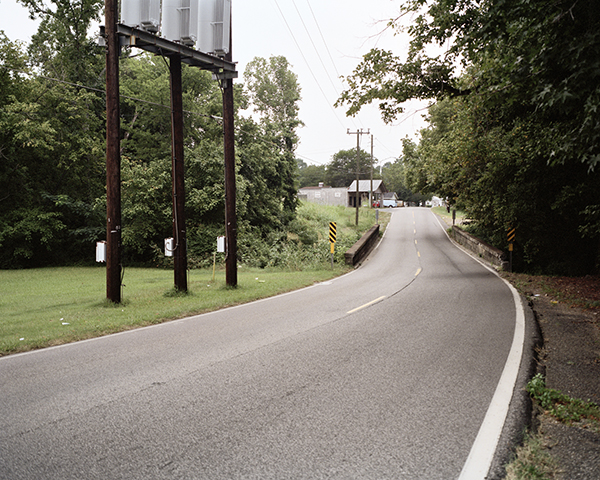
      To give you an overview, artist Jessica Ingram travelled to locations in the south of America where Civil Rights era crimes occurred in the 1950s and 1960s. At each location she took a photograph. Included are images of where the body of Emmett Till was discovered and where the Ku Klux Klan originated. In total, there were thirty photographs on display, each accompanied by a label that told the story of why the location photographed was significant. This exhibition was further supported by a range of oral history recordings.

      I’ve included this exhibition because I really was taken aback by the power of these photographs. Some were of really innocent looking locations, for example a pretty standard looking forest. Then, you read the story associated and all of a sudden you couldn’t look at the photograph in the same way. It really made me question how I define a memorial. Rather than something physical left in a specific place as an act of remembrance, Ingram used absence in ways I had never seen before. It was this combination of a seemingly benign location with a horrific story attached that kept me captivated in the exhibition space for a very long time.

      I want to finish this section with a short quote from the Society for Photographic Education. I think it beautifully sums up the impact of the display.

      “As the years pass and the landscape transforms itself in ways both beautiful and banal, all that remains of these events are the memories and voices of those who lived through them.”  (Source)

      virgilware 001
      Site of Virgil Ware’s murder, Docena-Sandusky Road, outside Birmingham, Alabama, 2007. Photograph by Jessica Ingram. (Source)

      2. Queensland Museum

      I will be venturing down a completely different path for my next entry. When I was younger, there was nothing I loved more than visiting my local museum, the Queensland Museum. In fact, one day, as a treat, I distinctly remember being told that I could choose two out of the following three options: go to the movies and see George of the Jungle for the millionth time, go shopping in the city, or visit the museum. I settled on George of the Jungle and the museum. So to correct what I said earlier, there was nothing I loved more than visiting my local museum and seeing George of the Jungle.

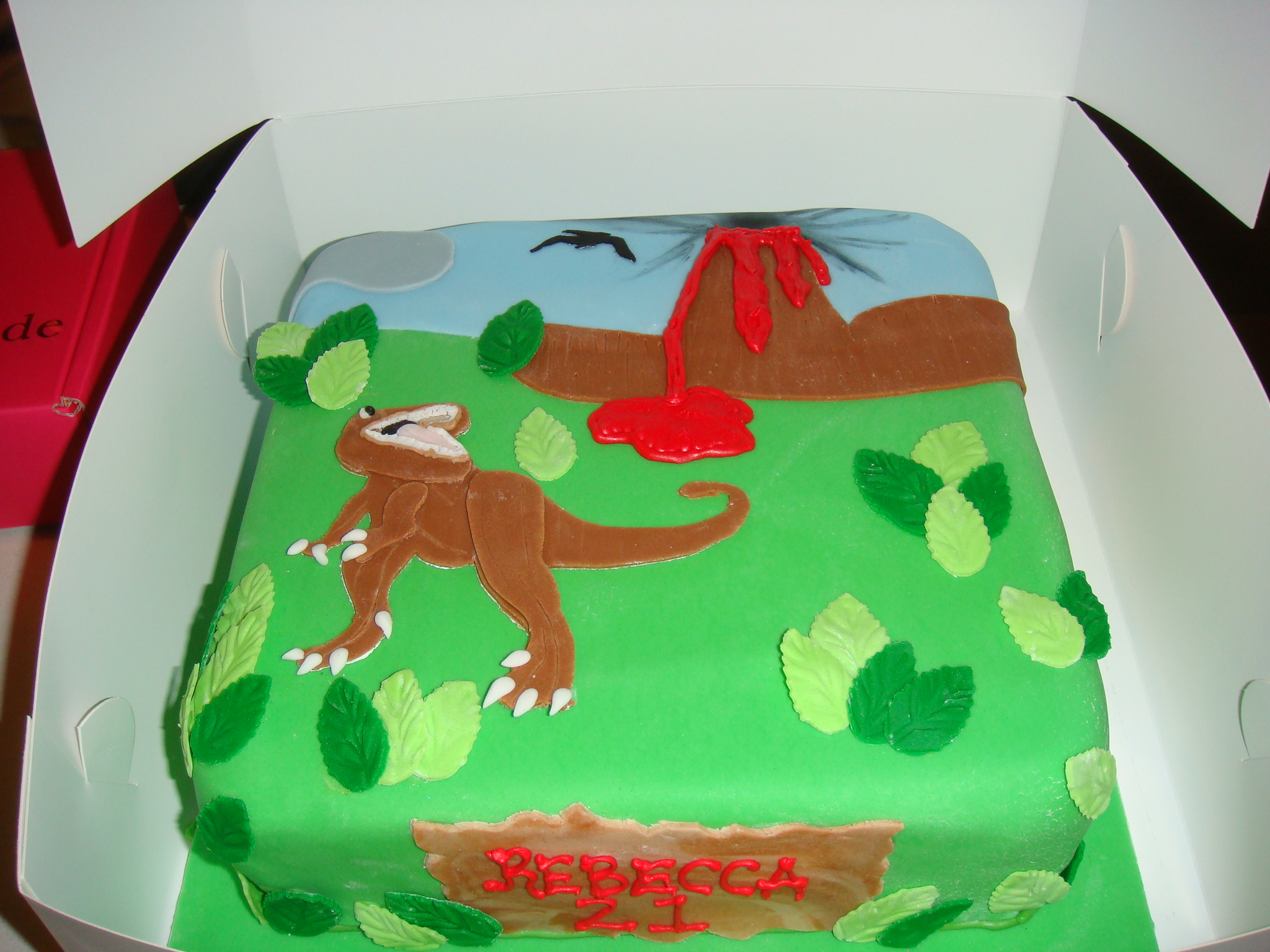
      I loved everything from the giant dinosaur statues in the dinosaur garden to the section on megafauna. So much so, I celebrated two birthdays in the museum including my 21st which was literally dinosaur themed and featured the cake pictured below.  In primary school, we visited multiple times on excursion. During the school holidays, I would visit in my free time with family and friends. One school holiday program I remember particularly well was digging for Ancient Egyptian treasures. I would even take in snake skins we found in our garden to have the species identified.

      Dinosaur Cake
      Birthday Cake

      I grew up really trusting and finding inspiration in this museum and, needless to say, it changed me because it made museums my happy place. I knew that when I was older, I wanted to eventually work in my happy place.

      3. Hunterian Museum (2016)

        So we’ve established I wanted to spend all my time in a museum from a very young age. In terms of what type of museum, I had no idea until my final year of undergraduate honours in history. I took a course essentially on the history of medicine and decided to focus on medical history museums, including specimen collections. And so began my absolute fascination.

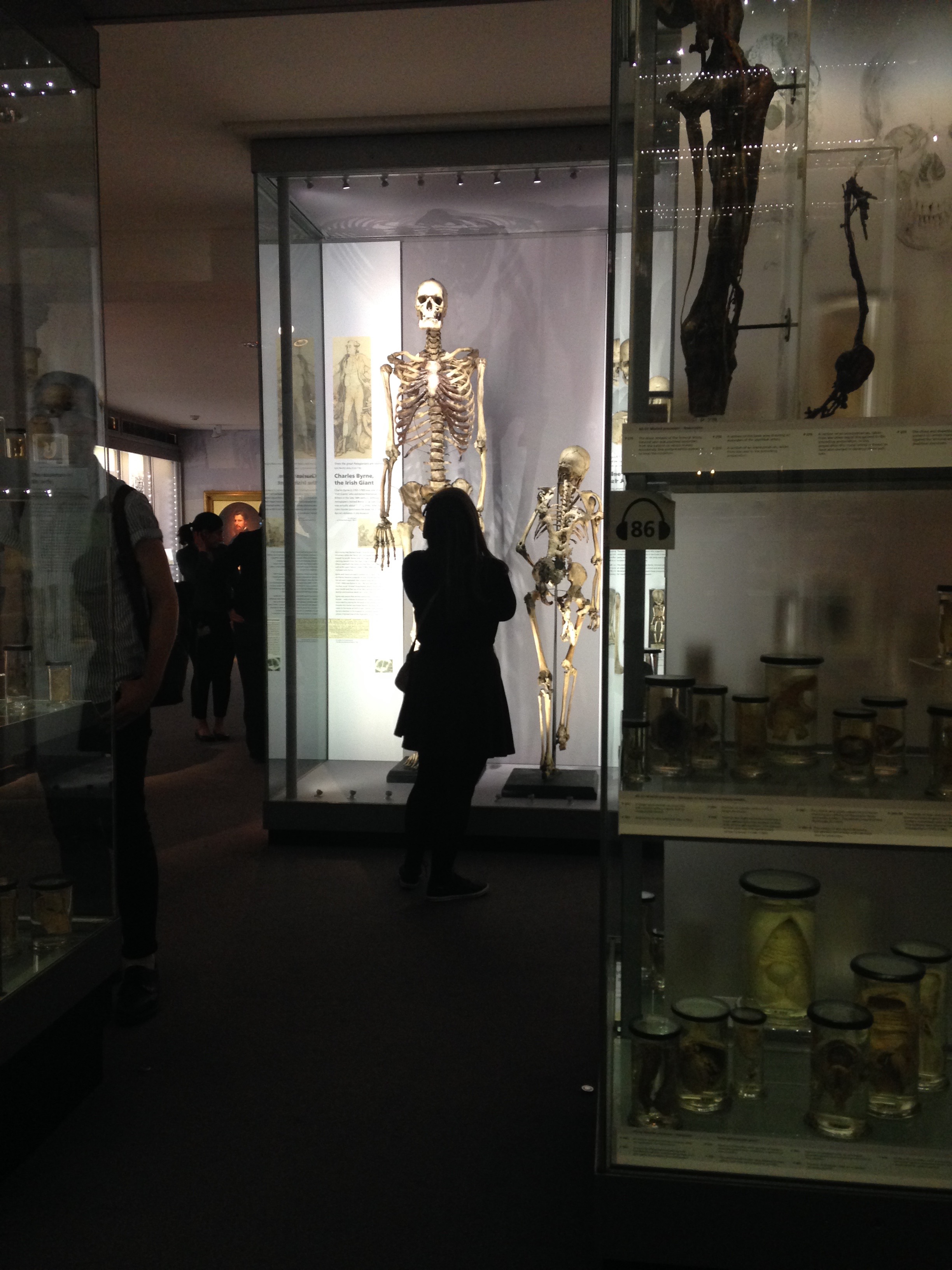
        However, it wasn’t until I physically visited the Hunterian Museum that I really knew this was the type of collected I wanted to work with. It set me on a course of volunteering, interning and eventually working with medical history/medical specimens. It also sparked a great interest in the ethics of display and bigger questions of what happens to your body after death.

        5. Irish Giant and Shadow
        Hunterian

        So you could say that visiting the Hunterian changed my long-term goals and set me on the path to where I am today.

        4. 100% Brisbane (Museum of Brisbane, 2017)

        Since I started with an exhibition, as opposed to museum, that had a great impact, I wanted to end with another. When I was younger I didn’t really like where I lived. I had this whole “grass is greener” mentality and couldn’t wait to leave Brisbane. After a disappointing visit to the National Museum of Australia where I felt there wasn’t really a sense of identity conveyed that I could relate to, I was hesitant to visit this exhibition.

        img_1076
        Museum of Brisbane

        I am so glad I decided to visit anyway. The entire exhibition was like receiving a warm hug. I think this is because I saw it while I was living in Sydney and the exhibition essentially showed me everything I had been missing. It changed me from someone who sort of missed Brisbane to someone who was actually really proud of their city.

        Final Thoughts

        Museums are truly incredible places that can spark a change you never thought possible. It is so important for them to challenge, confront and inspire. I can only hope that whoever is reading this blog post will finish and have some happy memory of a museum that has changed them.

      1. Brisbane: Walter Taylor Bridge (Brisbane Open House)

        I have absolutely no idea why, but, I’ve always been fascinated by the Walter Taylor Bridge in Brisbane. I think it’s because when I was younger, I was told that people used to live inside the bridge. This was pretty much one of the coolest things I had ever heard. Since then, I have always wanted to see inside the bridge and learn more about the people who called it home. Luckily, Brisbane Greeters were offering tours during Brisbane Open House. They actually run these tours all year round based on requests. I have added some more information at the end of the post in case you are interested in booking.

        IMG_8194
        Walter Taylor Bridge

        Here is a little more historical context.

        History of the Bridge

        The Walter Taylor Bridge, originally known as Indooroopilly Toll Bridge, opened on 14 February 1936. It was later renamed in honour of the contractor, engineer, and builder, Walter Taylor. Taylor designed the bridge and pushed for its construction during the Great Depression. The Taylor family first arrived in Queensland in 1884. After both the death of his father at an engine shed in Roma Street Station, and the birth of his first child Thelma with Louisa Braun in 1900, Walter returned to the United Kingdom. Unable to run a successful business, Taylor returned to Queensland in 1912. He was equipped with new knowledge surrounding concrete construction. One thing is certain, Taylor loved his concrete.

        Official Opening of the Indooroopilly Toll Bridge, Brisbane, 1936. (2003), State Library of Queesland
        Official Opening of the Indooroopilly Toll Bridge, Brisbane, 1936. (2003), State Library of Queensland.
        Official Opening of the Indooroopilly Toll Bridge, Brisbane, 1936. (2003), State Library of Queensland, Governor of Queensland, Sir Leslie Orme Wilson, and the official party crossing th
        Official Opening of the Indooroopilly Toll Bridge, Brisbane, 1936. (2003), State Library of Queensland. The photograph shows the Governor of Queensland, Sir Leslie Orme Wilson, and official party crossing the bridge. Walter Taylor is at the far right.

        In the late 1920s, the Queensland Government decided that there needed to be more river crossings connecting the north and south of Brisbane. Taylor submitted three designs between 1924 and 1931. Inspiration for the final design came from the Sydney Harbour Bridge that had to be supported by steel cables until the separate arms of the bridge joined together. Those cables used during the building of Sydney Harbour Bridge now support the Walter Taylor Bridge.

        As it was the Great Depression, the Queensland Government agreed on the condition that it would be a privately funded toll bridge. It operated as such until Brisbane City Council took ownership in 1963.

        Indooroopilly Toll Bridge, Brisbane, 1936. (2003), State Library of Queensland
        Indooroopilly Toll Bridge, Brisbane, 1936. (2003), State Library of Queensland.

        The toll keepers and their families lived in the two concrete pylons. You can see these in the image above. One family, the Green family, had members living in the bridge until 2010. This was under the condition that as long as a Green family member was living in the bridge, they would never pay a cent of rent.

        In 2013, the bridge was re-opened for visitors wanting to see what life was like living in a bridge. Since then, thousands of people have toured what was once the Green family residence. On the tour, visitors have the opportunity to see some pretty remarkable photographs. For example, there is one of a child’s birthday party celebrated on the balcony of the bridge, in a time before safety railings.

        IMG_8191
        Walter Taylor Bridge

        The Tour

        To start, we heard a little bit on the history of Brisbane and the first bridge that was built that stands next to the Walter Taylor Bridge. We also learnt a little about Walter Taylor himself and his flat out passion for concrete.

        IMG_8197
        Walter Taylor Bridge

        As we were the last tour of the day, our guide said we could spend more time exploring inside the bridge. This did mean, however, that the introduction was dragged out and could have been a lot shorter.

        It was a surreal experience going from the incredibly busy road to inside the pylon where you couldn’t hear a thing. This was thanks to 1.5 m thick concrete walls. It also meant that inside was incredibly hot. The multiple windows would have definitely come in handy during the hot summer months.

        I was so shocked to learn that the first generation of Green family members had six kids living in one pylon. It was pretty spacious inside, but, there was only one small bedroom for the three girls and one for the three boys. A constant theme I encountered over the entire Brisbane Open House weekend was this idea of space and how much space people now think they need to live comfortably.

        IMG_8228
        Walter Taylor Bridge

        On the first floor was one bathroom (to be shared by eight people). One was installed later on the top floor when family members became ill. Apart from the two kid’s bedrooms, there was another bedroom, kitchen, and lounge area. We heard a few stories about how the space was utilised to its full extent. My favourite was how the corridor of the bridge connecting all the bedrooms was transformed, at times, into a basketball court.

        My favourite part of the tour was standing on the balcony and watching the traffic below. Today, just over 35 000 cars use the bridge daily.

        IMG_8222
        Walter Taylor Bridge

        How Can You Book a Tour

        If you would like to experience life inside a bridge you can book by clicking here. It offers an amazing opportunity to delve into Brisbane’s past and see something unusual in this city.

        Information from this blog post has been courtesy of the State Library of Queensland.

      2. Brisbane: Mater Heritage Walk (Brisbane Open House)

        On the agenda for this morning was the Mater Heritage Walk. My friend and I spent 20 minutes walking around trying to find where exactly the tour was meeting. It was a very stressful start to the tour as no information had been provided prior to the day. Once the tour was underway, however, we were glad that we hadn’t given up. Similar to the post from yesterday, I’m going to start with a little history of the building then show, rather than tell, my experience of the tour. I’ll finish with a few final thoughts.

        I am more fascinated now than ever before about the history of hospitals. I guess it’s because I’ve never really stopped and thought about the stories of these facilities and how they once delivered healthcare. I have also never seen the heritage-listed buildings that we visited on the tour.

        Mater Hospital History

        There has been so much written about the history of the Mater Hospital. If you are looking for something a little more in-depth, I strongly recommend following this link. I am going to try my best and summarise the information.

        The history of the Mater Hospital begins with the Sisters of Mercy, a Catholic Order that originated in Ireland. When six Sisters settled in Brisbane, circa 1861, they established a congregation at All Hallows in Fortitude Valley. Considering all Brisbane had was a Convict Hospital at North Quay that was struggling to make ends meet, the Sisters decided to purchase some land in South Brisbane and build a hospital.

        Flash forward to 1906 when, finally, the dream was realised and a hospital was set-up in North Quay, not South Brisbane. In its first year of operation, Sisters of Mercy treated just over 141 patients. Construction at South Brisbane began shortly after North Quay opened. There was fear at the time that doctors wouldn’t ‘cross the river’ to the south side of Brisbane to treat patients. This did not end up being the case. Plans were given to the Brisbane architectural firm Hall and Dods who had also built the Lady Lamington Nurses’ Home now the Royal Brisbane and Women’s Hospital.

        The Mater Hospital officially opened on 14 August 1910 and one month later, the first patient was transferred from North Quay to the new facility. Just over 8 000 individuals attended the official opening. Five months later, in 1911, the Mater Public Hospital was opened containing around 40 beds for patients. It continued to operate on Mater Hill, near the Private Hosptial, until 1981 when a new Mater Adult Hospital opened. In 1912, the Mater became a training school for nurses.

        The history continues on from there and is really interesting so I encourage you to follow the link above and indulge in some good old fashioned medical history!

        Story to Share

        Before posting the photographs, I just wanted to share one particularly interesting story that was told on the tour. The following information has been sourced from a blog entry by Queensland State Archives titled “Tragedy at Wickham Terrace”.

        For context, we were in the Mater archives when our guide, the Mater archivist, drew our attention to a frame containing four portraits of orthopaedic surgeons.

        IMG_8147
        Tragedy at Wickham Terrace

        On 1 December 1955, a man by the name of Karl Kast murdered two of these doctors at their practices on Wickham Terrace. Kast had moved from Bavaria to Brisbane in 1939. He was interned during World War II and in 1944 moved to Alice Springs on his release. Kast went to Cairns where he gained Australian citizenship before moving back to Brisbane. While in Cairns, he had an accident at work, slipping and falling against a drain. Although he had been granted some compensation for this injury, Kast re-opened his claim after returning to work after one month of recovery.

        According to Kast, his re-opened claim was ignored. This is what sparked his rampage. Dr Michael Gallagher wrote a witness statement of the attack stating that a man walked into his rooms and fired a gun hitting his forearm, chest and leg. Kast went on to kill Dr Arthur Vincent Meehan and Dr Andrew Russell Murray. He also planted a bomb in the reception area of Ballow House that detonated and caused him great injury. Kast would later die of his injuries in hospital. A truly harrowing story of Brisbane’s early medical history.

        Virtual Tour

        Outside

        IMG_8108
        Robin Dods verandah-focused architecture is instantly recognisable. When this building functioned as a hospital, the first two floors were for patients and the top floor were living quarters for the Sisters of Mercy before they moved into a building next door to the hospital.
        IMG_8110
        Mater Heritage Building
        IMG_8113
        The light pole that you can see in this photograph is original.

        Inside

        IMG_8118
        Inside the front reception area. You can see the ceiling is original with the heart and cross pattern.
        IMG_8119
        A photograph of the August 1910 opening day with a plan of the hospital superimposed.
        IMG_8122
        The staircase connecting all three levels in the hospital.
        IMG_8126
        An amazing vintage lift that is no longer in working order.

        Inside the Archives

        IMG_8128
        An example of a nursery cot from the 1930’s. The Children’s Hospital was built after the Mater Public Hospital.
        IMG_8131
        Barbie Nuns on the top shelf.
        IMG_8132
        An original plan of the Mater Private Hospital.
        IMG_8133
        There were images on display on all walls of the archives showing the building stages of the hospital and some interiors.
        IMG_8145
        A cabinet showcasing all kinds of medical objects.
        IMG_8149
        Outside on the verandah.
        IMG_8153
        The original hospital that ran temporarily in North Quay.
        IMG_8154
        Photographs of the hospital’s interior.
        IMG_8158
        These pages contain all the information you need to know on how to bathe a patient.
        IMG_8159

        Whitty Building

        Whitty Building
        Whitty Building
        Whitty Building
        Whitty Building
        Lift down to the morgue.

        Sisters of Mercy Chapel

        IMG_8177
        Sisters of Mercy Chapel
        IMG_8181
        Sisters of Mercy Chapel
        IMG_8183
        Sisters of Mercy Chapel
        IMG_8189
        Sisters of Mercy Chapel

        Final Thoughts

        Overall, I found the tour to be well-paced and interesting. The stories about how the old hospital operated, in particular, were great to hear. This was enhanced by the fact that we were exploring the heritage building and seeing for ourselves where some of the stories took place.

        I wish it had been a little better organised. The second tour we went on today, the Walter Taylor Bridge tour, sent emails prior to the event confirming meeting place and time. Other than that, the tour ran smoothly and to time.

      3. Brisbane: Eisenmenger House (Brisbane Open House)

        As soon as I discovered I’d be moving back to Brisbane in time for Brisbane Open House, I signed up to be a volunteer. In 2013, I volunteered at the State Library of Queensland. It was fine, but, this year I wanted to volunteer somewhere that I was really desperate to see, Eisenmenger House. Before delving too far into the architectural history of the house, here is a little bit of information on the overarching event.

        Brisbane Open House

        Brisbane Open House began in 2010 with the aim of showcasing the architecture and heritage of Brisbane. The event is mostly free – there are some talks and workshops that come with a small fee. In terms of what is open this weekend, everything is free for visitors to explore. Just imagine having the opportunity to go behind-the-scenes of some of the weird and wonderful buildings in your city! There are quite a few similar events held worldwide, so, if you’re not from Brisbane, I strongly encourage you to see if your city offers an open day or weekend.

        Brisbane Open House is an annual event held in conjunction with World Architecture Day. In 2010, approximately 12 500 visitors participated. Numbers grow each year and what’s really exciting is that this has encouraged more and more buildings to open their doors.

        I have decided this year to try a bit of everything. Volunteer, explore places on my own, and join a couple of guided tours. The focus for today was on volunteering.

        Here is the georgeous bag I received today for volunteering!

        IMG_8015
        Brisbane Open House Goodies

        Eisenmenger House

        Before I post a whole album of photographs, that will hopefully make you want to live in this house as much as I do, here is some context.

        Eisenmenger House is a located in the suburb of Carina. In 1959, a section of the suburb was subdivided for residential building and named the Stella Heights Estate. This is where Eisenmenger was built in 1961 for the Eisenmenger family, hence the name. It was designed by Barry Walduck who worked as an architect primarily during the 1950s and 1960s and is a stunning example of modernist architecture.

        Eisenmenger was purchased by Chris Osborne and Susan Bennett in 2002 and restored to its original state. This original state was determined by a newspaper photograph that appeared in the early 1960s. As a sidenote, I met both Chris and Susan today and they are literally two of the nicest people. Susan and I were able to chat about how much we are in love with American modernism and I now have a list of objects I must look out for on eBay. This is not going to help my bank account.

        Inside, the house is filled with mid-century designer furniture. This includes a Featherston couch, dining table, and armchair. It feels as though you have stepped into a time machine.

        The house was small, but, had everything it needed. On the top level was a living room, kitchen, TV room, sewing room and bedroom. An extension was added to the house in 1972 including a veranda and storage room located beneath the original house. A pie-shaped pool was also added.

        Now, let me take you on a virtual tour of the house.

        IMG_8075
        Eisenmenger House
        IMG_8021
        Eisenmenger House
        IMG_8073
        A small plaque installed by the current owners noting the name, architect, and year the house was built.
        IMG_8078
        Eisenmenger House
        IMG_8065
        Eisenmenger House

        The mustard, white and red all worked so well together! I particularly liked the little cactus garden at the front of the house and how the mustard colour repeats asymmetrically.

        The first room you see when you enter the house is the kitchen and dining room.

        IMG_8025
        Kitchen and Featherston Armchair
        IMG_8028
        TV Unit
        IMG_8037
        Living Room
        IMG_8039
        Dining Room
        IMG_8055
        Dining Drawers
        IMG_8067
        Russel Wright dinner set.
        IMG_8082
        Dining Table
        IMG_8091
        The neon sign says modern – you can see it reflected onto the kitchen counter.

        The following are images from the rooms on the second floor.

        IMG_8071
        TV Room
        IMG_8047
        Boxes in the sewing room.
        IMG_8040
        I love this bag!
        IMG_8048
        Bedroom

        Finally, here are a couple of images of the pool.

        IMG_8035
        Pool
        IMG_8034
        Pool

        It is amazing to see this modernist architecture and furniture right on my doorstep. I would like to thank Chris and Susan again for their amazing hospitality.

        I cannot wait for more Brisbane Open House tomorrow!