• Adelaide: West Terrace Cemetery

    I have been in Adelaide this week for the Australasian Institute of Anatomical Sciences conference. It was a fantastic gathering filled with thought-provoking presentations and inspiring facility tours. Before heading home, I am spending a long weekend in the city to rest and recuperate, as well as visit museums and heritage places. There may also be a chocolate factory tour thrown in the mix. High on the list was West Terrace Cemetery on the outskirts of Adelaide CBD. Only a 1.1km walk from my accommodation. It is a massive cemetery and the first established post-colonisation in the state of South Australia. This post is going to cover the heritage listing of the cemetery, the engagement/interpretation activities on offer, and a concise explanation of the common grave symbols.

    Entrance Gate Sign

    Heritage Listing

    The West Terrace Cemetery was inscribed on the South Australian Heritage Places database in 1989. The main reason being, it dates back to the beginnings of colonisation and contains the graves of a number of significant political, religious, and social figures. The monuments inside the cemetery document various historical events and shed light on, for example, migration patterns. This information was sourced from its database entry.

    While the entry is short, you can find the history of the cemetery elsewhere. Plans for the cemetery were part of the original 1837 design proposals for the city of Adelaide. Despite being upwind from the city centre, and therefore posing a perceived disturbance to people’s health and the city’s environment, plans were approved. The first registered burial, James Laffan, occurred in 1840. Important to note that 500 individuals had already been buried in the space unofficially. Since its opening, there have been a number of significant people buried here, including the first Australian female graduate, Julia Margaret Guerin, and musician/composer, Percy Grainger.

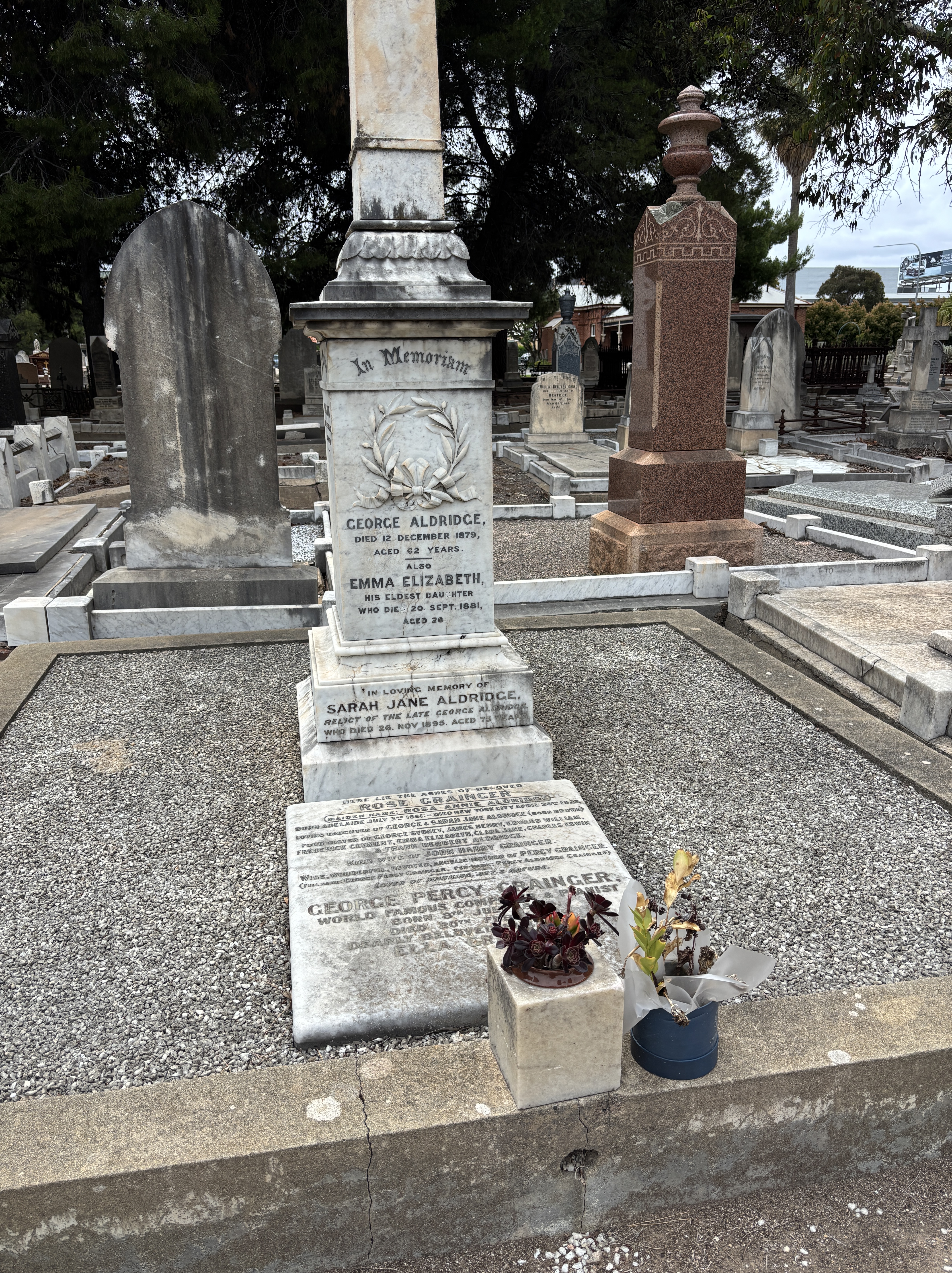
    Julia Margaret Guerin
    Percy Grainger

    As with many cemeteries, it is divided by religious denomination. There is a specific section for Jewish, Catholic, Anglican, Quaker, and Islamic burials. As you walk around the cemetery, the different areas are clearly signposted. There is one section that has been reserved for those who served in the Australian Imperial Forces or AIF.

    Within the grounds of the cemetery there is one chapel, the Smyth Memorial Chapel, built in the 1870s. Father John Smyth was an administrator of the Catholic Archdiocese of Adelaide hence the name. As this is one of the only mortuary chapels within a major cemetery in Australia, it is additionally inscribed on the South Australian Heritage Places database.

    Smyth Memorial Chapel

    Engagement and Interpretation

    Adelaide Cemetery Tours offer four different engagement experiences – self-guided tours, day tours, night tours, and private tours. Unfortunately, there were no day or night tours available for my visit. Instead, I elected to go on a self-guided tour. At the main cemetery entrance gate, you will find the Curator’s Cottage. On the side of the Cottage, there is a panel displaying five self-guided tour options:

    1. Stories of the Everyday
    2. Natural Heritage
    3. Beliefs, Attitudes & Customs
    4. Trailblazing Women
    5. Heritage Highlights
    Self-Guided Tours

    The tours range from 1 – 1.5 hours and between 1.2 – 3km. Despite the cemetery being extremely organised with pretty safe pathways, it is definitely not accessible.

    I opted for the Heritage Highlights tour as it is the longest and I had plenty of time. After deciding which tour to take, you can scan a QR code and open it on your personal device. You will see a map of the cemetery with a number of stops highlighted. When you arrive at each stop, you select it on your map and read the accompanying information. It would be great to have an audio guide option that includes some more wayfinding guidance. The estimated time to complete the tour was 90 minutes and I completed it in just over 90 minutes. One of my weaknesses is map reading. I got lost a few times along the way. However, there are some very helpful signposts around that guide you along the right pathway.
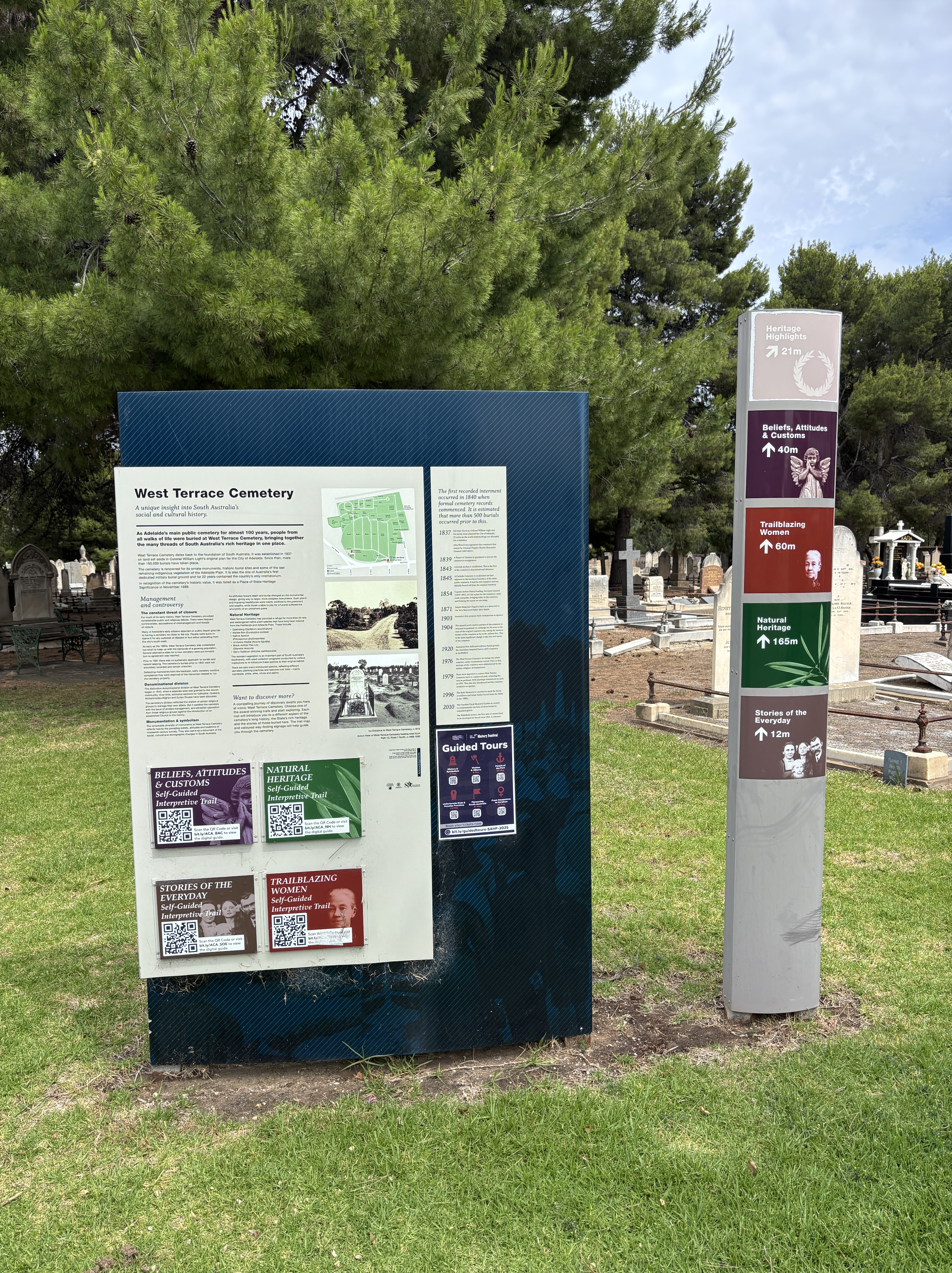
    Wayfinding Signs

    While the majority of the tour was fascinating, it was heavily colonial-focused and didn’t really stray into the Jewish or Islamic sections. I can imagine there are a few more tours on the horizon to fill these gaps and silences.

    What is an absolute positive is that these tours do exist and can engage people outside of formalised tour groups. I was delighted by this level of organisation and care. I was also impressed with the upkeep of the cemetery and just how easy it was to move around and visit the different graves.

    Grave Symbolism

    To finish, I want to share a few of the common grave symbols I saw throughout my visit. There are, of course, hundreds more I am not mentioning. These are just the ones that stood out to me.

    1. Angels

    Angels are one of the most common symbols you will see in a historic cemetery. They can represent grief, hope, and empathy. The ones I saw in the cemetery are guardian angels – watching over the dead with their arm raised to the sky/heaven.
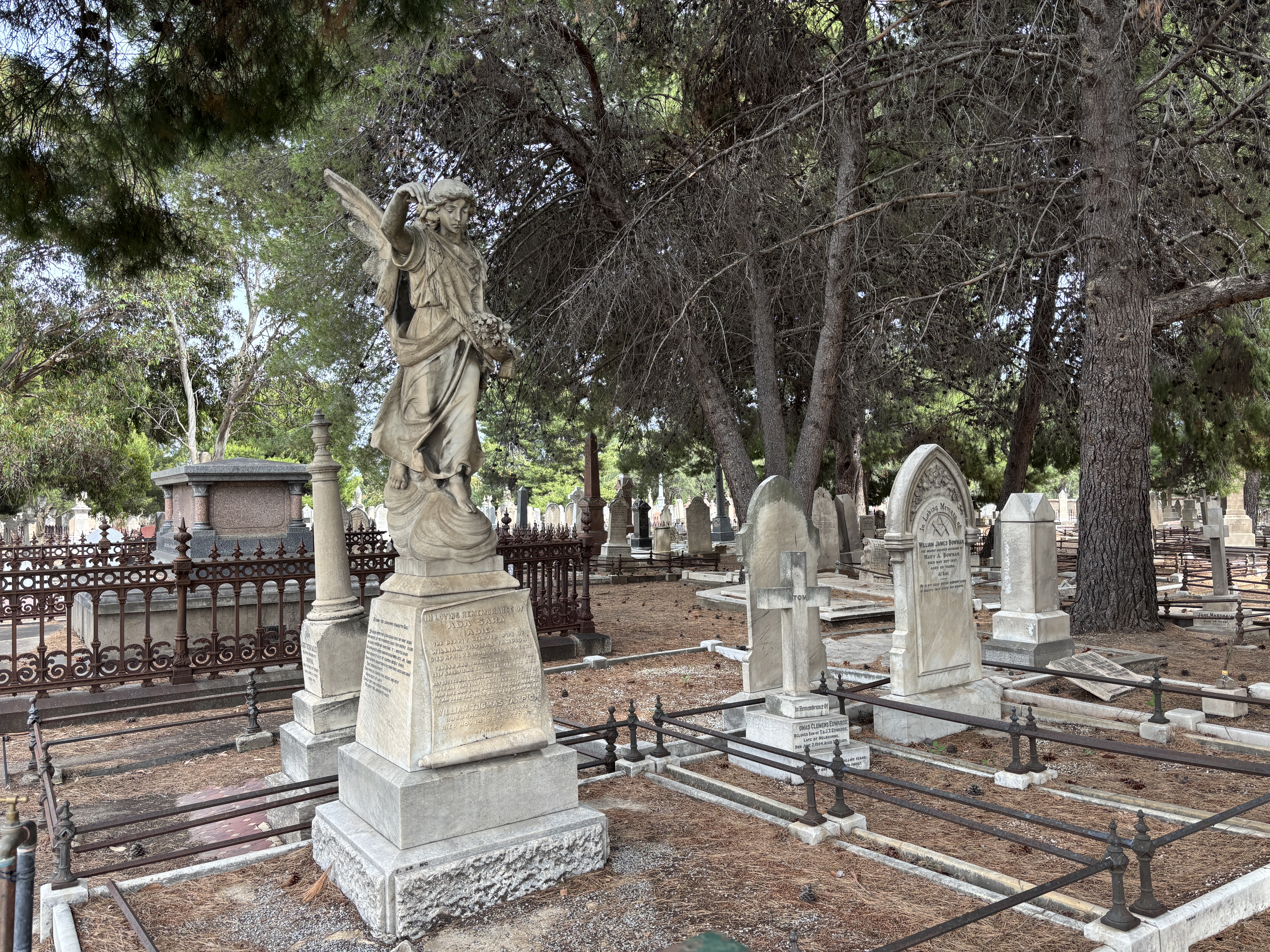
    Angel Example

    2. Covered/Uncovered Urn

    On top of a number of graves is an urn that is either covered or uncovered. Covered or draped urns symbolise the separation between the living and the dead and can be traced back to covering the body after death or covering mirrors and clocks during mourning (Victorian era). Urns that are uncovered represent the body as a vessel and the immortality of the soul as it ascends to heaven.

    Urn Example

    3. Sheep

    I saw one sheep and thought the individual must have been a farmer. However, this is a lamb and is used to represent innocence and purity. Rading the epitaph, everyone buried here was young and a life taken too soon.

    Sheep Example

    4. Book

    A few of the gravestones have books on them which could either represent the Bible or act as a book of life, documenting the good deeds of the individual.

    Book Example

    5. Holding Hands

    Last, but not least, is the motif of the holding hands. These can represent love, reunion in the afterlife and enduring bonds. Having hands clasped means that the hope is to be reunited with this person in the next phase of life.

    Holding Hands Example

    As well as these symbols there are many different flowers and plants that all have their own specific meaning. If you are looking to explore a cemetery, I highly recommend purchasing a cemetery symbolism book to help guide you through the imagery. For example, Stories in Stone: A Field Guide to Cemetery Symbolism and Iconography by Douglas Keister.

    Final Thoughts

    This was a very relaxing way to spend a Saturday morning. I was able to engage with the cemetery more than I was prepared for, which was a great highlight. If you are able to walk around some uneven ground, I would encourage a visit to this cemetery for its historic and aesthetic significance.
  • London: V&A East Storehouse

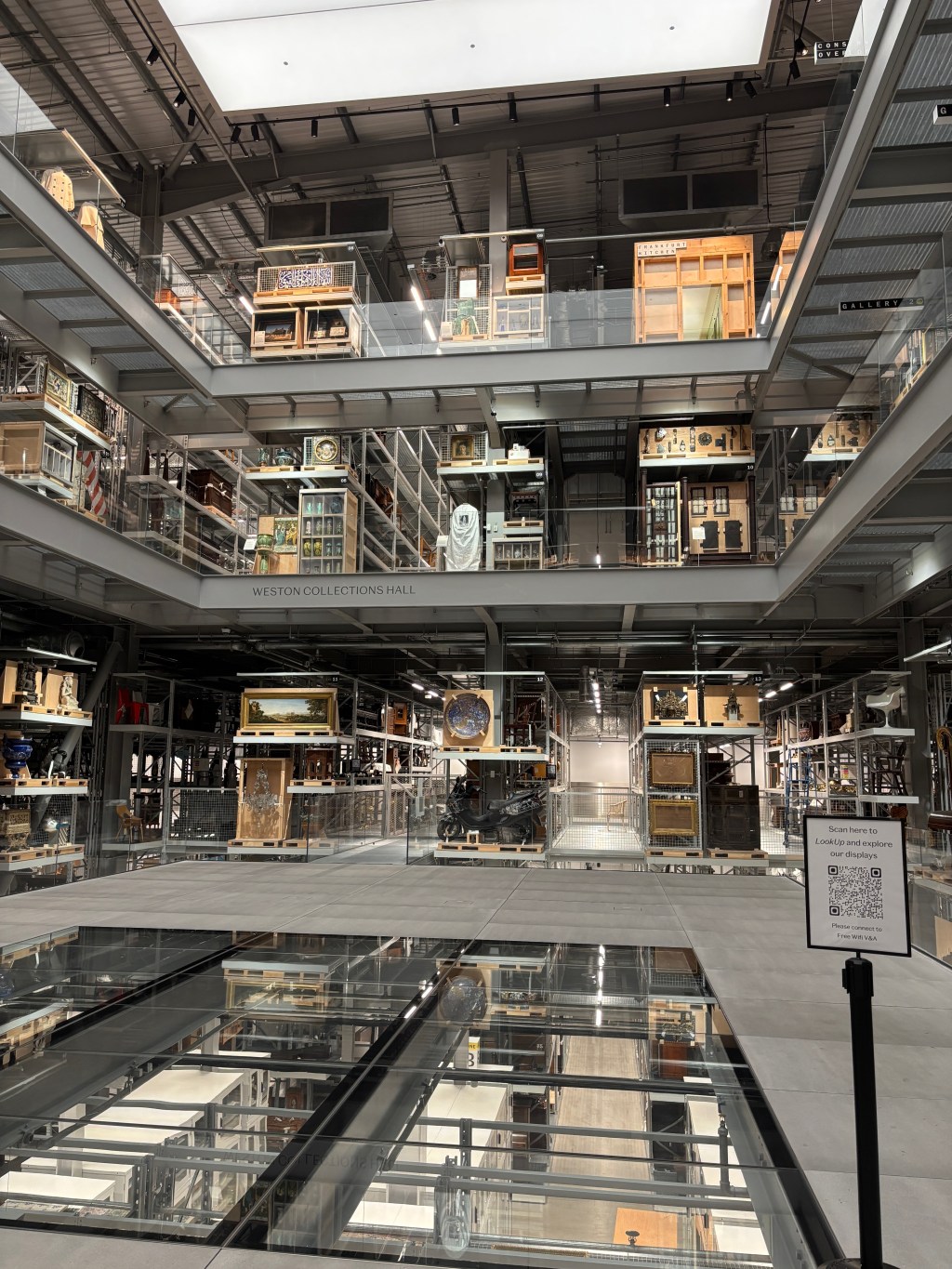
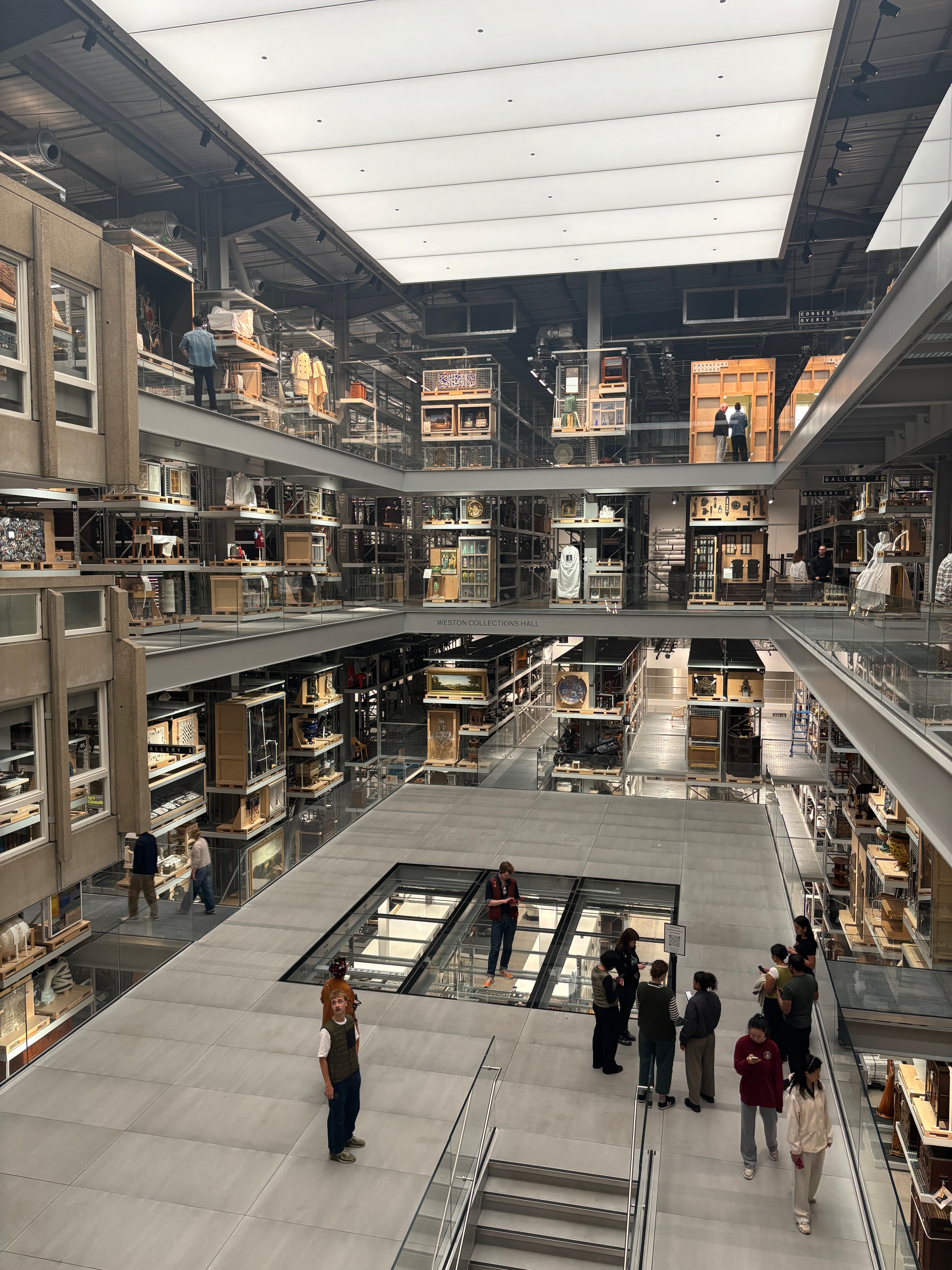
    Next on my catch-up list is the Victoria and Albert (V&A) East Storehouse in London. You are likely to have seen this museum all over social media sites, especially Instagram. Before visiting, I had the expectation that it was going to be a visible storage facility displaying some, but not much, information. A space where you can order objects as you explore so you can engage that little bit deeper with the collection. While it is an impressive space that clearly had a lot of funding go into its design and build, there were a few areas where I felt a bit lost. Lost and overwhelmed. I’m going to focus on more of an overall picture of the museum. This will include some highlights and hopefully give you a sense of what to expect.

    Pre-Visit

    Before visiting the V&A East Storehouse, I recommend doing the following:

    1. Read their website
    2. Plan to visit early in the morning on a non-weekend day
    3. Don’t wear a dress/skirt as most of the floors are see-through grates
    4. Have a fully charged phone.

    The reason for the first dot point is that the website does a pretty good job at setting expectations. For example, you can’t ‘order an object’ while you are onsite to view on the same day. You need to make an appointment at least two weeks in advance. Logistically, this makes sense. It was, however, not clear in initial museum marketing that this would be the case.

    The website also contains some fantastic information on getting to the museum. It is not located in central London. You will need a solid plan to get there and back if you are staying around the city centre. It is also important to note that bags and coats are not allowed in the museum and need to be stored in available lockers (first-come, first-served). You are allowed to take your phone inside. Therefore, don’t visit with any valuables if it can be avoided.

    Last, but not least, in terms of what stood out to me, there is no gift shop onsite and there is only a small cafe that serves drinks as well as a limited number of food items. Arrive with a full stomach.

    For more information you can click on the link below which will take you to their main visitor information website:

    V&A East Storehouse Information

    I am trying to stress here that the more prepared you are for what to expect, the less frustration there will be when you arrive and start your experience. We had looked through the website prior to our visit so for the most part, nothing was a surprise.
    Our Visit

    After securing our bags in a locker, we began our visit by walking up a set of stairs in the main entrance foyer and into the museum. As soon as you enter the museum, you are met with such an intense visual of the object storage. I say intense, because it is layers upon layers of interesting objects that can be overwhelming. This moment was interrupted by the need to connect to their Wi-Fi network so you could use your phone while exploring the collection. The Wi-Fi never really worked for me and my 5G was going in and out the entire time. We therefore didn’t engage too much with anything digital.

    V&A East Storehouse
    Example of Layered Objects

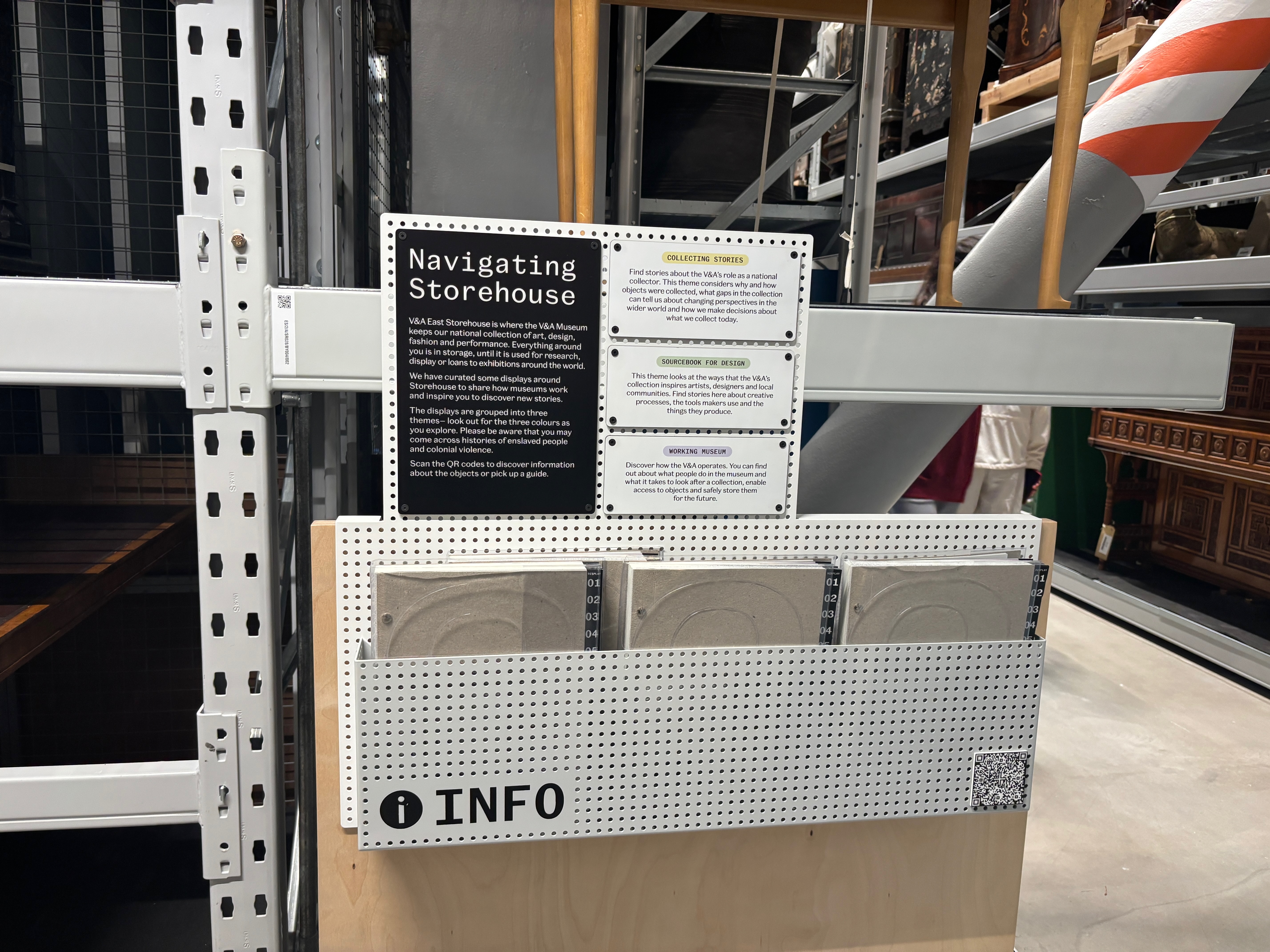
    We decided to start at the top level (the third level) and work our way down. There are these information stands dotted around with guides relating to the visiting experience. I depended on these throughout my visit and couldn’t help but think how difficult it would be to get a guide when it was busy. Nevertheless, it is a great addition having helpful stations on how to structure and navigate your visit.

    Information Stand

    As we walked around each level, my vertigo caused by the see-through grate floors and glass barriers, started to ease. We spent our time exploring the objects we could see on display and engaging with the objects that had more information in the form of panels. Here are some general museum highlights:
    1. Visitor Interaction

    There are a few places in the museum where you can provide your opinion on a number of different topics. For example, tucked away on one of the levels is an interactive where you can add what you’d like to see the V&A collect in the future. Not only can you suggest an object to collect, but also answer the question of why? There are a few prompt answers such as ‘it relates to my heritage’ but you can also add your own.

    What Would You Like to See Collected Interactive

    Another interesting type of interactive is located to the edge of an aisle. The interactive poses a question for you to answer using a blue token. The example I have below asks the question ‘do you collect things from your childhood?’ Using the blue tokens, you can vote for one of four answers include ‘No. I look to the future.’ I found that the answers to these questions could be a bit strange by adding an extra sentence that might not exactly fit your answer. At this station I voted for ‘Yes. If it has meaning.’

    Blue Token Interactive

    2. Conservators at Work

    On the third level of the museum, you can look into a conservator’s working space and see what they are doing. I would hate to be watched while I’m working. I don’t know how I’d feel if I was a conservator. These roles are usually away from the public so there might be a number who enjoy allowing the public to actually see what they do behind closed doors. They don’t have to work in this space and have access to other areas they can use depending on the type of work. There were no conservators in the space when we visited but I still enjoyed seeing all their different machines and equipment.

    Conservator Workshop

    3. Exploring a Museum’s Role

    Throughout the museum are some further insights into the role of museum staff and the broader role of a museum. One of these sections has a label on objects entering the V&A collection. This presents a glossary of terms for how museums acquire objects. For example, through bequest, long-term loans and purchased with funds. It’s great to have the lingo of museums accessible to the public. This can help with understanding a museum’s role and how an object might enter the museum. One obvious term that was not explored was ‘stolen’. I will get into this in the next highlight.

    Object Acquisition Information

    4. Difficult Conversations

    I was pleased to see that there are a few labels that focus on stolen or looted objects. It’s a great step to bring some transparency to a complex and difficult issue. The sign on looted objects did mention the 1983 Heritage Act in the UK that prevents the returning of objects. Instead, the V&A is working with countries of origin on long-term loans for displays. It is a layered issue and having a label explaining why, is a first step in building some level of audience trust. There is, however, no voice included from those representing countries that or individuals who have had objects looted in the past. So, one small step in the right direction, but room for improvement.

    Looted Objects Label

    Final Thoughts

    Overall, I did enjoy spending time in this museum and challenging my ideas of what is an exhibition, what is display, and how a museum can build more trust with the public. We are nowhere near a destination with that last point, but it is important to raise and tackle these questions with transparency. I would recommend visiting if you want to see a lot of objects in the V&A’s collection and hopefully learn about a few of them. If you are not ok with heights, this one might be a challenge. I wouldn’t return for a second visit but I’m glad I got to experience a new way of doing and seeing in a museum.

  • Vienna: Bestattungsmuseum and Wiener Zentralfriedhof

    At the beginning of my last post, I mentioned that I have a list of museums and heritage places to discuss that I am slowly working my way through. Next on the list is the Bestattungsmuseum in Wien (Vienna) which we visited back in March. It completely slipped my mind to write a post about this museum at the time. It’s weird, because this is a museum that sits inside a cemetery, focusing on death and funerals. The rough translation of Bestattungsmsueum is Funeral Museum. Exploring a museum inside a cemetery is my idea of a perfect day out. This post will cover both Wiener Zentralfriedhof (Vienna Central Cemetery), and the museum.

    We visited before heading to Graz for my one-week Erasmus program at their medical university. Originally, this was not part of our plans. In fact, I had no idea this museum existed until the day of our flight. The date we were going to fly to Vienna had to be changed due to the impending arrival of Cyclone Alfred. We decided it was safer to fly out a bit earlier and have a couple of extra days in Vienna. I had no idea how to fill these extra days so Googled ‘Death Attractions Vienna’. Expecting to find nothing, I was absolutely shocked when search results revealed the Bestattungsmuseum. How on earth have I never heard of this museum? Not only a museum focusing on death and funerals, but one that is inside the largest cemetery in Vienna and close to our hotel.

    Wiener Zentralfriedhof (Vienna Central Cemetery)

    Boasting a 4.7 on Google Reviews from just over 1 000 visitors, the Wiener Zentralfriedhof or Vienna Central Cemetery, is a stunning and huge cemetery about 20 mins (by public transport) from the city centre. To give you an idea of its size, there are four different tram stops for four separate entrance gates. Opening in 1874, the cemetery is approximately 2.5 square kilometers making it the second largest cemetery in all of Europe and about the same size as Vienna city centre. We caught tram 71 to Zentralfriedhof 2. Tor or Gate 2, which is the main entrance. It is also the closest entrance to see the famous graves and to visit the museum.

    What we first noticed was the sheer scale of the cemetery. It is incredibly overwhelming. Luckily, just inside the gate, there is a cafe so you can drink coffee and eat cake while you plan your visit. There is also a small souvenir shop inside the gate that I will be talking about later.

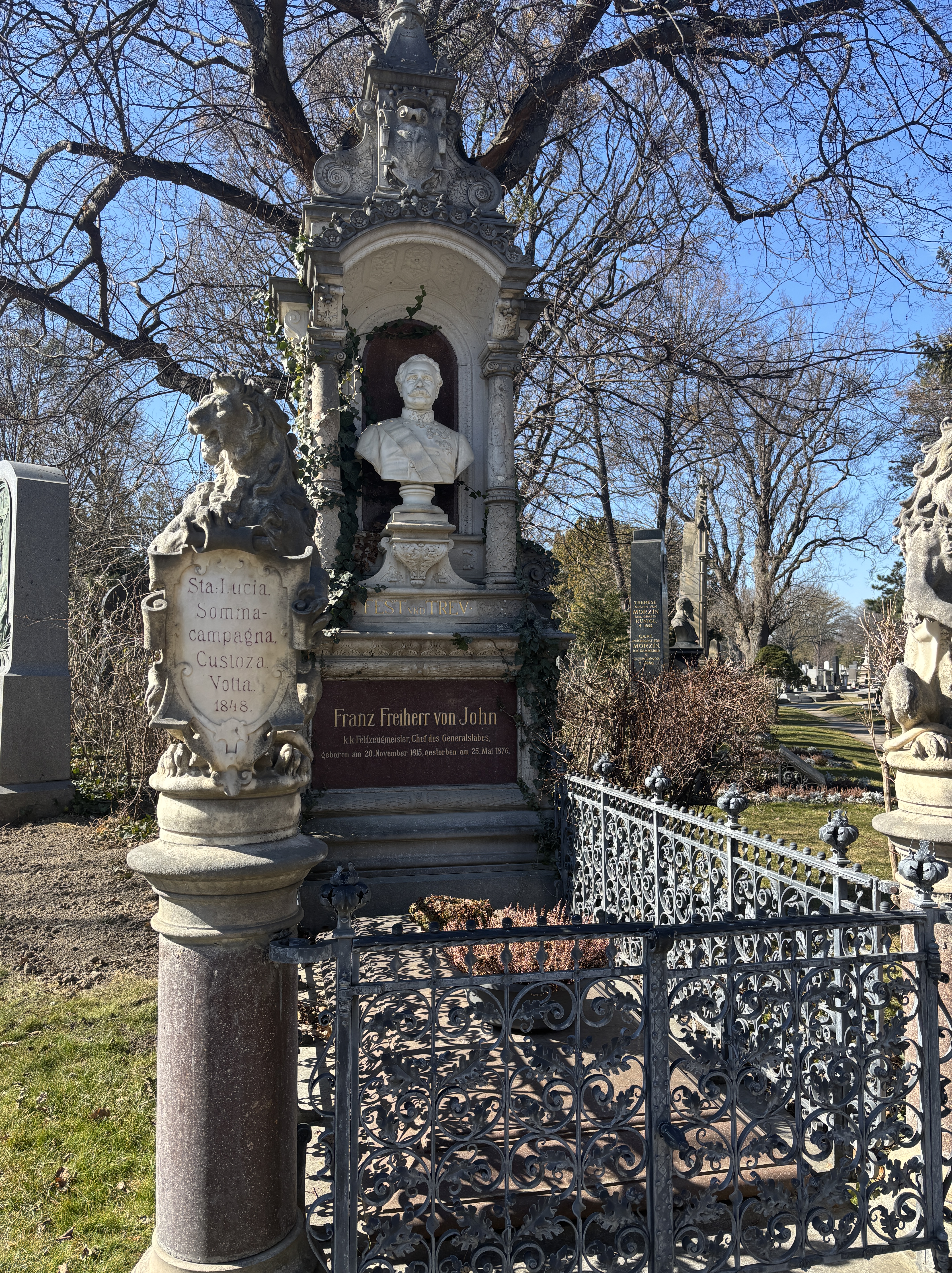
    We decided, post-cake, to spend the cooler part of the day walking around the cemetery and then visit the museum. Since it was our first time exploring, we walked along the main road leading from the entrance gate to the Friedhofskirche zum Heiligen Karl Borromäus (St Charles Borromeo Cemetery Church). Along the way, we were struck by the artistry and architectural significance of the tombs, mausoleums and monuments. There is a small section which has the graves of composers such as Johannes Brahms, Franz Schubert and Ludwig van Beethoven. This area was quite busy for obvious reasons. I’m going to include a few photographs to give you a sense of the tombstones. There are, in total, approximately 330 000 tombs/mausoleums.

    Example Tombstone
    Johann Strauss Tombstone
    Beethoven Tombstone
    Example Tombstone

    Bestattungsmuseum

    After exploring the cemetery, we returned to the entrance gate to find the Bestattungsmuseum. It is located in the basement of Mortuary 2, a building that seamlessly blends in. While reading about the museum for this blog post, I kept seeing references to the special relationship Vienna residents have to death and how that has been part of their cultural understanding for centuries. Not a ‘we love death’ attitude, but an acceptance of death leading to a better appreciation of life. Culturally, I think where I live has a lot to learn from this relationship and how we can develop a healthier outlook on life and death. I think it is important to highlight this because some of what I will discuss will make a lot more sense in that context.

    Museum Entrance

    After entering the museum we were greeted by the museum’s mascot, Quiqui, a grim reaper. The word ‘quiqui’ is an old Viennese word meaning death. Right from the beginning of our visit I had an idea of what to expect – a place where death is not taboo, but an important and inevitable part of life. A part of life where we can have a mascot.

    Quiqui

    The entrance foyer has the ticket desk, a gift shop, and the start of the permanent exhibition pathway. I will definitely return to the gift shop later because it needs its own section. Once we had paid for our tickets, we started our journey through the history and culture of funerals and death in Vienna. There is a set pathway to follow through the museum that winds you around thirty different display themes and 250 objects. Object labels and panels are in both German and English. The following were highlight objects for me.

    1. Bodice for a Mourning Dress (early 20th century)

    Lace Bodice

    I’ve selected this object because it is one of the most delicate and intricate in the museum. The relationship between clothing and mourning has always been of interest to me. This would have been worn under other clothing to add an additional layer of mourning wear.

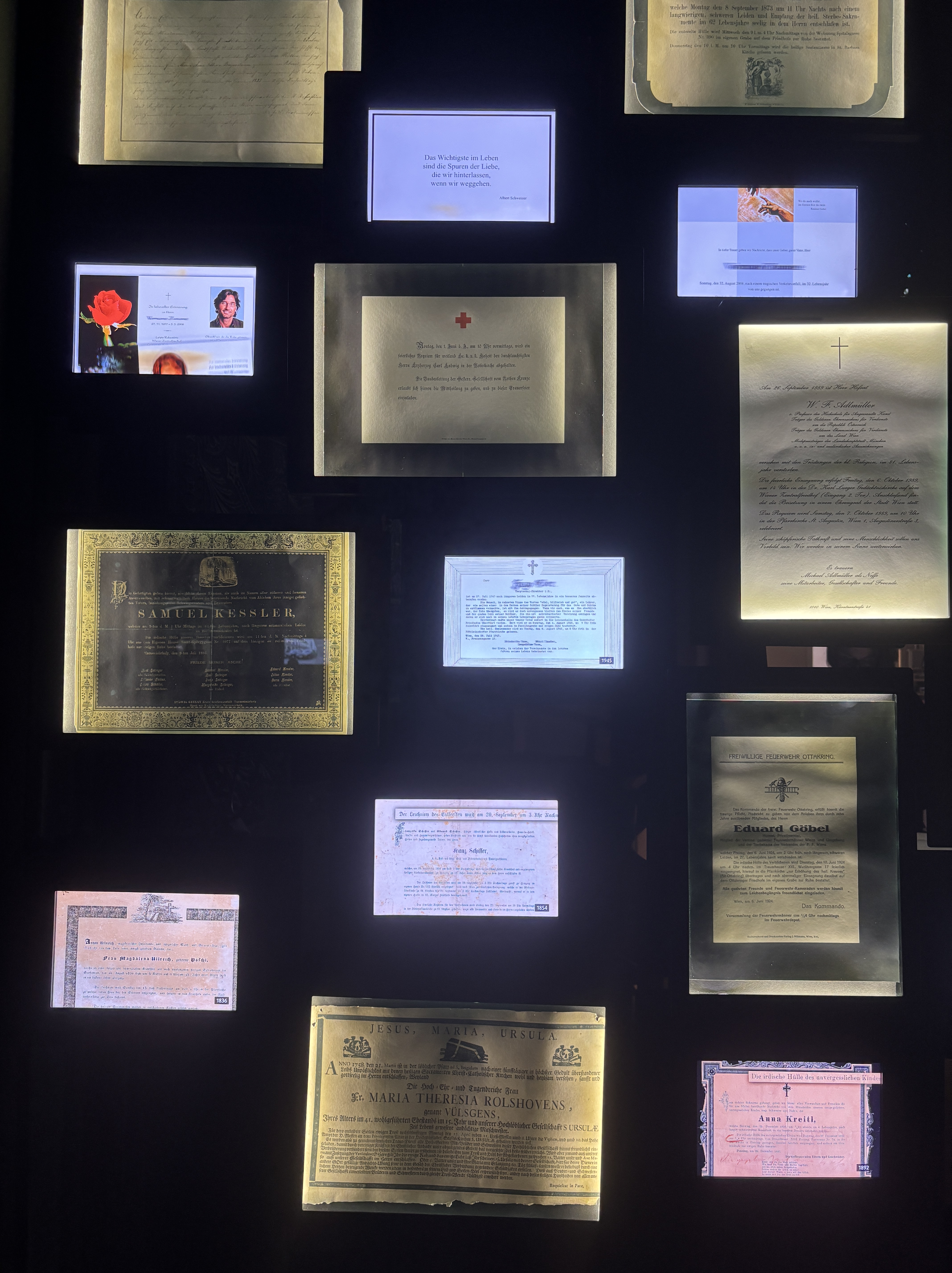
    2. Wall of Funeral Invitations

    Funeral Notices and Invitations

    This display is a mix of old and new, digital and paper, funeral notices and invites. It explores how funeral invites have transformed over time and what has remained a constant. It adds some diverse personal stories to the museum.

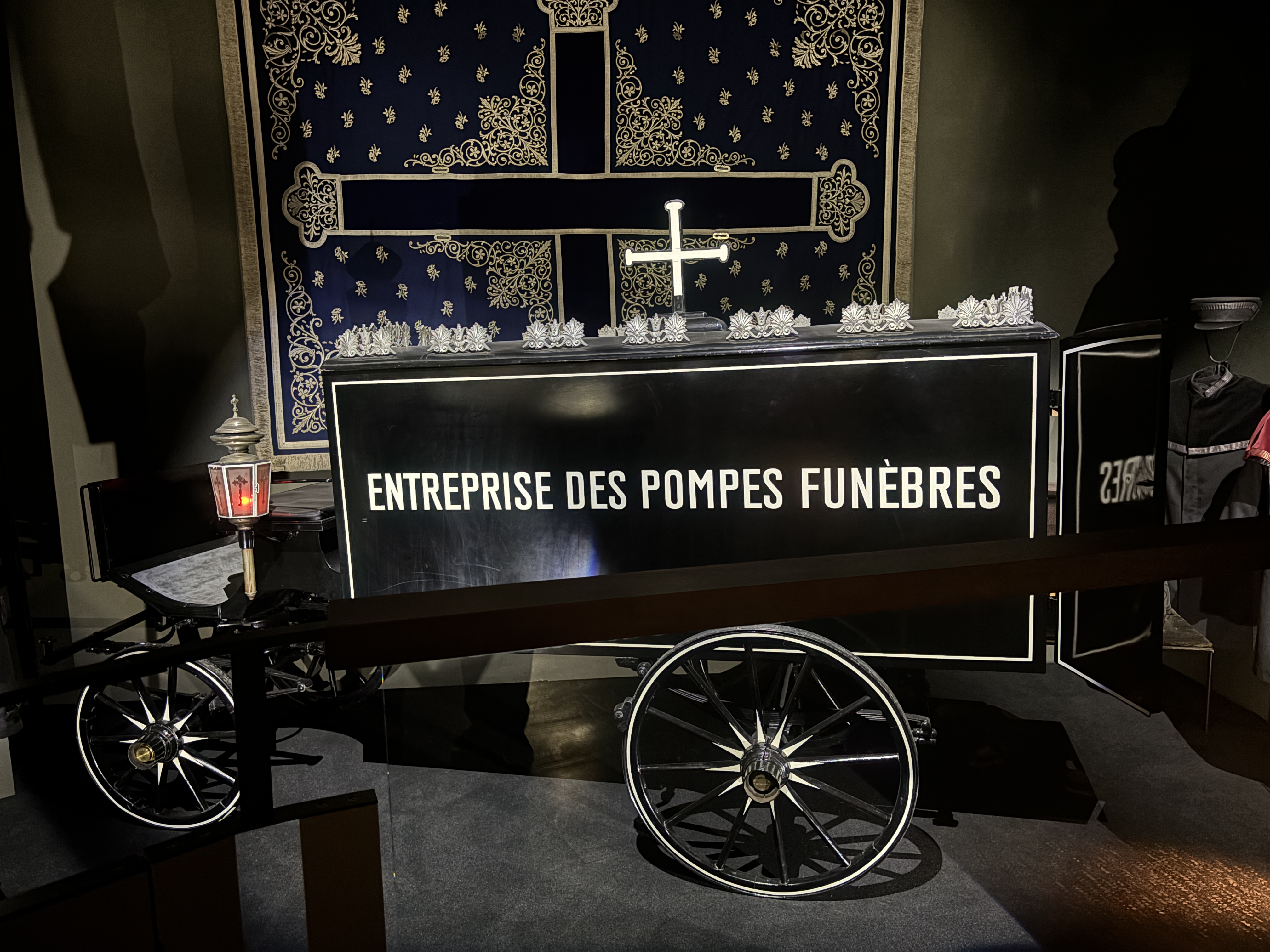
    3. Small Transport Van (early 20th century)

    Small Transport Van

    There are some large objects in the collection and this was one of my favourites. A small van, large enough to fit a coffin, used to transport the dead to the cemetery. It was created by Schustala & Co. Court Coach Factory and was a horse-drawn van.

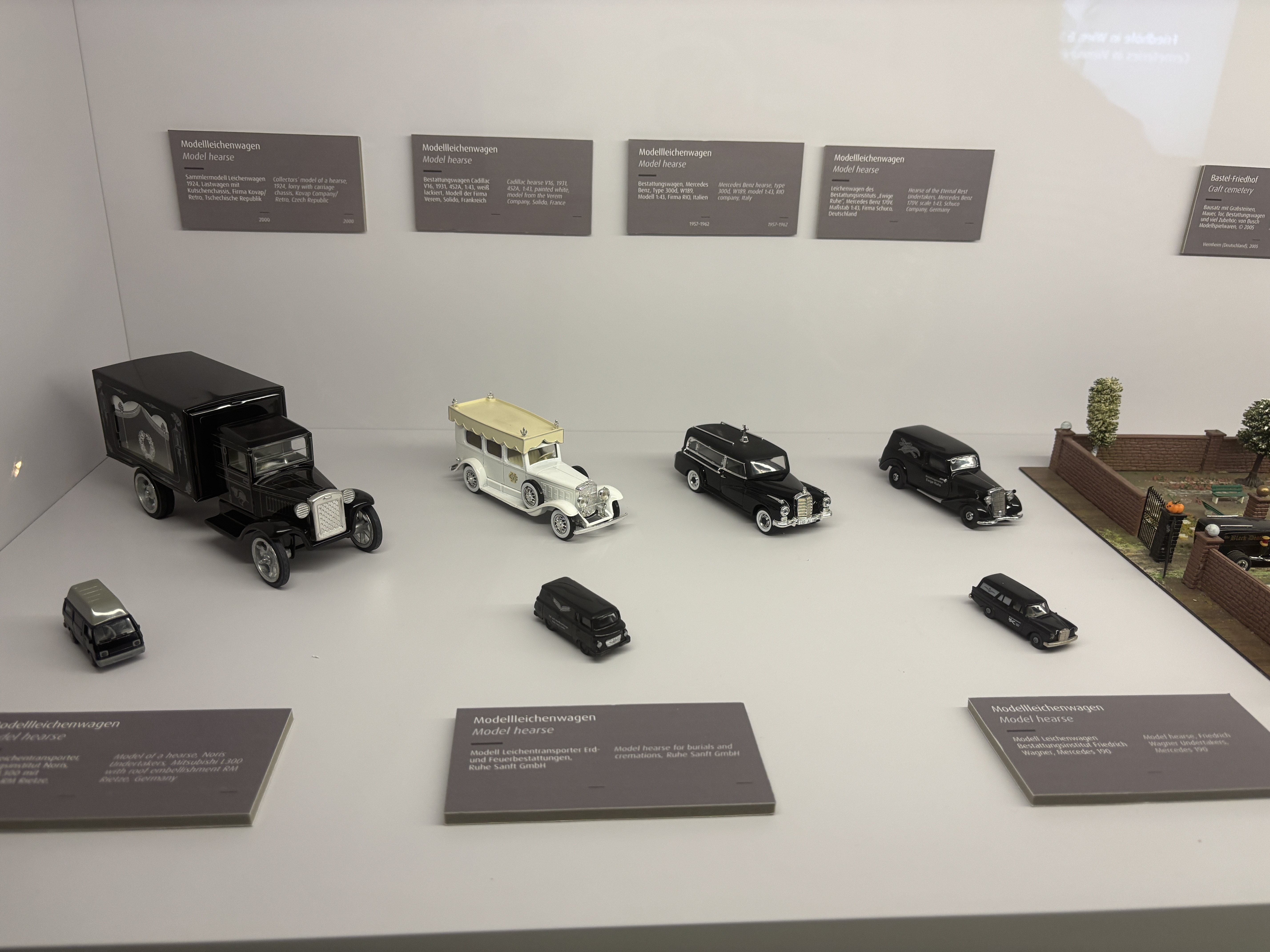
    4. Model Cars

    Model Cars

    Miniature anything is going to be adorable so these miniature hearse cars made my favourites list.

    5. The Coffin

    Coffins

    Towards the middle of the museum there is a display focusing on coffins and what constitutes as a coffin. The variety they have on display reminds visitors that the expensive, antique-looking coffin is not the only option.

    6. Coffin Chair

    Coffin Chair

    Inspired by the artwork, Perspective : Madame Recamier de David, this is a coffin chair. Instead of being horizontal for eternity, why not sit upright.

    Gift Shops

    I was not expecting there to be one, let alone two, gift shops attached to the museum and cemetery. In my travels, I have seen something similar at Oakland Cemetery in Atlanta and, to a lesser extent, Highgate Cemetery in London. Where Vienna differs, is the sheer quantity of specific themed items relating to both the museum and cemetery. It made me reflect on the idea of death-merchandise consumerism. Having learnt about the Viennese cultural attitude to death, this doesn’t surprise me. Money from these purchases goes to museum and cemetery maintenance. Could purchasing death-related merchandise and using said merchandise encourage conversations about death with others? Is the modern form of Memento Mori a t-shirt that reminds us we’re going to die? So many questions.

    Museum: The museum gift shop had such a variety of merchandise. Everything from sunscreen with a little skeleton on the front to sunglasses that say ‘I see dead people’. The one certainty for me, I was going to leave with at least one Bestattungsmuseum-Lego collaborative set. I am only so strong. I ended up buying a tombstone and a historic funeral wagon.

    Cemetery Gift Shop: At the entrance there is a small gift shop selling, amongst other things, t-shirts. I did purchase a t-shirt to wear at any and all future death-related conferences and presentations.

    Conclusion

    If you are visiting Vienna then I highly encourage a half-day trip to the cemetery. Entrance is free and it is a genuinely peaceful place to explore. I would love to return in winter and see the tombstones covered in snow. I feel very fortunate that we had the opportunity to visit and experience the Viennese relationship to death.

  • Ingolstadt: Deutsches Medizinhistorisches Museum

    I have been reflecting on the museums I visited in September and creating a list of exhibitions/museums for blog posts. At the very top of my list is the Deutsches Medizinhistorisches Museum (German Medical History Museum) located in Ingolstadt, Germany. I was fortunate enough to visit this museum three times over the course of the International Association for Medical Museums and Collections conference. The majority of this post will focus on their temporary exhibition, Ansichtssache. Menschliche Präparate im Museum. I will try to write a very brief paragraph at the end about their other displays.

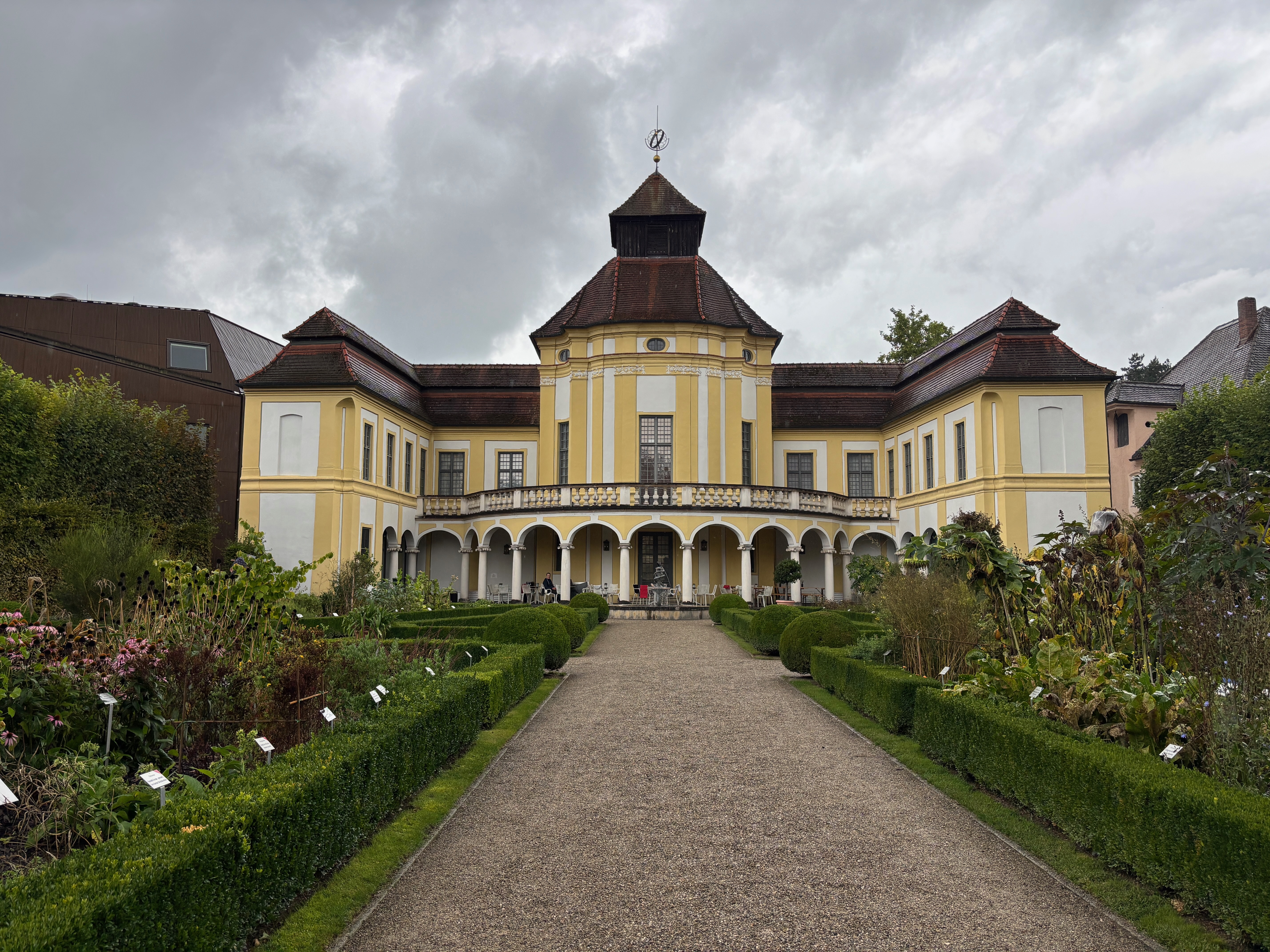
    Deutsches Medizinhistorisches Museum

    If you are wondering why Ingolstadt sounds familiar, you probably recognise it from Mary Shelley’s novel, Frankenstein. Shelley was inspired by Ingolstadt due to its connections to the Enlightenment-era. In the novel, Victor Frankenstein studies at the medical university (the university is now in Munich), and creates his famous monster. The building that was the medical university is now the medical history museum which is an excellent re-purposing of the space. The following will outline their current temporary exhibition which is located on the second floor of the building.

    Ansichtssache. Menschliche Präparate im Museum

    Roughly translated, this exhibition focuses on visitors’ opinions of displaying human specimens within a museum space. Considering my current role, working with a similar collection, I was incredibly interested in seeing how the specimens would be displayed and what kind of information would accompany them. The exhibition labels and panels are in German but there is an English translation guide available before entering the exhibition.

    Exhibition Street Sign

    The exhibition covers nine topics and themes. I will note here that this is no age limit for visitors and no rules surrounding photography. I am more comfortable not taking and sharing images of human specimens so there will be none in this post.

    Theme 1: Teaching Collection

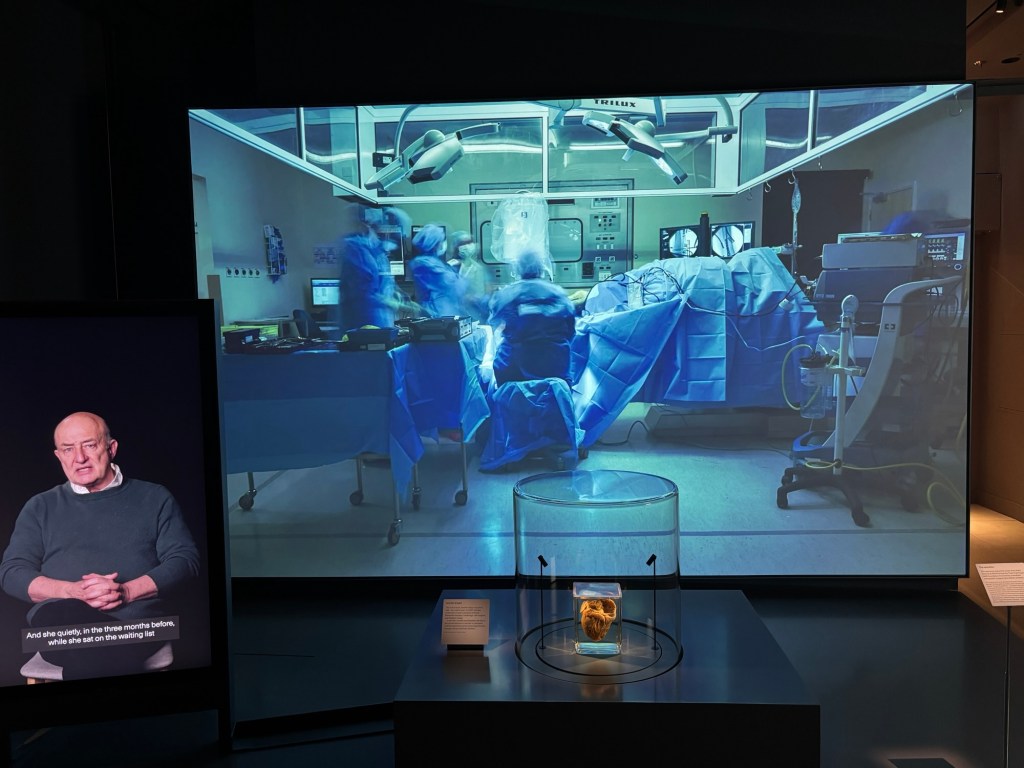
    When you first enter the space you see a single human specimen, a heart, on display in a dark room. On the walls surrounding the specimen are a series of questions such as ‘would I consent to it?’ and ‘is this real?’. I think this is a powerful way to start the exhibition as it not only ignites curiosity, but encourages a level of engagement with ethical questions. The other reason why I think it’s effective, is because if you are uncomfortable answering these questions, you can turn around and exit the space. If you want to proceed, you already have an idea of just how much self-reflection will be involved during your visit.

    Questions in Exhibition

    Around the corner is a metal display case with ninety anatomical and pathological human specimens on display from the Berlin Museum of Medical History of the Charité. A number of these specimens have corresponding audio guide numbers so you can hear more about what is on display. This is a very traditional type of display orientated towards medical teaching.

    Theme 2: History

    To the left of the metal cabinet is a small display focusing on anatomical history. It is a small but valuable inclusion, increasing historical awareness. There is a particularly interesting label on historical body donation and how voluntary donation was only established in the 20th century. Considering the exhibition floor space available, I am glad this theme has been included. The history of anatomy is integral to the context of displaying human specimens.

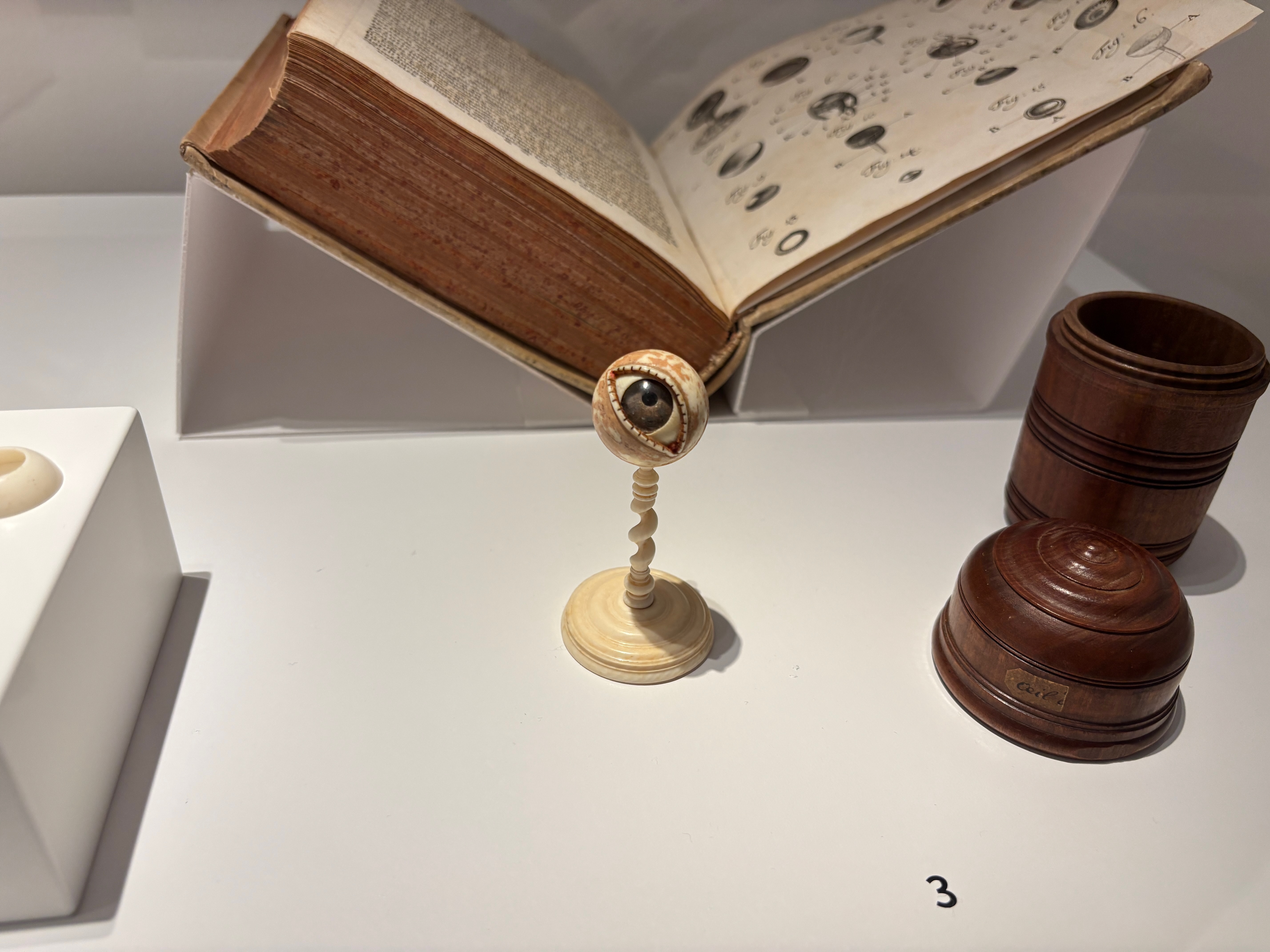
    Historical Eye Model

    Theme 3: Biography

    There are three highlight themes for me, and this is one of them. In this section, the research undertaken to discover the individual behind a specimen is on display. Not only is the physical human specimen on display, but images from the life of the individual, city plans of where they lived, and corresponding life documents. This is juxtaposed against other hearts which have no provenance information available. It sparks questions such as, should the stories of individuals be shared or should the specimens remain anonymous? By knowing who the individual was (or is), does this impact how we view the specimen? For me, attaching stories, when they are known, is critical. Researching into stories should be a priority so the specimens can be re-humanised, and their inherent dignity displayed. It is the intent that can be more important than the outcome. However, this needs to be transparent so visitors can see there is a level of care and research happening. Sharing personal details such as names is more difficult, but it is important to note that anonymous stories can still be shared.

    Theme 4: Body Donation

    The theme of body donation is something so personal. I was interested to see how this translated to display. In this section, there are a series of photographs from the Institute of Anatomy in Erlangen. Photographer Martin Eberle used photography to document the stages of body donation from arriving at the University to the final resting place of the memorial garden. It is one of the best depictions of body donation I have seen. The photographs really guide you through the stages and reflect on the importance of real human body donation in science and medicine. It is a balance of emotional and informative.

    Theme 5: Preparation

    Another highlight theme for me is the section on human specimen preparation. Alongside a wet/potted specimen and corrosion cast, is a digital screen where you can select different methods of preparation and watch them in practice.

    Theme 6: Research

    This theme could potentially be the most confronting for visitors as it displays and discusses a foetal specimen. It is delicately addressed through the sub-themes of ethics and art. For ethics, there are questions surrounding the role of anatomists and their work stemming from human specimens that are likely to have been taken with little to no consent. For art, Udo Andraschke and David von Bassewitz collaborated on a series of cartoon-like images and text to explore the idea of difficult collections and difficult conversations. The works are on display as both prints and in a book you can read through.

    Theme 7: Alternatives

    This theme asks the question, why use real human specimens when you can use alternatives? On display is a real tuberculosis specimen and a model of tuberculosis for visitors to compare. Are models truly able to capture a variety and diversity of lived human experiences and changes to organs through disease processes? Will digital replace the real? This is, of course, a discussion not confined to the walls of the museum. I believe that nothing can substitute reality, and rather than hide from ethics, the real can spark important and complex conversations that sit alongside traditional teaching.

    Theme 8: To Exhibition or Not to Exhibit?

    My third highlight theme is towards the end of the exhibition. It is a simple, yet effective way to consider if and how to display such human specimens. In the room are six display cases, all different, all containing a human specimen. One is completely clear, one has only the front visible, one has doors attached to open, one has a small viewing gap, one contains an empty specimen jar, and one is completely empty. Visually seeing the variances of display is what has the most impact. It helped me to think about different methods of display.

    Theme 9: What Do You Think?

    Before leaving the exhibition, you can share what you think. There is a digital and physical option to submit your answers. Do you think human specimens should be on display? Why, why not? I spent a lot of time with my German translator reading some of the answers. I am looking forward to reading any results that emerge from this exhibition.

    Visitors’ Opinions

    Other Exhibitions

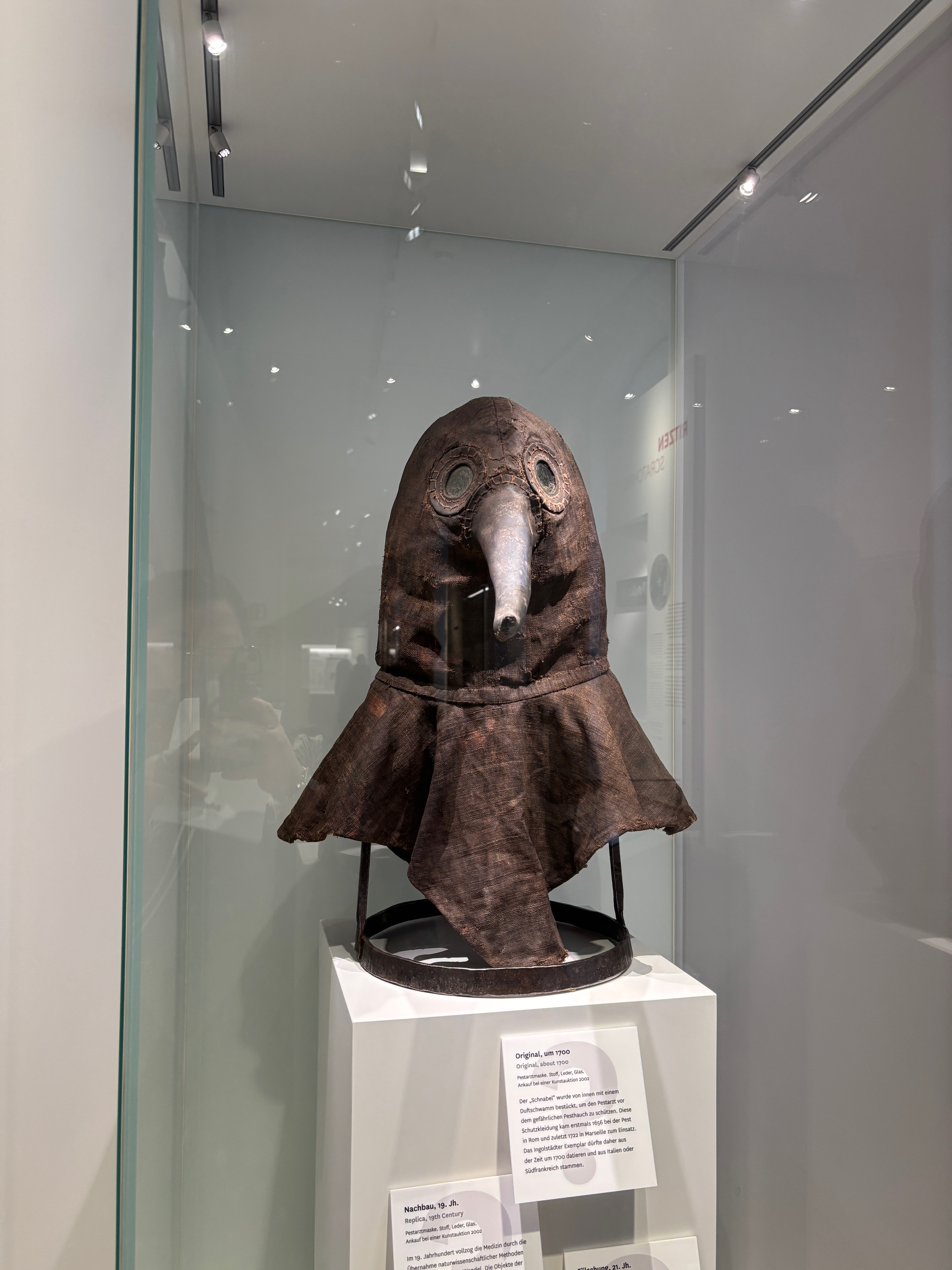
    The rest of the museum is not to be missed. There are so many wonderful displays covering topics such as religion in medicine, memorialising doctors (should we?), and a range of pretty confronting past treatments. For me, an absolute highlight was seeing the Plague Doctor mask. Or, more accurately, a pretty perplexing object that is unlikely to have been worn during the plague. It has three labels, offering three different perspectives. An interesting way to display objects without clear information. Towards the end of the museum is a little section on Frankenstein and the Ingolstadt connection. There are some labels in English throughout the museum, but most are in German. I speak a fair bit of German so didn’t struggle too much but when in doubt, translators like Google Translate will give you the gist.

    Plague Doctor Mask?

    If you need some fresh air, there is a delightful medical garden (and outdoor cafe) to explore. Here you will find all kinds of medical herbs and plants. If you’re lucky, you might even have a photo opportunity with Frankenstein’s monster.

    Me and Frankenstein’s Monster

    Conclusion

    Ingolstadt is close to Munich and definitely worth the day trip. Even if it’s just to see this museum! It is a well-curated, thought-provoking museum that is addressing some incredibly complex and intriguing questions. The human specimen exhibition is on until mid-January 2026. I am really looking forward to following the outcomes from this exhibition and gaining more of an insight into visitors’ opinions on displaying these types of collections.

  • Munich: Deutsches Museum

    Over the past couple of weeks I have been travelling through London, Ingolstadt and Munich. In Ingolstadt, I attended and presented at the International Association for Medical Museums and Collections. It was a fantastic conference filled with interesting papers. Before heading home, we are spending a few relaxing days in Munich. On our first full day, we visited the Deutsches Museum to see their health and medicine permanent exhibition. Despite visiting Munich in the past, I’ve never visited this museum. It is huge, covering everything under the general umbrella of technology and science. For example, there are objects and exhibitions relating to agriculture, space, chemistry, and mathematics.

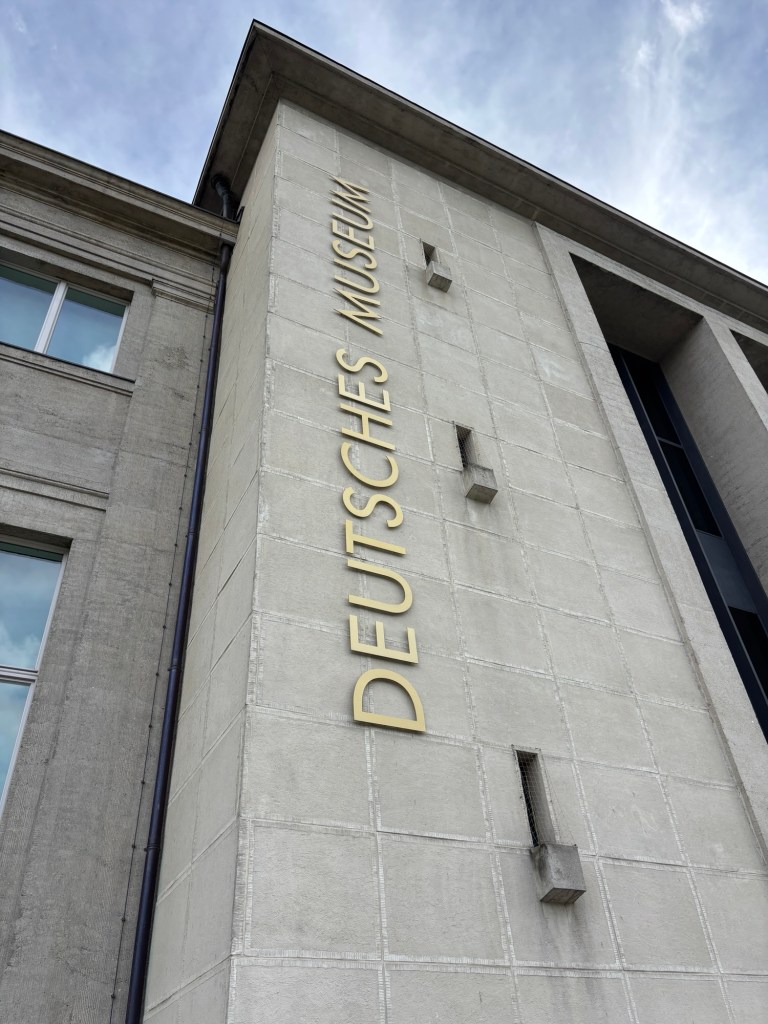
    Entrance to Deutsches Museum

    Due to its size, we decided to focus on the health and medicine exhibition, located on the third level. This is one of the best informative medicine displays I have seen. In order to explain why, I am going to focus on four themes: interactive elements, self-testing tools, significant objects, and diverse interpretation.

    The exhibition is isolated to one large room that traces health from the head to the toe. To help orientate and guide, there are three large sculptures of a head (start), heart (middle), and foot (end). You are free to explore on your own and not follow one defined pathway.

    Interactive Elements

    The exhibition is filled with interactive elements, both physical and digital. It is such a hands on space. We spent over an hour engaging with as many interactives as possible.

    I want to highlight one interactive we particularly enjoyed. Towards the centre of the exhibition is a large digital touchscreen with the outline of a human body. At first, I assumed it would be similar to other digital screens I’ve seen in health displays. That is, you can explore the different organs or parts of the body by clicking on the outline.

    However, this is not the main goal of the interactive. Instead, you select an organ and work through a patient case study. We selected the lung and were presented with a case study of a female smoker who had a large mass in one of her lungs. You are guided through talking to the patient, diagnosis, and treatment. In our case study, we had the opportunity to analyse X-rays and CT scans then suggest a treatment plan. At the end, you can follow-up with the patient and see how their treatment is progressing.

    It is an engaging interactive and a great way to inform visitors of the steps involved in diagnosing and treating various diseases.

    Self-Testing Tools

    Throughout the exhibition are a number of opportunities to test your skills and gain more of an insight into your own body. For example:

    1. In the area dedicated to surgery, you can test your suturing skills and learn surgical stitching techniques;

    Interactive Suture Station

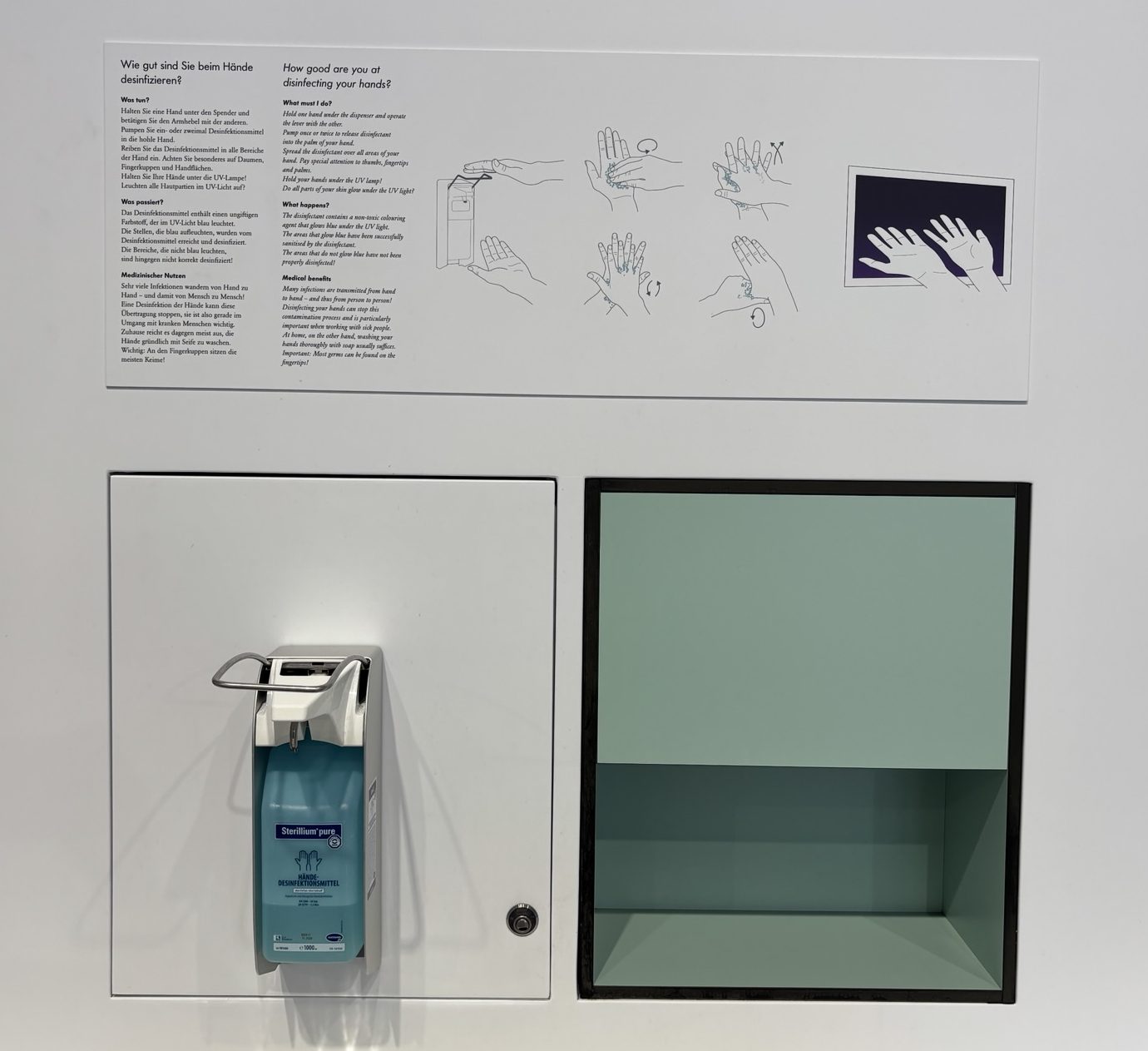
    2. When learning about germs, you can place your hands under UV lights before applying hand sanitiser to see the difference it makes.

    Visualising Germs

    3. Right at the beginning is a pupil dilation test which shows you how your pupils respond to light.

    Coming soon is a hearing test which would have been interesting to experience. These are all a great way to have visitors interested and invested in their own health while exploring the exhibition.

    Significant Objects

    There are a number of significant objects in this exhibition.

    1. Louis Pasteur’s Microscope, 1830

    This is one of the microscopes used by Pasteur in his work surrounding pasteurisation.

    Pasteur’s Microscope

    2. Robert Koch’s First Incubator, 1881

    Koch built this incubator to support his work on bacteriology (specifically growing bacteria).

    Koch’s First Incubator

    3. Miniature Ether Dome Display

    The label had no creator information. It is a miniature diorama depicting the first use of Ether as an anaesthetic in 1846.

    Miniature Ether Dome

    4. 18th Century Pharmacy

    Rather than one object, the 18th century pharmacy is a collection of many. This pharmacy is absolutely stunning. It is a teaching example of a historical pharmacy containing over 100 original containers from the St Emmeram Monastery in Regensburg.

    Pharmacy Installation

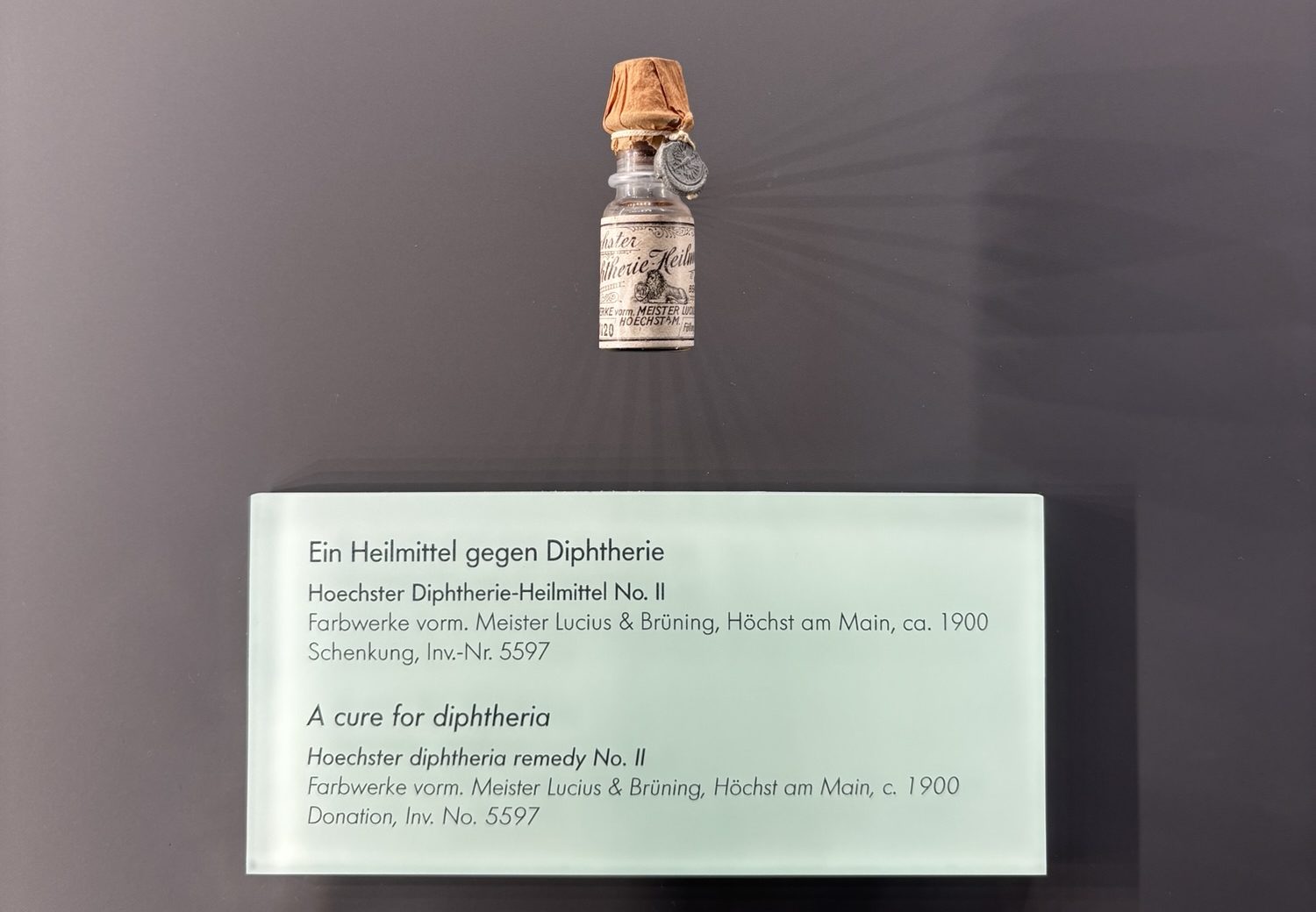
    5. Diphtheria Vaccine, 1900

    This tiny bottle held the vaccine for diphtheria, circa 1900s. It is one of the most beautiful vaccine bottles in the museum.

    Diphtheria Vaccine

    There are, of course, so many other objects to explore. Flowing on from this is the final theme of diverse object and display interpretation.

    Diverse Interpretation

    I thought there was a fantastic balance of visual and textual interpretation used throughout the exhibition. My favourite example is something so straight forward, but so effective. I think it’s because it relates to anaesthetics and I once worked with an anaesthetic collection. The below is a photograph showing the display of two intubation tubes. Rather than having the tubes laying flat, they are displayed alongside a visual of how they are inserted. This attention to detail makes such an impact.

    Anaesthetic Tubes

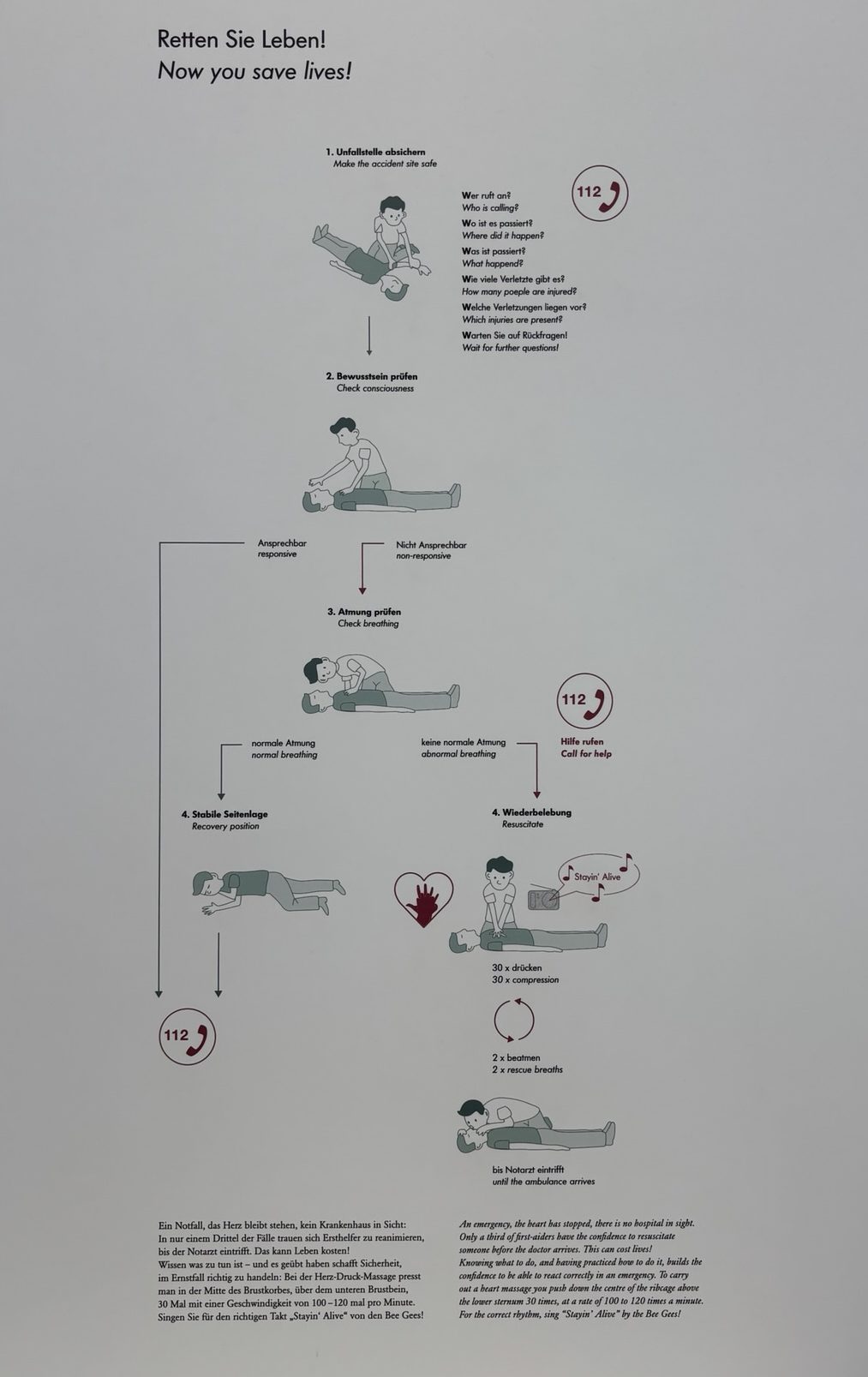
    Each main theme has some kind of visual that communicates a lot of complex information in an approachable way. For example, there is a visual focusing on how new drugs are created. Some visuals in the exhibition teach visitors basic first aid such as CPR.

    CPR Guide

    The mix of visual and textural interpretation is also balanced between physical and digital. For example, in the section on anaesthetics, there is no label stating what drugs are now used. Instead, you can interact with a digital game that teaches you about the many ingredients of anaesthesia.

    What is Missing?

    Exploring this exhibition did make me wonder where is the voice of the patient? Health and medicine exhibitions have a long way to go when it comes to including and highlighting the voice of the patient. Without it, these exhibitions seem didactic and a bit removed.

    If the museum integrated stories from patients, in their own words, then this would have significantly enhanced the exhibition. It would transform it from one that shares medical knowledge to one that shares experiences of health.

    Conclusion

    Overall, this was an enjoyable exhibition and a great way to communicate information on health and medicine. Having individuals become active participants and test their skills throughout worked well. I would love to see the space play a role in community health where possible. For example, becoming a place where people can receive their flu vaccines.

    The Deutsches Museum is open 9am – 5pm daily. There is an admission fee.

  • London: Wellcome Collection

    I have thoroughly enjoyed visiting medical museums across Europe and the United Kingdom this past month. They have both inspired me and allowed me to acquire a medical museum tote bag collection that I hold near and dear. The final blog post from this trip will focus on the Wellcome Collection located in London.

    Similar to the Hunterian, I first visited the Wellcome back in 2015. Also similar to the Hunterian, they have since renovated and refurbished their permanent exhibition space. I was excited to see the result. I did re-read my 2015 post on the Wellcome to remind myself of how the exhibition space looked, and how it might have changed. I will explore this further when writing about the highlights.

    As no human specimens are on display, the Wellcome allows photography in their permanent exhibition space. The temporary exhibitions also allowed photography, but this could change depending on what’s on display. Always best to check.

    Context: Museum

    The Wellcome Collection is part of Wellcome, a global charitable foundation that, according to their website, funds ‘curiosity-driven research’. The foundation was founded in 1936 and is named after Sir Henry Wellcome, an early pharmacist who designed an array of new drugs. After his death in 1936, his wealth and objects were donated to the foundation.

    Today, the foundation focuses on health and medicine research, especially issues such as climate change, infectious diseases, and mental health. They support a wide range of researchers and research projects and focus on long-term support, not short-term funding that is usually insufficient for major work.

    For this post, I spent a bit of time on their website to really grasp their mission and what they want to achieve. I was impressed with how they present themselves and what they have available and accessible to the public. For example, they have a section in their policies library on ‘the colonial roots of our collections, and our response’. When you click on the link, you can read all about the history of the collection, its roots in colonialism, and what actions they are committed to in order to be transparent and transformative.

    Context: Collection

    When I first visited in 2015, I remember seeing quite a few human specimens in the permanent exhibition space. Today, there are none on display (or at least there were none when we visited). The majority are on loan to the Science Museum in London. For full transparency, they do have a list online of all the specimens in their collection.

    Outside of specimens, the collection of the Wellcome is vast and diverse. They have artworks, books, manuscripts, and an array of historical medical objects. In order to fill the gaps and include more voices, they have also started collecting contemporary objects. A fantastic step forward! They integrate these collection areas in their exhibition spaces.

    Museum Permanent Display

    Context: Display and Layout

    There are two levels of the Wellcome to explore. When you enter the building, you are on the ground level. To your right is a cafe and shop. I am not joking when I say you could feasibly spend an entire morning browsing the shop and getting breakfast/lunch at the cafe. They have the most delightful museum shop with a whole range of interesting and insightful medical-themed books for sale. On the opposite side is a temporary exhibition space. The current exhibition is Hard Graft: Work, Health and Rights.

    Lights in Cafe

    On the second level is a permanent and two temporary exhibition spaces. ‘Being Human’ is their permanent exhibition, exploring trust, identity, and health. At the moment, they have one temporary exhibition titled ‘Zines Forever! DIY Publishing and Disability Justice’. Another exhibition exploring sign language is opening soon.

    The permanent exhibition is on display in one large room allowing visitors to choose their own path. There is a mix in this exhibition of display cases, interactive elements, sculptures, and video. I want to briefly focus on the two main interactives in this space.

    The first is The Transparent Woman, a training model created in 1980 for medical students. I’ve included a photograph below, but I’m sure you already have an idea of how it looks. You can press a range of buttons to have the corresponding organ or system light up in the model.

    The Transparent Woman

    The second is a jukebox containing a range of songs from different parts of the world that relate to illness and health. There is a slider so you can flick through the songs and hear them all. As a warning, it does play quite loudly in the space if there are few other visitors. A really interesting and engaging way to display some of their contemporary collecting.

    Illness and Health Jukebox

    Highlight: Accessibility

    One thing stands out above all else when you are visiting the Wellcome – their commitment to accessibility. Museums still have a long way to go with becoming accessible spaces, but it is great to see that many are really making efforts to be as inclusive as possible.

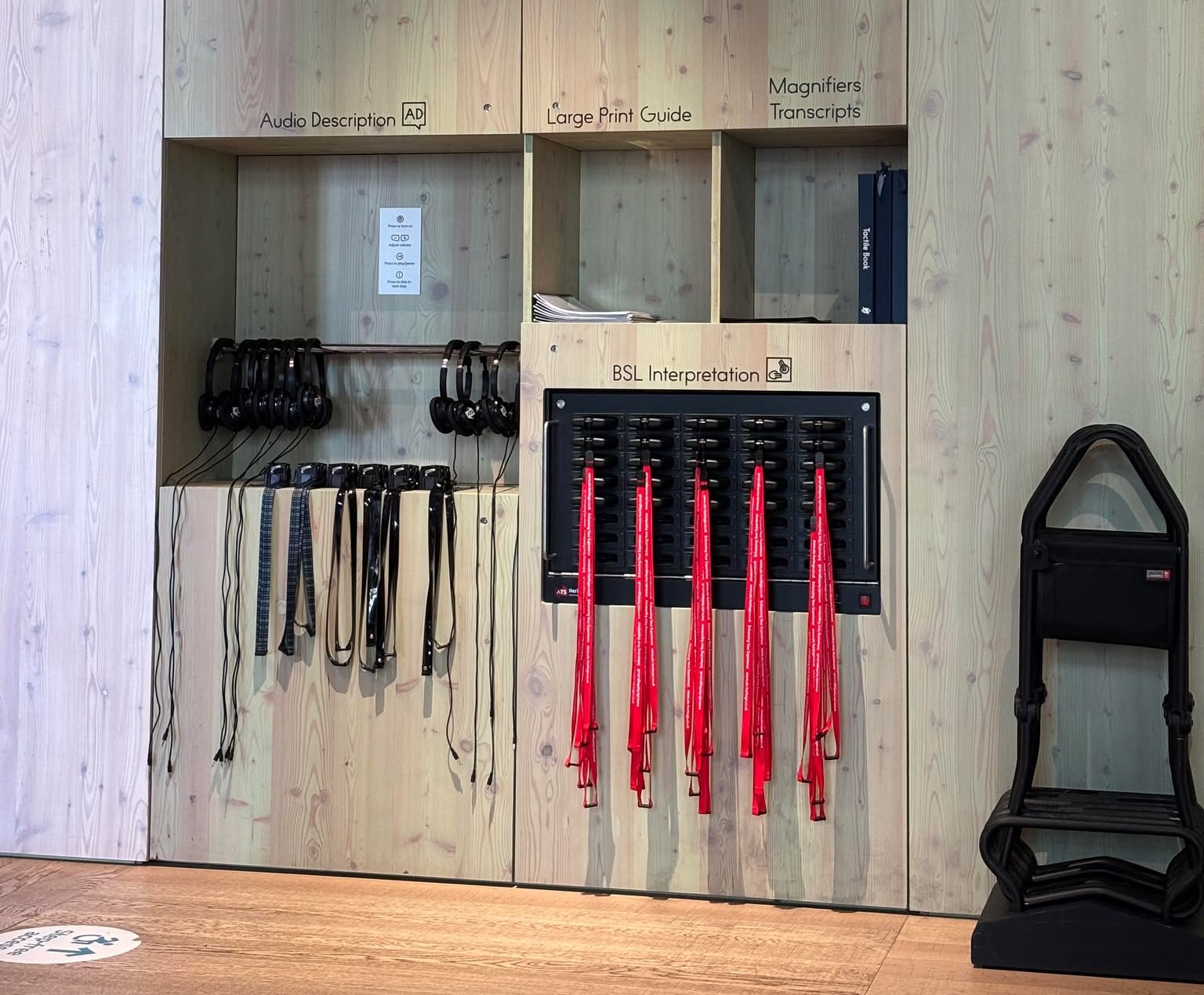
    Take, for example, their permanent exhibition. I am going to share a photograph below that captures just how much thought, care, and consultation has gone into their planning. In this photograph you can see a sticker on the floor outlining the best route for someone to take with a wheelchair. Then there are audio description guides, large print guides, magnifiers, transcripts, BSL interpretation, and stools. What isn’t pictured is the braille on all the labels. Having everything in the same place makes it very clear where someone would need to go if they had any accessibility requirements. This is the most care I’ve seen in a museum and considering they are dedicated to inclusion and access, it is great to see they practice what they preach.

    Accessibility Station

    Highlight: Content and Themes Addressed

    I was surprised, in the best way possible, to see the different themes on display. I think the surprise came from the fact that I remember a very traditional exhibition when I visited in 2015. Seeing how it has been transformed was fantastic. They address so many critical health issues, including topics such as climate change, that I haven’t seen in a medical museum before.

    Below is a photograph of one of the thematic signs about minds and bodies. It challenges the term ‘normal’ and asks some interesting questions for visitors to consider as they walk around and view the objects.

    Exhibition Thematic Sign

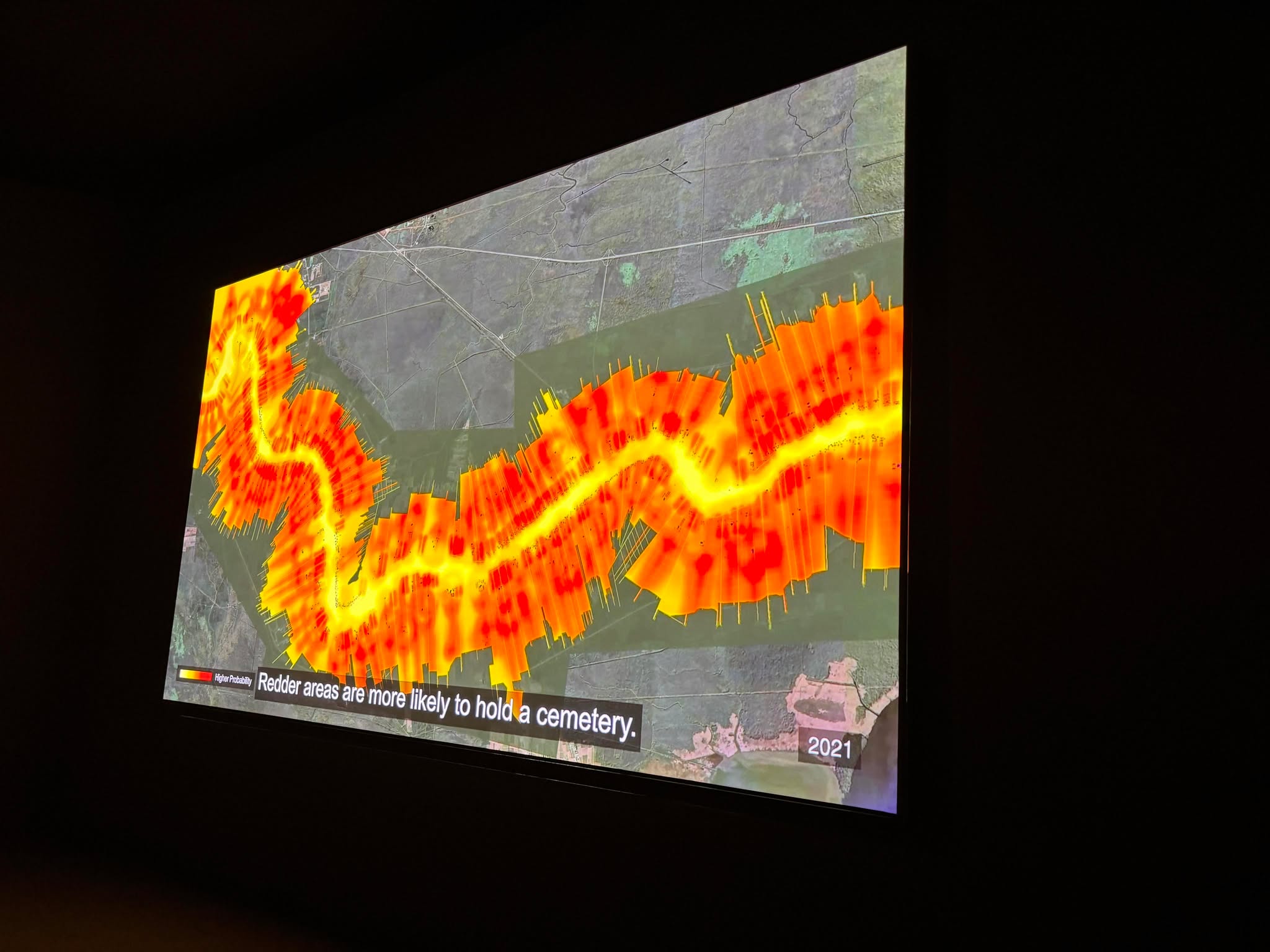
    Outside of the permanent exhibition, I did want to mention the content covered in the Hard Graft temporary exhibition. This exhibition focuses on the stories of those who are underrepresented workers. For example, there is a section on slavery, sex work, and domestic labour. One work that stood out to me in this section was a 35-minute film on Forensic Architecture that posed the question ‘If toxic air is a monument to slavery, how do we take it down?’ It was an engaging film about polluted air in a majority-Black community in Lousiana. The toxins are threatening both the living and the burial grounds of their ancestors – a form of environmental racism. I watched the entire film from start to finish and was absolutely captivated by the importance of its message.

    Forensic Architecture Film Still

    Conclusion

    I am so glad I returned to the Wellcome to see their new exhibition space. There is some amazing curatorial and accessibility work coming out of this space. I may have also spent some time in the gift shop purchasing a couple of new medical history books!

  • London: Hunterian Museum

    Disclaimer: This post will contain images of human specimens.

    The final stop on my professional development museum tour is London. On the must-visit list was the Gordon Museum of Pathology, Hunterian Museum, and the Wellcome Collection. I spent a couple of hours in the Gordon Museum, a pathology specimen museum attached to King’s College London. It is not open to the public. For this reason, I’m not going to write a post. I am so grateful to the Curator for meeting with me and letting me see the collection.

    After touring the Gordon Museum, I boarded a bus and headed to the Hunterian. The last time I visited the Hunterian was back in 2015. I remember the museum being quite overwhelming with hundreds of specimens and limited interpretation. I also remember seeing the skeleton of Charles Byrne and feeling extremely uncomfortable. I was looking forward to returning to this museum and seeing their new exhibition space.

    Photography without flash is allowed within the museum but they do request no close-up images of specimens. I will be sharing a couple of images with specimens that will help illustrate my highlights.

    Context: Museum

    The Museum is named after John Hunter, a surgeon and anatomist who lived in the 18th century. During his life, he amassed a huge collection of anatomy and physiology specimens. The estimate is around 14 000. At the time, this was one of the largest collections of comparative anatomy. Comparative meaning the study of different species. On his death, the collection was donated to the Company of Surgeons, an organisation that later became the Royal College of Surgeons of England. It has remained in their headquarters ever since, located at Lincoln’s Inn Fields, centre of London.

    In 2018 the Hunterian Museum closed for a five-year redevelopment. The total cost was approximately £4.6 million. It was great being able to compare how the museum looks today to how it looked in 2015. I will expand on this later but there is a lot more integration of specimens and historical objects, and a lot more opportunities for participation.

    Context: Collection

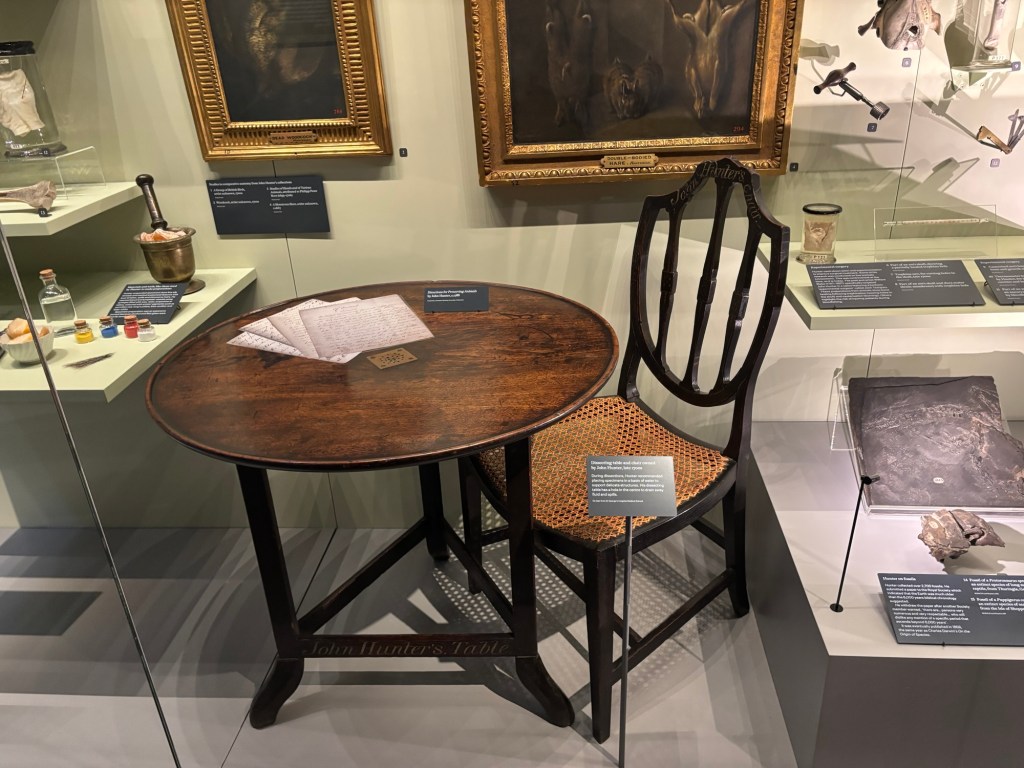
    The collection of the Royal College of Surgeons of England can be divided into eight categories. These are: Hunterian Collection (comparative anatomy and physiology specimens collected by John Hunter), Hunterian Museum Collection (specimens collected after the death of John Hunter), Odontological Collection, Surgical Instrument Collection, Microscope Slide Collection, Paintings/Sculpture/Furniture, Anatomy Collection, and Pathology Collection.

    John Hunter’s Dissecting Table

    Together, there is over 70 000 objects in their collection. These cover the history of surgery from around the 17th century to present day. If you are interested, you can actually search and explore the collection online.

    Context: Display and Layout

    The entire museum is on the ground level of the Royal College headquarters. When you enter the building, straight ahead is a museum information desk. Entrance is free but they do recommend reserving a timeslot to visit online. It is a single path, one-way museum that guides you both chronologically and thematically. There are times when you can visit rooms off to the side of the main path, but it generally doesn’t allow you to deviate too much.

    There are ten exhibitions to visit, half of which cover John Hunter and his collection. The other exhibitions are used to introduce visitors to the museum and track the history of surgery and anatomy. The final two exhibitions are dedicated to modern surgery and modern surgical procedures. To finish, there is a small gift shop with some collection-themed and anatomy-themed gifts.

    Exhibition Case Example

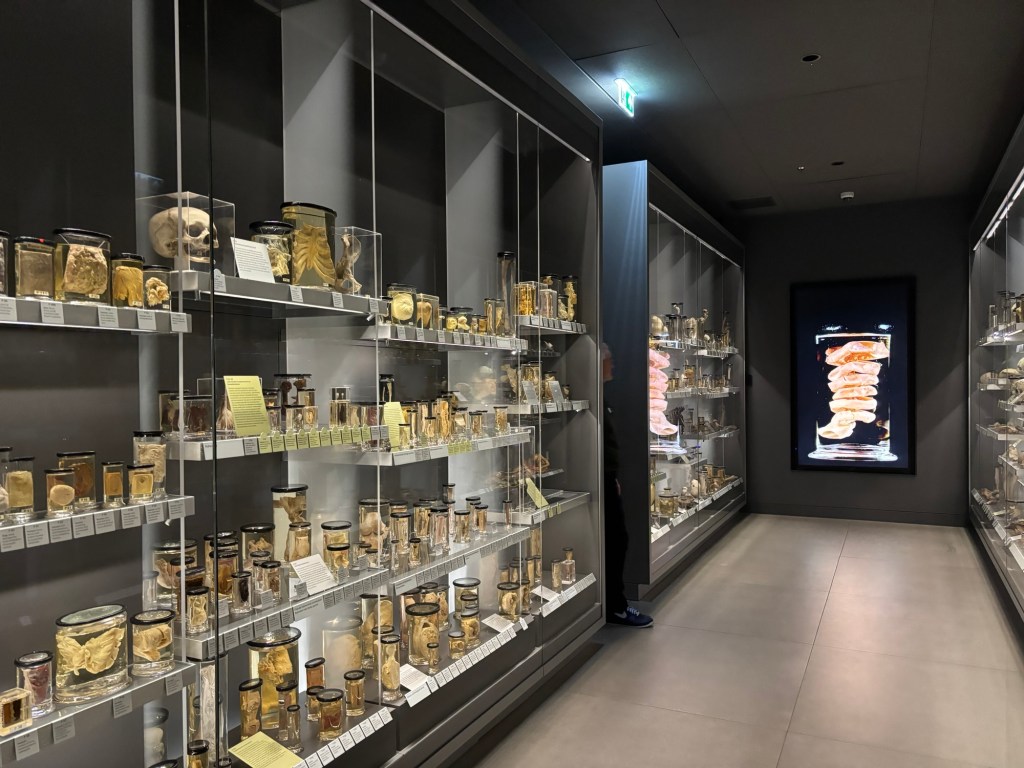
    I do want to highlight the Long Gallery, located towards the beginning of the museum. It’s basically how it sounds – a long gallery. Running along both sides are large glass cases displaying some of the original specimens collected by John Hunter. Outside of this space, specimens are integrated with objects in other exhibitions. This is the only space where you will see specimens.

    Charles Byrne’s skeleton is no longer on display which is a step in the right direction. Hopefully, his body will one day be repatriated to Ireland.

    Highlight: Display of Specimens

    My first highlight revolves around the display of specimens in the Long Gallery. As you can see in the image below, each specimen has a light grey plaque with the species it belongs to, name of the organ, and any disease information.

    Some specimens have green labels which are used to either highlight something rare or group specimens together. For example, there is a section on tuberculosis and how it affects the body. The green labels group the various organs together under this topic. To the side of the green-labelled specimens is an extra information label. The one I’ve shared below is all about nasal polyps. The label tells the story of Joseph Hayden, a man who visited Hunter in the 1700s to have his nasal polyps removed. He wrote of the pain that was caused by their removal, so his words are included on the label. These stories help to humanise the specimens and add some extra context.

    Human Specimens with Nasal Polyp Story

    The specimens not in this hall are displayed alongside objects to help illustrate themes or topics. My favourite section focuses on the surgical training of Hunter. There is a small section on how he preserved his specimens – including the tools and chemicals required. The specimens have been selected to show the different preservation techniques.

    Specimen Preservation Display

    Highlight: Interactives

    Before renovations, I don’t remember there being any interactives or participatory elements. The new exhibitions have a few engagement opportunities. I had two favourites:

    1: The interactive digital tables that teach the history of surgery and the human body systems.

    Human Body System Table

    2: Accessibility additions such as the touch plates of the Evelyn Tables. These are anatomical preparations from the 1600s including blood vessels and nerves that were removed and pasted onto wooden boards.

    Evelyn Tables
    Evelyn Tables Interactive

    Highlight: Patient Inclusion

    The final highlight for me is the inclusion of patient voices. In the final room, you can sit and listen to patients tell their healthcare stories. This is a great addition to the space and you leave feeling multiple perspectives have been included in the museum.

    Patient Inclusion

    Conclusion

    Overall, the renovations have transformed the museum into a more engaging experience that includes additional perspectives. The display of specimens is, to me, more educational than in the past. I enjoyed reading the stories and seeing the variety of specimens available. One day, I hope they have an empty case, displaying the story of Charles Byrne and how important it is to continue ethical discussions surrounding these collections.

  • Den Haag: Mauritshuis

    On our second last day in Amsterdam, we visited Den Haag or The Hague to see my favourite painting, The Anatomy Lesson of Dr. Nicolaes Tulp by Rembrandt. It is on display at Mauritshuis, a gallery in the city centre. Painted in 1632, this portrait of Amsterdam surgeons was commissioned when Rembrandt was only 25 years old. I’ll write more about it later.

    This is going to be a short post highlighting a couple of paintings in this gallery. As always, here is some context to start.

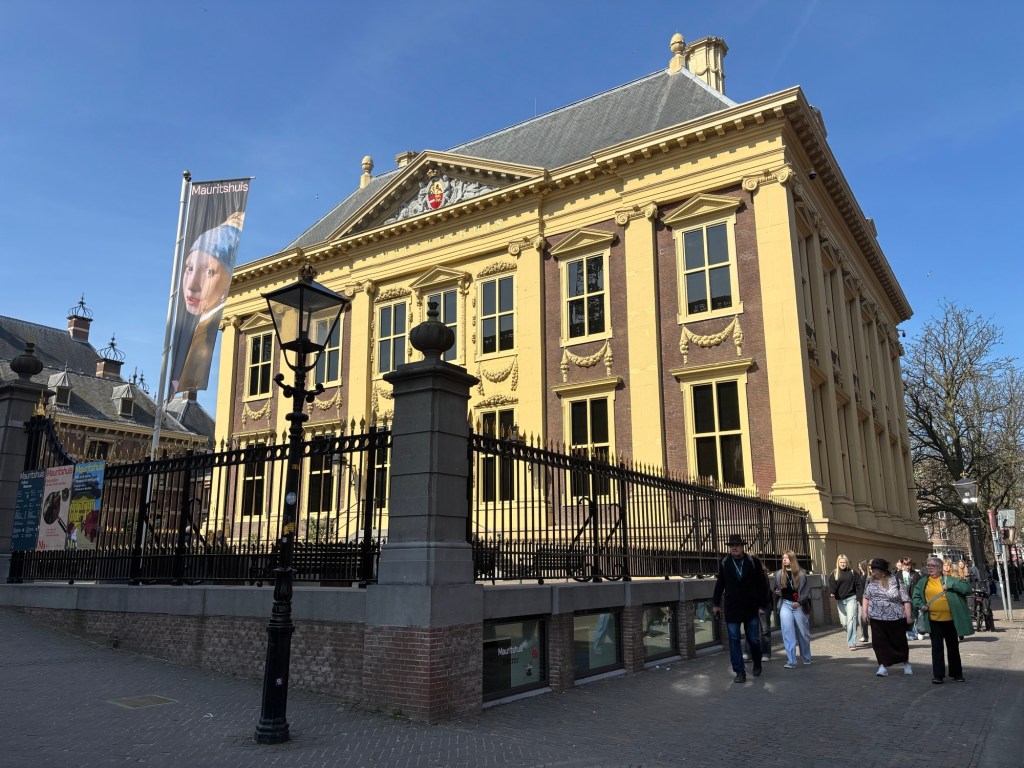
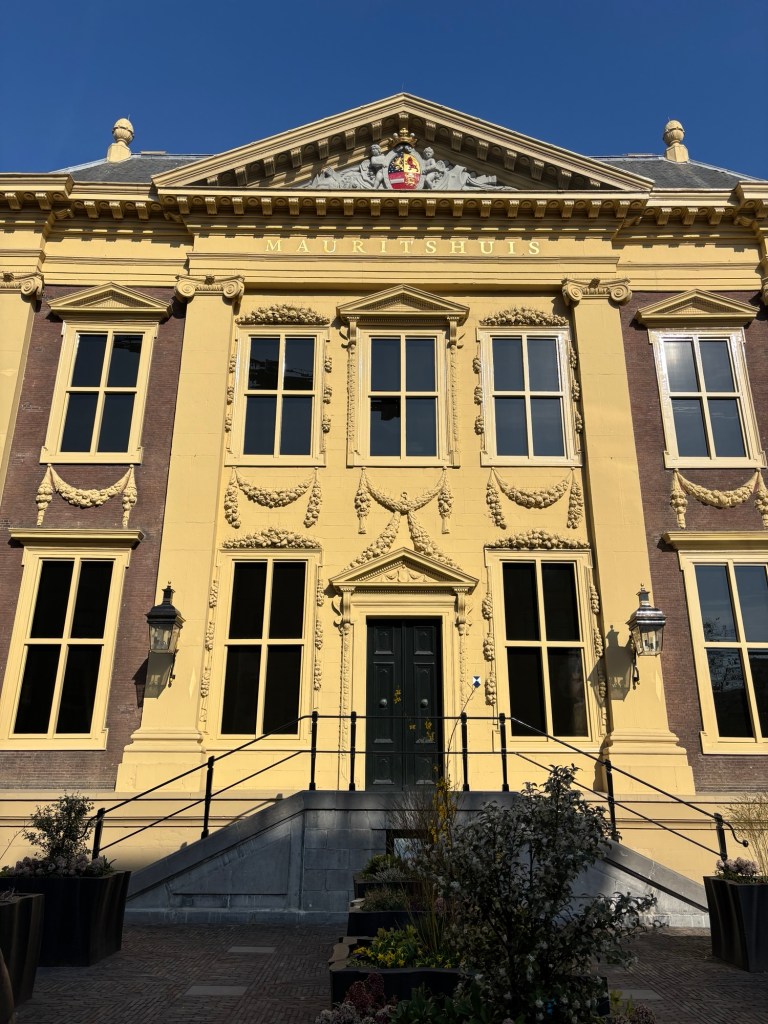
    Museum Entrance

    Museum Context

    Today, the Mauritshuis is a small art gallery in The Hague. It was built in the 1600s for Count Johan Maurits of Nassau-Siegen. Hence the name, Mauritshuis. Similar to most extravagant buildings from this period, there is a strong link to slavery. Maurits’ income mostly came from trading in sugar and enslaved people. It recently came to light that he also privately traded enslaved people. It is important to know this history before stepping inside. It makes you a more informed and aware visitor.

    In 1822, the building was transformed into a museum, housing some of the most significant Dutch paintings.

    Although the mansion is large, it wasn’t large enough to keep up with growing visitor demands. In 1987, an extension was built allowing the shop, cafe, education rooms, and temporary exhibition space to move into a connected building. The mansion itself has a ticket desk on the ground floor and two floors of exhibitions.

    The floors are quite small, only containing around six or seven rooms. However, each room is filled with paintings from Dutch masters such as Vermeer and Rembrandt. One room has a painting undergoing conservation treatment. It is set up so you can see the conservators at work.

    Highlight 1: The Anatomy Lesson of Dr. Nicolaes Tulp by Rembrandt

    The Anatomy Lesson of Dr Nicolaes Tulp

    To me, this is the absolute highlight of the museum. I’ve only seen this painting online and in art books so I was shocked to see it is massive. I was very much expecting an A3 size but it almost fills an entire wall. What stands out in this painting is the use of shadows and light. Something that made Rembrandt particularly famous.

    My favourite individual in the painting has to be the confused looking man at the back. The face of so many memes. I also enjoyed seeing the details in the dissection. The red vessels add some much needed colour to the rest of the painting.

    The Anatomy Lesson of Dr Nicolaes Tulp

    Highlight 2: Girl with a Pearl Earring by Johannes Vermeer

    This has to be the treasure of the gallery. It is a stunning small portrait that captures so much expression. The pearl earring is almost lost in the shadow, but has just enough reflection to draw your attention. We visited as soon as the museum opened so luckily the crowd was quite sparse. We had lots of time to view and reflect on this artwork.

    Girl with a Pearl Earring

    Highlight 3: Portrait of Jane Seymour by Hans Holbein II

    Seeing an original Hans Holbein portrait was also a significant highlight for me. I love how the frame itself has little inserts with the same colours as the main painting.

    Jane Seymour

    Highlight 4: Vanitas Still Life by Pieter Claesz

    My final highlight is this Memento Mori still life by Claesz. The skull is positioned on top of books, looking at a pocket watch. As these types of paintings were meant to remind viewers that death is inevitable and our time is not infinite, this seems fitting.

    Vanitas Still Life

    Highlight 5: Arm Candle Holders

    The unattached arms holding candles in one of the main rooms added a sort of eerie atmosphere to the museum.

    Arm Candle Holder

    Conclusion

    If you have never visited the Rijksmuseum before then that should be at the top of your list. However, if you have some spare time, or a particular interest in these highlights, add Mauritshuis to your itinerary.

  • Leiden: Rijksmuseum Boerhaave

    Yesterday we travelled to Leiden to visit Museum Corpus and the Rijksmuseum Boerhaave. Leiden is about a 40 minute train ride from Amsterdam Centraal making it a perfect location for a day trip. It is a beautiful historic city filled with museums and stunning heritage places. Right in the city centre is the Rijksmuseum Boerhaave, the national museum of science and medicine. If you are even slightly interested in medicine, I would strongly encourage you to visit. On display are some of the most fascinating exhibitions and objects you will ever see.

    Museum Entrance

    There is so much to cover in this post. I want to share how we spent our time in the museum and some highlights from each section. To begin, however, here is some museum context.

    Context: Museum

    The Rijksmuseum Boerhaave is located in the old buildings of the Caecilia Hospital. The hospital opened in 1600 and closed in 1852. After this time, the buildings were used as workhouses. After World War II, the buildings were purchased by the federal government and transformed into a museum. There are two floors of exhibitions to explore including a temporary exhibition space and an entire floor of permanent exhibitions.

    The name Boerhaave has come from the Dutch physician Herman Boerhaave. He taught in the hospital during the 18th century and was a early supporter of clinical teaching or teaching students within the hospital. There are a few displays around the museum that tell his story.

    Stop 1: Anatomical Theatre

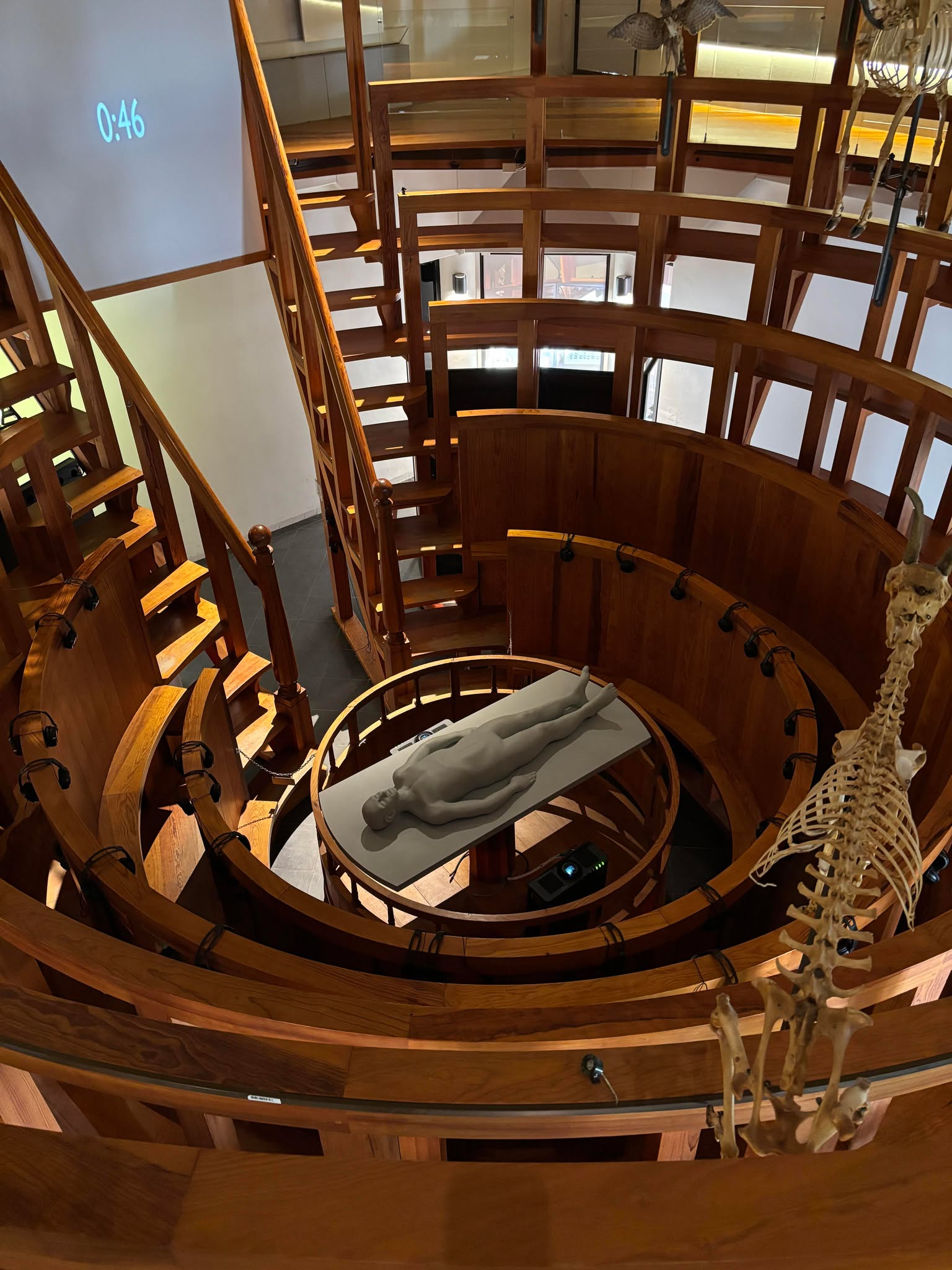
    After paying the entrance fee, we walked around to the anatomical theatre for a seven-minute show. This is a reconstructed 14th century anatomical dissection theatre with a model body in the centre. Surrounding the theatre is a medical cabinet of curiosities, containing objects such as wax models of eye diseases, anatomical texts, medicinal jars, and taxidermy animals, to name a few.

    Wax Eye Models

    Through a series of light projections, the show highlights the history of science and pursuit of anatomical knowledge in the Netherlands. It is a quick introduction to the museum in quite an atmospheric environment. At various stages, the model body in the centre lights up to show the internal organs and blood vessels. I was disappointed that issues, such as the role of colonialism, were not mentioned. This would have added another layer to the presentation and kept it at the forefront of visitors’ minds.

    Stop 2: Unseen – Inequality in Medicine

    To say I enjoyed this exhibition is an understatement. Right from the start, the introductory panel clearly states the aim of the exhibition; to examine the gender bias in medicine and correct some assumptions and perceptions. There are two disclaimers on the panel. The first is that the language in the exhibition might not always include intersex people. The second warns visitors that there are human remains inside.

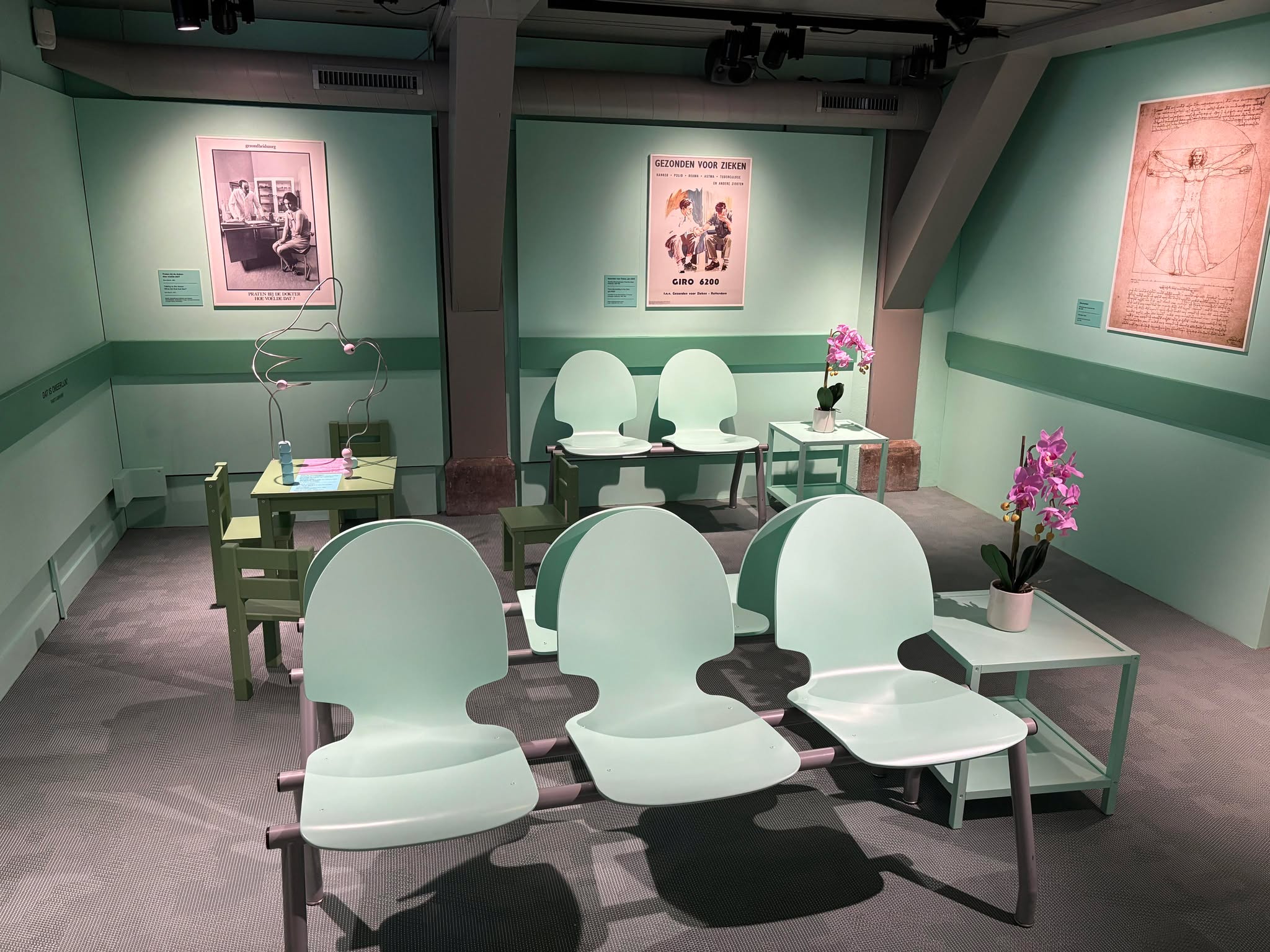
    After reading the introductory panel, you enter a doctor’s waiting room. It looks exactly like a waiting room with chairs, an area for children to play, and some healthcare posters displayed on the walls. When you are ready, you can head into the main exhibition space to see the doctor. There are three separate themes and sections in the exhibition.

    Waiting Room for Unseen

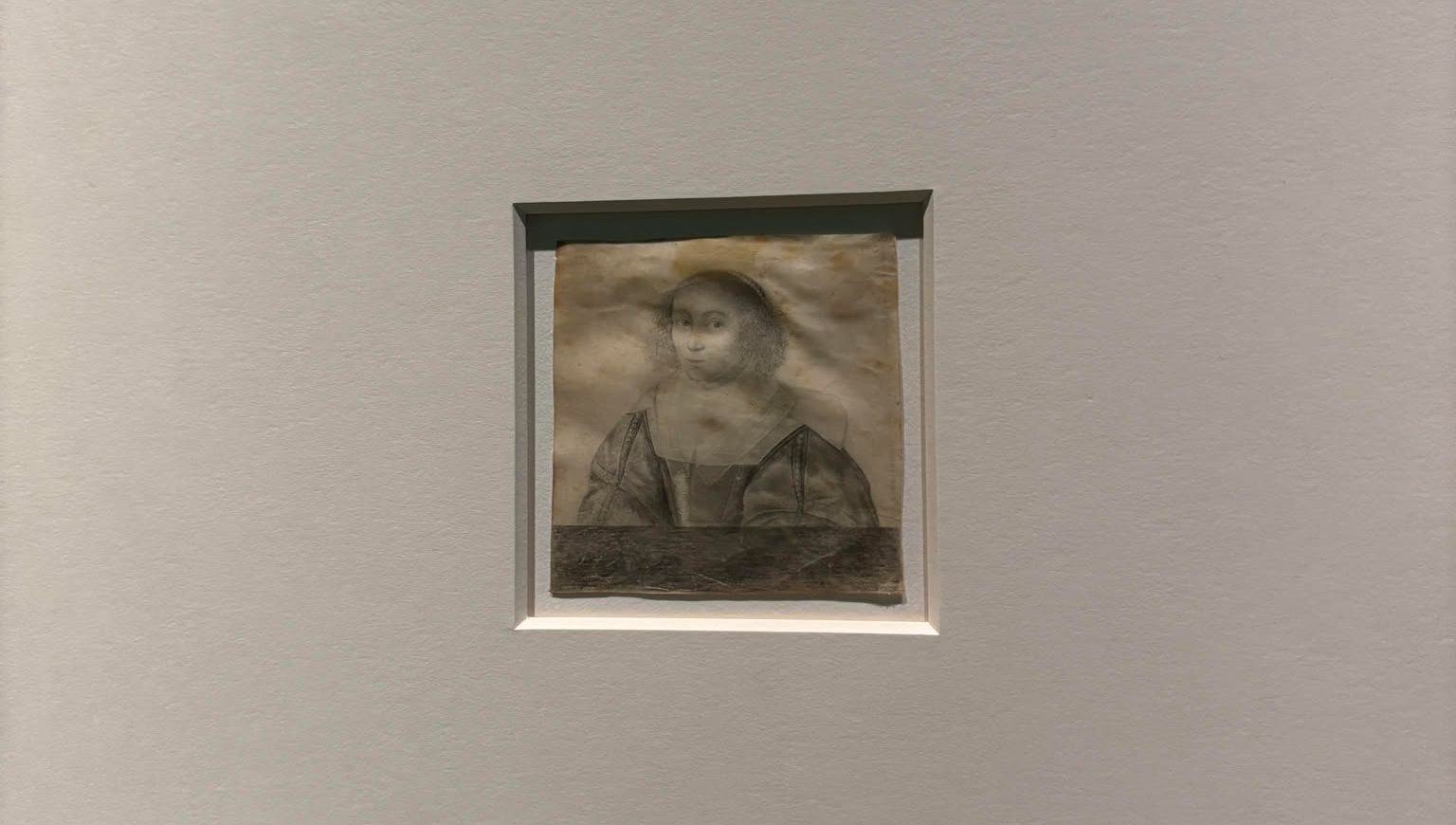
    The first is titled unseen. It focuses on how the male body was the only one studied for centuries. There are a selection of texts and models on display including a fragment from a medieval manuscript dating back to between 1400 – 1500. A highlight object in this section is the self-portrait of Anna Maria van Schurman from circa 1630. Although she was allowed to attend medical classes in the 17th century, she had to sit behind a curtain, invisible to the male students. She attended the classes but was not allowed to graduate and become a doctor.

    Anna Maria van Schurman

    There are models of the female body on display with the point made that these were usually in the form of the anatomical Venus. A woman, laying in bed, pregnant and delicate. According to the object label for the small Venus figurine, it was a collector’s item for male doctors who wanted to show ‘authority over the pregnant body’.

    Anatomical Venus

    The second section is titled ignored. Here you learn all about how women and gender diverse people have been ignored by medicine and how this often leads to long-term suffering and incorrect diagnoses.

    A highlight in this section is an interactive outline of a female body. You are asked to move a stethoscope around the body and listen to find six medical conditions. This, along with other objects in this section, draws visitors’ attention to the fact that women and gender diverse people are far less likely to receive a correct diagnosis when compared to males. This section also addresses intersectionality. For example, the fistula knife of Dr James Marion Sims is on display. He operated on enslaved women without anaesthetic in order to treat a fistula or opening between the vagina and bladder. Many Caucasian women at the time were provided anaesthetic for this procedure.

    What is Wrong

    The final section is titled rebellion. This is where authority is handed back to women and tells the story of how we are fighting for health equality. A highlight object in this section is the booklet by Aletta Jacobs published in 1900. This was sold for a small price to women with limited money so they could learn more about their bodies.

    Aletta Jacobs Book

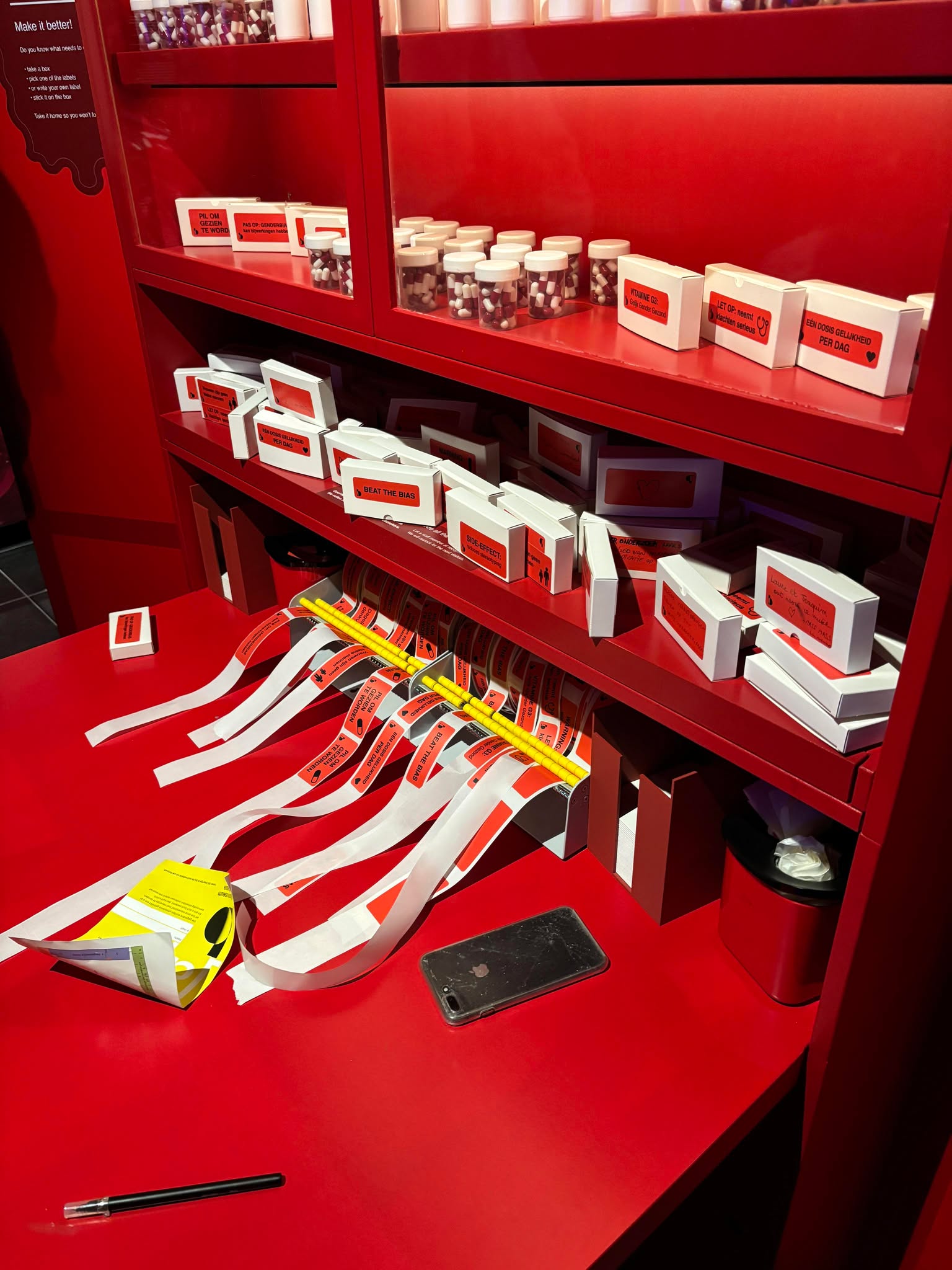
    The interactive in this section was a standout for me. Here you can make your own medication box and add stickers with sayings such as ‘beat the bias’ and ‘women are not small men’. Such a powerful interactive and I saw so much engagement by visitors.

    Medicine Box Creation Station

    Stop 3: Permanent Display

    After a break in the cafe, we headed to the top floor to view the permanent display. This covers themes such as the Golden Age, Sickness and Health, and Great Collections. We made it through three of the sections before visitor fatigue set in.

    Golden Age

    This exhibition covers the Golden Age of Dutch exploration and what contributions were made to science and medicine. There are objects on display such as an original Andreas Vesalius anatomical text from the 1500s.

    Andreas Vesalius Book

    About half-way through the exhibition there is a digital interactive that is truly a highlight. You lay your arm on a screen which activates the video. Lights are projected onto your arm to make it look as though it is being opened with a scalpel. As surgery is performed, your muscles and bones become exposed. Meanwhile, the screen is telling the story of Vesalius and his dissections at the university of Padua. It is an extremely effective interactive learning tool.

    Surgery Interactive

    Sickness and Health

    This exhibition focuses on the advent of different medical specialities and how they advanced our knowledge of the human body. Similar to a couple of other medical museums we have visited, the exhibition uses patient beds as a way to separate different themes.

    One of the themes is on childbirth and contains this obstetrical training manikin from the 18th century. It was used to train doctors who could use the model to practice birthing techniques. Recent study of such manikins has shown that many actually contain human bone material.

    Obstetrical Training Manikin

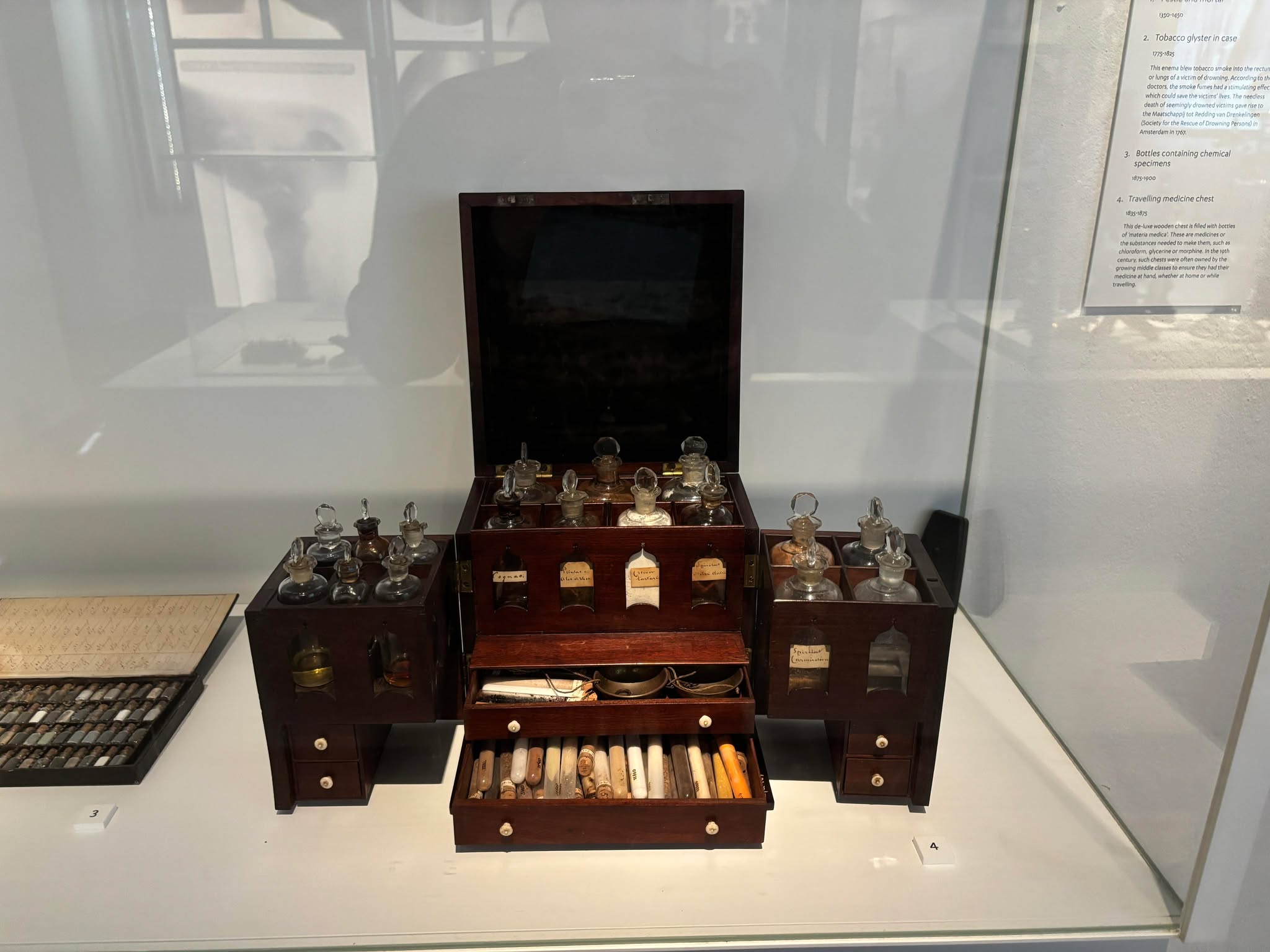
    The next room covers the laboratory and how they were critical for studying the human body and, in particular, disease. One of the first objects you see in this space is a travelling medicine chest or materia medica. These compact chests had everything you needed for an in-home, 19th century first aid kit.

    First Aid Kit

    Great Collections

    The final exhibition I want to cover contains some significant objects from the collection, each with an accompanying digital screen. The objects on display show the future of medicine and raise some critical ethical questions. You can engage with these questions on the digital screens.

    For example, on display is an artificial kidney, or early dialysis machine, from the 1940s. The object label describes how the machine works and how it has saved so many lives. The digital screen discusses non-human donors and the ethics behind growing organs in animals or in a laboratory setting. You are asked, would you accept an organ that did not originate from a human?

    Early Dialysis Machine

    Conclusion

    I have only really skimmed the surface of what is available in this museum. In total, we spent close to three hours here which is almost a record. I would like to revisit in the future and see what we missed. The temporary exhibition, Unseen, is on display until 8 March 2026.

  • Amsterdam: Museum Vrolik

    We arrived in Amsterdam yesterday and have hit the ground running. This is my third time visiting Amsterdam, so I wanted to explore some more niche museums and sites. I am also so excited to finally see the tulip fields! Today, we visited two museums, one of which was Museum Vrolik, located within the Academisch Medisch Centrum (AMC). This is about a 45-minute metro ride from Amsterdam Centraal.

    Similar to other museums with specimens, there is absolutely no photography. This is made clear at the entrance and also throughout the museum space. I really like how they speak about this on their website, encouraging visitors to become students of anatomy. By this they mean respecting the material on display by observing and learning. Not by sharing images and potentially causing distress.

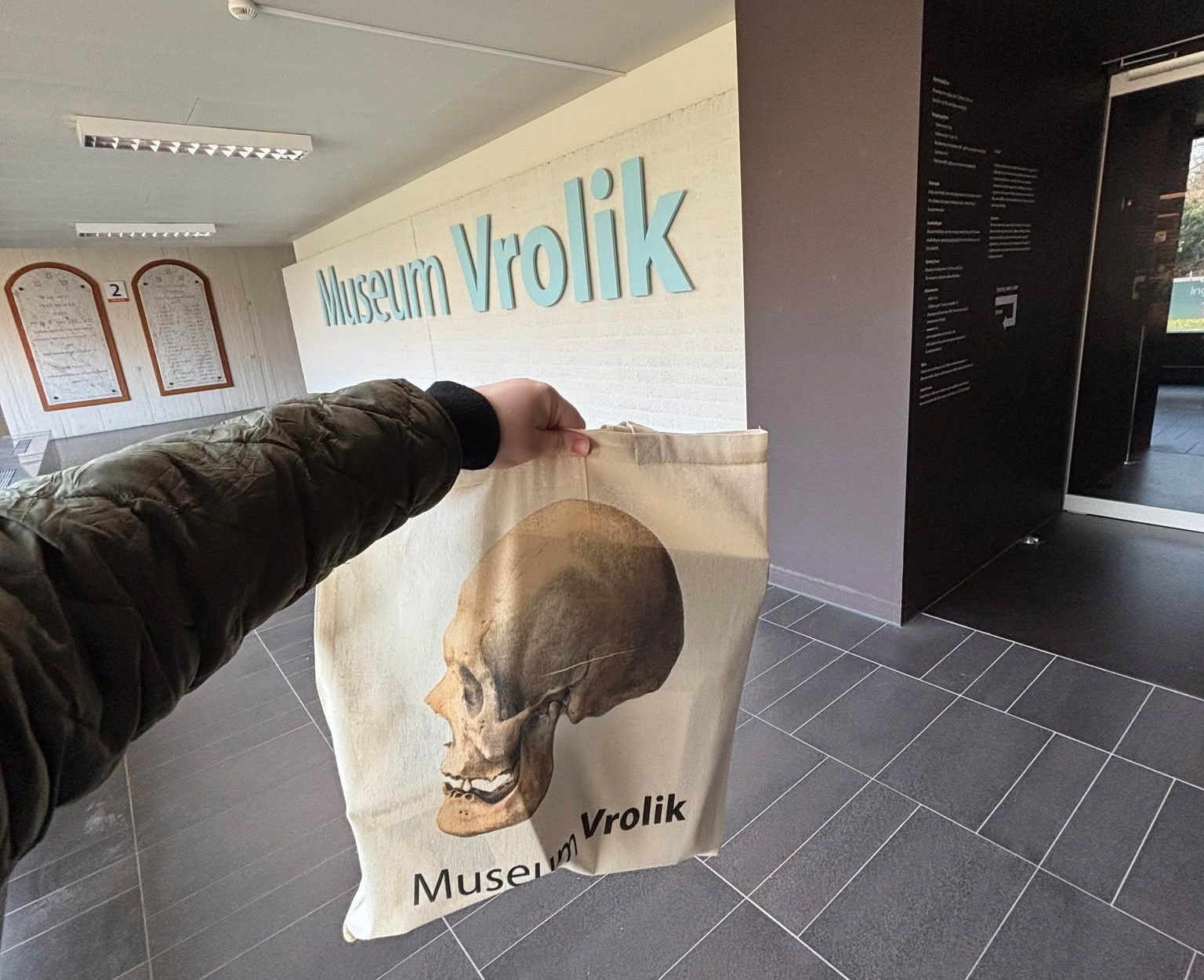
    For this reason, I only have a couple of photographs to share (from outside the museum and of my amazing new tote bag).

    Museum Entrance

    Context: Museum

    The museum’s website offers a comprehensive history including information on those who have contributed to the collection. For this post, I am going to summarise it here. The museum is named after Gerard (father) and Willem (son) Vrolik. Both were professors of anatomy in Amsterdam and collected anatomical as well as pathology specimens (human and animal) between the late 1700s and mid-1800s. As with so many of these early collections, it was initially stored at their private home.

    The museum is transparent about this next section of their history. Skeletal specimens of colonial origin was also collected to understand race theories of the time. None of this collection is on display today. I can only imagine the many ethical and repatriation discussions happening behind closed doors. I will mention here that in 2018, Māori material was repatriated.

    After Willem’s death in 1863, the collection was purchased by some rich Amsterdam citizens and donated to the precursor of the Amsterdam University. Over time, more anatomists contributed to the collection, acquiring specimens that reflected their various interests.

    The museum was housed in different locations around the city centre before being moved to the University in 1984.

    Context: Collection

    The collection contains a standard array of preparations including potted specimens, wax models, plastinated specimens, and dried skeletons. What stood out to me is the extent of the skeletal collection. Not just human, but also animal.

    The earliest contributor to the collection was Jacob Hovius, a physician from Amsterdam. He collected skeletons displaying pathological conditions, donating them to the guild of barber-surgeons in 1772. If you don’t know the history of surgery and barbers then I encourage you to stop reading here and go down that rabbit hole. His wooden cabinet of skeletal specimens is now housed within the museum.

    There are some medical history objects on display surrounding the museum that I presume are also in the collection and not on loan. These consist of medical texts as well as medical devices and historical instruments.

    Context: Display and Layout

    Museum Sign

    The museum consists of one large room filled with glass cabinets. As mentioned in the previous section, there are objects surrounding the museum but no specimens. Directly inside, on the right, is a small ticket desk and shop. After paying the entrance fee, you are free to explore.

    At the front of the museum, on the left, is a section dedicated to animal material. There are some potted specimens as well as skeletal specimens to view. As you move around the perimeter, you come across some full adult human skeletons. Right at the back, on the left, is the Hovius display. As you move around the perimeter you then come to a reading area with books, chairs, and a table.

    In the middle of the museum (and on the left hand perimeter wall) are a series of glass cabinets containing the various anatomical and pathology specimens. The glass cabinets are divided by body part or organ and, at times, themes. For example, there is a section on the arm rather than a section on the musculoskeletal system. This is a bit different to what I’ve seen so far. This is the first museum where body system classification is not primarily used.

    Each cabinet has a laminated sheet where you can discover more about the specimens. I’ll speak about this later.

    That essentially summarises the museum and its layout. It’s not a huge space and the specimens are displayed with not much room to spare. If this is your first pathology or anatomy museum, I suggest taking your time so to not become overwhelmed.

    Highlight: Information Sheets Summary of Organ

    Each glass case has a laminated sheet in English and Dutch where you can find more information. Take, for example, the cabinet on the brain. The sheet firstly outlines the function of the brain and how it fits into the entire body and body systems. At the top of the sheet is an outline of the specimens in that section with a corresponding number. So, if you’re looking at the fourth specimen along, you can find its outline on the sheet, get the number, and read what exactly the specimen is further down.

    The summary of each organ adds context to the display and would be a fantastic initial read for anyone looking for a bit more baseline information. There is only one sheet in each language available, but I’m sure the front desk would be able to assist if needed.

    Highlight: Digital Display

    The Hovius wooden cabinet really dominates the space and is quite intimidating on first viewing. Rather than a sheet, the museum has opted for a digital label where you can select specimens in the cabinet to read more.

    This works a lot better for this particular section because more information on the bones can be disseminated via the screen. I would be interested in learning if this kind of digital integration is something the museum wants to expand on in the future. It works really well within the space and can allow for the information to be edited and updated without needing to print new sheets.

    Conclusion

    It has really been fascinating to see how these collections are opening more to the public and grappling with providing information to a wider audience. At the end of my visit, I purchased the absolutely essential museum tote bag and the museum’s catalogue.

    Museum Tote Bag

    Despite it being quite heavy, I am going to find a way to safely transport the catalogue back to Australia. It has a great overview of the collection and its educational value.