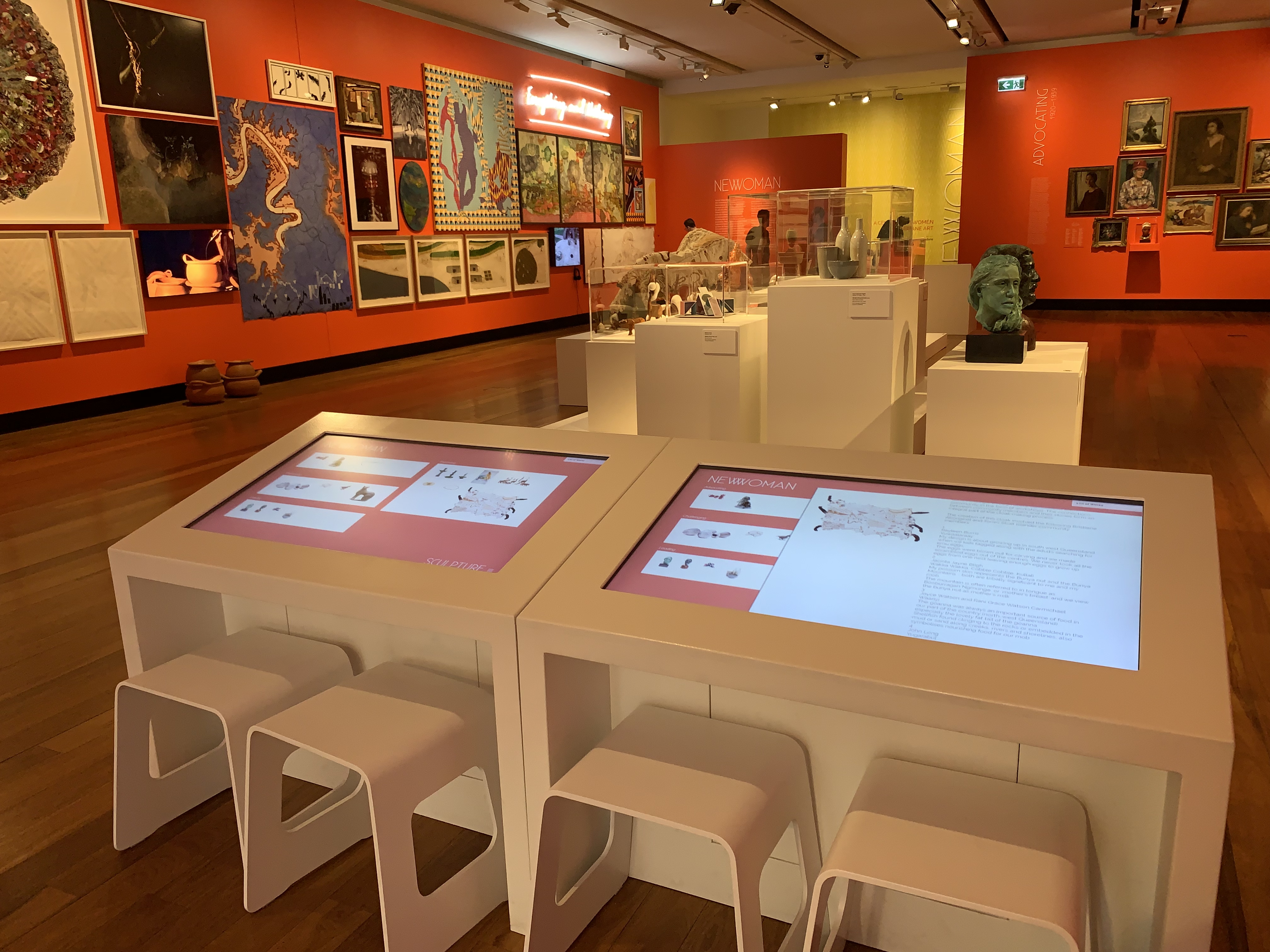
In mid-September this year, the Museum of Brisbane unveiled their new exhibition, New Woman. It features just over 80 artists, with artworks displayed chronologically starting from the 1920s. The exhibition is a really significant look at the women who have been an integral part of the development and continuing strength of Brisbane’s arts and culture scene. It is certainly a bright and colourful exhibition, accentuated by the almost neon orange walls. When I first entered the space I certainly had to adjust my eyes. There are a few aspects of this exhibition I want to focus on for this post.
Chronological Layout
Due to the layout of the room (one large room with no room dividers) visitors can explore the exhibition freely and not follow any prescribed path. However, for those wanting a bit more structure to their visit, you can move around the room in a clockwise direction (from the introductory panel) and view the works chronologically. Each time period has an overarching theme: advocating (1920-1939), teaching (1940-1959), challenging (1960-1979), leading (1980-1999) and expanding (2000-2019). I felt I got a lot more out of the exhibition by following the themes and slowly building my knowledge of Brisbane women artists over time.
Layout
Take, for example, the theme of challenging. The thematic panel explores how the 1960s and 1970s were a time of experimentation with the introduction of Modernism. However, it was also a time when female artists were challenging their role in society and how they were represented.
The artworks for each theme are displayed in a salon hang, i.e. a lot of works displayed together in a rustic but ‘work together’ kind of way. Depending on the display, I can either hate or love this technique. I am putting myself in the middle for this one. Mostly because I am really short and couldn’t appreciate the works that were super high, even when I was standing back. Also, the works higher up were often obscured by the lighting making them more difficult to see. However, it did have impact displaying all these works together quite closely.
Finally, on the theme of layout, the artworks don’t have individual labels. To discover more about each piece you have three options:
Look on the wall near each theme for a layout card with numbers that correspond to an artwork
Get a room guide
Look up the works on large digital screens (there are four of them dotted around. These actually provide more information on the artist as well as the work on display so I highly recommend spending some time reading about your favourite works here.)
Artwork LabelsDigital Screens
This is a great way to balance a salon hang. Rather than try to awkwardly include a label next to each work, the exhibition gives multiple options to find the relevant information without compromising the hang.
Text
I just want to take a moment here to talk about the text. Keep in mind the walls are close to neon orange. The text is in white writing and quite small. Virtually impossible to read and an accessibility issue. For those who have poor eyesight or find reading quite difficult, you may struggle in this exhibition. Perhaps the digital screens will be your best bet.
Favourite Works
As with so many posts, I want to take a moment to share some of my favourite pieces and why.
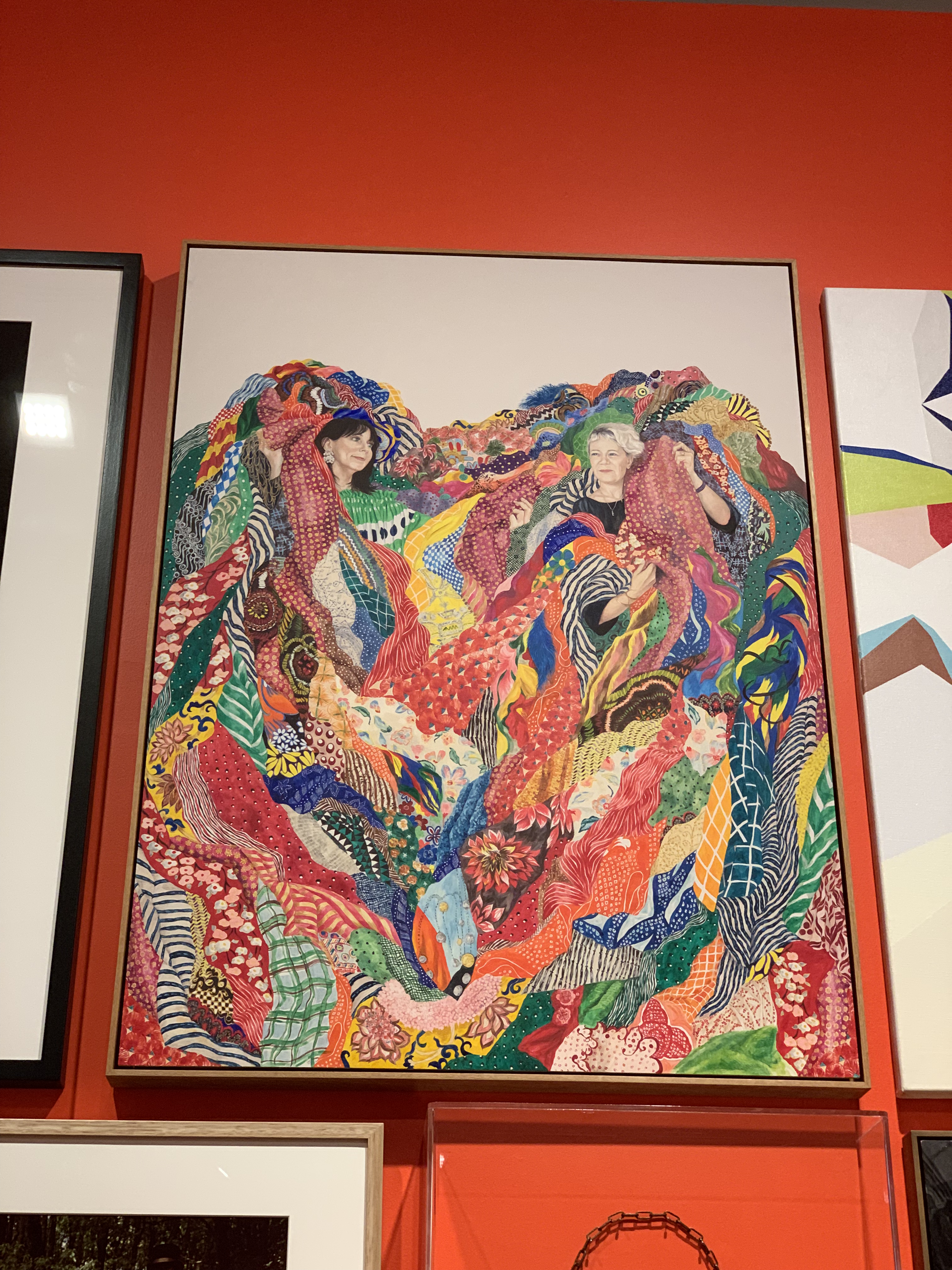
1. Monica Rohan, Easton Pearson, 1990
Monica Rohan, Easton Pearson
I absolutely adore the work of Monica Rohan. It is so unbelievably colourful and fun. Depicted here are fashion designers Pamela Easton and Lydia Pearson. All the different patterns and colours are actually inspired by their fashion label and designs. In 2016, this work was a finalist in the Archibald Prize.
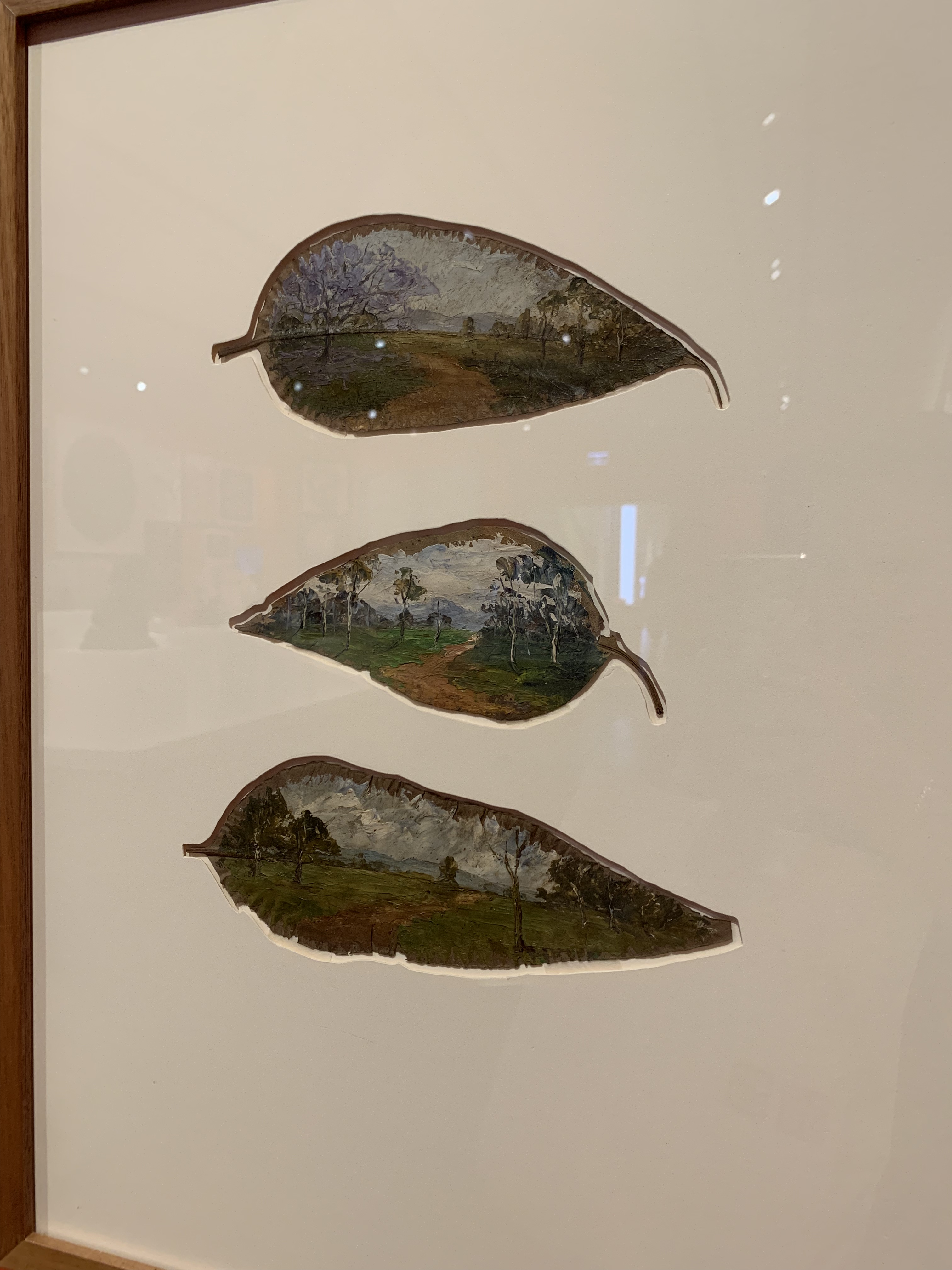
2. Jeanettie Sheldon, Gum leaves decorated with landscape and seascape scenes, 1930
Jeanettie Sheldon, Gum leaves decorated with landscape and seascape scenes
These are actual gum leaves painted with small, intricate, and beautiful scenes. It is amazing to think that they have lasted all this time!
3. Anne Wallace, Assignation, 1997
There is something very Art Deco-y about this work which immediately caught my eye. It plays with the notion of desire and a nostalgic past.
Anne Wallace, Assignation
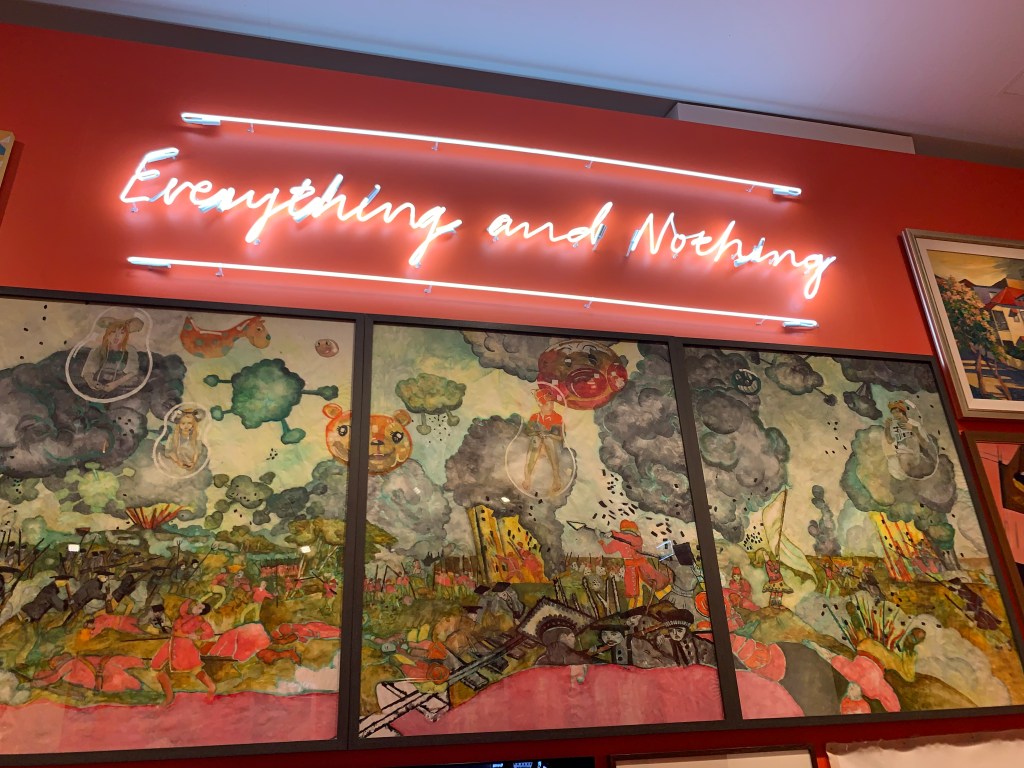
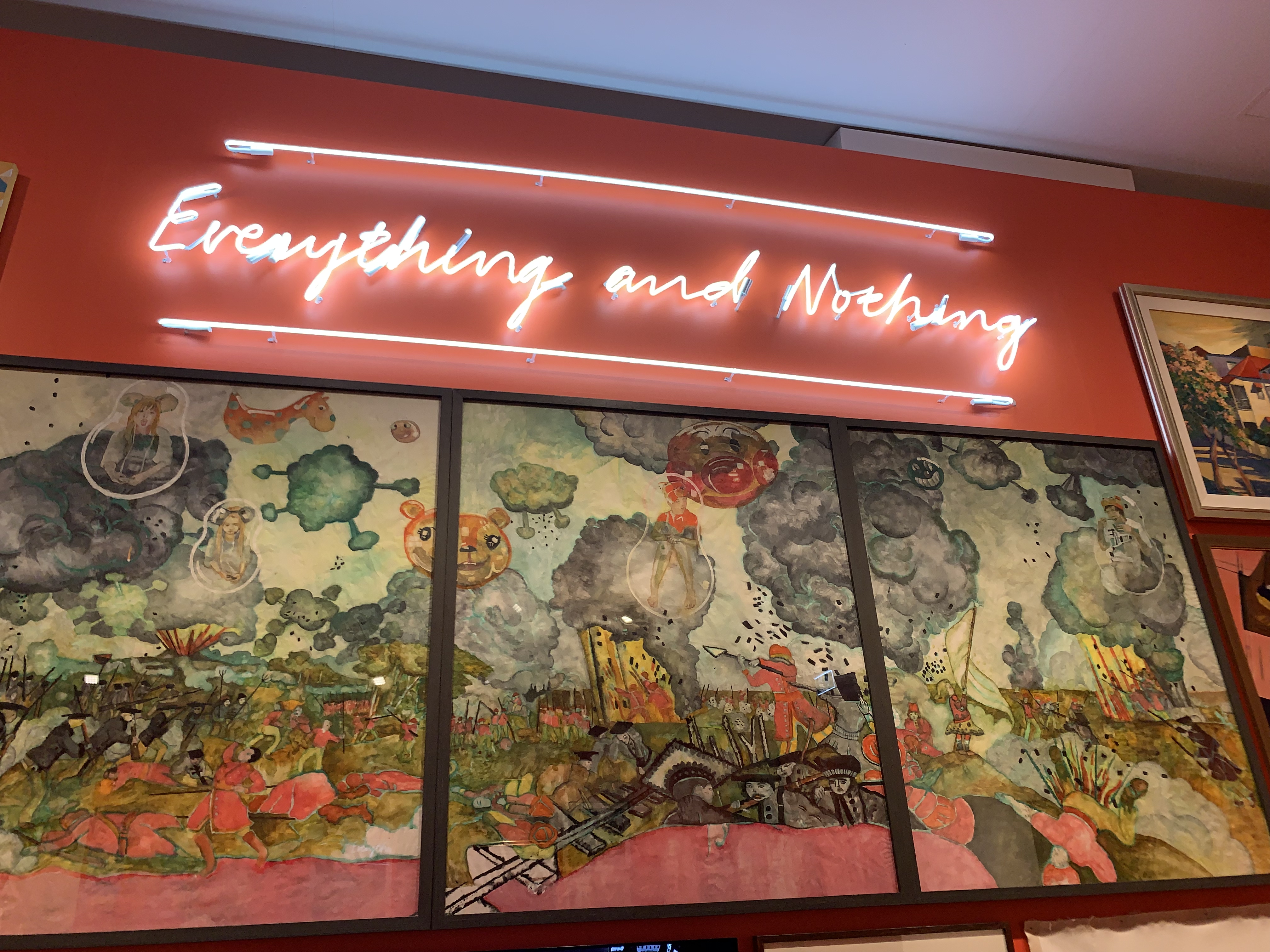
4. Courtney Coombs, Everything and Nothing, 2019
Courtney Coombs, Everything and Nothing
I love a good neon sign.
5. Caroline Barker, Untitled (life class model), 1925
Caroline Barker, Untitled
Caroline Barker was an amazing still life and portraits artist. During her life, Barker taught art at many schools around Brisbane and inspired many talented artists including Margaret Olley, John Rigby and Hugh Sawrey (to name a few). Although this work is quite dark, it really stood out to me as one portraying a lot of emotion and depth.
Practical Information
New Woman is open at the Museum of Brisbane (3rd floor of Brisbane City Hall) until March 15, 2020. It is free. Apart from those issues with the text, it is accessible. I visited with a friend and we maybe spent half an hour looking through the exhibition reading some of the labels. If you were wanting to go through the digital information in a bit more depth, I’d probably allow half an hour to an hour.
Thursday was the final day of sessions for the Museums & Galleries Queensland Conference. I would like to thank the organisers, sponsors and presenters for making the past couple of days truly memorable. Queensland is a huge state and this conference provided a great opportunity for cultural workers to gather together, network and share ideas. Read on for a brief summary of the talks I attended during the day and some key takeaway messages.
9.00 am
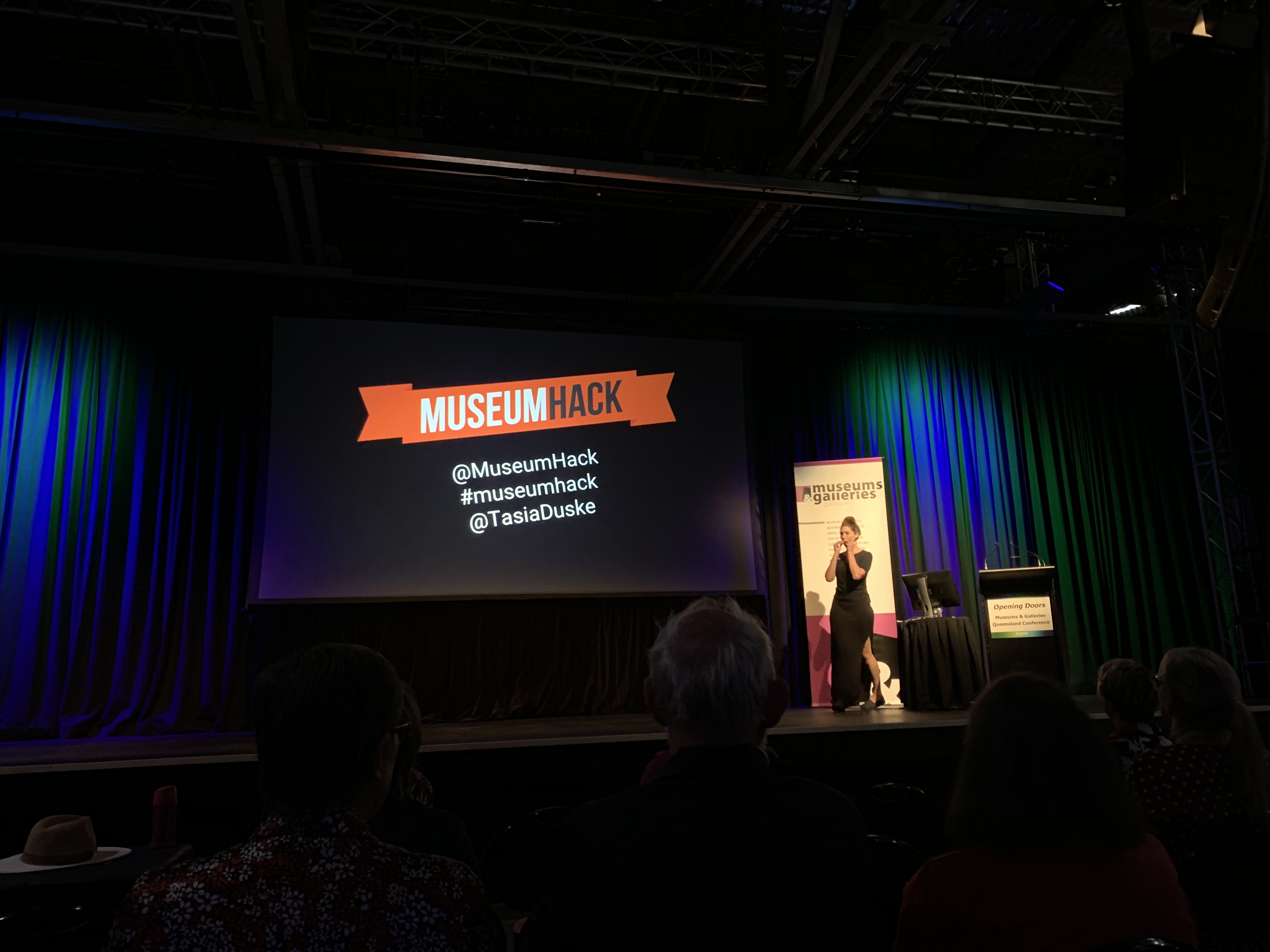
International Keynote Presentation by Tasia Duske, CEO from Museum Hack
International Keynote Presentation by Tasia Duske, CEO from Museum HackInternational Keynote Presentation by Tasia Duske, CEO from Museum Hack
This was the presentation I most looked forward to seeing. Museum Hack is a company based in the United States, that delivers, in their words, ‘renegade, small group tours for people who think they don’t like museums’ (source). I was fortunate enough to experience a Museum Hack tour of The Getty back in 2017. These tours offer an accessible entry point into museums and galleries for those who might otherwise never set foot inside. Of course, the tours can also be enjoyed by those with an interest in museums as a way of experiencing a new perspective. What started as some impromptu tours, led by founder Nick Gray, soon developed into a company with more than 50 team members delivering over 40 tours per week in cities such as New York, Washington DC, San Francisco, Chicago, Los Angeles and Philadelphia.
Tasia Duske is the current CEO of Museum Hack and injected some much needed enthusiasm and energy into the morning. Her presentation focused on the four main pillars of Museum Hack: start with entertainment and passion, the power of storytelling, social experience and create a sense of VIP. I can attest to the fact that our tour delivered on everything and hearing the theory behind the practice was really insightful. Duske not only spoke about the tours, but almost delivered one herself encouraging audience participation and sharing some intriguing stories. I am still buzzing from the talk and cannot wait to brainstorm ways of implementing some strategies into our programs.
There are two things about this talk that will stay with me. The first is that when targeting groups try not to get wrapped up in age, gender, etc, but also try to target different mindsets. Duske used the term ‘millennial mindset’ to describe the audience Museum Hack are hoping to reach. This isn’t the elusive age group termed ‘millennials’, but anyone with a suited mindset. The second thing is I really appreciate companies that want to make the inaccessible, accessible. After visiting numerous art galleries and even working in one for a year, I can still feel quite alienated and isolated when I visit. What is mostly responsible for this is the language used, especially on labels. Museum Hack really broke down that barrier for me at The Getty and it was great to hear that it’s achieving the same goal for so many other people.
11.00 am
For our first concurrent session of the day, I selected the talks in the Visitor Centre. These all focused on new audiences and in-depth engagement. A nice link to the morning’s session.
Nicola Holly, Manager from Queensland College of Art
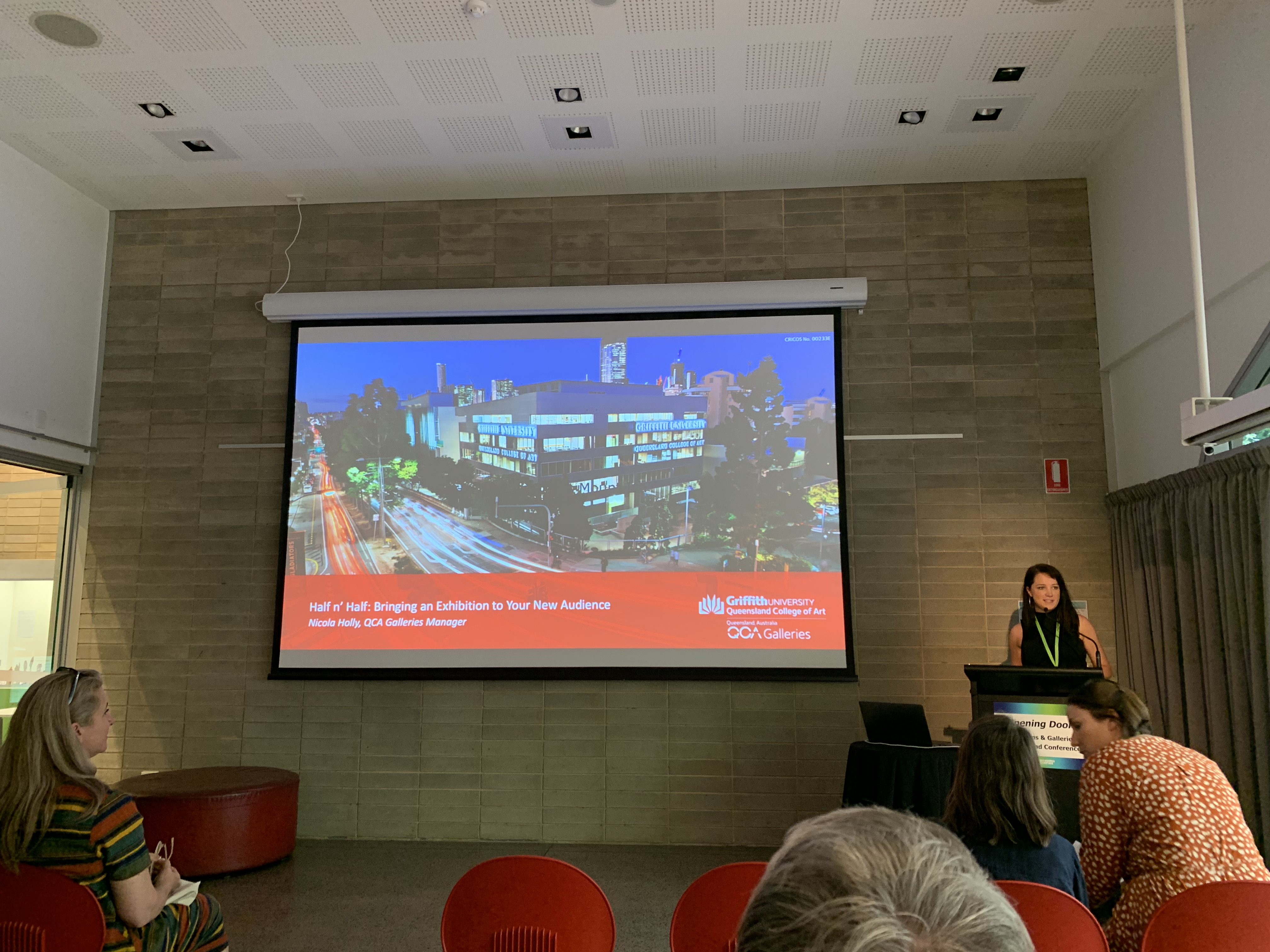
First in this session was a wonderful talk from Nicola Holly on how Queensland College of Art managed to engage their new neighbours at Southbank, Flight Centre. The level of collaboration was very impressive as Flight Centre allowed for an exhibition, ‘Morphosis: The Art of Sustainable Transformation’, to be held in their entrance foyer. Of course, this came with challenges such as how to install somewhere unfamiliar and how to conserve the works on display. Despite this, the benefits far outweighed the challenges with increased sales in artworks, a new audience, and the formation of a new partnership.
Shanna Muston, Arts and Cultural Advisor from Banana Shire Regional Art Gallery
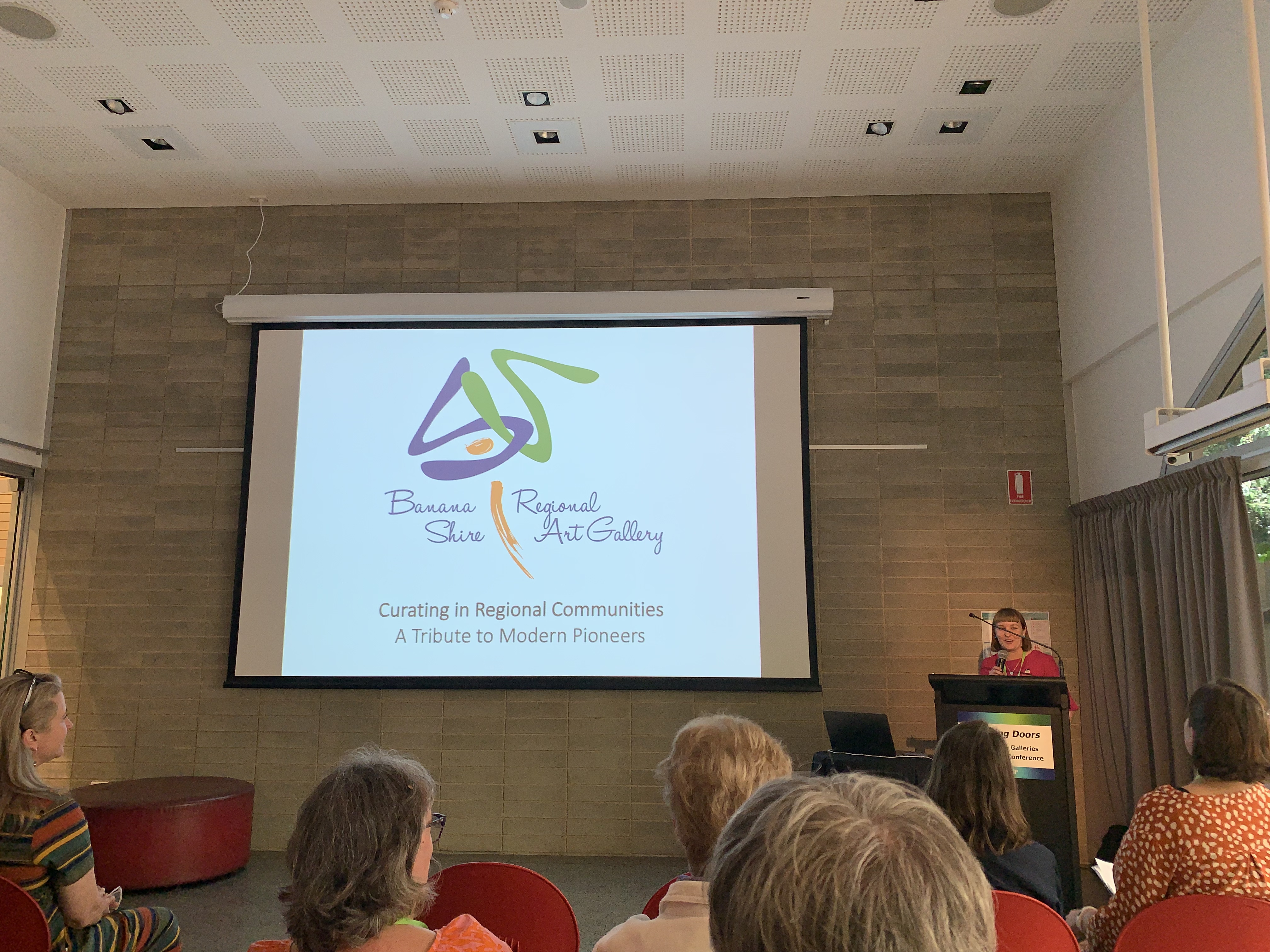
Next in the session was Shanna Muston talking about a recent exhibition, A Tribute to Modern Pioneers. This was a bit of a different exhibition for the Banana Shire Regional Art Gallery. The project included finding modern pioneers in the region, collecting their stories, and exhibiting these alongside professional photographs. One huge takeaway message from this talk was how you might have a clear idea for a project and its outcomes, but when collaborating it’s also important to allow a project to evolve. What was initially going to be 10 portraits with a publication and tour, became a project that included loaned objects, additional photographs, behind the scenes videos and public programs.
Lisa Jones, Curator from the Queensland Police Museum
The final speaker in this session was Lisa Jones who introduced delegates to the new Augmented Reality app at the Queensland Police Museum. Originally, the museum had an actual reality crime scene (using mannequins for obvious reasons) where students and visitors could put on their detective hats and solve a murder. To allow for deeper engagement, this is being replaced by an app that all visitors can download onto their smart device and that’s activated by a marker in the space (mannequin). Now, solving the crime can be done digitally and will include searching for evidence that can be sent for fingerprint or blood analysis. I cannot wait to try this app in person when it’s released!
1.30 pm
Similar to yesterday, it was about this time that I started to feel the need for a nap but powered through.
Elspeth McEachern, Senior Cultural Heritage Officer from Sunshine Coast Council
Everything in Elspeth McEachern’s talk linked back to her ‘Awesome’ Principle for museums. In a society where there is a marked decrease in leisure time, how can museums ensure they remain relevant? Awesome can help and I’ve included a photograph below of what it means. Soft fascination refers to the fascination people have that’s not directed and, therefore, not depleting.
Elspeth McEachern, Senior Cultural Heritage Officer from Sunshine Coast Council
Rachel Arndt, Gallery Programs & Touring Exhibitions Manager from Museums & Galleries of New South Wales
The focus of Arndt’s talk was on cultural mediation – the process of negotiating and gaining knowledge about the arts through some kind of exchange. A model for this comes from the Palais de Tokyo in France that has employed cultural mediators to be present in gallery spaces. They are not invigilators. Instead, they are there to encourage people to make connections with the artworks and guide people ‘beyond comprehension’.
3.00 pm
Similar to the Museum Hack presentation, the two final talks of the day were a call to action.
Gail Mabo, Curator and Kellie Williams, Director from Umbrella Studio Contemporary Arts
It was a wonderful experience to hear Gail Mabo talk so passionately about how to effectively engage Indigenous communities in the arts. You can’t just walk into a community, ask them to produce works for an exhibition, then leave. It’s about fostering a relationship, providing some form of ongoing support, and not using the opportunity as tokenism. Kellie Williams provided an example of working closely with artists when reviewing and signing contracts. Williams sits down with the artist and goes through it word by word to ensure both parties are happy with the contents. It takes time, but it’s necessary.
Sprouting from this discussion also came a fantastic takeaway – ‘Living RAP’, or living your Reconciliation Action Plan. Don’t just have one sitting on your bookshelf gathering dust, you have to read it, action it, and live it. Mabo and Williams also spoke about their co-curated exhibition ‘Legacy: Reflections on Mabo’ that will be touring around Australia not only to ‘white cube’ galleries (as Kellie put it) but also to community centres.
Tracy Puklowski, Director of Creative Arts and Cultural Services and Curator from City of Launceston, Queen Victoria Museum and Art Gallery
Our final speaker of the day also presented a very passionate talk focusing on the direction and future of the Queen Victoria Museum and Art Gallery (QVMAG). Tracy Puklowski spoke about her background, working in New Zealand, and how this will impact on her new role at QVMAG. Specifically, Puklowski is looking at more seamless integration of stories from different cultural groups that are not stuck in a past, but have a thriving present. It absolutely resonated with me when she stated that you first need to lay solid foundations before moving onto large projects. Something I am currently focusing on in my role. It will be fascinating to see how such a strong background filled with bicultural normality will start to shape and influence QVMAG into the future.
Final Thoughts
I am very grateful to now have a weekend that will no doubt be filled with reflections on the conference and how I can apply some of what I’ve learnt to my own practice. Thank you again to everyone involved in making this conference so incredible!
It has been a very long day filled with incredible talks containing so many new ideas and innovative programs. I forget how utterly exhausted I feel at the end of a full conference day! At least this time I came prepared with a portable charger so my phone battery could remain fully charged. At each conference I attend, I like to provide a summary of the day including the talks I attended and some of their key messages. That way, if you’re not here, you can still learn a little about what has been discussed.
9.00 am
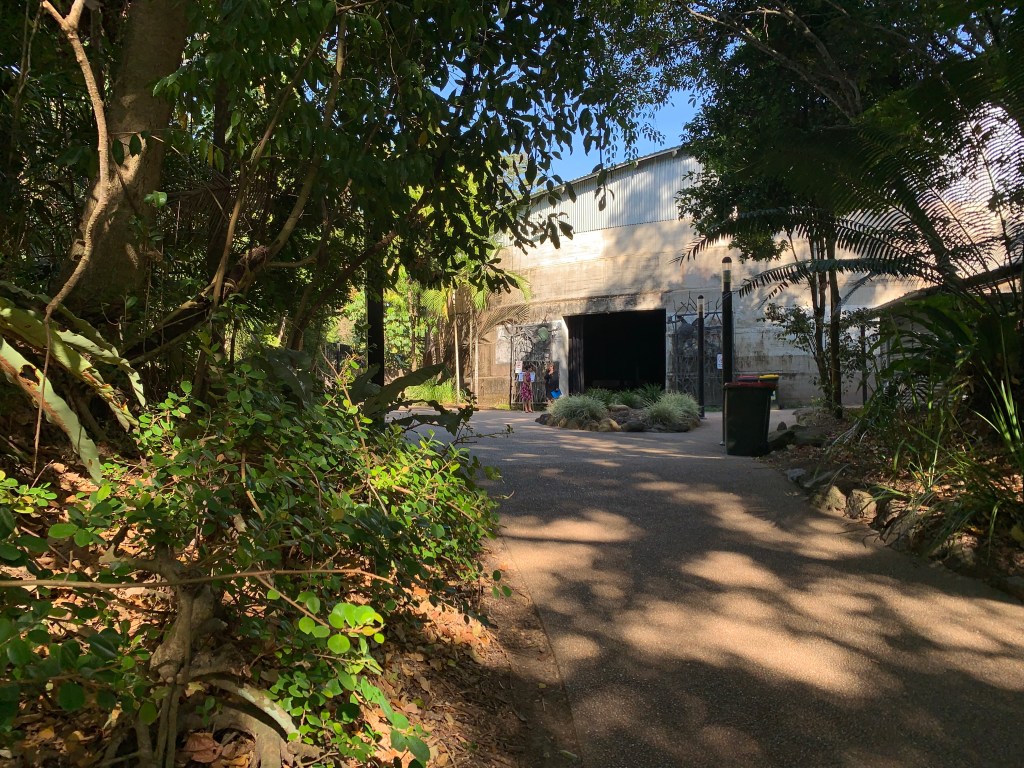
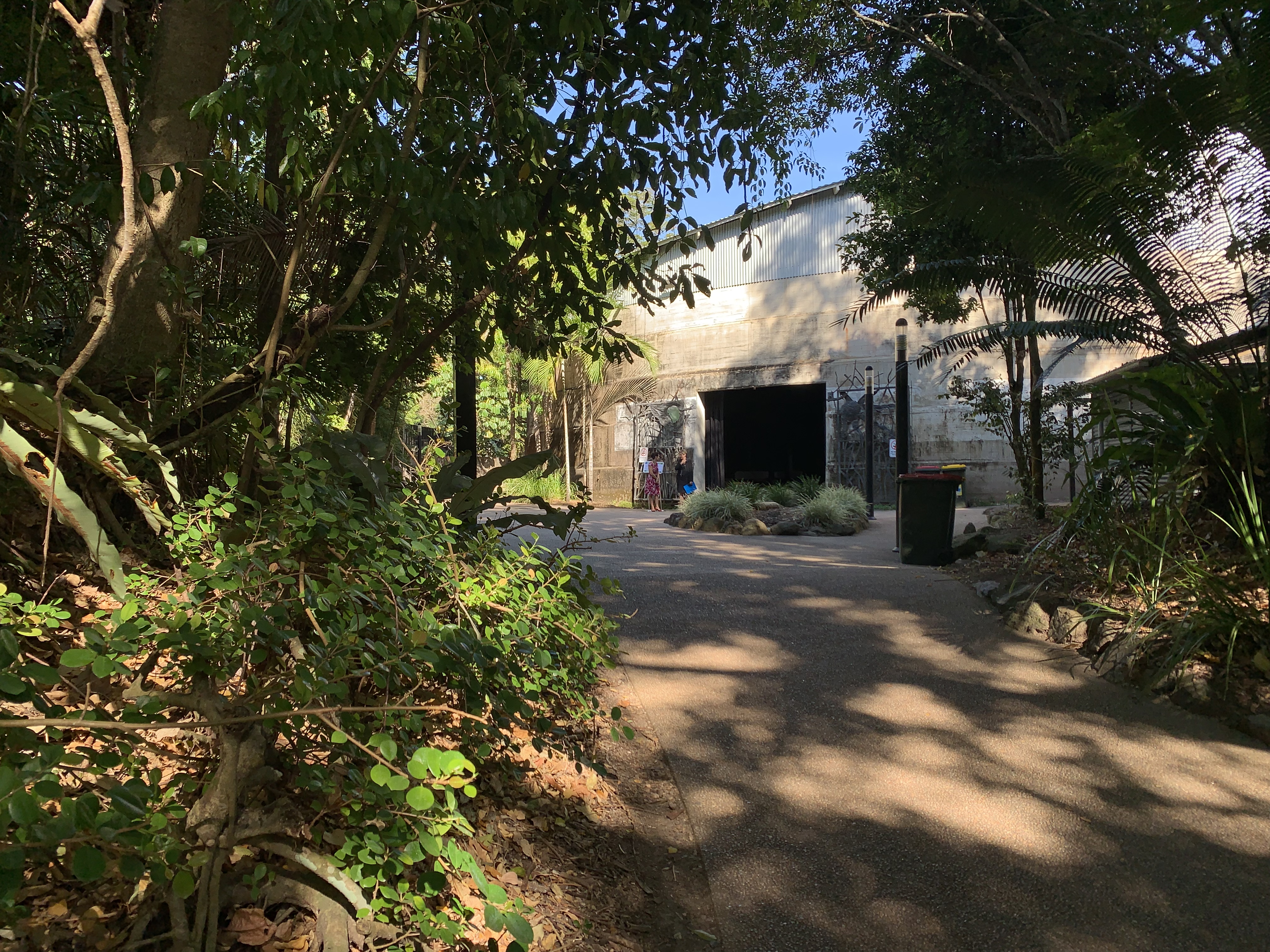
Similar to the National Conference in Alice Springs, I am so grateful that this conference is offering a complimentary bus service transporting delegates from the CBD to the conference location, Tanks Arts Centre. This venue scores 11/10. For a bit of historical context, the Centre consists of three concrete fuel tanks that were built for the Royal Australian Navy in 1944 in the rainforest of Mount Whitfield. They were decommissioned in 1987 and repurposed into an arts centre from 1992. In 2006, the entire precinct was inscribed on the State Heritage Register for its significance to the region. It is such a peaceful spot for a conference.
The TankThe Tank
To start the conference, we had a wonderful Welcome to (and connection to) Country performed by the Minjil Dancers. Then, we were welcomed by Cr Bob Manning OAM, Mayor of Cairns Regional Council. Manning highlighted the significance of the arts in Cairns and his dedication to seeing its influence grow through new programs and projects.
9.45 am
International Keynote Presentation by Frith Williams, Head of Experience Design from Museum of New Zealand (Te Papa Tongarewa).
Frith Williams, Head of Experience Design from Museum of New Zealand
I have probably raved way too much in the past about how great Te Papa is and how amazing they are for their seamless integration of Māori language and culture in everything they do. I was very fortunate to visit the Museum last year and experience it for myself.
Frith Williams spoke about their newly opened permanent exhibition, Te Taiao|Nature. Essentially, the talk delved into how the exhibition was imagined from the beginning and what, in the end, was delivered. Part of this process relied on knowing their audience and collaborating with the wider community. There were some fantastic insights provided including their ‘Inspire’ renewal approach (it’s like an acrostic poem).
Inspire wonder
Nurture diversity
Shake things up
Prepare for the Future
Invite Involvement
Reach Out
Empower our Communities
Although undertaking this new and exciting renewal, Williams also spoke about the five fundamental principles of Te Papa that had to remain central to the project (bicultural, sustainable, accessible, updateable, and safe). I want to briefly mention one thing about their bicultural principle in this exhibition. Going one step further than having a label in English and one in Maori, the new exhibition actually tries to merge them together to teach visitors new words. Make your visitors stop, think, and learn. It creates more memorable experiences.
Williams also made an effort to relate to smaller museums, with restricted budgets, by offering some tips. For example, you don’t need state of the art technology to help people interact. What you can do is have something big and imposing that many can stand in front of and talk about.
11.30 am
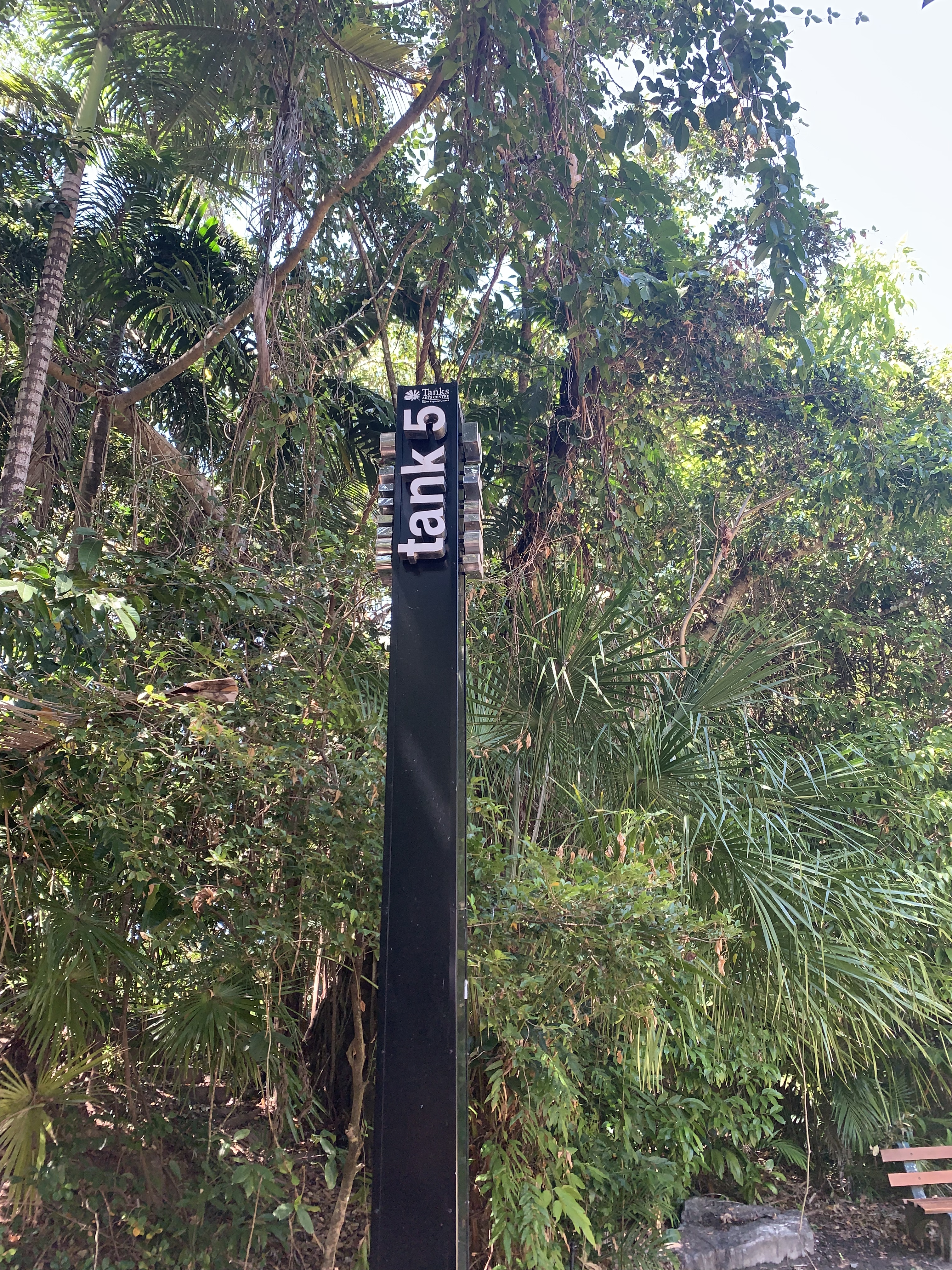
After morning tea, we had a choice of three concurrent sessions. I decided to attend the talks in Tank 5 looking at the Rockhampton Art Gallery, volunteers, and creative engagement.
Bianca Acimovic, Gallery Director from Rockhampton Art Gallery
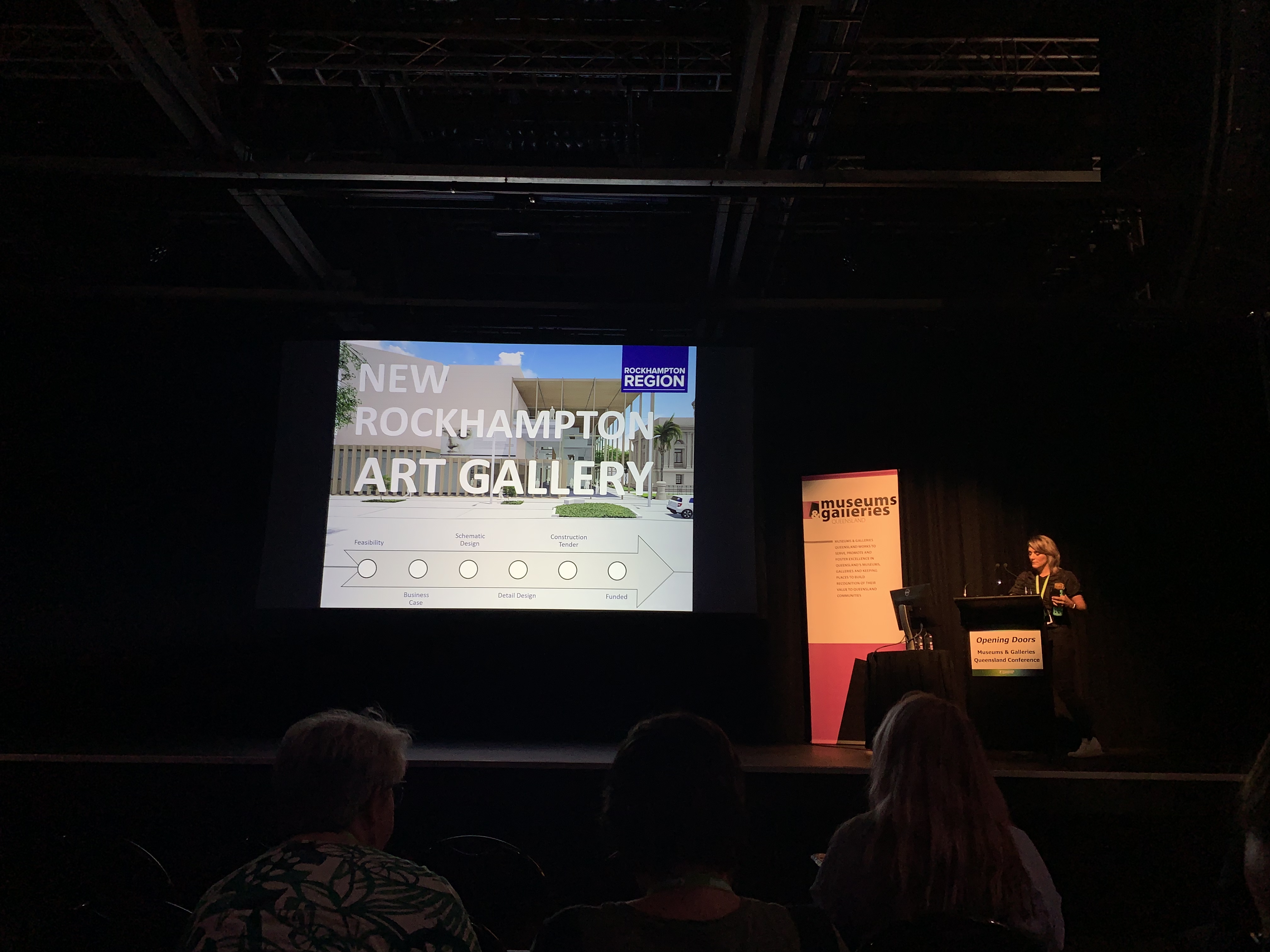
Rockhampton Art Gallery is currently undergoing a huge 31 million dollar revitalization project that will see the construction of a brand new gallery precinct. In Bianca Acimovic’s talk, delegates learnt about the stages involved, how funding has been acquired, and watched a short video showcasing what the new gallery will look like (at this stage). I visited the gallery a couple of times while living in Gladstone and I cannot wait to return once the new one is up and running. No doubt it will be a very significant place in Rockhampton.
Melanie Sorenson, Collections Manager & Melissa McQuillan, Volunteer Coordinator from Cairns Historical Society
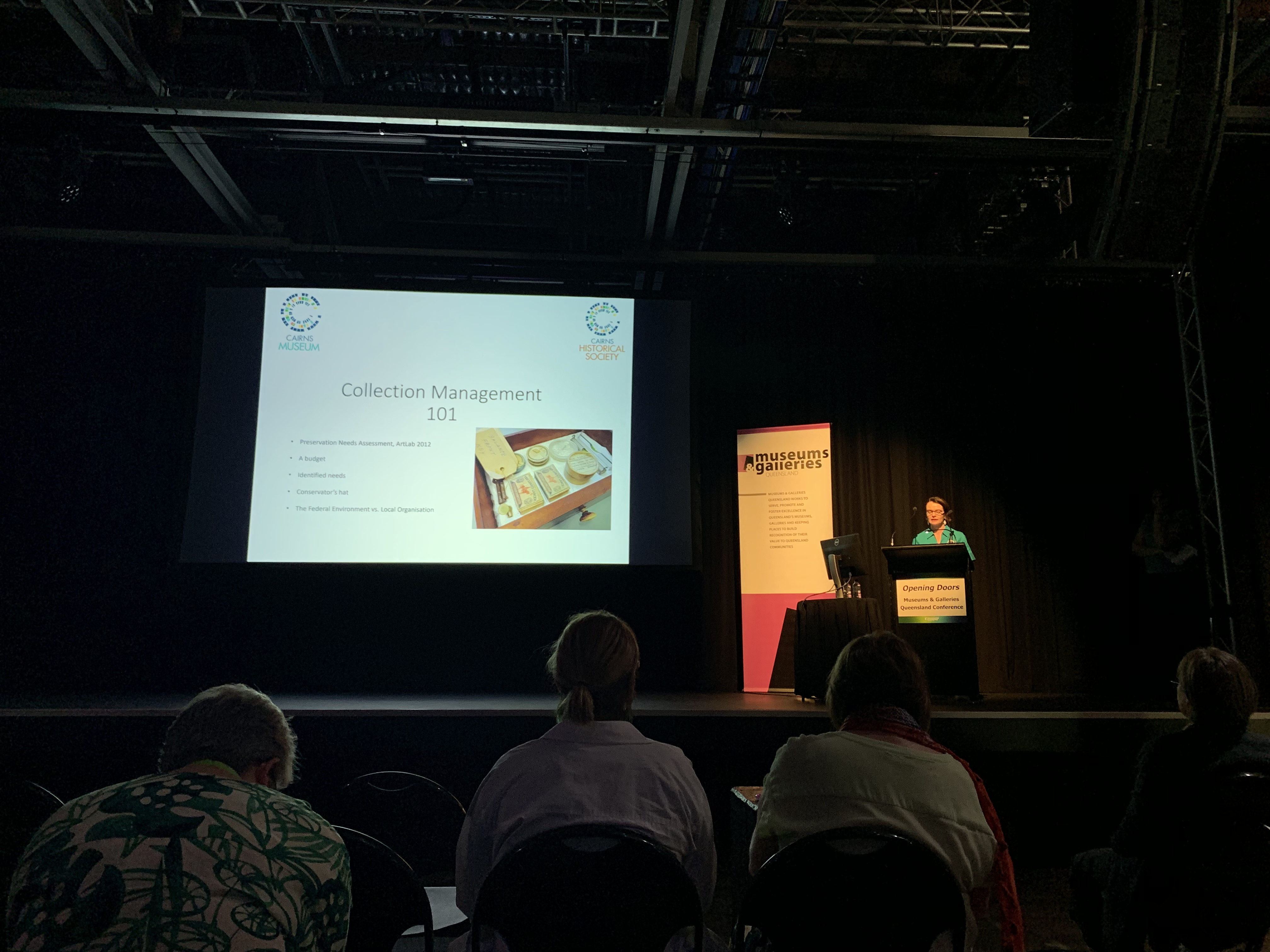
The next talk went behind the scenes of volunteer recruitment and retention in the Cairns Historical Society and Cairns Museum. It was really interesting to listen to this talk as I’ve volunteered in the sector for quite some time and have worked as a volunteer coordinator. Therefore, I have some very strong opinions on how volunteers should be treated and their potential. I was so happy to hear that this volunteer program has clear goals, great volunteer support, and opportunities available to suit a whole range of skills and interests. One quote I loved is that when selecting a project for a volunteer, it shouldn’t be age or gender specific, but attitude specific. It sounds like they run a very rewarding program that values the work of the volunteers and motivates them to become passionate promoters of the Museum!
Sheona White, Director from Penrith Regional Gallery
The final talk in this session was delivered by Sheona White and focused on creative engagement. One important takeaway message from this talk is that to be truly accessible (not just physically but much more broadly) everyone needs to be on board with a program, exhibition, etc. If you have conflicting experiences within a cultural institution (e.g. a fun program followed by VSOs policing people as they walk around) it can greatly lessen impact.
2.00 pm
I was very glad we only had to make one concurrent panel choice today. It’s very relaxing when you don’t have the fear of missing out on a good panel.
Julian Meyrick, Strategic Professor of Creative Arts from Flinders University
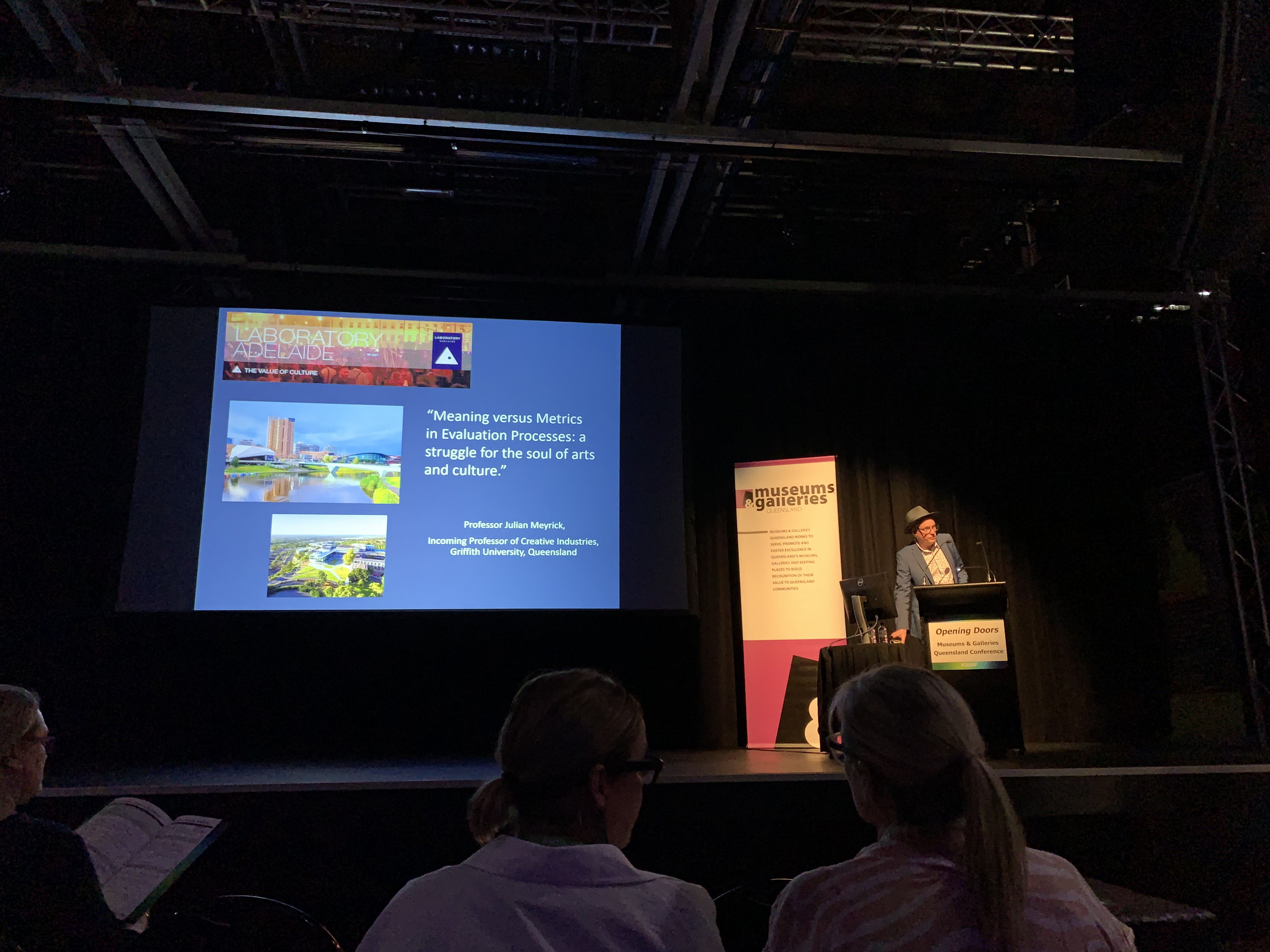
This talk managed to cover so many incredibly important points when it comes to cultural institutions and evaluations. How can we measure meaning? Clearly, counting people through the door is not a sustainable way for cultural institutions to evaluate their work. But, we often come into disagreement with those who want to see these numbers, and these numbers only, due to a lack of understanding. If you are familiar with the sector you’ll know all too well that qualitative evaluations are underemphasised in cultural policy and are not captured by current assessment methods. Julian Meyrick, Tully Barnett and Robert Phiddian discuss this at length in their book ‘What Matters? Talking Value in Australian Culture’. They narrow down the problem of evaluation to being something political, not methodological. I, for one, am excited to purchase the book and read more about their concepts and outcomes.
Deanne Fitzgerald, Senior Aboriginal and Torres Strait Islander Advisor from Western Australian Museum
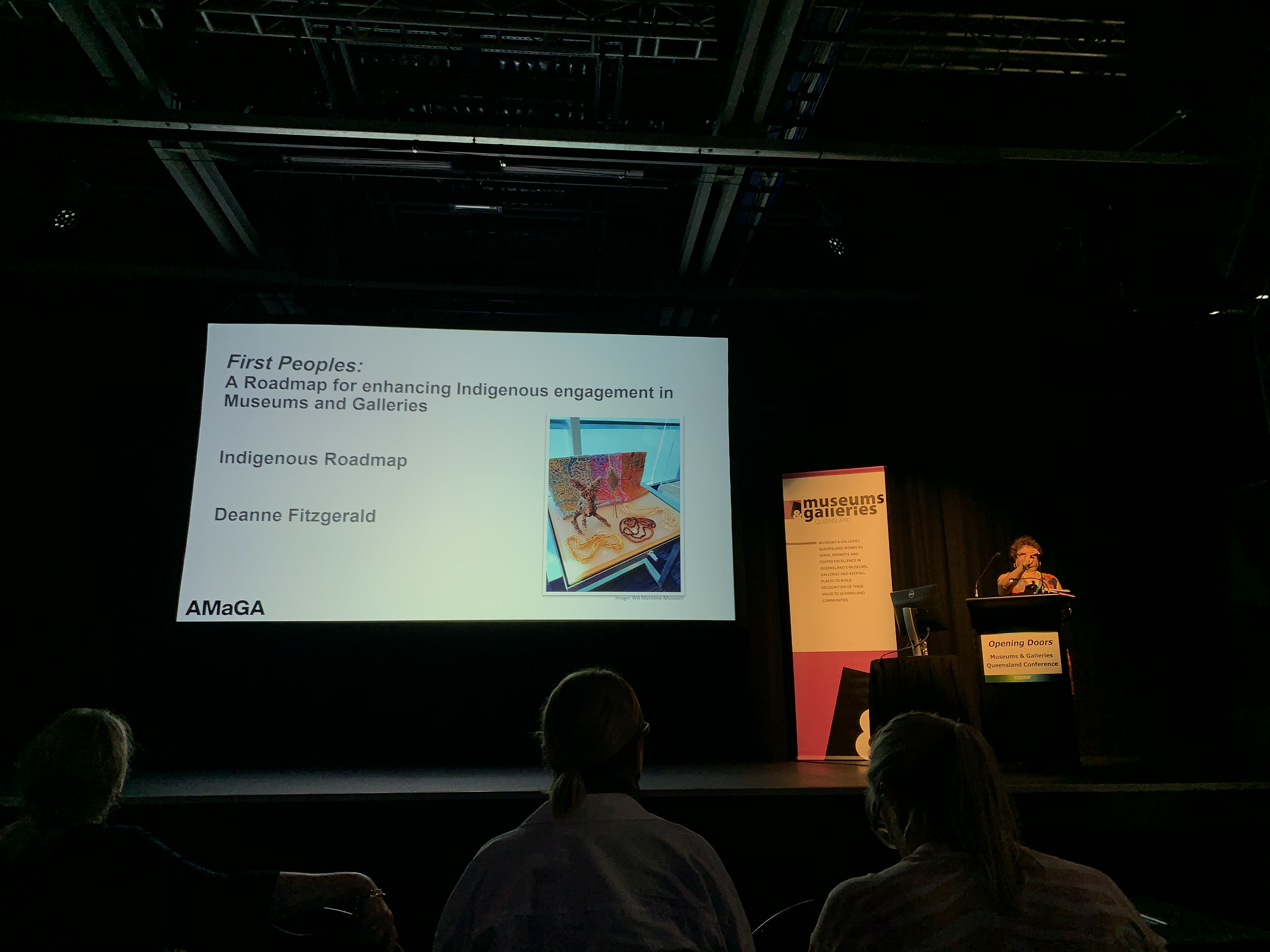
I won’t write much about this talk because Deanne Fitzgerald presented on the Indigenous Roadmap that I’ve already covered in a previous blog post from the National Conference in Alice Springs. You can read that here. It was a great talk for those unfamiliar with the Roadmap and also reinforced what was spoken about at the National Conference. In a very short amount of time for such a large topic, Fitzgerald was able to summarise the Roadmap and talk about the future goals outlined in the publication. These include increasing Indigenous voices in exhibitions and collaborating more with Indigenous communities when it comes to collection items and their use/storage.
3.55 pm
To end the day, we had four presentations that focused on Far North Queensland.
Suzanne Gibson, Manager; Dr Jo Besley, Consultant; and Dr Jo Wills, Museum Development Officer
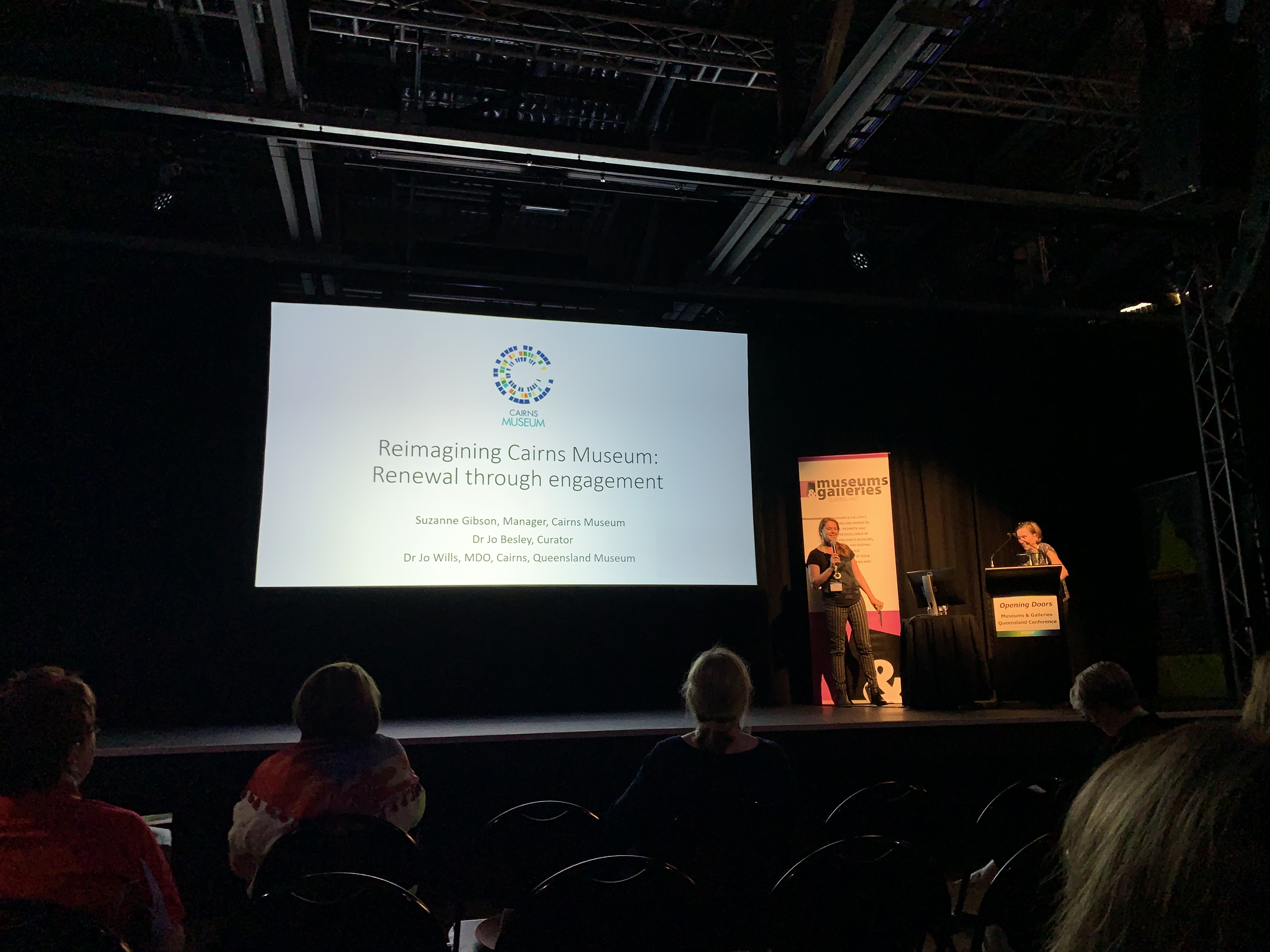
In 2017, Cairns Museum was completely redeveloped, transforming the Museum into a more modern, interactive space. Suzanne Gibson, Dr Jo Besley and Dr Jo Wills were instrumental on that team. In their presentation, they were able to provide an insight into engaging with the community throughout the process and involving the volunteers as much as possible. The end result, a museum that reflects and has been significantly influenced by the community.
Wills also presented the second talk focusing on her work as a Museum Development Officer with the Queensland Museum Network. Wills delivers support and programs for all Far North Queensland museums. This is around 50 institutions with only 8 paid members of staff and just under 400 volunteers. Wills has been involved in some amazing initiatives assisting museums with exhibitions, cataloguing their collections, and engaging with their communities. One particular program that stood out to me, is the work happening at Gab Titui Cultural Centre on Waiben (Thursday Island) in the Torres Strait concerning exhibition development. There are some wonderful exhibitions, including ‘Evolution: Torres Strait Masks’, that have emerged from this partnership.
Cultural Services from Cairns Regional Council
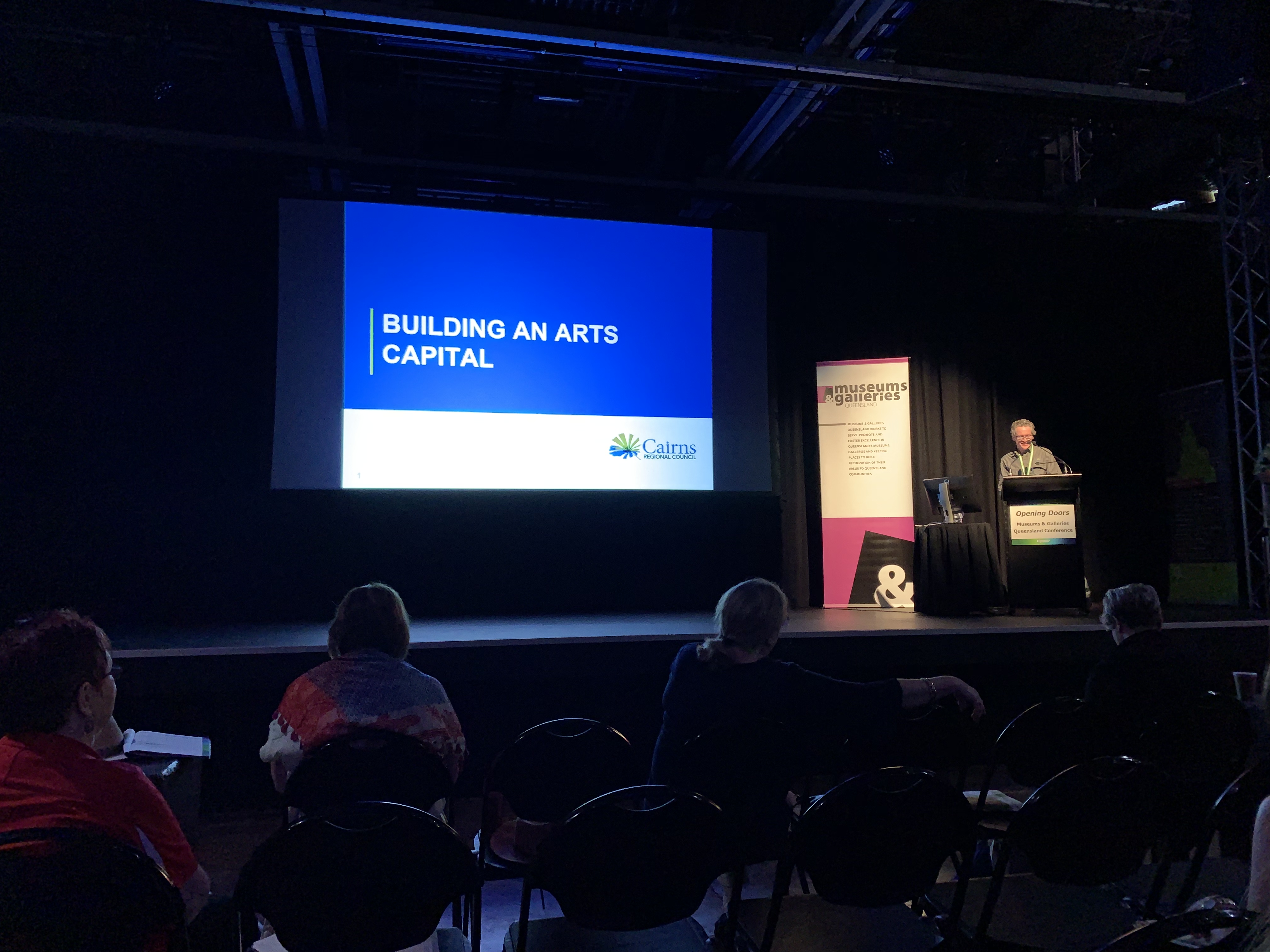
There was a last minute presenter change and I completely forgot to record who gave this presentation. If you were in attendance and noted it down, please let me know! The focus of this talk was on growing the arts in Cairns and creating an Arts Capital in the Far North. There was some discussion on the new gallery precinct that I linked to in the blog post on Cairns Art Gallery. The presenter also mentioned that the new Performing Arts Centre was shortlisted, alongside only fourteen nominees, for an international architectural award. What an achievement! The attitude of Cairns Regional Council towards the arts is unbelievably positive and reinforcing. A great model for other councils.
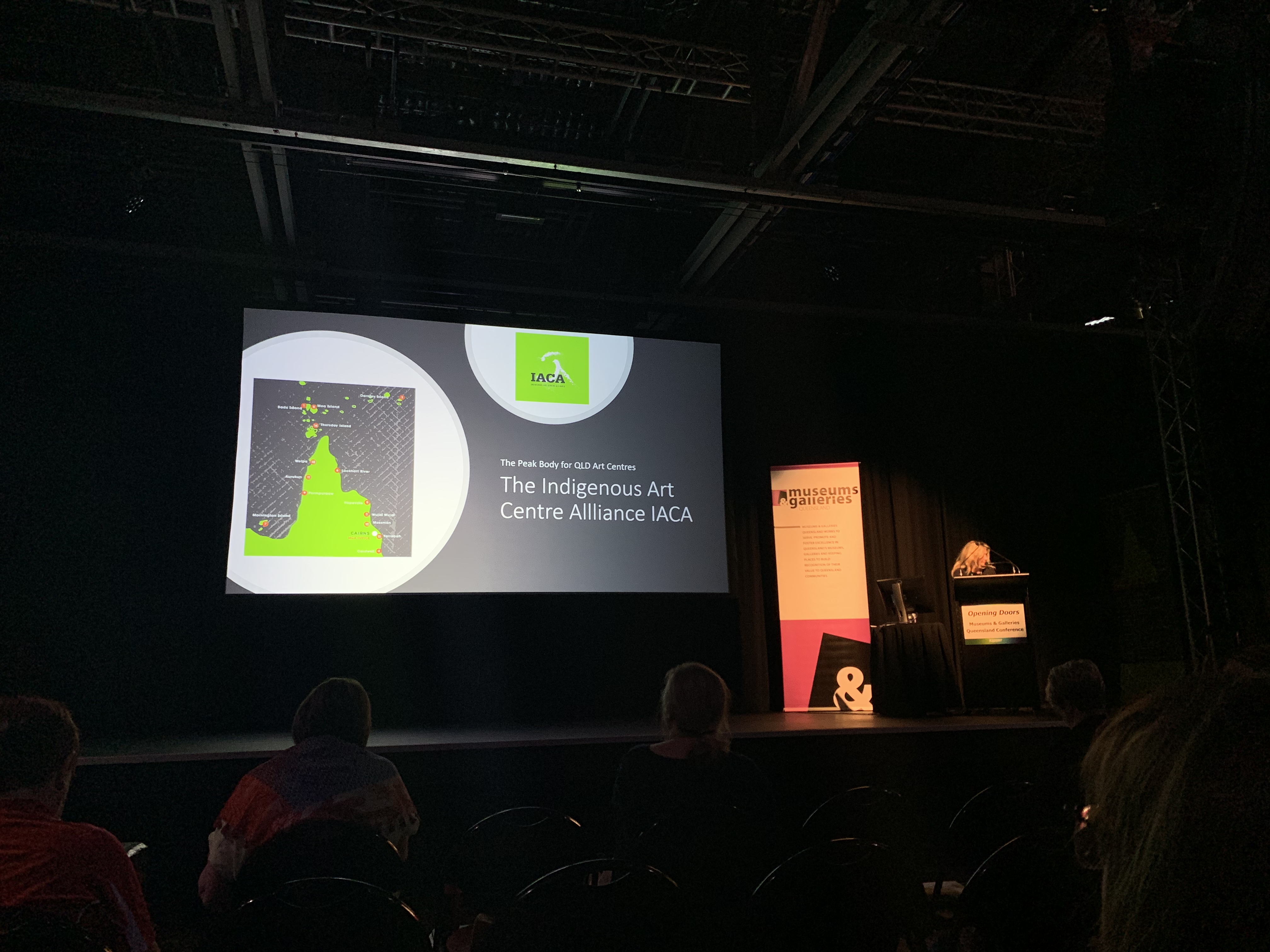
Pam Bigelow, Manager from Indigenous Art Centre Alliance
Our final speaker for the day was Pam Bigelow who talked about the role of the Indigenous Art Centre Alliance and its impact on Far North Queensland. This advocacy and support group grew from a need for a peak body. It aims to ‘effect sustainable growth through advocacy and long-term quality support for development, marketing and promotion’ (source). The work promoted by this group was noticed by the National Museum of Australia who will be exhibiting work from thirteen of the art centres in June 2020.
Final Thoughts
As you can see, it was a very jam-packed day with so many interesting presentations. I hope tomorrow challenges us even more about what it means to open doors.
Last night was the welcome reception for the Museums & Galleries Queensland conference held at the Cairns Museum. I wanted to briefly write about the public art tour I went on prior to the reception and also a bit about the Museum.
Public Art Tour
We were very fortunate to have two representatives from Cairns Regional Council join us for a walking tour around Cairns CBD to explore some of the public art. To give you an idea, there are 180 pieces of public art in the wider Cairns region and Cairns CBD. This basically means that everywhere you go in Cairns, you’re going to see a few works of art along the way.
At the start of the tour we were directed to the Cairns arts and culture map, an initiative of the Council. This map was launched in accordance with the Council’s Arts and Culture Policy that aims to enhance and promote cultural programs and facilities. Although not an app, it works pretty well on mobile devices. I wish I knew about this map earlier so I could explore more on my own! It geographically displays any arts, culture or heritage place in Cairns that fits into any of the following eight categories: facilities and spaces, festivals, public art, industries, artists, organisations, historical places, and city collections. You are able to select which category you’d like to explore so everything doesn’t show up at once.
If you are walking along the Esplanade and come across a sculpture that doesn’t have any interpretation available, this site is able to tell you the artist, year it was created, etc. There is also a ‘more details’ button that gives you a lot more information and some fantastic images of the work. It is a really great tool for exploring Cairns and must have involved a lot of work in setting up. If you would like to explore this site further click here.
The following is a selection of works we visited on the tour. I tried to take as many photographs as possible, but didn’t capture everything.
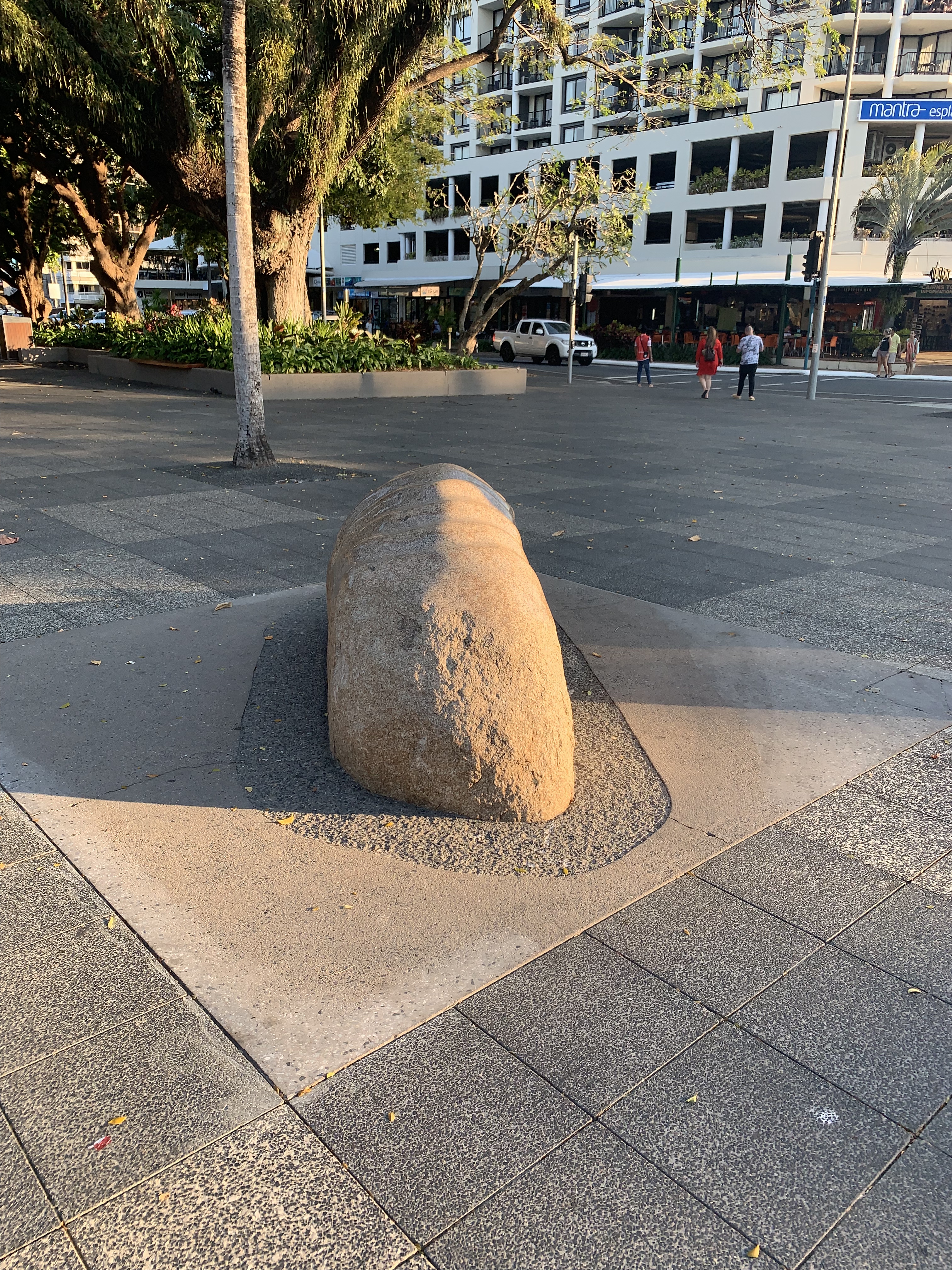
1. The Herd by Hew Chee Fong and Loretta Noonan
These granite sculptures were added to the Esplanade in 2003 during redevelopment. They represent a herd heading out to sea.
The Herd by Hew Chee Fong and Loretta Noonan
2. Brass Plaques by Brian Robinson
Dotted along the walkway of the Esplanade are brass plaques depicting Indigenous designs and motifs used by craftspeople and artisans from the Oceania region.
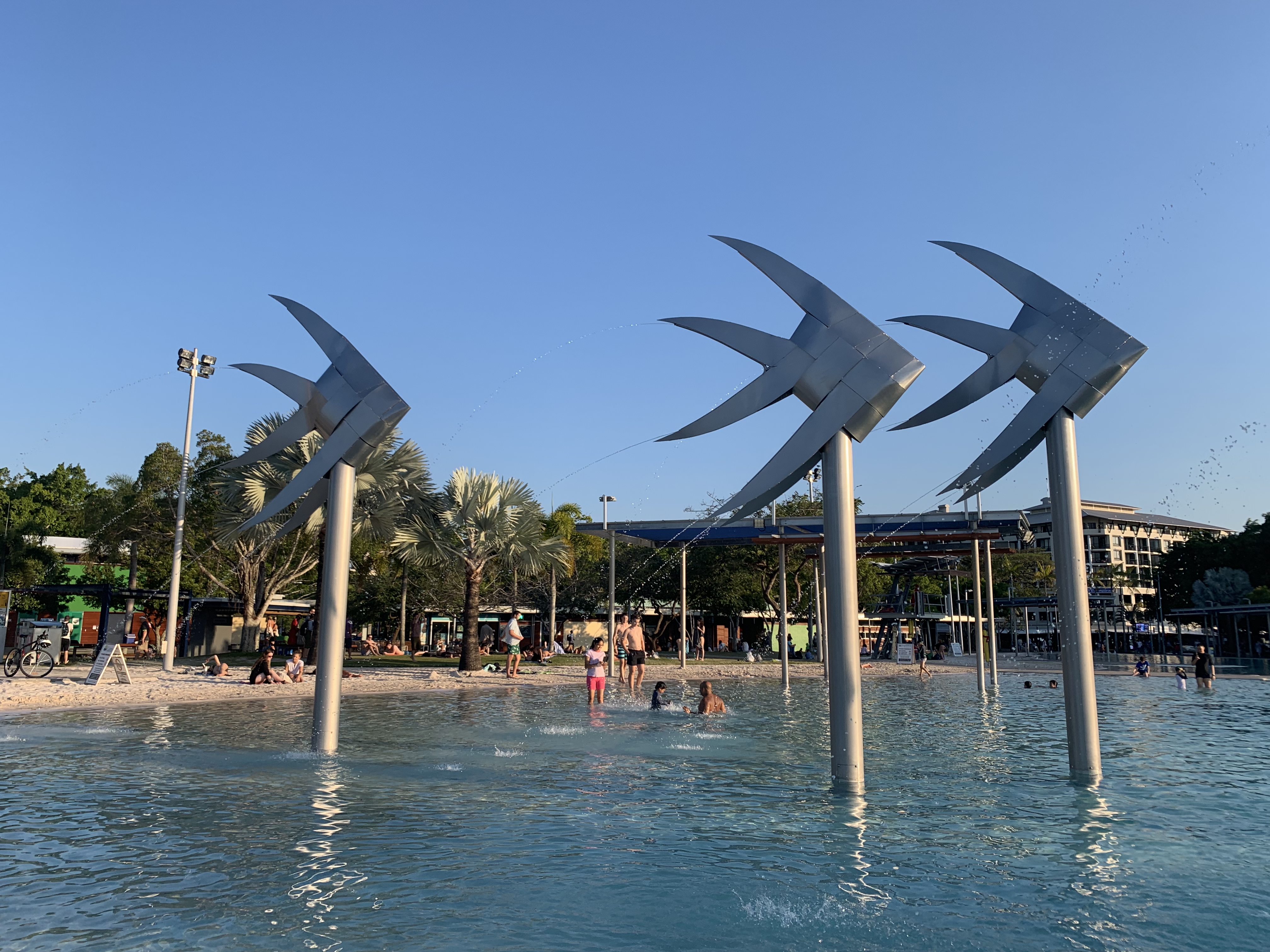
3. Woven Fish by Brian Robinson
If you have ever seen any advertising for Cairns, you’ve probably already seen these fish. Made from stainless steel, these fish are replicas of the traditional Torres Strait Islander practice of weaving palm leaves to create fish.
Woven Fish by Brian Robinson
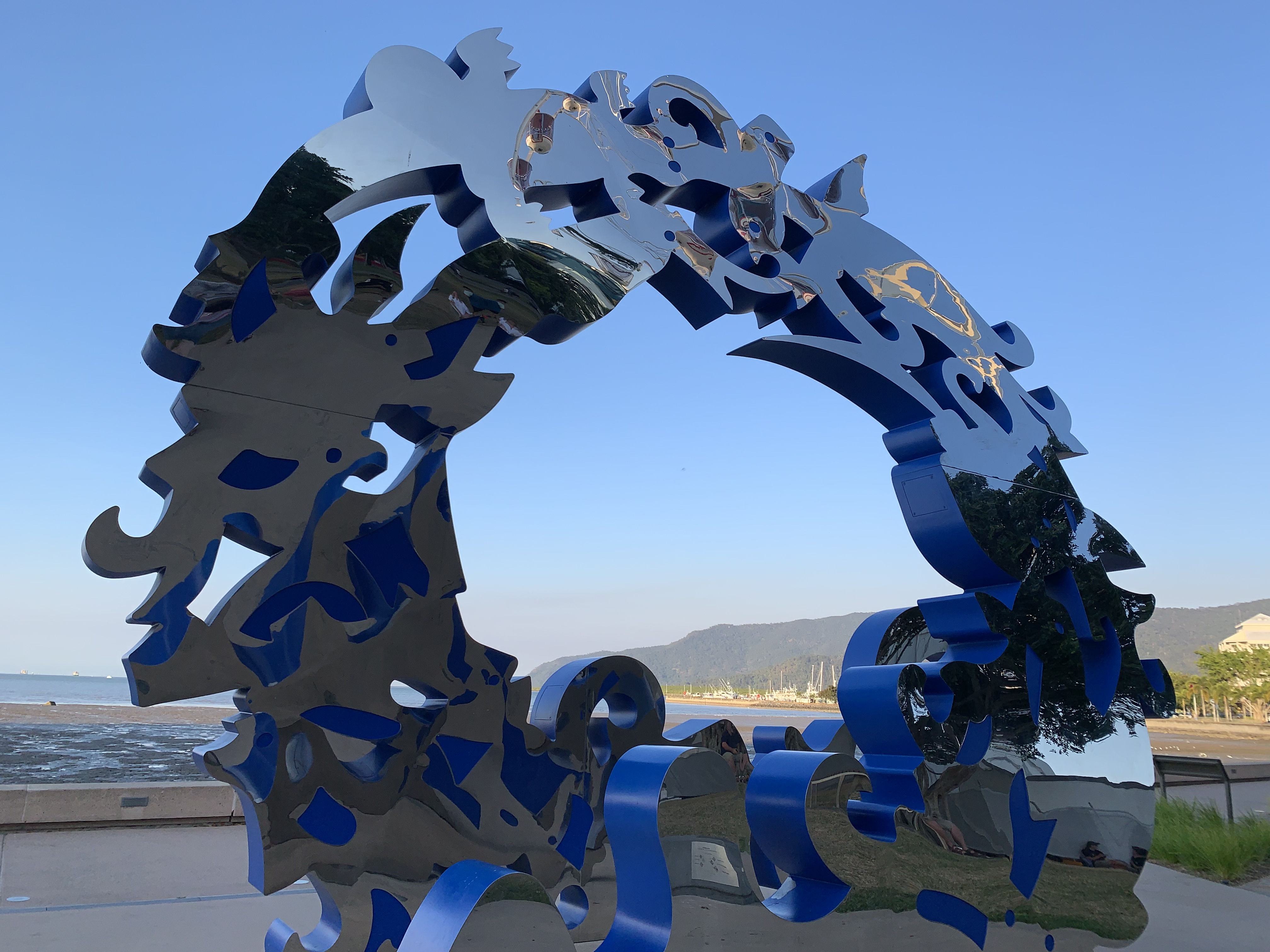
4. Citizens Gateway to the Great Barrier Reef by Brian Robinson
This is the most recent piece of public art to be unveiled in Cairns. It is a stunning work that aims to represent and encompass a social movement towards protecting the reef and ensuring it has a future. You could spend quite a bit of time looking at this work trying to decipher all the animals included. This was my favourite work to see on the tour.
Citizens Gateway to the Great Barrier Reef by Brian RobinsonCitizens Gateway to the Great Barrier Reef by Brian RobinsonCitizens Gateway to the Great Barrier Reef by Brian Robinson
5. Seasonal Lines by Paul Johnson
A very subtle but beautiful work using mosiac to map the tropical seasons in Cairns.
6. Rainforest Shields by Paul Bong
Paul Bong is a Yidinji Elder from Babinda, south of Cairns. This work consists of five shields that all represent something different, from welcoming everyone to country to telling ancestral stories.
To see photographs of all the works mentioned above, make sure you visit the arts and culture map.
Cairns Museum
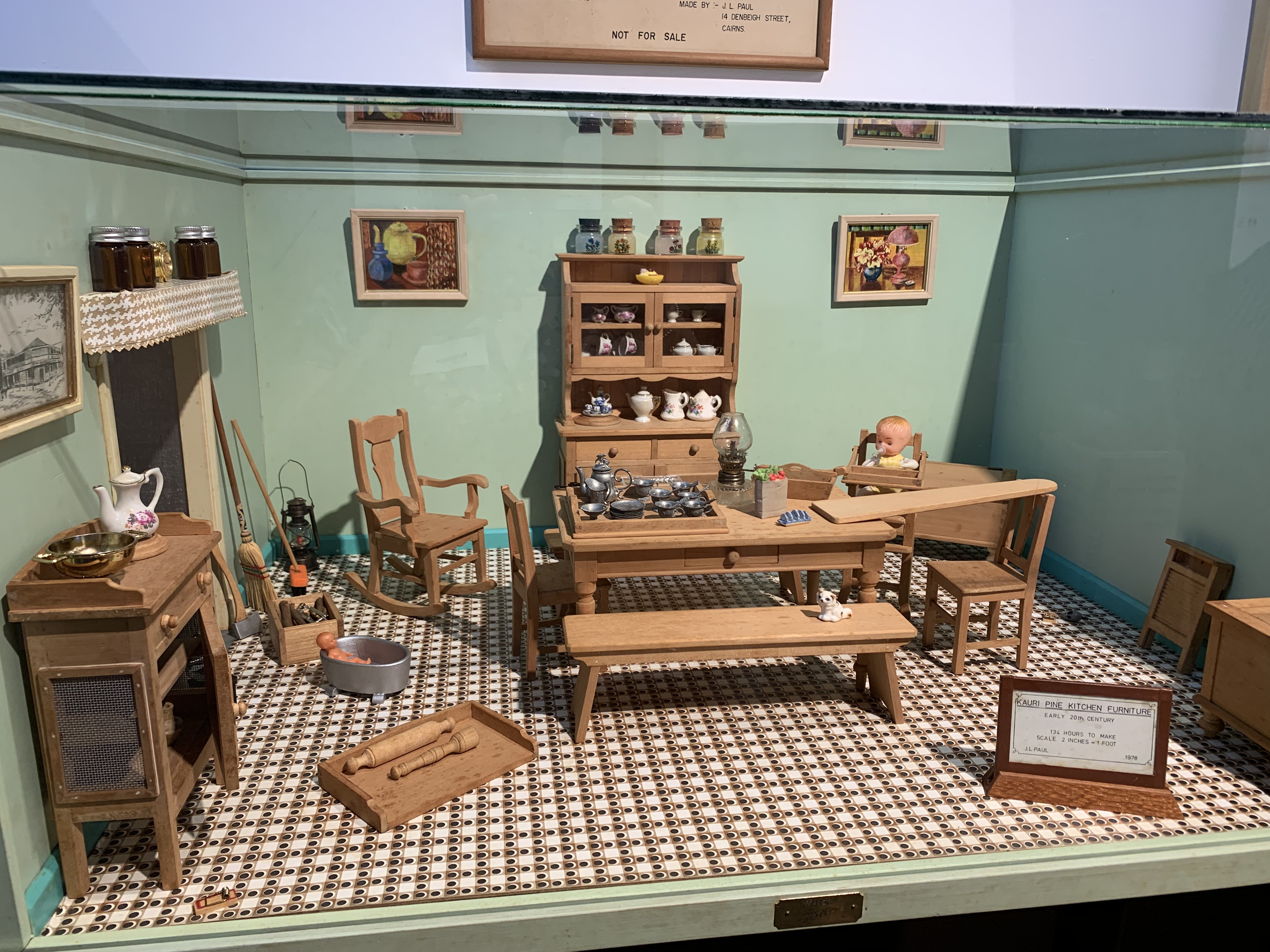
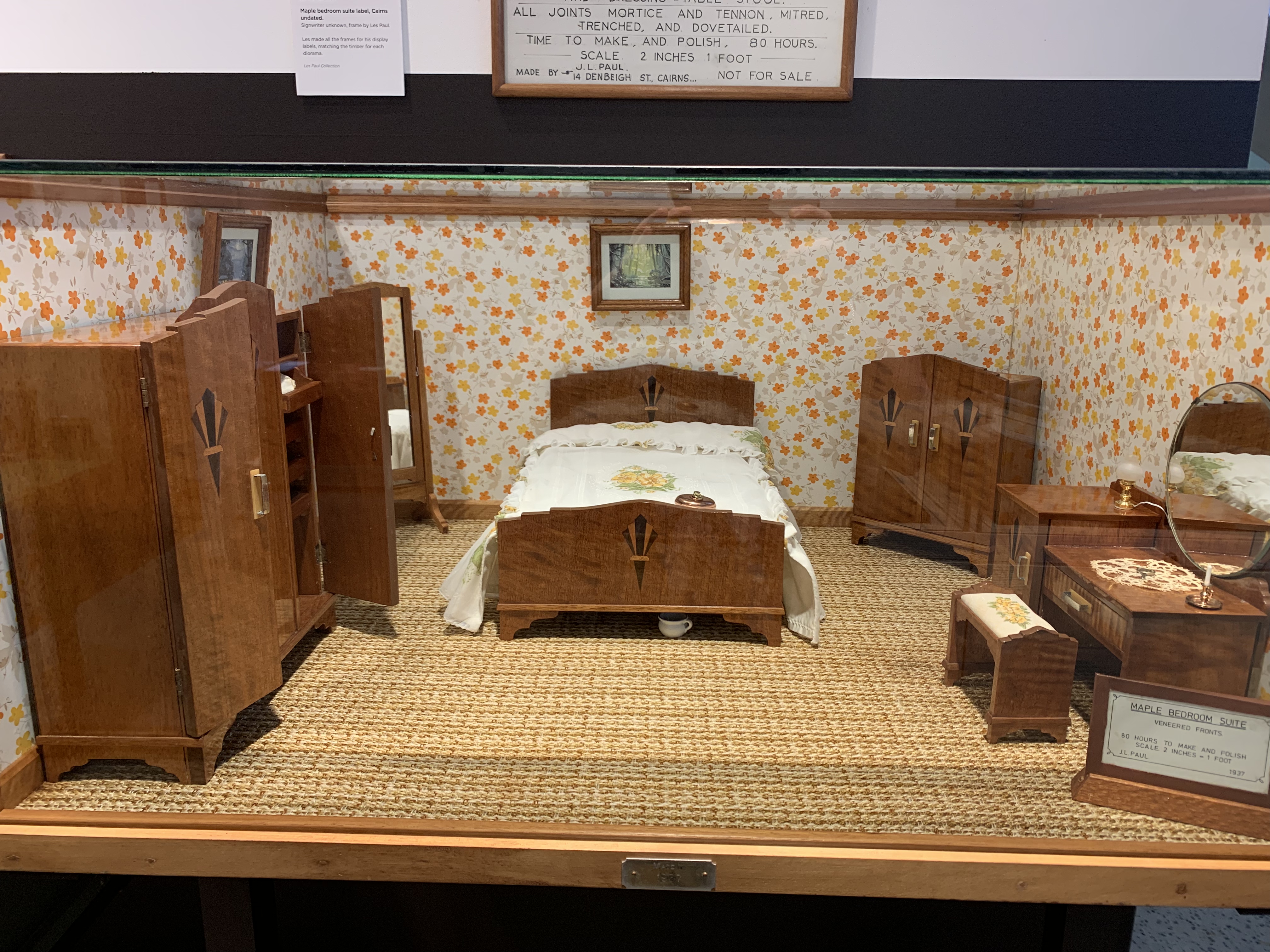
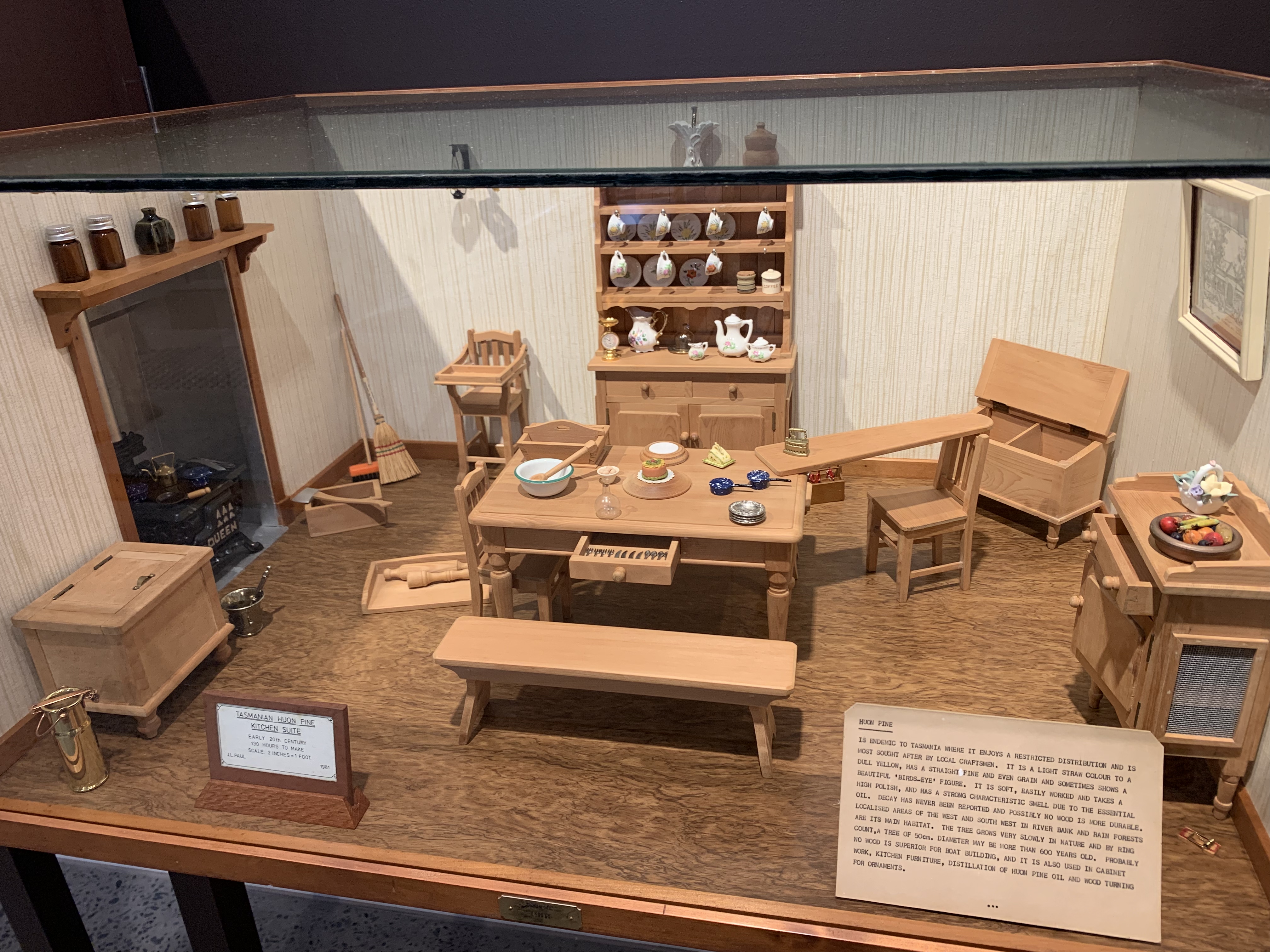
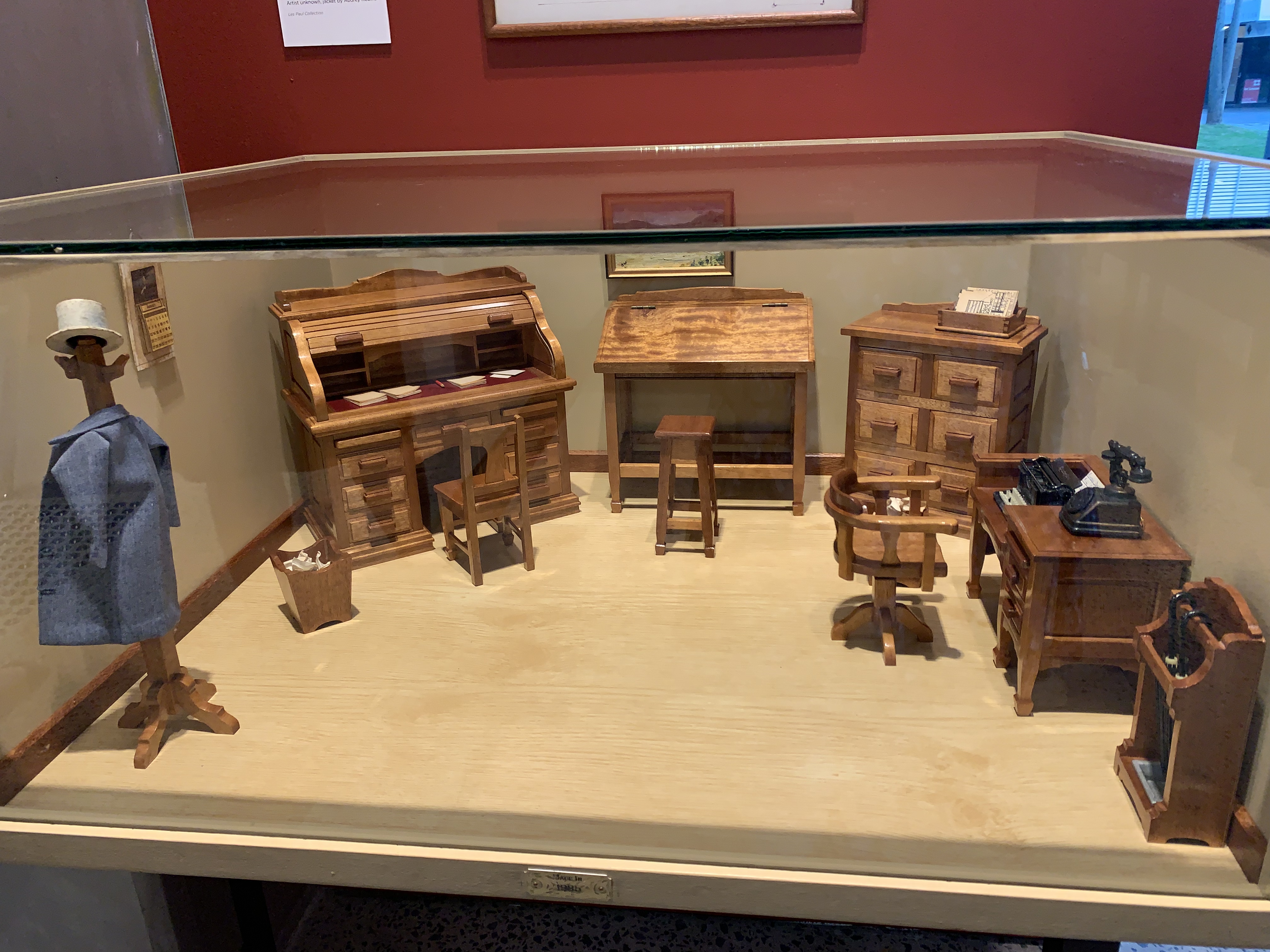
After the tour, it was time to explore the Cairns Museum and join everyone for the welcome reception. Much to my surprise, one of the temporary exhibitions on display is called Small World: Les Paul’s Miniature Furniture. Between 1973 and 1987, Les Paul created 11 miniature dioramas and 4 miniature collections depicting ‘typical’ rooms in Cairns using available rainforest timber. The main skill involved in creating miniature items is to ensure that the proportions of each object are to scale. Not only do they display his skill, but allow for some insight into Cairns in the early 1900s. The Cairns Museum acquired Les Paul’s collection, along with his tools and records.
Here are my favourite rooms.
Kitchen – early 20th centuryBedroom Suite – 20th centuryKitchen – Tasmanian Huon PineOffice Furniture – 19th century
Tour
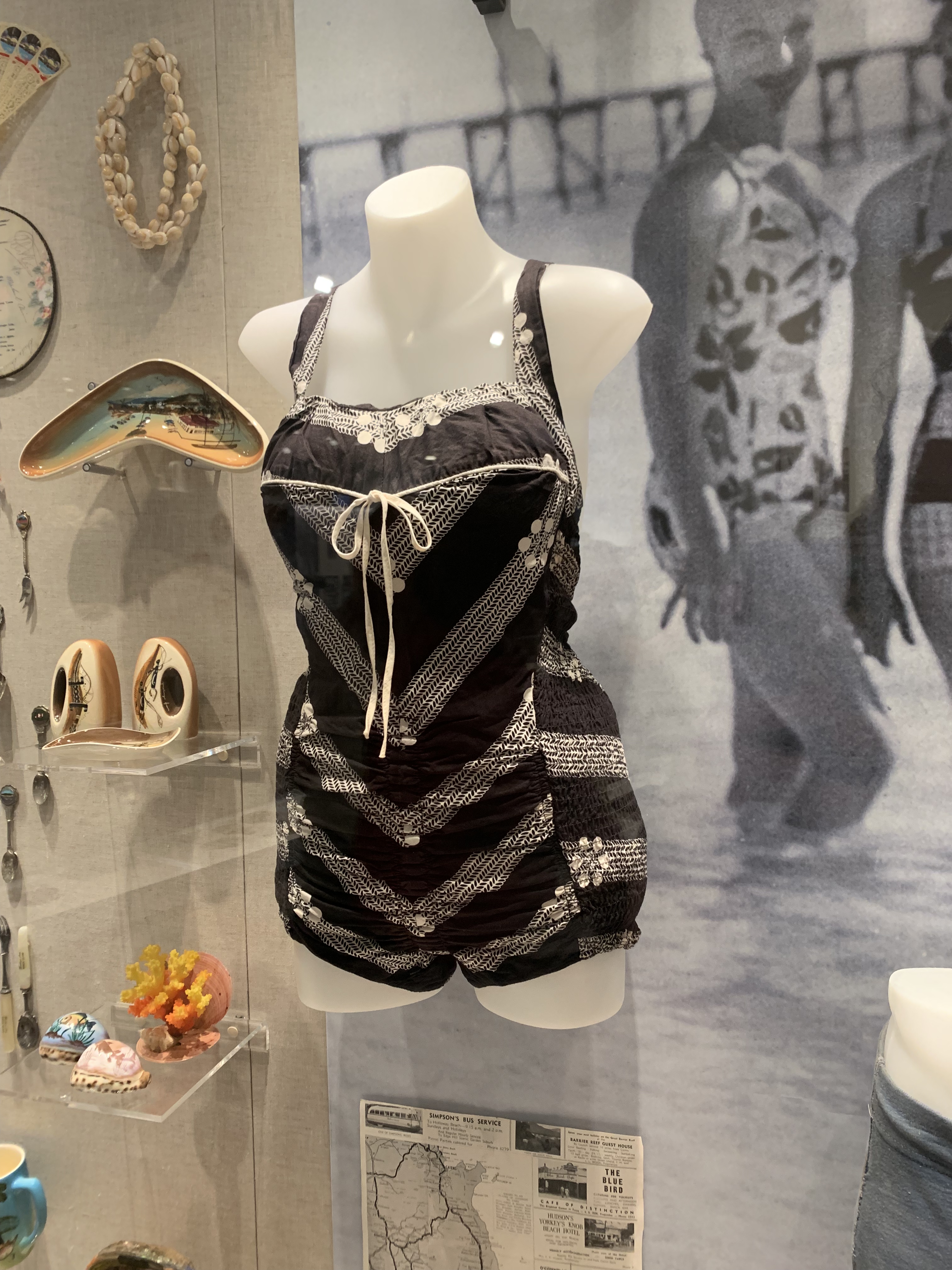
A huge thank you to our volunteer guide, Shannon, who briefly showed us around the other floors of the museum pointing out a few objects along the way. A highlight for me was seeing these bathers from the 1950s in the context of early Cairns tourism.
Bathers
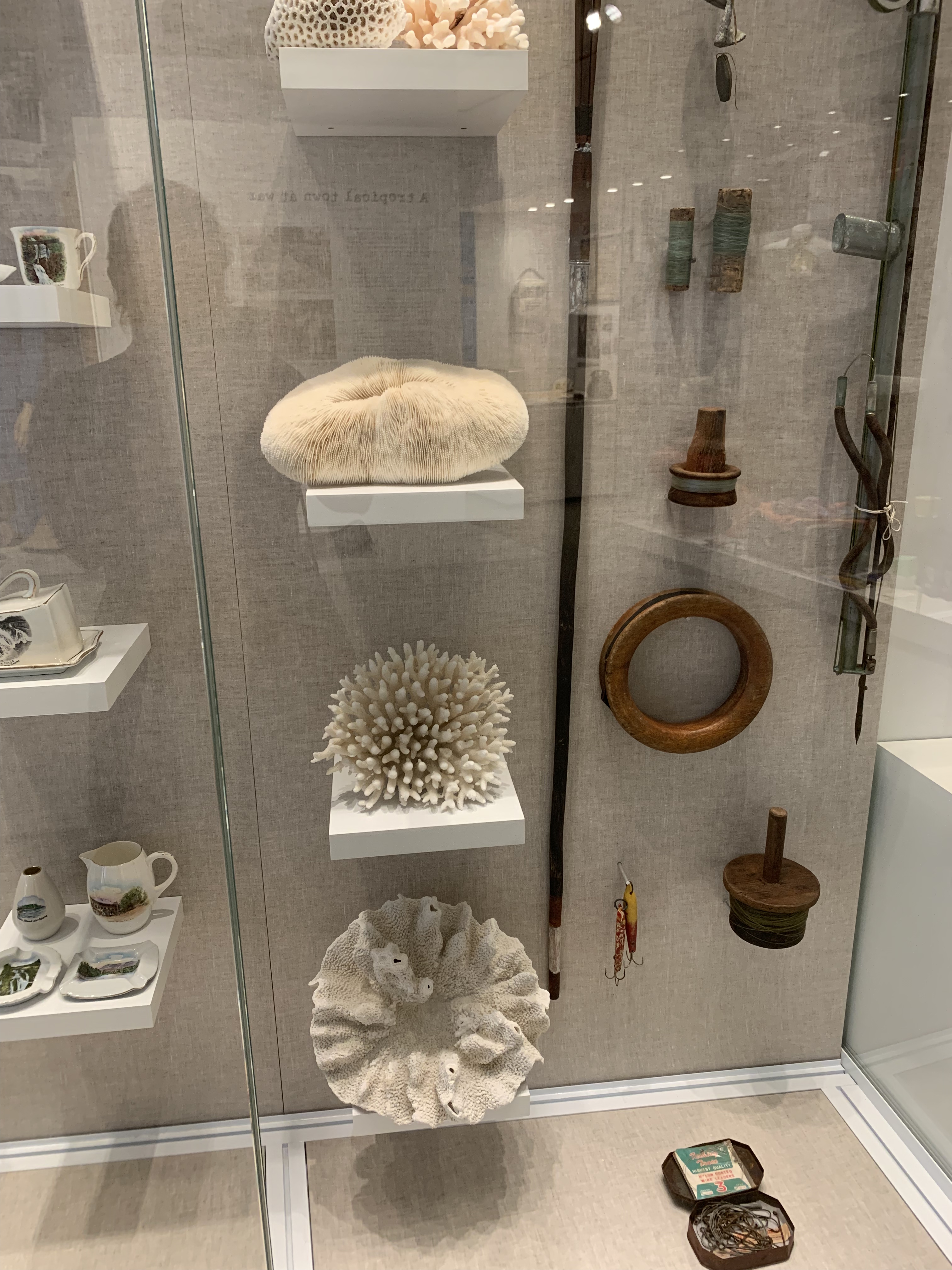
On the same topic, visitors also have the opportunity to look at what happened to the coral that was taken from the Great Barrier Reef way back in the past and kept as souvenirs. As you can see below, the bright and colourful coral would eventually die and turn white.
Coral
As well as presenting a timeline of Cairn’s history with some significant themes and industries included, the exhibitions also highlight a few locals and their stories. For example, Elizabeth Hides who owned and operated the Hides Hotel in Cairns becoming a well-respected and well-liked businesswomen between 1895 and 1916. On display is a Victorian-era blouse that would have been similar to one worn by Hides.
Victorian Blouse
Practical Information
There is a lot more to explore in the Cairns Museum. It is open Monday to Saturday from 10 am to 4 pm, closed for public holidays. Admission is $15 for adults, $12 for concessions and there are special family prices available. It is an accessible museum. I am unsure from the website if and when the Small World exhibition will close.
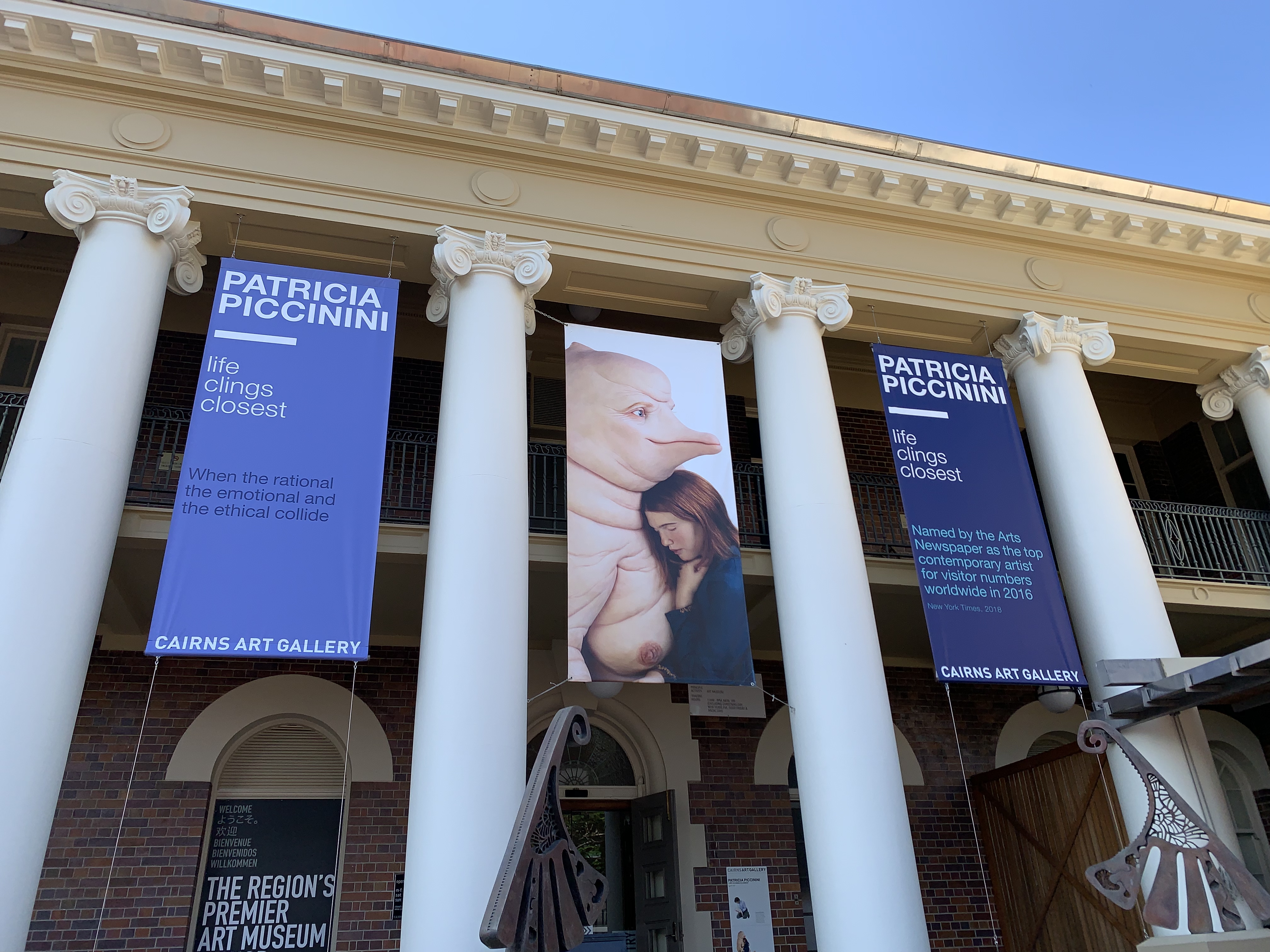
This week I’m in Cairns for the Museums and Galleries Queensland conference. I’m really looking forward to the conference officially starting tonight with a public art tour and welcome reception at the Cairns Museum. This morning, I’ve been exploring the city – my first stop was the Cairns Art Gallery. I was particularly excited to visit as there is a Patricia Piccinini exhibition currently on display. Unlike the exhibition I saw at the Gallery of Modern Art (GOMA), this particular array of sculptures and drawings is inspired by the environment of Far North Queensland. They present a commentary on the ecology of the region, but also speak to the overwhelming number of challenges.
I did spend a bit of time in the exhibitions Connecting Narratives and Home is where the heart is. Connecting Narratives showcases fifty works from the permanent collection of the Gallery. If you are visiting for the first time, I recommend starting with this exhibition so you can gain a sense of the Gallery’s mission and collection focus.
Cairns Art Gallery
If you have been following my blog you might already know that there is nothing I love more than combining heritage with museums. Mainly because it’s great seeing new life injected into a heritage building and new stories being told within its walls.
Cairns Art GalleryCairns Art Gallery
The Cairns Art Gallery building was formerly the Public Curator’s offices and State Government Insurance Office. It first opened in 1936 and was repurposed into the Art Gallery in 1995. When trying to find some further information on the heritage-listed building I came across these plans for a Cairns Gallery Precinct. Essentially, keeping the heritage, but expanding the site. Despite all the potential problems that may arise during this project, it is always so fantastic to see places embracing the arts and growing, rather than destroying, its presence.
Patricia Piccinini – Life Clings Closest
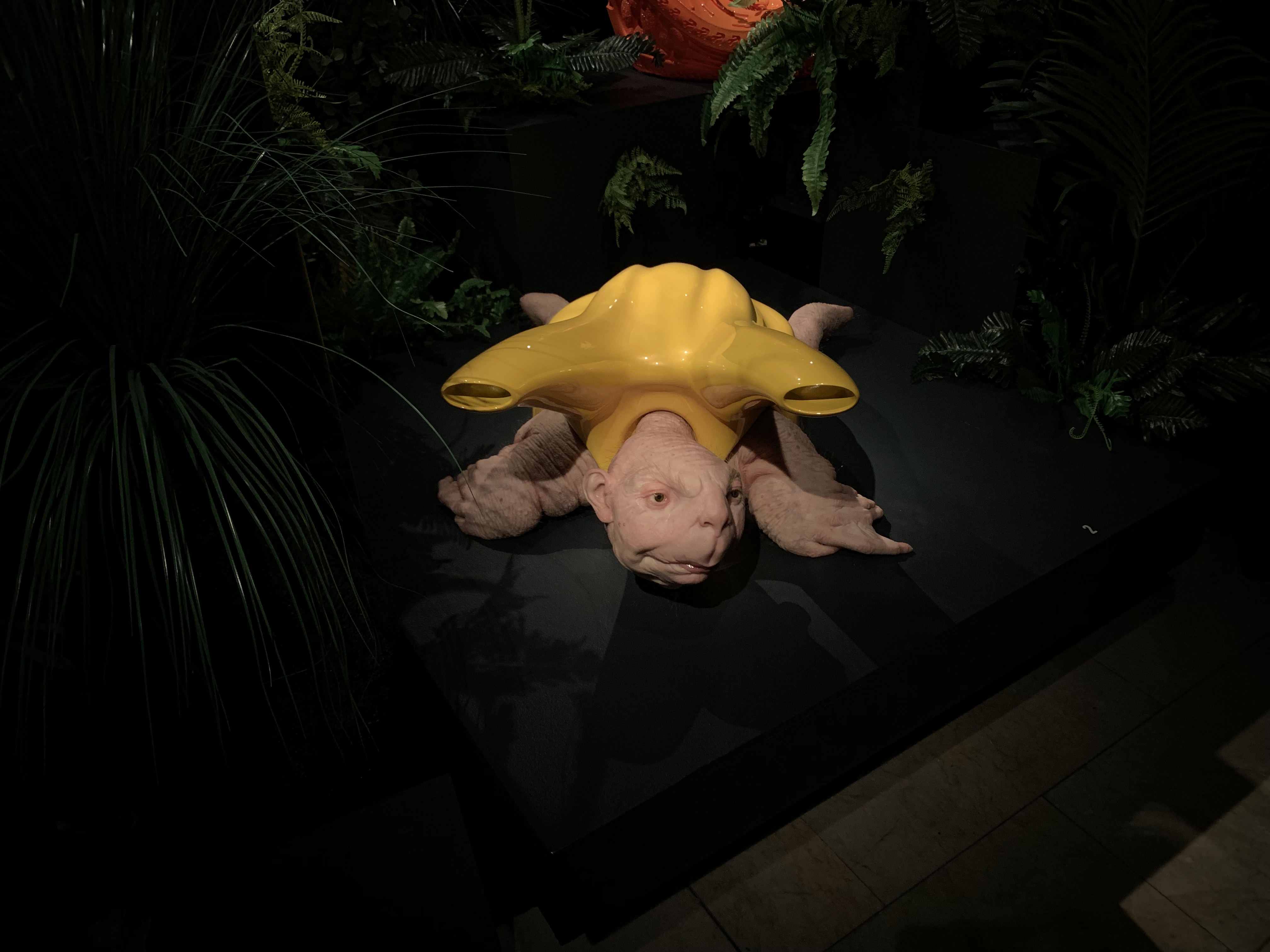
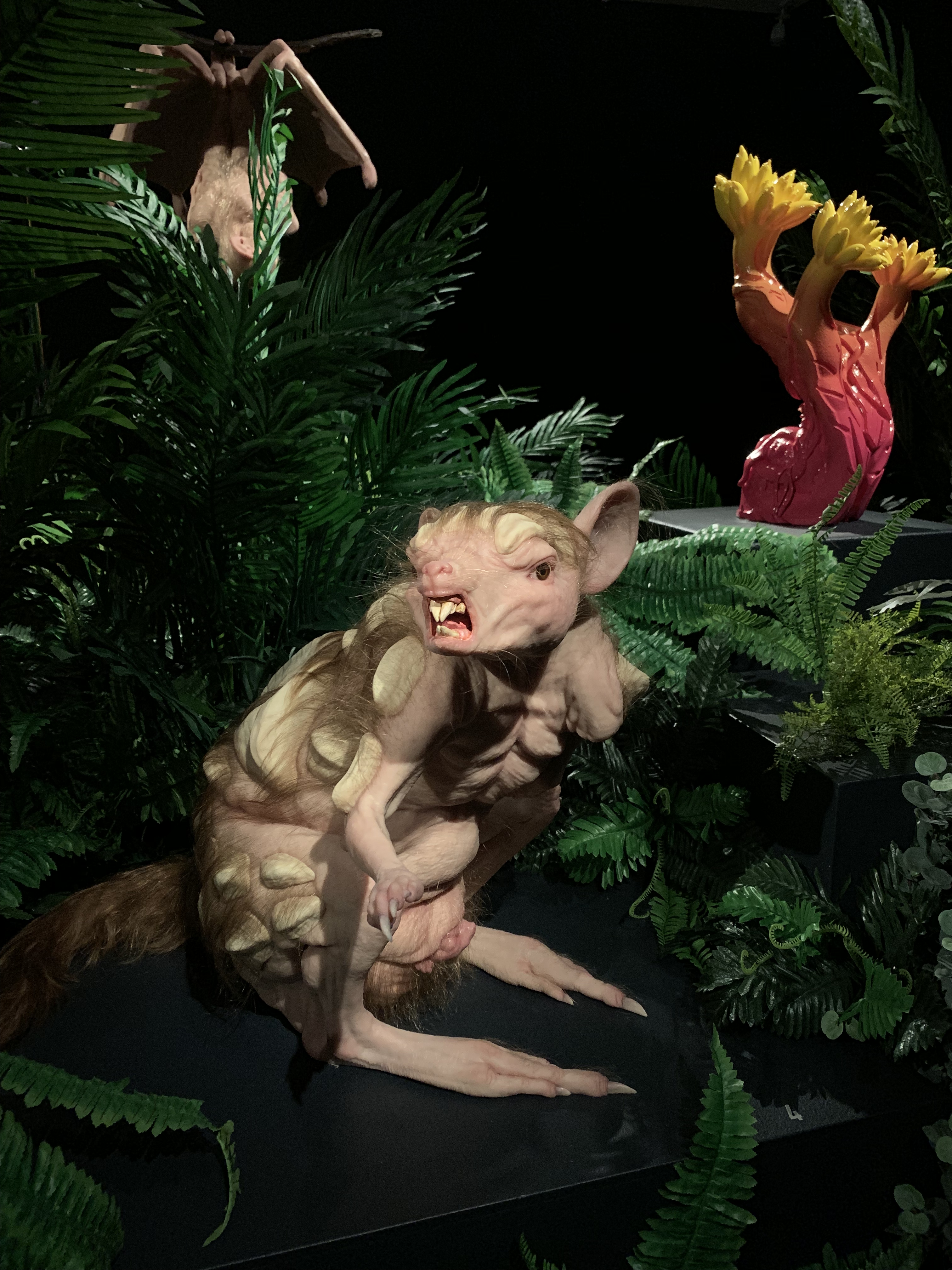
Patricia Piccinini’s work can be incredibly confronting – and that’s why I love it. Her human-animal hybrid sculptures are uncomfortable to look at, but at the same time oddly entrancing. They definitely demand attention. In this particular exhibition, Piccinini deals with themes of evolution, environment, technology, family, maternity and the artificial. The first room you enter displays a series of works with titles such as Shoeform, Defender and Cleaner. I have included a couple of photographs below. These sculptures explore what can be described as a much stronger, different relationship between people and nature. The aim of this installation, to show people as one animal amongst many. What I admire most about her work is its potential to spark conversations. Rather than providing answers, Piccinini is more concerned with debate and furthering an individual’s understanding of themselves and their environment.
Life Clings ClosestLife Clings Closest
What really works in this exhibition is having a set of A4 laminated floor plans available that have the titles of the works on display, their year of creation, and materials. Not having labels can sometimes be really problematic if there are works by different artists in the same space. I think it has great potential, in an art context, when the works are all by one artist. Especially for works like those by Piccinini that need to stand on their own and not have anything, such as labels, as a distraction.
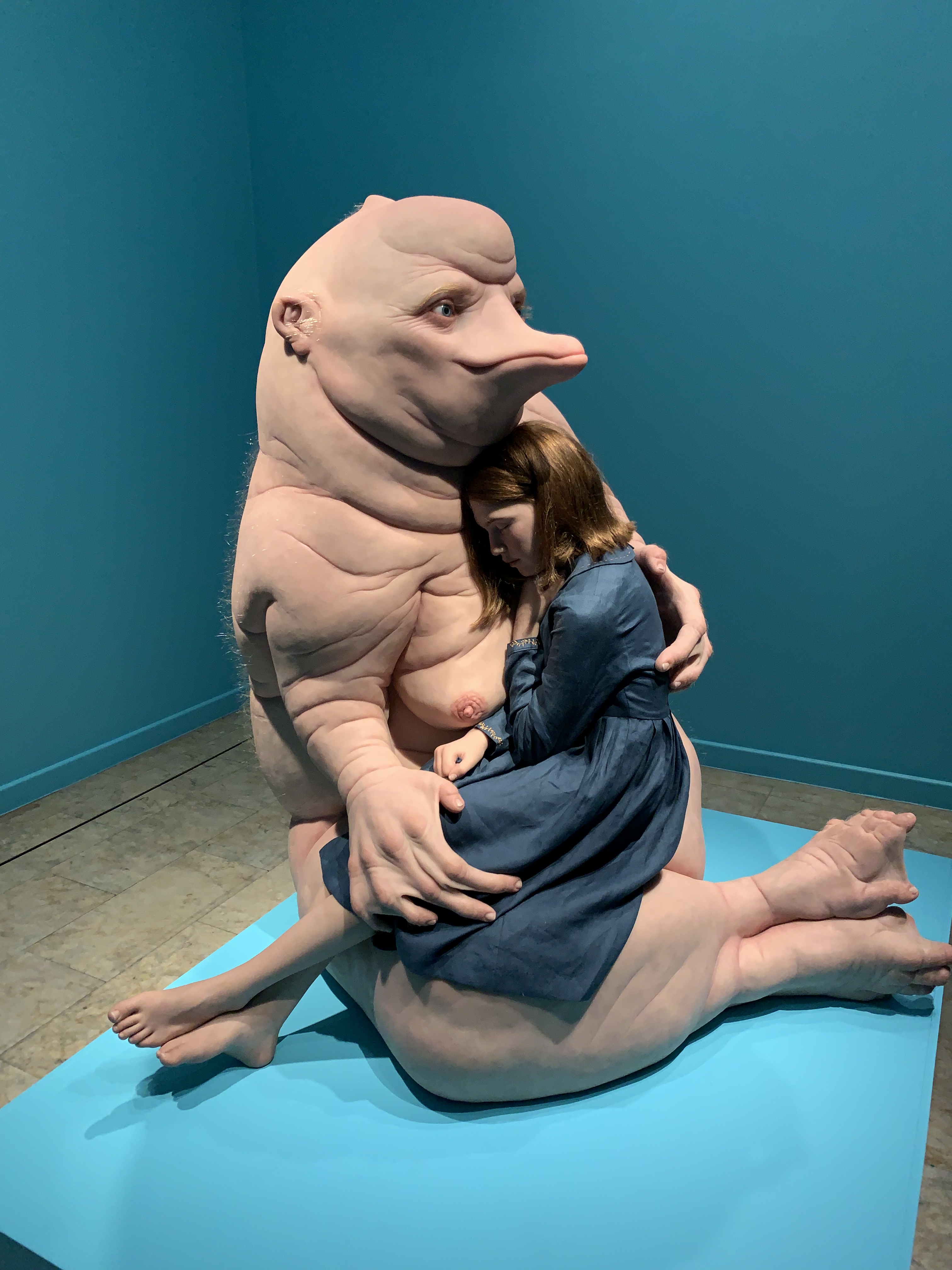
Without doubt, the most uncomfortable I felt in this exhibition was seeing this sculpture titled No Fear of Depths created in 2019.
No Fear of Depths
The dolphin-human hybrid is pretty disturbing, however, it is playing a comforting role hugging a small child. So, despite my initial shock, I ended up really liking the work. That’s not to say that the dolphuman will forever haunt my dreams.
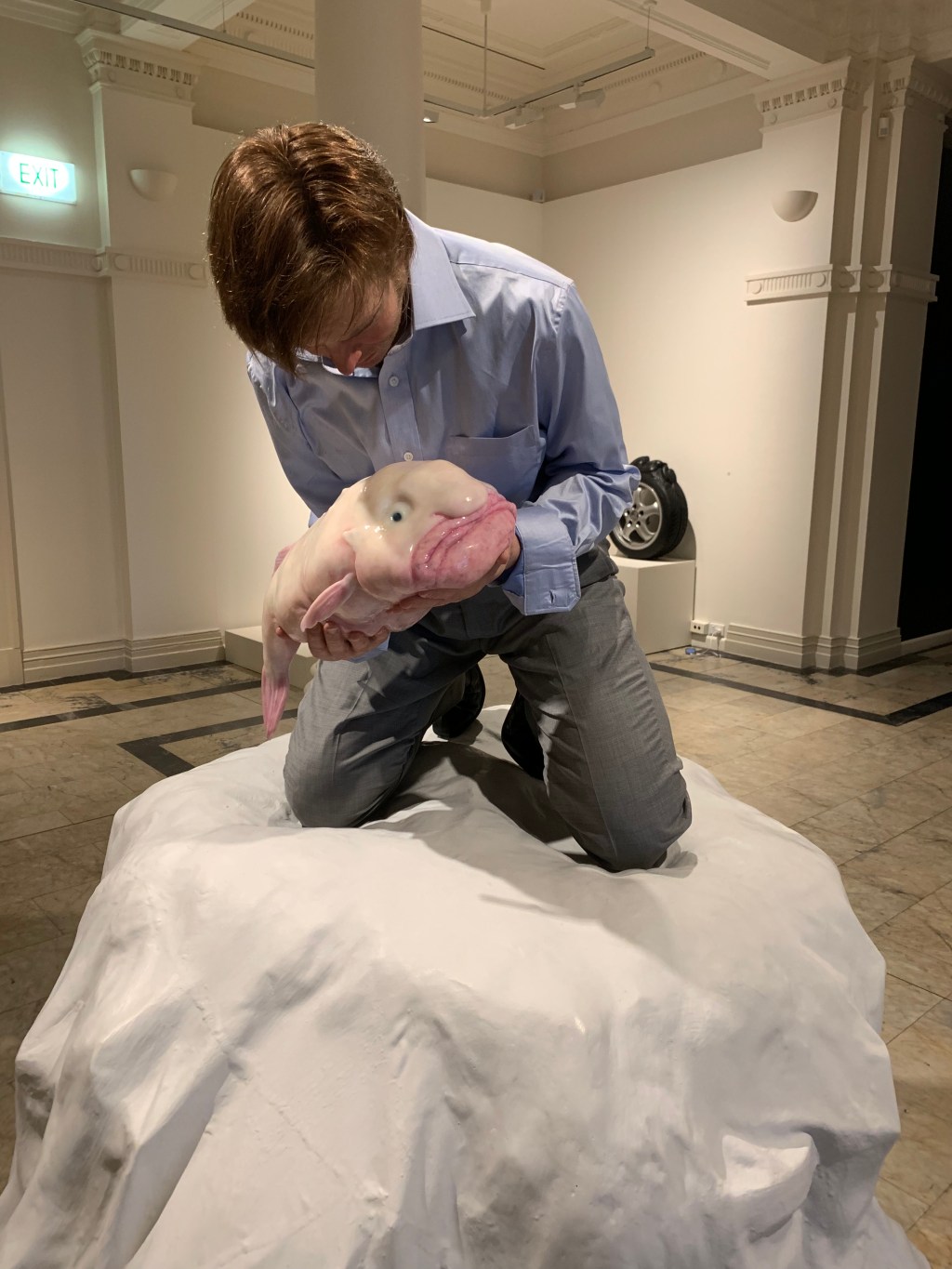
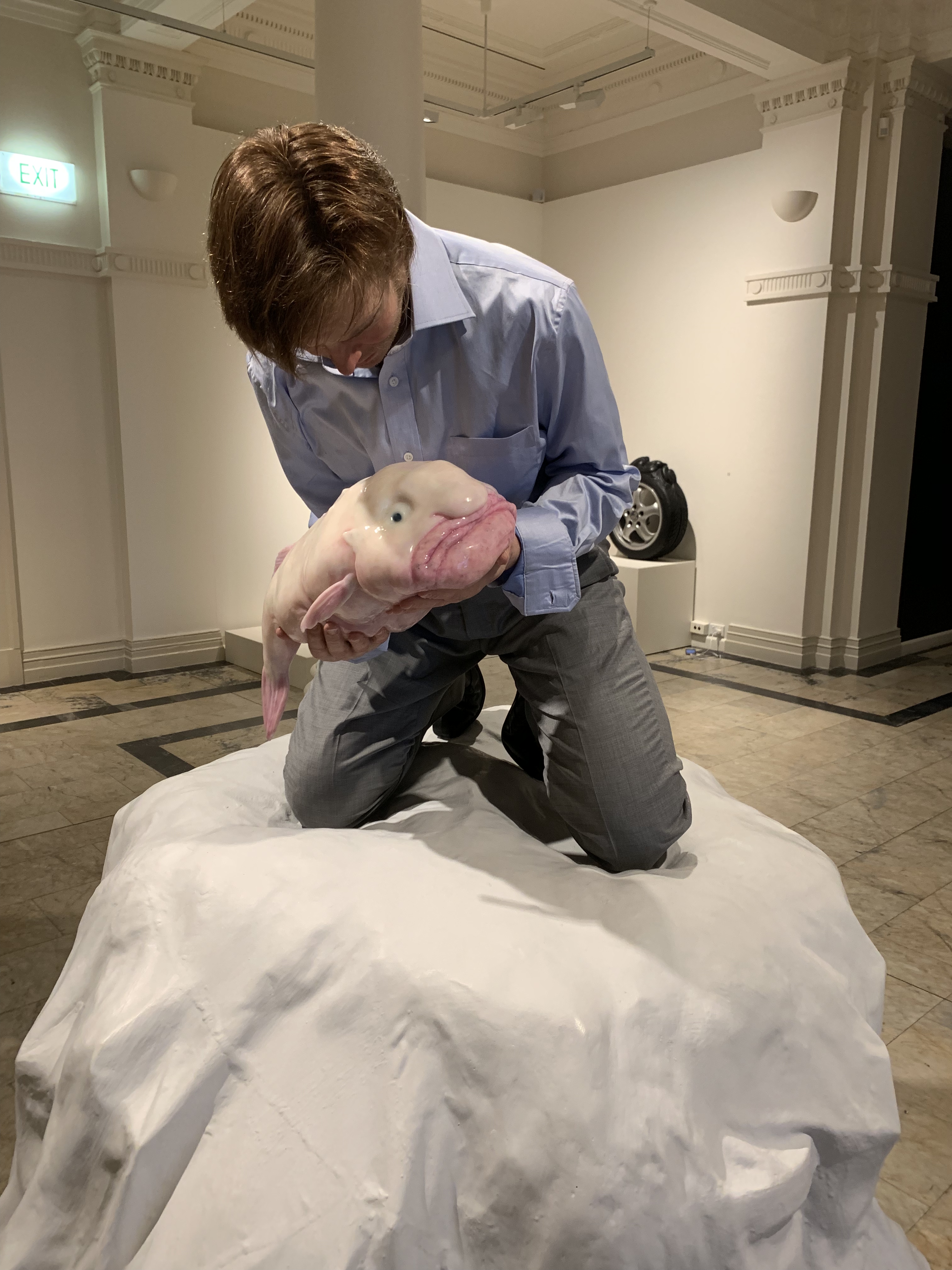
In total, the exhibition has five rooms. Three of these have either one sculpture or a video installation. As well as the room containing the nature/people hybrids, there is another large room with multiple works inside. In this room, the first sculpture that captured my attention was the blob fish. Created in 2011, this sculpture, titled Eulogy, represents the poor blobfish not as ‘the world’s ugliest animal’ (a title it did win), but as an animal that has adapted to its surroundings. It is now being held by a man who is contemplating and reflecting on its existence.
Eulogy
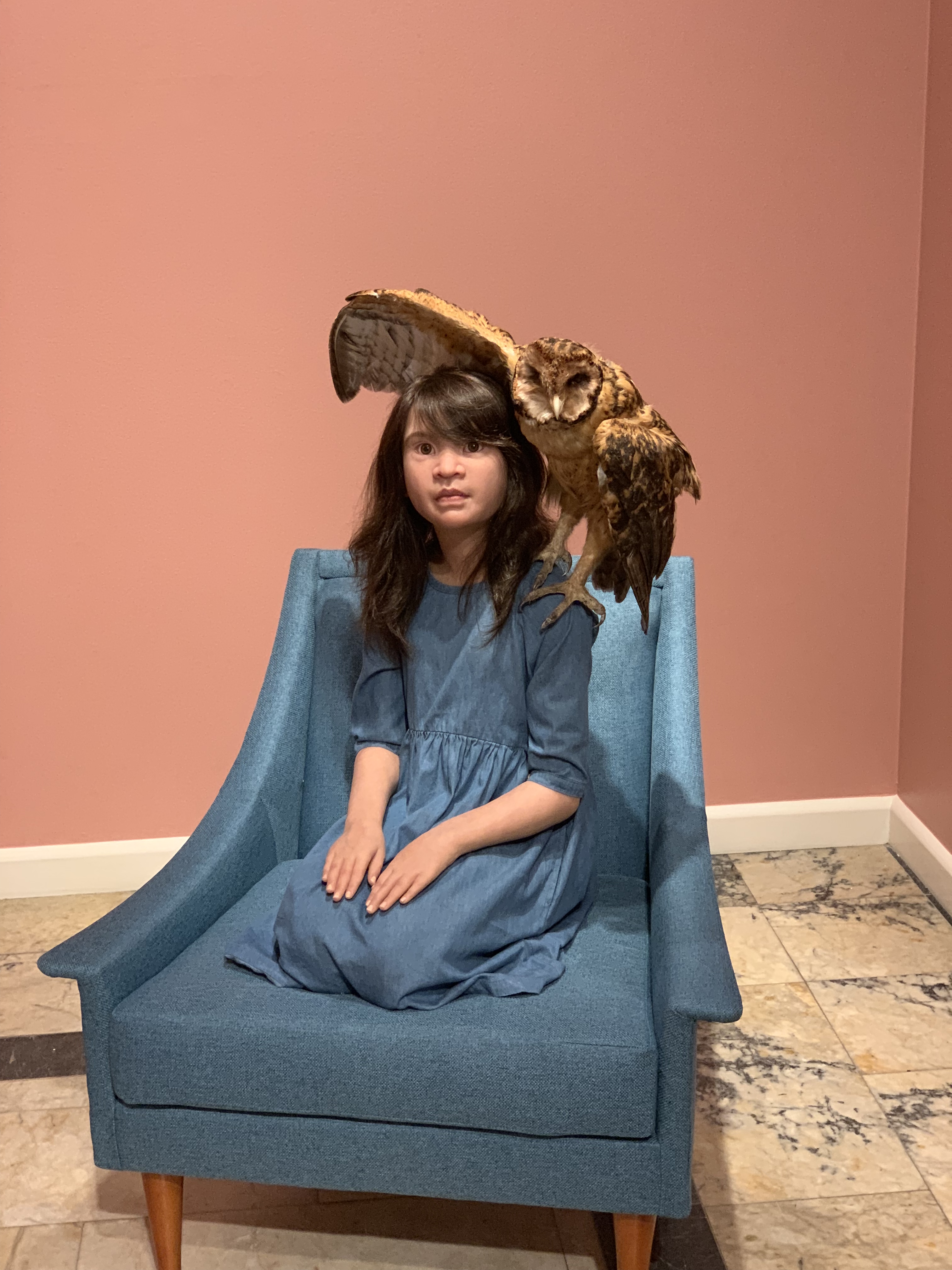
The final piece I want to talk about is Unfurled. Right at the end of the exhibition (or start if you use the lift) there is a bright pink room with a sculpture in the middle of a child and owl. It is so realistic it gave me a shock. Similar to the dolphuman, I interpreted this sculpture as the animal (in this case not so creepy) having some influence over the person. Rather than comforting, however, I see the owl protecting the child.
Unfurled
I would have appreciated seeing some more in-depth descriptions of the works on display. In writing this blog post, I’ve Googled quite a few of the works to discover more. Having that integrated into the display, on the floor plan sheets, would have been very beneficial.
Connecting Narratives
The aim of Connecting Narratives is to connect historical and contemporary narratives of Cairns in the one display from three different regions – Cairns, Cape York and the Torres Straits. I was amazed to learn that since the mid-1990s, the Gallery has acquired over seven hundred works documenting the cultural heritage of Far North Queensland. A very impressive collection!
Similar to Patricia Piccinini’s exhibition, there are no labels in Connecting Narratives. Rather than a floor plan, each artwork has a number next to it that corresponds to a label on a separate room guide. Because of the multiple artists, I didn’t think it worked as well as in Piccinini’s installation. As I spent more time in the space, I did start to see why they opted for this rather than labels. It would have looked too crowded with so many works on display alongside an equal number of labels.
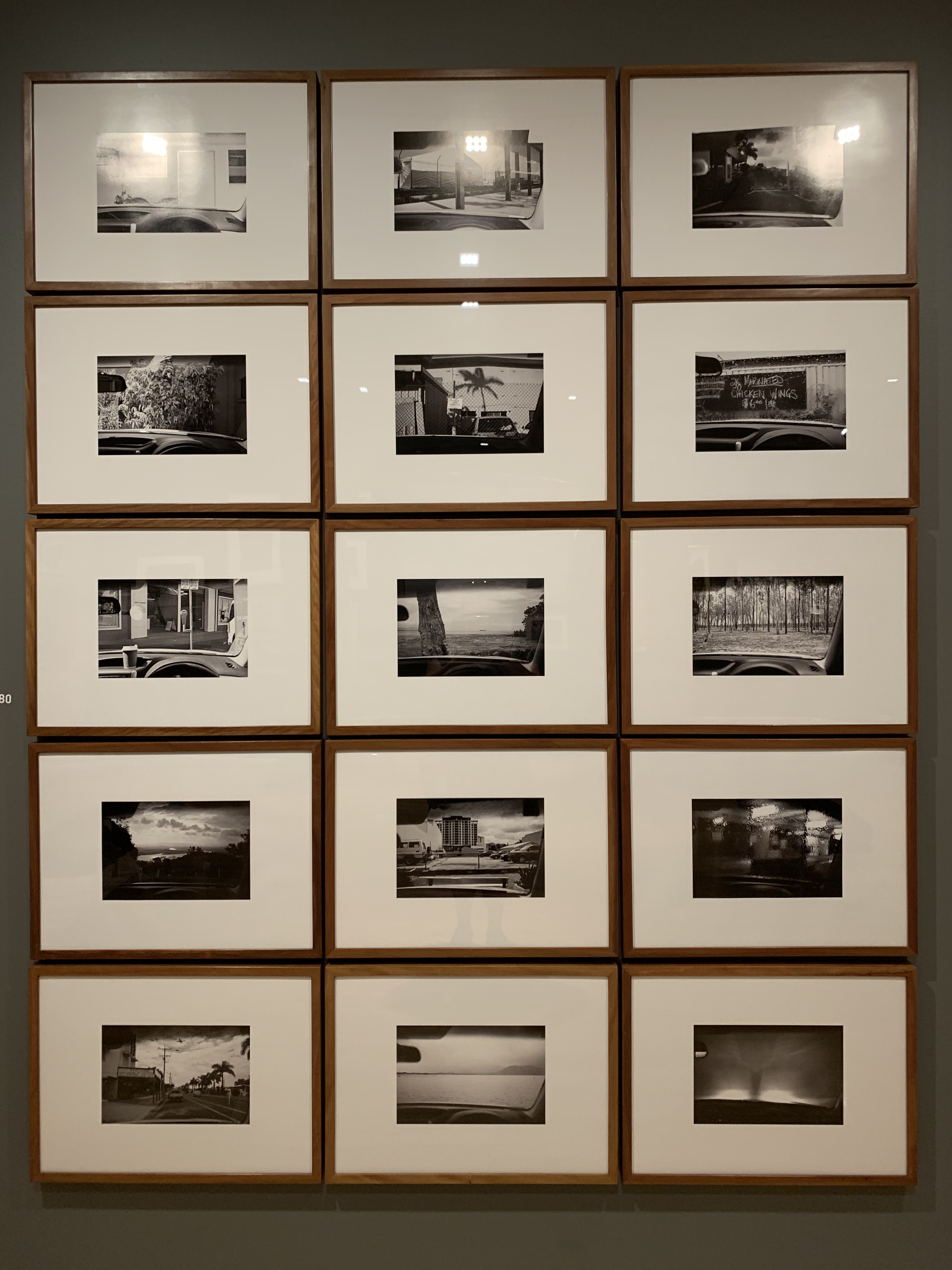
Despite this, the works on display from the Cairns Art Gallery permanent collection are stunning. One work in particular titled Untitled (from the Parkingland series) by Michael Marzik presents 15 black and white photographs of scenes around Cairns.
Untitled
I also enjoyed the Torres Straits display with such a diversity of works including paintings, digital prints and cultural objects. They look incredible displayed together. Going back to what I said before, it would have ruined the display having labels for each of the works on the wall. You can just make out the little numbers next to each work.
Torres Strait Artworks
Further Information
To finish, the Art Gallery has a really wonderful gift shop with so many great art supplies and works on offer. I was able to find some Aqua Painter pens that I’ve been looking to buy everywhere!
Cairns Art Gallery is open daily (except public holidays) from 9 am to 5 pm (Monday through Friday), 10 am to 5 pm (Saturday) and 10 am to 2 pm (Sunday). It is free entry and completely accessible. If you are in Cairns I would highly recommend starting your trip here to better your understanding of the city. Life Clings Closest is on display until 8 December 2019. Connecting Narratives is on display until 17 November 2019.
Last weekend I attended my second Brisbane Writers Festival held at the State Library of Queensland. It was a really interesting day filled with tours and talks. I started by joining a curator-led tour of the exhibition Plantation Voices in the Philip Bacon Heritage Gallery. A huge thank you to Imelda Miller for her wonderful and informative tour. I really appreciated hearing about the decision-making process behind why certain objects and themes were included. It added this incredible new layer to seeing the exhibition. I want this post to focus on the exhibition and tour then briefly mention the other two events I attended at the end.
Plantation Voices Context
Plantation Voices Sign
Plantation Voices tells such a crucial story of the history and identity of both South Sea Islanders and Australian South Sea Islanders. Throughout the tour, Miller helped to clarify the difference. South Sea Islanders refers to the first generations who were brought to Australia as indentured labourers to work for the sugar and cotton industries. This occurred between 1863 and 1904. Many of these individuals were blackbirded, kidnapped or tricked into working on such plantations. In total, around 62 000 contracts were issued. After 1904, 10 000 individuals remained in Australia, specifically in Queensland where they had worked.
Australian South Sea Islanders refers to the latter generations who are not connected to ‘any one place or land’ (source). For those reading this post who are unaware, the South Sea islands consist of around 80 separate islands including Fiji, Vanuatu, and New Caledonia.
Exhibition
The exhibition is divided into four themes – repatriation, repression, reclamation and resilience. There is also a small introduction section that sets the scene and showcases a large map of the South Sea islands from the 19th century. In each section there are a number of physical objects on display including books, treaties and photographs. As Miller explained, being able to show this history in its original and physical form is important in order to reclaim the history. Some of the most powerful objects in the exhibition are the photo albums and a hospital register.
Historical RecordsHistorical Records
Repatriation
Repatriation addresses what happened after 1904 and the effect of the White Australia Policy on South Sea Islanders. A highlight object in this section is the Pacific Islanders’ Association Petition from 1906. It really highlights the agency of South Sea Islanders when being faced with the challenge of deportation. This petition fought for exemptions from deportation – primarily for those who had married outside the Pacific, owned freehold land or had a disability that prevented them from working on the islands. As Miller stated, petitions such as these came as a shock to the Government who didn’t believe South Sea Islanders had the ability to be so organised.
Repatriation
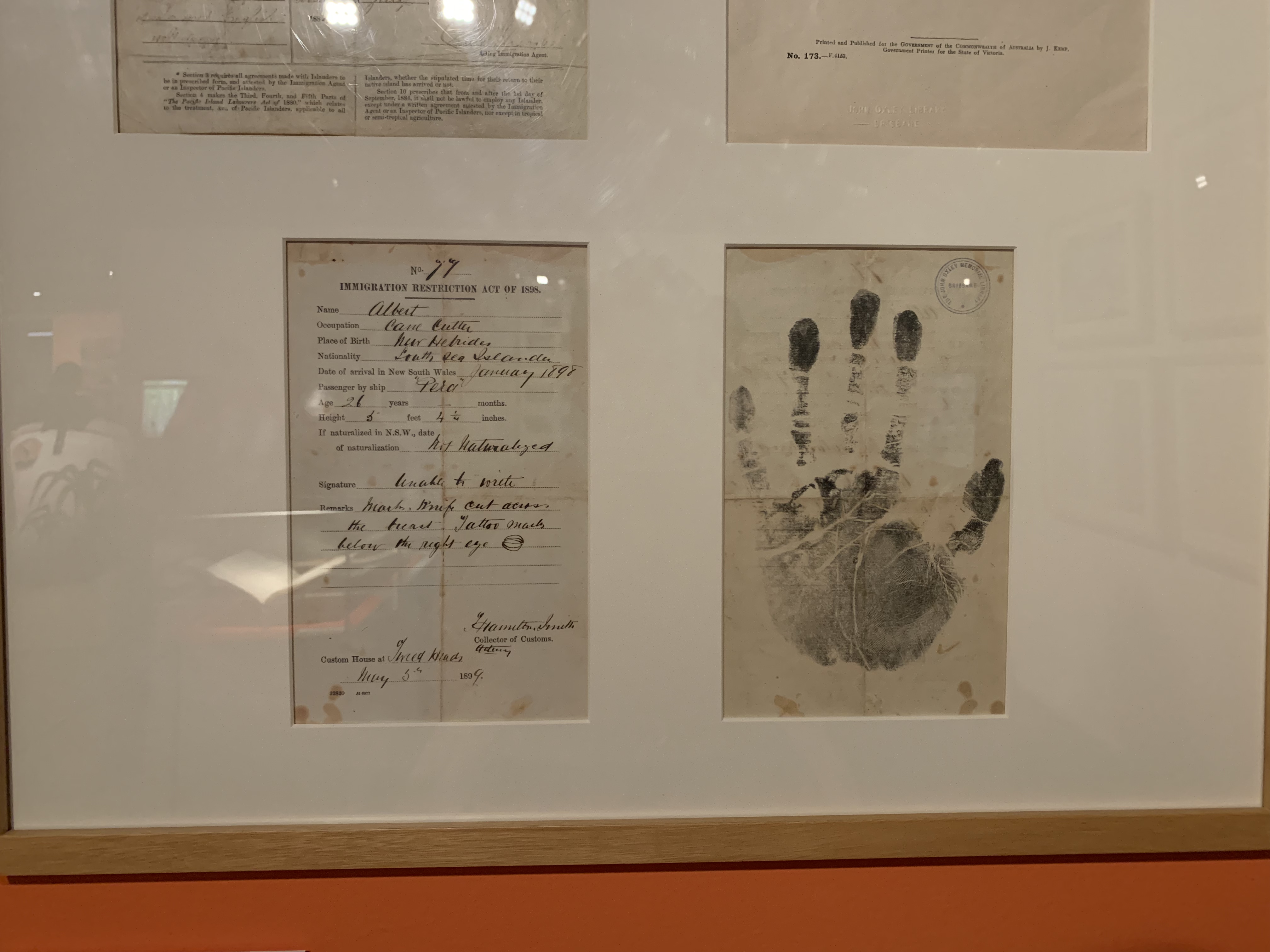
Another powerful object in this section was a passbook issued to Takin-we-her in 1883. Next to this document is an identity paper from 1899 displaying a handprint found on the reverse side of the form. For those unable to read or write, this was an alternative to making their mark. Miller pointed it out as an object that really resonated with her as you could feel a strong connection as someone’s entire hand had been placed on this sheet.
Takin-we-her
Repression
This is a particularly difficult theme that looks at how South Sea Islanders then Australian South Islanders were treated post 1904. The use of Miller’s family photographs and story adds an emotional and personal touch to the exhibition helping visitors make sense of the isolation and exclusion felt (and continuing to be felt) by South Sea Islander communities.
Reclamation
Moving from repression to reclamation transforms the story into one of hope. As South Sea Islanders began to reclaim their history and document their heritage, there was a desire to have this acknowledged by the wider community. On 25 August 1994, the Australian Government officially recongised South Sea Islanders and Australian South Sea Islanders as a unique cultural group with their own history and culture.
Resilience
This theme is an amazing way to end the exhibition. Rather than stopping at reclamation and the positives that have been achieved, the exhibition really goes further. By having this theme at the end, it is a way of ending on a comma and not a full stop. This space is dedicated to sharing a few examples of how this community continues to thrive. There are artworks by four artists on display that play with the notion of identity and what it means to be part of this community. The artists featured are Dylan Mooney, Jasmine Togo-Brisby, LaVonne Bobongie and Joella Warkill.
Overall, this exhibition achieved its aim, to provide voices to those from the past, and highlight the community’s continuing strength. Unfortunately, the exhibition is now closed. I am very grateful to have had the opportunity to hear about Miller’s experience with developing the exhibition and promoting this often overlooked Queensland story.
Other Brisbane Writers Festival Events
The other two events I attended were true crime related. One was Crime Fiction & #metoo featuring authors Caroline de Costa, M J Tjia and Meera Atkinson. This was quite a fascinating discussion on crime fiction and whether or not we can morally read and write crime in this day and age. Essentially, the answer was yes, yes we can. Especially when the female trope in true crime (as the nameless victim) is turned on its head.
Crime Fiction & #metoo
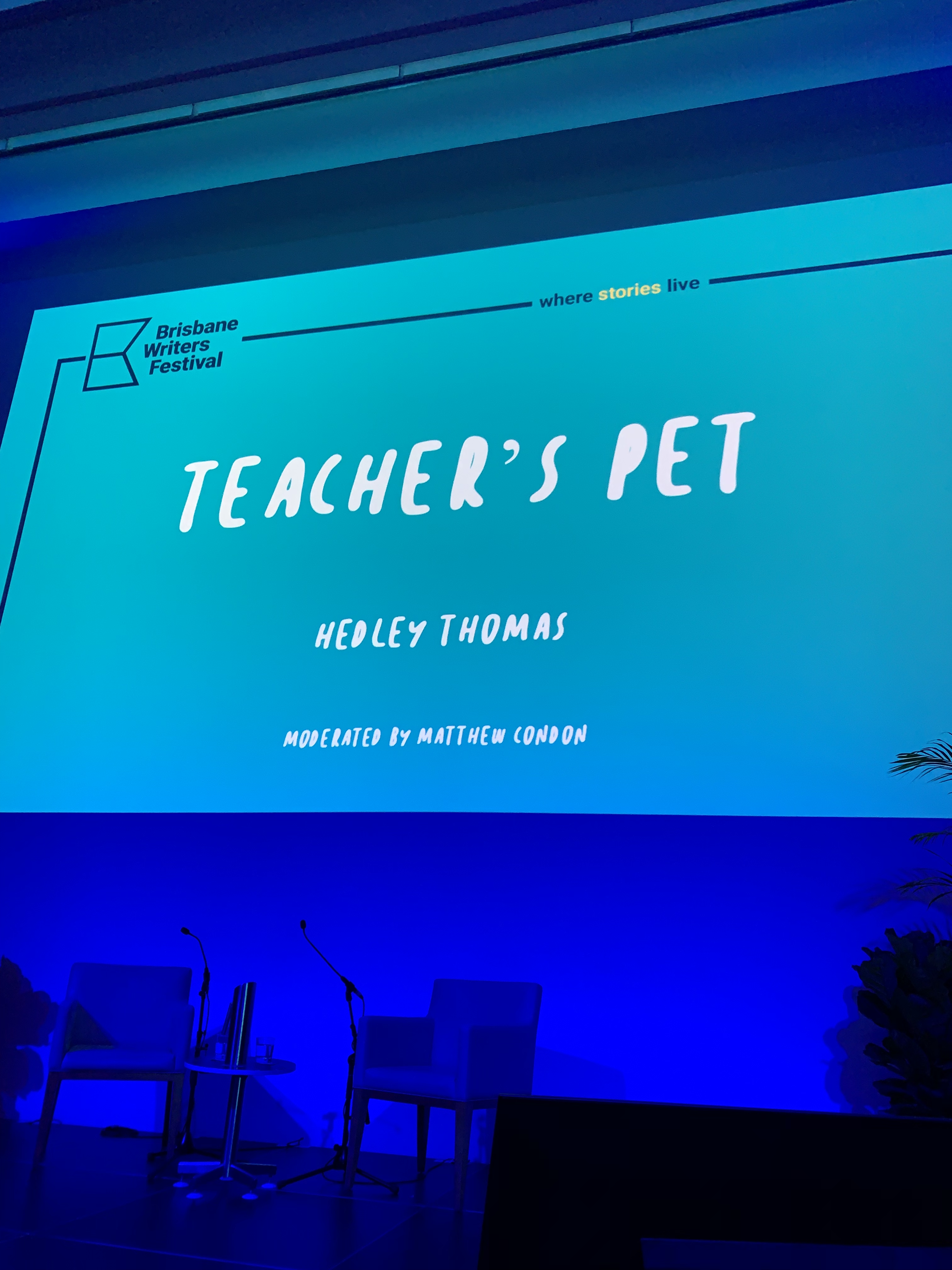
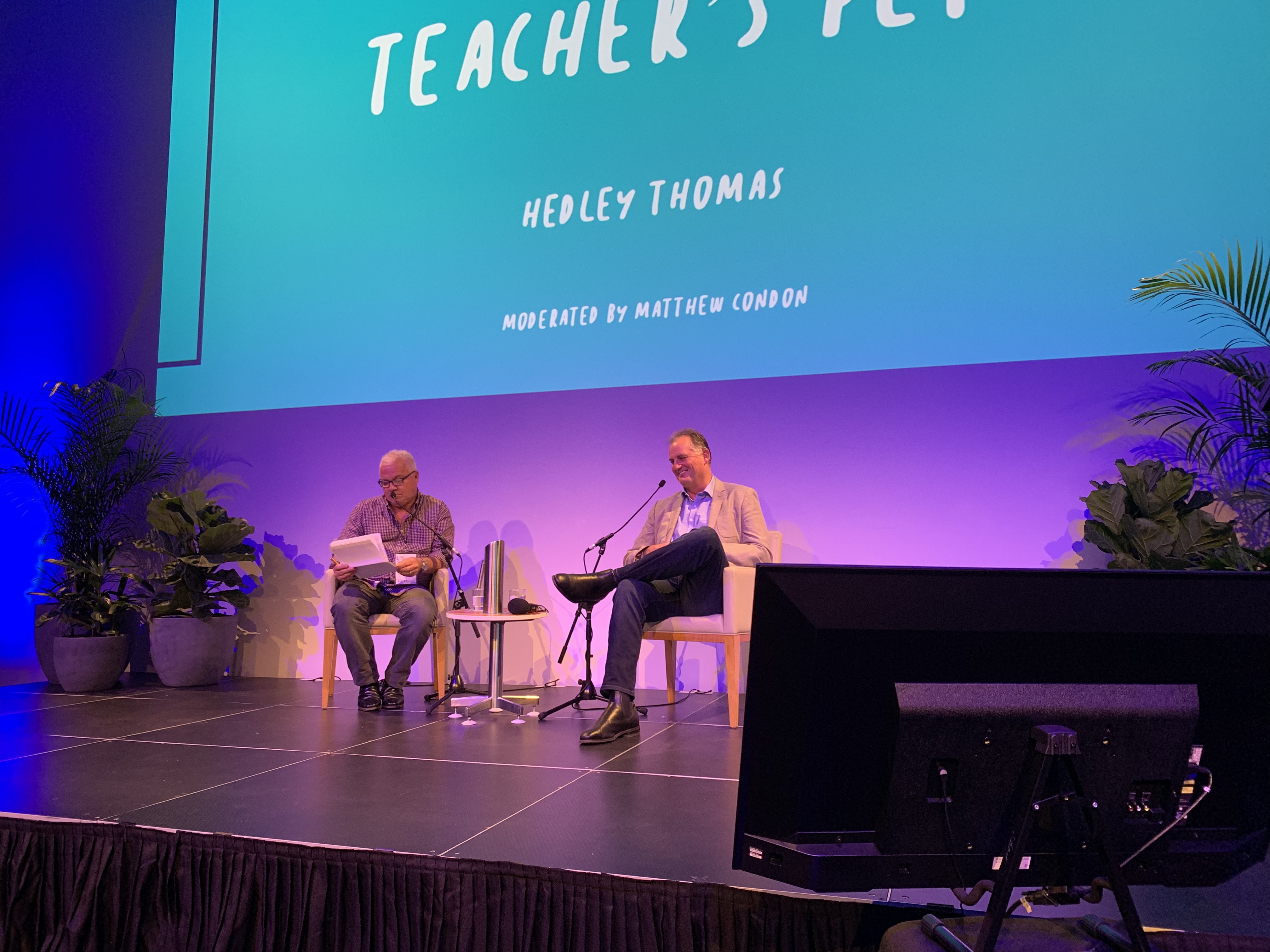
Finally, I had the amazing opportunity to listen to Hedley Thomas, journalist behind the podcast Teacher’s Pet. In an interview with Matt Condon, Thomas spoke about his experience making the podcast. Considering Teacher’s Pet has been downloaded over 50 million times around the world, it was great to hear the stories behind making the podcast and how it was recorded. For legal reasons, Thomas couldn’t disclose much about the podcast itself. It was revealed that Thomas is currently working on a new podcast that will be released soon!
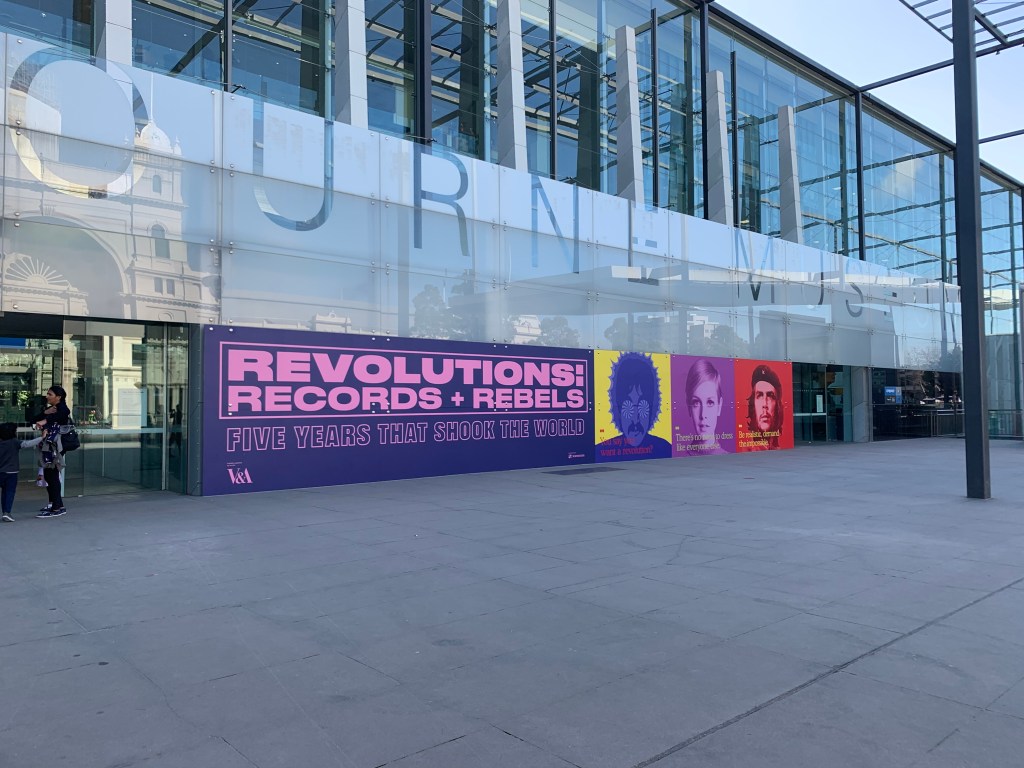
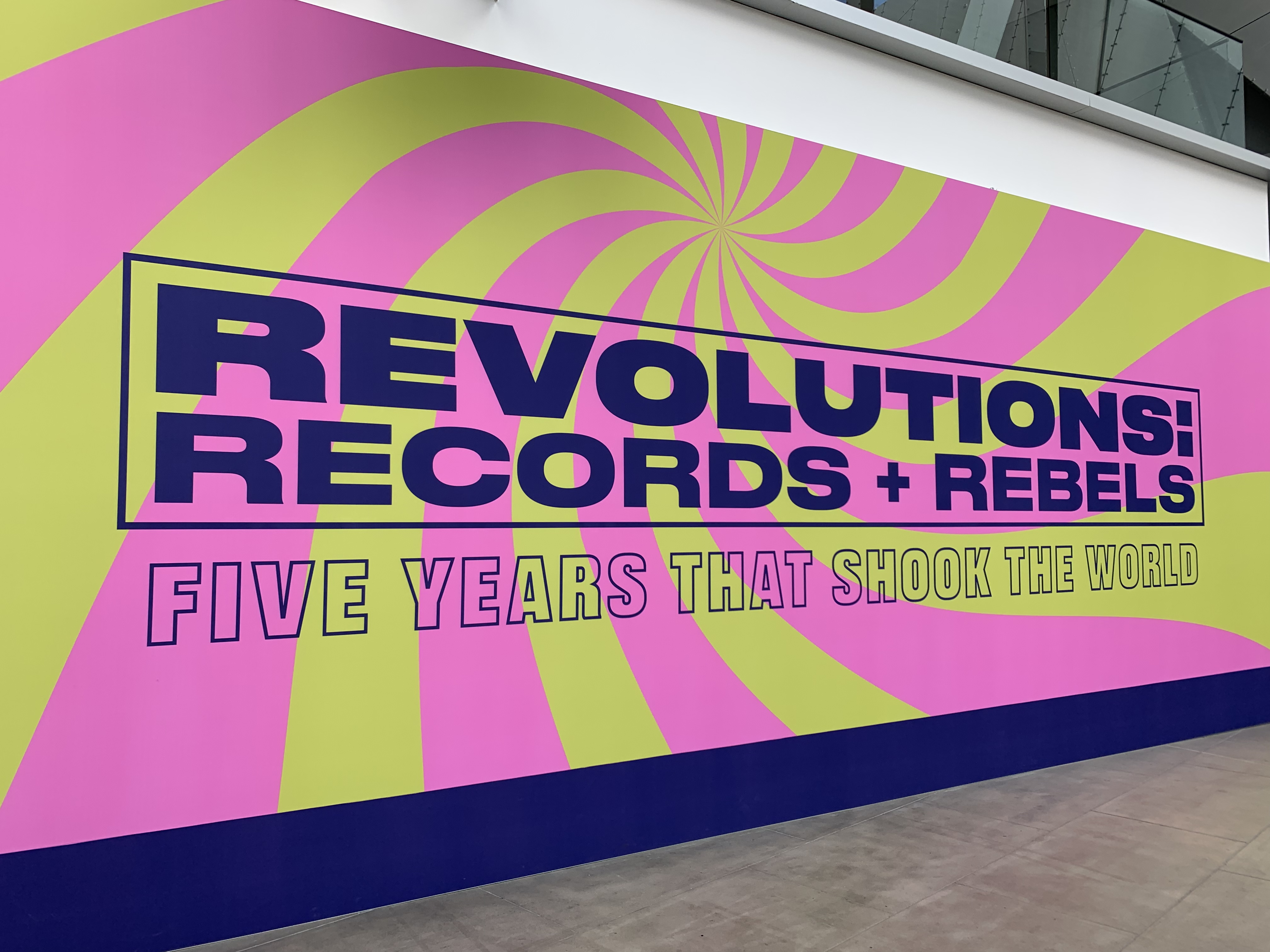
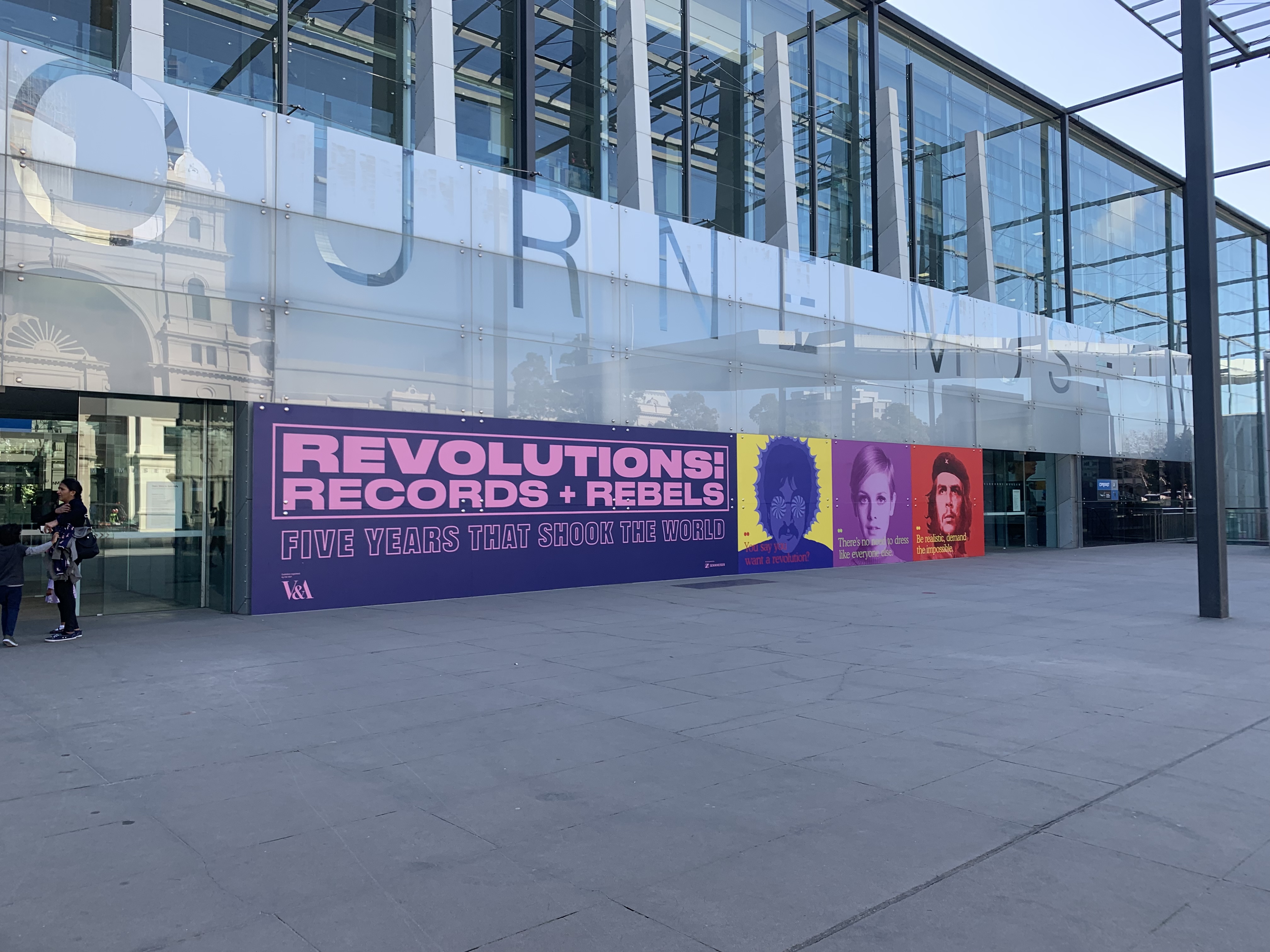
On our final day in Melbourne we visited the Melbourne Museum. Our intention was to see the exhibition Gut Feelings and spend a little bit of time in some of the permanent displays. In the end, we had enough time to also wander through the temporary exhibition Revolutions: Records and Rebels. With the latter, I was unsure what to expect, but was really glad we made the decision to upgrade our ticket.
Gut Feelings
I wanted to double check the name of the gallery where you can find this exhibition and stumbled across a link for booking dinner and cocktail parties in the Mind & Body Gallery. Now that the venue for my next function is already mentally booked, I was glad that I had remembered the name of the gallery correctly. As you can probably imagine, the Mind & Body Gallery is my absolute favourite in the Museum.
This is why I was particuarly excited to see a new exhibition opening in the space. I couldn’t find when Gut Feelings opened (I think February 2019), but I know it is on display until February 2020. This means there is plenty of time left to visit. It isn’t a big exhibition (only a few small rooms), but it is very interactive. Here is a quick summary of what’s inside.
Gut Feelings Sign
On first entering the space you are told to quite literally follow your gut. Rather, the gut visual on the floor showing the comparative length of the small intestine, large intestine, etc. There is an interactive screen where you can place your hand and tiny microbes appear only to float away. The introduction panel contextualises all of this by stating some quick facts about the gut and how the gut and the mind are linked. To discover more, you have to step inside.
From here you have more choice over where to explore. I had two favourite rooms – one showing the gut network and one on superbugs and antiobiotics.
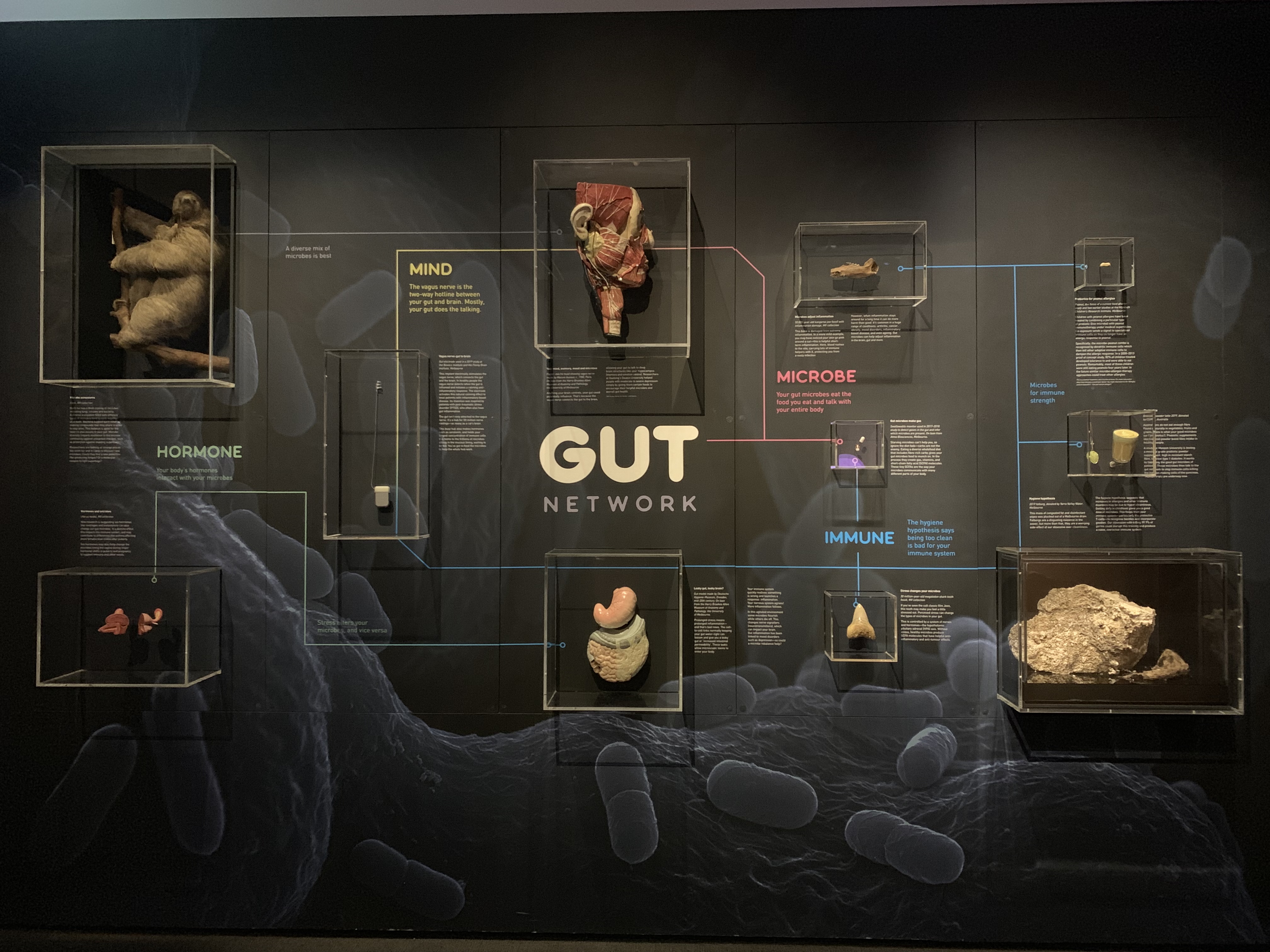
Gut Network
You can see from the photograph below the display looks exactly as it sounds – mapping the network of the gut. This includes delving into immunity, microbes, hormones and the mind.
Gut Network
What really struck me about this display is the seamless integration of objects allowing it to be quite inviting. The use of different colours connecting the various compenents is also a real draw card. One negative, and I will note this again for the next exhibition, is the use of white writing on a dark background. This absolutely does not sit well with me. Not only from an accessibility point of view, but also because it is harsh to read over even a short period of time. Despite this, the gut network was informative without providing an overload of information. I must also admit that as soon as I saw the sloth, I was captivated.
Antibiotics and Superbugs
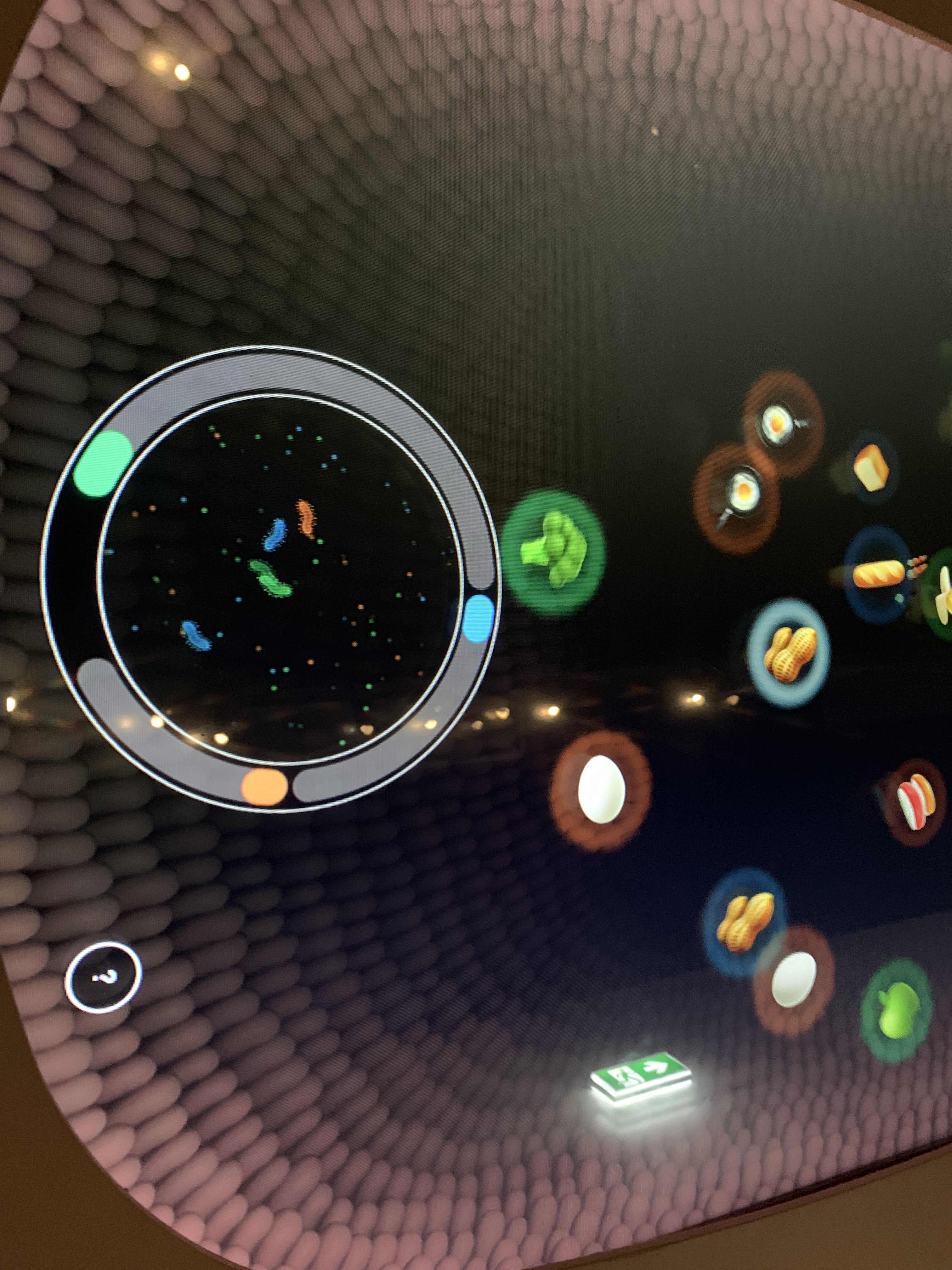
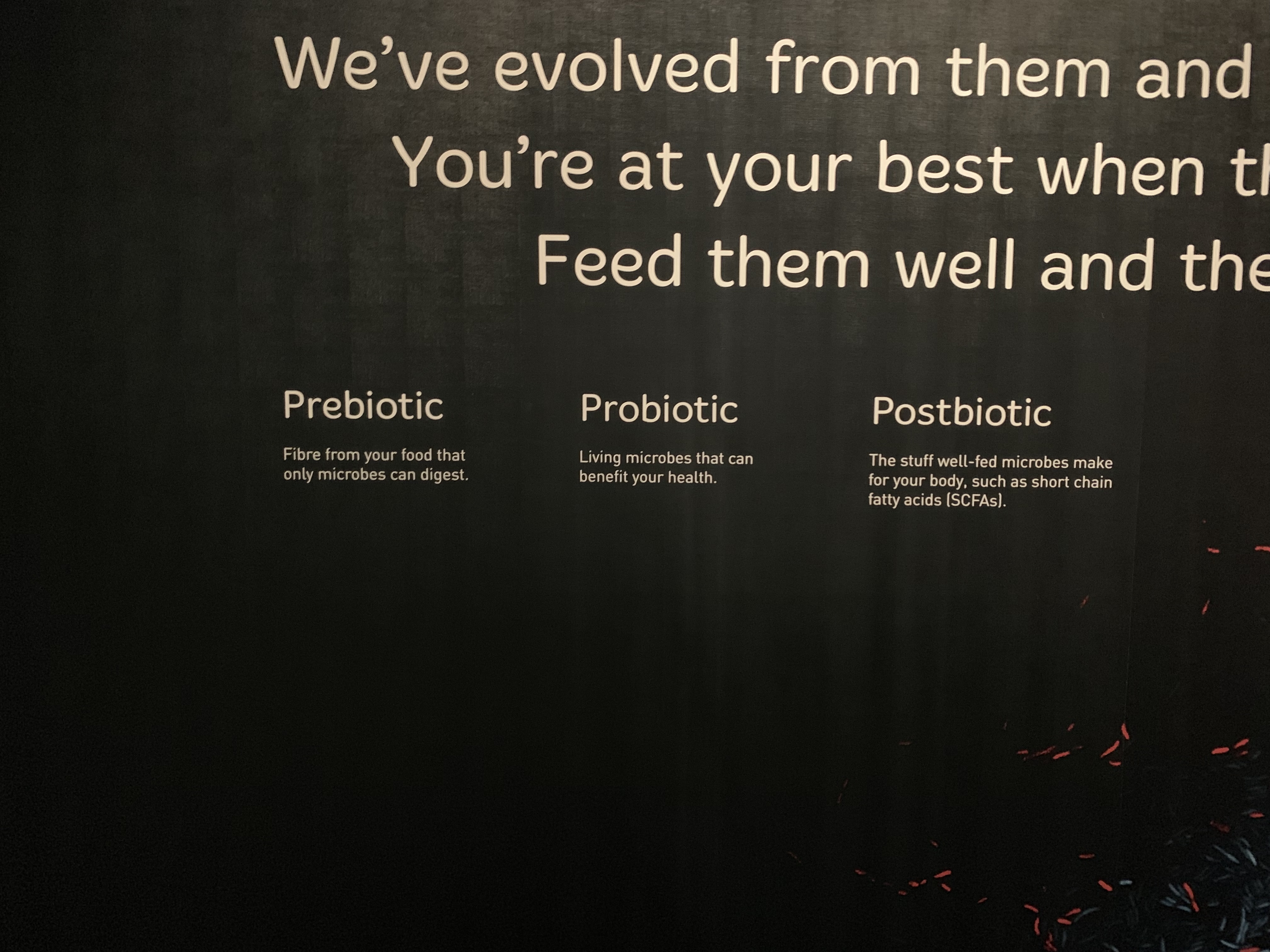
My favourite room consists of a touch screen in the centre where you can drag different foods into a Petri dish-like shape to see what microorganisms they contain. Behind the screen, printed on the wall, are definitions for three words: prebiotics, probiotics and postbiotics. It was really interesting to see exactly what each word means and get that clear in my head.
Antibiotics and SuperbugsAntibiotics and Superbugs
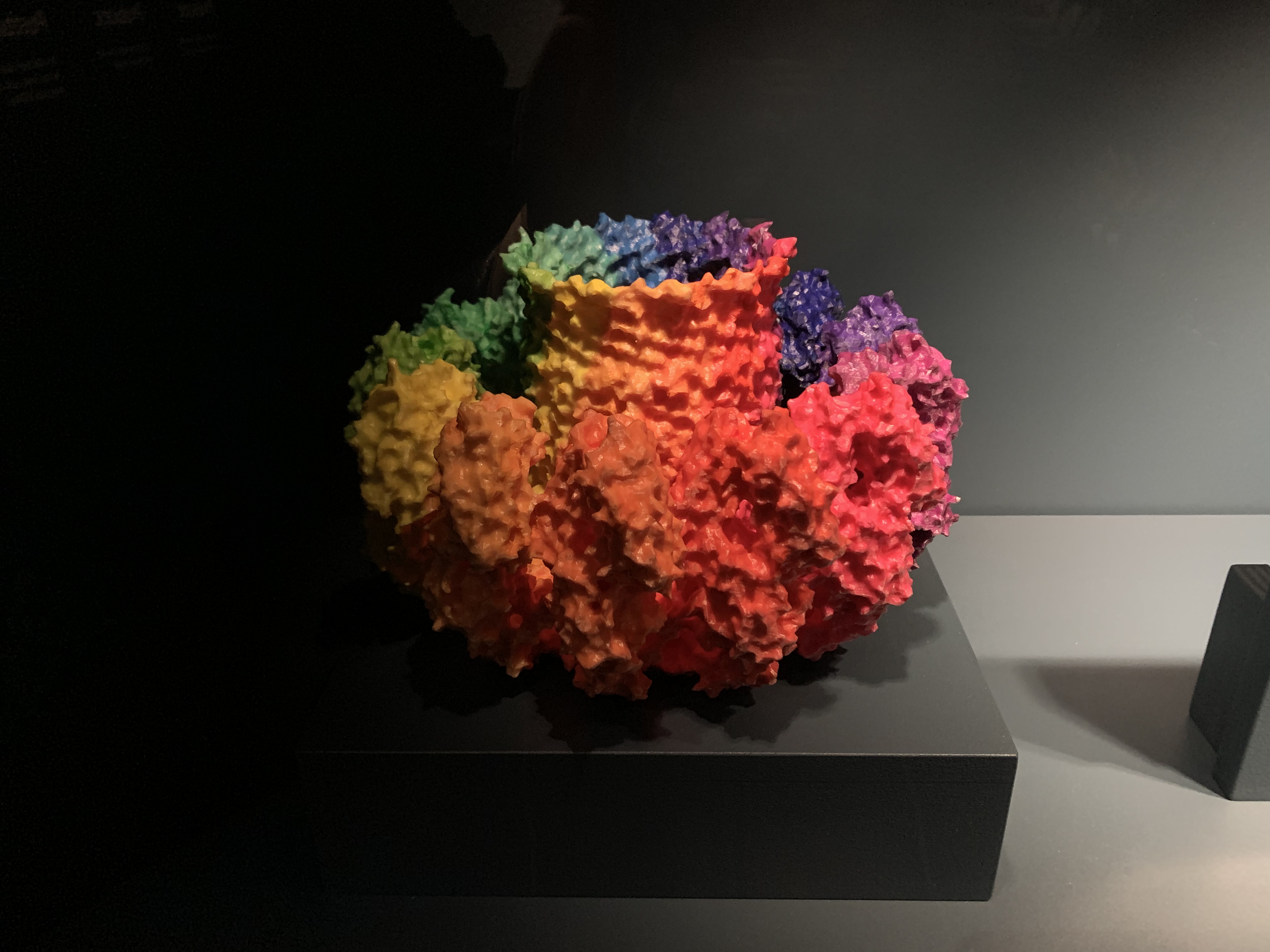
Also in this space was my favourite object, 3D printed bacterial molecule perforin. Essentially, a rainbow molecule. The object label highlights three therapies ‘beyond antiobiotics’ – molecular therapies, immunotherapies and phage therapies. The latter has an amazing story attached of a man who was saved by extractions of phages from sewage.
Antibiotics and Superbugs
Ending
The final room in the exhibition is definitely tailored towards an instagrammable photo. Food wallpaper lines every surface and in the middle is a huge pink neon sign stating Love Your Guts. I don’t mind seeing something like this in an otherwise super informative exhibition. A great way to end – with a bit of fun. And yes, yes I did have my photo taken with the sign.
Love Your Guts
Revolutions: Records and Rebels
Unlike the previous exhibition, this large temporary exhibition has a more prescriptive path. Initially I was concerned that the only thing on display would be music from the five year period (1966-1970). I was happy to learn, quite soon after entering, that the exhibition does, in fact, cover so much more.
Revolutions: Records and Rebels
Music
Similar to the Tatau exhibition at the Immigration Museum, this exhibition employs sound as a way of creating a strong atmosphere. All visitors are encouraged to take a device and headphones to listen to music as they walk through the space. Moving through the different themes, the music automatically changes to suit the surroundings. It is not as distracting as I thought and proved to be a really great way of engaging sound in the space without being a traditional audio guide tour.
I was equally shocked that it actually worked and automatically changed the music in each room. Usually I’m the person with a device that doesn’t work and I was half expecting to spend the entire exhibition on the same song.
Highlight Themes
I found something in almost every theme that really grabbed my attention, but my two favourite themes were Voices of Dissent and Expos and Consumerism.
Voices of Dissent
Within this space I really enjoyed the section on Second Wave Feminism including a display of notable books released during this period.
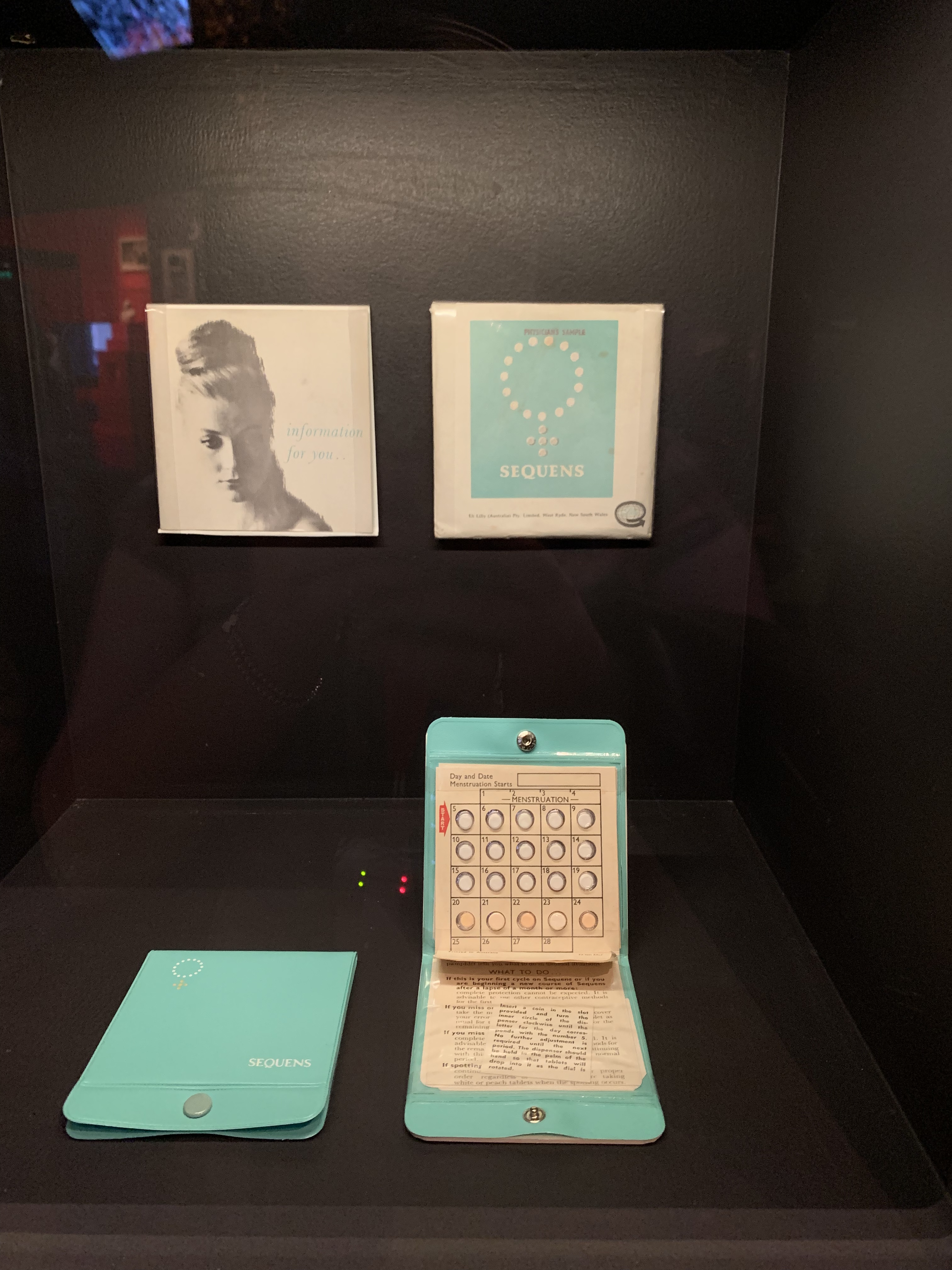
However, the contraceptive pill, Sequens, was my favourite object in the whole exhibition. The pill, for those unaware, was pivotal in the sexual revolution of the 1960s. Not only did it give women control over their reproduction, but it also had flow on effects to views on relationships, higher education and careers. It could only be obtained by prescription meaning single women in particular had to find a sympathetic doctor in order to obtain. On top of that, there was a 27.5% luxury tax. Such a great object to have on display and an important story to tell.
Sequens
Expos and Consumerism
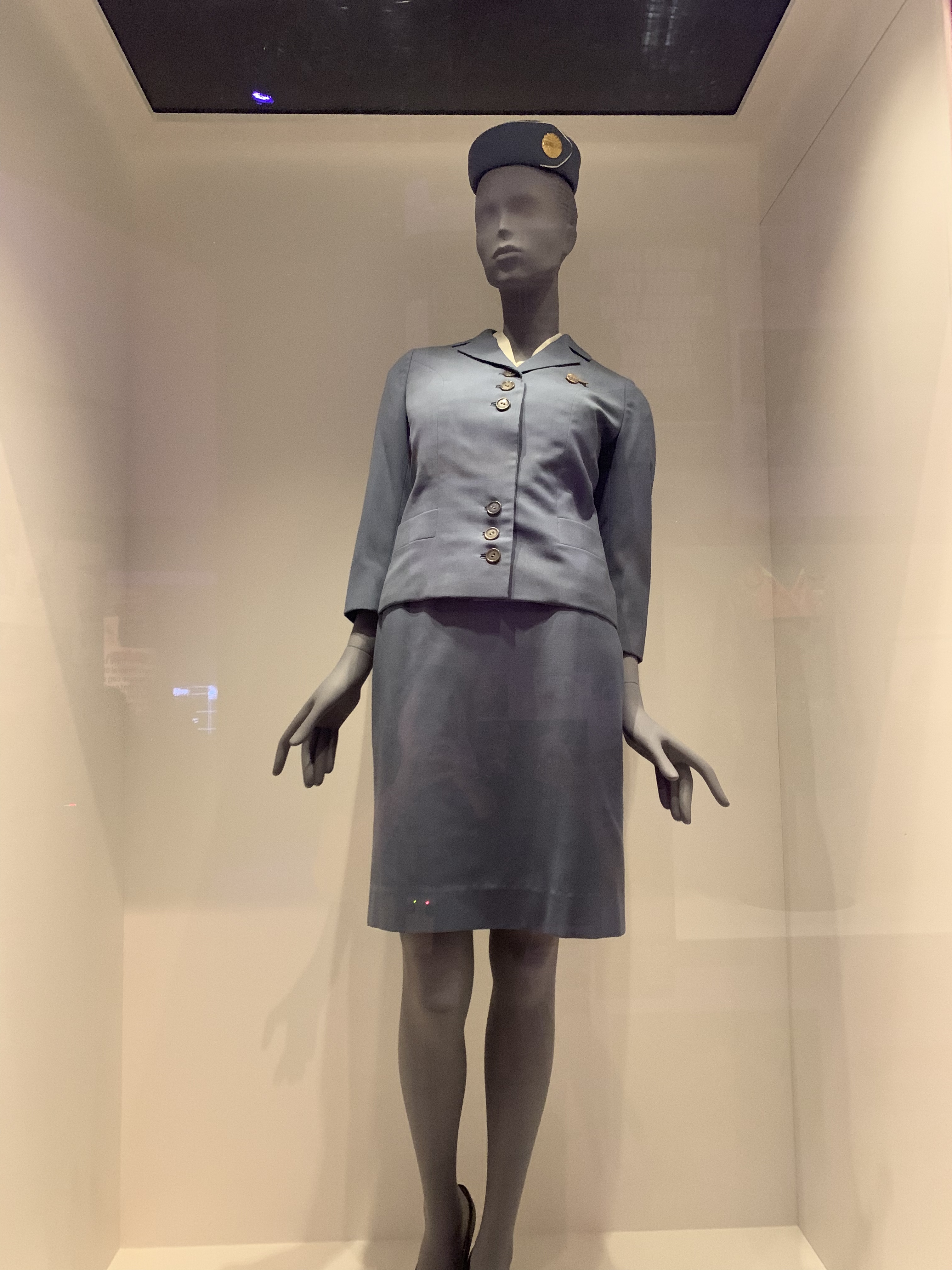
There are almost too many highlight objects to mention in this section. I have to start with the Pan Am hostess uniform from 1965 that is on loan from the Smithsonian National Air and Space Museum.
Pan Am Uniform
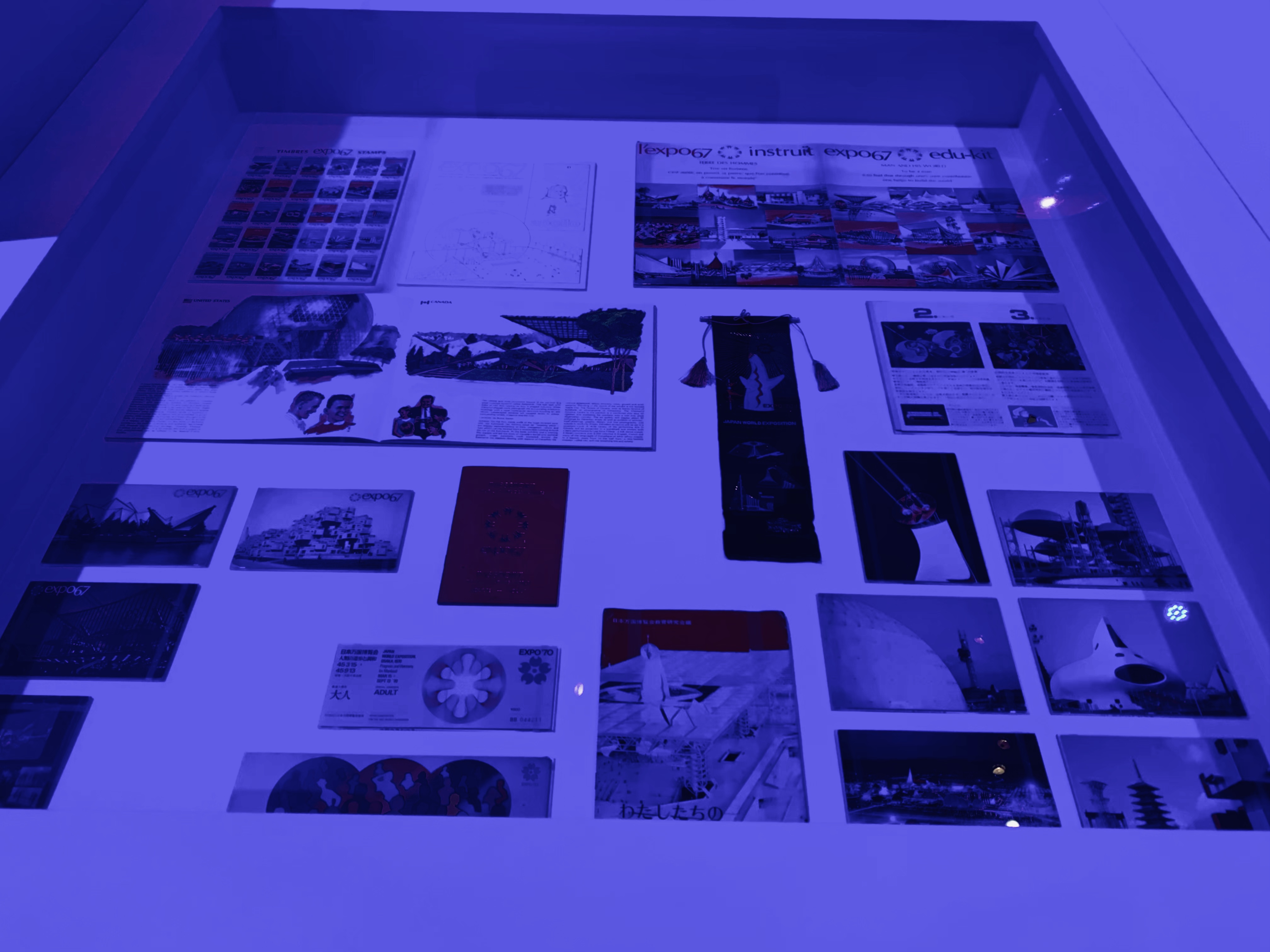
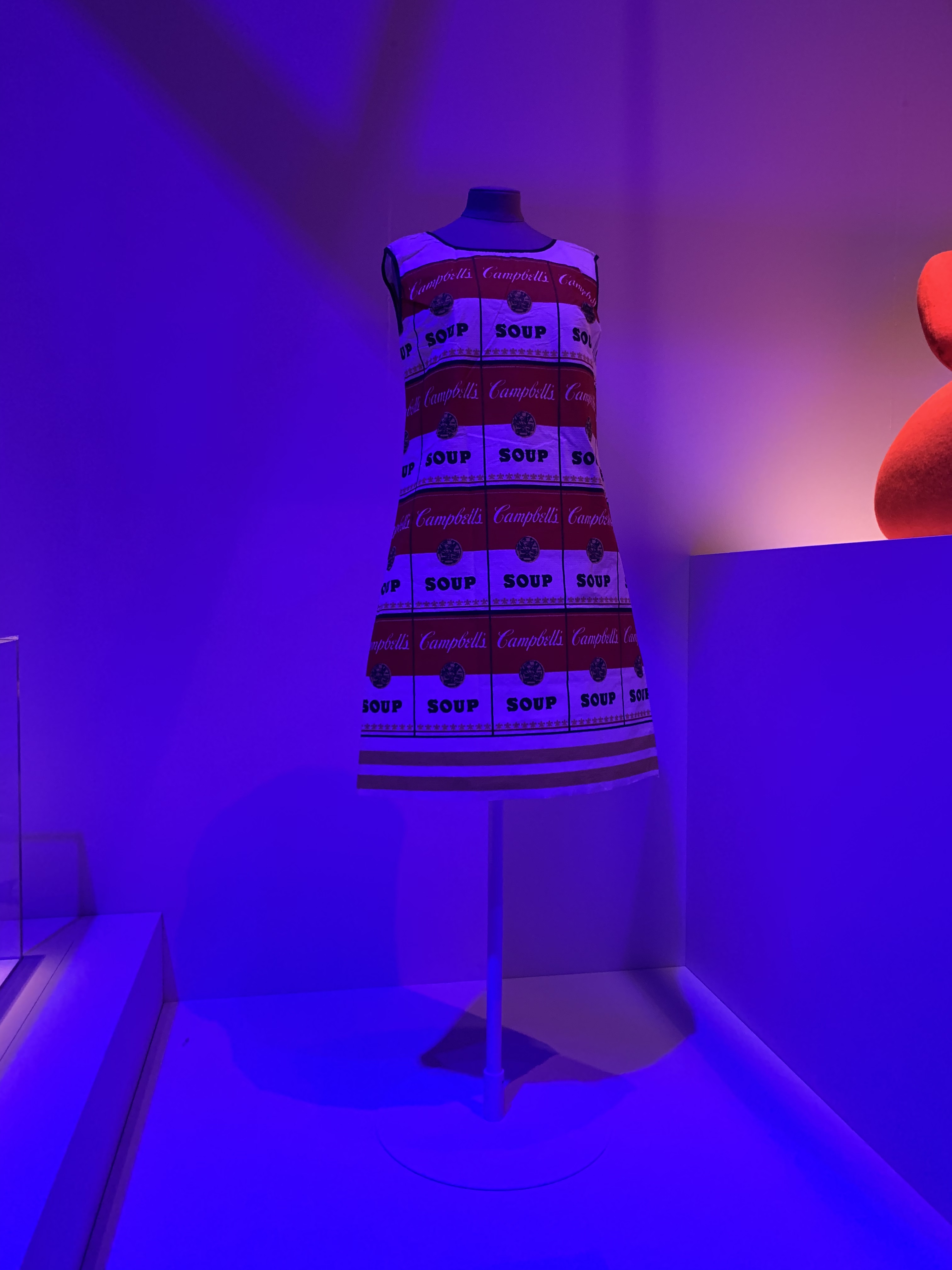
It was near impossible to take photographs in the rest of the space as extremely vibrant blue lights meant all images came out royal blue. I’ve tried my best with photo-editing software to normalise the following two images: one of expo material from 1967 and 1970, and one of the Souper Dress from 1966.
Expo MaterialSoup Dress
Other
There are a couple of other things to mention about the exhibition. Not only is music utilised to create an atmosphere, but there is a real attempt to match the aesthetics and design to the theme as well. For example, in the section on music festivals, there is a room off the main exhibition space filled with beanbags on green carpet for visitors to sit and watch three huge screens showing performers. There are also benches for those who may find getting in and out of beanbags problematic. This helps to create the illusion that you are at a music festival.
Seated Zone
Similar to Gut Feelings, my only major criticism of the exhibition is that the majority of labels are white writing on black backgrounds. I really hope this stops.
Practical Information
Melbourne Museum is open daily from 10 am to 5 pm (excluding Christmas Day and Good Friday). Gut Feelings is in the Mind & Body Gallery and is on show until February 2020. Revolutions: Records and Rebels is in the temporary exhibition space only until 6 October 2019.
General museum entry is $15 for adults and free for museum members, children and concession. Please keep in mind if you want to see Revolutions, there are additional charges. The Museum is located at the top of Melbourne’s CBD grid meaning it’s easy to access via public transport. Apart from the labels which could be problematic for some visitors, the whole museum is accessible.
Today we visited the Immigration Museum in Melbourne specifically to see two new (ish) exhibitions – Tatau and Perseverance. Essentially, both look at the significance of tattoos – one focusing on Polynesia and the other on Japan. Even though there were a few similarities, I am going to address each exhibition separately.
I have previously visited the Immigration Museum to view their permanent displays. If you are interested in reading more about what else is on offer, follow the link here.
Immigration Museum Entrance
Tatau: Marks of Polynesia
Context
Tatau: Marks of Polynesia is a traveling exhibition on loan from the Japanese American National Museum in Los Angeles. The aim of the exhibition is to showcase the work of traditional tatau (tattoo) practitioners and contemporary artists who are currently working with the motifs and style. For example, parts of the exhibition focus on the Sulu’ape family in Samoa who are instrumental in continuing the tatau tradition. They believe it is crucial to strengthen cultural connections and a sense of identity in the country.
The exhibition consists of mounted images, cultural objects and a video. Everything is on display in one room located on the second floor of the Museum.
Exhibition Highlights
There are a few specific highlights I want to mention.
1. Exhibition Atmosphere
Even before entering the space you can start to hear music coming from inside. This traditional Samoan music creates an amazing atmosphere. I’m not usually a fan of loud noise in exhibitions, but this just works perfectly. It is so soothing to hear while walking around. A couple of songs do include lyrics, meaning at times I found it difficult to listen and read the display panels at the same time. Overall, however, it added a new layer to the exhibition and allows for a multi-sensory experience.
2. Video
Leading on from the first point, I will note here that there are headphones available to watch the video. If both headphones are in use, the video has subtitles. A very wise decision considering you wouldn’t want there to be any competition for noise.
The video is a great place to start. Not only are there interviews with some of the tatau artists who have work in the exhibition, but you can see the practice in action. I would highly recommend going straight to the video after reading the introductory panel. It’s also a fantastic opportunity to hear firsthand accounts about both the significance of tatau and having work on display in an exhibition.
Quote from the video.
3. ‘Au ta tatau (Tattoo Tools)
In the middle of the exhibition is a small display case containing a few tools of the trade. These include the sausau (striker or mallet), ‘au mono (for small patterns), ‘au sogiaso (for medium patterns), ‘au sogi’asofa’aifo (for large curved lines) and ‘au tapulu (for blackening the thighs of men’s tatau).
‘Au ta tatau
4. Display Panels
There are two display panels I want to mention – the introductory panel and the first panel you see on entering the space.
The introductory panel not only has the text in English, but also in Samoan. I see this as a way of allowing for some agency. In other words, the society or culture being displayed can have their voice added to the space in their own language.
Panels
The first panel in the space explores the social structures in Samoa. This serves as both an introduction to Samoan culture and an explanation for some of the tatau visitors will see in the exhibition. This context, along with the music playing, allows for the exhibition to really reinforce its cultural significance.
5. Photographs of Process
Although all the photographs on display are simply stunning, I really enjoyed those that document the tatau process. In particular, this image below of Su’a Sulu’ape Peter tattooing.
Photography of Process
The other photographs on display are mainly of individuals proudly showing their tatau.
Perseverance: Japanese Tattoo Tradition in a Modern World
Context
Like Tatau, this exhibition is currently on loan from the Japanese America National Museum. Its aim is to explore the history of tattooing in Japanese culture and how this ‘underground’ (aka not overly socially acceptable) activity has persevered. The work of many artists is on display including Horitaka, Horitomo, Horishiki, Miyazo, Shige, Junii, and Yokohama Horiken.
Perseverance: Japanese Tattoo Tradition in a Modern World
The exhibition consists of full-size images, framed close-ups, cultural objects and a video. Again, everything is on display in one room, but this time located on the third floor of the Museum.
Exhibition Highlights
1. Introduction to Japanese Motifs
After walking past some projected images of animated carp fish, you come across a large introductory panel exploring common Japanese motifs in tattooing. These include snakes, dragons and tigers. You can spend a bit of time here reading about the significance and history of the most popular designs. A great way to introduce the exhibition.
While Tatau utilises sound to create an atmosphere, Perseverance focuses more on the physical layout. There is a video playing in a separate room that, to an extent, isolates the sound. Instead, what I noticed immediately about this exhibition is the use of light and projections along with the different photographic displays. The use of projectors and lanterns helps to create a certain feel to the exhibition that relates directly to the theme. As for the photographs, as well as smaller framed images, there are large full-size posters hanging from the ceiling near the entrance. Both exhibitions implement different techniques in order to set the scene for their content.
Exhibition Layout
Further Information
Tatau and Perseverance are on display until October 6, 2019 at the Immigration Museum. Entrance costs $15 for adults and is free for children and concessions. The Museum is accessible and open everyday except for Good Friday and Christmas Day.
I highly recommend visiting to see these exhibitions. They are both so important in communicating the significance of tattoos and how they can reveal so much about a particular society or culture.
This will be my final post celebrating 100 Years of Bauhaus. We have arrived at our final Bauhaus destination, Berlin. There seems to be an ongoing trend with these posts – places that I visited have either closed down or been transformed/renovated. What’s really exciting is that this is happening so brand new museums and archives can open in each of the three cities. It is certainly an ideal time for Bauhaus fans to make the journey to Germany!
The final post in this series will be short and sweet. While in Berlin, I only visited one Bauhaus-related site, the Bauhaus-Archiv/Museum für Gestaltung (Bauhaus Archive/Museum of Design). The original museum closed in 2018 for renovations and is due to re-open in 2022. It sounds like it will be quite a fascinating building with architect Volker Staab winning the design competition with his work “glass museum tower”. In the meantime, there is a temporary location open for the public in Charlottenburg. I will provide more practical information at the end of this post.
Museum History
If you have read either of my other two pieces in this series (Weimar and Dessau) you will already know a little something about the history of the Bauhaus School. The legacy of the Bauhaus continues to permeate our culture and our perception of design. Quick recap – after being forced out of Weimar, the Bauhaus School moved to Dessau in 1925. In 1931, the National Socialists won municipal elections in Dessau and members of the School once again found themselves on the move. They settled in Berlin in 1932. After only one year, the school officially closed. For some, the only viable option was to emigrate overseas and escape World War II.
In 1955, the Hochschule für Gestaltung opened in Ulm (near Munich). Here, art historian, Hans Maria Wingler, met Walter Gropius and started collecting documents and objects relating to the history of the Bauhaus. Gropius was one of the Masters of the Bauhaus School.
Over time the collection grew and in 1960 Wingler established the Bauhaus Archive. Just like any other collection, it eventually began to outgrow its location, Ernst Ludwig House. Wingler was soon searching for a new location to display and store the extensive collection. Eventually, the Bauhaus Archive opened in Berlin Mitte in 1979.
Bauhaus Archive
Museum Today
Today, the Bauhaus-Archiv/Museum für Gestaltung holds the largest collection of Bauhaus-related objects in the world. It aims to display the history, practice and impact of the movement. Gropius, along with other Bauhaus members, donated their entire private archives in order for this goal to be achieved. Needless to say, it has become quite a significant repository of information relating to the significance of the Bauhaus School.
I visited the Museum back in 2012. I cannot remember a lot of details, but I do remember enjoying my visit and thinking it had a very impressive collection. I spent a couple of hours in this one room looking through some old papers trying to read and understand the German. I also really enjoyed the large furniture rooms filled to the brim with Bauhaus chairs, desks, lamps, etc. I am interested to see the layout of the new museum and how they are going to display such a rich and in-depth collection. I hope they have some weird and wonderful exhibitions and really have fun with what’s on offer.
Bauhaus Archive
As you can probably imagine, the temporary museum is holding many programs and events to celebrate the 100 years. You can find more information by clicking on the link here.
Practical Information
If you are lucky enough to be in Berlin this year for the centenary, or if you’re visiting prior to 2022, make sure you pop in to see the temporary location. Admission is free and the Museum is open Monday to Saturday from 10 am to 6 pm (closed on public holidays). It is located at Knesebeckstrasse 1-2, Berlin-Charlottenburg. There are so many other things to see and explore around that neighbourhood so I would strongly recommend visiting.
Reflection
It has been so wonderful to share these three blog posts. This year I have really committed to getting back into my German studies. This is partly because I’ve been reminiscing about my time in Berlin visiting all these amazing places. I cannot wait to explore these three cities again in the near future. How exciting to think that as I’m writing this post, new Bauhaus museums are preparing to open. This will potentially mean new stories, new objects, and a new look at the history of the School through some different perspectives.
Information sourced for this post can be found here.
I usually try and write my blog posts immediately after visiting a museum/heritage place. Sometimes, that doesn’t happen and sometimes you wake up on a Sunday morning at 6 am and realise you still have a blog post pending.
This is my final post on Chicago which is now long overdue. I’ll be covering the Devil & The White City tour offered (and initiated) by Weird Chicago Tours. In 2003, Erik Larson published a book of the same name covering two quite distinct yet completely interrelated stories – the construction and proceedings of the 1893 World’s Columbian Exposition and the Murder Castle/Hotel operated by Herman Webster Mudgett, better known as H H Holmes. If you haven’t had the opportunity to read this book, I highly recommend it.
According to our guide, Eric, there are three types of people who are attracted to this tour:
Those interested in true crime
Those interested in Chicago’s history
Those who have a friend interested in either 1 or 2 and who came along because they either got a free ticket or had time off and wanted to support said friend
If you’ve read my “About This Blog” page, you’ll know that I am not only a historian, but also, a true crime buff. If you’ve read any of my previous blog posts, you’ll also know that the first exhibition I ever curated was on Queensland’s representation in World Exhibitions during the 1800s. The tour might as well have been called “Psst Rebecca you should do this tour because it combines pretty much everything you are interested in and because you’re speaking about H H Holmes at a conference this year it may be tax deductible.”
According to the Weird Chicago Tours website, the tour visits locations that transport visitors back in time to when the Windy City (coincidentally not named because of windy weather, but because, well, you can Google it) was home to the 1893 World’s Exposition. It balances the history of Chicago in the lead up to the fair, during the fair, and finally, the city’s dark past. Here is where we ventured on the tour. I will include a link to the company’s website at the end of this post.
1. The Congress Plaza Hotel
If you are looking for one of the most haunted hotels in Chicago then The Congress Plaza Hotel should be your first stop. Built for the 1893 World’s Exposition, the Hotel has since undergone some renovation and reconstruction and continues to operate today. We visited not only because of its connection to the Exposition, but also, because there is evidence to suggest H H Holmes would hang around the lobby from time to time offering young women who couldn’t get a room one at his hotel.
The Congress Plaza Hotel
I’m going to pause here for a moment in case anyone is wondering who is H H Holmes. Basically, he is regarded as America’s first documented serial killer who murdered somewhere between 27/28 (what he confessed) and 200 (what the original police report stated) in his hotel located in Englewood, Chicago. Holmes tried completing a medical degree but was kicked out of College due to using cadavers to defraud insurance companies. This is one of the only pieces of information we know for sure about Holmes. I will talk more about this Murder Castle/Hotel later in the post.
2. Great Chicago Fire Memorial
After the hotel, we went on a bit of a drive to see a memorial dedicated to the Great Chicago Fire and where the fire allegedly began. The fire broke out in 1871 killing a few hundred people and leaving thousands homeless. As the city mostly contained wooden structures, the effects were devastating. But, the people of Chicago rebuilt their city and only a couple of decades later were in a position to even consider holding the World’s Exposition.
Great Chicago Fire Memorial
One thing I really enjoyed about this stop is that our guide went through the story traditionally taught about the fire. That is, Catherine O’Leary’s cow knocked over a lamp starting the fire. Then, we discussed how history treats those who were marginalised. As O’Leary was quite an outspoken woman in early American history, she was a scapegoat. Today, there is no exact answer as to what did cause the fire. What has been discovered, however, is that both O’Leary and the cow have been largely proven innocent.
3. Union Stockyard
We made a brief stop at the Union Stockyard for two reasons. Firstly, it was mentioned in the book. Secondly, the entrance gate to the stockyards was one of the first works designed by Daniel Burnham who later became Director of the World’s Exposition. For this reason, it is a heritage place in Chicago. The Stockyard operated from 1865 to 1971 and at one stage processed more meat than anywhere else on earth. If you think about Workplace Health and Safety in the 1800s you’ll probably get an idea of just how dangerous and exhausting working in the stockyards must have been and the dark history lurking behind every corner. Outside of incidents and accidents, one of the most disturbing things we learnt was that the waste of the stockyards was tipped into the south branch of the Chicago river eventually causing the water to bubble.
Union Stockyard
To learn more about this aspect of Chicago’s history, I endeavour to read The Jungle by Upton Sinclair.
4. Murder Castle/Hotel
Here is an original image of the hotel:
Wikimedia Commons Public Domain
Here is an image of the United States post office that now stands on the site:
Murder Castle/Hotel
After a few fires that wrecked the inside, the hotel was eventually demolished in 1938. To give you an idea of what you’re looking at in the original photograph, this hotel was built by Holmes in around 1889. Beneath the hotel rooms operated a few legitimate businesses. Multiple individuals were hired to build the hotel then were fired to ensure no one ever knew the full plan. There were soundproof rooms, secret passages, hallways that led to nowhere and trapdoors with chutes that led directly to the basement. The actual hotel of nightmares. It wasn’t discovered until after Holmes left Chicago and was charged with yet another insurance scam, this time though he actually killed someone and didn’t use a medical cadaver. As I mentioned before, Holmes confessed to killing 27/28 individuals. The actual numbers may never be known.
5. Jackson Park & the Museum of Science and Industry
The final stop on our tour was Jackson Park, the grounds of the World’s Exposition. Frederick Law Olmsted, a landscape architect, designed this park for the event. If his name sounds familiar it’s probably because he also designed Central Park in New York.
Jackson Park & the Museum of Science and Industry
It was a really great way to end the tour, in peaceful surroundings actually standing on the ground where the Exposition was held. Unfortunately, very few remnants of the Exposition survive today. The building that now houses the Museum of Science and Industry is the only building to have survived. Originally, it was the Palace of Fine Arts, built out of concrete to assure artists that their work would not be stored and displayed in a building deemed a fire risk. The building is listed on the Chicago Landmarks list published by the City of Chicago.
Final Thoughts
I would highly recommend this tour as not only being a great historical/true crime tour, but also, a great way to get orientated in Chicago. You can find more information by following this link including ticket prices, booking details and other tours that the company offers: Weird Chicago.