• Dessau: Bauhaus

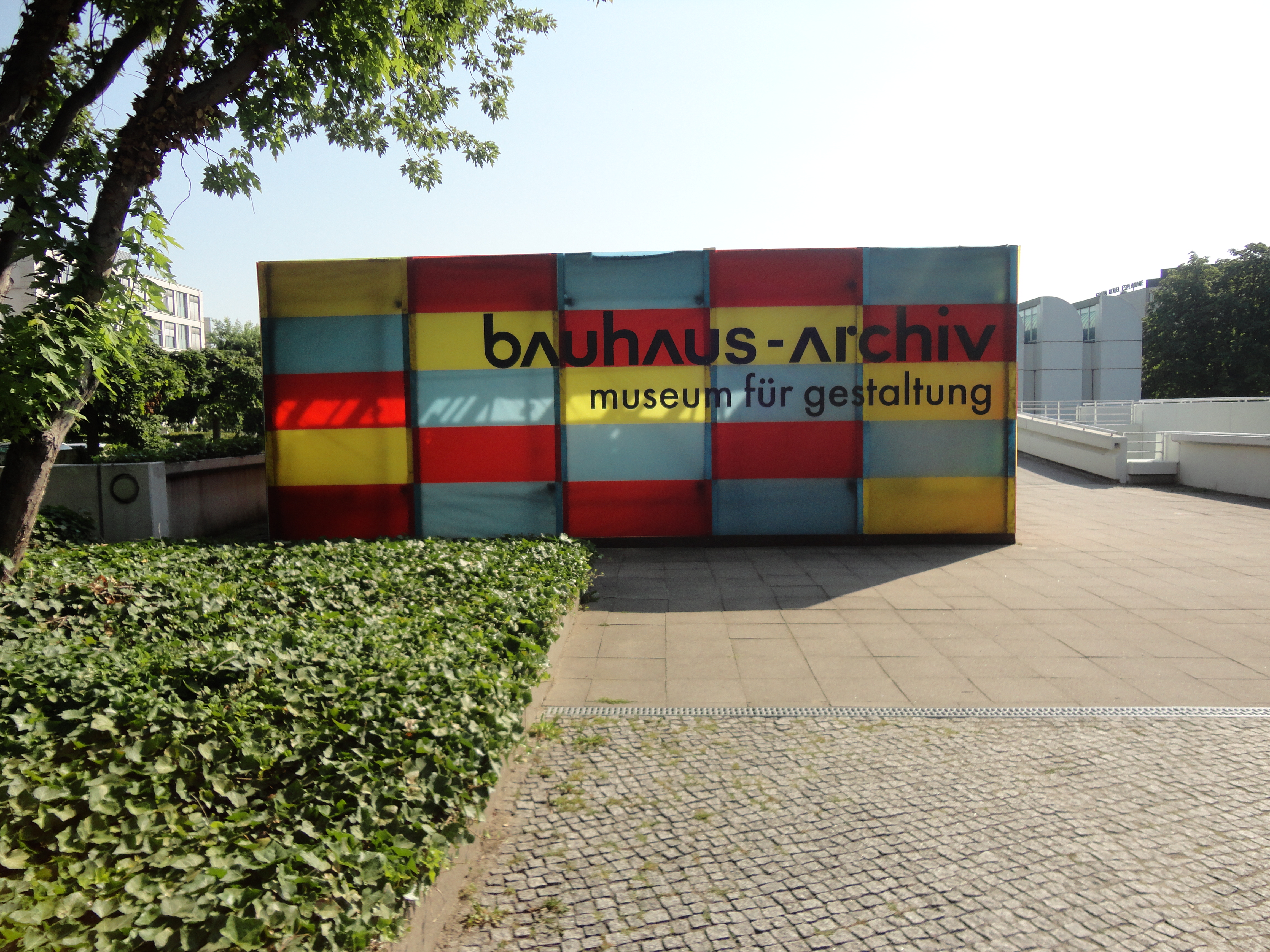
    Welcome to my second blog post celebrating 100 years of Bauhaus! In this post, we will be travelling to the city of Dessau – about a 2 hour drive/train journey from Berlin. If you remember from my post about Weimar, Dessau was the second location for the Bauhaus School operating there between 1925 to 1932.

    It is also where you will find this building:

    Bauhaus Museum 6
    Bauhaus Building

    I divided my post about Weimar into the various things you could do in the city including, of course, anything Bauhaus. For this post, however, I’m just going to focus on the two main Bauhaus sites. This is primarily because I only spent one day in the city and spent the entire time seeing everything Bauhaus. At the end of the post, I’ll include some further information on why both sites have been World Heritage listed.

    Bauhaus Stairs
    Bauhaus Building

    Bauhaus Building

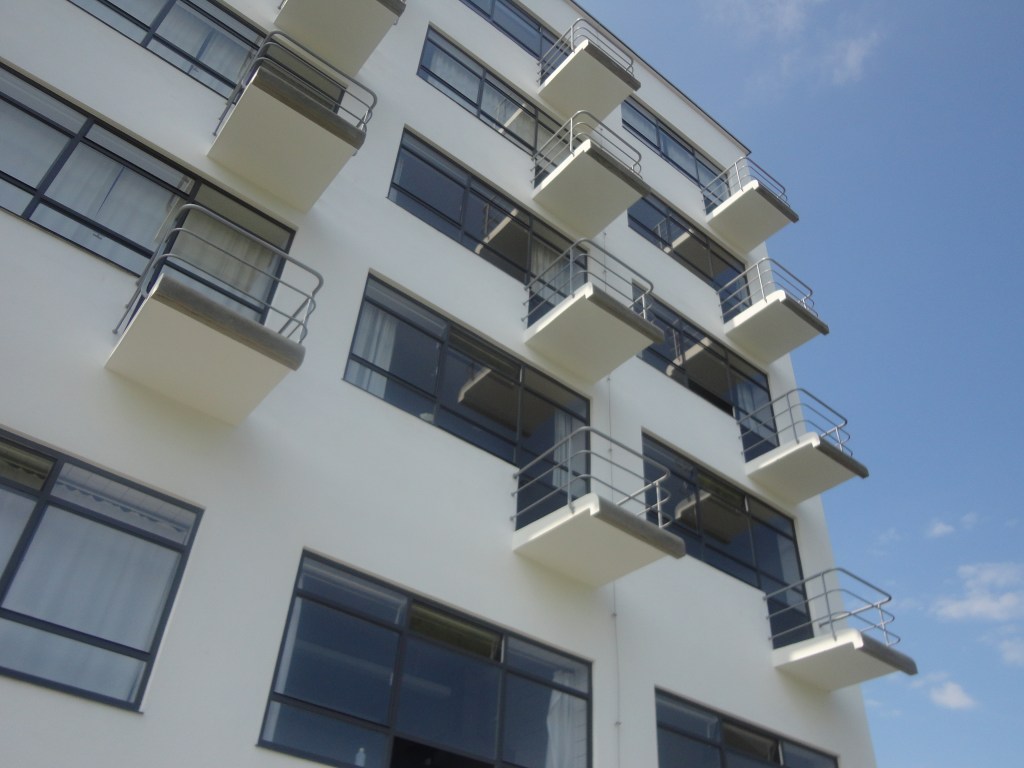
    I highly recommend starting any trip to Dessau with a visit to this museum/heritage place. Not only does it offer everything Bauhaus you could possibly need, but, tours run from here to the Masters’ Houses. It is such an impressive building really juxtaposed against the quaint city. It was designed by Walter Gropius and commissioned by the city of Dessau. What makes this building particularly impressive is its large glass walls and windows. The idea behind this design was to provide a sense of transparency. It also has rooms for 28 boarding lecturers and students with protruding balconies, as you can see in the photograph below. When I visited, back in 2012, you could spend the night in one of these rooms. It would have been an amazing experience.

    Student Balcony
    Bauhaus Building Student Accommodation

    Inside, you can learn all about the Bauhaus School and view an impressive number of Bauhaus-related objects including, my personal favourite, furniture. After taking copious amounts of photographs of me on the stairs, I joined a guided tour to visit some of the other locations in the building including the cafeteria and the stage. There is a guided tour offered in English on Fridays between March and October at 12 pm. If you are unable to attend this very specific time, I highly recommend going on a guided tour in German. They run daily at 11 am and 2 pm (also at 12 pm and 4 pm on weekends) and cost € 5. Even if you don’t speak German, it is a great opportunity to see these locations and chances are you’ll pick up on a few phrases before the tour is over.

    Famous Stairs
    Bauhaus Building
    Gropius Desk Weimar
    The desk of Walter Gropius

    Entry tickets to the museum are € 8.50 for adults and € 4.50 for concessions. Entrance is free for those under 18. I opted for a combination ticket that also included a tour of the Masters’ Houses and entrance to their exhibitions. This is well worth purchasing if you plan on spending the day in Dessau and is only an extra € 4.50.

    Masters’ Houses

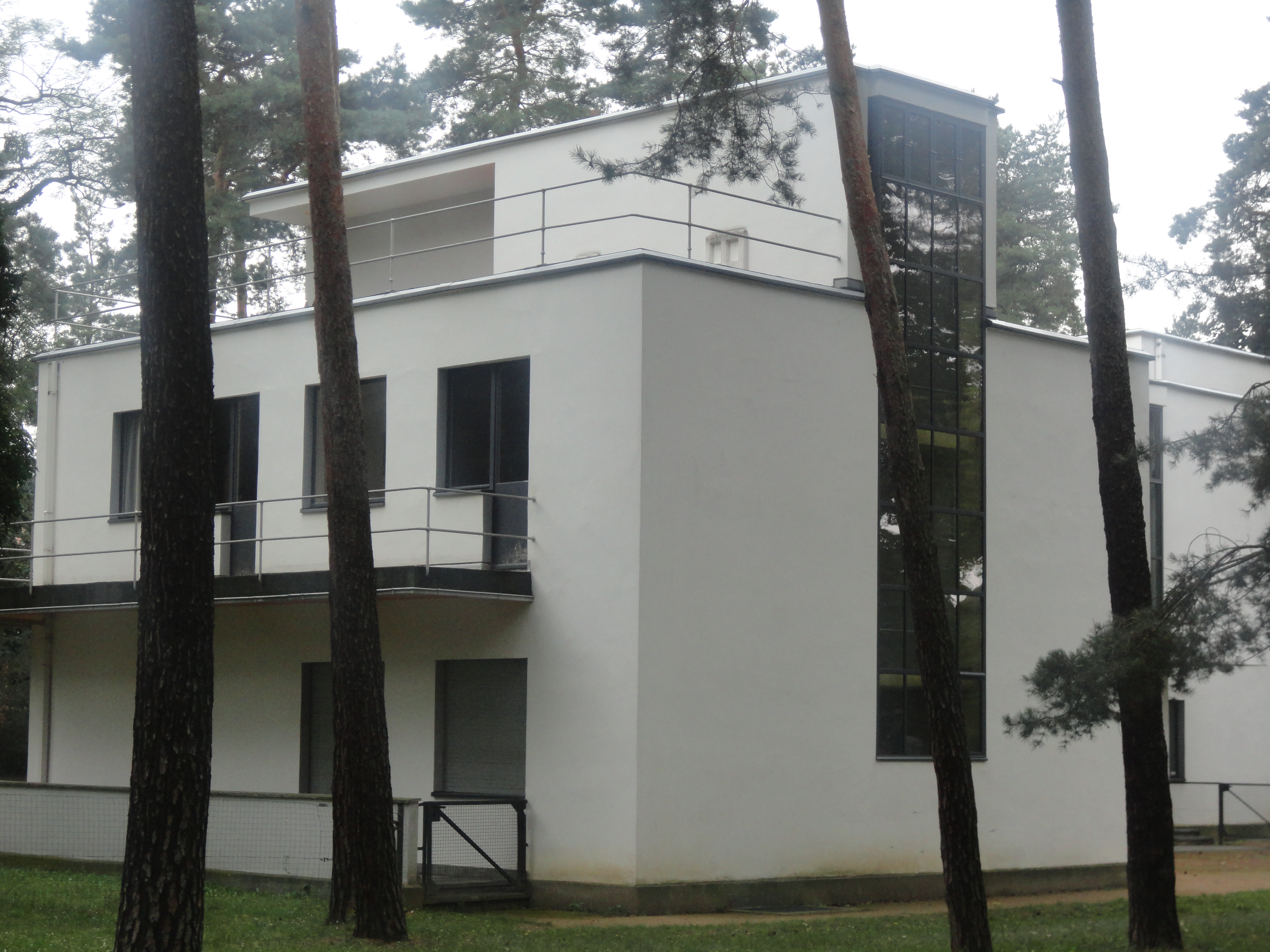
    On the tour of the Masters’ Houses, you are able to admire both the exterior and interior of the houses that once belonged to individuals such as Walter Gropious and Paul Klee/Wassily Kandinsky. They are all built in a complex that is based on the modular principle using prefabricated components. In other words, they all look like interlocking cubic structures.

    Kadinsky's House 2
    Masters’ Houses

    When I visited, there was some reconstruction taking place on the houses that belonged to Klee and Kadinsky. Whilst researching for this piece, I discovered that this reconstruction has been completed and the houses have re-opened. The houses that we were able to enter, Gropius’ house being one of them, were fascinating. The large glass encased studios are stunning and the re-introduction of Bauhaus furniture allows visitors the opportunity to view them as the might have looked during their occupancy.

    Kadinsky's House 6
    Kadinsky’s House
    Klee
    Klee’s House

    Heritage Listing

    Along with sites in Weimar, the Dessau Bauhaus locations were inscribed on the United Nations Educational, Scientific and Cultural Organisation (UNESCO) World Heritage List in 1996. According to UNESCO, the sites tick three criterion.

    Criterion ii – they exhibit an important interchange of human values, over a span of time or within a cultural area of the world

    There is no doubt that these buildings represent, and are themselves, works of art that reflect the renewal of architecture and design championed by the Bauhaus School. As Modernism is said to go hand-in-hand with Bauhaus, the buildings are also central in understanding this art movement and its influence on the world.

    Criterion iv – they are an outstanding example of a type of building which illustrates a significant stage in human history

    UNESCO specifically highlights the houses with balcony access in Dessau as a perfect illustration of how Bauhaus hoped to achieve unity between practice and teaching. Also, all buildings in Dessau are clear representatives of the movement and have all the essential Bauhaus components.

    Criterion vi – they are directly associated with artistic works of outstanding universal significance

    There is obviously a clear link between these buildings and the Bauhaus School which revolutionised design concepts and permeated almost every facet of art and architecture.

    Final Thoughts

    Similar to Weimar, Dessau will be celebrating 100 years by opening a new museum in September this year. I would love to return to Dessau and spend more time exploring the city and stay in the Bauhaus School overnight. Also, of course, seeing the new museum will be a must.

    If you would like to read my post on Weimar, please follow the link here. I only have one more Bauhaus-themed blog post to write. The next post, which I hope to release in September/October, will be focusing on the Bauhaus School in Berlin.

  • Queensland: Queensland Museum

    I want to begin this blog post by saying this exhibition, NASA – A Human Adventure, has been created to celebrate 50 years since the Moon Landing. Since then, the historiography of who was involved has been revised exposing those, particularly women, who achieved virtually the impossible to make the event happen. Unfortunately, this exhibition does not include them. I wanted to get this out of the way because I was so excited to see the exhibition and left feeling as if these important figures in history have yet again been hidden. This was a real opportunity to include these forgotten histories. Alas, the opportunity was not grasped and I believe the exhibition suffered from it.

    I would by lying if I said this didn’t taint my entire experience. As I went from room to room looking at huge posters of American and Soviet Union men I was continuously hopeful that the other stories might be around the next corner.

    IMG_7511
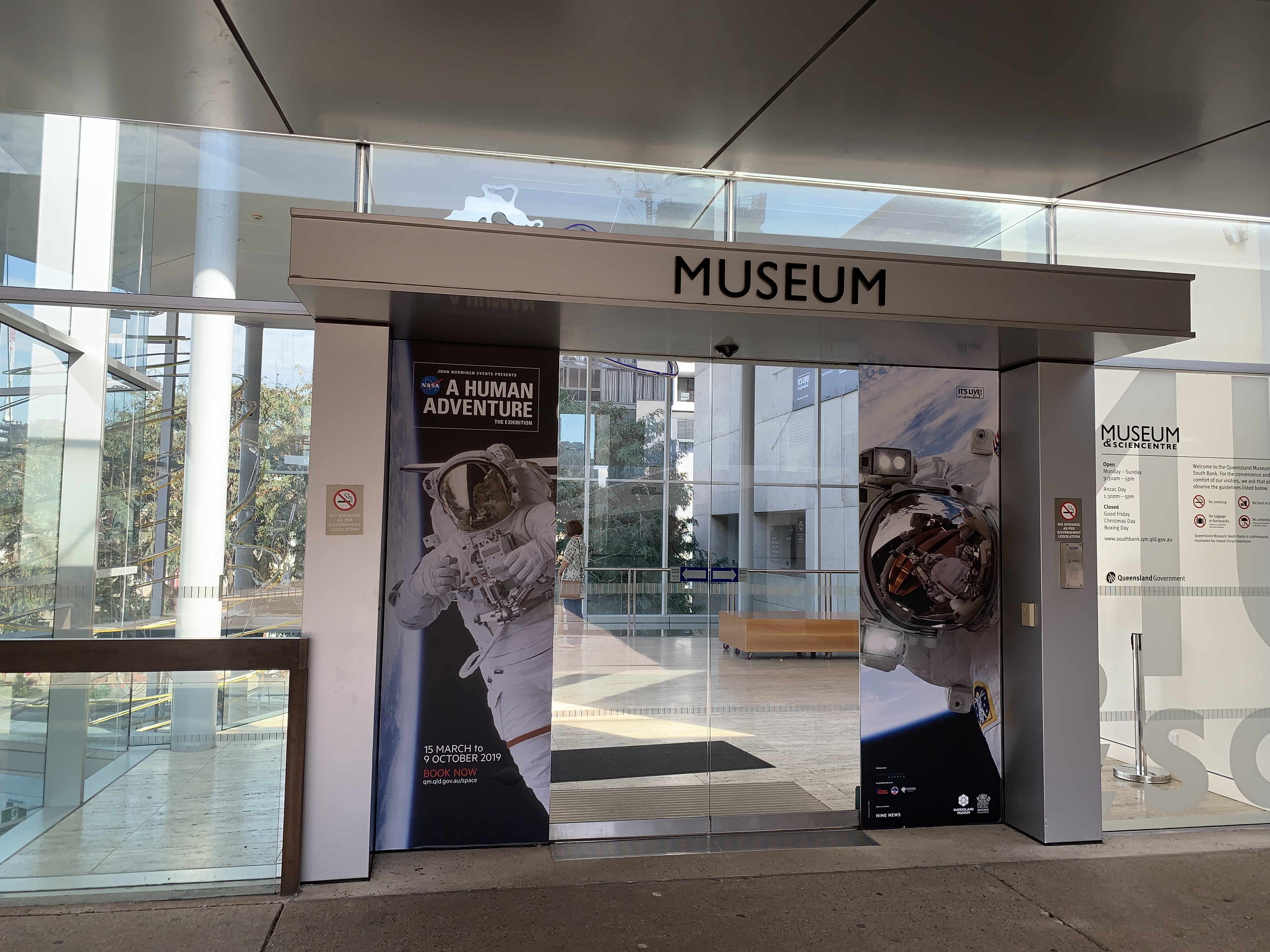
    NASA – A Human Adventure
    IMG_7512
    Museum Entrance

    The rest of this post is going to focus on the objects I found fascinating. I will say that, on the whole, the objects are displayed thoughtfully in beautifully designed cabinets. Whoever designed all the display elements did a wonderful job.

    Before entering the exhibition, there is a thematic panel that covers everything you’d expect to see – including the aim of the exhibition. The placement of this panel, just outside the exhibition, is refreshing. It means there is no bottleneck formed when first entering the space. At the bottom of the panel are two small images of a moon and footprint. Thirteen objects in the exhibition have a moon next to them indicating they have been on successful Apollo missions. Those with a moon and footprint mean they have landed on the moon. This sets the scene nicely and provides some extra information to look out for while in the space.

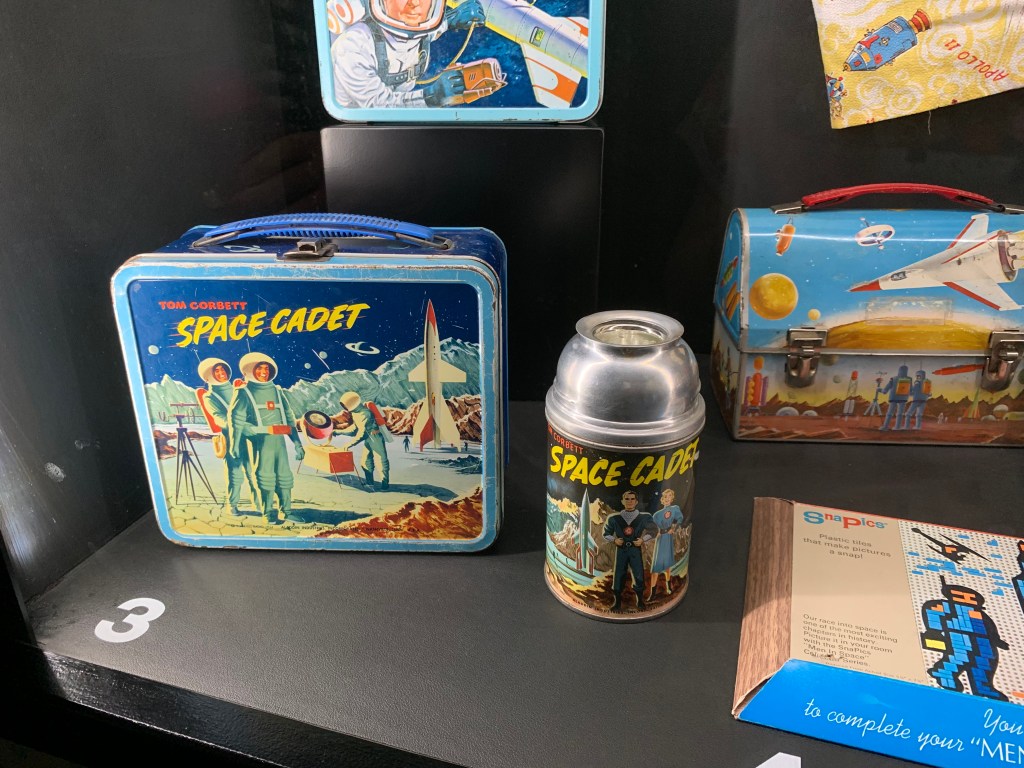
    1. Space Pyjamas and Drink Bottles/Lunchboxes

    The label for the first two objects I want to share doesn’t really say much except ‘Space Pyjamas’ and ‘Space-themed Vintage Lunchboxes’. Just quickly, all the object labels are on computer screens. This makes them difficult to read and I imagine visitor fatigue would set in quicker than if you were looking at a conventional label. I did try and find more information on the pyjamas, however, was not successful. Random side note, I did find that on 20 July this year the Science Museum in London is having a Space Sleepover where kids aged between 7 and 13 will get a free pair of ‘spacey pyjamas’.

    What I appreciate most about these objects is the fact they really show how significant the Moon Landing was in capturing the attention and imagination of the public. You can just imagine excited children taking their space lunch boxes to school and hoping that one day they might have the chance to go on a space ship and travel to the moon.

    IMG_7527
    Space Pyjamas
    IMG_7529
    Space Lunchbox

    2. Spacesuits

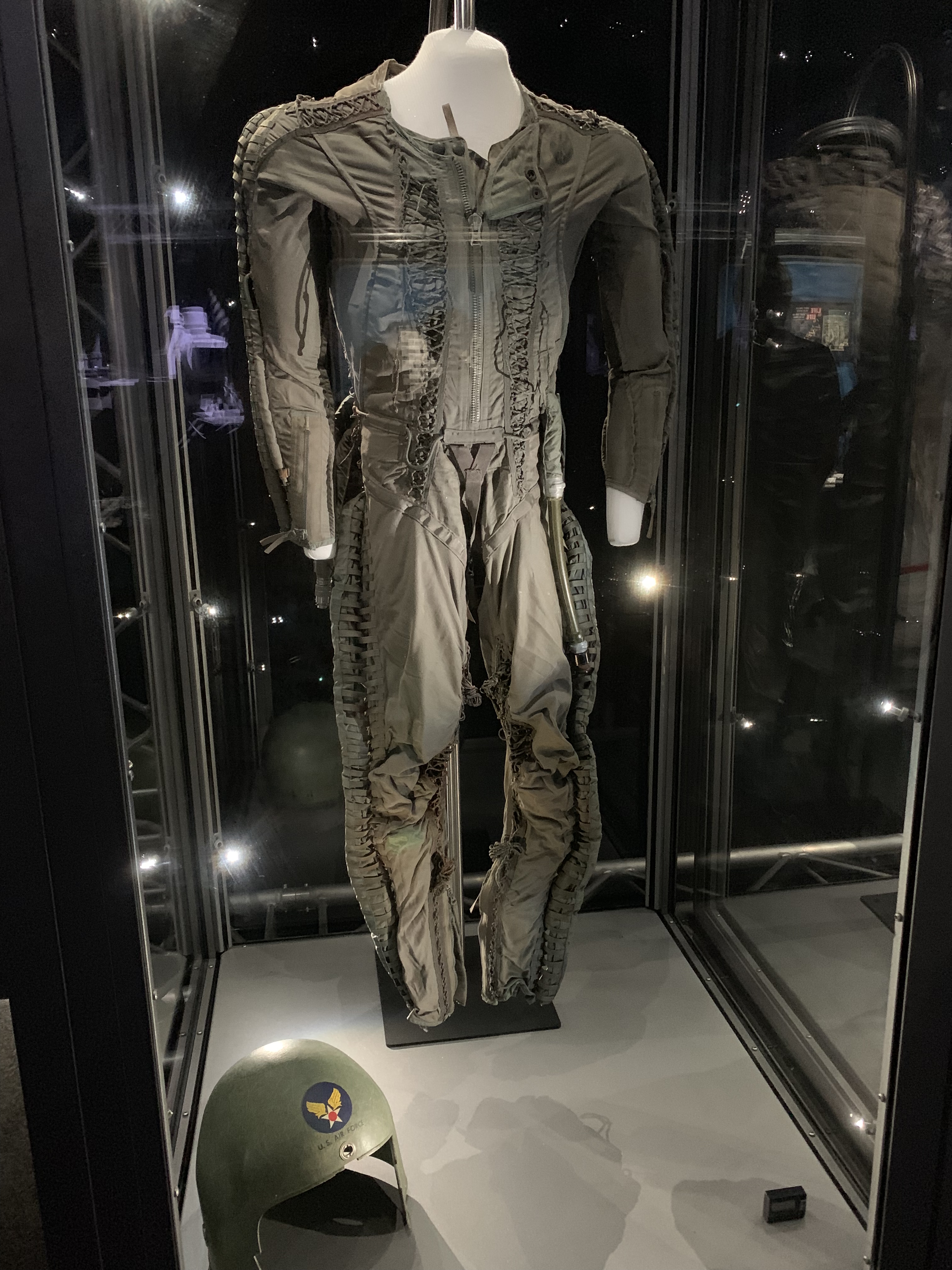
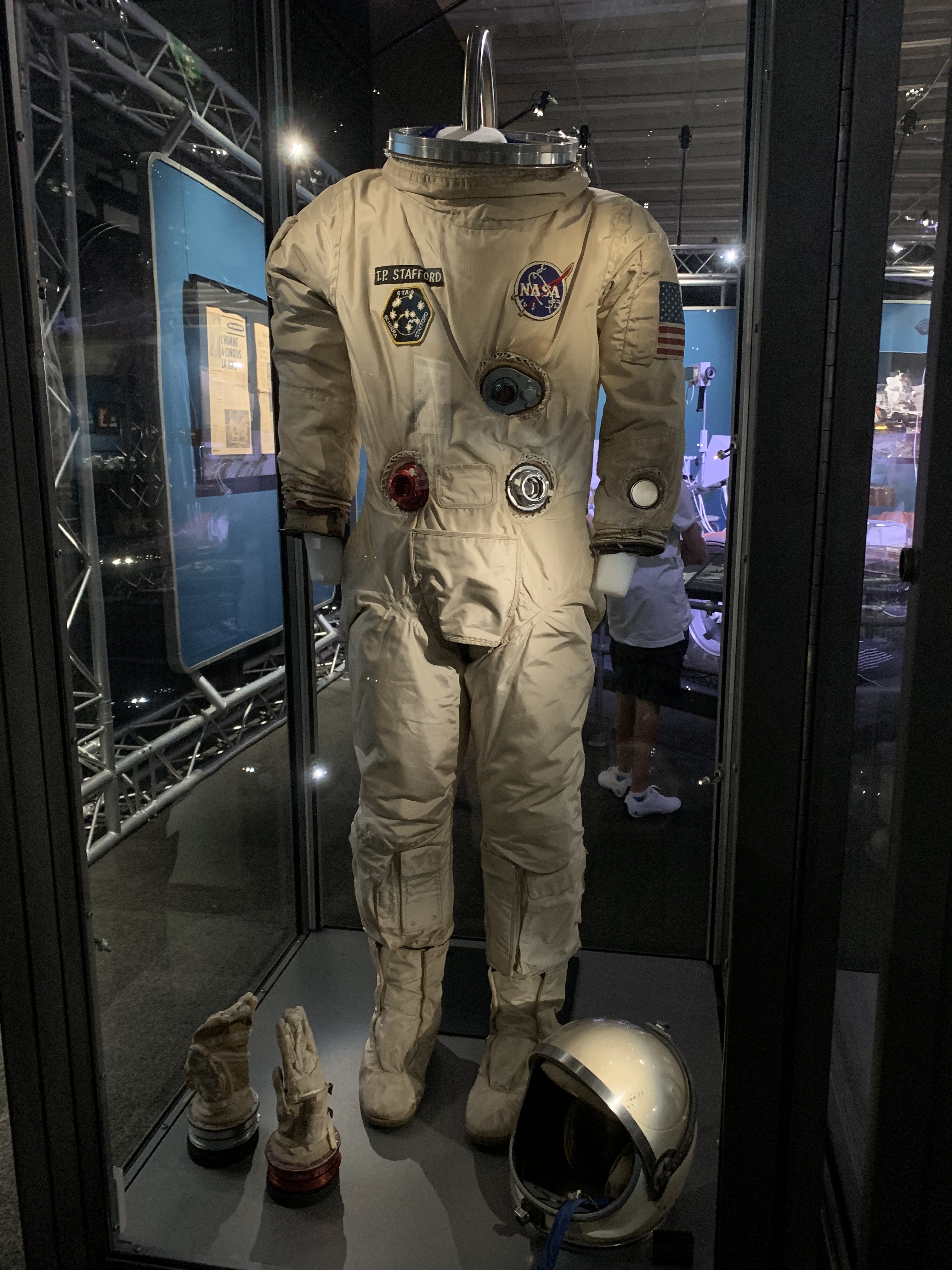
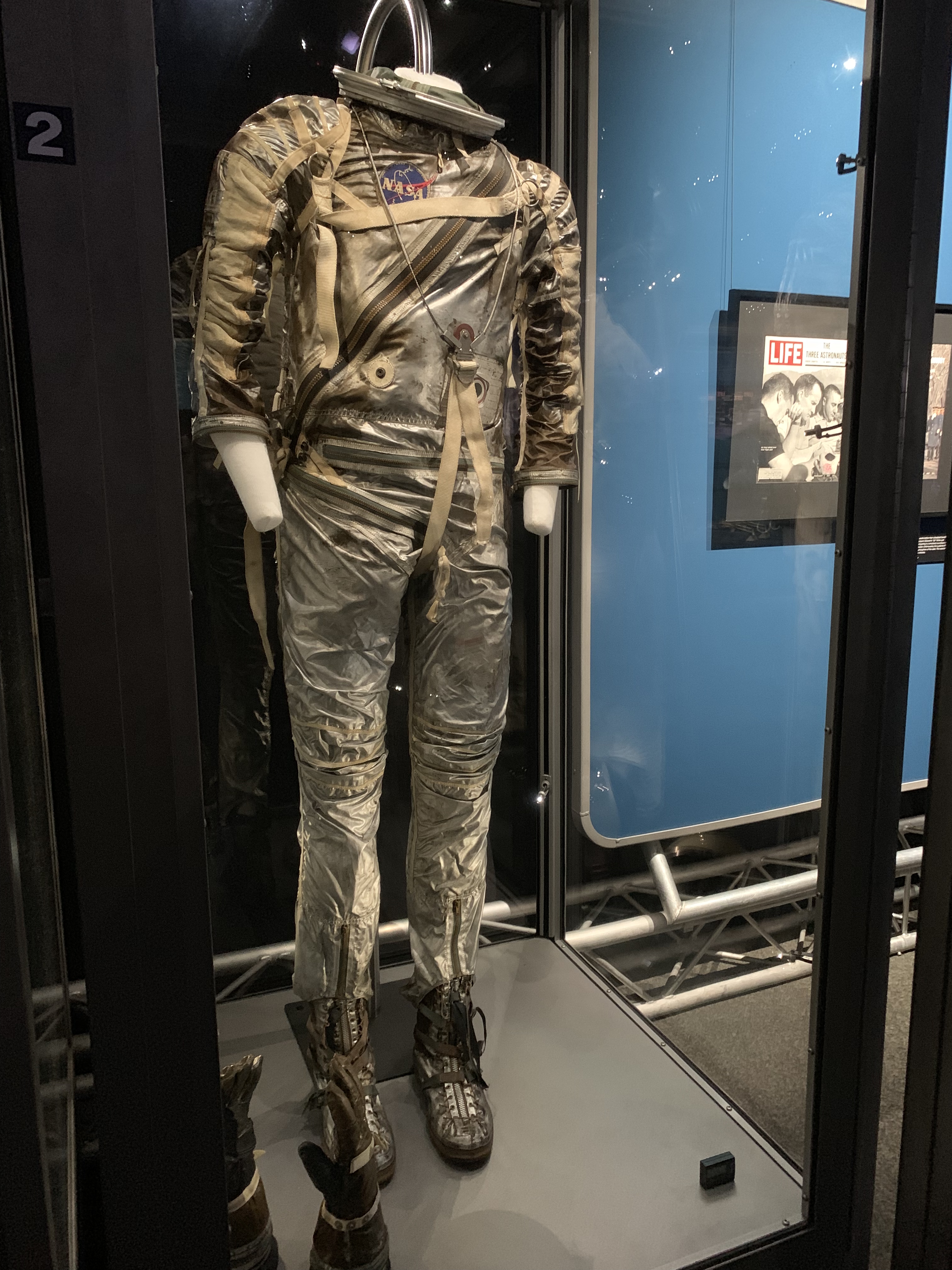
    These are the objects I was most excited to see. On display are 8 spacesuits ranging from those worn in space to those used in training. A personal favourite of mine is spacesuit number 5, an Apollo and Skylab A7LB spacesuit that has been dissected to show the different layers. Details can be found in the caption for each photograph.

    IMG_7534
    United States Air Force high altitude pressure suit and helmet shell – helmet shell is flown
    IMG_7535
    Gemini G4C spacesuit, helmet and gloves – Pressure Garment Assembly space flown on the Gemini VI mission
    IMG_7536
    Mercury spacesuit and gloves
    IMG_7540
    Apollo A7L spacesuit, helmet and gloves
    IMG_7543
    Apollo and Skylab A7LB spacesuit – cutaway – liquid cooling garment landed on the Moon on the Apollo 15 mission
    IMG_7546
    Apollo in-flight garment for training

    3. Apollo Survival Kit

    In what is known as a ‘splashdown’, Apollo missions, on returning to earth, landed in bodies of water. This kit has everything you need to survive 48 hours in the ocean – three water containers, one radio beacon and spare battery, three pairs of sunglasses, six packages of desalted chemicals, one desalter kit, two survival lights, one machete and two bottles of sunscreen.

    IMG_7557
    Apollo Survival Kit

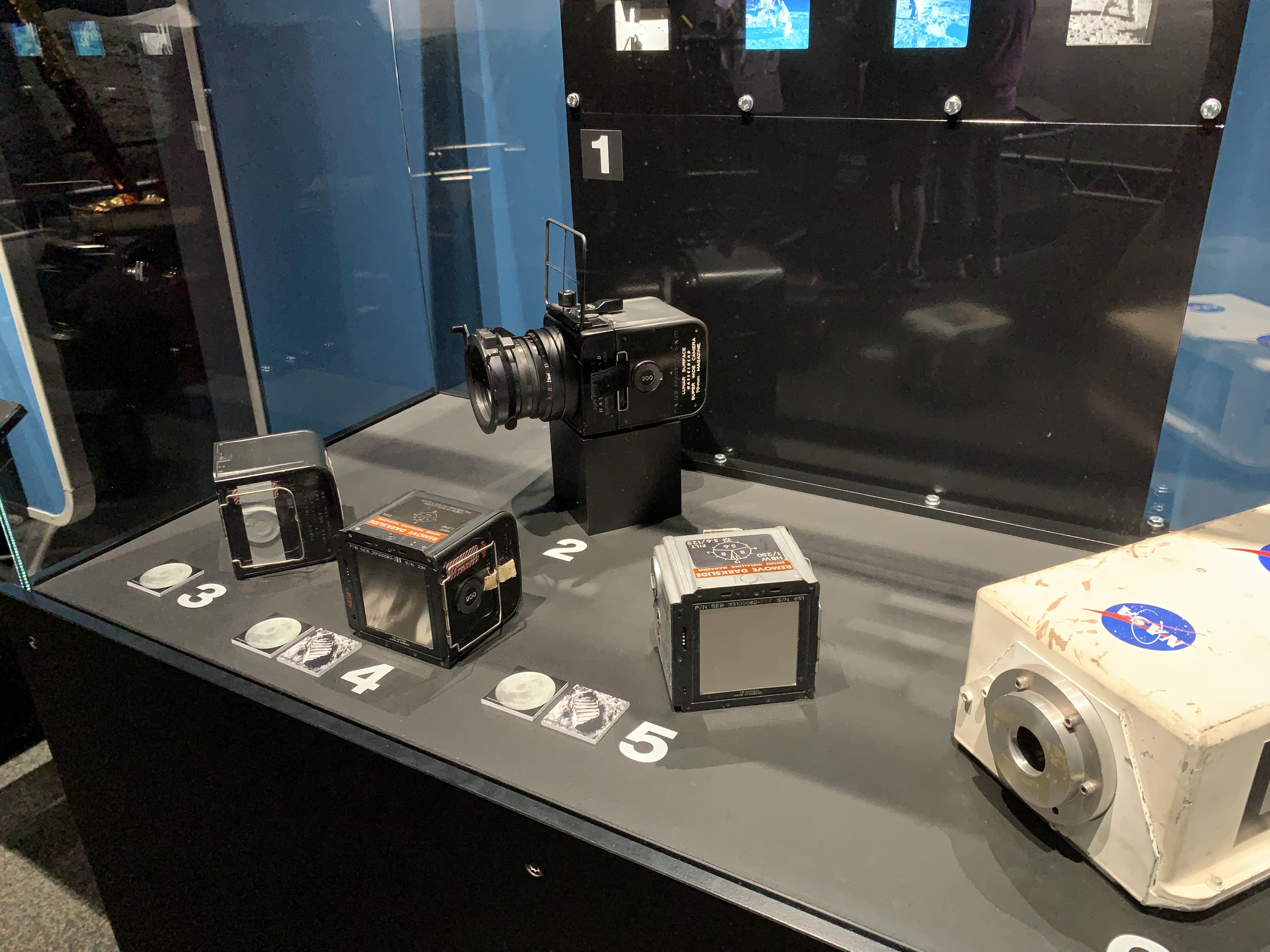
    4. Three Hasselblad 70 mm Film Magazine

    Two of these cameras (numbers 4 & 5) made it to the moon on the Apollo 12 and Apollo 17 missions. The other (number 3) was taken into moon orbit on the Apollo 8 mission. Number 5 is the camera used by Eugene Andrew Cernan on the last Moon landing mission in 1972, Apollo 17.

    IMG_7564
    Three Hasselblad 70 mm Film Magazine

    5. Food

    Some of the items in this display case made me feel nauseous. Most notably, the remnants of the mixed Italian vegetables (number 10) and the Canadian bacon and apple sauce (number 3). This display really makes you think about the logistical day-to-day needs of the astronauts and how products, such as food, have to be packaged.

    IMG_7575
    1. Grapefruit Drink, 2. Coffee, 3. Canadian Bacon and Apple Sauce, 4. Day Meal, 5. Canned Food in a Clip Holder, 6. Cheddar Cheese Crackers, 7. Bacon Wafers, 8. Creamed Peas, 9. Cherry Drink
    IMG_7576
    10. Mixed Italian Vegetables, 11. Granola, 12. Beef Patty
    IMG_7574
    13. Table Bread, 14. Cured Cheese with Black Currants, 15. Black Currant Juice, 16. Borscht with Meat, 17. Lingonberries with Sugar, 18. Curd Cheese with Apple Puree, 19. Ambassador Vodka, 20. Pork Goulash, 21. Liver Stroganoff with Potato Puree, 22. Sturgeon in Tomato Sauce

    6. Letter from Queensland

    As the exhibition is at the Queensland Museum, there had to be a link somewhere. This letter was sent by Michelle Cooke from Scarborough who witnessed the Moon Landing when she was 16. She sent a letter of congratulations to the astronauts and received a letter in return from Neil Armstrong thanking her for her well wishes. Something she treasured for life.

    IMG_7595
    Letter from Queensland

    7. Gemini Survival Kit and Life Raft Pack

    Needless to say, I find survival kits fascinating. There is something about reducing everything you need during a disaster or emergency into one kit that makes me feel like the situation is under control. In this kit, another ‘splashdown’ kit, there is a radio, pocket knife, signal mirror, shark repellent, seawater desalting tablets, sunscreen, soap, sunglasses, first-aid kit and some other items.

    IMG_7584
    Gemini Survival Kit and Life Raft Pack

    Final Thoughts

    As I said at the beginning, I was very disappointed in the content displayed. The objects were amazing and they were carefully displayed. Considering there is quite a cost involved in visiting, I would encourage you think about what the exhibition covers before making your decision.

    NASA – A Human Adventure is on display at the Queensland Museum until 9 October 2019. It is an accessible exhibition. Tickets can be purchased online before visiting and a season pass is available.

  • Sydney: Art Gallery of New South Wales

    This weekend I had the wonderful opportunity to visit the Art Gallery of New South Wales and see The Archibald Prize finalists for 2019. Although I technically saw finalists from The Archibald, Wynne and Sulman Prizes, I just want to focus on The Archibald. This was my second time visiting an Archibald exhibition. If you’re interested in reading about the exhibition in 2017, you can follow the link here.

    Art Gallery of New South Wales

    In that post I gave a brief history of the Prize and talked about some positives and negatives. Can I just say that after rereading that post to prepare for this one, I realised I have almost exactly the same comments to make. The labels were still problematic (do not get me started on kid’s labels), but, the overall vibe of the exhibition was fantastic. The balance of artworks throughout the rooms meant it felt spacious and you could really take your time looking around and not feel rushed.

    The Archibald Prize

    History

    For those who would prefer a refresher, The Archibald Prize is awarded each year to what is judged to be the best submitted portrait. The judges for the main award (worth $100 000) are the trustees of the Art Gallery. Once they have made their difficult decisions, the winner and finalists are exhibited. There is also a Packing Room Prize awarded by staff and a visitors favourite that you can vote on in the exhibition.

    The first Archibald was held in 1921. JF Archibald, an Australian publisher and journalist, wanted to support portraiture and ensure the memory of “great Australians” could be captured through artwork. This year marked the 98th Archibald Prize so I can imagine in two years time there will be a huge celebration. I also noticed this year that the exhibition is becoming quite meta. New artists are painting artists who have won The Archibald Prize in the past.

    Dogs of Archibald

    Rather than voice extremely similar opinions I have about almost every Art Gallery I walk into, I want this post to have a different focus. I dedicated my visit to two things: seeing the portrait of David Wenham (I will get to that later) and playing spot the artworks with dogs. Please enjoy seeing the Archibald Prize through the eyes of someone who loves dogs.

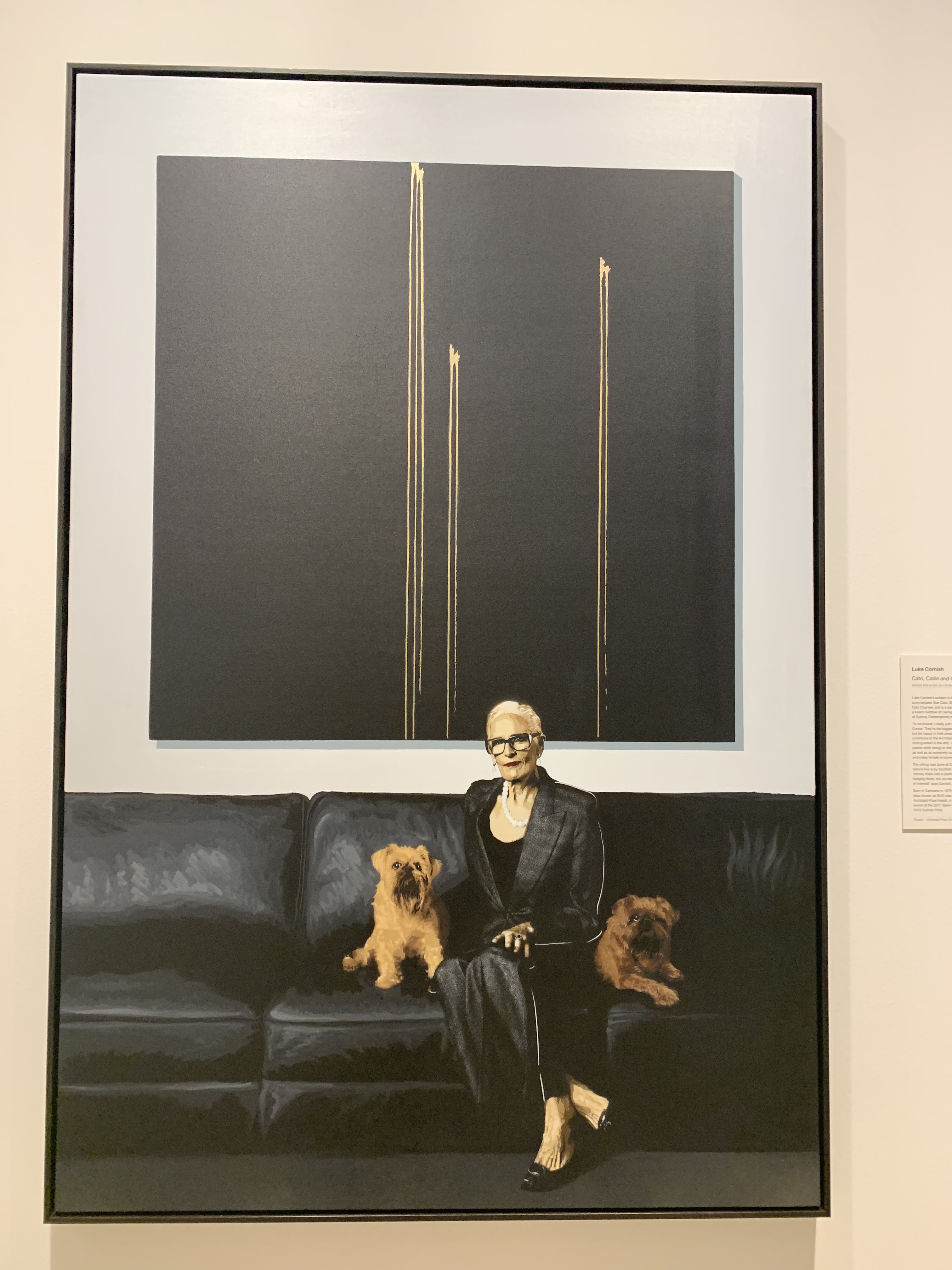
    1. Cato, Callie and Comet by Luke Cornish

    Cato, Callie and Comet by Luke Cornish

    This artwork had me at the label. Artist Luke Cornish admits he really just wanted to paint the dogs. Instead, he had to make the work eligible to enter into the Archibald Prize so included their owner Sue Cato. Cato is the head of her own company, Cato Counsel, sits on the board of Carriageworks and is on the Sydney Contemporary’s advisory council. What an incredible woman.

    Back to the dogs, Callie and Comet are, I believe, Griffon Bruxellois. Cornish really did capture how adorable they are and their extremely friendly nature. I personally love the one sitting up looking directly at the audience. Although the colours used are primarily blacks and browns, the dogs prevent the work from looking too dreary.

    2. Idris Murphy and his dog Wally by Marc Etherington

    Idris Murphy and his dog Wally by Marc Etherington

    The first thing you may notice about this work is the unusual, yet fun, frame. The little figures of Idris Murphy in different outfits all surround the main painting. Despite different outfits, however, they are all wearing an Akubra hat. The painted image shows Murphy wearing a shirt covered in images of his Golden Retriever, Wally.

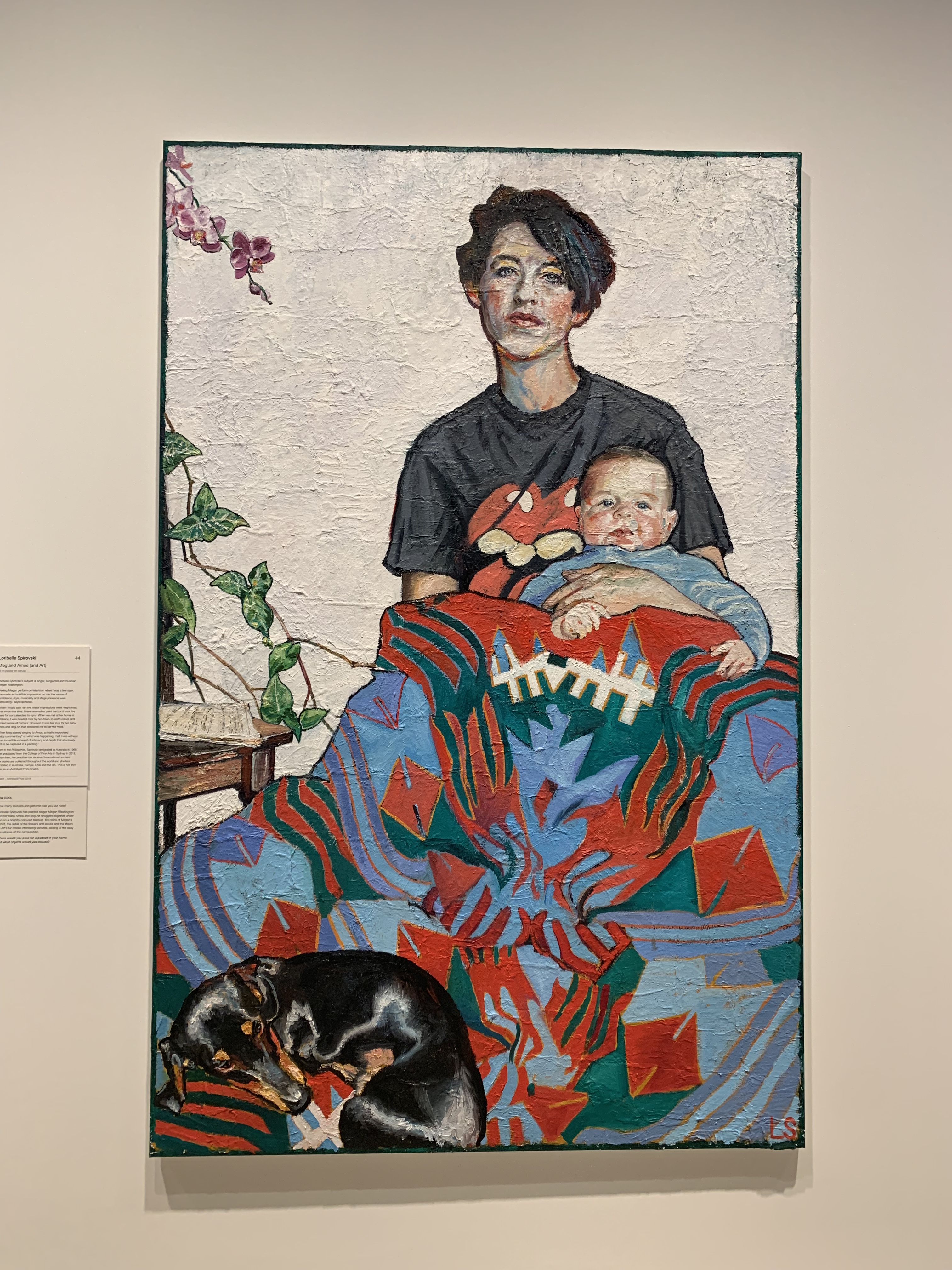
    3. Meg and Amos (and art) by Loribelle Spirovski

    Meg and Amos (and art) by Loribelle Spirovski

    Brisbane singer, songwriter and musician, Megan Washington, is posed in this work with her child, Amos, and dog, called Art.

    It is a stunning work that just looks so balanced on the canvas and so colourful. A highlight, of course, is the Daschund. The way Art is curled up in the bottom corner of the painting is precious. When creating this work, the priority for Spirovski was to represent Washington’s love for her child and dog. I think that comes through very nicely.

    4. Boy’s best friend by Sophia Letizia

    Boy’s best friend by Sophia Letizia

    I am so glad to have a Young Archie included in this list! Sophia Letizia is only 17 and has created this beautiful portrait of her brother holding their dog. The Young Archie runs alongside The Archibald Prize and allows students the opportunity to start displaying their portraits early.

    I hope you enjoyed a walk through of the dogs in Archibald 2019. There is one more artwork I want to mention before revealing the winner.

    Through the looking glass by Tessa MacKay

    Through the looking glass by Tessa MacKay
    Through the looking glass by Tessa MacKay

    This painting is one of the most intricate and lifelike I have ever seen. It is truly almost a photograph. Everything from the hair of David Wenham to the reflections in the glass window of the cafe are amazing.

    Although it did win the Packing Room Prize, I am honestly perplexed why this artwork didn’t win overall. It is actually breathtaking to see in real life. Besides from how lifelike it is, it’s also a massive painting which is even more impressive. I was not expecting that after seeing images of the work in marketing material.

    Lindy Lee by Tony Costa

    Lindy Lee by Tony Costa

    This is the winning artwork. Although I like various elements of the work, it didn’t even come close, in my mind, to the work of MacKay. Everyone will have a different opinion and I would love to hear yours! Leave a comment if you agree/disagree and share your thoughts.

    Further Information

    The Archibald, Wynne and Sulman Prize finalists are on display until 8 September 2019. There is an entrance fee ($20 for adults, $18 for concession and $16 for members). It is an accessible exhibition. You can see images of all finalists on the Art Gallery website, but, I strongly encourage seeing them in person.

  • Chicago: Frederick C. Robie House

    I still have a few blog posts pending from my recent trip to America. One that I am most excited to share is on Frank Lloyd Wright’s Frederick C. Robie House. Visits are by guided tour only and are conducted by representatives of the Frank Lloyd Wright Trust. You can see the outside of the house without being on a tour, but, I highly recommend spending 50 minutes of your day exploring the interior and learning about it’s significance to American architecture.

    History

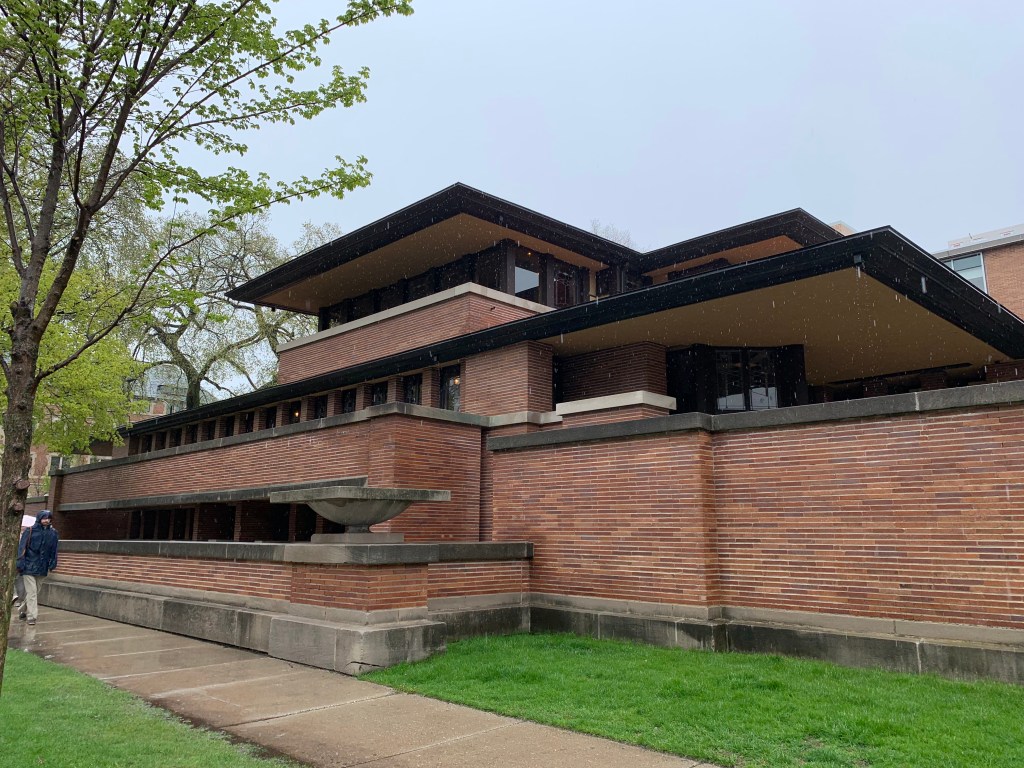
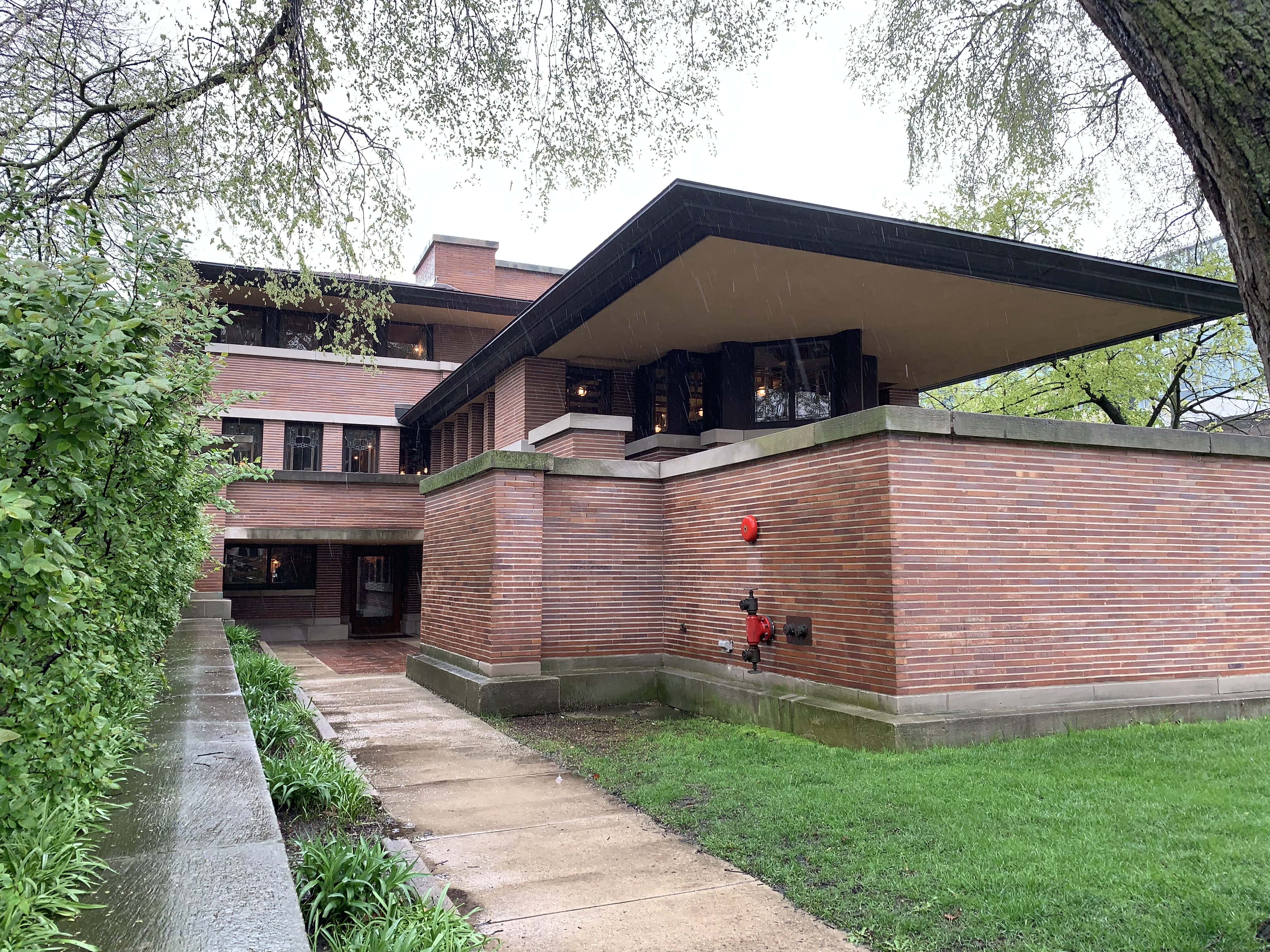
    Frank Lloyd Wright is generally regarded as one of America’s most influential architects. His aim was to find a style of architecture that felt native to America. In the late 1890s and early 1900s, Wright settled on a style that was to become known as the Prairie Style. Common features include low-pitched roofs, no attics or basements, and long lines of bricks to emphasize the horizontal nature of the buildings. This reflected the long and low prairie landscape that surrounded Wright. Later in his life, he designed a particularly famous building, the Guggenheim in New York.

    IMG_6226
    Frederick C. Robie House

    The Frederick C. Robie house was commissioned in 1908 and completed in 1910. It is regarded as the best example of Prairie Style. It was also a personal favourite of Wright who campaigned twice to prevent the house from being demolished (once when he was 90 years old). This was the only one of his designs that he campaigned so actively to save. It would be Wright’s final example of the Prairie Style house and in 1991, it was recognized by the American Institute of Architects as one of the ten most significant structures of the twentieth century.

    The house has an extensive history of ownership. Originally commissioned and owned by the Robie family, it was sold in 1909 to pay off the debts of Frederick Robie’s father. From 1911 to 1912, the Taylors family moved in and in 1912 to 1926 it was occupied by the Wilburs family. They were the last family to call Robie house home. For seventy years it served as a classroom, refectory, dormitory and office space. In 1997, the Frank Lloyd Wright Trust took over and both operated and cared for the site. The University of Chicago owns the building and allows the Trust to operate tours and undertake any restoration work.

    We were very fortunate to visit when we did as the House has just undergone one of its biggest restoration projects. This included re-plastering the entire inside of the house – a huge task.

    The Tour

    To reiterate, it is definitely worth going on a tour to see the inside of the Robie House. Don’t miss the opportunity. Tickets can be purchased online, or, if you’re willing to risk it being sold out, at the gift shop/tour starting point.

    On the guided tour, you will see every room in the house and learn about the architectural style. For example, in the living room we were told that Frank Lloyd Wright popularized open plan living in American homes. In the image below you can see next to the fireplace there is a corridor that leads to the dining room. Another common design feature of the Prairie Style is that the ceilings are extremely low at the entrance then become higher and open up as you move throughout the house. This is supposed to make you feel uncomfortable at first then relieved once you get to the main rooms.

    IMG_6141
    Entrance

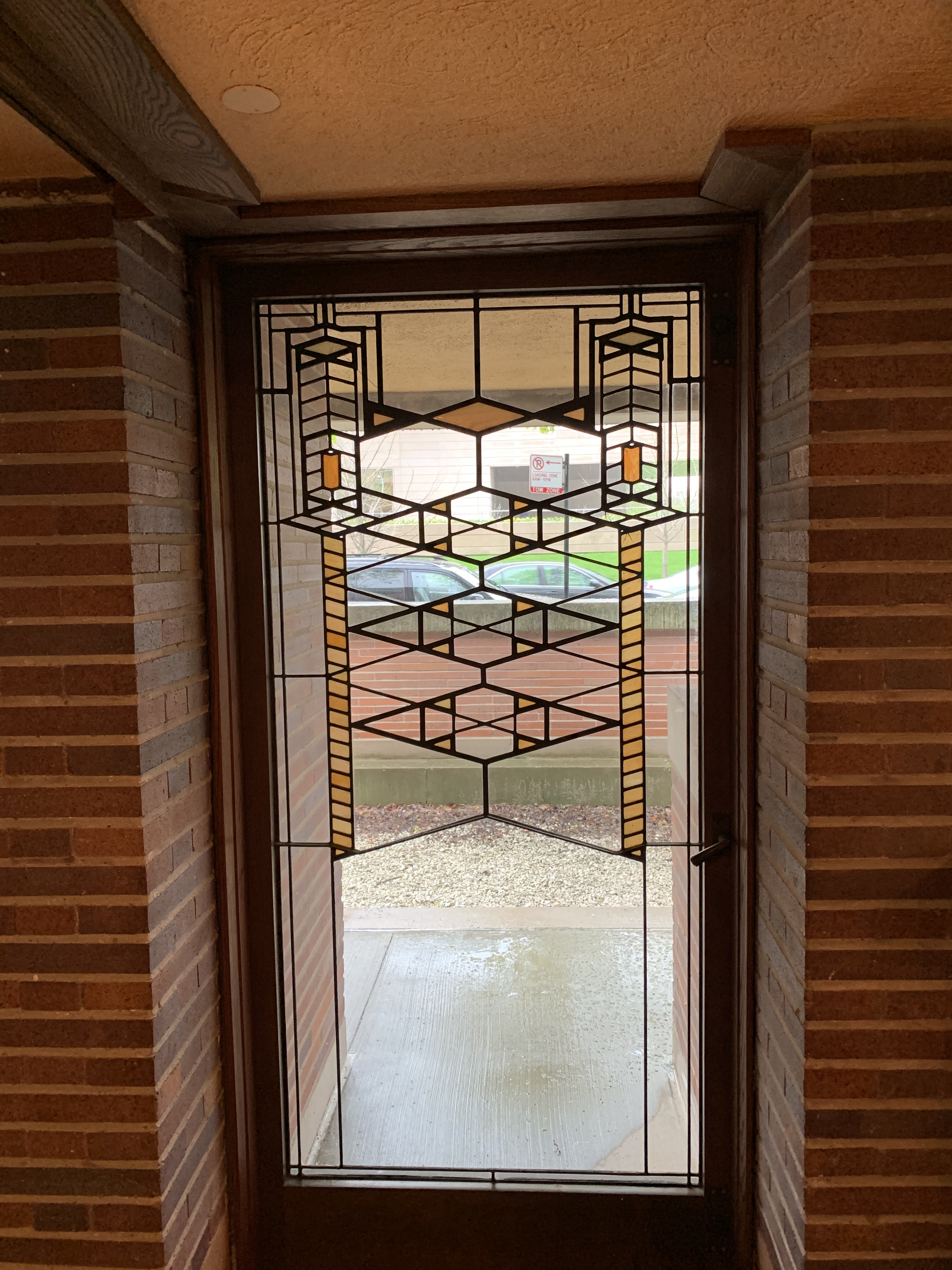
    There is one small element that I really want to mention. These are the leaded glass windows pictured below. Basically every window or door to the outside had a similar pattern on the glass. On the tour we were told they offered the residents some privacy as they didn’t have blinds. Not sure how much privacy it would have allowed, but, the pattern is stunning.

    IMG_6133
    Lead Glass Windows
    IMG_6082
    Lead Glass Windows
    IMG_6077
    Lights

    The tour also takes visitors outside and points out key features of the exterior. As it was pouring down rain, our guide made the wise decision to say indoors. Parts of the exterior were pointed out when we had the opportunity to look outside. We also had the wonderful opportunity to see the drainage system in full swing re-directing water to the garden bed.

    Chair Exhibition

    Upstairs, spread across the three bedrooms is an exhibition on famous Frank Lloyd Wright chairs. Late last year I saw a miniature chair exhibition which featured a few of his chairs. My absolute favourite was the Peacock Side Chair.

    It was great to see a full-size version and admire its design. This style was designed for the Imperial Hotel in Tokyo in 1921. The patterns seen in the chair were recurring motifs throughout the hotel. I love it because it looks so simple yet has multiple intricate features. The contrast of mustard yellow to the wood is beautiful.

    IMG_6201
    Frank Llyod Wright Chairs

    As the bedrooms contain no original furniture, this exhibition works nicely in the space. It allows for a wider representation and display of Wright’s work. Exhibitions can be a little difficult to fit into historic houses without looking a little out of place. This one blends well with its surrounds and enhances, rather than distracts, from the overall experience.

    Photographs

    To finish, I’m going to share a few more photographs from the Robie House.

    IMG_6073
    A distinct pattern cast by the light – designed by Frank Lloyd Wright
    IMG_6169
    The dining room of Robie House
    IMG_6104
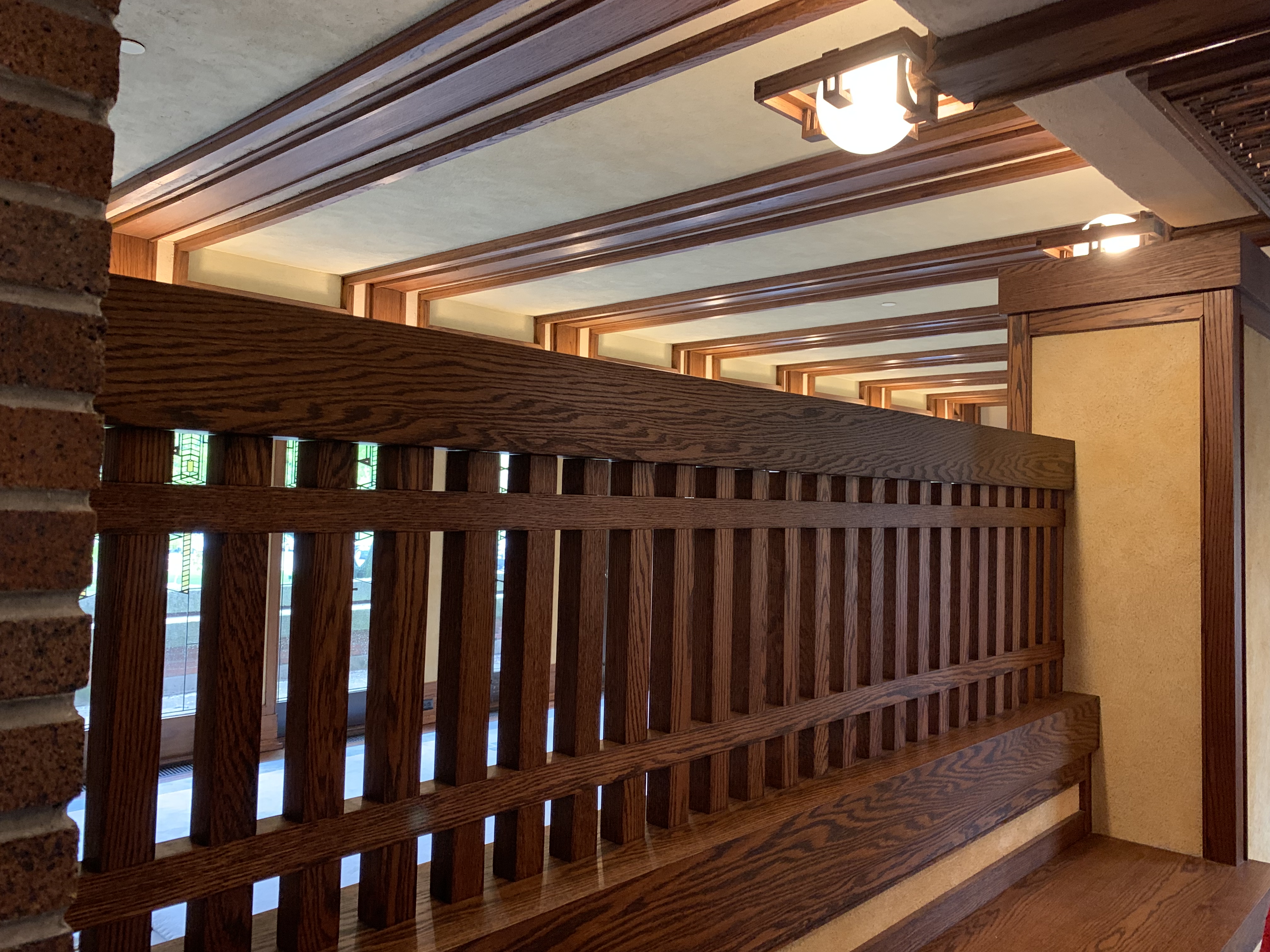
    A wooden grate petition separating the entrance stairs from the living room
    IMG_6212
    Doors leading to the children’s play room

     Final Tip

    The 50 minute tour was about the right amount of time. Benefits of the 90 minute tour (only available on weekends) is that groups are limited to 10 people. Small group tours are ideal and I imagine this tour would be great for those who are a huge fan of Wright’s work. If you are happy just to keep things to 50 minutes then I encourage aiming for the first tour of the day – you might be lucky and have a small group.

  • Australian Museums and Galleries Association Conference Day 5 & Megafauna Central

    Conference

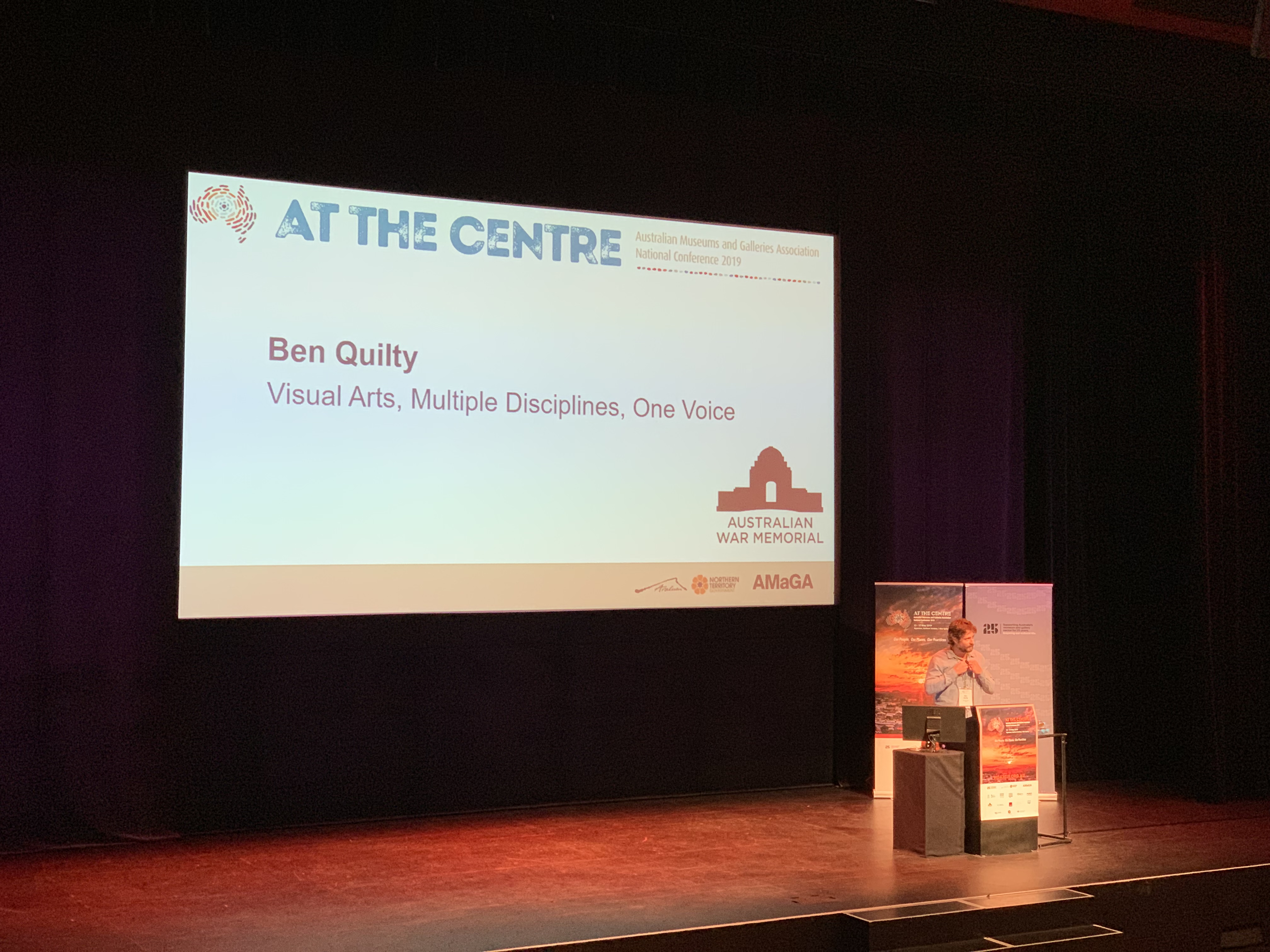
    This morning was the final plenary for the conference, presented by Ben Quilty, and the official handing over of the conference to Canberra for 2020. Quilty touched on something significant that I believe we can all learn. That is, there is no shame in admitting there are things you don’t know and that you are still learning. It is far better to recognise your limitations and act on them rather than not care at all.

    Ben Quilty

    The conference has been a truly humbling experience. There is so much I will be taking away. Above all else will be the fact that I still have so much to learn. As soon as I get back to work I will be reading the Indigenous Roadmap and The University of Queensland’s Reconciliation Action Plan that was just recently launched. On top of this, I am going to ensure that I just listen, whenever I can.

    I want to say a huge thank you to the conference organising committee, speakers, sponsors and everyone I’ve met along the way. I am unbelievably proud to be part of this industry – one that, on the whole, is willing to learn and grow. This industry is full of challenges and obstacles, but, I have never met a more dedicated group of individuals willing to face these head on. I am not sure at this stage if I will attend Canberra 2020, but, I am definitely going to be at Perth 2021 so see everyone in two years!

    Megafauna Central

    Megafauna Central

    Megafauna Central, a branch of the Museum and Art Gallery of the Northern Territory, opened on 5 July 2018. It showcases the megafauna of Central Australia from Alcoota Scientific Reserve. Alcoota is a site containing numerous fossils from the late Miocene Epoch (8 million years ago) located approximately 150 km east of Mparntwe (Alice Springs). What is most unusual is that over a 200 metre stretch around 3000 fossilised animals have been discovered. The exhibition asks questions such as ‘what brought all these creatures to the one spot and killed them?’ That question was taken from the official website accessible here.

    The exhibition is small but filled to the brim with information. The introductory panel does a fantastic job setting the scene. Out of all the species discovered in Alcoota, fourteen have be classified as megafauna (a species where the adult weighs more than 45 kg). One thing I noticed about the signs is that right down the bottom there is a button you can press to hear the sign read in Arrernte (an Indigenous language from the region).

    Here are some incredible highlights from the exhibition.

    1. Getting the Dirt – a window into behind the scenes

    Getting the Dirt

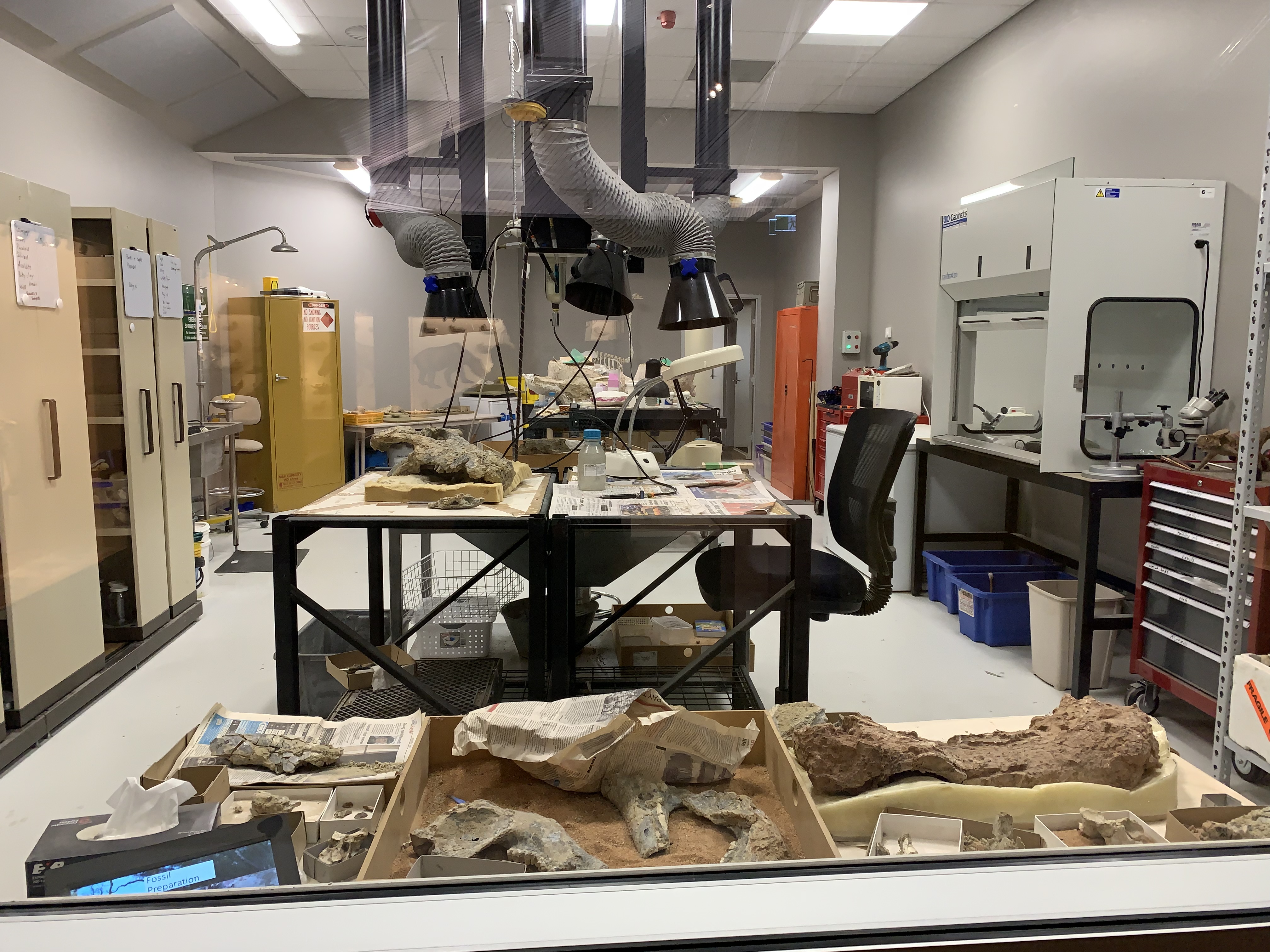
    I am a huge fan of allowing visitors who come into the museum, any museum, the opportunity to see what we do behind the scenes. In Megafauna Central, there is a window at the back that allows you to look into the lab where fossils are cleaned and maintained. There is a little step ladder available for small children to climb and see into the lab which is fantastic. Next to the window you can select to hear audio answering four questions: what is in this room, what is happening, what tools are being used and what happens next?

    Getting the Dirt

    I really think that spaces like these develop trust and place more of the museum on display – a part that visitors don’t normally get to see. It can add to an understanding of the multiple roles in the museum and even show objects at various stages of conservation.

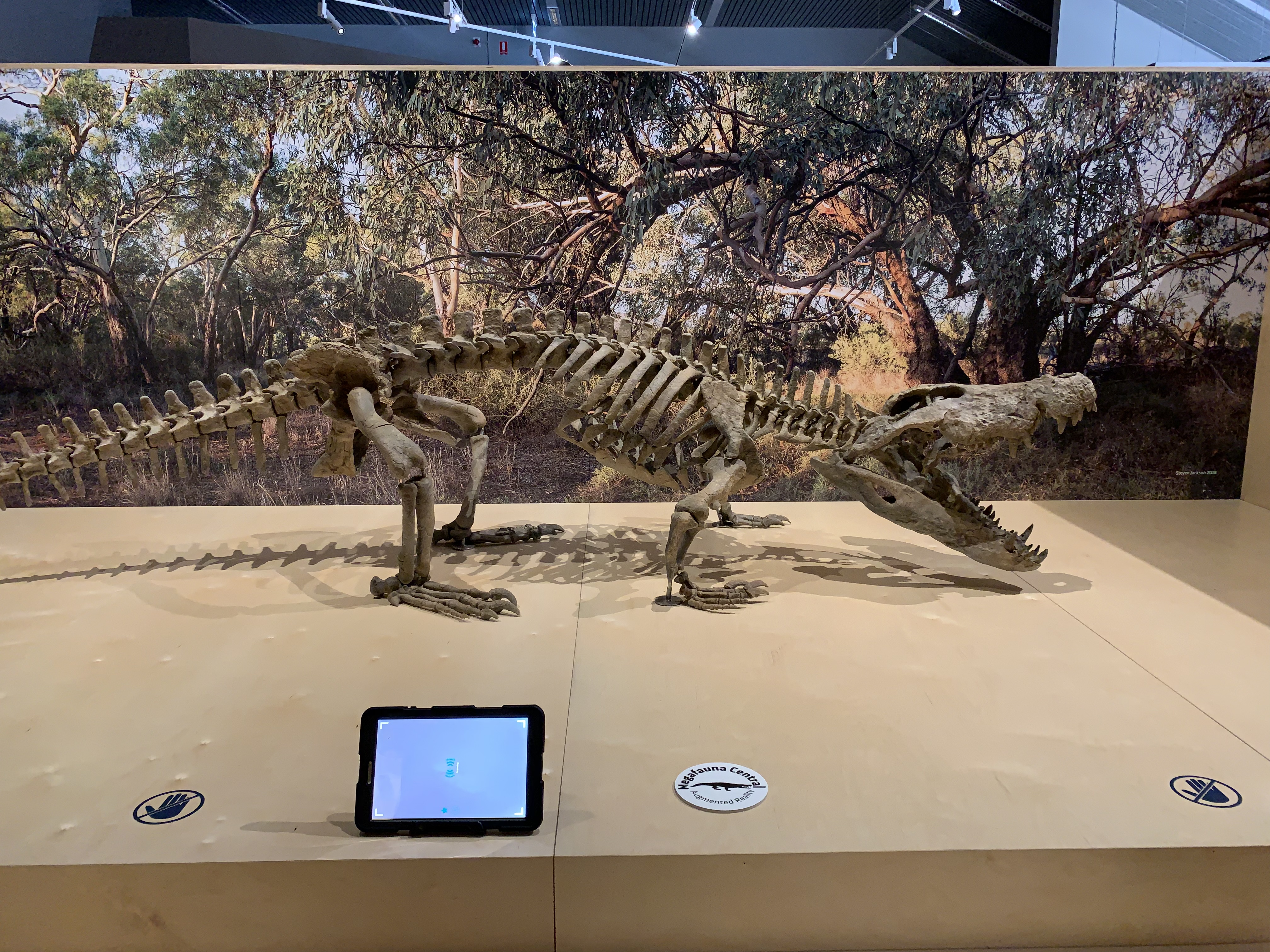
    2. The Baru

    The Baru
    The Baru

    After hearing the talk by Adam Yates on day 2 of the conference, I was particularly looking forward to seeing the Baru. It is incredible to think the skeleton has been 3D printed – it looks so real.

    According to the label, the Baru could grow up to 4 metres long and weigh up to 800 kg. Just let that sit for a minute. Everything from its build to its skull indicate it was a predator to be feared, preying on other megafauna. Although it is yet to be granted an official name, Baru is a genus where similar species found in northern Australia belong.

    3. Piecing the past together

    Piecing the Past Together

    This small display serves a similar function to the window into museum museum life, revealing the work of paleontologists. The thematic panel explains the role of a paleontologist, studying fossils and piecing together the past. The objects on display are very insightful, especially if you had no idea on entering the exhibition what the job might look like. If you think it’s all flashy high tech work, then you just have to see this picture to realise the work can be very low tech and labour intensive.

    4. Interactive activities for kids (and kids at heart)

    Interactive Dig

    I have to admit I was a little worried when I first walked around the space and saw a table with colouring-in pictures for kids, and that was all. On my second lap around, I noticed the incredibly large room at the back of the exhibition space (I didn’t make promises that I am observant). Inside, are two mini excavation sandpits with hidden fossils and brushes. Considering the theme of the entire exhibition, I think these are great for engaging kids and also work really well with also engaging their parents/guardians. That feeling of discovery can be wonderful.

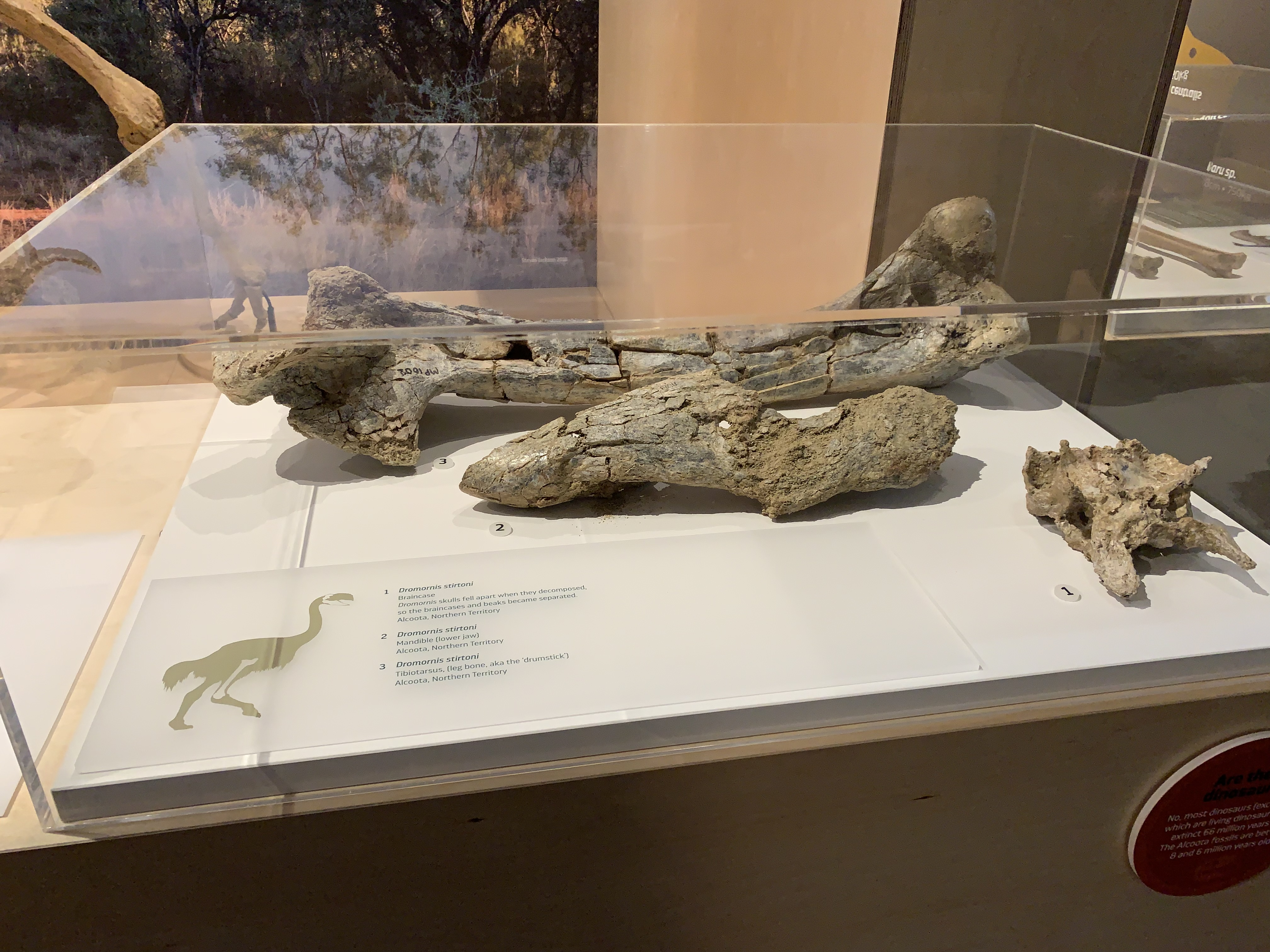
    5. Dromornis stirtoni

    Dromornis Stirtoni
    Dromornis Stirtoni
    Dromornis Stirtoni

    If you start the exhibition by turning left and following the path, after the large-obvious-but-I-missed-it-the-first-time room you go around a corner and meet the Dromornis stirtoni. Or as I like to call it THE HUGE BIRD.

    On display is a life-sized model made to the correct proportions. This was ascertained by examining the available bones. As the bones were from a male, this model is of an adult male. Honestly, it shocked me because of its sheer size. In front, there is a model of its egg which, I mean no surprises here, is also massive.

    Towering behind the model is a cast of the skeleton. This animal could weigh up to 750 kg and is related to ducks and geese, not emus, which I originally thought. Fun fact, they were herbivores and swallowed stones to help digest food. There were some real bones in a case just next to the cast that are great to view.

    6. What’s in a name?

    Panel

    Just a quick shout out to the panel titled ‘What’s in a name?’ It goes through how scientific names for animals are decided. As long as a name is unique and not overtly offensive to anyone, you are free to name a species what you wish. It was great to learn that trends in scientific naming now mean a lot more Indigenous languages are being incorporated.

    7. Diprotodon

    Diprotodon

    I am going to finish with the largest marsupial to ever have lived and one of the last Australian megafauna, only becoming extinct 42 000 years ago. The Diprotodon lived all over Australia from the top of the Northern Territory to the south of Victoria. The skeleton on display is a cast, created from fossils discovered in Lake Callabonna in South Australia. Sad story, animals would often wander into the lake looking for drinking water, get stuck in the sticky clay on the lake bed and die. The skeleton from which  this cast was made was the first complete skeleton of the species discovered.

    Megafauna are fantastic creatures and Megafauna Central brings them all to the one place. The exhibition space feels modern, uncluttered and, although small, designed in a way that allows you to explore and see something hidden around every corner. I thoroughly enjoyed my visit and treated myself to a couple of items at the gift shop.

    Entrance to Megafauna Central is free. It is open seven days a week from 10 am to 4 pm except for Good Friday and between 25 December and 5 January this year/next year. It is an accessible museum and a great place to bring kids.

  • Australian Museums and Galleries Association Conference Day 4

    Well, I think my brain is so full of information it might actually burst. That’s a good indication of how today went at the conference. Everything from the first plenary to the last was just filled with important messages and questions to mull over. In this summary, I’m really going to try and do the day justice. If there are any comments or corrections, I strongly encourage you to leave a comment on this post. Ok, let’s begin.

    9.00 am

    This morning we had two fantastic plenary sessions. Both were so relevant to the overall theme of the conference with the latter being a significant event to have witnessed.

    Our first speakers were Donna Oxenham and Jane Lydon from the University of Western Australia. Their talk, ‘Aboriginal photographic archives in museums and galleries: engaging heritage and culture’, focused on the Returning Photos Project. This involved five partnering institutions: The Pitt Rivers Museum (Oxford), Museum of Archaeology and Anthropology (Cambridge), The Musée de Quai Branly (Paris), The Museum Volkenkunde (Netherlands) and The Berndt Museum of Anthropology (University of Western Australia [UWA]).

    Donna Oxenham and Jane Lydon

    Essentially, the Project has paved the way for photographic repatriation from these collections to Indigenous communities. This can allow for gaps in knowledge to be filled and connections made to ancestors and, therefore, the past. To assist, UWA have created a website where Aboriginal community members can search for photographs of significance. It can be accessed here. There has also been a concerted effort to physically travel to communities and show them the photographs. Both Lydon and Oxenham highlighted some challenges that this project has raised including what happens to the photographs that remain unidentified?

    It was a very interesting talk that really made me think about repatriation as not just concerning physical objects, but also, the digital.

    9.45 am

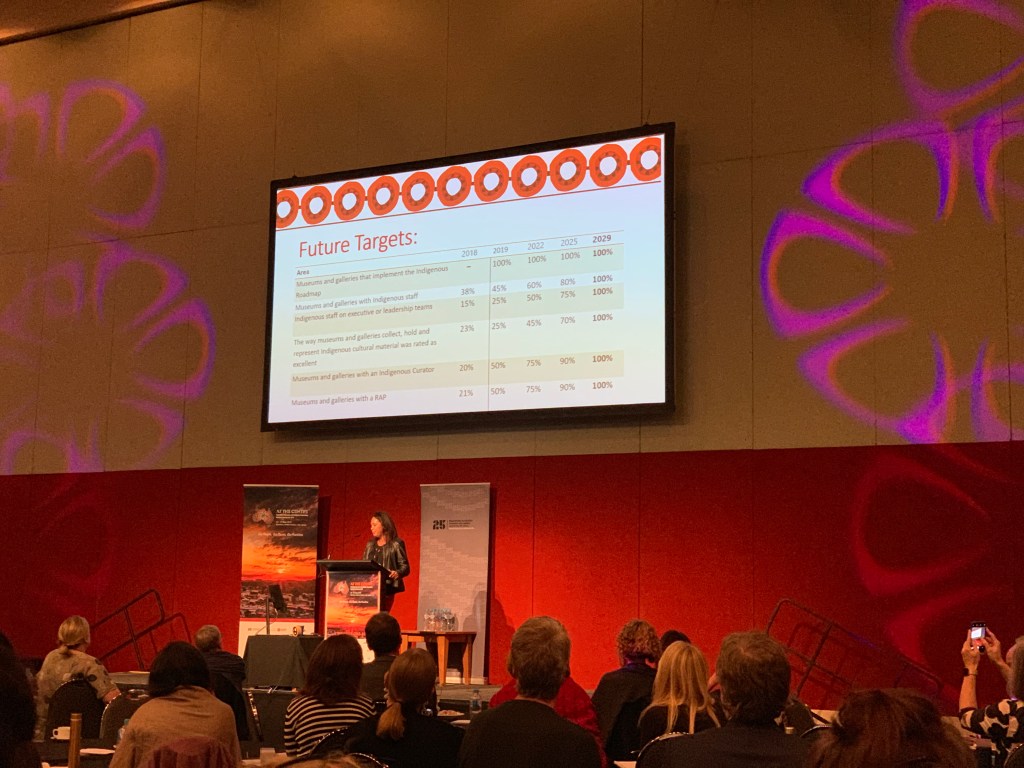
    The significant event I was referring to earlier was the launch of the 10-year Indigenous Roadmap! This has been such a momentous project led by Terri Janke and, of course, supported by a multitude of individuals. It sets out a plan to improve Indigenous engagement and employment in the sector highlighting five pathways: reimagining representation (acknowledging the value of Indigenous knowledge), embedding Indigenous values into museum and gallery business (Reconciliation Action Plans and Indigenous programming and interpretation), increasing Indigenous opportunity (increase employment and retention), two way caretaking of cultural material (access and management) and connecting with Indigenous communities (building trust and strengthening relationships). What I have included in brackets is only really the tip of the iceberg.

    Terri Janke

    I strongly recommend reading this document. You can find more information here including a link to download the Roadmap. Congratulations to everyone involved in this project, in particular, Terri Janke. Next steps include circulating and discussing the Roadmap and developing implementation plans so targets and goals can be reached by 2029.

    11.00 am

    Time for the first concurrent sessions of the day and I was very excited to attend the Education Network Session.

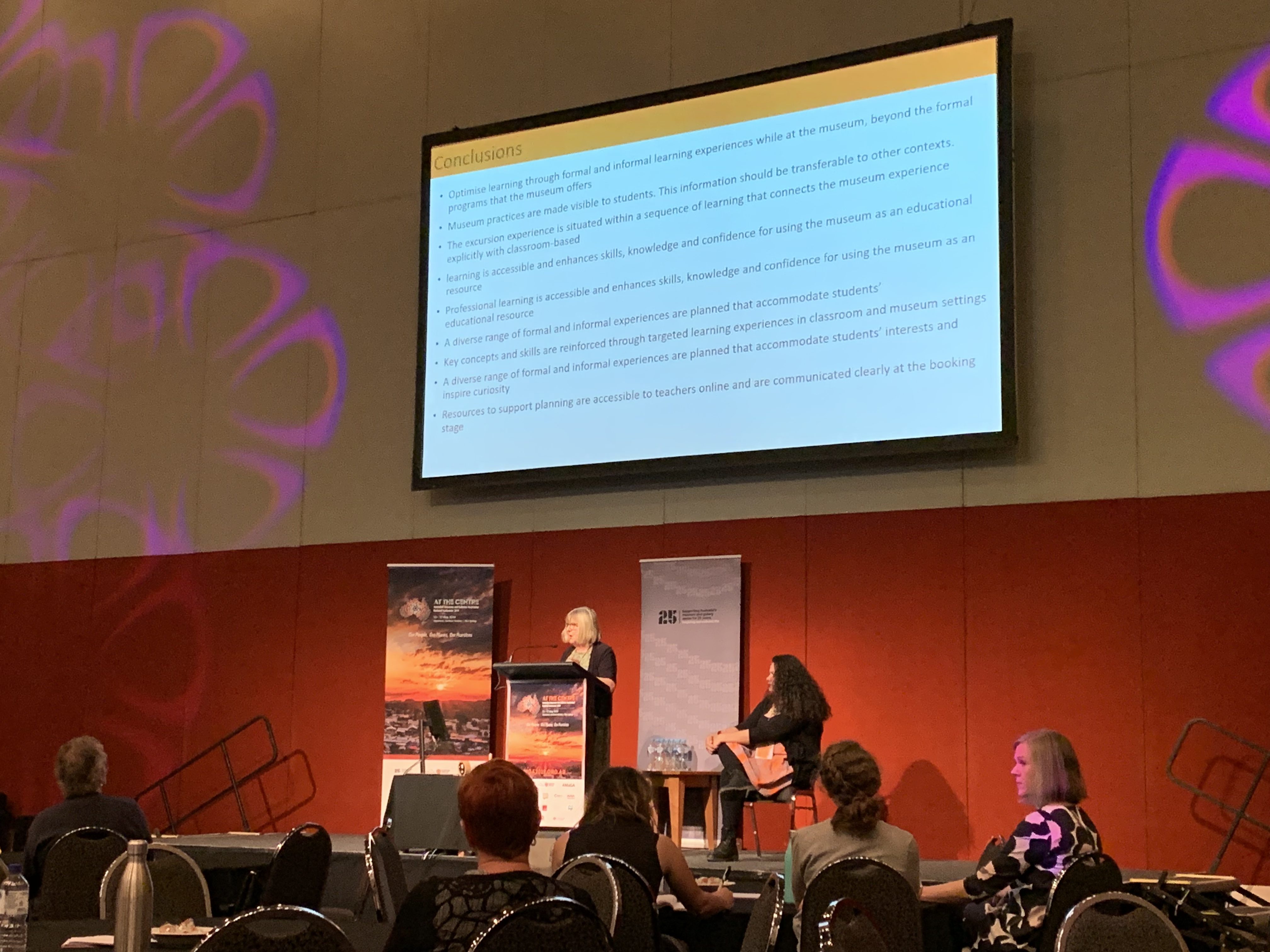
    First up to the microphone was Liz Suda and Isobel Morphy Walsh from the Melbourne Museum presenting on creating ‘more than just another excursion’. Their talk focused on how the museum can influence curriculum. This was an interesting slant to take as usually we are looking at how the museum can fit into the already prescribed curriculum and not actually influence its development. As they were looking for qualitative, not quantitative, data, the Museum worked closely with one school, developing a program that involved time for formal and informal learning. I have included a picture of the slide that outlines the conclusions from this study. I will also note that one very important takeaway from this presentation was provided by Isobel Morphy Walsh who emphasised how important it is to incorporate Indigenous objects and stories into these programs and not separate and treat them as ‘other’.

    Isobel Morphy Walsh

    Next was Breann Fallon from the Sydney Jewish Museum exploring, amongst other things, the pedagogical approach applied when designing their Human Rights Education Program. The approach is termed reciprocal ‘isomorphic hermeneutic’ dialogue (Al-daraweesh and Snauwaert, 2013). When I first heard this phrase I immediately thought sorry, what? Fallon did an amazing job at breaking this concept down and exploring what it actually means. Basically, it takes Human Rights away from its own construct and considers equivalents or similarities on an individual level. Then, it zooms out to consider broader contexts. How this is achieved is through, for example, listening to a Holocaust survivor, to first look at the human experience without overarching politics etc. Then, students (and other individuals) can begin to see how human experience fits into the broader context.

    Breann Fallon

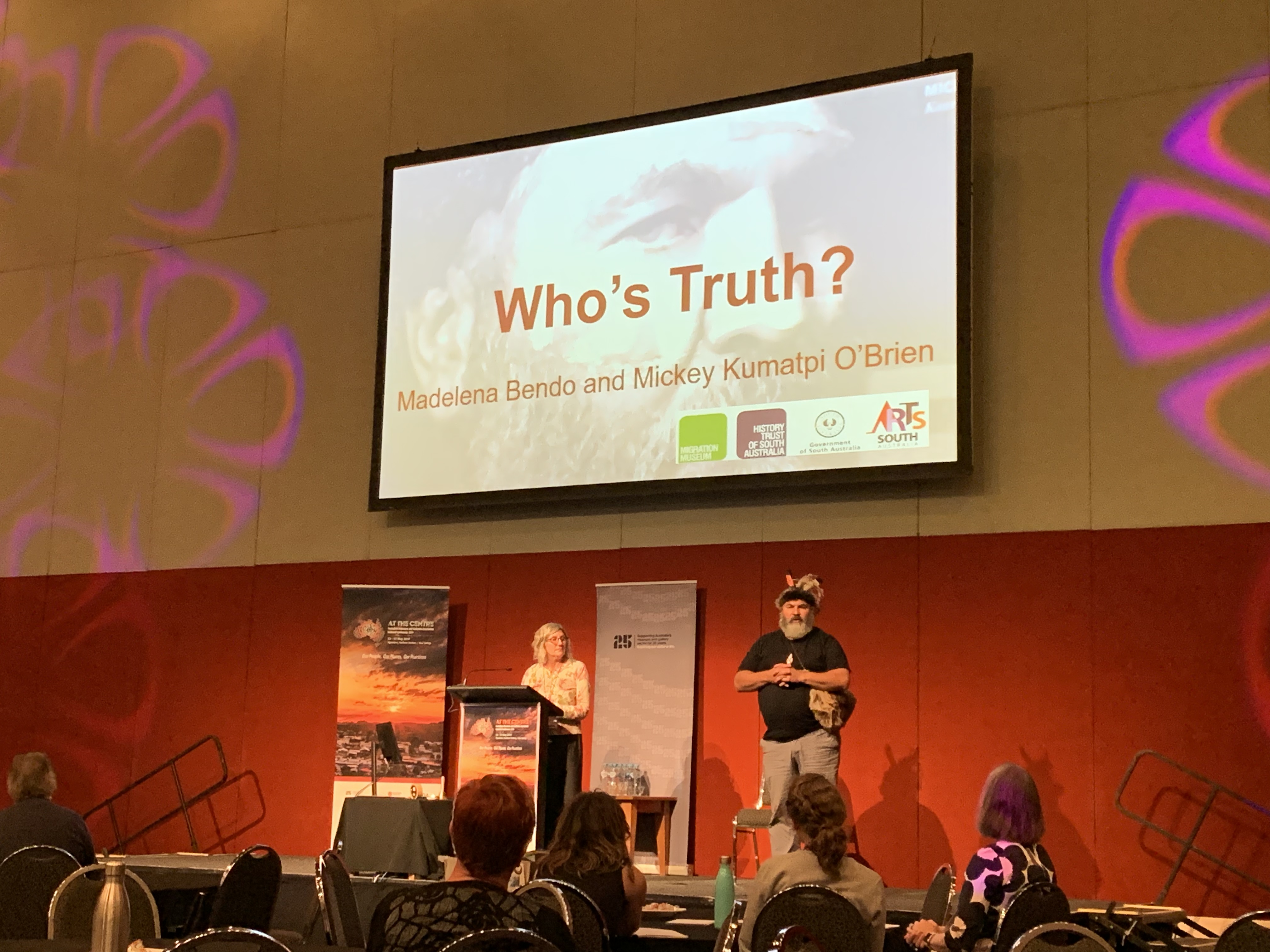
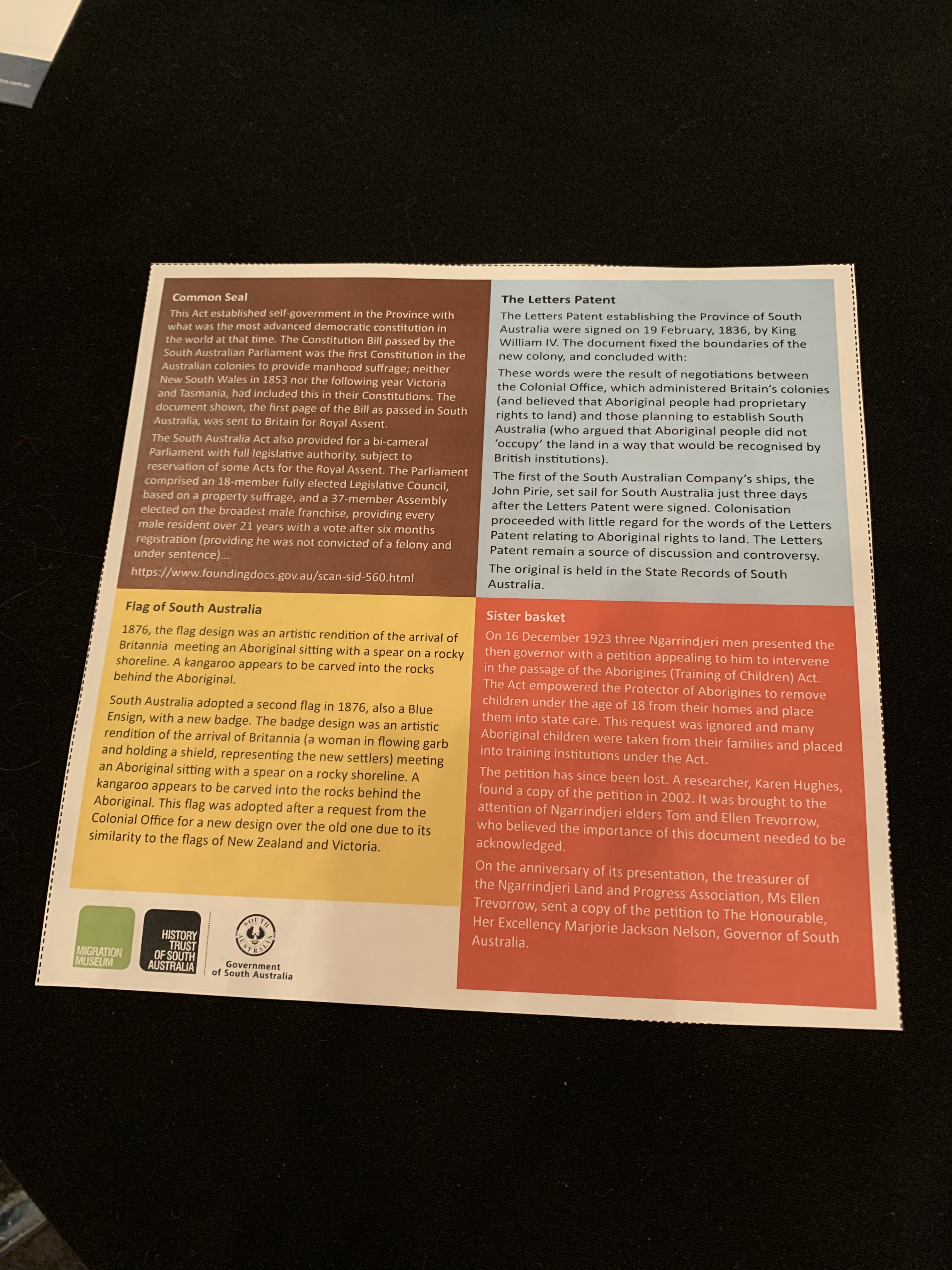
    Finally in this session was Mickey Kumatpi O’Brien (History Trust of South Australia) and Madelena Bendo (Migration Museum) looking at ‘whose truth?’ A complete absence of Indigenous communicators led the North Terrace Precinct Educators Group to call on the Indigenous community to tell their story. Mickey Kumatpi O’Brien presented a segment of this story in a very interactive way. This included providing everyone with a chatterbox that looks at four objects/symbols: The Letters Patent, Sister basket, Flag of South Australia and Common Seal. O’Brien stressed that you need to share stories because no one person has the capacity to know everything. For this reason, I have included a photograph of the chatterbox so you can read for yourself.

    Mickey Kumatpi O’Brien (History Trust of South Australia) and Madelena Bendo (Migration Museum)
    Mickey Kumatpi O’Brien (History Trust of South Australia) and Madelena Bendo (Migration Museum)

    1.30 pm

    I started the afternoon in the Historians Network Session ready to learn all about repatriation. It was a panel discussion and as the names of panel participants were not published I must apologise for not being able to provide all names.

    Historians Network Session

    Apart from the panel facilitator, Lyndall Ley, I believe participants included Chris Simpson, Jane Lydon and Shaun Angeles. Ley posed three difficult questions:

    1. How do we apply the Ask First principle when we don’t know who to ask?
    2. Whose responsibility is it to provenance the material?
    3. What should happen to material with no provenance?

    Here are some short answers to these questions:

    1. If you are unsure where to start, then just start somewhere and see where conversations can lead you
    2. Communities themselves are best placed to be able to undertake uncovering the provenance (they may, however, not have the resources available to achieve this)
    3. I genuinely cannot remember if this question was answered or not as there was a great discussion on what should happen with materials in international institutions. Long story short, they should take some responsibility when it comes to trying to determine provenance. You should never underestimate the ignorance of these institutions when it comes to Indigenous culture and history. There is a need to educate which may result in the return of objects. It is estimated by AIATSIS (Australian Institute of Aboriginal and Torres Strait Islander Studies) that around 75% of Indigenous material held in overseas institutions requires further research.

    After this presentation I hopped over to the presentations in Ellery B. Corinne Estrada was second to speak in the session and the first I saw. Estrada presented on a few case studies looking at changes to visitor engagement. A personal highlight for me was an audio guide around the Van Gogh museum that played dance music to reflect the artwork on display. To paraphrase a slide in Estrada’s presentation, museums are becoming more social venues, more emotional than academic, more collective than individual, more universal than national and more digital than scientific. There is, therefore, a need for new ways to engage and offer cultural experiences with audiences at the centre.

    Ellery B. Corinne Estrada

    The final talk in the session was Blake Griffiths from Broken Hill Regional Art Gallery who presented on FRESHbark, a collaborative project between the Gallery and emerging Indigenous artists. The outcome, not a perfect project (as stated by Griffiths), but, one that achieved incredible outcomes fostering a more enriched relationship between the Gallery and Indigenous community.

    Blake Griffiths

    3.30 pm

    The day finished on an absolute high. The best way to summarise Jacinta Koolmatrie and Jade Turner’s talk is to say that they spoke the truth. It was a really really powerful presentation. The two presenters started by telling the audience that their white male boss was going to come on the stage only when they had told their story. I didn’t tweet during this presentation, I just listened. Everything from representing Indigenous women in displays to personal experiences working in the museum were addressed. Honestly, this was exactly the kind of plenary I was hoping for when I signed up to this conference and I want to thank Jacinta Koolatrie and Jade Turner for delivering one of the best presentations of the conference.

    Jacinta Koolmatrie and Jade Turner

    5.00 pm

    I cannot believe that tomorrow is the final day. One more plenary to go and then I’ll be exploring Megafauna Central.

  • Australian Museums and Galleries Association Conference Day 3

    What another fantastic day at the Australian Museums and Galleries Association Conference. I am truly grateful to be able to attend and listen to some incredible speakers from all over the country (and internationally). The good news is, there are still two days to go! As per usual, I will be writing this post to basically provide a summary of my day. Because literally so much happened, I am going to try my best to pick out some of the key points from all talks and spend longer on those that I feel left me with food for thought.

    9.00 am

    Neil MacGregor

    First speaker for the plenary this morning was Neil MacGregor who was the former Director of the British Museum and is now working with the Humboldt Forum. I won’t say a lot about this presentation because it skirted some of the most significant issues I wish had been addressed, i.e. Indigenous objects in the British Museum. There were a few interesting points raised including the role of the museum in reflecting and shaping identities. MacGregor also asked a lot of questions for the audience to contemplate. My favourite was, can museums be a place of atonement? I most definitely think museums need to engage in difficult conversations, but, I’ve never thought about whether or not museums can serve this specific function.

    As well as identity, MacGregor raised issues of decolonisation. It would have been nice to have these related to an Australian context. I’m saying this primarily because it was a plenary presentation. Instead, MacGregor focused on case studies in Berlin, America, the United Kingdom and Palestine, to name a few.

    11.30 am

    Jumping straight ahead, past morning tea, to the Session 2E (CAUMAC Network session). CAUMAC stands for Council of Australian University Museums and Collections. It is such a shame that at this exact time there was a talk on disruption as a strategy. I really believe it should have been a plenary. Anyway, I was in this session because I was a presenter and wanted to support other university museums.

    First in the session was Dr Barbara Rothermel visiting from the Daura Gallery at the University of Lynchburg, Virginia. There are a few statements I want to mention that were particularly relevant. The first is that university museums are central to the academic experience. Secondly, university museums should be inter-disciplinary and encourage their faculty to engage with others. I also completely agree with the fact that university museums are an indispensable component of a university’s mission. It was a pleasure listening to Dr Rothermel and hearing about all the wonderful collaborative exhibitions and projects that have either happened in the past or are currently underway at the Daura Gallery.

    Dr Barbara Rothermel

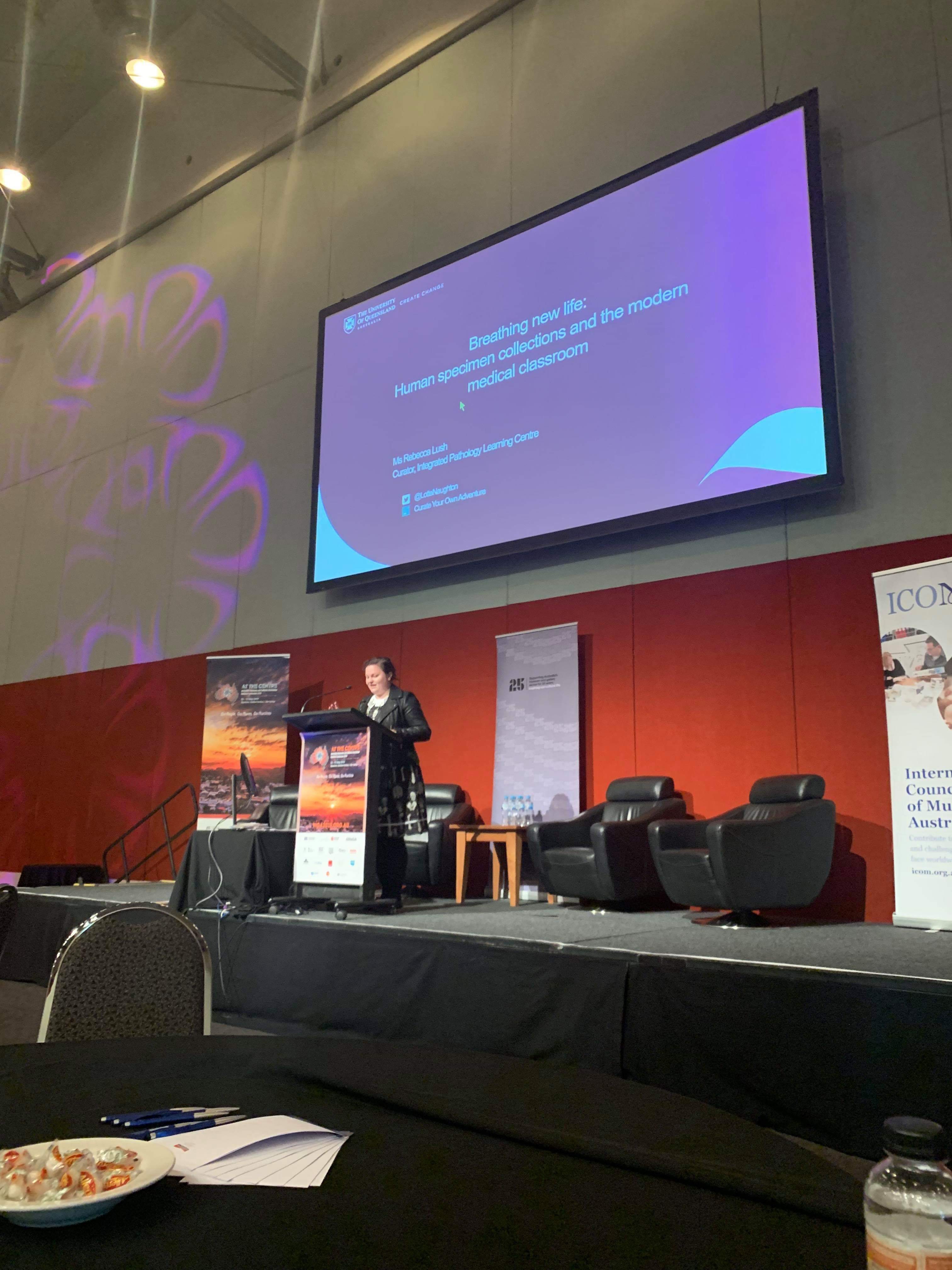
    Next was my talk! I was a little nervous, but, mostly excited to speak about the Integrated Pathology Learning Centre (IPLC). It was a perfect opportunity to reveal our brand new statement of purpose. After a quick overview of who we are and what we do, I spoke about our three main audience groups – medical students, secondary school students and students from other University of Queensland disciplines. I looked at how each of these groups use our specimens to further their study of health and disease. For example, I outlined our secondary school program and how we have been able to incorporate public health campaigns when discussing certain specimens. Thank you to everyone who attended my talk.

    Photograph courtesy of Imogen Kennard-King

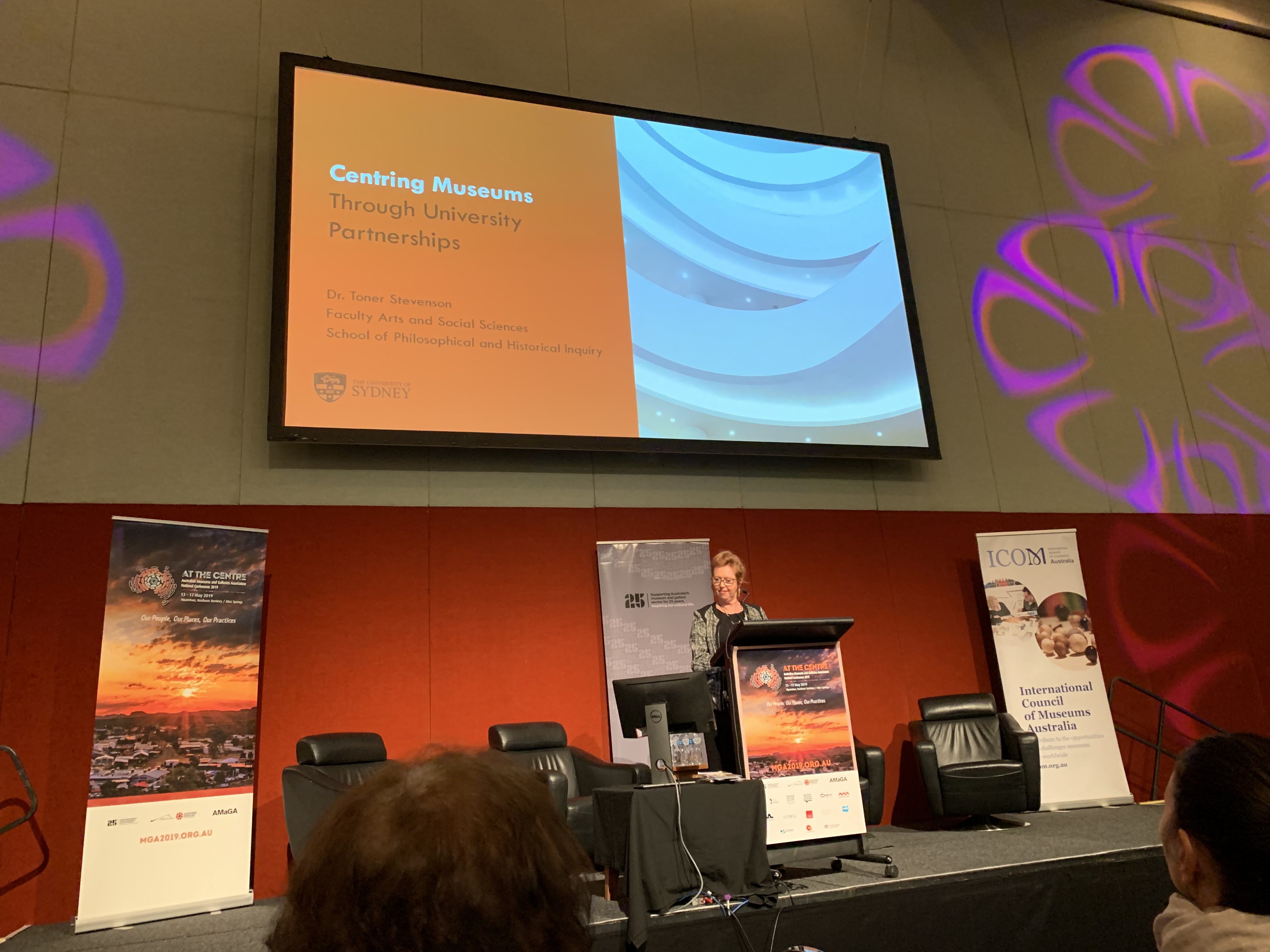
    After my talk, we heard from Dr Toner Stevenson who focused on partnerships between museums and universities. In particular, financial partnerships and how universities and museums can work together to achieve grants and deliver amazing outcomes.

    Dr Toner Stevenson

    1.30 pm

    I’ve had my eye on this workshop session, facilitated by Sabine Doolin and Sally Manuireva and titled Tear up the Audience Rule Book, since the program was released. I was interested in seeing how the workshop would be structured.

    To start, we learnt a little about how museums need to change their approaches to audience. With so much happening in the world around us, now is the time to stop and respond in order to remain relevant.

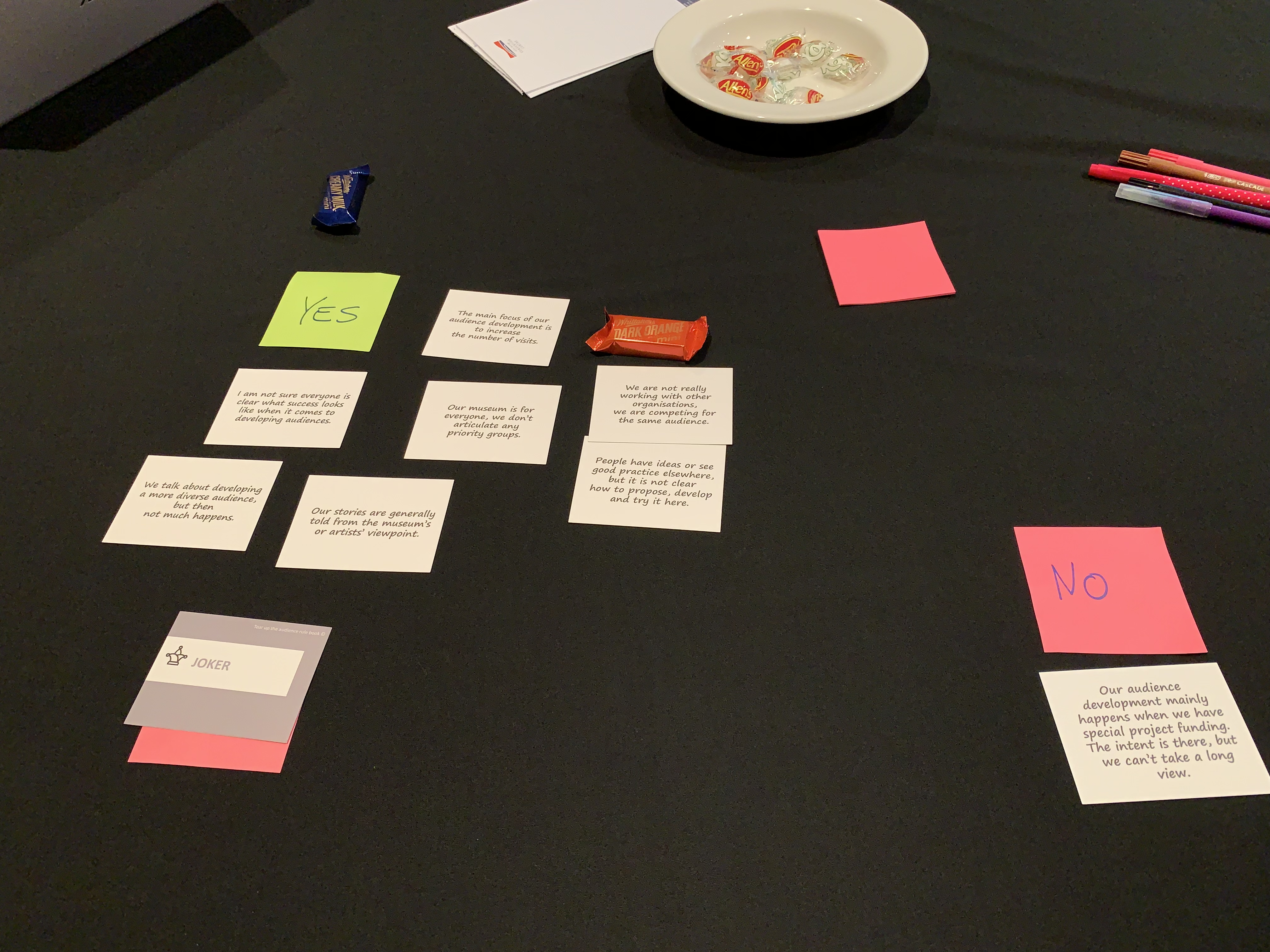
    This was the context which sparked our first activity. As a group, we were given a pack of cards with a statement on one side, regarding audience, and a colour/theme on the other. We were told to read the statements and, as a group, decide whether or not we would hear them in our institution.

    Sabine Doolin and Sally Manuireva

    Statements included, our museum is for everyone, our stories are generally told from the museum’s perspective and our audience development mainly happens when we have a specific project. Our group had such a great discussion surrounding each of the cards. I was very interested in hearing how other institutions viewed their audience and what challenges they faced.

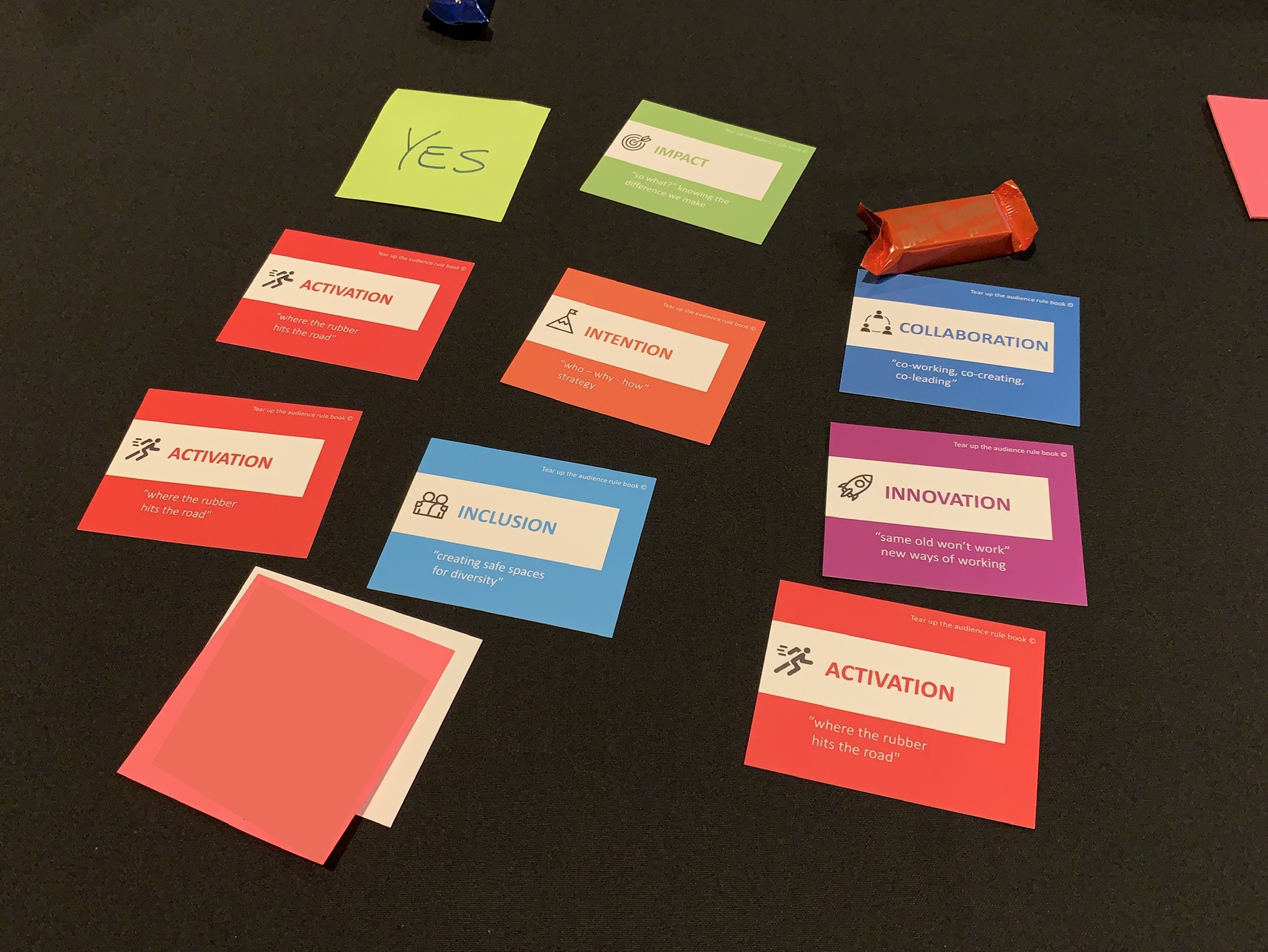
    After we had decided whether the cards were a yes (we do hear this in our institution) or no (we do not hear this), we turned them over and saw the themes. They were: insight, intention, innovation, collaboration, inclusion, activation and impact. Basically, we had to see whether our yes and no piles had many of the same theme/colour or not. We ended up with quite a rainbow and decided that because we were all at different stages of audience engagement this made sense.

    Sabine Doolin and Sally Manuireva

    With this information, we then had to brainstorm what mindset is required to truly place the audience at the centre. We brainstormed the following words (it is much easier to provide them in a photograph then type them all out):

    Sabine Doolin and Sally Manuireva

    Finally, we had to write down a rule of audience engagement then tear it up! A really good one was that a museum audience can be everyone. Rip that up!

    3.30 pm

    To finish the day, our plenary presentations were by Keir Winesmith and Shaun Angeles.

    Winesmith came to the stage with a great energy to talk about the museum and the future, specifically looking at technology. We learnt that the museum does not need an app. What we do need is a really engaging website. Around 90-100% of visitors will have looked at your website before visiting, so, make sure it is informative and accessible. I have been to too many websites where even finding opening hours is near impossible.

    Keir Winesmith and Shaun Angeles

    The most important thing I took away from this presentation was that sometimes, and for some people, there is a preference to play over a preference to read. I could not agree more. There are multiple exhibitions I have visited where I have enjoyed interacting and immersing myself in the exhibition through doing, rather than through reading. A perfect example is the American Writers Museum which had so many interactives that were directed at adults, not kids! Shock horror!

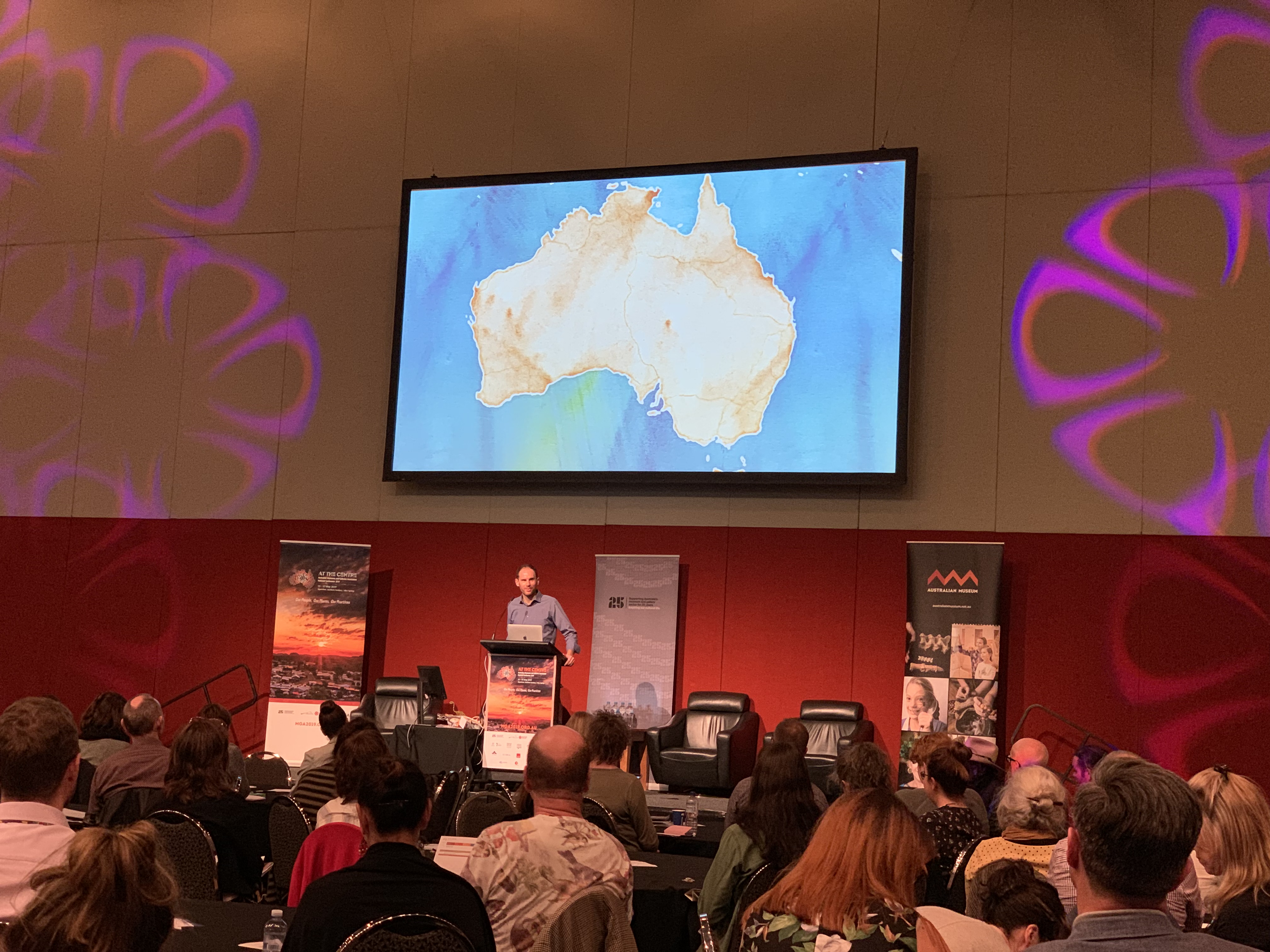
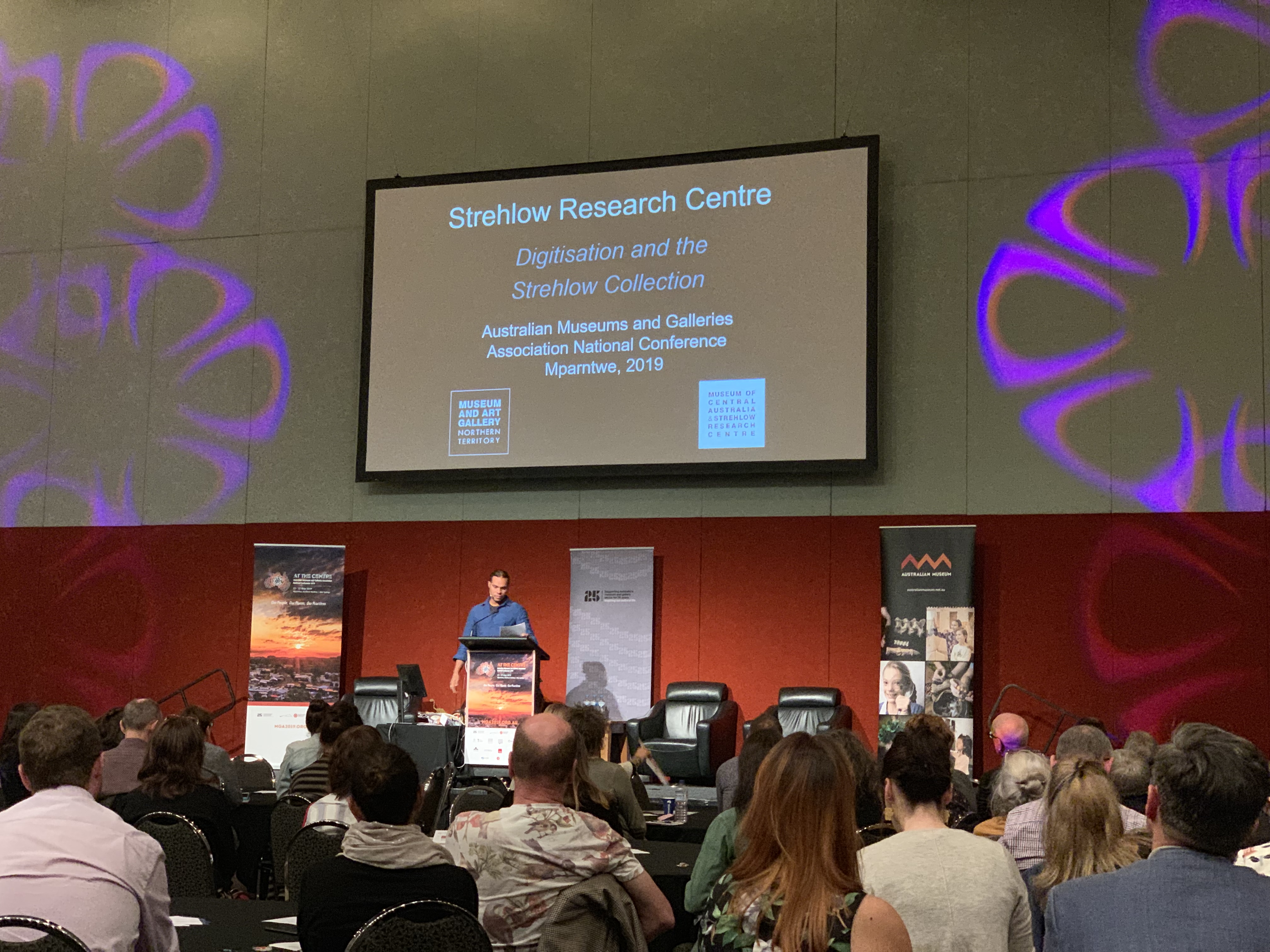
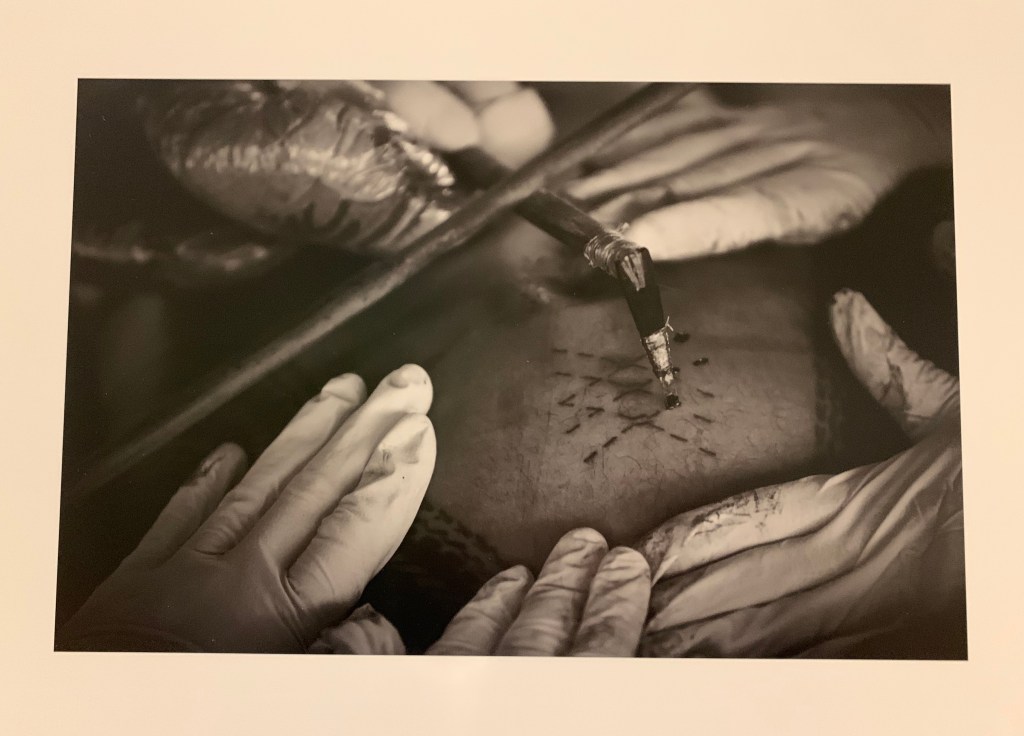
    Our final speaker, Shaun Angeles, presented on the opportunities and challenges of digital collections, providing an incredibly valuable Indigenous perspective. Thank you Angeles for sharing some wonderful photographs from the Strehlow Research Centre collection and their stories. It is sensitive material with some images depicting private ceremonies. Through working with the collection, there has and continues to be this amazing transfer of ancestral knowledge between generations. Something that could only be achieved through the meaningful hiring of Indigenous staff.

    Shaun Angeles

    5.30 pm

    Tonight, there was the Museums and Galleries National Awards (MAGNA) and Museums Australasia Multimedia and Publication Design Awards (MAPDA). Congratulations to all the very well-deserved winners.

    Until tomorrow.


  • Australian Museums and Galleries Association Conference Day 2

    Day 2 of the conference can be divided in half. In the morning we had the final regional, remote & community day(s) sessions. In the afternoon, the start of the official conference. Similar to the post from yesterday, I’m going to basically outline my day and share any highlights and insights. I do want to make it clear that this post will serve as a summary. For those who can’t make the conference, or for those who joined other concurrent sessions, I hope there is something in it for you. This also extends to all other conference posts.

    9.00 am

    This morning was the final plenary talk for the regional, remote and community day(s). Although technically one day, because it was spread over the afternoon of Monday and morning of Tuesday, I’ve used the (s). To start, we had a panel talk featuring Veronica Perrurle Dobson AM, Fiona Walsh, Daniel Featherstone, Clare Fisher and Kelly Lee Hickey. Each offered some incredible insights into what it means to be at the conference telling their stories about Mparntwe – Alice Springs.

    Veronica Perrurle Dobson AM, Fiona Walsh, Daniel Featherstone, Clare Fisher and Kelly Lee Hickey

    There were a couple of highlight moments. The first was courtesy of Veronica Perrurle Dobson AM who used technology to overlay Indigenous cultural stories on today’s physical landscape. The yeperenye caterpillar were digitally placed on the map to help visualise their story and show the sacred sites. Dobson spoke about the significance of passing these stories on to the younger generation and keeping them safe in cultural institutions.

    Veronica Perrurle Dobson AM

    Another highlight, for me, was the talk presented by Clare Fisher, Manager of Library Services at the Alice Springs Public Library. To put things in perspective, this library welcomes over 500 visitors a day, that’s 15 000 a month. Around 42% of all Alice Springs residents are members. This is absolutely incredible. The range of programs and events on offer prove that this library is doing exactly what Fisher said, adapting and evolving. This includes, among many other things, offering family and youth programs and digital spaces. As Fisher said, you have to listen to your community, see what they want and reflect it back.

    Clare Fisher

    10.00 am

    After the panel we heard from Mandy Paul who is the Director of the Migration Museum. With my historian cap on, I found this to be a very interesting talk that looked at how museums must engage with the complexity of the past and not simplify issues. We must acknowledge that museums are part of the colonial archive and work against this context to become more inclusive and reflexive. This means, for example, realising that source material you may need for an exhibition that covers an aspect of Australia might not be in English.

    Mandy Paul

    11.00 am

    It is always difficult to choose between concurrent sessions. I decided to go with Session 3A because not only did it sound like a great group of talks, but, I also wanted to support a previous boss of mine, Bethany MacRae (shout out!).

    There were three talks and I really just want to focus on one common theme that ran between the first two – that of challenges and learning from what doesn’t work. It is really refreshing at a conference like this to hear about what goes wrong.

    The first speaker to address this theme was Fiona McFadyen from the Shoalhaven Regional Gallery who spoke about an artist-in-residence program that was a little testing. Support from the community was lacking as they were unsure of who the artist was and why they should offer support. In the end, the exhibition turned out great but it wasn’t without a lot of speed bumps along the way. For example, public programs weren’t well received and the traditional advertising routes that often work for the Gallery, all of a sudden weren’t attracting responses.

    Fiona McFadyen

    I really want to focus on the talk by Bethany MacRae who really spoke to this theme well. MacRae achieved this by comparing and contrasting two exhibitions – Living Hurstville and St George on a Sunday. In the former, the Hurstville Museum & Gallery staff tried to remain in control of the project from start to finish. Just briefly, the project was to interview and photograph residents who live in the Georges River Council. Museum & Gallery staff controlled the schedule for photography, who was the photographer and all the administration and paperwork associated. Although this did mean they knew exactly what stage the project was up to, it was a lot of time and energy.

    Bethany MacRae

    In the latter project, the Museum & Gallery teamed up with TAFE, allowing students to take some of that control and, for example, photograph participants and work out a suitable schedule. Unlike the former, the focus of this exhibition was more on the leisure activities of those living in the Georges River Council. While both posed their own challenges, such as the photographer from council not always being available and TAFE restructures and re-scheduling, there were some pretty important overall lessons learnt. My favourite was that administration is inevitable and that you must remain as flexible as possible with a project starting collaboration as early as possible.

    I really want to say a huge thank you to speakers who are boldly going into challenges they have faced.

    1.30 pm

    The start of the official national conference. After a beautiful Welcome to Country, we had our first plenary by Matthew Pinta Tjapangati, Luke Scholes and Bobby West Tjupurrula. They spoke on the exhibition Tjungunutja: from having come together that was curated in 2017 and displays Papunya artworks. It is now on display at The Galleries in the Araluen Arts Centre. In total, there are over 80 works that reflect the significance of the Western Desert art movement.

    3.30 pm

    This time, and for me, it was an easy choice which concurrent session to attend. The lightning sessions are a fantastic way to hear a little about a lot. Here are all the presenters and what they had to discuss:

    1. Tracey Avery – Arts & Heritage Consultant

    Tracey Avery

    The first speaker looked at a serious of climate change adaptation plans and realised that cultural institutions are not included. Avery argued that we need to make a list of what is significant in our collections, nationally, and how these objects can be protected from climate change.

    2. Adam Yates – Senior Curator of Earth Science (Museum & Art Gallery of the Northern Territory)

    Adam Yates

    I was especially looking forward to this talk because it had the word Megafauna in the title. In this presentation on reconstructing Baru, a million year old crocodile, Yates explored how 3D printing could be utilised to create a skeleton. This did mean using 6 machines non-stop over 3 months to meet the printing goals. I am hoping to find time and visit the 3D printed skeleton at Megafauna Central.

    3. Emma Williams – Curator (Albury Library Museum)

    Emma Williams

    Emma Williams explored how to curate from a private collection. In this instance, an exhibition based on a collection of Charlie Chaplin memorabilia.

    4. Yael Filipovic – Public Engagement Manager (Museum of Contemporary Art)

    Yael Filipovic

    Yael Filipovic presented six ways in which museums can spark difficult conversations. This is through starting with the art as a point of discussion, creating a safe space, using different formats to spark conversations (i.e. workshops, programs), ensuring space is set aside for the unplanned, include voices that aren’t usually in the conversation, and have fun.

    5. Michael Rampe – Senior Learning Designer (Australian History Museum)

    Michael Rampe

    This was an amazing presentation looking at how digital technology can be used at heritage sites. One particular case study, on the Macquarie Lighthouse, had objects scanned from the Museum of Applied Arts and Sciences that were originally in the lighthouse. They were then added back to the lighthouse digitally and could be seen through an AR experience.

    6. Sarah Ozolins – Head of International and Domestic Engagement (National Museum of Australia)

    Sarah Ozolins

    It was at this stage I could feel my eyes getting heavier and heavier. So much information in one day! Ozolins spoke on the absolutely extensive international touring program of the National Museum. Not just exhibition touring, but, running public and education programs. I cannot believe the reach with around 50 countries having received an exhibition from the National Museum.

    7. Sarah Reeves – Assistant Curator (Museum of Applied Arts & Sciences)

    Sarah Reeves

    Sarah Reeves spoke on the Inside the Collection blog and how it has been transformed and regenerated. Reeves shared ways in which you can re-evaluate your museum blog including promoting it on social media, improving wayfinding online, increasing staff contribution, implementing a regular post schedule and re-visiting content.

    8. Caddie Brain

    Caddie Brain

    Our final speaker for the session is behind the creation of the Darwin Audio Tour. If you are ever in Darwin (or even somewhere else wanting to hear the history and sounds of Darwin) download the app and enjoy the tour.

    5.30 pm

    To finish the day, we all gathered for a Smoking Ceremony and the welcome reception.

    Welcome Reception

    I am greatly looking forward to the program tomorrow and having the opportunity to speak at my first Australian Museums and Galleries Association Conference!

  • Australian Museums and Galleries Association Conference Day 1

    Greetings from Alice Springs! Today was the first day of the Australian Museums and Galleries Association Conference for 2019. I can already feel that this is going to be quite an interesting conference. Here is what I got up to during the day.

    9.00 am

    This morning there were a few tours on offer. I selected the Alice to Mparntwe Sacred Sites Tour led by Doris Stuart Kngwarreye (Apmereke – artwye), Dan Murphy and Lucy Stewart. This tour has been running since 2008 when it was launched for the ‘Art in the Heart’ National Regional Arts Australia Conference.

    The tour guides visitors through some of the most sacred sites in Alice Springs with Doris sharing stories of her culture and family along the way. At times, it was very emotional. Doris shared some incredible stories with the group including her community’s struggle to try and maintain the sites and compromise with developers. I am so glad I had the opportunity to see these sacred sites around town. It was eye-opening and will stay with me for the duration of my stay.

    We finished the tour in Araluen, at the Arts Centre.

    10.30 am

    After the tour, I wandered around the Museum of Central Australia. I hope to return later in the week and spend longer reading the labels and immersing myself in the permanent display. There are some skeletons that I want to more closely observe. Overall, my first impression was quite positive. Side note – if you are currently at the conference, entrance to the Museum is free.

    12.30 am

    Registration opened. I have to admit that seeing the word ‘speaker’ on my name card has made me very excited for Wednesday.

    1.30 pm

    Indigital – Using New Technology to Tell Ancient Stories, Mikaela Jade, Indigital

    Mikaela Jade

    I’m so glad I tweeted my thoughts (although sometimes incoherent) throughout the day. It really helps me to remember what happened when. I’ve also learned from past experiences that it proves to be a great reminder when it comes to writing my blog post. For those who are interested, the conference hashtag is #amaga2019 and you can follow me @LotteNaughton.

    After being welcomed to the conference, we had our plenary speaker, Mikaela Jade, who Zoomed in to talk about her company Indigital. It was actually quite incredible that Zoom worked smoothly. Shout out to the conference team for making that dream happen. It was also quite fitting that technology was used to give a talk about technology.

    Indigital is a company started by Mikaela Jade that focuses on utilising technology to tell the stories of Indigenous culture. There is an Indigital app that we were able to play with during the presentation. One thing I greatly appreciated was a slide basically stating what is AR, VR and Mixed Reality. As someone who doesn’t always come into contact with these concepts, it was great to have them outlined.

    AR – digital content on top of your real world

    VR – digital environments that shut out the real world

    Mixed Reality – content interacts with the real world

    This app has been introduced in schools as a way for students to interact with cultural stories and language. In one case study, students heard stories from their Elders then selected an element to bring to life via the technology. They also created word cards with Indigenous and English words appearing together. I do hope to use the app around Alice Springs at newly opened stations to see some Megafauna (just need to find the time!). Here is a list of the stations:

    1. ANZAC Hill

    2. Todd River, adjacent to Undoolya Road and Leichardt Terrace

    3. Megafauna Central

    4. A public garden between Alice Plaza and Todd Mall

    5. A public garden outside Adelaide House, Todd Mall

    6. The ‘Coolamon Garden’ outside the Alice Springs Town Council Chambers

    7. Olive Pink Botanic Garden

    8. The Museum of Central Australia lawn

    9. The entrance to the Alice Springs Desert Park

    10. Adjacent to the Dingo enclosure, Alice Springs Desert Park

    2.15 pm

    Concurrent sessions started. I decided to attend the 1B session that had the following talks:

    Curator’s Perspective: a journey of discovery and shared experience, Lynette Nilaweera, Yarra Ranges Regional Museum, and Brooke Wandin, Wandoon Estate Aboriginal Corporation

    Lynette Nilaweera and Brooke Wandin

    Engaging community members as collaborators and citizen curators, Erin Wilson, Devonport Regional Gallery

    Erin Wilson

    In the first presentation mentioned above, Nilaweera and Wandin focused on their journey creating the exhibition dhumba-njan (speak I) dhumba-njarr (speak you) now on display at the Yarra Ranges Regional Museum. There were so many memorable quotes from the presentation including, “a good working relationship makes a bloody good exhibition” and “we cannot move faster than the community we seek to represent – we must move at their pace” (the latter quote has been paraphrased). It served as a reminder that sometimes you have to take a chance and step outside your comfort zone.

    The second presentation focused on three projects that have been sparked by The Robinson Collection (photograph collection) in the Devonport Regional Gallery. These photographs show the people, landscape, and streetscape of Devonport from around the 1920s until the 1950s. Originally, they were displayed thematically. Wilson, the Curator of this collection, discussed how this has transformed. These were the three projects/exhibitions mentioned: displaying the photographs alongside voices of those in the community, displaying the photographs as curated by youth and digitising the photographs creating an online memory box. A great way to look at the Collection through a new lens.

    3.15 pm

    Afternoon tea.

    3.30 pm

    The final session I attended was:

    Thinking it through: Using design thinking to tackle common problems for small museums, Amanda James, History Trust of South Australia

    This was a workshop where participants had to isolate a problem faced by small museums and work out a possible solution. As a large group, we decided on the problem that locals aren’t interested in the museum. In smaller groups we then had to figure out why locals might not be interested. We wrote down, for example, that they might not know we exist and that the museum/gallery might not be offering anything relevant.

    Workshop

    From there, we had to break down one idea even further. We selected that people might not know we exist and brainstormed creating a new advertising campaign, changing the signage and painting the museum/gallery building bright yellow. Finally, we discussed how to implement a solution. We selected painting the building and ended up talking about covering the building in Hi Vis shirts that the community could stitch together. Not only would this make the building a whole lot more obvious, but, it could lead to discussions on safety in the community. This was especially pertinent considering many in our group were from industrial and agricultural towns.

    Workshop

    5 pm

    Day 1 – done and dusted and looking forward to tomorrow.

  • Chicago: Museum of Science and Industry

    Warning: the following post contains images of human specimens that may make some viewers uncomfortable.

    Similar to The Field Museum, the Museum of Science and Industry is a huge cultural institution that you could spend the whole day exploring. Everything from the building itself to the collection has a fascinating history. We never intended on visiting this museum. Why we decided to go will soon be revealed.

    Museum of Science and Industry

    History of the Building

    Try to imagine Chicago in the 1880s. A huge fire, that is estimated to have destroyed 90% of the city, had only occurred a decade prior. Community spirit, finances from business magnates and the ingenuity of architects melded together eventually resulting in huge parts of the city being rebuilt. It is actually quite astonishing how quickly new buildings went up. A huge World Exposition was planned for 1892 to celebrate 400 years since the journey of Christopher Columbus. New York, St Louis and Washington DC all threw their hats in the ring to host. Pressure was on considering Paris had wowed the world in 1889 by unveiling the Eiffel Tower at their Exposition Universelle.

    Chicago also stepped forward and no one thought for a second that they would win the vote. Spoiler alert, they did and Chicago only had a couple of years to prepare everything from the buildings to the exhibitions. I’m currently reading The Devil in the White City by Erik Larson who beautifully maps out how this all played out and how it almost didn’t happen. It was so close to failing and then, suddenly, there were buildings, a park was designed by the same individual who designed Central Park, Frederick Olmsted, and Chicago welcomed over 27 million visitors in a six month period.

    I’ll note here that The Devil refers to Dr H H Holmes and his murder castle. A great book to read if you’re also interested in true crime.

    Why is this relevant? The Museum of Science and Industry building was originally constructed to exhibit prized and valuable artworks sent over for the Exposition. So collectors and artists felt at ease, it was built from stone to be completely fireproof. Today, it is the only building left standing – a testament to the Exposition. The collection held in this building just after the Exposition is now at The Field Museum and has been replaced with what you see today.

    Our Visit

    In my previous blog post I talked about quality over quantity when it comes to visiting large museums. I want to talk a little bit more about how I start my visit when I feel overwhelmed. First things first, I obviously purchase a ticket if necessary. Then, I grab a visitor’s map and find the nearest cafe. Chances are, there will be a couple to choose from. After getting something to eat and drink, I open the map and plan my route. This gives me the opportunity to make sure I don’t miss anything or spend too long in one part at the expense of seeing something else I’m more enthused about. I decided on three exhibitions: YOU! The Experience, Yesterday’s Main Street and Science Storms.

    Side note: I said at the beginning of this post that we had no initial plans to visit the Museum. However, at The Art Institute of Chicago, I found a book on what to do in Chicago. The first page I opened to was on the Museum of Science and Industry. I skimmed a few lines and saw the words “human specimens”. All of a sudden, we were going to visit this museum.

    YOU! The Experience

    This is such an intense exhibition on the human body. One of the reasons why I say this is because there is a room, completely open to the public, containing real foetal specimens displaying different developmental phases throughout pregnancy.

    Although not real, there are also large displays that break down the body showing the entire nervous, circulatory, digestive and muscular systems. The nervous system absolutely unnerves me, pardon the pun.

    Anatomy
    Anatomy
    Circulatory System
    Nervous System

    As we made our way through the exhibition, we came to the human specimen cross sections. The introductory panel explains how these sections were prepared by staff at The University of Illinois and Cook County Hospital Anatomy Department in the 1930s and 1940s. The sections are of a man and a woman who both died of natural causes. They were originally used in university medical teaching until 1943 when they were donated to the Museum for public education. I thought they were fantastic to have on display and can only hope they spark many discussions about health and the human body.

    Foot
    Body Slice
    Body Slice
    Arm

    Dispersed throughout the exhibition are plenty of displays exploring themes such as happiness, health and vitality. There are also many interactives. For example, for vitality there is a game called ‘Mindball’. To play, you need two players to sit opposite each other. In the middle is a straight track with a ball positioned in the centre. Each player wears a headband that tracks brain waves. To win, you must be as relaxed as possible. This will push the ball towards your opponent until it reaches the end. I have honestly never seen a group of primary school kids so quiet in my entire life as they each took turns to focus and win.

    Mindball

    Yesterday’s Main Street

    In this exhibition you can walk down the Main Street of Chicago in 1910. Highlights include seeing a dentist’s office and a pharmacy. There is also a movie theatre where you can go to watch a silent film.

    Dentist
    Dentist
    Dentist

    We were very excited for the ice-cream shop, but, it was closed on the day we visited. Disappointing because I’m sure the ice-cream would have been delicious.

    Science Storms

    The first thing that will catch your eye is the huge tornado at the entrance of this exhibition. Ive included a photograph below so you can see the scale. Science Storms also covers rainbows, avalanches, tsunamis and sunlight, to name a few. There are a couple of things I want to briefly mention.

    Tornado

    Dotted around the exhibition are listening stations. Rather than having a lot of different noises competing with each other, the various audio elements are isolated. This made things a lot easier to hear and I was surprised by just how well they were able to direct the sound.

    Listening Stations

    Once you have seen the large tornado, you have the opportunity to try and create your own, on a more miniature scale. It took me a while, but I managed to make my own little tornado. I was so proud.

    DIY Tornado

    Other Mentions

    Layout

    One thing that works really well with regard to the Museum layout is that there are four staircases each with their own colour. This helped us to navigate. I imagine it is of great help to school groups as well. If you’re trying to remember where something is near or need help with orientation, all you need to do is take note of the colour and you can find your way around.

    Stairs Sign

    Tours

    The Museum offers low sensory experiences a few times a year. Exhibitions are altered on this day until noon and noise reducing headphones and weighted vests, amongst other things, are available. I absolutely applaud this practice and considering their last couple have been completely booked out, it’s being embraced.

    There are quite a few other tours available so definitely head to the website for more information.

    Practical Details

    The Museum of Science and Industry is open daily from 9.30 am to 4 pm. Tickets are available online. There are a range of experiences you can also book so make sure you research these before selecting a ticket option. It is an accessible museum. There are food options available. If you have your own food, you are able to use the food court tables. Overall, it is a very welcoming museum.