Seeing 100% Brisbane at the Museum of Brisbane in City Hall was kind of tough. I really miss living in this city and while you can take the gal out of Brisbane you will never take the Brisbane out of a gal. We visited for a Mother’s Day vintage high tea and lecture on changing fashion in Australia. It was such an engaging talk filled with examples of well-preserved vintage fashion and incredible stories from Brisbane’s past. Never forget Cloudland ladies and gentleman.
Museum of Brisbane
Post-event, I wandered through the 100% Brisbane exhibition with my mother. First things first, it is an exhibition that aims to engage your senses. As you can see from the map below, there are spaces to smell, listen, watch, touch, and contribute. The following will provide a breakdown of what you can do throughout the exhibition space.
Museum of Brisbane Map
My favourite space was ‘Scents of the City’. Here, you could smell what defines this city – frangipani, thunderstorms, sunshine, and mangroves. All of these scents sparked memories of my childhood and really got the nostalgia train moving. Behind each scent was a quote printed on the wall and there was a small thematic panel when you first entered the space.
Scents of the City
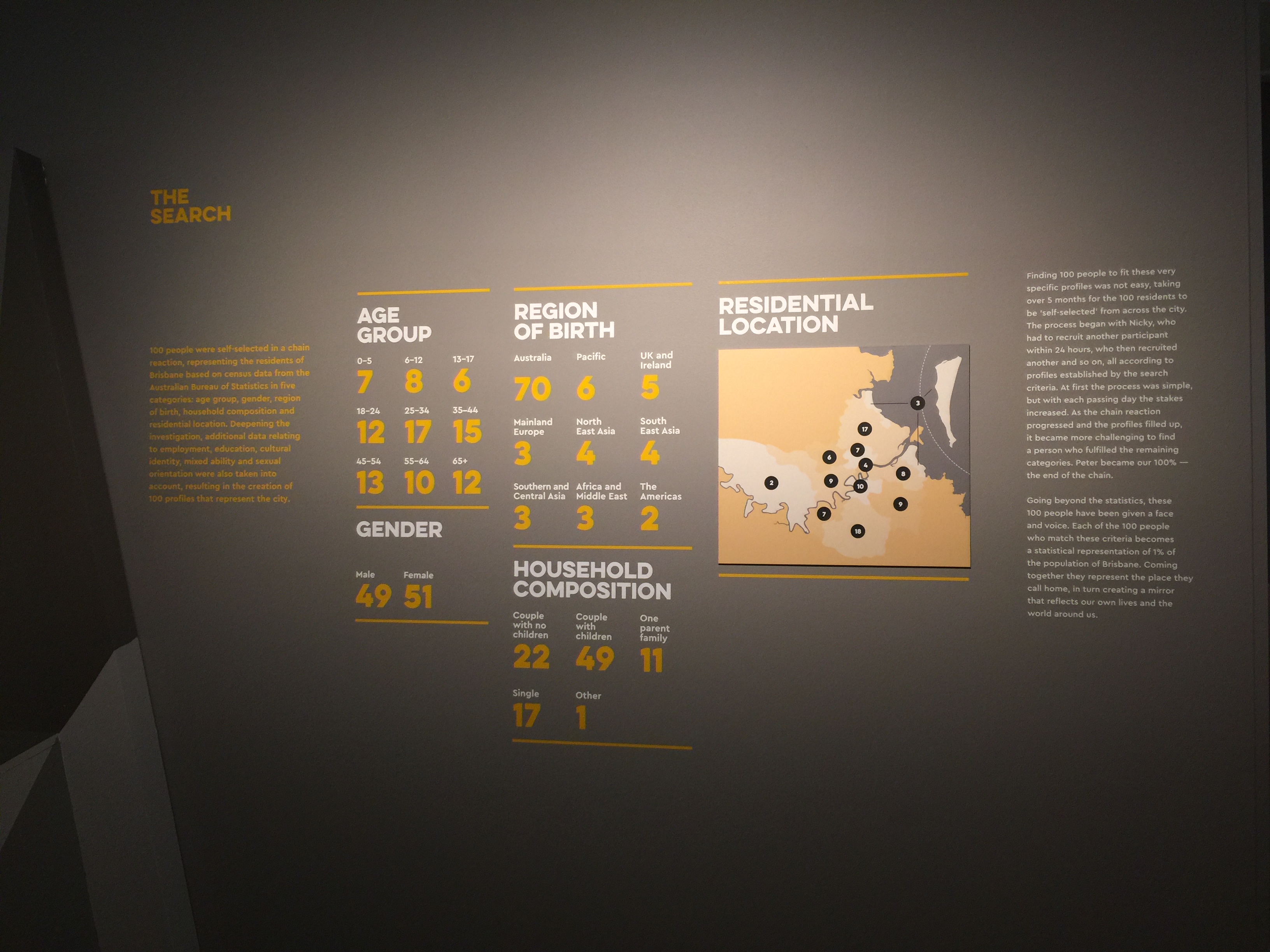
Another section that really stood out to me was ‘Brisbane DNA’. If you are visiting Brisbane, this is a fantastic place to start. Basically, it tells you the demographic information of Brisbane. It is told, however, in an interactive and interesting way transforming it from reading like a census to actually being engaging. There was a giant screen in the corner of the room revealing some of the more quirky statistics. This included “do you now work in your dream job?” FYI 22% of people said yes.
On the opposite side to the screen were a series of computers. If you are a resident, you could see how your demographics compared to the rest of the city. It was both data collection, but, a cool way for you to feel as though you were contributing to the exhibition.
Brisbane DNA
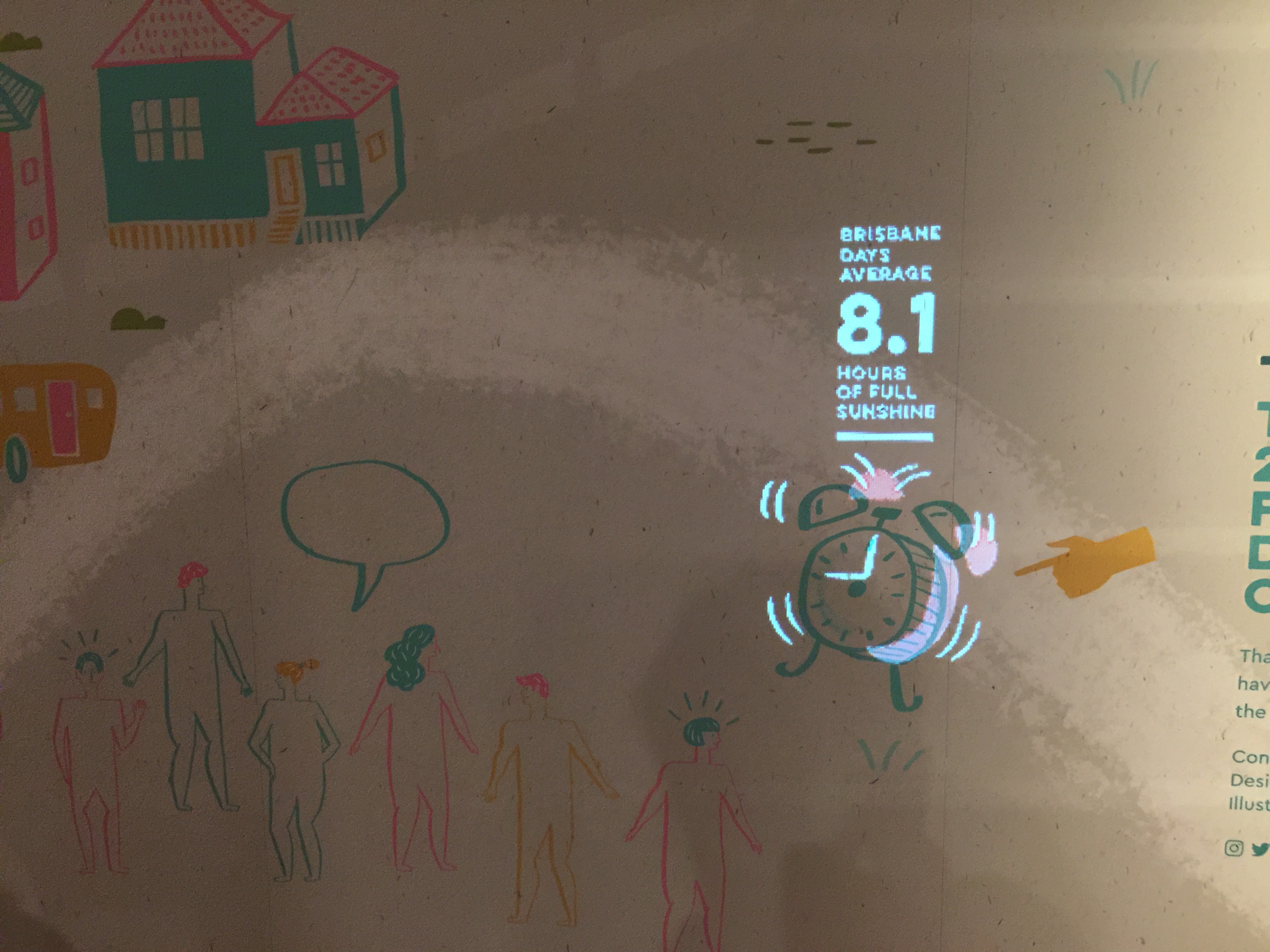
Moving between ‘Brisbane DNA’ and ‘Scents of the City’, you walk through a space called ‘A Day in the Life of Brisbane’. There is a wall with some sort of projections on it that, when touched, gave you a little taste of waking up, working, and living in this city. The technology is integrated so well I couldn’t even tell where exactly the projections were coming from. That goes for the rest of the space, everything just seemed so perfectly integrated.
Brisbane DNA
The rest of the exhibition tells the story of Brisbane from the birth of the city to how often our river floods. This is all in a very well-designed space with the option of following the story chronologically or selecting your own path. Again, referring to the map, you can see how everything feeds into each other without being a prescriptive path.
I did wander through wondering who is included and who is excluded from this narrative and why. This is why I found the contribution part of the exhibition to have great impact. If a story you could relate to wasn’t included, then you had the power to make sure it at least was represented somewhere.
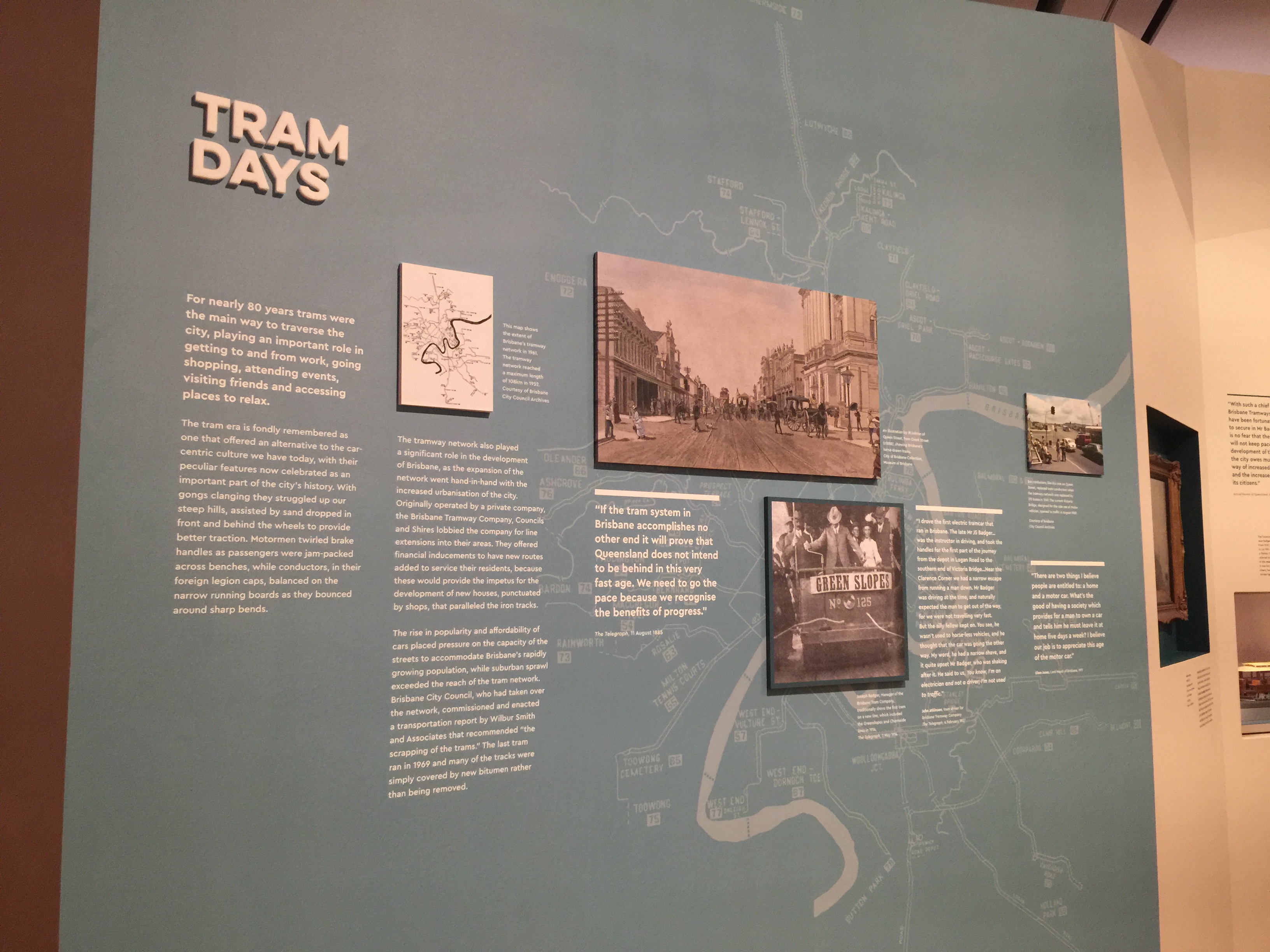
It was such an engaging exhibition I cannot speak highly enough of it. Sure, I am biased. I related so strongly to the contents because I’ve spent the vast majority of my life in this beautiful city and have since moved away. Seeing the stories and people who live here was quite emotional for this very reason. Even seeing the part of the exhibition on trams made me feel nostalgic and I was born long after they left the city.
Tram Days
I guess then the exhibition caters to a diverse audience. If you know nothing about Brisbane then it’s a great place to start. In one exhibition you can learn quite a substantial amount of information without feeling overwhelmed. If you live here, you can work your way through with the knowledge that you are a part of this exhibition.
Not to mention the gift shop has now been raided and I will return to Sydney as a loud and proud Brisbanite now equipped with the merchandise to prove it.
Thank you Museum of Brisbane, for reminding me of how much I love this city.
It’s been quite a while since I’ve posted a new entry. This is mostly because I’ve spent the vast majority of my time working. Rather than keep silent because of this, I thought why not post about what exactly I do. I’ll start by saying each week is completely different. Although this might sound exhausting to some, shaking things up, to me, keeps things interesting. I thoroughly enjoy doing something a little different every day!
Here is a basic list of my roles:
Heritage Interpreter – Cockatoo Island
Curator – Harry Daly Museum
Program Producer/VSO – Museum of Applied Arts & Sciences
Digitization Assistant – State Library of New South Wales
Museum Assistant – Hurstville Museum
Curriculum Program Deliverer – Sydney Living Museums
The rest of the post will literally go day-by-day through my week.
Monday:
Roles: Program Producer – Museum of Applied Arts & Sciences and Digitization Assistant – State Library of New South Wales
My day begins at 11.00 am. I have a four hour shift working on the floor of the Museum of Applied Arts & Sciences assisting in delivering their school holiday program. This time, the program consists of a huge archaeological dig pit containing hidden objects.
Until the 30th of April, the museum is showcasing the blockbuster exhibition ‘Egyptian Mummies’ from the British Museum. The dig pit was created to compliment this exhibition, allowing children to dig for their own ‘treasures’. During the shift, I welcome visitors to the space, interact with them in the dig pit, and monitor supplies. Children have the option of taking a bucket and a check list before jumping into the sand and digging away.
3.00 pm
My shift ends and I leave the museum to travel to the State Library of New South Wales. Between 5.00 – 10.00 pm every Monday, I work with a small team that is currently digitising some of the rarer books in the library’s collection. We operate the scanners, handle the books, and capture each of their pages. As an estimate, we aim to scan around 500 pages per hour.
State Library of New South WalesState Library of New South Wales
Tuesday:
Roles: Visitor Services Officer – Museum of Applied Arts & Sciences
From 9.15 am to 5.15 pm, I am again on the floor of the Museum of Applied Arts & Sciences. This time, however, my role is to essentially assist visitors with their enquiries.
Wednesday:
Roles: Curriculum Program Deliverer – Sydney Living Museums
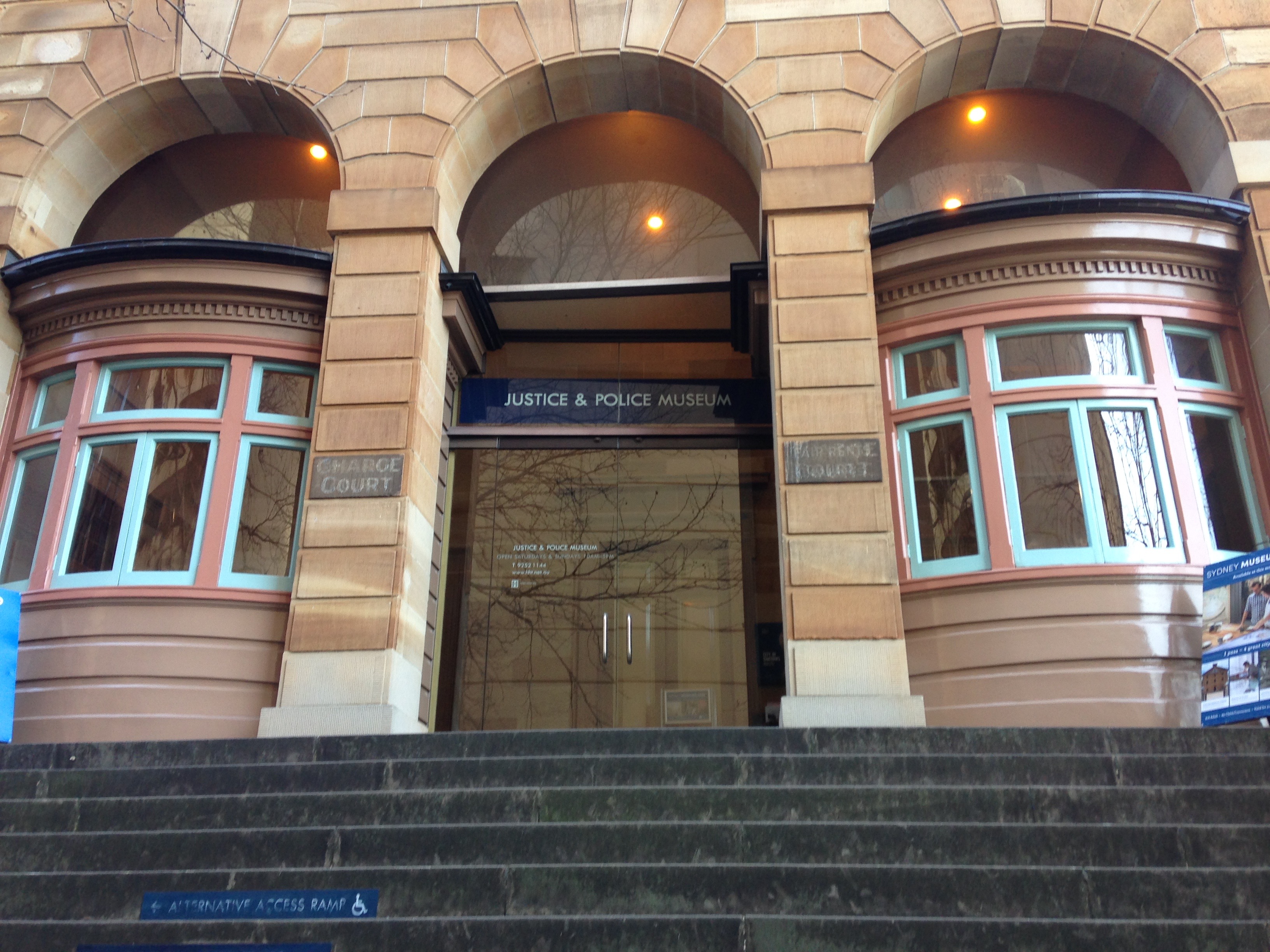
Today I had training for my new role as a Curriculum Program Deliverer with Sydney Living Museums. My day started at 9.30 am at the Justice & Police Museum. Considering I once volunteered with the Queensland Police Museum, I was extremely excited to learn more about New South Wales policing.
The morning consisted of a basic tour of the museum and an explanation of our roles. We then ran through the entirety of the program “A Trial Run” designed for High School Students.
Finally, we had a more comprehensive tour led by the curator. It is such a fascinating collection. Most importantly, the collection can tell some pretty incredible stories of how crime and justice have transformed in New South Wales over the decades. It is great to have the opportunity to share this history with visiting students.
Justice & Police Museum
Thursday and Friday:
Role: Curator – Harry Daly Museum
I am combining these two days together because every Thursday and Friday I work at the same location – the Harry Daly Museum.
On Thursday, I spent most of the day preparing the program for an upcoming seminar we’re running – Collecting, Curating, & Conserving. We have had such an excellent response to the seminar! Quite a few medical collections in Sydney will be represented along with some from Canberra, Melbourne, and regional New South Wales.
On Friday I spent the day with Vanessa working in the archives. She has been an amazing archives assistant. We are currently creating new “archive-safe” boxes, transferring the archival material, and re-auditing the collection. Soon we will start on some de-accessioning of objects.
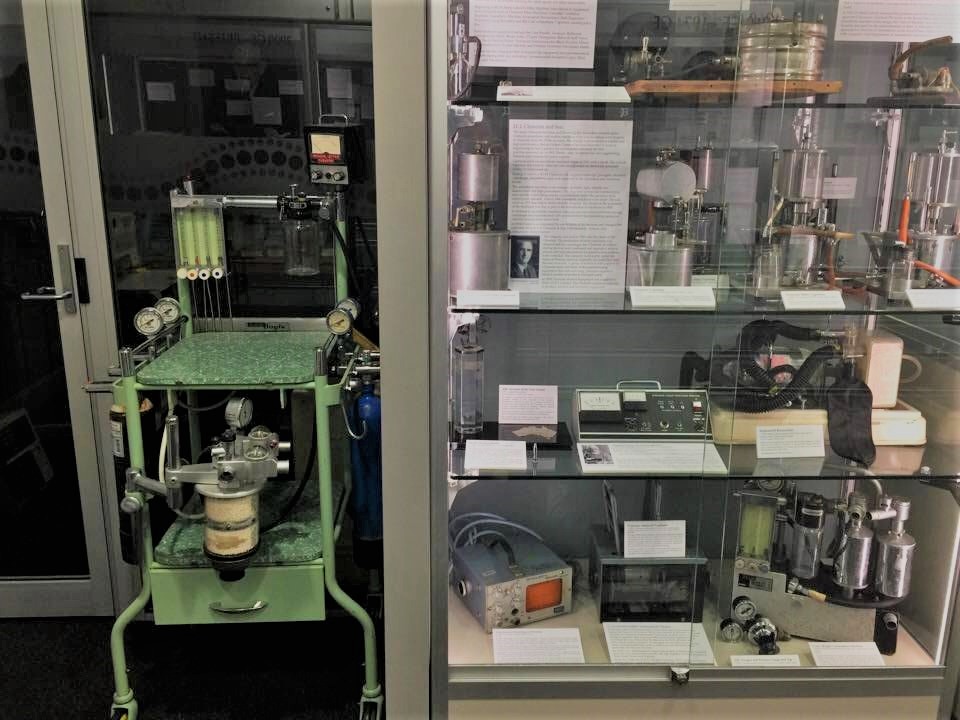
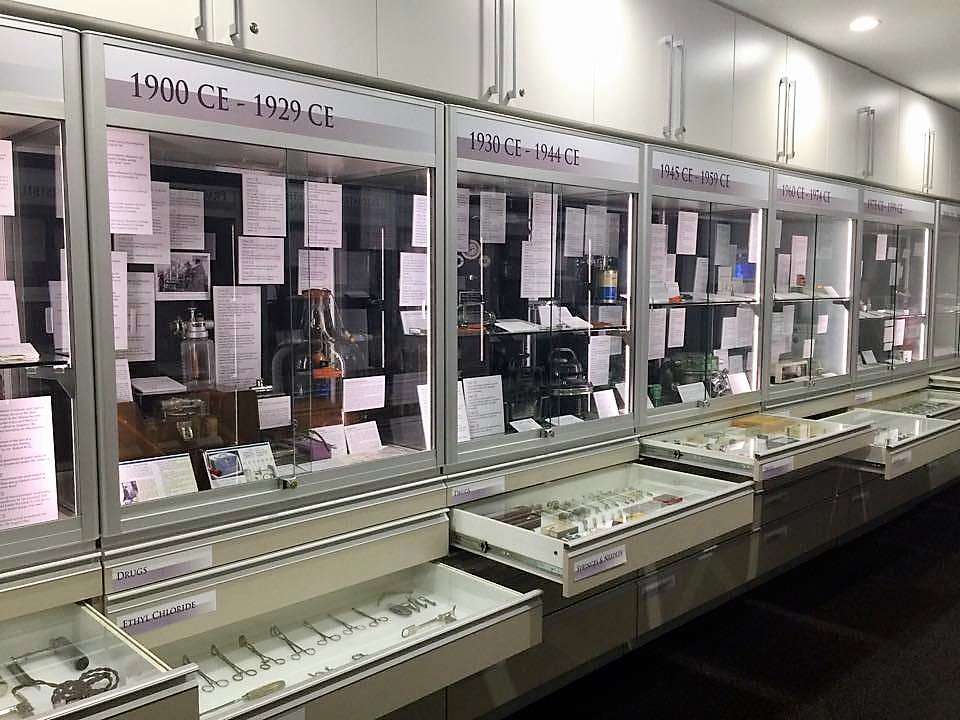
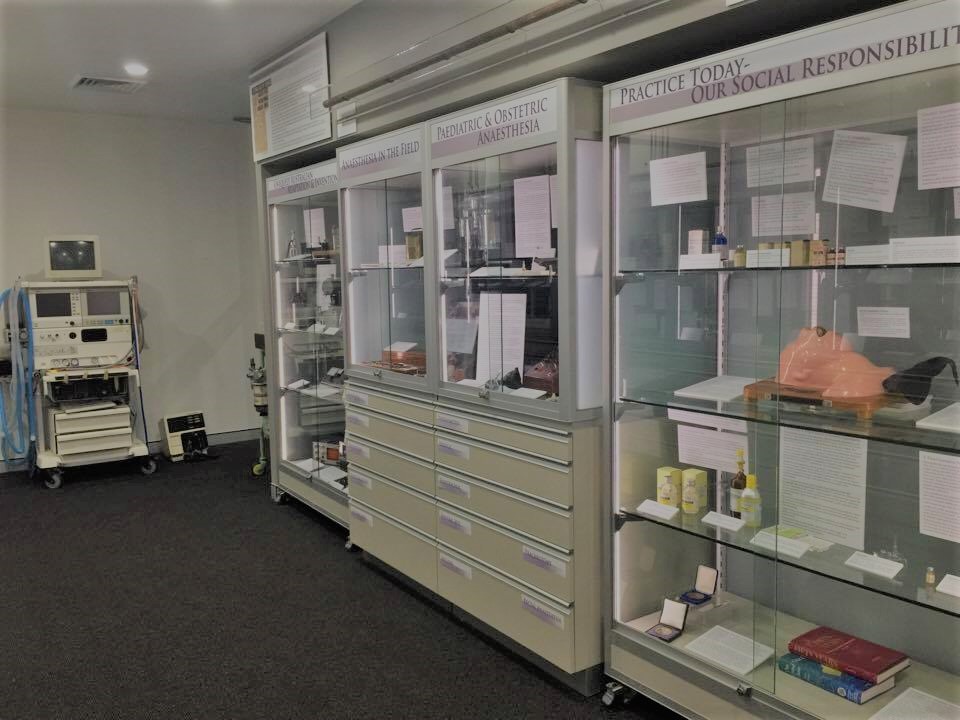
At around 2.00 pm I gave a tour of the museum for the Heritage Festival. The visitors had no knowledge of anaesthesia and were surprised to learn about its complex history. Although an anaesthetic museum, I think of it more as a museum documenting how people have managed pain. There are so many stories behind the objects that show how we have had to deal with pain over time.
Harry Daly Museum
Saturday:
Role: Heritage Interpreter – Cockatoo Island
Saturday was a beautiful day to tour some people around the island. For the Heritage Festival Cockatoo Island is running three tours every Saturday and two every Wednesday that run through the convict history.
Today I had three completely packed out tours. Each tour lasts around 45 minutes and traced the material evidence left by the convicts. This is the kind of work I absolutely love – communicating history.
Cockatoo IslandCockatoo Island
Sunday:
Role: Heritage Interpreter – Cockatoo Island
A perfect weekend for me is spending both days on the island. Rather than running three short tours, today I had one tour that lasted around 1.5 hours.
Our On Demand tours introduce visitors to the whole of the island. This includes its convict, reformatory school, prison, and naval shipyard history. The island is absolutely saturated with history and the evidence that remains can show us what life was like from 1839 to today.
Sunday Afternoon:
I’ve actually enjoyed sitting down and writing about my week. It’s provided a great opportunity to reflect on what I do and how I spend my time. I am grateful to be involved with so many museums/heritage sites in such a diversity of roles.
Next week I have my graduation ceremony on Wednesday (finally after what seems like an eternity of waiting)! So something different all over again.
Also, the Museums Australia Conference is fast approaching so expect numerous entries between the 14th and 17th of May.
Thanks yet again to Bec for sharing her blog space with me. This, even more so than my previous posts, will be entirely biased as I am a huge fan of John Olsen’s work, and was very eager and excited to visit his new retrospective at the Art Gallery of New South Wales (AGNSW). To me, Olsen’s work is immediately recognizable and quintessentially Australian both in its style, aesthetic, and through the exploration/celebration of the natural environment. This is despite the fact that much of his work was inspired by his time spent in Spain.
John Olsen
Based on past experiences of major exhibitions at AGNSW, I was expecting the exhibition to be very busy and crowded. To my delight, however, the exhibition space was almost empty when we arrived (tip – Wednesday afternoons are a great time to visit, as the Gallery is open late on this day. I think most people were saving their visit for later in the evening to attend the special events). This might seem an odd thing to dwell on, however, I find the busyness of an exhibition space, particularly for art exhibitions, to be a really influential factor in how I am able to experience and enjoy the display.
The display itself was laid out chronologically and included works from all of the different themes and physical forms that make up Olsen’s catalogue. While I say that his work is immediately recognizable, the aesthetic of his work, including the colours and forms used, did vary quite significantly over the course of his career (which is continuing, Olsen continues to paint at age 89). This was reflected well in the exhibition. He has also worked in various formats, which is something I wasn’t fully aware of prior to seeing this exhibition. On display was his more widely known works on paper and large-scale paintings, as well as pottery work and two of nine tapestries designed by Olsen. Prior to visiting the exhibition, I had seen pottery and crockery pieces decorated with Olsen’s designs for sale in the Gallery shop in association with the exhibition and assumed they were a somewhat gimmicky tie-in. I was, however, pleasantly surprised to realized that such pieces had actually been made by Olsen throughout his career and make up an important part of his body of work.
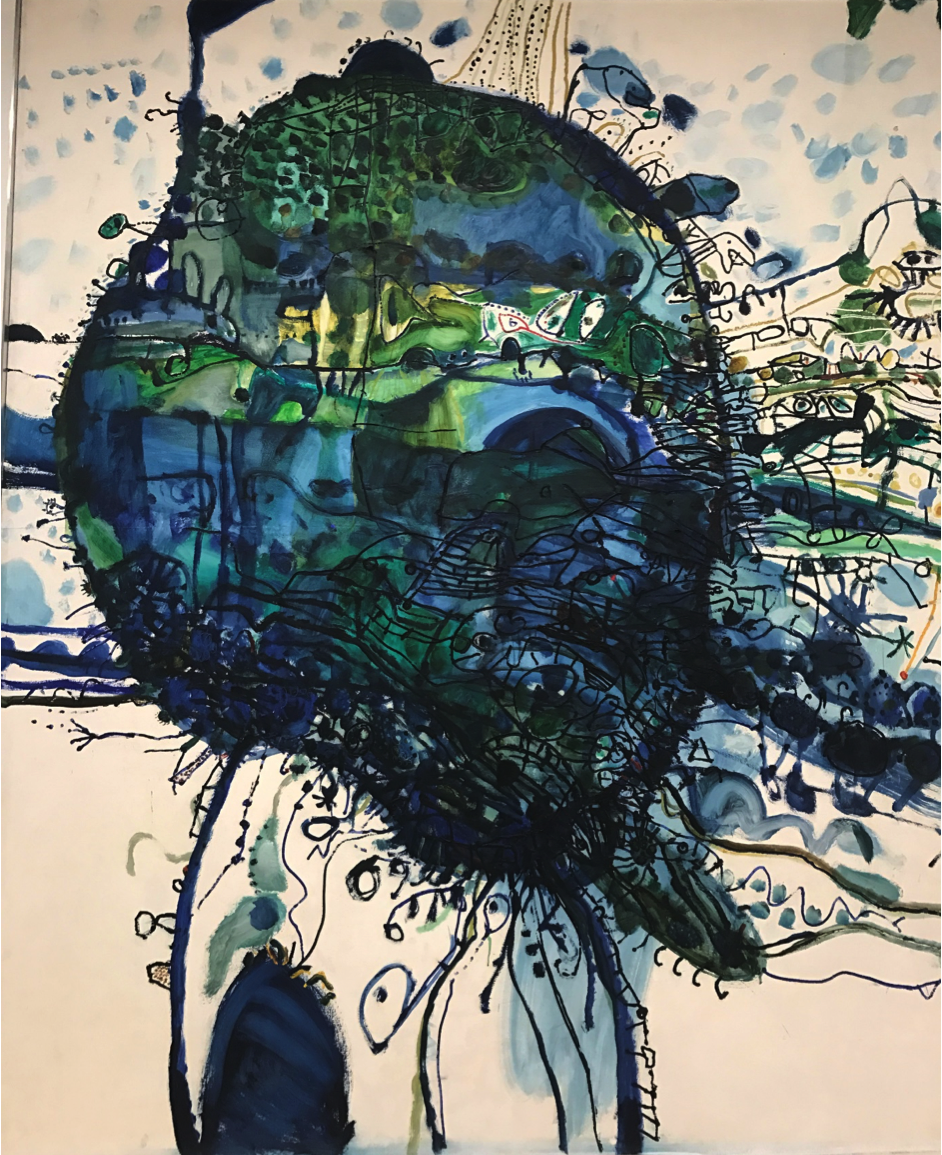
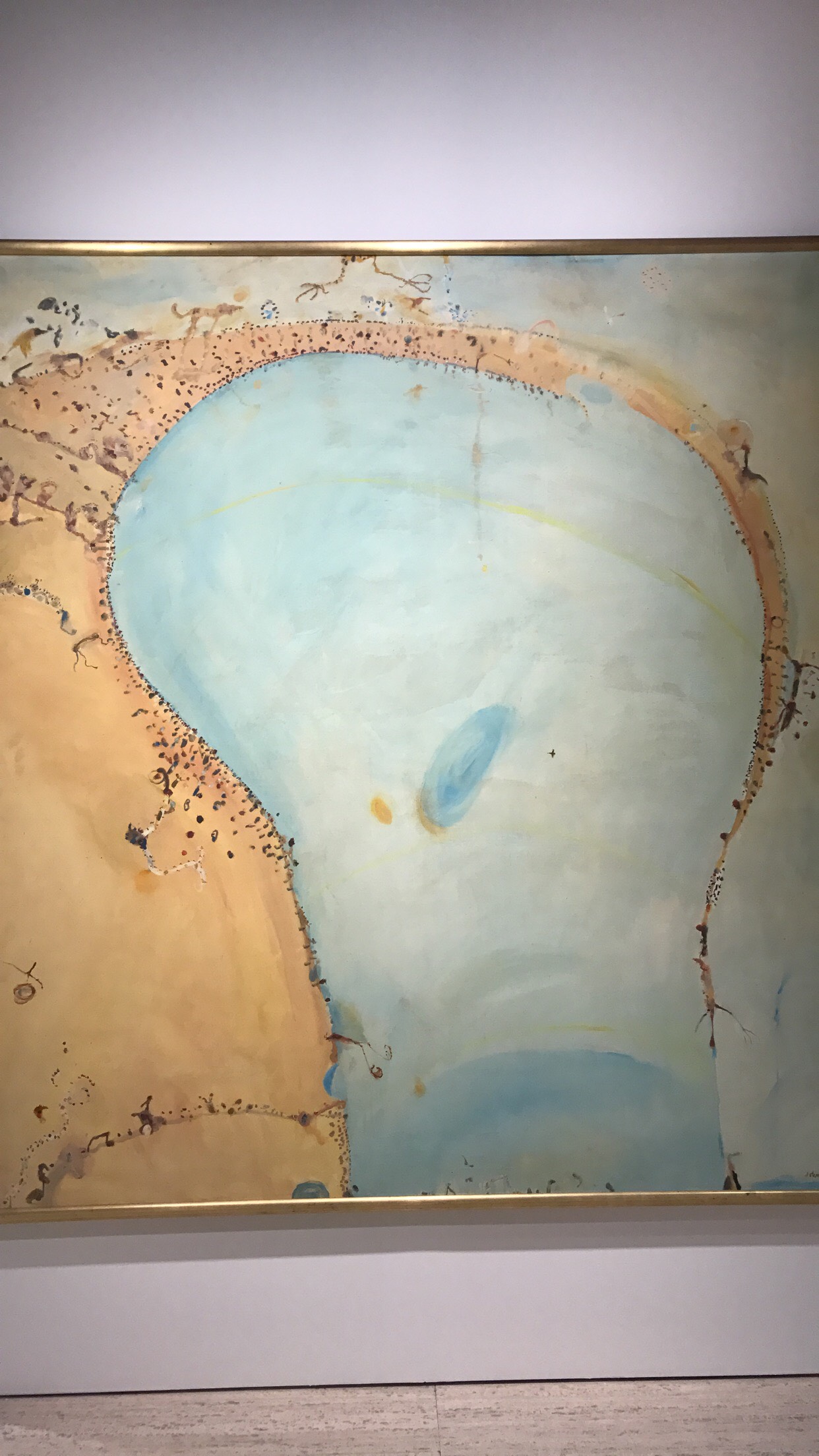
There are two artworks in particular I would like to discuss. The first is Olsen’s Five Bells (1963) (pictured below), which is probably my favourite piece of Australian art I have ever come across. It is a part of the AGNSW permanent collection, and I let out an audible gasp when I saw it on display in the exhibition. Like most of his paintings, Five Bells is quite a large-scale piece and has a dominant presence in the room given the vibrancy and depth of the colours used. Given this nature of the works being displayed, I was glad to see the generous spacing used in the layout of the artworks in each of the rooms.
In my experience, there has been a recent tendency towards displaying as many works on the wall space as physically possible, but the approach to this exhibition was fitting and refreshing. Five Bells mirrors earlier pieces that reflected the presence of the sun and territorial landscapes – this time in a marine setting as Olsen worked from Watson’s Bay. The work was inspired in part by Australian Kenneth Slessor’s 1939 poem Five Bells, which reflects on the death of the poet’s friend Joe Lynch in a ferry mishap on the harbour. The poem has inspired many creative endeavours in all formats, and it’s interesting to consider these works in relation to one another and it’s interesting to consider these works in relation to one another.
John Olsen
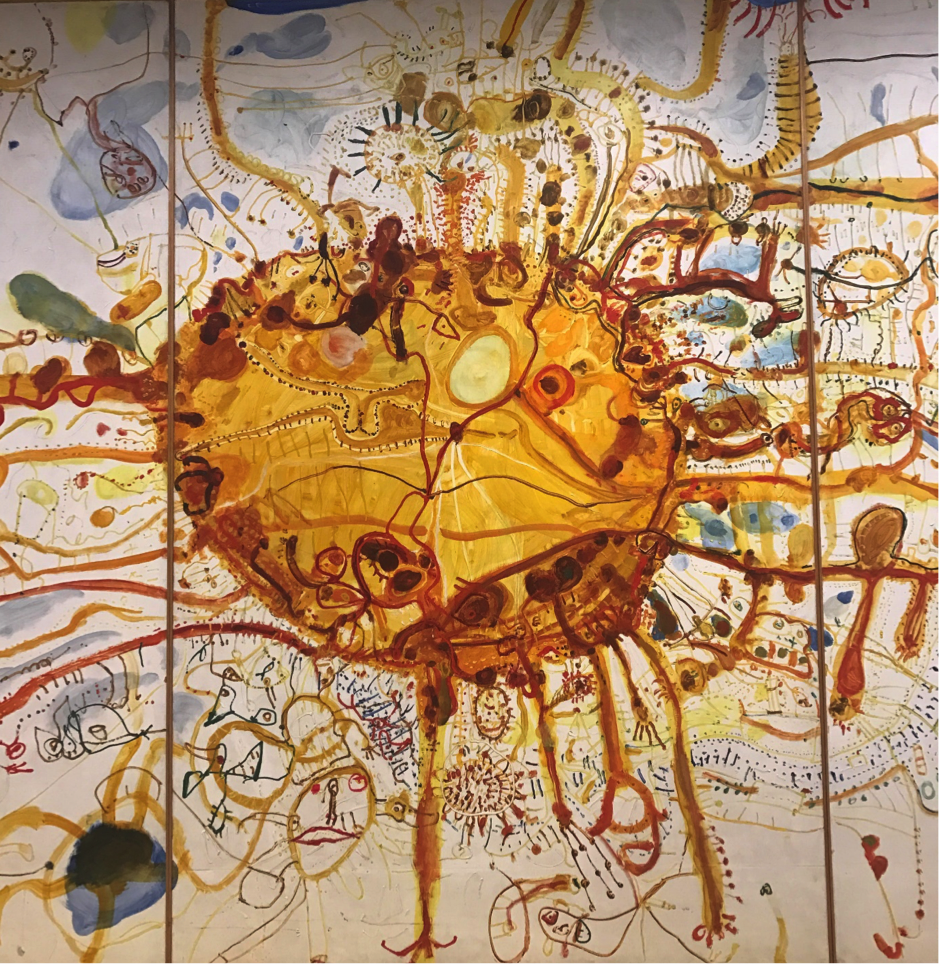
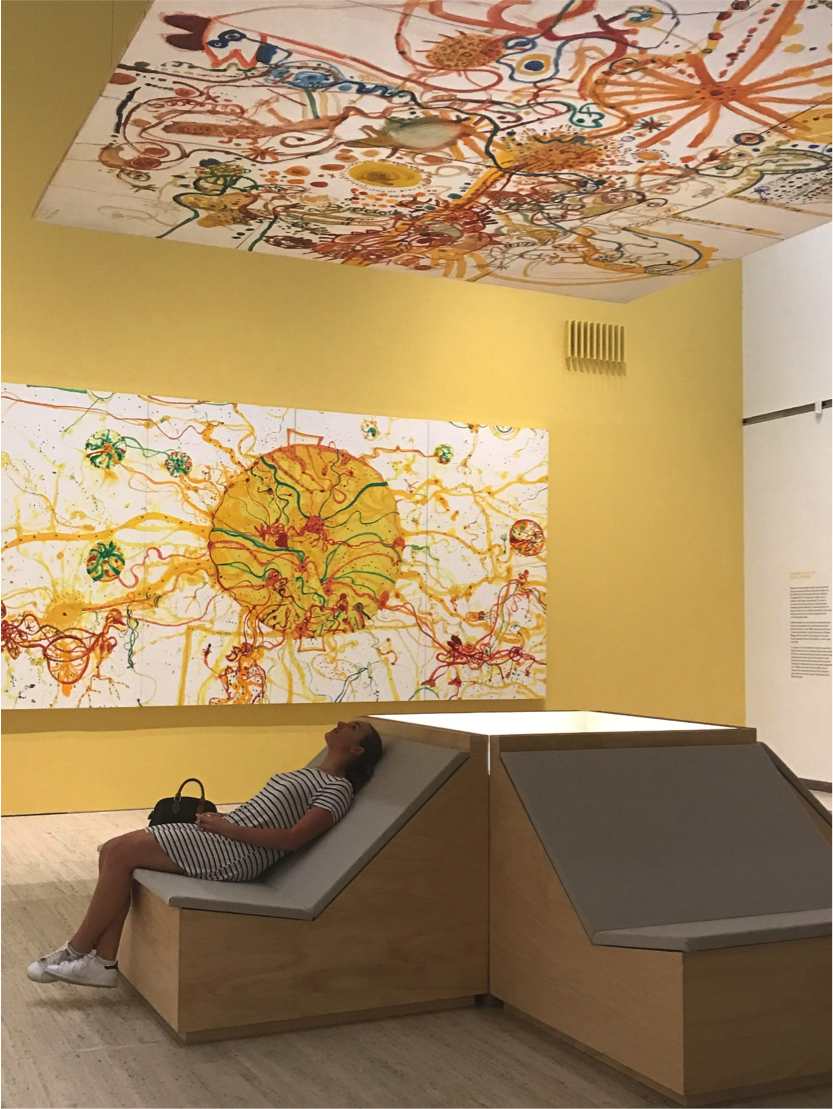
The other work I wanted to mention, Summer in the You Beaut Country, was one that obviously inspired the title of the exhibition and was quite heavily advertised in the lead up to the exhibition’s opening. This painting, another large-scale piece, was commissioned for Olsen to paint and is a ceiling piece, meaning viewers can best view it by lying down underneath it and looking up. In a video interview playing elsewhere in the exhibition, Olsen explained that he felt it made perfect sense to depict the sun as a ceiling painting given this is how we normally see the sun.
While it’s an intriguing concept, I found it interesting that he didn’t feel the need to paint the sun from this perspective in the majority of his other works. While it was fun to be able to experience a piece in a slightly different way in such a formal setting (see picture of me demonstrating how the painting was viewed), I did feel the display would have benefitted from more explanation on how the painting was supposed to be viewed, as only myself and one other visitor laid down to view it while I was there. Others looked at me very strangely while I did it and largely ignored the painting – a shame when it was this piece that inspired the exhibition as a whole. The chairs chosen could also have been more thoughtfully considered – they were very uncomfortable and did not allow viewers to lie flat, meaning that it was impossible to view the whole painting at once, and viewers had to change seats at least four times to get a good view. Obviously, this was enough to put most people off.
John Olsen
To end on a more positive note, I cannot speak highly enough of this exhibition both in regards to the approach to the display and the extensive overview it provides of Olsen’s body of work. It was great to see so many works from private collections on loan, being shared with a wider audience. You can see The You Beaut Country at the AGNSW until June 12.
As always Imogen, it’s a pleasure sharing your work! I cannot wait to see this exhibition for myself! To finish, here are some more of Imogen’s photographs from the exhibition.
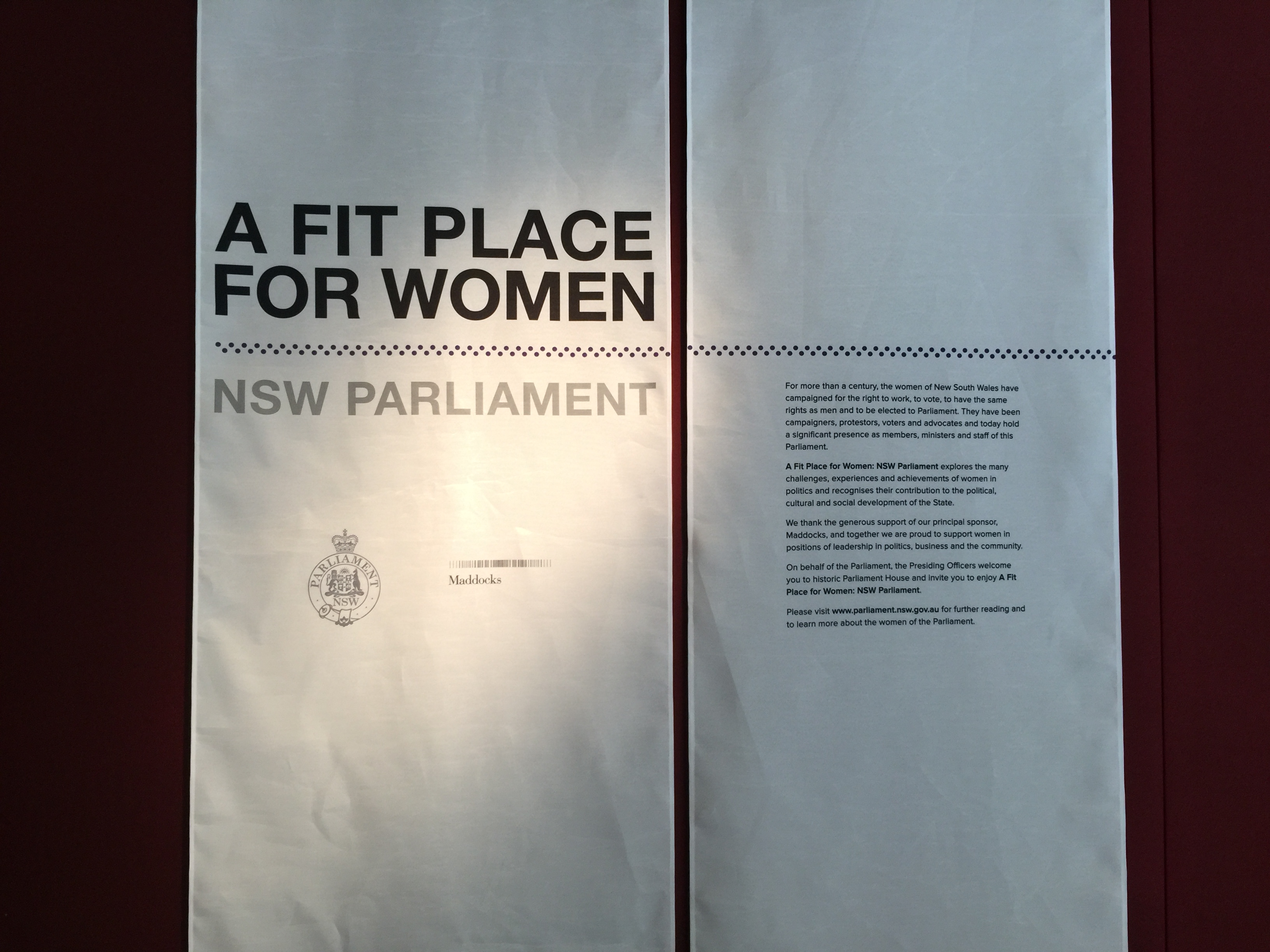
Happy International Women’s Day! To celebrate, here is a review of “A Fit Place for Women” currently on show at New South Wales Parliament House on Macquarie Street. I visited this exhibition quite some time ago. My memory of what was on display is a little hazy so thankfully I have pictures to help me remember!
The aim of the exhibition is to trace the role, history, and achievements of women in state politics. I have close to zero knowledge about New South Wales politics having been born and raised in Queensland. I am glad that my formal introduction to this topic was through this exhibition. On display is a collection of artefacts, artworks, photographs, rare documents, and newsreels each providing some insight into women in politics. The overall vibe I had of the exhibition was that it was trying to cover as much as possible without being overwhelming. At times, however, it did feel as though a history textbook had been printed on a panel.
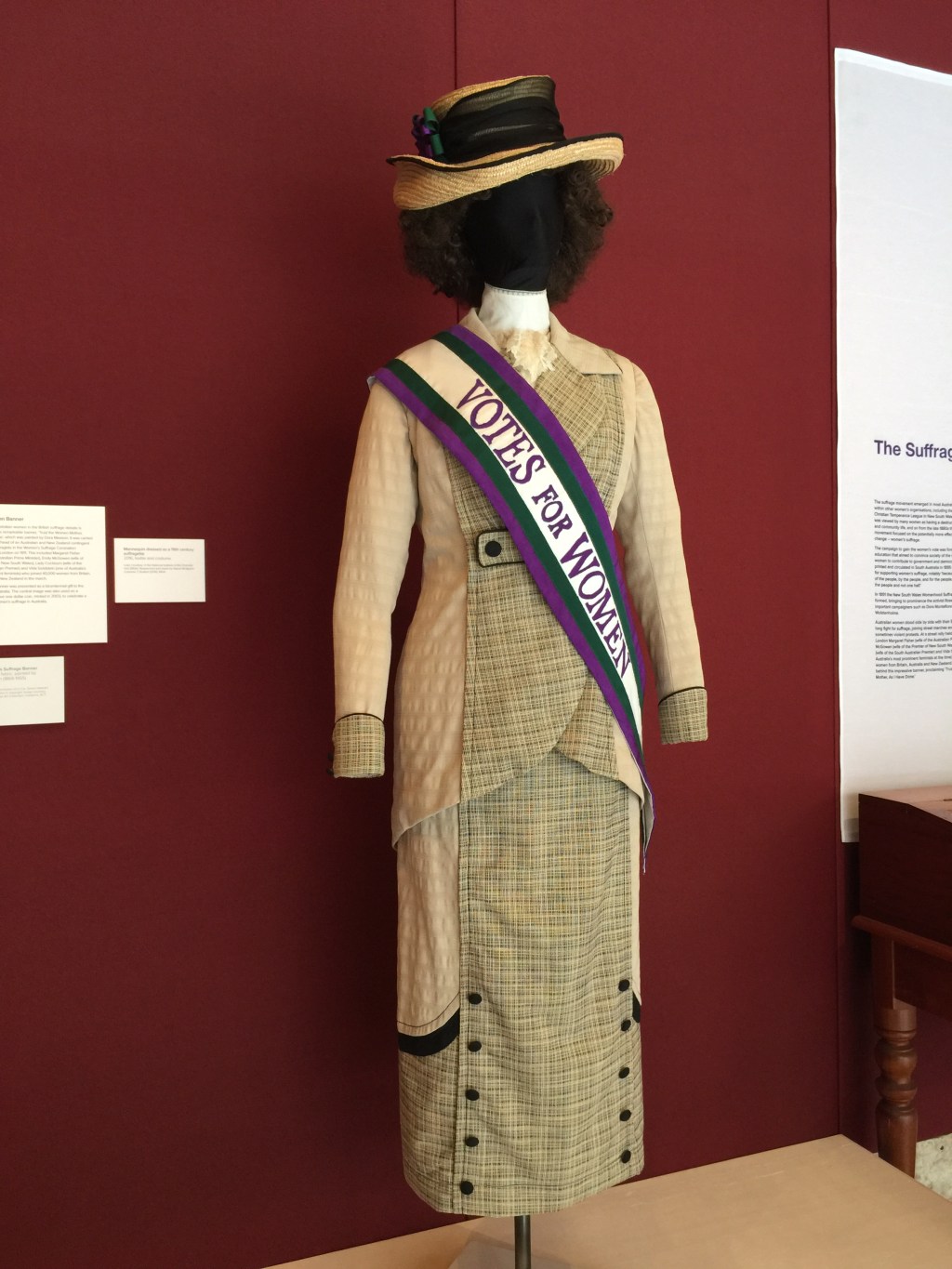
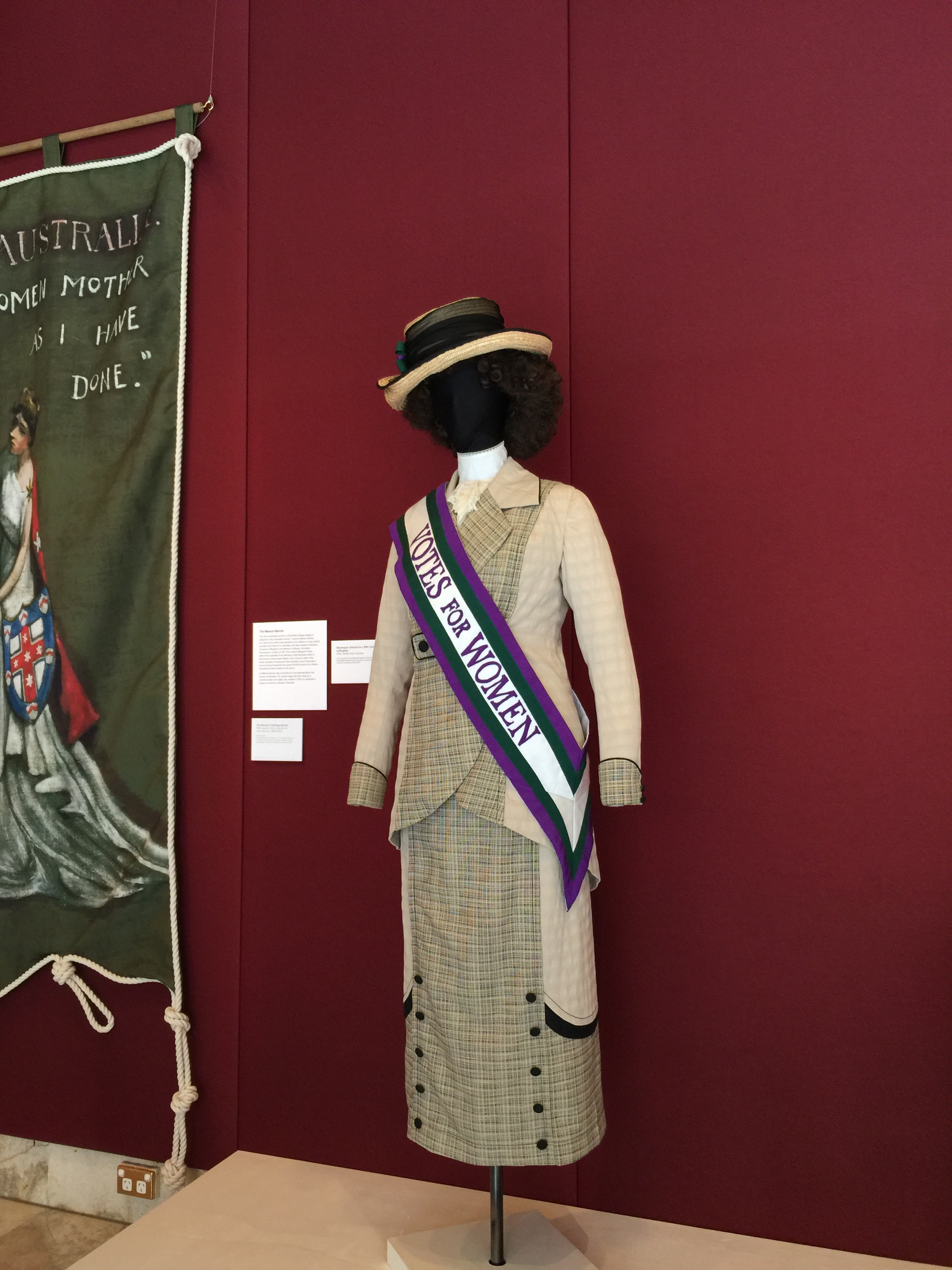
When you walk inside the front doors of Parliament House, it is literally the first thing you see. Exhibition panels, display cases, and textiles are located around the perimeter of the reception room. It’s great that the exhibition is so exposed. It would be difficult to visit Parliament House and not see at least some of its contents. One ‘object’ that stands out in particular is a mannequin dressed in suffragette garments and sash. As I walked around with my friend, Imogen, I frequently saw people coming in and out of Parliament stopping to see the mannequin and read the label.
A Fit Place for Women
I’m going to divide the rest of the blog post into what worked well and what didn’t work well. These points will include exhibition design, content, and presentation.
~ What Worked Well ~
Design
The interior of the Parliament House reception room is essentially a giant circle. The exhibition ran around the circumference of the room allowing visitors the opportunity to follow a prescribed path or jump between different sections. It was displayed chronologically, however, I felt as though you didn’t have to start reading at one end and finish at the other. I skipped particular sections in order to spend more time reading others.
Suffragette Content
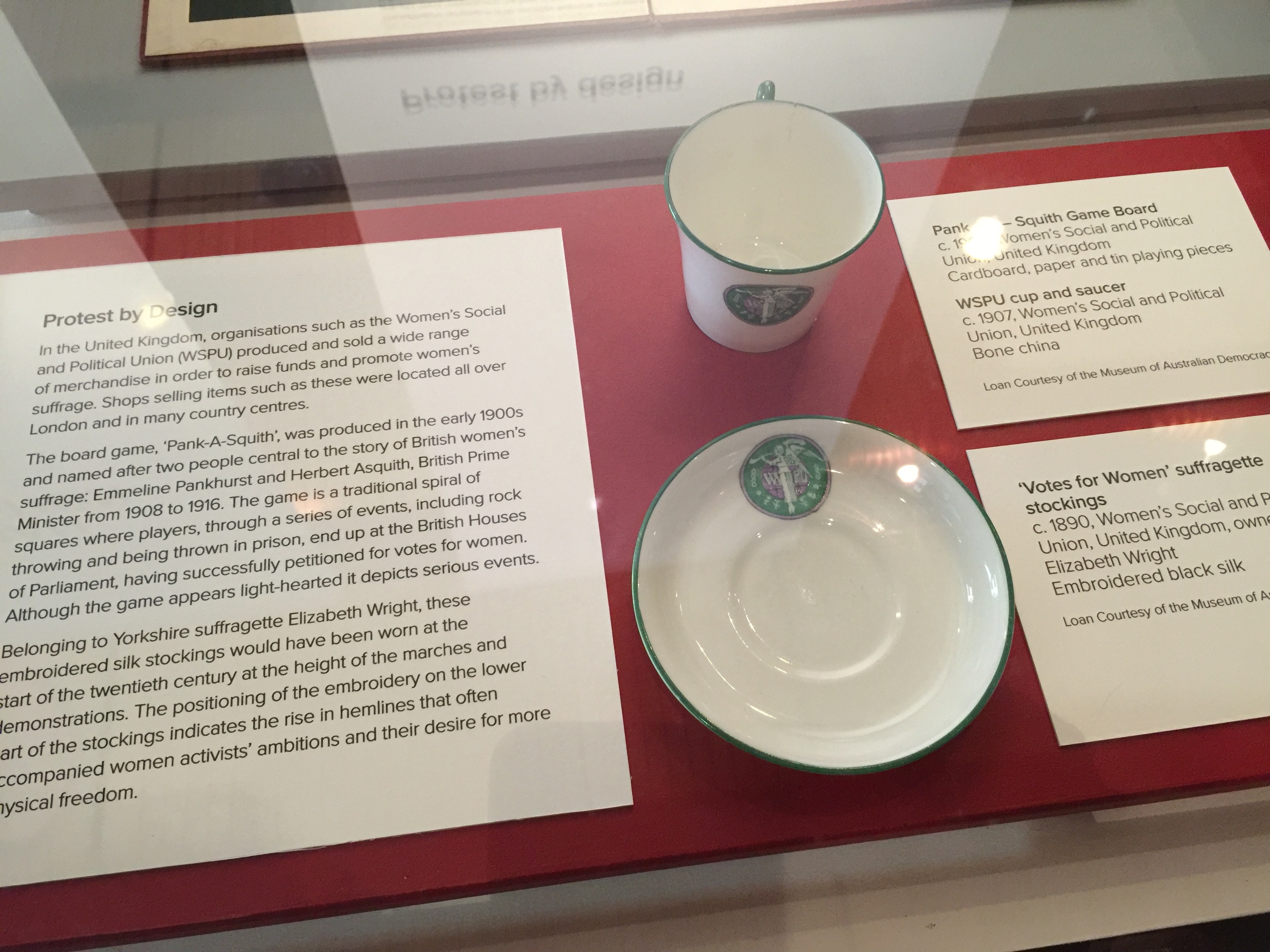
My favourite part of the exhibition was seeing the objects relating to the Australian and British Suffrage Movement. Apart from the beautiful sash and garments, there was a medium-sized display case at the beginning of the exhibition containing assorted objects. There was a pair of embroidered tights and a board game that was so fascinating. I had seen a similar cup and saucer in “Disobedient Objects” at the Powerhouse Museum last year. Although the accompanying thematic label was long, it was very interesting. It covered how merchandise was utilized by the movement in the United Kingdom to raise funds for the protests etc. These objects were positioned next to a thematic panel and documents from the movement in Australia. Seeing an original petition from 1900 was incredible. Displaying the movement in both England and Australia was, to me, powerful as it highlighted the wider historical and political context.
A Fit Place for WomenA Fit Place for WomenA Fit Place for WomenA Fit Place for Women
Biographies
This one is both a positive and a negative so brace yourself for the alternative perspective. What I did like about the biographies was that they were accompanied by photographs and had just the right amount of text on each individual. You could easily skim all of them picking up some interesting information as well as inspiring messages. In saying that, and as mentioned before, it did feel a bit textbook put together. It would have been nice to have some objects related to specific individuals on display.
~ What Did Not Work Well ~
Thematic Panels Printed on Cloth
All of the thematic panels and biographies were printed directly onto cloth that was then hung around the exhibition space. This looked fine, for the most part. When it came to reading the labels, however, for some reason it was very hard on my eyes. Not to mention it was difficult to see all of the words where the fabric had creased. I understand this is perhaps a good idea for a temporary exhibition as the cloth won’t have a long time to crinkle and look tatty. This is not the worst thing I’ve seen a thematic label printed on. Please can we stop printing onto mirrors? It is almost impossible to read! Anyway, this is just a nit-picky thing I picked up on concerning the aesthetics of the exhibition.
A Fit Place for Women
End Message
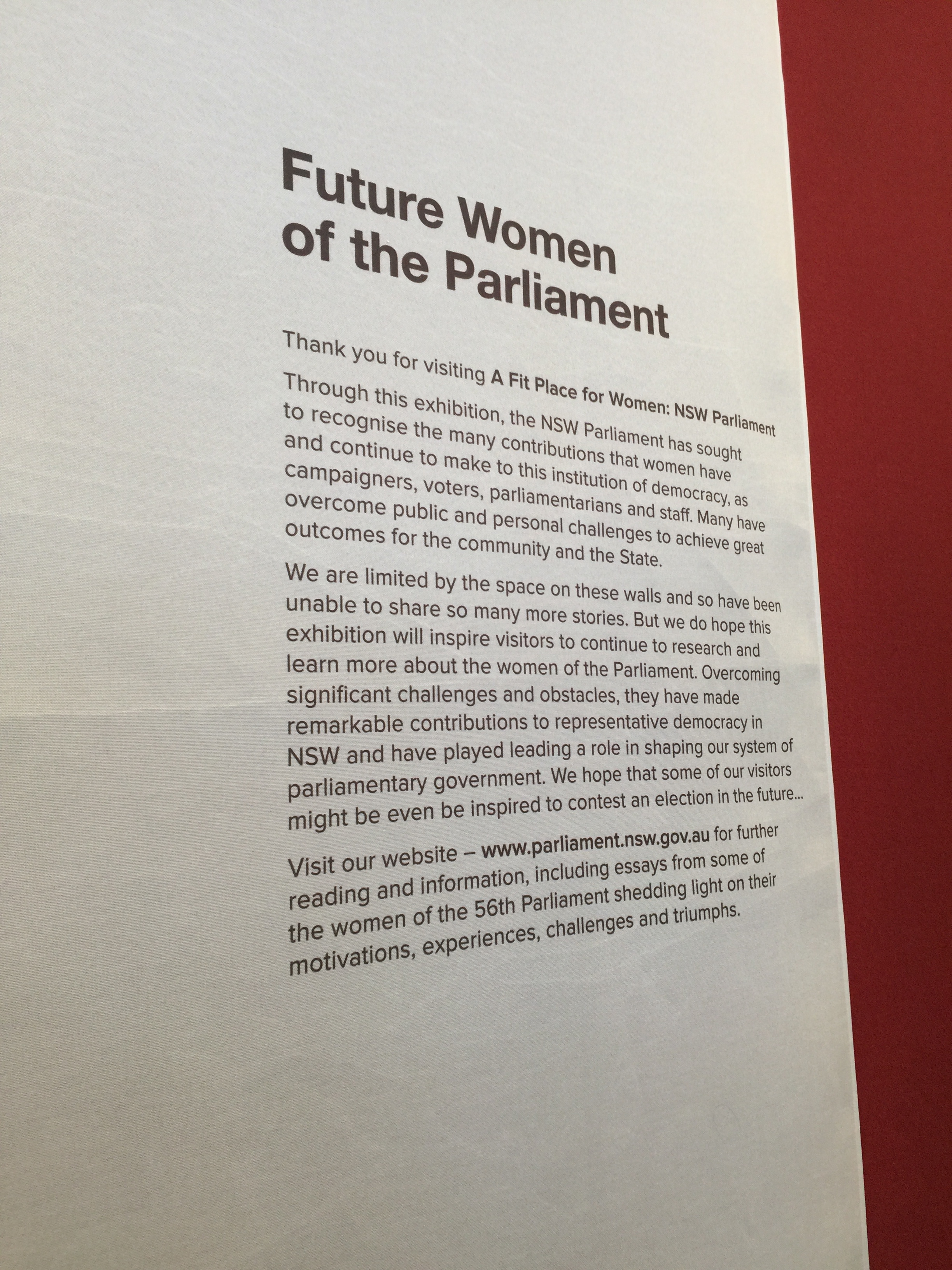
I like leaving exhibitions with a little bit of closure. If that cannot be provided by the exhibition itself, it’s nice to know I can continue my experience online or through other means. The exhibition finishes by stating there has been limited space so not all stories have been shared. Also, if you have been inspired you can now go on to research more. Whilst this is all lovely, nowhere does it say where you could begin your research. Not to mention raising questions of – whose story was left out and why? How were these particular stories selected? It was a bit of an airy way to leave such an important exhibition raising more questions than answers, and not in a good way.
A Fit Place for Women
Thank you as always for reading my ramblings!
If you would like to see the exhibition for yourself it is open until 28 April 2017. Entry is free, and doors are open from 9:00am – 5:00pm Monday to Friday, and from 9:00am-6:00pm on Wednesdays when Parliament is sitting.
WARNING: Aboriginal and Torres Strait Islander viewers are warned that the content on this page may contain images and references to deceased persons.
I am very excited to share with you a blog post from the wonderful Katharine Cousins! Enjoy reading about this incredibly powerful exhibition.
Hello I’m Katharine, a Museum Studies graduate and genealogy lover!
I had the pleasure of visiting Another Day in Paradise at Campbelltown Arts Centre early last month. It was one of those exhibitions that had quite a buzz surrounding it. After chatting to family and friends, I was encouraged to see it for myself. I decided to visit with a friend, one whom had limited experience with the arts but was still keen to visit due to her law background. I myself do not have an art history background but love to classify myself as an appreciator of art.
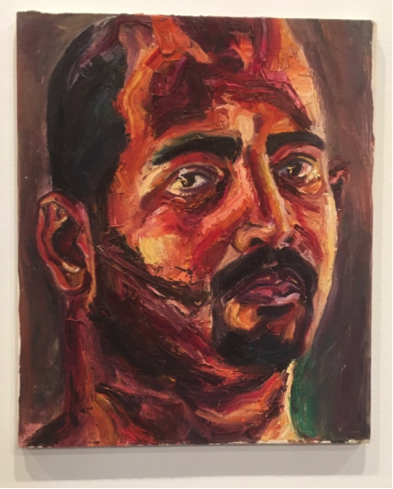
One of many self-portraits by Myuran Sukumaran
Exhibited in conjunction with the Sydney Festival, Another Day in Paradise was curated by Myuran Sukumaran’s mentor Ben Quilty and Director of the Arts Centre, Michael Dagostino. The exhibition focuses on the artistic works of Myuran Sukumaran, one of the nine convicted drug smugglers in Bali, Indonesia. Along with Andrew Chan, Myuran spent ten years or 3665 days in Kerobokan Prison, before his execution in April 2015. During this time, Sukumaran developed a passion for art, using his paintings as ‘a means of communicating with the world and [as] a redemptive practice’ (Ben Quilty, Curatorial Statement, Exhibition Catalogue 2017).
The exhibition was displayed in all but one room of the Arts Centre. Walking into the white walled foyer, you are immediately faced with a large scale self-portrait of Myuran. The image is not only used to guide you into the complex, but also to create impact on your arrival. It reminds visitors that not only is this exhibition about the art and the tragic story of the Bali 9, but it also represents the personal journey of the artist as he developed his art and dealt with the consequences of his past actions. Following from this lone portrait, each section of the exhibition devoted to Myuran’s work flows by periods of time. It begins with an explanation of the Bali 9, accompanied by portraits of each member and ends with his last work; an Indonesian flag.
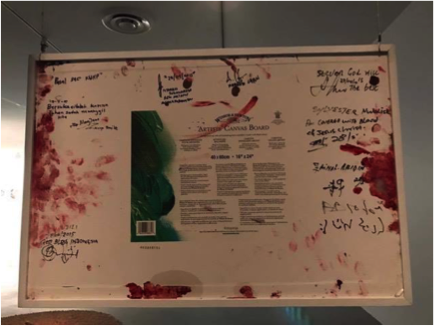
The last of Myuran’s works at 12.25 am, the Indonesian Flag (top). The back of the flag (bottom) features the nine signatures and messages of foreign and local prisoners, eight of whom were executed alongside himAK-47, 2015. Crosses, hearts and guns preoccupied Myuran as his death drew near
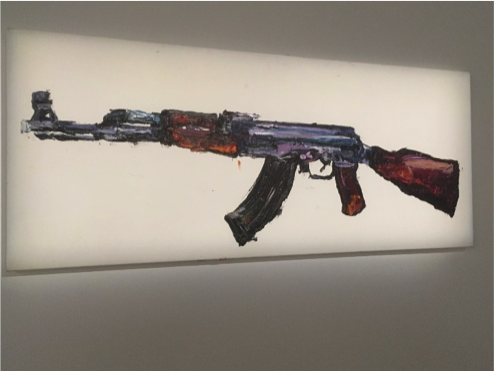
Each artwork is confronting in its own way – some portraits are smudged, some unfinished. On one wall hangs a sole painting, an AK-47 (Gun (Large) 2014), the rifle Myuran discovered was used for the executions.
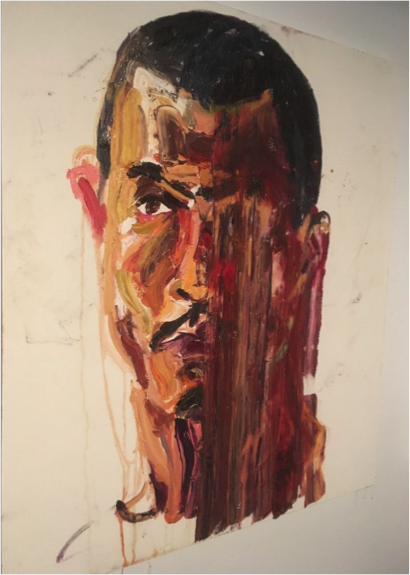
However, the artwork which affected me the most was one of the last displayed in the exhibition, the portrait of President Joko Widodo (Jokowi, 23 January 2015). The man who ultimately decided Myuran’s fate. The work is hung with the back of the painting facing the audience. This is to highlight Myuran’s simple but powerful message; ‘People can change’. It’s a message which has stayed with me.
According to his lawyer, Julian McMahon, Myuran created his best paintings after writing his message, ‘People Can Change’
In addition to Myuran’s work, five contemporary artists were chosen to look at the themes of justice, transformation and punishment. These works were dispersed evenly throughout the rooms. The artists had used a variety of forms and media to convey their messages. All artworks were interesting and provoking, but I want to focus on two different works.
Aside from Sukumaran’s work, I was particularly moved by the work of Taloi Havini, entitled Tsomi, wan bel (Sorry, win-win situation), 2017, which was presented alongside Sukumaran’s ‘Prison Life’ works. Havini introduces audiences to the idea of reconciliation and restorative justice, presenting the traditional ceremony of Wan bel (win-win situation) practiced in Northern Bougainville.
These ceremonies are pre-arranged social gatherings which bring offenders and victims together. They are watched over by an adjudicator, permitting perpetrators to publicly admit the wrong committed before proclaiming sorrow to the effected individual, group or community. Watching the ceremony, I was moved and confronted by the situation. Each individual looks directly down the camera and therefore at you. It was intimate. Although unable to understand what is being said, you are witness to every action, every emotion and every vulnerability of all involved. For many, like my friend, watching this exchange for almost ten minutes was too confronting and uncomfortable. We stayed for roughly half the presentation before she wished to move on with the exhibition. So we left the idea of restorative justice back with Sukumaran’s contrasting depiction of prison life and Western law and justice.
Whilst the additional contemporary works added layers of meaning to Myuran’s work, I believe there can be a divide between artistic vision and audience understanding. I do understand that meaning is mostly in the eye of the beholder and open to interpretation. However, the average audience is not always able to read the artworks through aesthetics. On entering the exhibition, I observed most visitors throughout the space did not carry or read the exhibition catalogue or handout. Like many galleries, the design and presented information is minimal and relies on the catalogue to convey necessary information about artists, titles and interpretation. The catalogue was particularly important for audiences, allowing them to gain insights into Quilty’s personal relationship with Sukumaran as well as the exhibition themes. For example, as a general observer, the implications of restorative justice within the ceremony in Tsomi cannot be understood.
This brings me to my friend with a law background. Walking through the exhibition, she was able to connect well with Sukumaran’s works. She spent long periods looking at Sukumaran’s portraiture and commented on various elements of his work. However, when the commissioned contemporary artworks were displayed, even with the trusty catalogue in hand, she was more likely to view the art with confusion.
One example of this confusion came when we viewed Abdul-Rahman Abdullah’s piece, The Days (2016). After gazing at the work for some time, I heard my friend say, ‘I don’t get it.’ Whilst I was able to interpret elements to the piece for her, I didn’t have an adequate answer for its overall meaning. The questions continued… ‘I don’t get the bird.’ ‘But why is the light there?’ We looked at the artist statement in the catalogue, the majority of which spoke of Rahman’s personal connection to Myuran and the Sukumaran’s. We continued to ponder. After some time, they eventually said, ‘I don’t think I’m going to understand, let’s forget it.’ It was only after we left that I was able to gain insight into the significance of the piece through other media. This highlighted to me a growing need to make art more accessible to those audiences outside of the visual arts world. As it is an exhibition connected with the Sydney Festival and one that wants to challenge public views on punishment, human rights and rehabilitation, it can’t just connect with artists or art lovers. If a ‘regular’ everyday viewer cannot fully understand an artwork’s intended meaning, then how are Art Centres, Galleries and Museums able to achieve their desire to challenge communities and individuals? Whilst I believe art can communicate messages, there needs to be more consideration regarding communication devices to attract new audiences… and get them to come back for more.
Unfinished self-portrait of Myuran during his last 72 hours, left resting on the exhibition floor to represent his unfinished story, 25 April 2015Example of Myuran’s smudged self-portraits, 2015
Aside from my criticism with communication and the contemporary art within the exhibition, overall I feel privileged to have gone. Not only did I get to see the art of a figure which dominated the news during a good portion of my life, but it also did personally affect me. Most particularly it challenged how I viewed the rehabilitation of prisoners and how our justice system operates, juggling the ideas of justice and punishment. This was the main aim of the exhibition, and so I can only encourage others to come out to the Campbelltown Arts Centre to visit. If nothing else, Myuran’s story and artistic work should be discussed in as many households as possible. The exhibition runs until March 26, don’t be the one who wished to go and didn’t.
This post was written by Katharine Cousins. Her email is: kcousins29@gmail.com.
A huge thank you to Katharine for her review. What an amazing exhibition tackling such difficult and emotional content. I hope to visit and see it for myself!
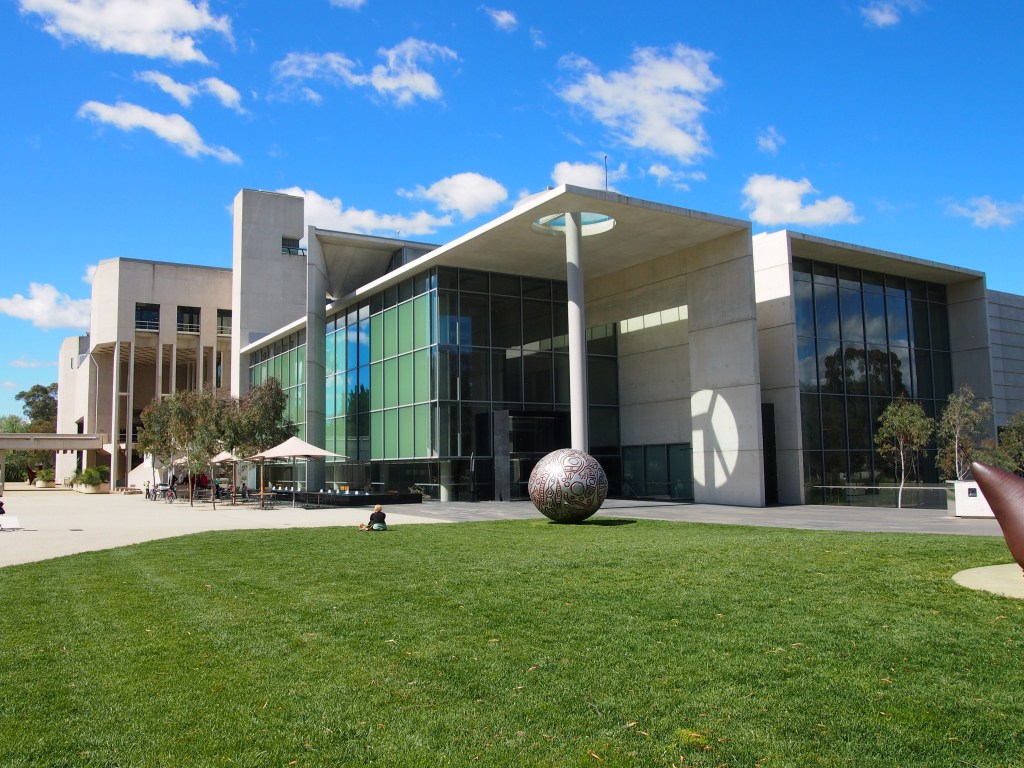
Hello lovely readers! Bec has kindly allowed me contribute another guest post, this time sharing my thoughts and feelings on the ‘Versailles: Treasures from the Palace’ exhibition currently showing at the National Gallery of Australia (NGA) in Canberra. I visited the exhibition earlier this month, and while I expected it to be very busy and crowded on a Saturday morning, the crowds were very manageable, and we were very grateful to be in the air-conditioned gallery on an incredibly hot day.
I was lucky enough to visit the Palace of Versailles in 2009 on a school trip to France, where we spent a day touring the palace and exploring and picnicking in the surrounding gardens. I was keen to compare what I remembered from this visit to how the palace was represented in the form of an exhibition. My main memories from my own visit as a 16-year-old were lots of gold, the sheer enormity of the palace itself and everything in it, and the gardens, so I was curious how these elements could be communicated in a gallery space, to an audience that may not have seen the ‘real thing’ themselves.
I was apprehensive that the curatorial approach of this exhibition would be to attempt to recreate the palace in the exhibition space, in terms of the aesthetic and scale, which in my opinion would have been an impossible and fruitless task. However, upon entering the exhibition space I was relieved to see that this was not the case. The exhibition really did include the ‘treasures’ of Versailles, in that it was a display of a hugely eclectic mix of all different kinds of objects from the palace. These ranged from gold gilt gates and fences, statues and sculptures, artworks, tapestries, crockery, works on paper and furniture.
Seeing these objects in the gallery space really made them stand out in terms of the sheer size needed to fill the large spaces at the palace, which gave a great indication of the enormous scale of the place that was being represented. One of my favourite objects for this reason were the woven tapestry wall hangings and rugs. They were absolutely enormous and incredibly detailed. I was surprised to see that these pieces were in excellent condition (most were made in the 16 and 1700’s). I learnt that this was because the king’s that reigned from Versailles would commission vast numbers to be created (the rug pictured was one of 93 made at the request of King Louis XIV), however they were never actually used, and were kept in storage.
While I noticed other visitors to the exhibition were also in visible awe of the scale of the objects, which reflected the size of the palace itself, I was surprised to see how many visitors stopped to view the numerous screens displaying slideshows of images from the palace. Despite all the incredible objects on display, the digital images definitely received the most viewing time from most visitors which I found very interesting.
Despite all the huge tapestries, paintings and pieces of furniture on display, it was actually a small room of works on paper that I enjoyed the most, because for me they best communicated what life was like at Versailles, and the extravagance and enormity it is synonymous with. One small room of the exhibition space (which, unfortunately was the one room visitors didn’t actually have to walk through, so it may have been missed by many) contained about two dozen framed works on paper, mainly etchings and hand drawings. These works all depicted the ‘divertissements’ at Versailles, the extravagant, incredibly over the top celebrations hosted by the King. While I was familiar with these events and they have been depicted in films, these etchings made to commemorate them represented them to me in a new and meaningful way, and truly made me understand their scale.
The etching pictured here by Jean Lepautre (1676, the photo really does not do it justice) shows the fifth day of a two-month long celebration at Versailles, which culminated in an enormous fireworks display. I was really glad these works were included in the exhibition, as for me they were the one element that portrayed Versailles in a new light.
To end on something pretty, I can’t help but mention one of the most stunning objects in the exhibition – Marie Antoinette’s harp, made in 1775 by Jean-Henri Nadermann. This was truly stunning and caught my eye from across the room. It was gilded all over and covered with glittering glass and pearl beads. I have no idea if she was much of a harp player or if it was ever actually used, but it was stunning none the less – I can’t imagine living in a palace where every object was as extravagant as this one.
As is always the case with exhibitions of this kind, visitors must leave via the gift shop filled with tie-in products to purchase. I decided that this iteration of the giftshop must have been an in-joke from the curators and organisers, as it was filled with the kind of frivolous objects the residents of Versailles (with more money than they knew what to do with) would have purchased and never used. The objects in this gift shop were some of the most tenuously connected to the exhibition I’ve ever seen, however any exhibition sponsored by Moet and Chandon and Dom Perignon with a giftshop filled with champagne can be taken with a grain of salt and a smile.
The exhibition is showing exclusively at the National Gallery of Canberra until the 17th of April 2017.
I love tours of neighbourhoods that focus on the history and heritage of the area. I was browsing through What’s On Sydney when I came across heritage walking tours of Chippendale – a suburb very close to Sydney’s CBD. Whilst living in Newtown, I often walked through the suburb on my way to work. Seeing it through a heritage and history perspective, however, was refreshing and fascinating. I am going to share with you some of the stops on the tour and the accompanying information.
Stop 1: Kent Brewery
Back in the days, Chippendale was known as the location of the Kent Brewery. According to our guide, you could tell you were in Chippendale because of the smell. The area has undergone significant transformation since the closing of the brewery. If you are interested in the history of the brewery there is some great research going on here. In Kensington street, you can still see some of the original worker’s cottages from 1847 that were used to house brewery employees. Today, they are galleries and small restaurants.
Kent Brewery
Stop 2: Kent Brewery Boiler House
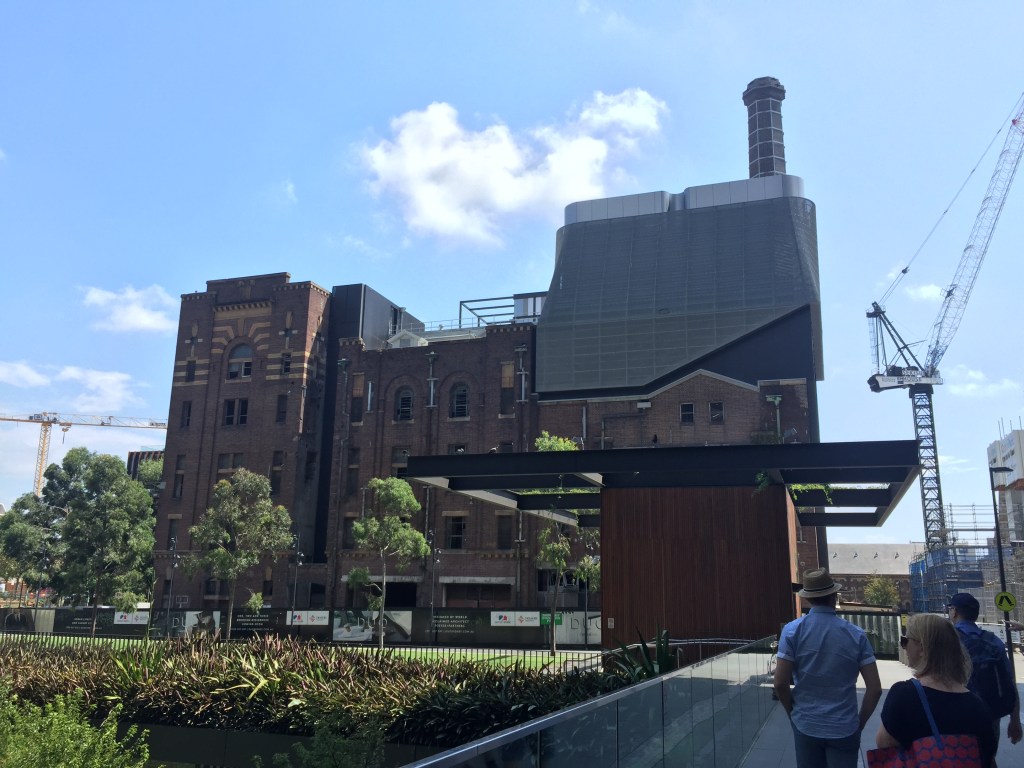
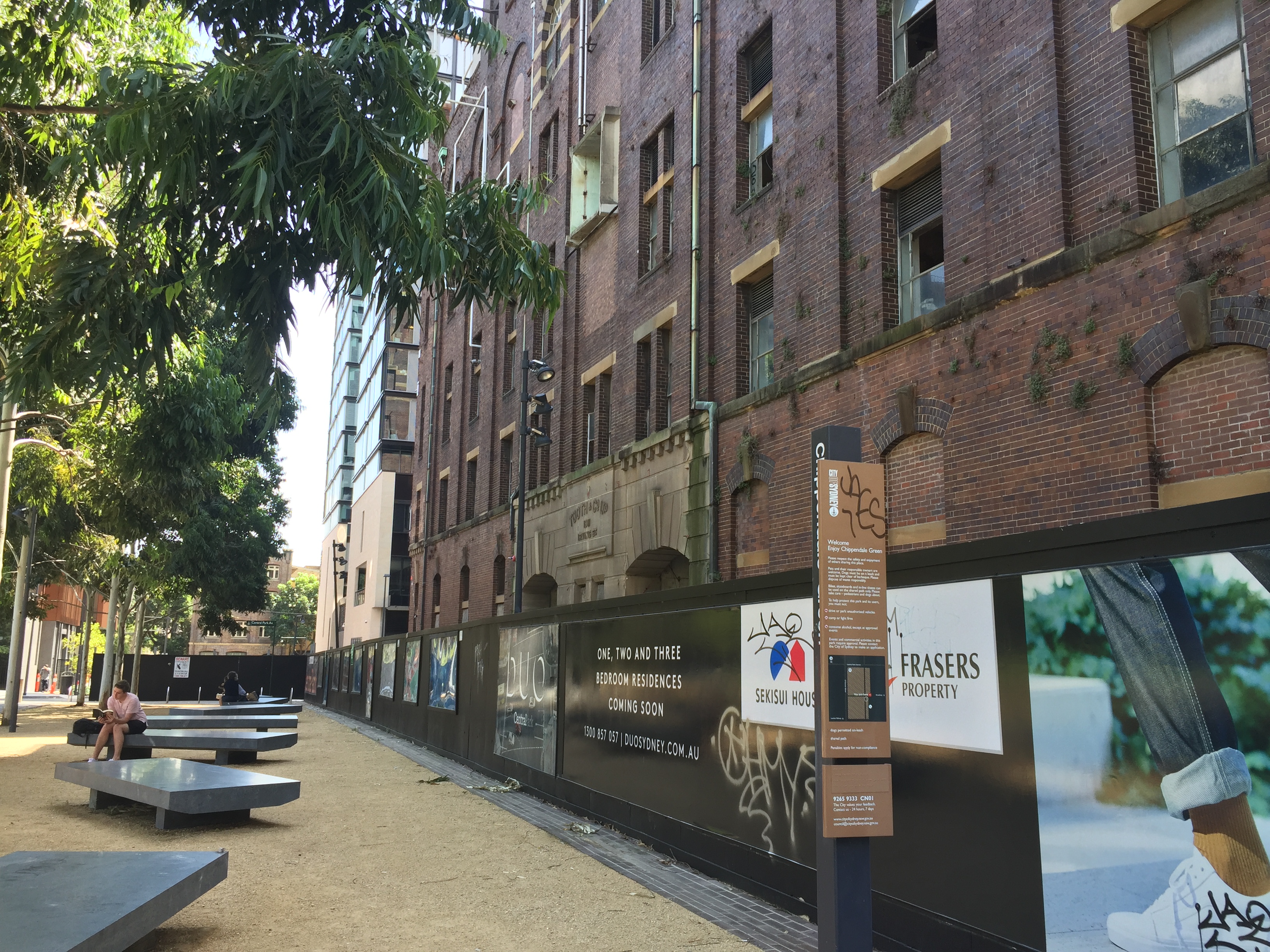
Whenever I catch the bus into the city I see this building. I’ve never actually bothered to learn what it was. It’s amazing how a heritage tour can open your eyes to what’s basically right in front of you. This was the original boiler house of the brewery that has been transformed into a tri-generation powerhouse. The aim is for this building to generate enough power for all of Chippendale. As the building is Heritage Listed, the original business sign over the doorway remains.
Kent BreweryKent Brewery
Stop 3: Strickland Park
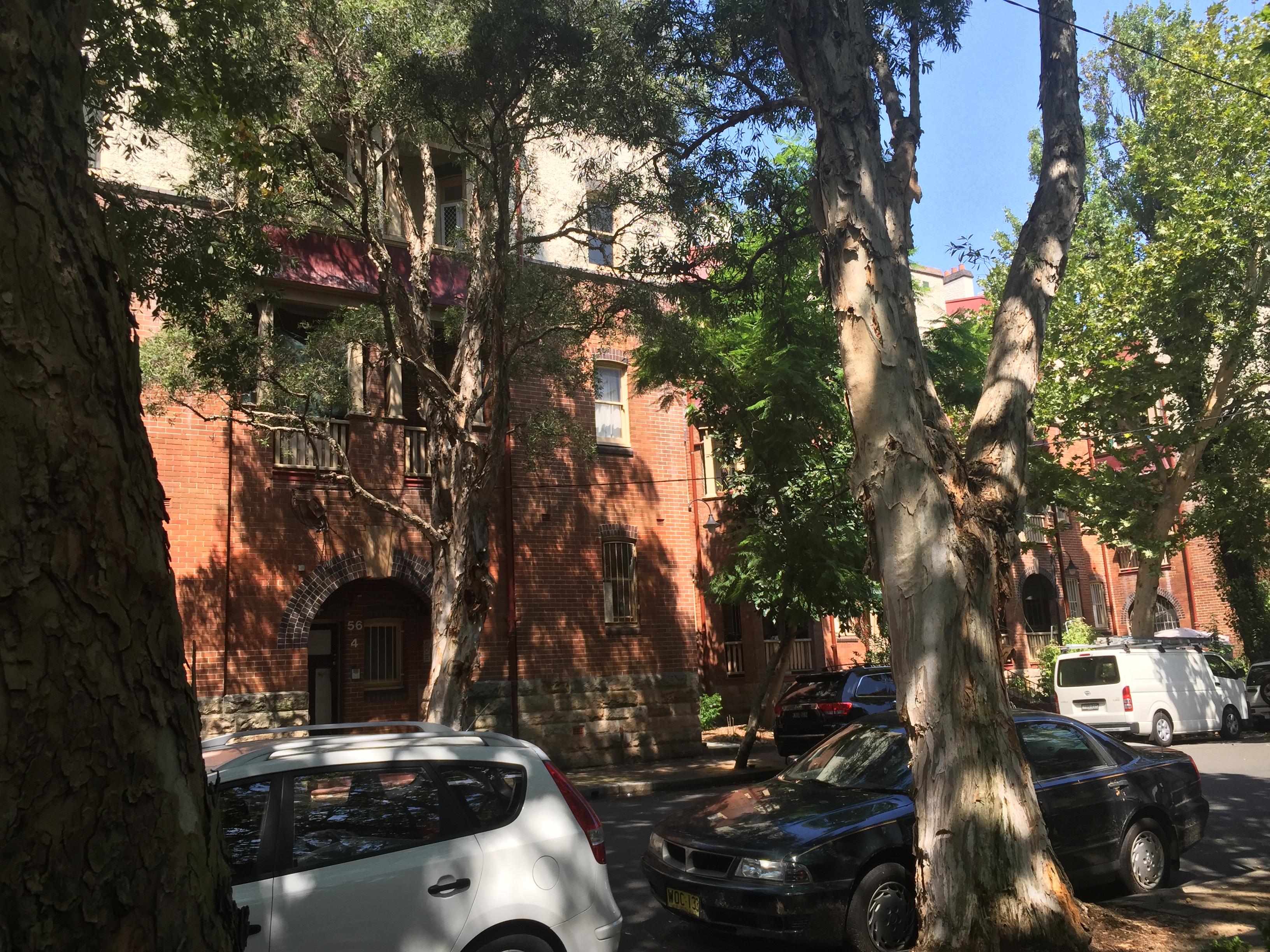
Opposite Strickland park are some of Sydney’s oldest apartment buildings. At only three stories high it’s amazing to think that these were dubbed apartment buildings. Considering today Sydney has some pretty intense skyscraper apartment blocks! Anyway these were built in 1912 and were utilised as public housing. They still function as public housing today.
Strickland ParkStrickland Park
Stop 4: Peace Park
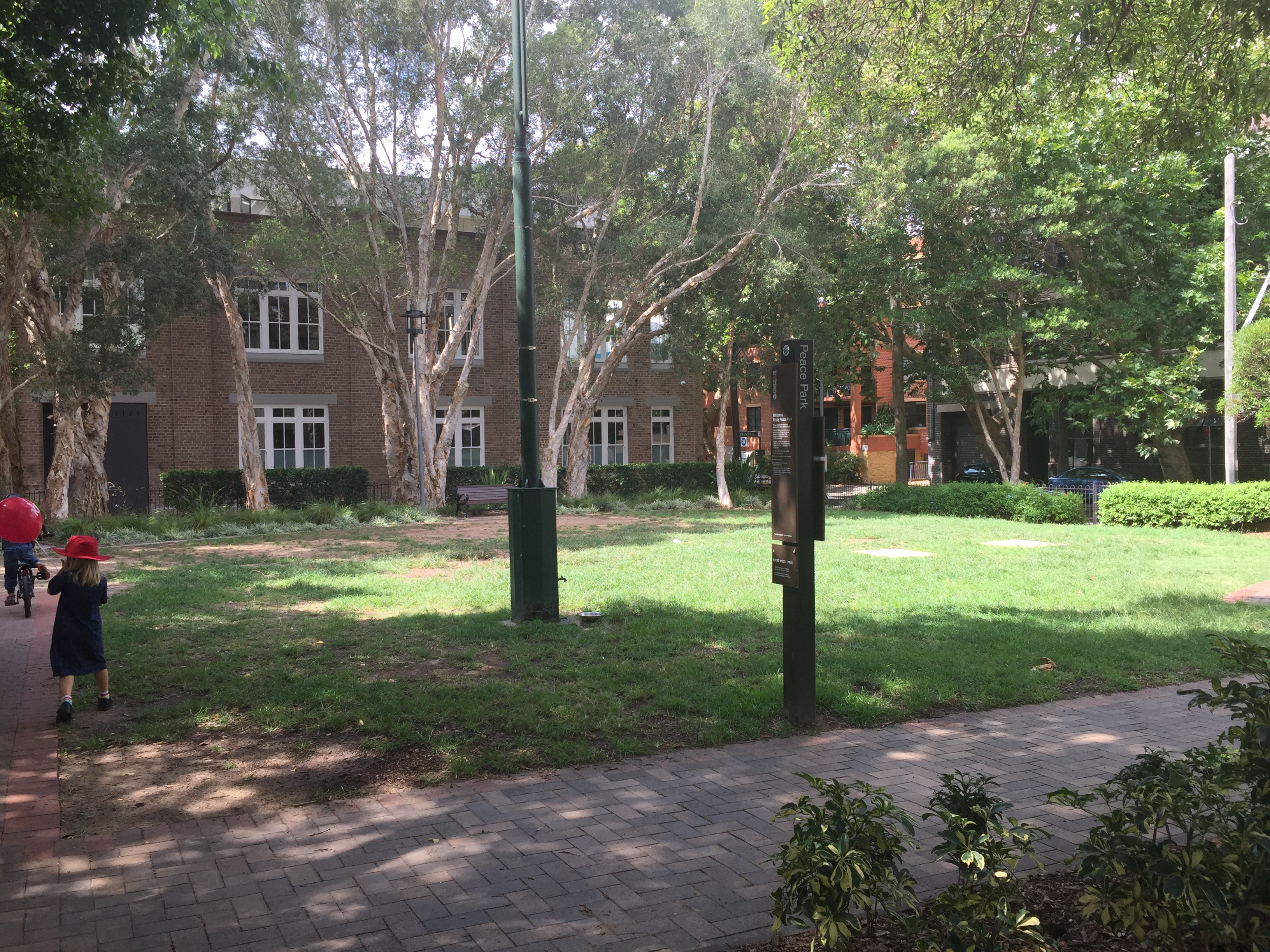
Around 1926, this park functioned as Darling Nursery, an important forerunner to the Botanic Gardens. Because of the natural water supply from Blackwattle Bay, ventures such as these could be naturally supported. It would have been wonderful to see different types of plants on display here in the early 20th century.
Peace Park
Stop 5: Blackfriars school
Opening in 1883, Blackfriars was the first school in Chippendale. It was also where the Montessori Method was championed first in Sydney. Basically this method acknowledges that children learn differently and you should allow each child to learn at their own pace. Considered absolutely revolutionary, children, for example, would not sit at desks but on the floor and on pillows.
Blackfriars school
Stop 6: Brisbane Distillery
Before beer there was gin. A true start to a modern romance novel. The gin distillery operated on the grounds of Blackfriars school before it was transformed into a school. It was founded by ex-convict Robert “the Large” Cooper.
Chippendale most certainly has an interesting past that really came to life on this tour. Our guide was clearly passionate which made an hour and a half fly by. It was a large group which did make it difficult to hear the guide at times. Just means you have to keep up if you want to hear all the information! If would you like to go on the tour you can find the link here. They don’t run that often so make sure you plan ahead!
The following blog post will contain two perspectives. I am going to start the post reflecting on the Snugglepot and Cuddlepie anniversary display and the talk at the State Library of New South Wales. Imogen will then write her thoughts on the talk.
Me:
To celebrate the centenary of May Gibbs Gum-Nut babies, the State Library of New South Wales has curated a small display of sketches and organized a lunch time talk with Robert Holden. For those of you reading who did not grow up in Australia, the Gum-Nut babies by May Gibbs is a series of children’s books that follow the adventures of cute little gum-nut (Eucalyptus nuts) characters. They are well-known and well-loved in Australia.
May Gibbs Gum-Nut Babies
I remember the books from when I was little so I was very excited to see some of the early sketches. I am hesitant in calling it an exhibition considering it was small and consisted of artworks hung along a corridor. There wasn’t really an atmosphere created. The introductory panel is great in providing a summary of the gum-nut babies and Gibbs’ life. They are not original sketches which raises very interesting debates over how authentic is the display.
I really liked this one sketch of a dog with gum-nut babies dancing around. The display had four of these prints showing how the images developed from black and white sketches to colour prints. Besides from the gum-nut babies, Gibbs was very active in the Suffragette movement in England. A copy of her sketch for The Common Cause journal is also on display.
Suffragette
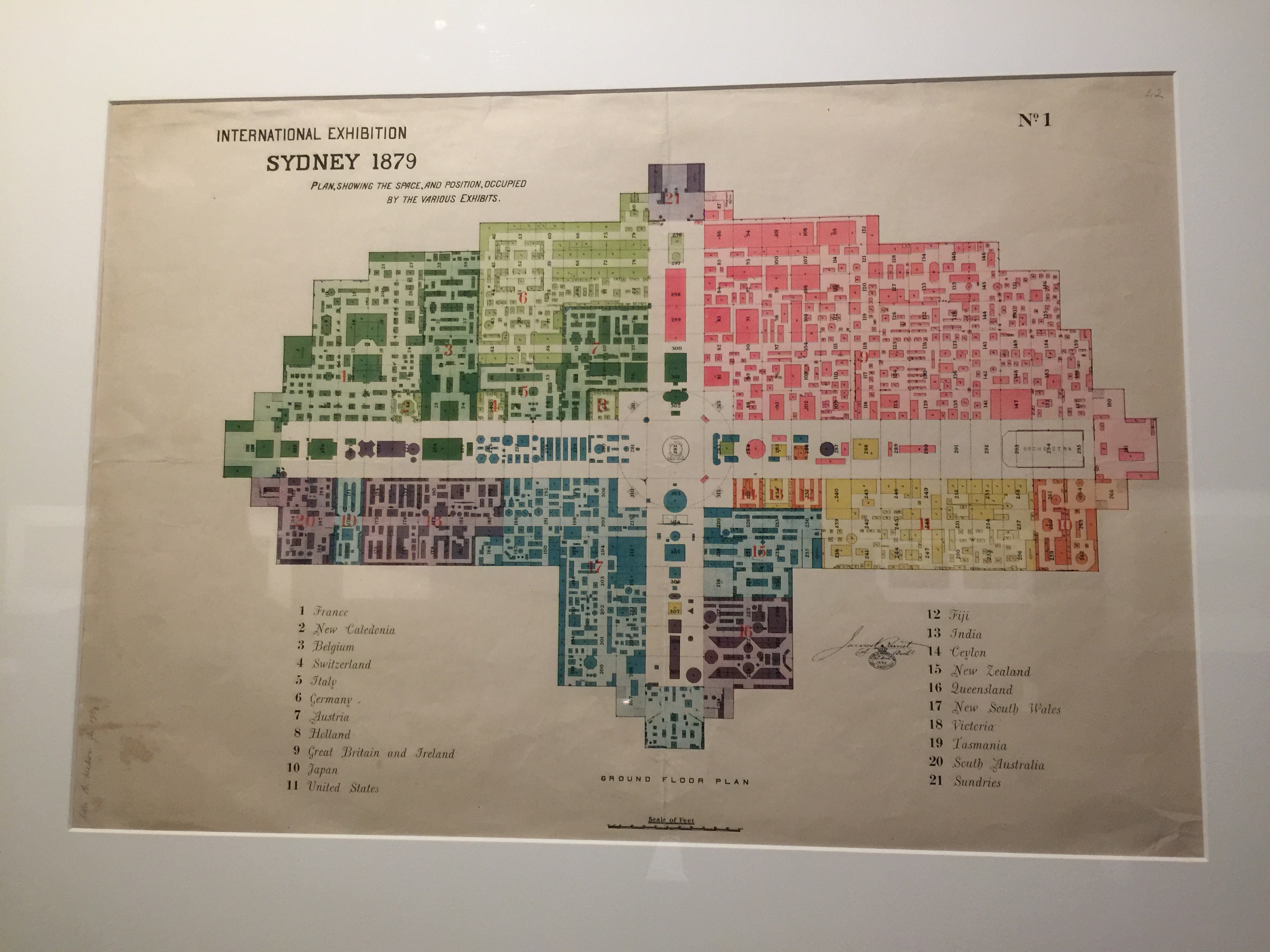
What I really encourage visitors to do is walk through to the Amaze Gallery. Right now, there is a great collection of ephemera on display relating to the 1879 International Exhibition in Sydney. There is a great map showing the ground of the exhibition and the various stall holders. The books reminded me of the ones I worked with at the Queensland Parliament Library!
International Exhibition in Sydney
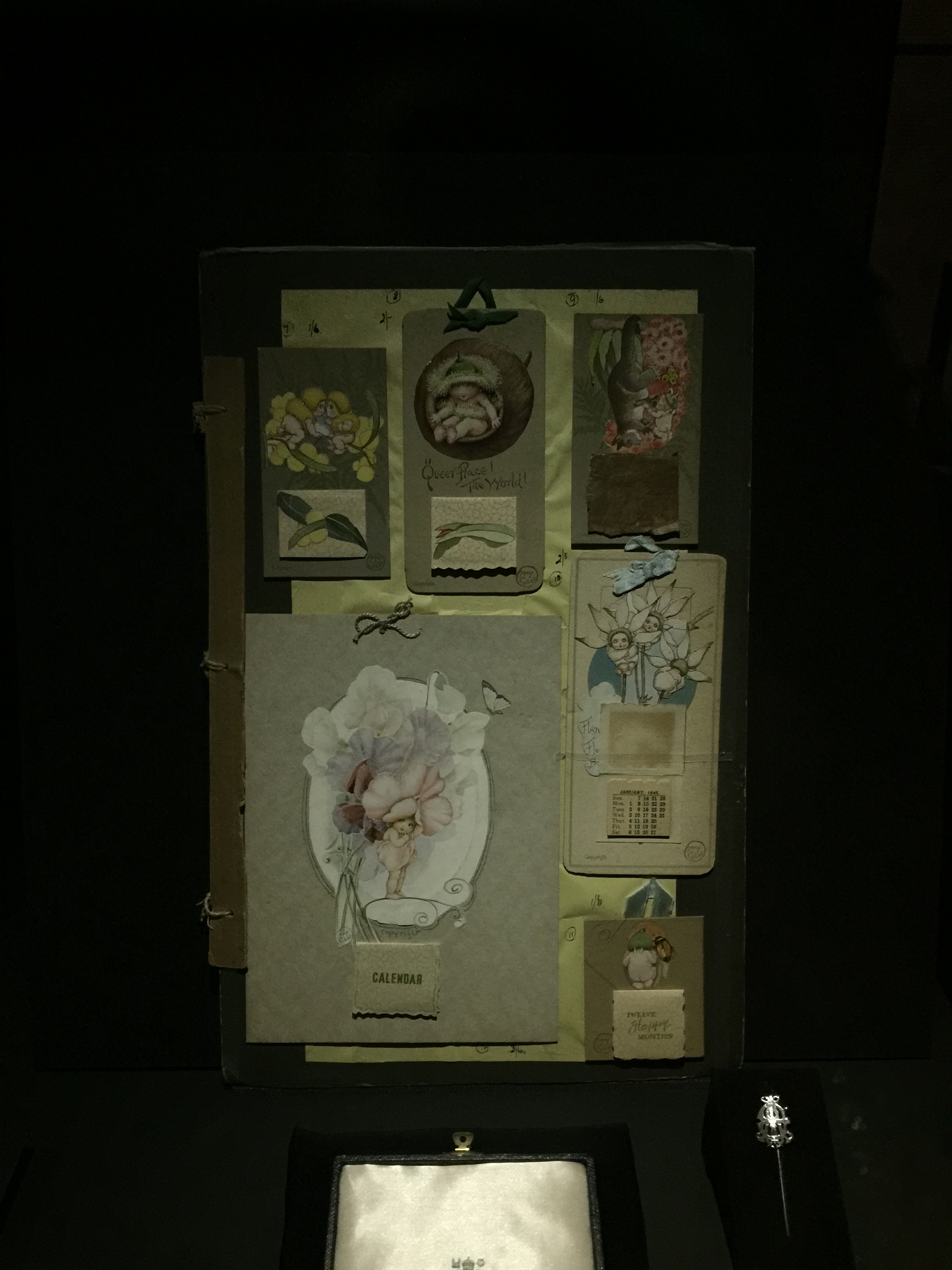
At the back of the Amaze Gallery are some original works by May Gibbs. There is a cute collection of gum-nut babies calendars and some original prints. I enjoyed seeing these more than the prints in the commemorative display.
Gum-Nut Babies Calendars
After seeing these displays I was ready for the lunch time talk. Robert Holden is an expert on Australian children’s books. He presented on his work with the Mitchell Library (within the State Library of New South Wales) and what he uncovered in their collection. This included a lot of May Gibbs postcards that were sent to soldiers fighting during World War I. According to his research, they were very treasured objects, often kept with personal letters and diaries.
It was also interesting to hear the contrast between May Gibbs and Norman Lindsay (who wrote the Magic Pudding). Especially considering Lindsay’s work was published in many different countries whereas Gibbs only really found an audience in Australia. It would be great to hold another talk on May Gibbs focusing on her time with the Suffragette Movement. Understandably, Holden ran out of time to cover even just one her books let alone more of her life! It just seems like a very interesting period of her life that would challenge this image of her solely as a children’s author.
Imogen is virtually an expert herself on May Gibbs so I cannot wait to read her thoughts on the talk.
Celebrating 100 Years
Imogen:
While I’m not exactly an expert, I’m certainly a big fan and great admirer of May Gibbs and her work. I, like most Australians, grew up with her books and have loved them and their uniquely Australian aesthetic and narratives since then. I developed a greater appreciation for Gibbs’ work after I completed a class during the Museum and Heritage Masters program called ‘Backstage at the Mitchell Library’.
In this class, the students were given a truly behind the scenes experience of the Mitchell Library (a part of the State Library of NSW, and more of an archive than a library in the traditional sense) as we were able to choose any object from the library’s collection to research, study and write about over the course of the semester. I chose the original manuscript works of May Gibbs, which are stored in the Mitchell Library’s archive, on behalf of the Northcott Society and the Cerebral Palsy Alliance – the two charities that have owned the copyright to her work since her death.
Throughout this process I learnt so much about Gibbs herself and her work, as well as gaining an understanding of the way she is represented in and understood by society. One of the most fascinating aspects of my research was discovering May Gibbs’ involvement in the suffragette movement in England, and how she used her artistic skills to engage in this social upheaval. As Bec mentioned this was discussed in the talk by Robert Holden, however I can’t help but be dismayed by how often this important and political aspect of her life is so often ignored and downplayed in both critical discussions of her work and in the formation of a perception and representation of the author/artist.
I have encountered this systematic underplaying of the political aspect of her life many times, and am always surprised by the traction it receives. During the audience Q and A at the talk, one audience member announced that Gibbs was categorically A-political, and that her connection to movements such as the suffragettes was purely to document facts, rather than to choose a political side or have a voice of her own. I can’t help but disagree with this view, as in my opinion any woman choosing to work for pro-suffrage publications and involving herself in war efforts and public heath campaigns (Gibbs did all of the above and more) is truly interested and engaged in social and political events. To argue that she is A-political seems to suggest she had no opinions or motivations of her own, other than writing children’s stories.
Despite my own research, I learnt more still about May Gibbs at the library talk, which was presented in such a fascinating and engaging way. It is always a pleasure to hear someone discuss their passion in an engaging, articulate and knowledgable way. For anyone who is interested in this topic and missed the talk, I would strongly encourage you to find a copy of Robert Holden’s commissioned biography of Gibbs ‘More Than a Fairytale’ – it is the foremost text available on the topic and includes some beautiful copies of her original illustrations.
Thanks to Bec for coming with me to the talk!
This post was co-written by Imogen Kennard-King. Her email is: Imogenkennard.king@gmail.com.
For Valentine’s Day last year, I created a list of museums I love. This year, I’m going to focus on the museums I’d love to visit. My list is long…very long. I have painstakingly selected six that I want to share. Six may sound like a random number because it is a random number. I originally planned on narrowing my selection down to five, but, that proved an impossible task. Here is my shortlist arranged in no particular order!
Mütter Museum – Philadelphia
The Mütter Museum showcases an array of anatomical specimens, models, and medical instruments. It is essentially one huge curiosity cabinet. Ever since I became interested in medical history this museum has been at the top of my must-visit list. I have researched the museum for countless essays and have spent literally hours trawling through its website, online exhibitions, and Youtube channel.
Click here for a great little online exhibition of radiation in the United States. As you can see, quite a few of the exhibitions are very specific to my interests. I hope to visit this museum as soon as possible.
Museum of Broken Relationships – Los Angeles & Croatia
A chain of museums that examine how we experience love and loss. I am fascinated by the types of objects that this museum contains and its acquisition policies. It would be very interesting to see what objects they refuse!
It is an unusual museum that actually tackles a pretty difficult subject matter. I see it as emotional heritage in a museum space. It is taking something incredibly personal and sharing it with a wide audience. For somem this could be very cathartic. For others, it would probably be their worst nightmare.
The National Museum of New Zealand consists of six floors that explore the history and development of the country. I have heard very positive reviews of the museum especially regarding its integration of Indigenous and non-Indigenous content.
They have such a large percentage of their collection searchable online. Browsing through their object list has made me very excited to visit.
Smithsonian National Air and Space Museum – Washington D.C.
When we visited Washington D.C. in 2013 there was so much to do in so little time. The Air and Space Museum was not at the top of my list. After visiting the Kennedy Space Centre and working in the Powerhouse Museum, however, I have developed a new appreciation for these types of objects and stories.
Needless to say, I am very keen to return to Washington D.C. and visit this museum!
United States Holocaust Memorial Museum – Washington D.C.
Another museum we did not have time to see in Washington was the United States Holocaust Memorial Museum. Having studied genocide memorials and museums this year, I am hoping to visit and see how they interpret this history.
I am, therefore, interested in visiting to see their exhibition design and how they have decided to display their objects. I am also interested to see how they have integrated other genocides into their narrative.
The Henry Ford Museum
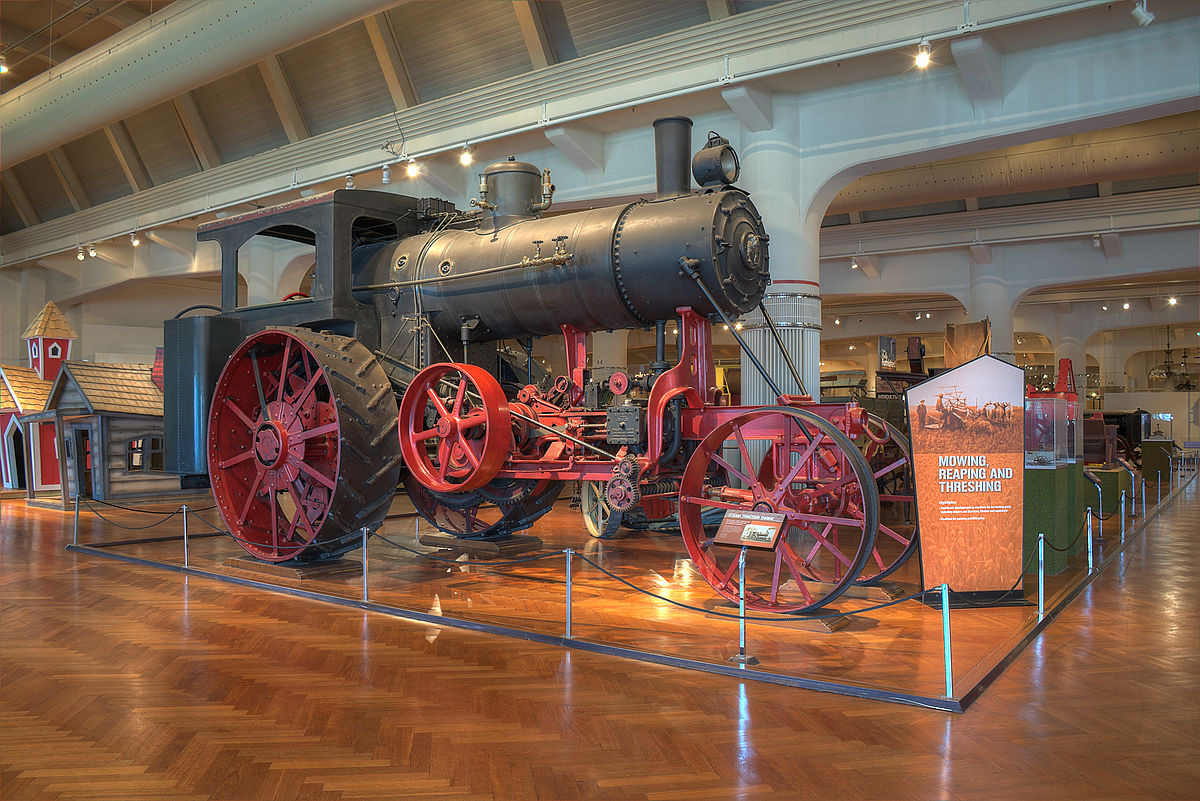
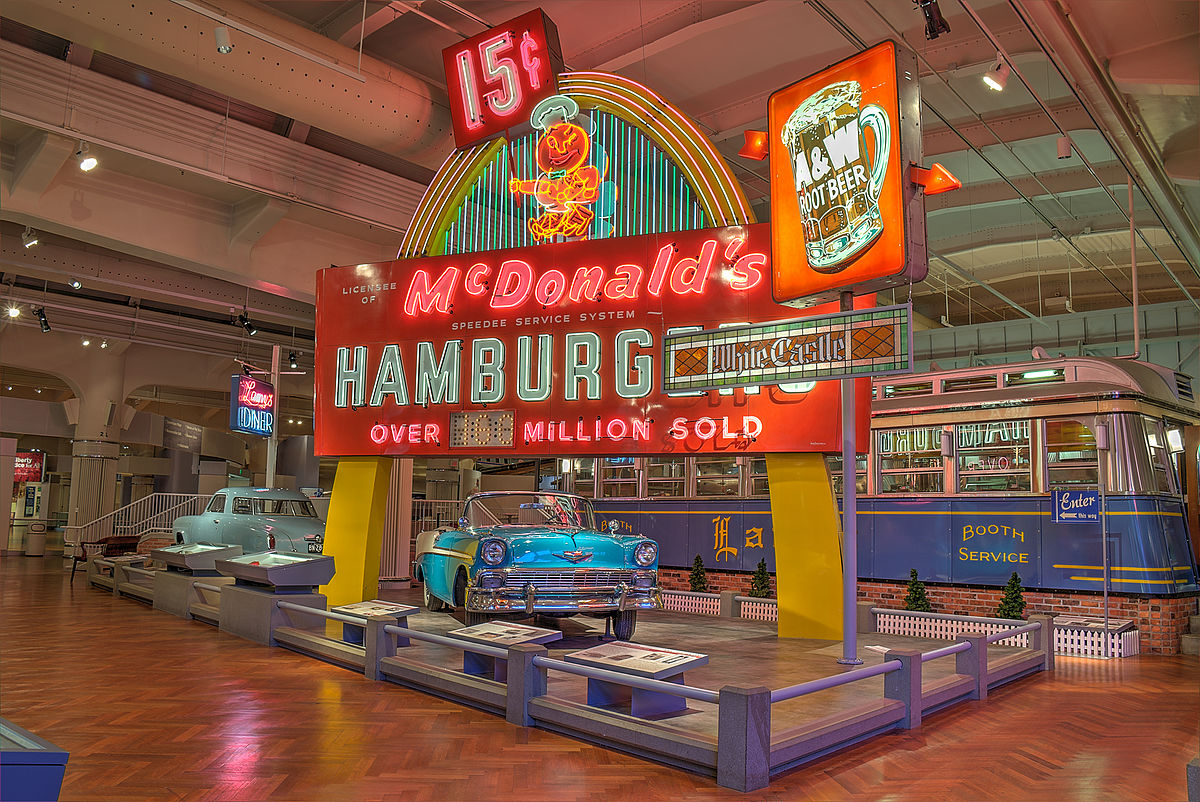
There are so many objects I want to see in this museum. Mainly because of the stories they can tell whilst adding an authentic element. For example, the Lincoln Continental from President Kennedy’s Assassination and the bus Rosa Parks refused to give up her seat on are just two of the fascinating objects on display.
Basically, it is a museum of large objects each of which can shed light on a significant event in the history of the United States.
I cannot wait to hopefully see some of these museums in the next few years. It will be interesting to reflect on this list next year and see how much it has changed. Better yet, it would be amazing to actually visit a couple of the museums between now and then. Tick them off the list! We will see what 2017 has in store.
From the 18th of April until the 21st of May, the Harry Daly Museum will be participating in the Australian Heritage Festival! Although a couple of months away, I am already getting everything prepared. This will be the first in a series of blog posts leading up to the event. I hope to share with you some behind-the-scenes finds from the museum and go through how, exactly, a tour can be pieced together. This first post will look at what exactly is the Australian Heritage Festival and how the museum has decided to participate.
Background
Since 1980,the National Trust has held the Australian Heritage Festival to celebrate heritage and culture. Each year, thousands of volunteers and institutions band together to support, promote, and enjoy the wonderful heritage on offer. This year, the festival is promising to be bigger and better than ever.
It is an incredible opportunity for museums, heritage places, and other cultural institutions to really showcase the amazing work they do within their local communities. Also, it will expose the larger networks that these places can feed into. I am very excited for the Harry Daly Museum to be part of this national movement.
Each year, the festival has a specific theme. For 2017, the selected theme is “Having a Voice”. Organizers are encouraging institutions and communities to tell their stories through many voices, hence, many perspectives. It will be wonderful to see the variety of participating places and the interesting stories that will be at the forefront. A list of what’s on offer will soon be available in both digital and hard copy form.
On top of all this, the festival is hoping places will hold an event or do something special. For example, opening to the public if they don’t normally do so. With all this in mind, I had to decide how the Harry Daly Museum was going to participate and why.
Harry Daly Museum
Why we should participate was the easiest question to answer. Why not join other institutions around Australia and promote our heritage? Feeding into the theme for the year, it will also be the perfect time to share stories that emerge from a medical history perspective.
Harry Daly Museum Harry Daly Museum Harry Daly Museum
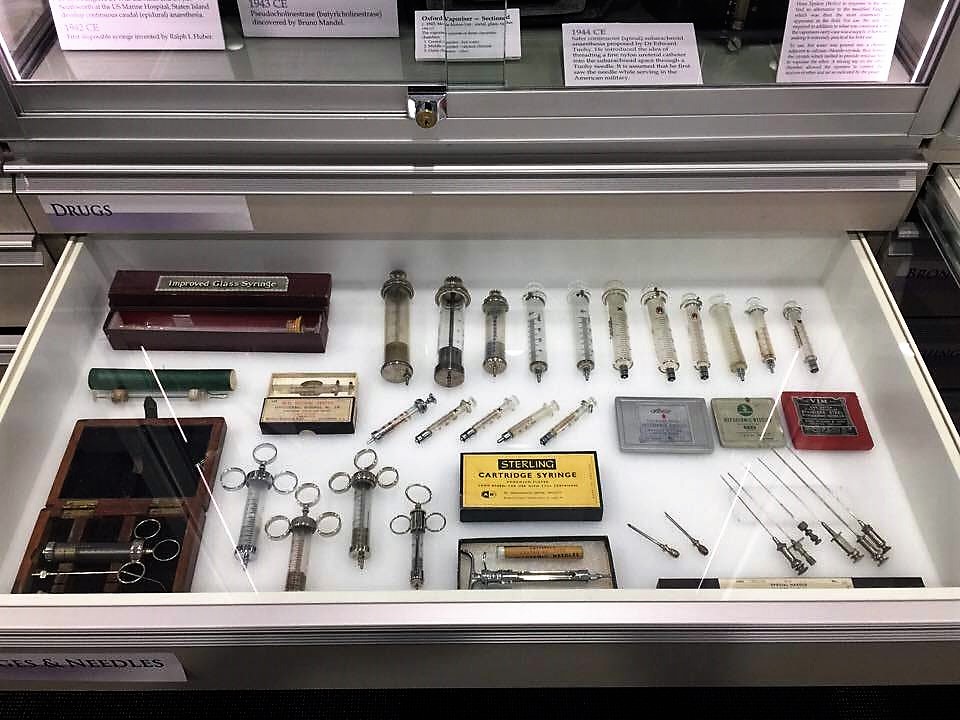
After going through so many options of what to do I decided to settle on a tour. The next stage involved deciding what exactly to revolve a tour around. I considered a general tour of the museum and library, but, wanted something a bit more focused. Drawing inspiration from exhibitions such as a History of the World in 100 Objects, this tour is going to look at specific objects in the collection and the stories they can tell about the history of anesthesia.
Harry Daly Museum
Over the past few weeks I spent time narrowing down the objects and content. There were two ways in which I could go – selecting events or major advances and finding suitable objects, or selecting the objects first and talking about what they represent. To find out what happened next watch this space!
The next blog in the series will delve deeper into how a tour can be constructed and how to organize content. I am also hoping by this stage to be able to release more information on how you can join one of our free tours during the festival.