• Hobart: Mawson’s Huts Replica Museum

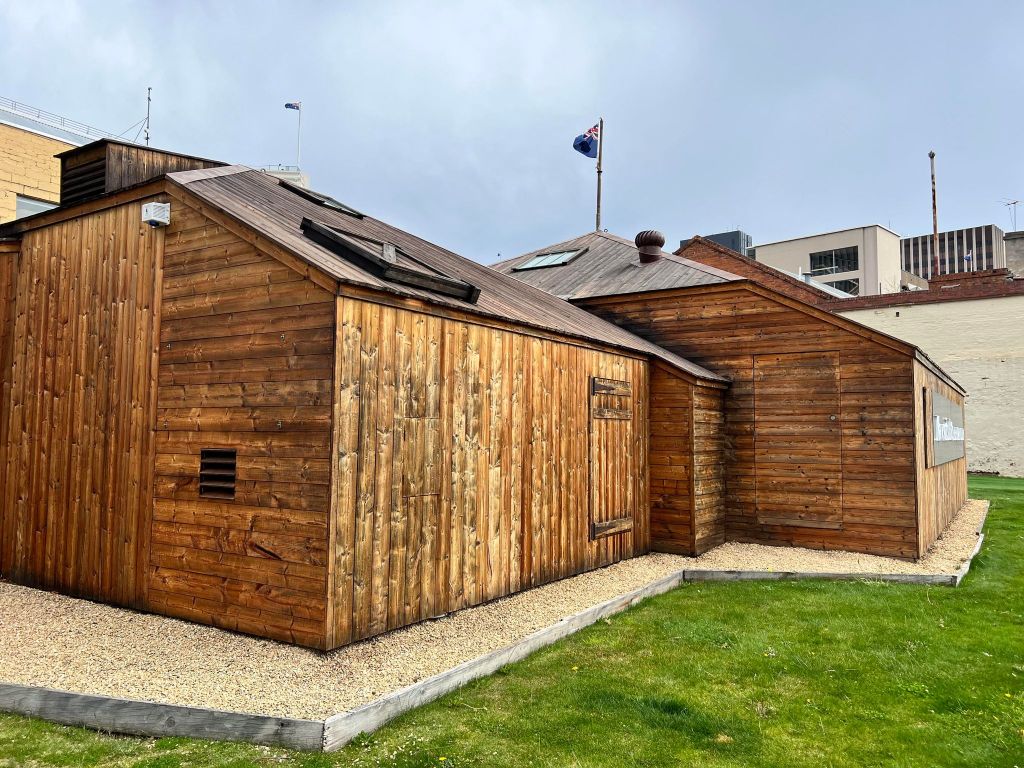
    When we arrived in Hobart on Friday, we went for a walk around the city centre. During this walk, we saw the Mawson’s Huts Replica Museum and decided to return for a visit the next day. I didn’t even know this museum existed! Situated near Constitution Dock, this small wooden structure certainly stands out as something a bit different. I want to start this post with a bit of information about the replica itself before delving into the layout of the Museum and our experience. There will be lots of photographs as dogs featured heavily in the Museum.

    Replica Museum History

    384488756_1481957242563035_7730832293265674122_n
    Mawson’s Huts

    The Museum is part of the Mawson’s Huts Foundation, a not-for-profit charity developed in 1996. The purpose of this charity is to conserve a series of historic huts at Cape Denison, an area in East Antarctica. This area experiences some of the fiercest winds of anywhere in the world so conservation work is a necessity. I’ll note here that sales from admission tickets go towards this conservation effort which is a great way to raise funds.

    These huts were used during the Australasian Antarctic expeditions that occurred between 1911 and 1914. They are of both national and international significance for being the only surviving Australian Antarctic sites. The Museum is a replica of one of these huts. So not only does the Museum provide visitors with information about the expeditions, but also a feel for the living conditions. Construction began in 2013 and after four months, it opened on December 2, 2013. It is as authentic as it can be, built according to photographs and measurements supplied by the heritage carpenters who worked at the original hut. It has the exact same dimensions as the hut and even the Baltic Pine flooring and cladding was sourced from the same area of Scandinavia as the original.

    The location of the Museum is significant as it’s approximately 200m from where the first Australian Antarctic expedition departed. It is in such a beautiful area you could easily combine a visit to the Museum with a leisurely walk around the waterfront. There are some great museum elements I want to focus on for the rest of this blog post.

    Overall Layout

    I would argue that the Museum is compact, but filled with relevant information. There are so many stories to follow throughout ranging from those of individuals to thematic panels exploring themes of the Antarctic exploration. By far, my favourite area was all about the dogs. No surprises there. I am going to start with an overview of this particular area then share a few other highlights.

    Dogs

    Before Mawson left for Antarctica, he purchased approximately 50 Greenland sled dogs to accompany him and his team. Unfortunately, only around 28 dogs survived the journey. I warn you now, there are many sad dog-related stories in the Museum. I won’t be sharing them all but just be aware if you are going to visit. In the Museum, the story of these dogs is presented towards the end of the permanent display.

    384494554_1351356945468691_373991760465747230_n
    Mawson’s Dogs

    This section starts strong with a very large image of a husky puppy displayed on the wall. It has a thematic panel with the names of the original dogs and an overview of how they were used throughout Mawson’s journey. There is also a great panel consisting of select diary entries about the dogs (photograph below). What I thought worked well within this space was the ‘something lighter’ panel that leaves visitors with happier thoughts of the dogs. Stories of them causing mischief and getting into all sorts of trouble.

    384494557_349676880736242_5764606817237882533_n
    Dog Names

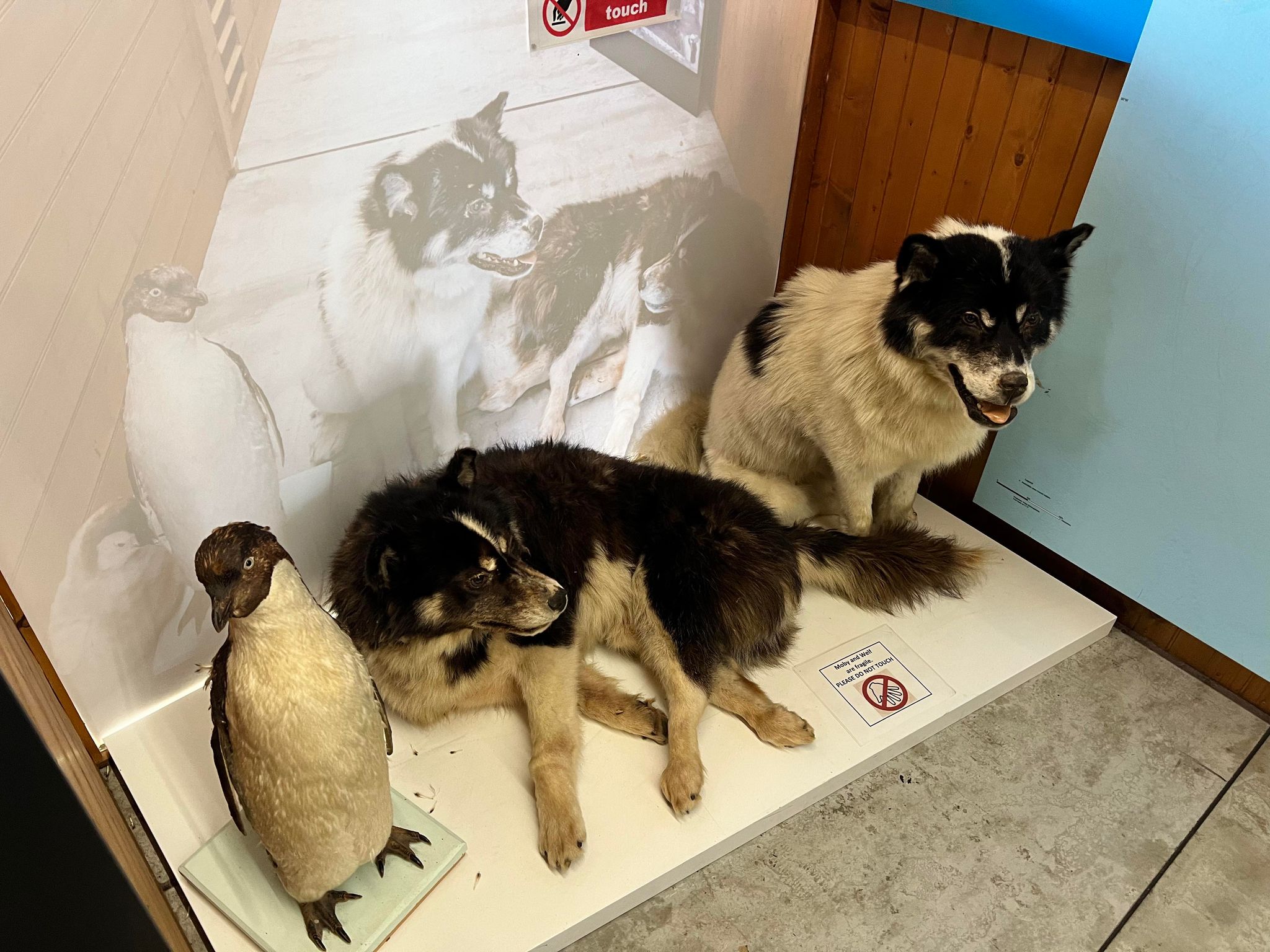
    The dogs aren’t just in this particular section – they are everywhere in the Museum. There are a couple of taxidermy dogs at the entrance, a painting by a contemporary artist towards the end, and a statue in front of the Museum of two of the dogs. Needless to say, you will learn a lot about Mawson’s dogs. Moving away from dogs, there were a few other highlights from our visit.

    Taxidermy Dogs

    Soundscape

    When you first enter the permanent display you can hear the soundscape of Antarctica. Basically, really harsh wind. This soundscape works so well in the space as you genuinely start to feel cold as you make your way through. I thought it had great impact and added another dimension to the visit. Even if it did make me reach for my jacket.

    Pacing

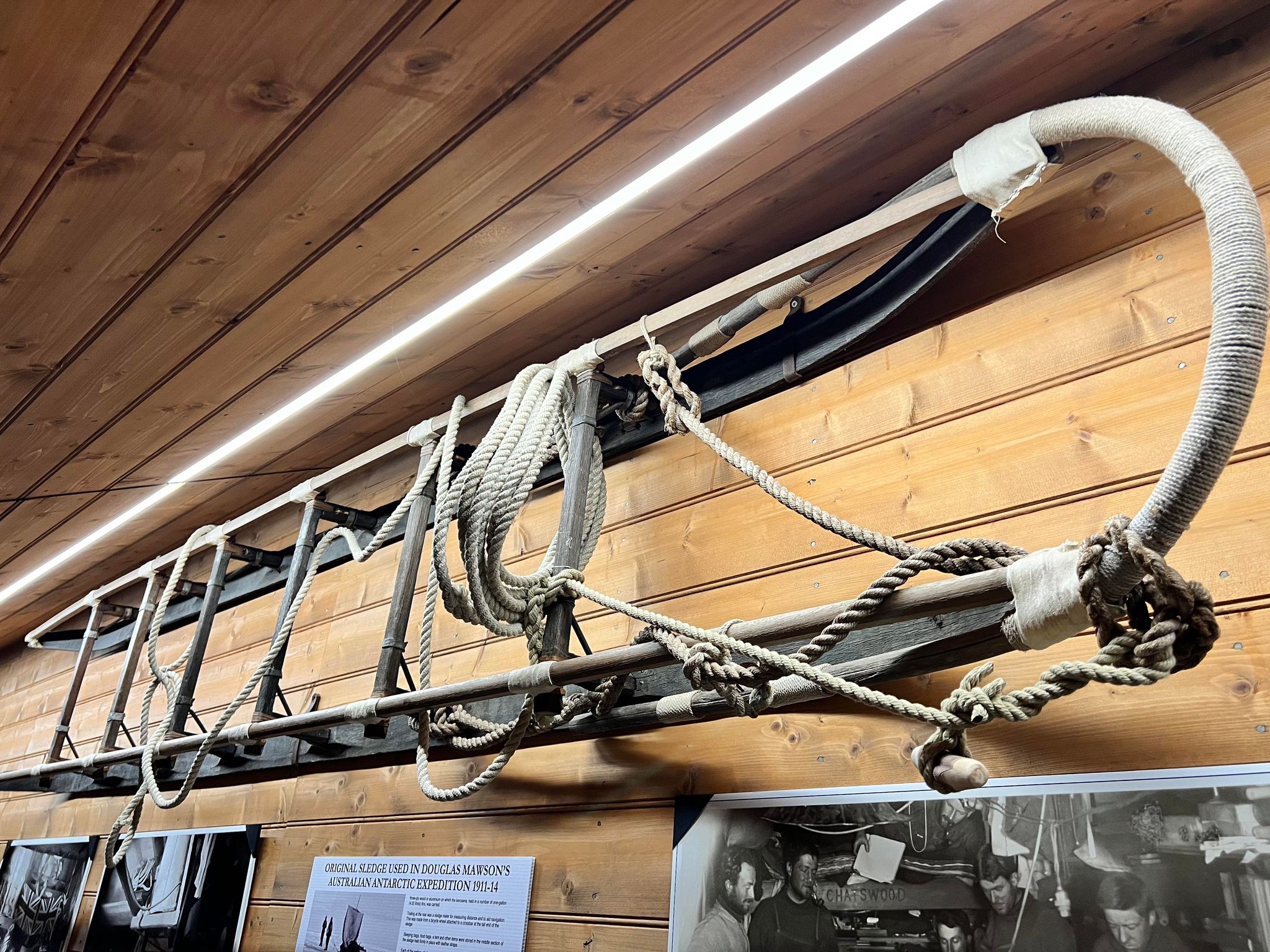
    The pacing of the Museum is another positive worth mentioning. There are large thematic boards that progress the story and contain a lot of contextual information. In between these panels are photographs, videos, and objects to support the theme and guide visitors through. I’ve included an example below of some photographs and an original Mawson sled. These breaks helped with the pacing and also with visitor fatigue.

    384495512_1058045041854133_6943895298026593918_n
    Mawson’s Sled

    Replica Hut

    At the end of the Museum is the full replica experience with beds, kitchen, Mawson’s room, and designated work areas. It felt very much like a living museum experience which is a great way to end the visit. I would not like to have visited when it was busy as it’s a small area. Too many people in there would have felt too crushed. It was interesting to see the layout of the original hut and this ultimately helped with imagining how tough the conditions were for those who joined the expeditions.

    384487017_344669844685979_142498666183569991_n
    Kitchen
    384487017_1029488798398341_795184878677124476_n
    Bedroom
    384401807_244438191519299_3860810440606771865_n
    Supplies
    384496068_845780050473778_8287182623242397864_n
    Work Room

    Logistical Information

    Mawson’s Hut is an accessible Museum in the centre of Hobart. It is open seven days a week from 10am to 5pm. There is an entrance fee ($15 for adults) but remember this money goes toward  conservation of the original huts in Antarctica so it’s money well spent!

  • Sydney: Art Gallery of New South Wales

    I’ve been in Sydney this past week for a University Museums conference. It was an incredible conference and a wonderful opportunity to present on how our museum is engaging with interdisciplinary learning. I’m glad I gave myself a couple of extra days to explore Sydney and visit a few more museums and galleries! Yesterday, I visited the Art Gallery of New South Wales to see the Archibald/Wynne/Sulman Prize and their new North Building. I also visited the Sydney Jewish Museum but I’ll leave that for another post. I’m going to start with the Archibald Prize and then share my thoughts on the new building.

    Archibald Prize

    It is so strange to think that the last post on this blog about Sydney was the 2019 Archibald Prize. Here we are four years later and back for another Archibald review. I was reading both my posts from 2017 and 2019 (they are linked) and honestly, my opinions haven’t changed that much. I am going to share some new opinions though and my favourite artworks from the exhibition. I also want to share my favourite from both the Wynne and Sulman Prize.

    In short, the Archibald Prize is a portrait competition open to anyone in Australia or New Zealand. The winner receives $100 000 so it’s a pretty amazing prize on offer. As well as an overall winner, there is The People’s Choice award (voted on by visitors) and the Packing Room Prize (awarded by those handling the entries). Having worked on a small-scale (by comparison) art award show in the past, I can say that it is a hectic time managing these types of shows so well done to the team. This year, I didn’t feel as though the pieces were as crammed together as they have been in the past. There was a lot more room to breath and it was really thoughtfully curated. The labels additionally contained long artist quotes which I enjoyed reading. They probably have done this in the past but this is the first time it registered. In 2019 I wanted to find all the artworks with dogs in them. I was genuinely excited to do the same thing this year and……there was only one. So instead, here are my top 5 in no particular order.

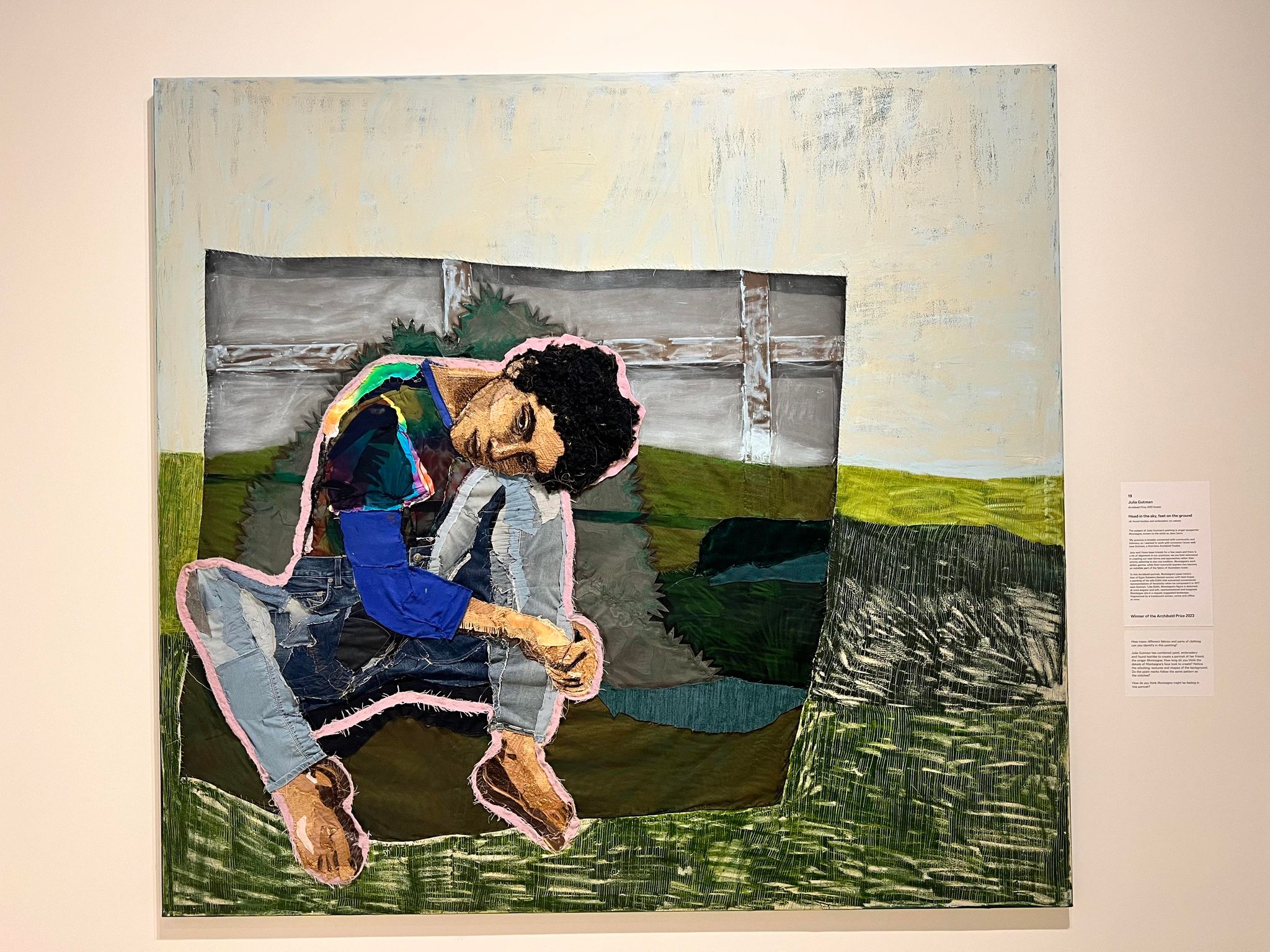
    1. Julia Gutman – Head in the sky, feet on the ground

    Head in the sky, feet on the ground

    I’ll start strong with the winning entry. This artwork is spectacular in real life. It’s of singer-songwriter Montaigne and comprises of textiles pieced together and embroidery on canvas. The texture of this artwork is what really drew me to it in the first place. I purposefully didn’t look up who the winner was before visiting and when I saw this work I thought it was very worthy of the title.

    2. Charles Mouyat – As below, so above

    As below, so above

    The colours of this work are stunning. Similar to the previous, this one also stands out on the wall. The individual painted is Michelle Simmons, a quantum physics professor. On a quick glance, I thought she was giving the finger. Instead, she is representing a ‘qubit (quantum bit) neither zero nor one but both’.

    3. Eliza Gosse – Breakfast at ours

    Breakfast at ours

    I loved the shape of this artwork and how it is cut out around the two individuals. The label also speaks a lot about food and breakfast which did just leave me feeling very hungry. This work is comforting and casual.

    4. Jaq Grantford – Through the window

    Through the window

    I swear I’m not just selecting the ones that won a prize. I grew up watching PlaySchool so I already felt a strong connection to the subject. How her personality has been captured by the artist, is why I’ve placed it in my top 5.

    5. Jason Jowett – Alex Greenwich

    Alex Greenwich

    Greenwich is an independent member for Sydney in the NSW Parliament and was the co-chair of the marriage equality ‘yes’ campaign. The texture of this work is beautiful and similar to my first choice, it’s what drew me over to take a closer look.

    The Wynne and Sulman Prizes

    Last, but certainly not least, for this section, I want to share one work from the Wynne Prize and one from the Sulman Prize. The Wynne is the longest running prize offered by the Gallery and, according to their terms and conditions, is awarded to ‘the best landscape painting of Australian scenery in oils or watercolours or for the best example of figure sculpture by Australian artists’. The Sulman is awarded to the best subject/genre painting or mural.

    Louis Pratt’s Wynne Prize entry, A very Dutch ghost, was my favourite in the entire exhibition. It represents the old Dutch memento mori paintings. I was disappointed to see that wasn’t mentioned on the label! Basically, you use the mirror behind the skull to play with how it looks and view it from different perspectives.

    A very Dutch ghost

    The final work I want to discuss here is by Richard Lewer, Richard’s medical disasters. Documenting his ailments over time, this artwork takes something that might usually be seen as a taboo and puts it in the public realm. That taboo being, talking about personal experiences of disease. I want to create something similar documenting my health journey!

    Richard’s medical disasters

    North Building

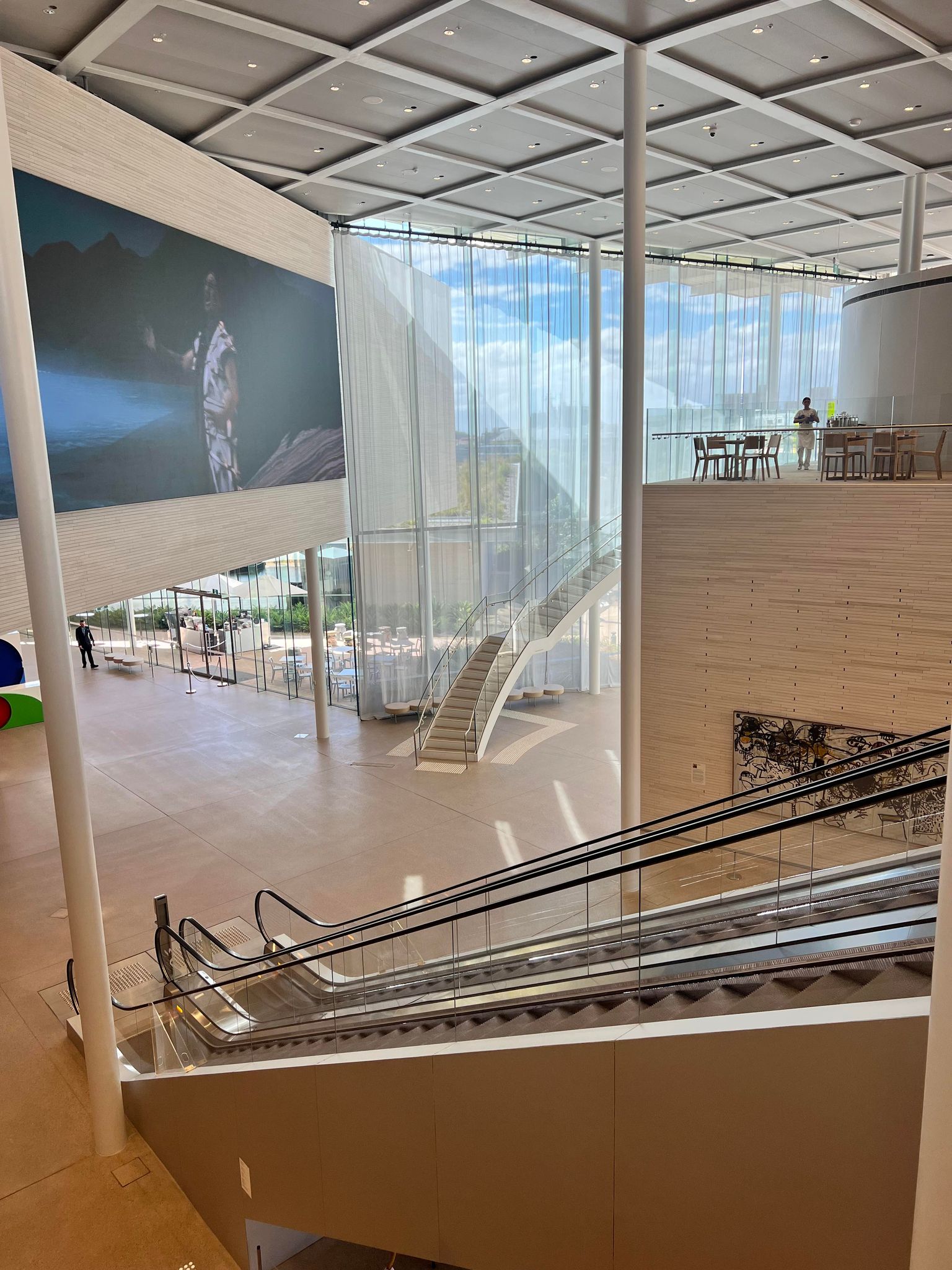
    The new addition to the Gallery is just next door and called ‘North Building’. It is certainly an impressive space! Rather than floors going up, visitors start on the ground level and head underground. Each floor has a main gallery space and right down the bottom is The Tank. To me, the building gave very ‘airport vibes’. I’ll share a photograph so you can see what I mean. However, I was really impressed with the scale of the building and the works on display.

    North Building

    The combination of old and new art in the space does provide a more contemporary approach when compared to the original or South Building. After viewing some more modern works I stood looking at this cute little porcelain pond. Literally a piece from the 1300s. How the old and new is curated really adds to the space.

    Porcelain Pond

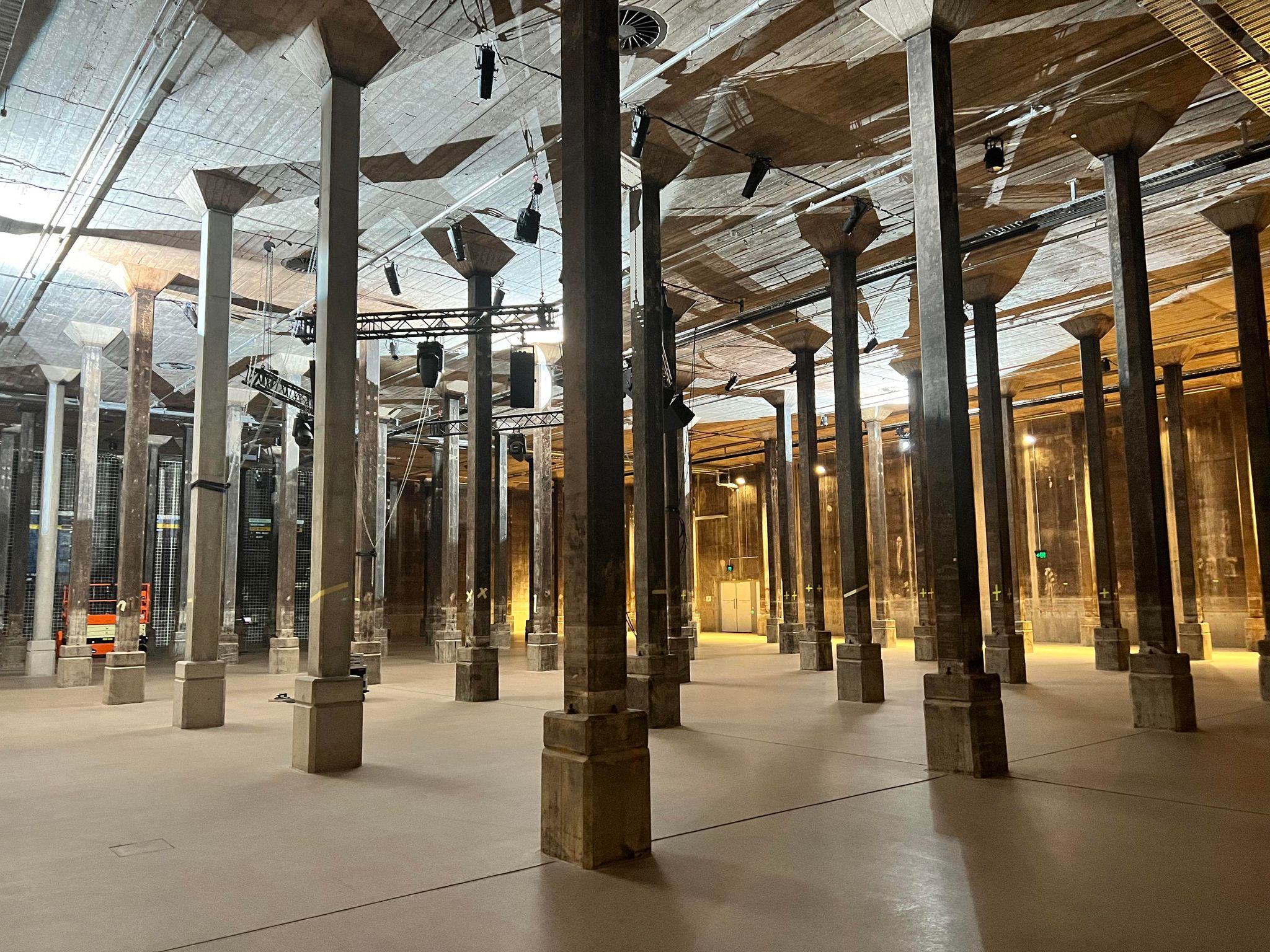
    Although they are currently installing a new exhibition in The Tank, I was glad I got to experience this space. It is a cool, dark, easy-to-fall-asleep-in space that has so much potential. I cannot wait to see future exhibitions here.

    The Tank

    You could spend hours just in this building, but I was tired so I walked around all floors to get a feel for the space. I would definitely recommend focusing on just the North or South Building if you visit. Both are possible to do on one day if you don’t have time, but gosh, it’s exhausting.

    Logistical Information

    Both buildings are open daily between 10am and 5pm. On Wednesdays, they actually open until 10pm so if you want an after-work art experience, that day is perfect. They are both accessible and it was great to see the amenities in the new building are so inclusive. If you would like more logistical information, you can follow this link: https://www.artgallery.nsw.gov.au/visit/plan-your-visit/.

  • Adelaide: Art Gallery of South Australia

    I have travelled to Adelaide for a history of medicine conference. Overall, the conference was fantastic! Great to hear about the research taking place in this field and to present on a project happening in our museum. Yesterday, the conference finished around lunchtime so I took the opportunity to visit the Art Gallery of South Australia and see the new Frida and Diego exhibition. Fortunately, I had a friend at the conference who also wanted to visit. This had a huge impact on my experience as she spent longer in the exhibition than I would have on my own. In the end, this meant I read every panel and every artwork label which is definitely not something I normally do. Overall, I enjoyed the exhibition and the delightfully colourful display. As with so many posts, I am going to begin with an overview and then discuss my favourite artworks on display.

    359694492_155855487515756_2899624028995254288_n
    Exhibition Pamphlet

    Exhibition Overview

    I don’t think it’s possible to hold a Frida Kahlo exhibition without an accompanying rainbow of bright and bold colours. Every room in this exhibition is painted a striking colour which beautifully complements the artworks on display. You can tell that each colour has been carefully selected in order to help tell the exhibition’s story. For example, the second last room focuses on Kahlo’s health. The walls are painted black with black curtains separating some of the photographs. This is in stark contrast to the final room which welcomes you with extremely bright colours and a flower installation suspended from the roof. This is where you also see the first colour photographs of Kahlo so it really feels like you are being overwhelmed with colour.

    Another positive is the pacing of the exhibition. Each room has a select number of artworks that seems to be the perfect number to further the exhibition’s story. There were only a couple of times I wanted to see more on display but that was because of the subject matter and my interest. I did not get visitor fatigue from this exhibition which was surprising considering I was reading everything!

    My one criticism of the exhibition would have to be the labelling. Shocking, I know. However, I will say that the language used in this exhibition wasn’t as alienating as other exhibitions. There were just a couple of labels where my friend and I had to Google the meaning. Rather than the language being the primary issue, it was the text size and position of labels. At times they were positioned to the left of the artworks and other times to the right. This did lead to some confusion. Also, the font was super small and I felt nervous standing close to the artworks just so I could read the labels. This wasn’t an issue with the thematic labels which were very easy to read and to the point.

    I am now going to highlight my favourite artworks in the exhibition in no particular order.

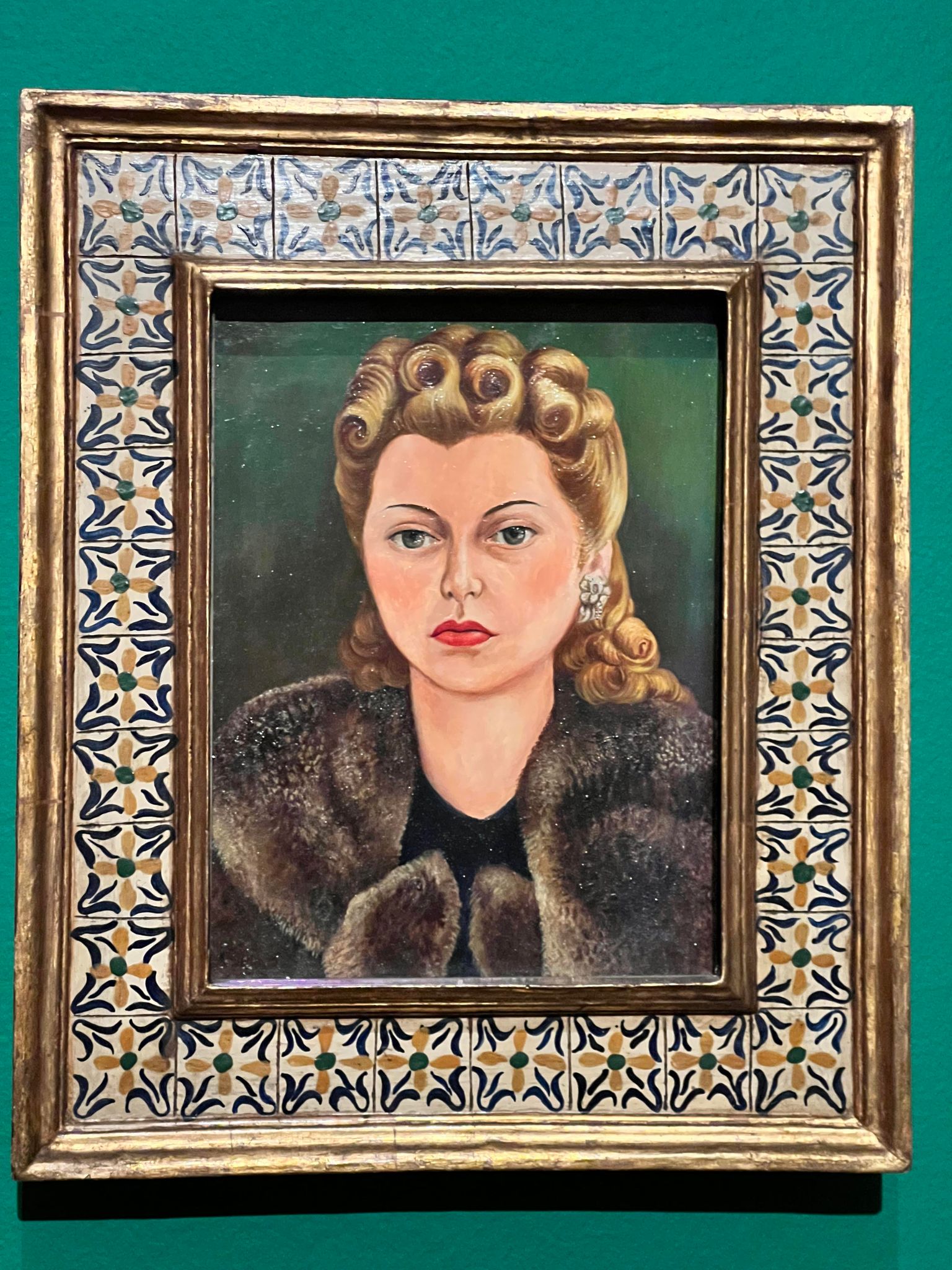
    1. Portrait of Natasha Gelman, Friday Kahlo, 1943

    This was one of my favourites in the exhibition mainly due to the frame. It looks like little individual tiles pasted around the portrait. Depicted is Natasha Gelman, an American art collector.

    361074452_203583412673366_5202666248782435220_n
    Portrait of Natasha Gelman

    2. Self-Portrait with Monkeys, Frida Kahlo, 1943

    As you can see in the photograph, this painting is displayed on a vibrant blue wall. This really accentuates the colours in the painting and made it stand out in the exhibition. The monkeys are a fun addition to the work and are believed to be included to reflect Kahlo’s developing role as a mentor for students.

    361155564_232724709641131_8102618837094765110_n
    Self-Portrait with Monkeys

    3. Anatomical Images

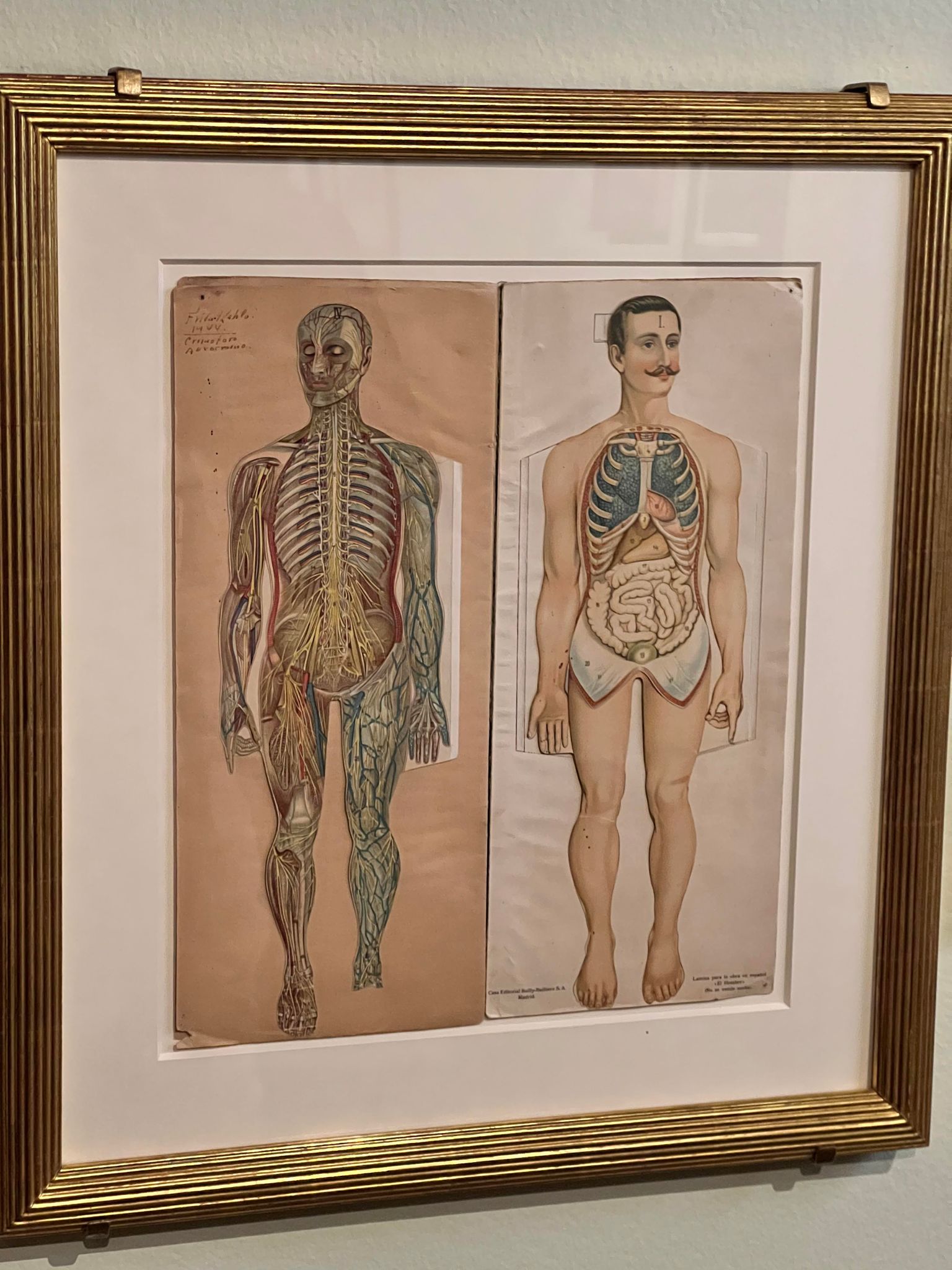
    I forgot to take a photograph of this artwork’s label so I’m missing the context. I’ve included it, however, because these anatomy books and interactive pages are favourites of mine. If you zoom in, you can see that they once belonged to Kahlo. In the top left corner is written ‘Frida Kahlo, 1944’.

    360088702_1019500119041378_3101720729947666250_n
    Anatomical Images

    4. Clothing Room

    Towards the end of the exhibition there is a room filled with Kahlo’s clothes. They are so bright and beautiful, representing traditional Mexican clothing and patterns. My favourite was the Tehuana dress photographed below (the one with large colourful flowers on a black background).

    361077687_245763158251866_7340648548392980732_n
    Clothing Room

    5. Diego on my Mind, Frida Kahlo, 1943

    This is the featured artwork in the final room. It is quite famous, depicting Kahlo with a portrait of Diego on her forehead. There is still debate surrounding the meaning behind this artwork. According to the label, the roots sprouting from her flower crown could reflect new growth or depletion of energy.

    361092881_1992444634435430_7963183492650317408_n
    Diego on my Mind

    Logistical Information

    Frida and Diego: Love and Revolution is on display at the Art Gallery of South Australia until 17 September 2023. There is an additional fee to visit this exhibition. It is fully accessible. For further information, please follow the link: https://www.agsa.sa.gov.au/whats-on/exhibitions/frida-diego-love-revolution/.

  • Newcaslte: The Lock-up

    Please note the following blog post contains mention of an exhibition responding to stories of survival that were uncovered during the Royal Commission into Institutional Responses to Child Sexual Abuse.

    Front of House Dog Macca

    This is Macca – an excellent front-of-house staff member who was a comforting presence during my visit. The Lock-up in Newcastle combines an old heritage building with contemporary art shows that don’t shy away from difficult topics. Although my visit challenged me, I kept thinking about how critical it is to have this space to display reflective and empowering works surrounding traumatic issues. The focus of my blog post will be on the building itself and its history. I will briefly mention the exhibition currently on display, but there will be no images.

    Building History and Heritage

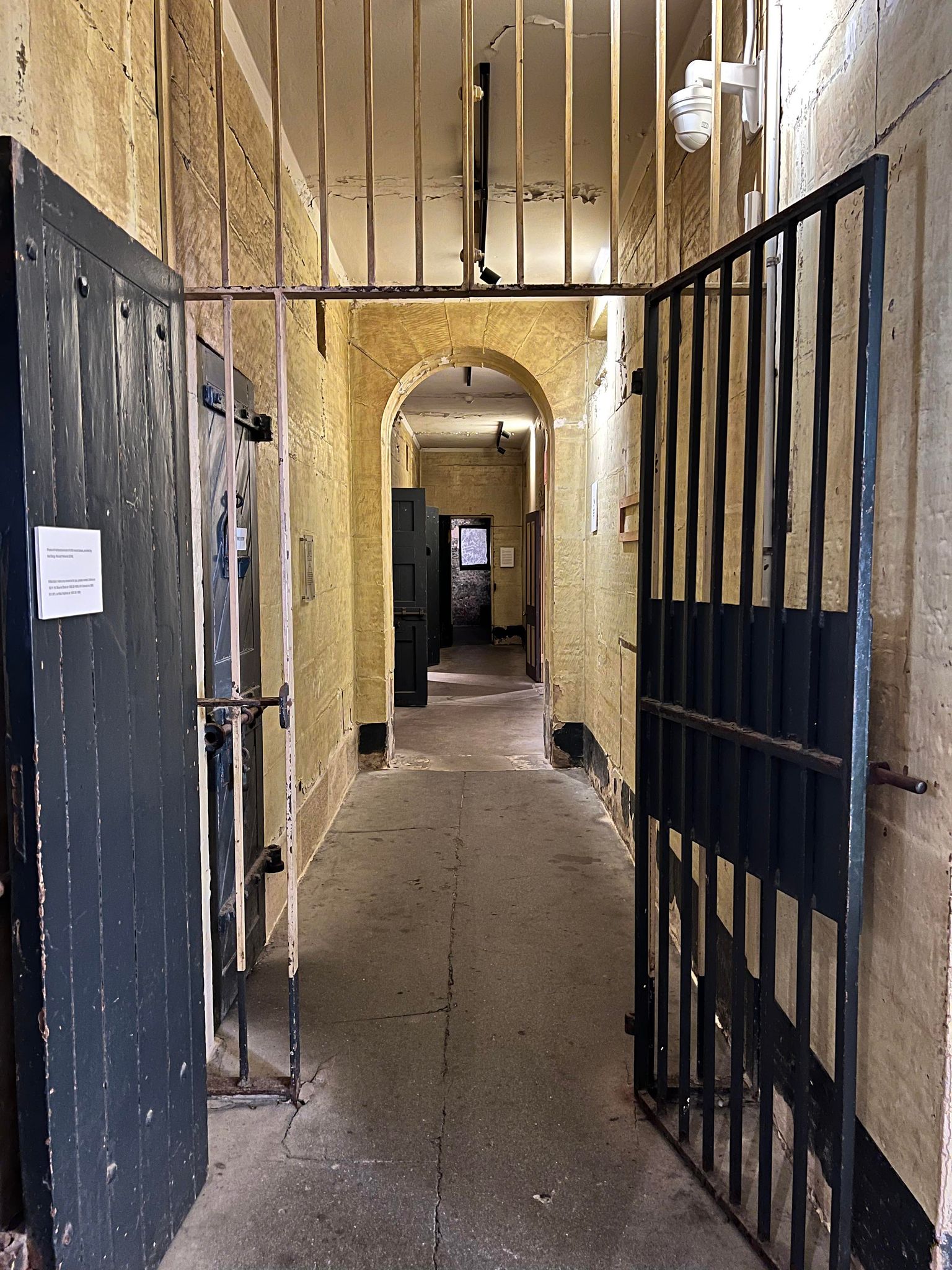
    No surprises here, but the lock-up refers to the building’s past as a police lock-up situated next to Newcastle Police Station. Prior to the 1860s, those convicted of a crime were sent to cells under the Court House to await their trial. The usual period of detainment was a few days. However, the longest recorded stay was 42 days. From here, those convicted were either released or moved to, for example, Maitland Gaol after receiving their sentencing. As the city grew, so too did the need for a new police station. What you can see today is the building completed in 1861, designed by Mortimer Lewis Jnr. There were a few demolishes, and extensions between 1867 and 1926. One of these extensions added an exercise yard that you can still visit today.

    Exercise Yard

    The lock-up closed in 1982. A few years later, the Hunter Heritage Centre moved in and opened a museum with accommodation for artists in residence. They also established an exhibition space. This operated until 2014 when The Lock-up re-launched itself as, according to their website, a ‘dedicated multidisciplinary contemporary arts space, dedicated to presenting contemporary and experimental arts within a historical building.’

    Today, the building is listed in the New South Wales Heritage Register. It functions both as a heritage place but also an award-winning contemporary art space dedicated to training, exhibiting, and supporting the local community and artists.

    Cells

    Balancing Heritage + Art

    Overall, I would say that the balance between acknowledging the heritage/history of the building and displaying art is incredible. Both are equally acknowledged and share the space rather than competing against each other. Here is how both are presented and represented:

    Art

    The current exhibition on display is titled Loud Sky. The exhibition showcases the art of five local artists responding to stories of survival uncovered through the Royal Commission into Institutional Responses to Child Sexual Abuse in 2016. I have decided not to write about it as I couldn’t do it justice. It is such a powerful exhibition that should be experienced in-person if that’s something you’re comfortable doing. Instead, here is some more general comments on how art is displayed.

    The artworks are distributed throughout the building including in the cells and exercise yard. There is the capacity to not only have physical works on display, but digital ones too. These were projected on screens and walls very effectively. The only location that didn’t have a display is the padded cell. This was added in 1893 and used to house prisoners who were at risk of harming themselves. It is believed to be one of the best-preserved cells of its type in Australia. In 2023, it underwent a conservation process so might open in the future.

    Padded Cell

    Not only is there contemporary art on display, but the graffiti covering the walls from past detainees can also be regarded art. I suggest you take the time to read this graffiti that has been etched into the walls using some kind of sharp object. In the cells that held female detainees, some is painted onto the walls with red nail polish.

    Last but not least, if you enjoy textiles there is a gallery and shop displaying some local pieces.

    Heritage

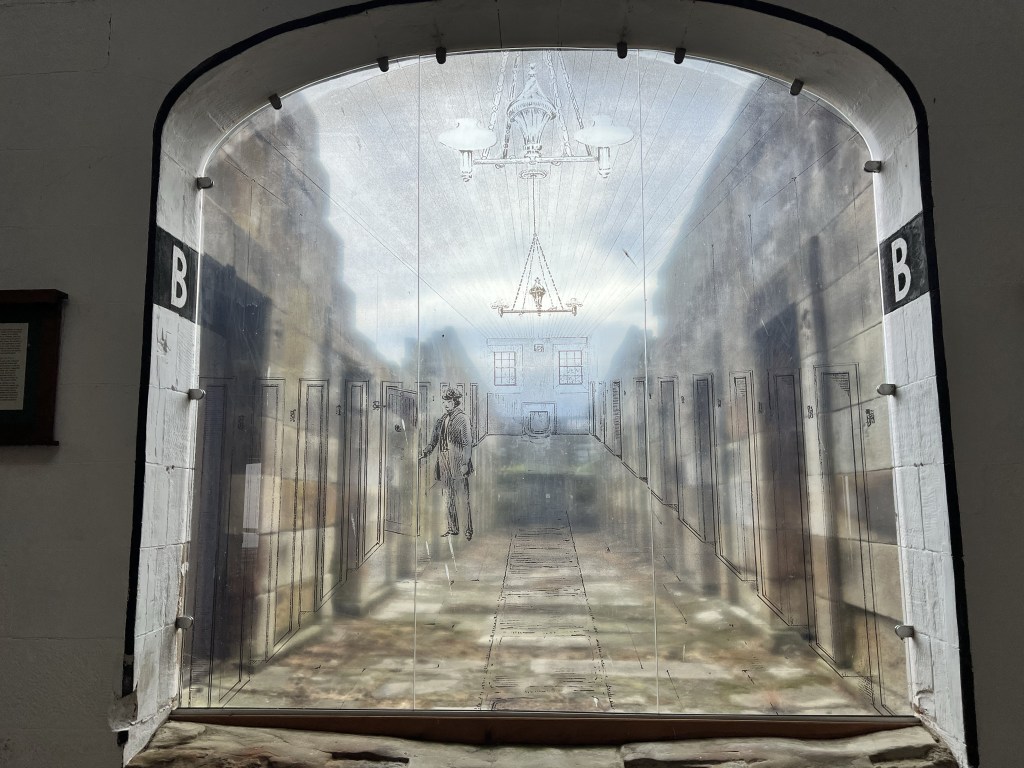
    There are plaques in the building that refer to its heritage and remind visitors that they are inside a heritage-listed building. I’ve included an example below of the plaque relating to Cell B. These are well worth reading as you make your way around.

    Heritage Sign

    Logistical Information

    I would strongly recommend visiting The Lock-up as both a heritage and art experience. Entry is free and the majority is accessible. Loud Sky is closing soon (21 May) but there are some fascinating upcoming exhibitions: https://thelockup.org.au/whats-on/.

    From their website: We encourage visitors to come to the exhibition with a friend, family or support person. If this topic raises any concerns for you, please contact Lifeline on 13 11 14, Beyond Blue on 1300 22 4636, DV Connect on 1800 811 811, or Kids Helpline on 1800 55 1800.

  • Newcastle: Maitland Gaol

    This morning I journeyed out to Maitland Gaol for a self-guided audio tour experience. The Gaol is approximately one hour from Newcastle by train and very easy to access without a car. There are a few tour options available so definitely check their website before you visit. The only option I had available today was the self-guided audio tour that you can download to your device before your visit. You can take either the Maitland Gaol Revealed or Escaping Maitland Gaol tour (a kid’s tour is also available). Because I had the time, and really wanted to explore the Gaol, I selected Maitland Gaol Revealed. This is a 1.5 hour tour that guides you through all the main areas. The benefit of this app is you can re-read/listen to any sections post-visit. Before reviewing the experience, here is a brief history of the Gaol.

    History of Maitland Gaol

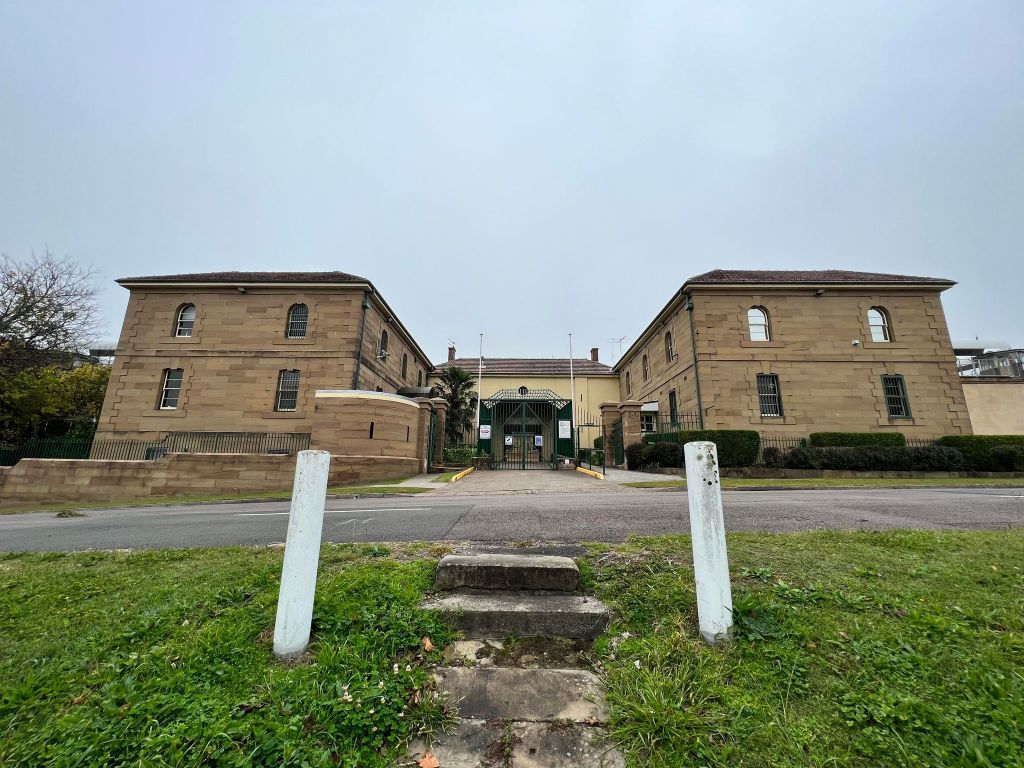
    Maitland Gaol officially opened in December, 1848. However, building the Gaol started as early as 1846 with a foundation stone laid in 1844. You will see in photographs that the sandstone used to construct the Goal is that quintessential convict-era sandstone. This was quarried by convicts at Morpeth – an area near the Gaol. The first structures to be built were the southeast wing, gate, and enclosing wall. Towards the end of the 1880s, the warders’ quarters, watch towers, and building containing the chapel were added. Extensions continued to be built to support the growing number of inmates. In 1972, Maitland Gaol became a maximum-security prison.

    Fast forward to the early 1990s when modern prison cells were built including 5-wing – a high-security cell block for those who had committed especially serious crimes. Eventually the Gaol closed in January 1998. Today, it serves as a heritage-listed tourism site.

    The Gaol was inscribed on the New South Wales State Heritage Registrar on 2 April 1999. Mainly because it’s the oldest substantially intact country gaol in New South Wales. It is also Australia’s oldest structure to be continuously used as a gaol and the last surviving example of the ‘Inspectors’ Gaols’ or those designed by the Colonial Architect in New South Wales.

    Maitland Gaol

    Maitland Gaol Revealed

    I strongly suggest taking the Maitland Gaol Revealed tour if you are wanting an in-depth experience. It is filled with firsthand accounts from both ex-inmates and wardens. I do think there is room to develop this tour to include more diverse voices. Each stop is well-timed and well-sign posted meaning I wasn’t getting lost or standing in the same place for too long. Overall, I really enjoyed the tour and exploring the Gaol. It was great being able to bring your own device and headphones (but both are available to purchase onsite if you need to). Here are my highlights from the tour:

    1: 5-Wing

    5-Wing

    The fifth stop on the tour is 5-wing. This is one of the most notorious cell blocks in the entire Gaol as it housed some of the worst criminals. It looks quite new as it only opened five years prior to the Gaol closing. Inmates weren’t allowed any personal belongings or contact with other inmates while in this wing.

    2: C-Wing

    C-Wing

    After hearing a bit more about 5-wing, the next block you explore is C-wing. This was originally built in the mid-1880s to house female inmates. It is a building separate from the rest. When female inmates were no longer sent to Maitland (1950s onwards) it housed high-risk criminals and those with access to the outside (through visiting family and friends). Strangely enough, this block was used as a makeshift maternity hospital in 1949 when the main hospital’s maternity wing closed due to flooding.

    3: The Kitchen

    The Kitchen

    The reason why I’m including the kitchen in this list is because of its surrounding gardens. There are a few panels that explain what was grown in the garden to feed inmates. For example, one area grew lettuce and beans from 1900 – 1955 to provide fresh vegetables. There are a couple of amazing lemon trees planted outside the kitchen too. I am a food-orientated person so it’s always interesting to learn about anything relating to food.

    4: B-Wing

    B-Wing
    B-Wing

    Construction on B-wing started in 1867 making this the second oldest wing at the Gaol. It is three storeys high and long-term inmates were housed on the top level.

    5: The Hospital

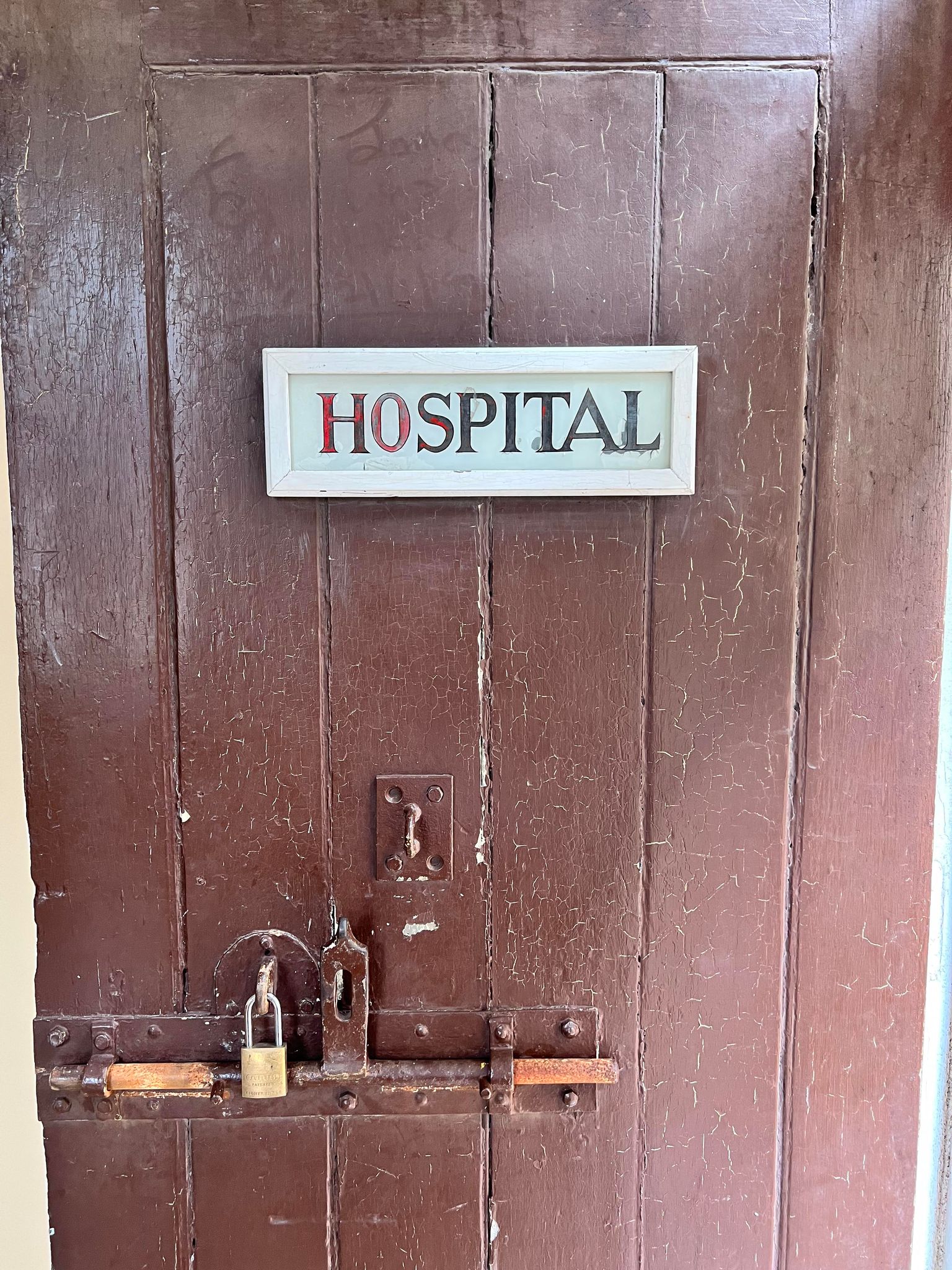
    The Hospital

    No surprises here – the hospital was another highlight of the tour. All inmates passed through the hospital before heading to their cell. As well as blood and urine tests, inmates underwent psychological evaluation. There is a little display here of some historical medical supplies.

    6: The Chapel

    The Chapel

    The Chapel was a highlight for me as you can clearly see the great preservation work happening. The stained glass windows overlook the entire chapel and there are a few murals on display that were uncovered in 2007. I really enjoyed listening to the audio guide in this area. There was a great story about a chaplain who gave lamingtons to inmates attending his service. Lamingtons were classed as contraband so this had to stop and attendance dropped.

    7: A-Wing

    A-Wing

    Opening in 1848, this is the oldest wing in the Gaol. The audio guide shares some LGBTIQA+ history via stories about those who identified as homosexual or transsexual. Going back to what I said before, it would be worth including the voice of someone from the LGBTIQA+ community. It is also the wing that held inmates sentenced to execution. The room where all these inmates spent their final days is at the back of the wing.

    There are 25 sites in total to explore. A few have additional stories you can listen to during your visit.

    Logistical Information

    As mentioned before, you can either drive or take public transport from Newcastle. There is some fantastic information on accessibility here: https://www.maitlandgaol.com.au/visit/visitor-services/accessibility/. The Gaol is open weekdays from 9am to 4pm and weekends from 10am to 4pm. You can find all the information on tours and tickets here: https://www.maitlandgaol.com.au/visit/.

  • Brisbane: The Art of Banksy

    The Art of Banksy: Without Limits has recently opened in Brisbane. I purchased my ticket as soon as they went on sale because, like so many people, I enjoy Banksy’s works and their broader political messages. Over the past week or so, I have been glued to the articles emerging speaking to the exhibition’s controversy. I want to divide this blog post in two. To start, I am going to summarise the issues that have been raised in public media. Then, I am going to share my experience of the exhibition.

    Controversy

    The Art of Banksy has been deemed by Banksy as a “fake” exhibition. Why? Because Banksy hasn’t endorsed the exhibition nor is he a fan of museums and galleries stating they are ‘the trophy cabinet of a few millionaires.’ (source) The exhibition has been pieced together by Kemal Gurkaynak, managing director of Muse Marketing and Entertainment. They have partnered with an events platform, Fever, in order to hold the exhibition.

    How can you hold an exhibition of an artist’s work when they are adamantly against the idea? Well, Banksy does own the copyright to his work but in order to enforce that copyright, he would need to prove he is the unquestionable owner, therefore revealing his identity. Not knowing who is Banksy is as Banksy as you can get. In short, the artworks can be displayed because there are currently no copyright restrictions.

    There are so many interesting arguments raised in the media which are drawing the public into conversations that have been happening in the museum/gallery sector for decades. For example, there is a discussion surrounding authenticity. In an article published by ABC News (source), it is revealed that approximately 34 of the 150 works on display are original. According to Mr Gurkaynak, ‘authenticity is beside the point – real or replica, each work’s ability to provoke thought is what matters’ (source). Does it matter to you if you see something on display that isn’t authentic? Personally, it depends on the context. Do I get joy from seeing something authentic? Yes. I am trying to think of an example and I cannot look past the space shuttle Atlantis on display at the Kennedy Space Center. I felt more connected to the object because it was real. However, I’ve also seen replica objects that have elicited a strong response. I don’t think there is an easy answer to this question but I do find it fascinating to see it raised in an ABC article.

    The second major theme raised in these articles is accessibility. A huge justification for holding the exhibition seems to be that this art needs to be shared with more people. Rather than traveling all over the world, you can pay $38-$40 and see 150 works (authentic or not) in a room that used to be a Coles Supermarket. Similar to the previous issue of authenticity this one is a massive can of worms. Is asking people to pay $40 truly accessible? Is having the exhibition only in select capital cities truly accessible? I am being nitpicky since accessibility is used heavily to justify the existence of the exhibition.

    The ABC article I mentioned earlier ends by stating, ‘The Art of Banksy: Without Limits is perhaps best viewed as a celebration of the artist and his philosophy – an exhibition about Banksy, rather than a Banksy exhibition’ (source). So an exhibition about an artist who would prefer to have their identity concealed in order for their work to take the spotlight. It’s interesting to think of which version of the exhibition Banksy would hate the most.

    The rest of the post will now turn to reviewing the exhibition experience. Will this context influence how I view the exhibition? Yes, of course. Enjoy.

    Visit

    Exhibition Entrance

    There is a bit to unpack with this exhibition. I am going to address the layout, labels, and works on display.

    Layout

    The first portion of the exhibition is dedicated to Dismaland – a temporary amusement park opened by Banksy back in 2015. After walking through a fake security gate you are greeted by the large Dismaland arch. From here, there are a few large rooms that are connected by smaller walkways. I don’t think the rooms were organised thematically – some were and others seemed random. The walkways became bottlenecks as the exhibition was completely full and very overcrowded. I don’t understand the point of selling timed tickets when you are going to oversell them anyway. This did mean it was a struggle to see some of the works. It was not unusual to wait 10 – 15 minutes to catch a glimpse of some of the more famous works. It would have been beneficial to have the exhibition either chronologically or thematically organised. Last, but not least, the exhibition ended with a small gift shop. After seeing works responding to the dark side of consumerism it was quite poetic, and not in a good way.

    Labels

    Most of the labels are positioned under the works. If you want to read them, you have to bend down. This is exacerbated by the very small text size. The information is easy to understand and is, ultimately, interesting. However, I was expecting some indication of which artworks were authentic and which weren’t.

    Works on Display

    As mentioned previously, there are 150 works on display in the exhibition. Here are my top 5.

    Dismaland Bemusement Park Map, 2015

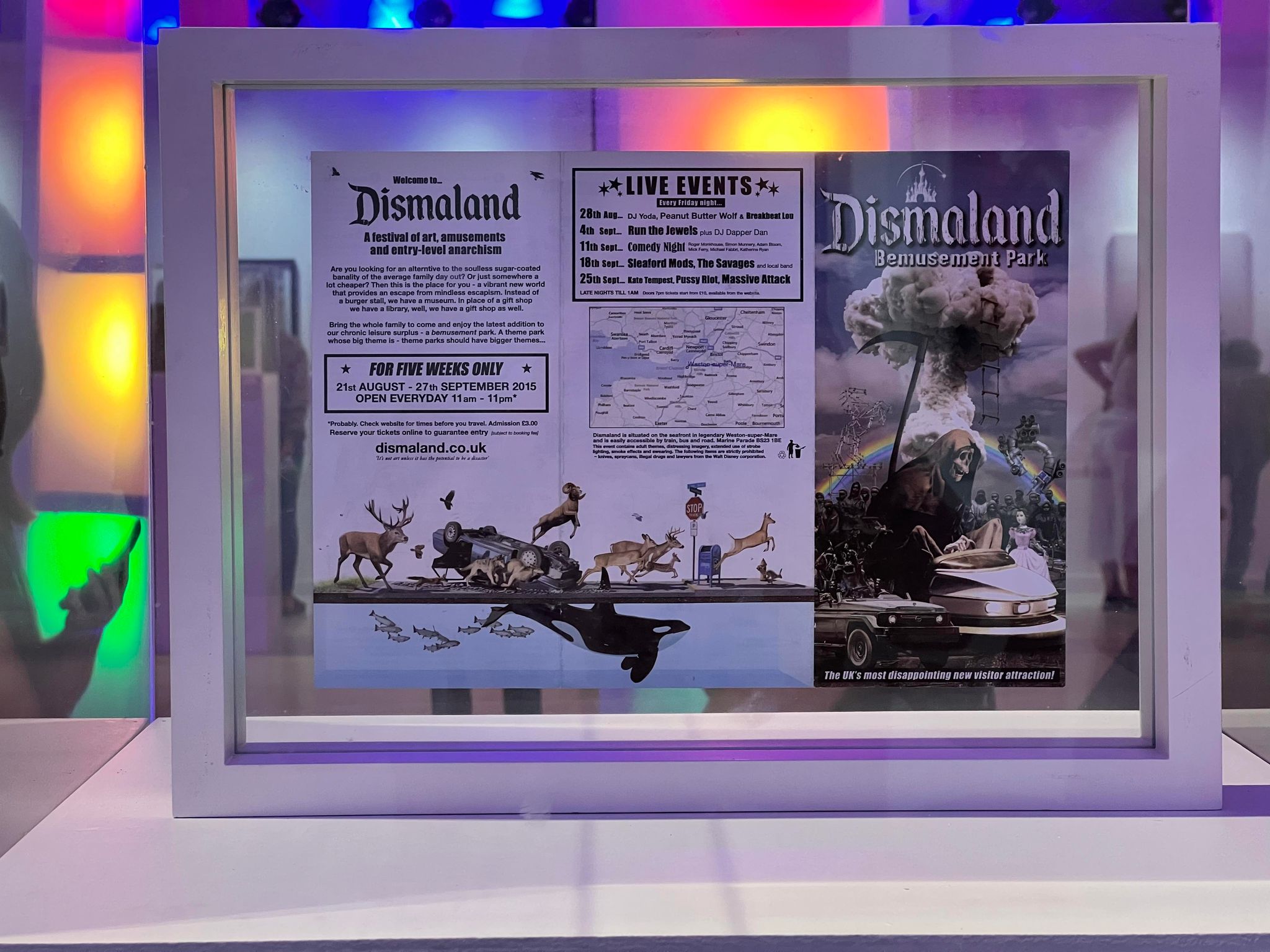
    This is the map from Banky’s temporary art project, Dismaland. Banksy built an entire amusement park in Weston-super-Mare, Somerset, England. My favourite part of this map is number 13 – portrait artist. Nettie Wakefield worked drawing the back of peoples’ heads for a portrait. The other side of the map also had some fantastic commentary. A grim reaper figure is on the front. It promises the park will provide ‘an escape from mindless escapism’. Very different to Disneyland.
    Stop and Search, 2007

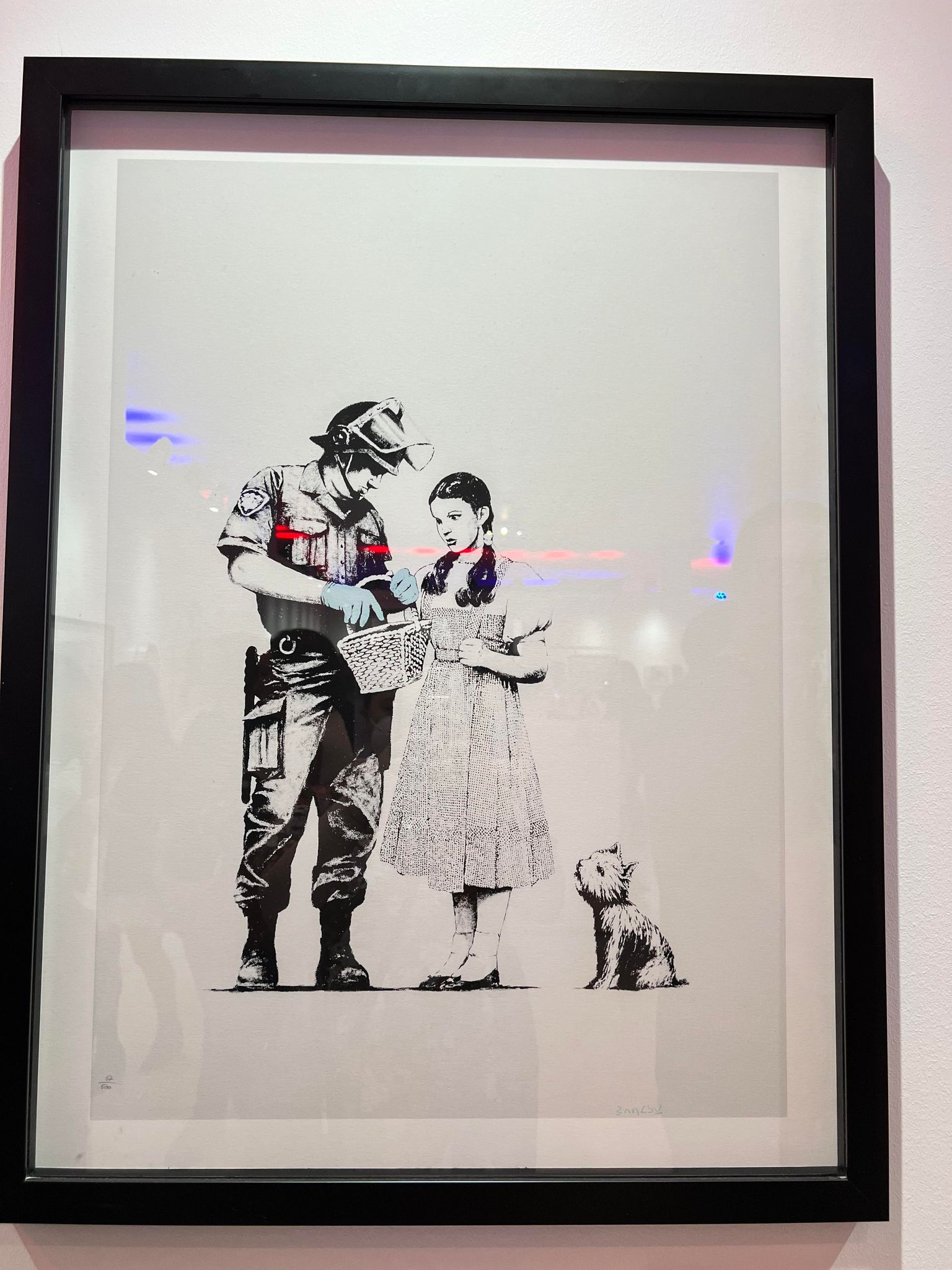
    Stop and Search

    In this work, a police officer is searching Dorothy’s bag (from The Wizard of Oz). It speaks to a security state and how no one is safe from scrutiny.

    Paranoid Pictures, 2003

    Paranoid Pictures

    I really enjoyed reading the label for this work. There is a quote from Banksy stating ‘your mind works best when you’re paranoid. You explore every avenue and possibility of your situation at high speed with total clarity.’

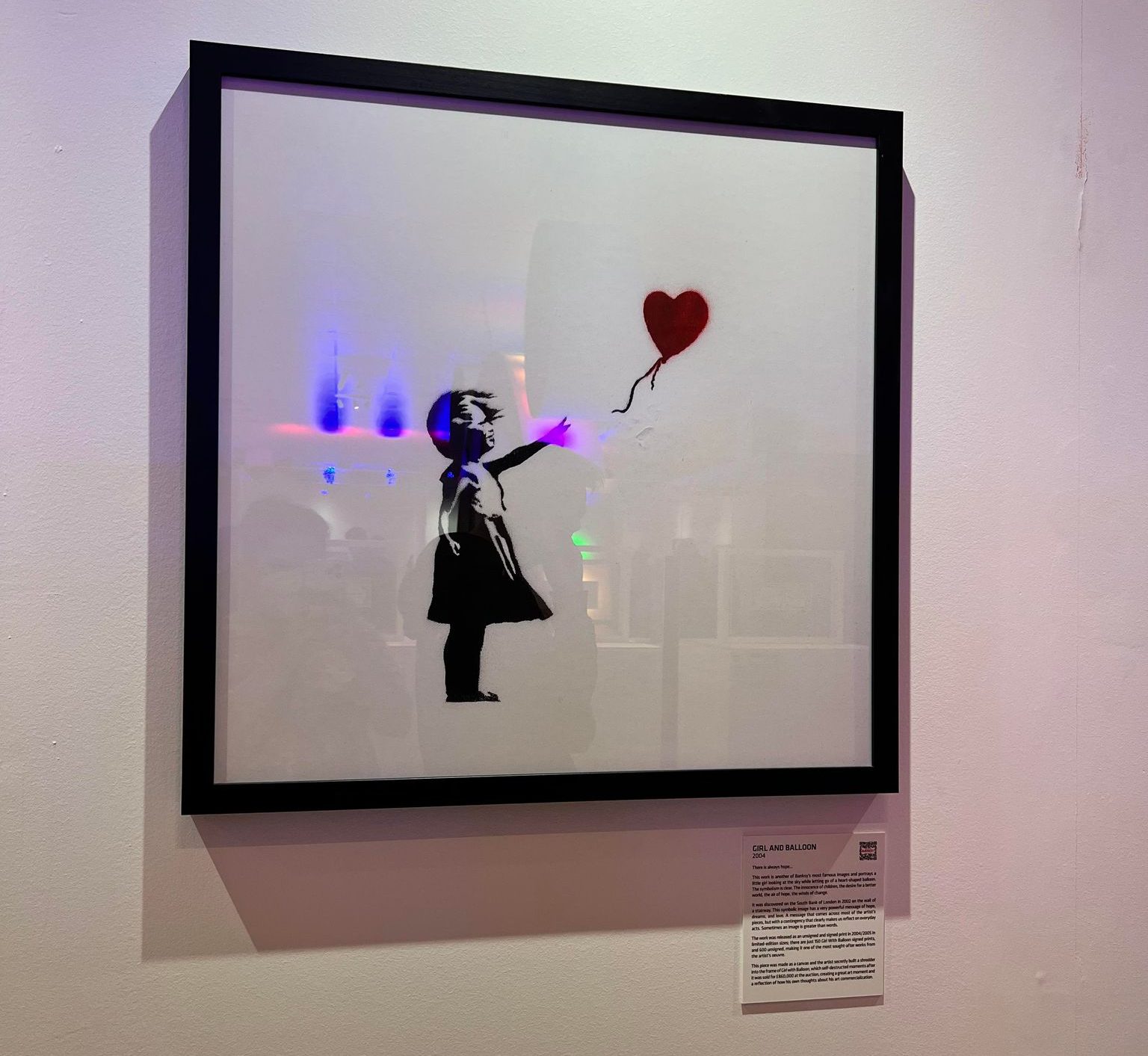
    Girl and Balloon, 2004

    Girl and Balloon

    A very famous work depicting a girl letting go of a heart-shaped balloon. It reflects the innocence of children and carries a message of hope and love. It is now one of the most sought-after works of Banksy.

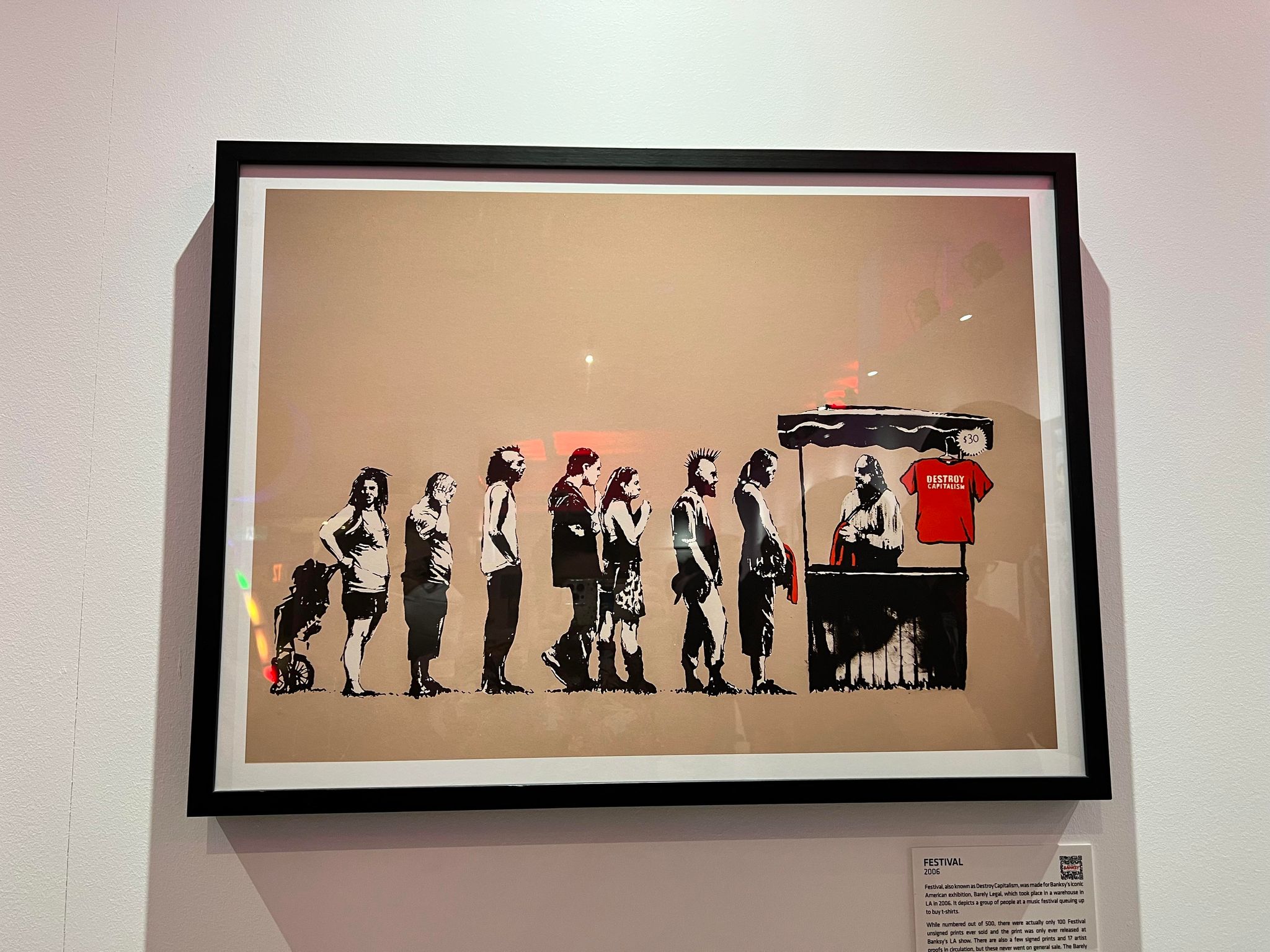
    Festival, 2006

    Festival

    In this print, we have people at a festival lining up to purchase a $30 t-shirt that says ‘destroy capitalism’. A comedian I once saw asked in their show, ‘do you ever think that we are just trying to buy our way out of capitalism?’ This reminded me of that quote.

    Logistical Information

    The Art of Banksy is on display in Brisbane until (at this stage) the end of June. You can find more information here: The Art of Banksy.

  • Gold Coast: Home of the Arts (HOTA)

    Last weekend, we left the city to visit Home of the Arts (HOTA) on the Gold Coast. We also met capybaras at Currumbin Sanctuary – a very worthwhile experience. This was my third time visiting HOTA and I have to say it is an exceptional regional gallery and I feel very fortunate to live a short drive away. Short by the standards of driving anywhere in Australia. We wanted to see the new Pop Masters exhibition and one titled Lost in Palm Springs. I am a massive mid-century fan, so I was very excited to see the latter. I’m going to briefly cover both exhibitions starting with Pop Masters.

    HOTA Building

    Pop Masters

    The full title for this exhibition is Pop Masters: Art from the Mugrabi Collection New York. All of the works on display have come from one individual’s private collection. The introductory panel sets the scene well. It states that, when we hear ‘pop art’, we usually think of Andy Warhol. While he is represented in this exhibition, there are an additional fifteen artists on display. It challenged my perception of what pop art is and exposed me to new artists I had never heard of before.

    I want to share a couple of highlight works but I will say a few overall comments. Firstly, I felt there was a lot of thought behind the layout. A lot of open space with virtually no bottlenecks or crowded areas. Even though the exhibition was super busy, we never felt overwhelmed. There is also plenty of seating! I do comment on space often because, to me, that is what makes or breaks a good exhibition experience. If I am battling a large crowd just to walk through the space let alone read any of the labels, I am going to get exhausted.

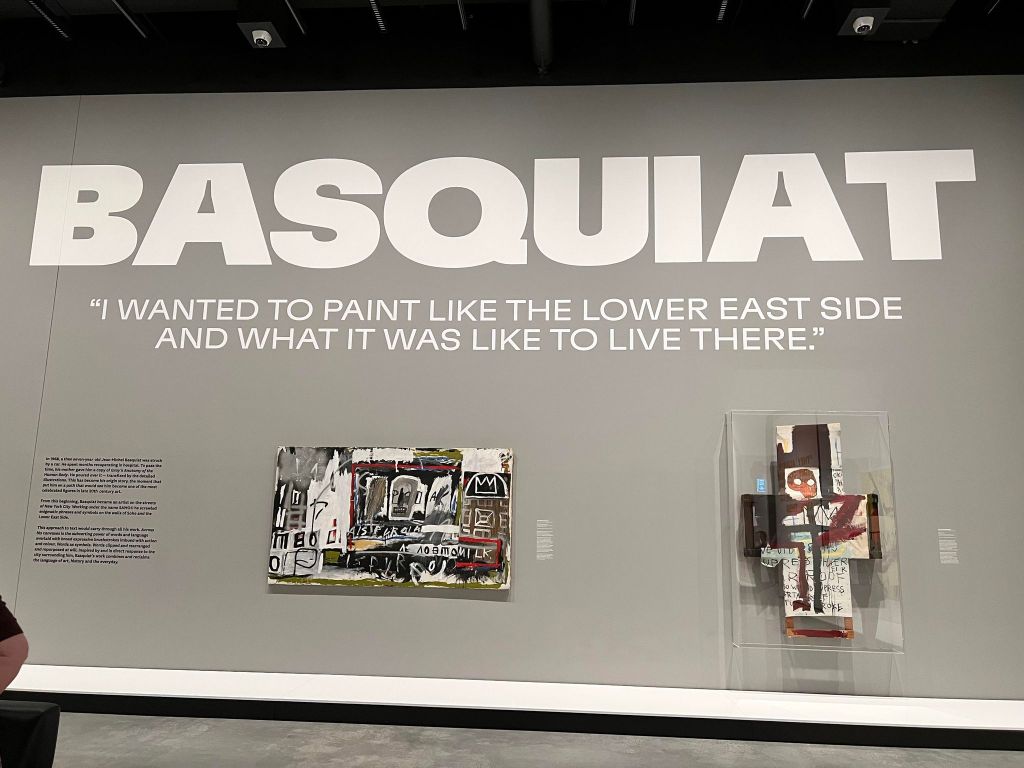
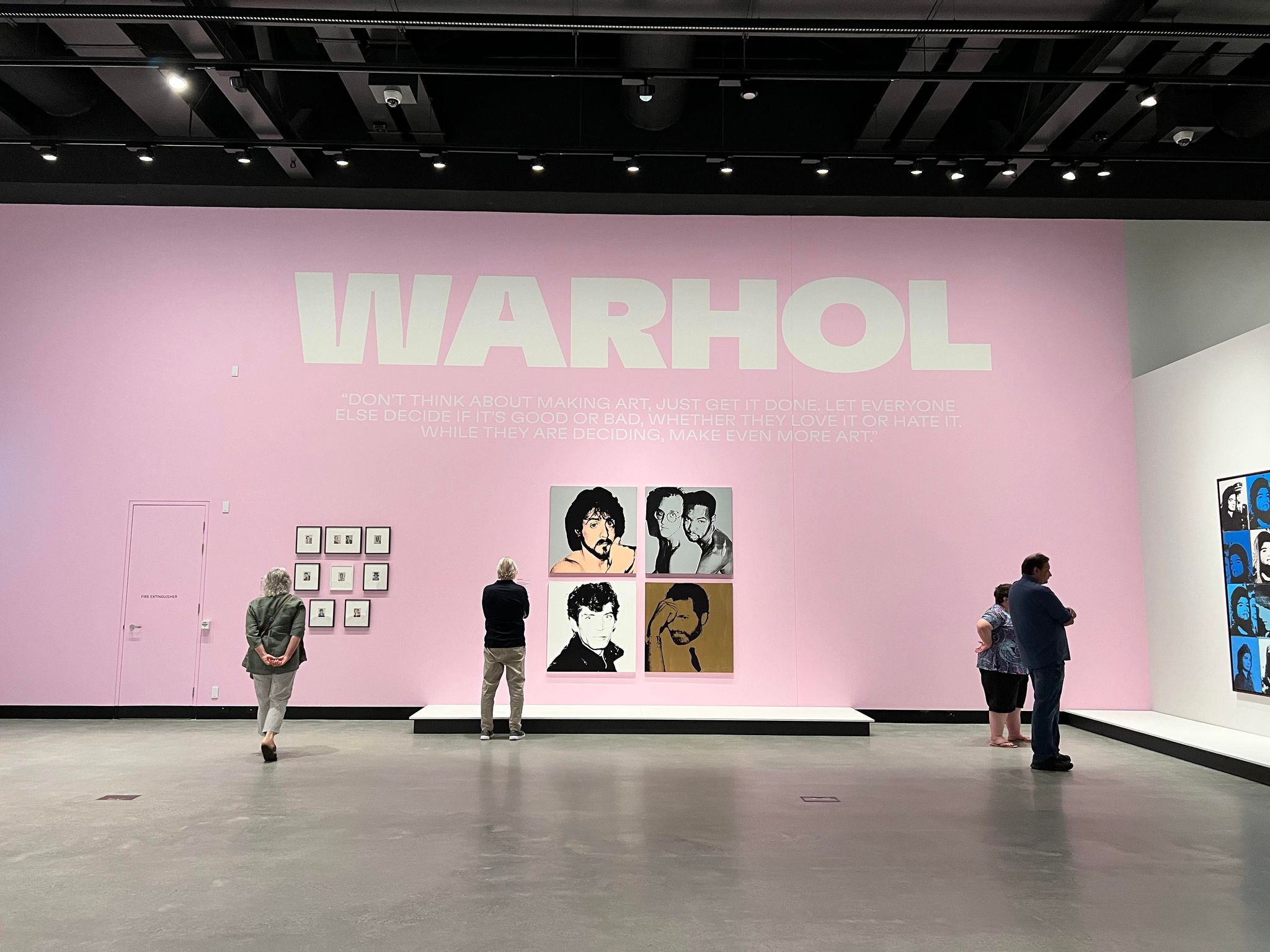
    Each of the main artists has a large feature wall with their name and a quote. In total, there are three: Warhol, Haring, and Basquiat. These walls thematically divide the rooms and help to situate the other artists on display. The entire exhibition has a nice flow to it and each theme both adds to the broader exhibition, but can be viewed as its own pocket in the space.

    Warhol Sign
    Basquiat Sign

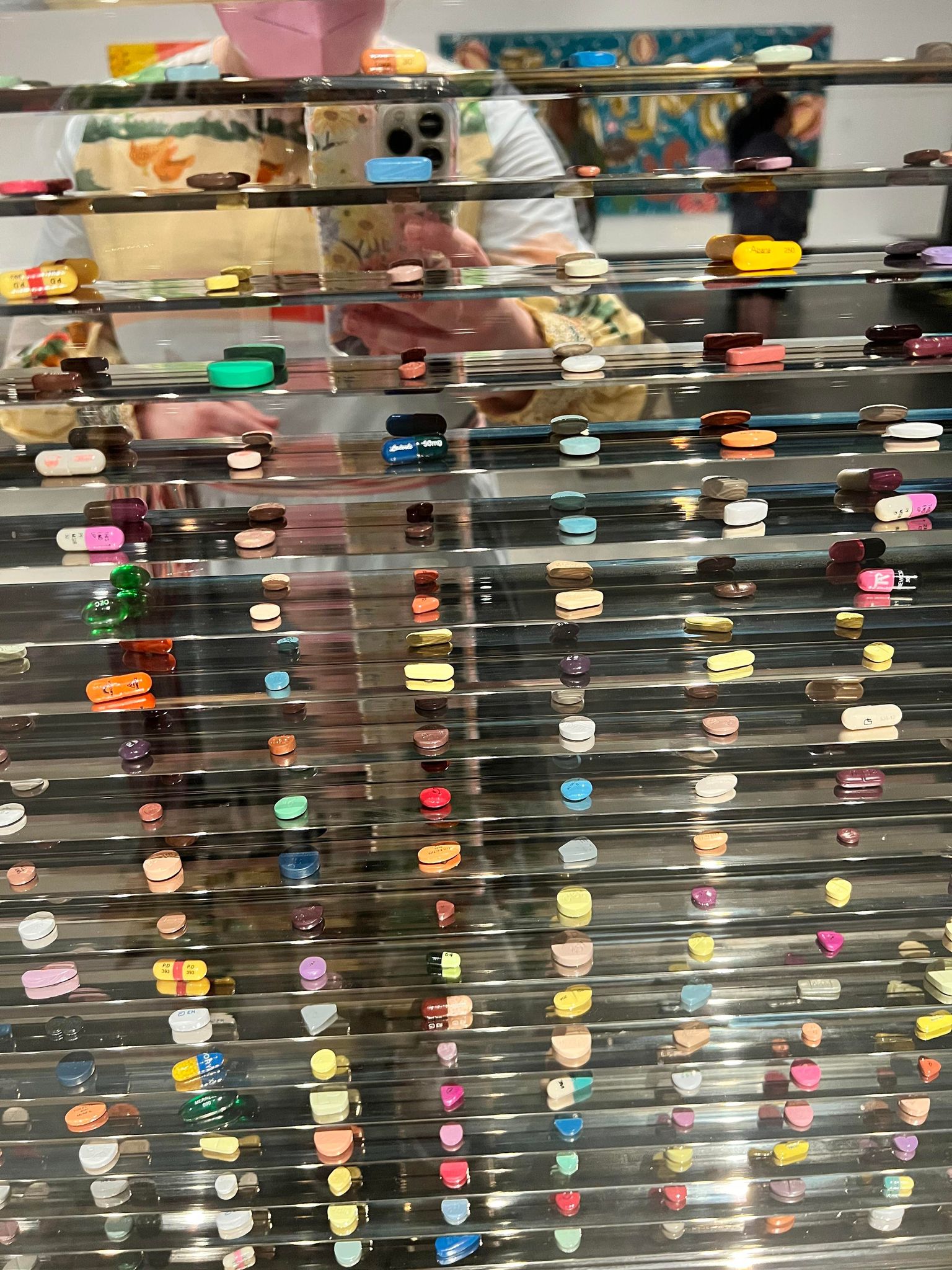
    1. Damien Hirst: When They Were Down They Were Down (2007)

    This was, by far, my favourite work in the entire exhibition. It has been included as the work speaks to mass production, a typical theme of pop art. As you can see, there are hundreds of little pills on shelves with a mirrored surface behind them. You could spend hours looking at all the pills and their unique shapes/colours/etc. When we were in the space, this was, by far, the work that generated the most discussion.

    When They Were Down They Were Down

    2. Jean-Michel Basquiat and Andy Warhol – Untitled (1984-1985)

    My second favourite work was the following.

    Untitled

    When Basquiat was 7 years old, he was hit by a car and spent months in hospital. During this time, his mother gave him a copy of Gray’s Anatomy to read. This was one of the inspirations for his work and you can definitely see that influence in this painting. This section of the exhibition had some amazing works relating to race, racism, and identity. These three artists combined proved how there is a much deeper layer to pop art than first meets the eye.

    Lost in Palm Springs

    The second exhibition we visited was Lost in Palm Springs. A must-see if you are a fan of mid-century modern. The exhibition showcases work by fourteen artists who have responded to an element of Palm Springs. Similar to Pop Masters, I really appreciated the layout of this exhibition. Nice and spacious with plenty of wiggle room around the works. Here are my two favourite works from this exhibition.

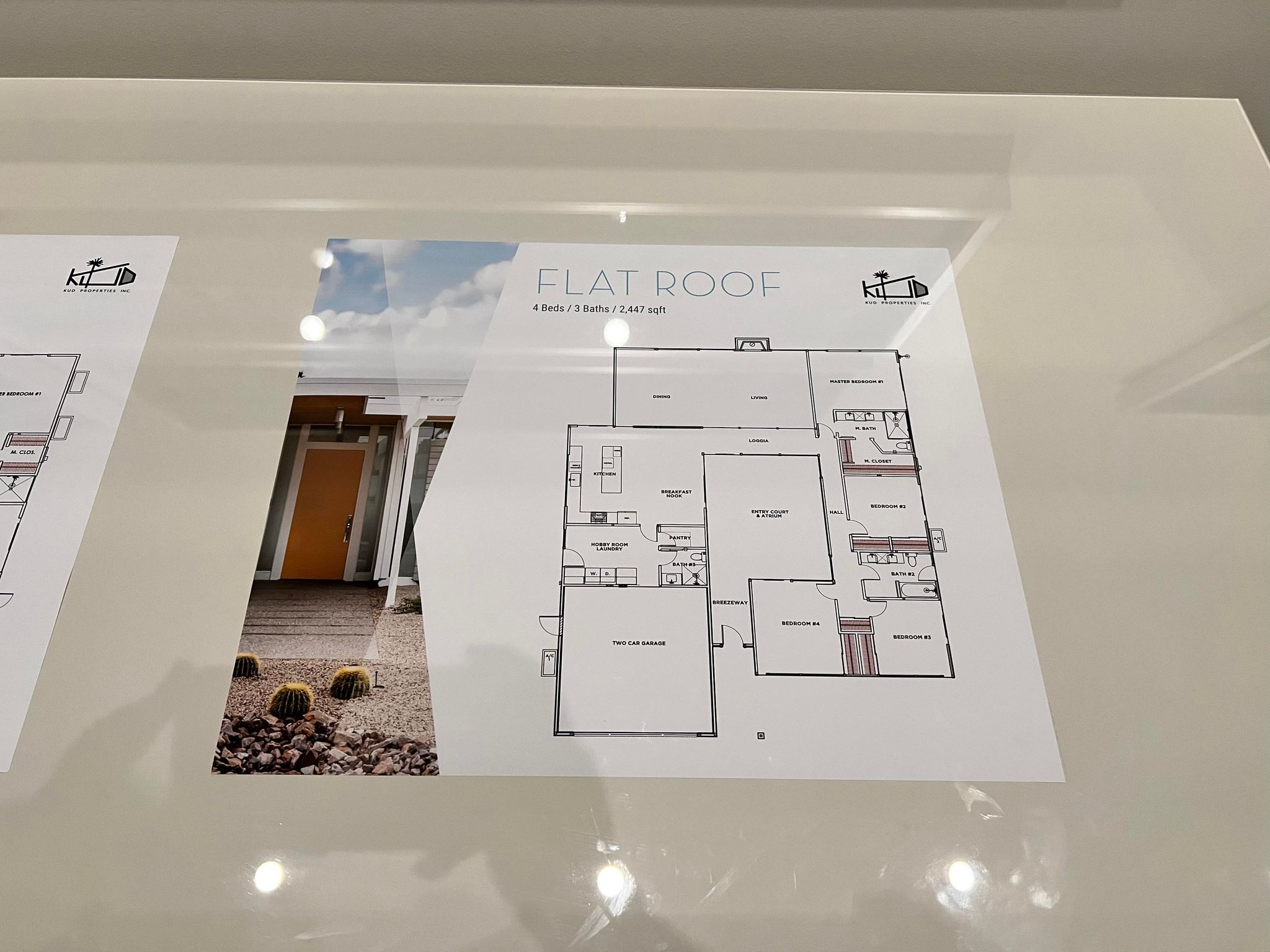
    1. Troy Kudlac: Floor Plans and Photographs (2020)

    The photographs and floor plans represent the work of Kudlac who is trying to re-imagine mid-century modern homes in Palm Springs. I particularly like how the floor plans are displayed as if they were on an architect’s table. They provide more insight into the work and give a sense of how these homes are being built.

    Floor Plans and Photographs

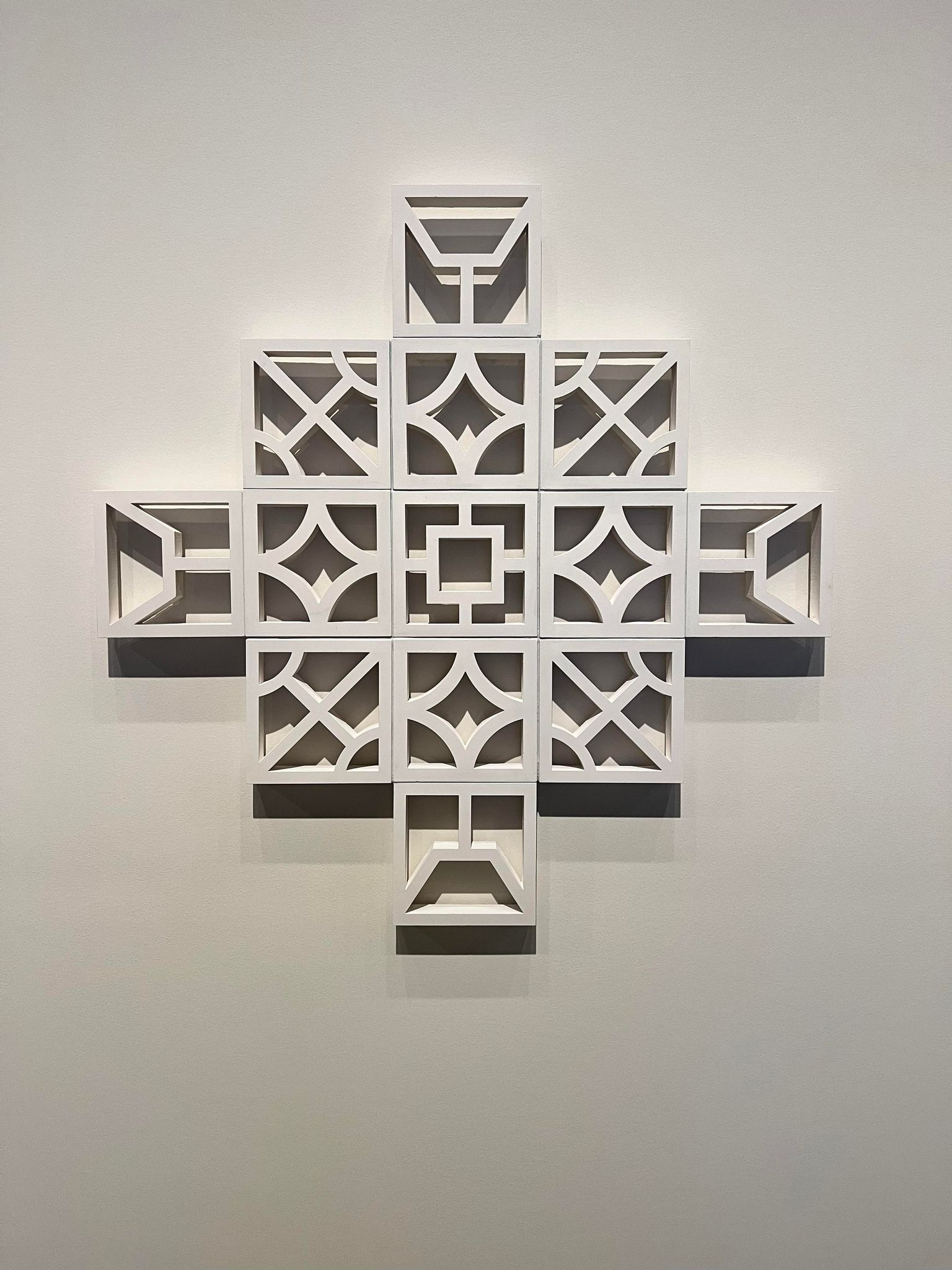
    2. Sam Cranstoun: Retro Modern 1, 2 and 3 (2015-2021)

    Cranstoun’s interest in breeze blocks is most definitely represented through these three works. Inspired by the blocks at the Lorraine Hotel in Memphis, Cranstoun found similar breeze block patterns around the Gold Coast. These sculptures capture both his interest in breeze blocks and link his work to Bauhaus industrial techniques.

    Breeze Blocks

    I left the exhibition desperately wanting to get on the next plane to visit Palm Springs!

    Logistical Information

    Pop Masters is on display until 4 June 2023. There is an additional ticket cost to see this exhibition. It is fully accessible.

    Lost in Palm Springs is free to visit and is on display until 21 May 2023. It is also accessible.

    Before you leave, I strongly recommend visiting the gift shop. I purchased some very cute little bits and pieces and there are free Lost in Palm Springs exhibition catalogues! Both exhibitions are well worth seeing!

  • Melbourne: National Gallery of Victoria (NGV)

    On our first day in Melbourne, we visited the National Gallery of Victoria (NGV) for their Alexander McQueen exhibition. Subtitled Mind, Mythos, Muse, the exhibition showcases over 120 garments and accessories from McQueen and those affiliated. I have a lot of opinions on this exhibition that I can’t wait to share. I want to start with the critiques then move onto the positives, or what worked well. There are two main critiques that, if you’ve read my blog before, will come as no surprise.

    Before I delve in, I want to share a bit more context. The exhibition is a combination of garments and historical objects sourced from the National Gallery and the Los Angeles County Museum of Art. As the interests of McQueen were varied, the exhibition reflects the many themes and ideas that inspired his work. There were some themes that resonated with me, but I’ll leave that discussion for later.

    NGV Entrance

    Critique 1: Labels

    In the past, I have written extensively about my issue with art gallery labels and how they need to be more inclusive and accessible. While I felt that the language in this exhibition was slightly more approachable than other NGV exhibitions, there is still a major accessibility issue.

    Small, white font printed on a light grey background is not something I enjoyed reading. I took a photograph and changed the contrast levels so it didn’t give me a headache. I don’t imagine this particular combination of colours could be read by everyone. The labels for the garments were mostly on the floor which is fine if they are short and sweet. Quite a few of the labels, however, were extensive. Trying to read them on the floor was a challenge. While I understand the design of the exhibition might have prevented accessible labels in some rooms, as far as I could see there were no visual aids on offer. There is a PDF of labels you can download but it is a huge document and is quite confusing.

    Critique 2: Crowd Control

    We visited the exhibition around 10.30am on a Friday. Originally, we were planning to see the exhibition on a Saturday. I am so glad we made the decision to go a day early because I can’t imagine how busy it will be on a weekend. This is great! I love seeing a busy exhibition with people engaging and admiring the works. However, the design of the exhibition did mean there were multiple bottle neck areas where it became uncomfortably busy and quite overwhelming.

    We thoroughly enjoyed the larger rooms which had space to breath. These are the rooms where garments are on display in the middle and people can walk either side. There are a couple of rooms like this, but the majority have garments on one side so it feels a bit like a conveyor belt to get through. I assumed that timed tickets would overcome this barrier, but it does feel that a lot of tickets are offered per time slot. More than is a comfortable number.

    Alexander McQueen Exhibition

    Those were my two major concerns with the exhibition. I now want to switch and talk about the positives, or what worked well in the space.

    Positive 1: Combining Old and New

    As stated in the introductory panel, the exhibition not only showcases the work of McQueen and associates, but objects from museum collections. These match the overarching themes and help to contextualise some of the pieces. It is curated so seamlessly with the old and the new interacting well in the space. To illustrate this point, I want to share a couple of examples.

    My favourite is this dress – a 1760s silk dress from Italy, currently in the Los Angeles County Museum of Art collection. It blends into the display so well and clearly shows an inspiration example for McQueen.

    1760s Silk Dress

    In the same room there is this Afternoon Dress from 1905. Just behind is a jacket and skirt inspired by the film Picnic at Hanging Rock. They blend so well together.

    Afternoon Dress

    The last example I want to share is this sculpture (circa 1871) titled Owl and Skull by Jean-Baptiste Auguste Clésinger. It is combined with McQueen’s Raven Cape which also speaks to the theme of memento mori.

    Positive 2: Combination of Garments and Accessories

    Each individual display is a work of art. Most mannequins combine shoes, a dress/other clothing, and a headdress. The Scottish-themed room was my favourite for this reason. I’ve included a few photographs below. This room also contains my favourite dress overall, the tartan one with tulle underneath.

    Mannequin – Tartan
    Mannequin – Flowers

    Positive 3: Personal Interest Themes

    Going to be a bit selfish here and say one of the positives for me, was just how many themes were of personal interest. Not only are there some anatomical references, but there is one theme which refers to the Salem Witch Trials. I wrote about the trials extensively for my honour’s thesis hence the interest. As McQueen had familial connections to the trials, this inspired one of his autumn-winter ranges.

    Salem Witch Trials Connection

    Overall, this exhibition is fantastic if you are interested in McQueen, fashion, and how they have been inspired by the past. For this reason, the exhibition will also appeal to those interested in history and design.

    Logistical Information

    The Alexander McQueen exhibition is open until Sunday 16 April. It is open from 10am to 5pm daily, with extended opening hours on the final day (until 9pm). I am hesitant to say it is an accessible exhibition. This is considering the labels and bottle necks when it’s crowded. In fairness, there is some information on their website that would prepare you for a visit if you needed assistance. I would highly recommend looking at this if required.

  • Barossa: Bethany Pioneer Cemetery

    During our time in the Barossa, I wanted to visit one of the historic cemeteries. At the top of our list was the Bethany Pioneer Cemetery. Overall, it is quite a small cemetery. However, a large number of people are buried here. Later in the post, I’ll share a link to the burial registry. In 2002, the cemetery was confirmed as a State Heritage Place in the SA (South Australia) Heritage Register. This is going to be a short post because I want to share my photographs of the cemetery. You get a much better sense of this heritage place through the images than through writing and describing.

    Heritage Register Entry

    I will share why it was entered into the Heritage Register. According to the entry, the cemetery is a significant site relating to the settlement of Bethany, a town in the Barossa. It also serves as a demographic record, highlighting the German families who immigrated to the Barossa in the nineteenth century. For this reason, it meets criteria a and f.

    A – it demonstrates an evolution or pattern in the State’s history

    F – it has a strong cultural or spiritual association for the community.

    My Experience

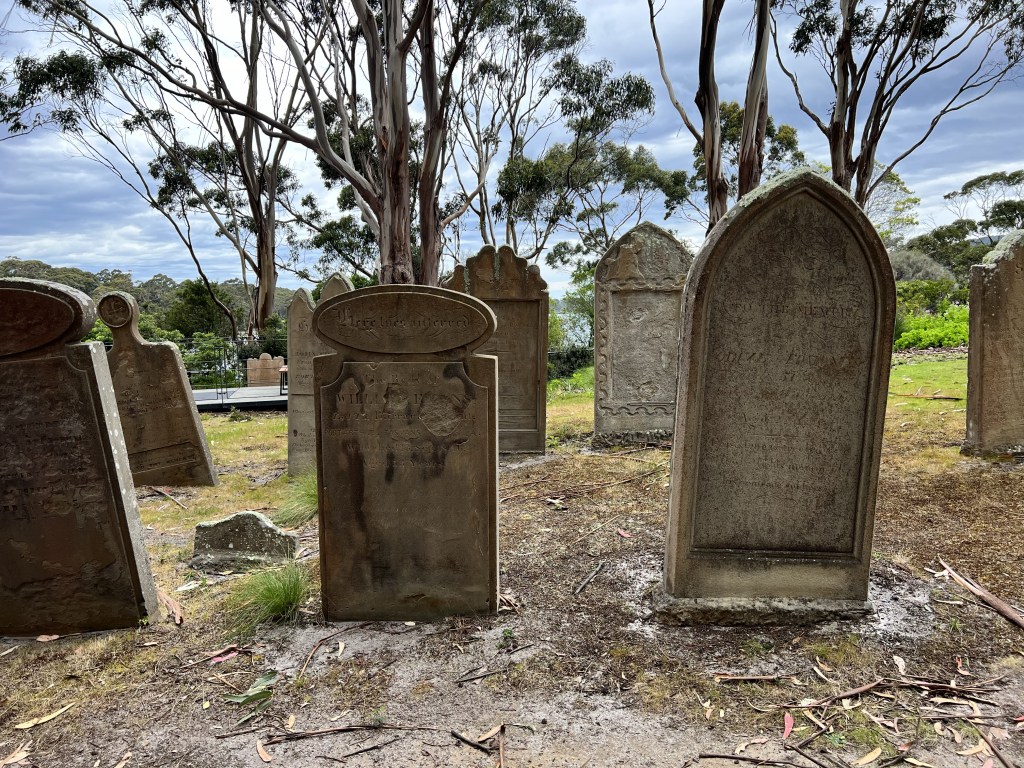
    Walking around any cemetery is a humbling experience. They shed so much light on the past and often have insightful information printed on the gravestones. In this cemetery, almost every gravestone has a German phrase printed on the front and back. I spent a while translating each gravestone and taking photos of others to translate later.

    These photographs show an overall panorama of the cemetery and a few individual gravestones. For example, there is a gravestone with two hands holding each other in a handshake. This was a very popular nineteenth century carving used to represent husbands and wives. It signifies that even in death the bond of marriage has not been severed.

    The rest of the post will be images from my time in the cemetery. Thank you to the dedicated team who upkeep this cemetery. You can find the burial registry here: https://bethanytabor.org/d/ftl6eDLvtXIe5qECgzfd88n1z.

    View from Street
    Entrance Sign
    Handshake Gravestone
    Gravestones
    Gravestones
    German Translation: I live for you, I die for you, I am yours, in death and life.
    Angel Gravestone
  • Adelaide: Museum of Discovery (MOD.)

    It is such a great time to be in Adelaide. Adelaide Fringe brings this energy and atmosphere to the city that has been wonderful to experience. I’m back in Adelaide as I was very fortunate to have a paper accepted for a writing workshop last Friday. The workshop truly was one of the most insightful experiences that has left me excited to try and publish some of my work! Post-workshop, we’ve been attending some Fringe shows and, of course, returning to museums. MOD. was high on my list because of their new exhibition, Flex. Since I’ve already written a post on the museum overall, I’m going to focus on this particular exhibition and the different themes.

    Exhibition Entrance

    Overall

    To provide some context, Flex is an exhibition that will test you and your ideas. On their website, MOD. poses the question “are limits made to be pushed? We dare you to find out.” Already, I was intrigued. The exhibition is spread across two levels and is really well spaced out. We spent an hour navigating through the space and trying (literally) every single activity. The level of interaction is fantastic. Almost every room has something you can interact with and explore. I’ll cover some examples later. The other highlight is how this exhibition tests your stance on select ethical issues and encourages you to question it in light of new or conflicting information. I’ve selected a few themes from the exhibition to focus on. These were the themes that stood out to me for one reason or another.

    Bodification

    For obvious reasons, this was my favourite theme of the exhibition. Bodification asks audiences to consider how our bodies could be repaired and enhanced in the future. Each display case in the room poses a question relating to the contents inside the case. For example, what if you could engineer your body? Inside this case are three organs, each enhanced by the addition of various animal parts. A part of a leech in the saliva gland to recognise and prevent strokes. A part of an electric eel to recognise and shock heart attacks. Finally, a part of a rattlesnake to release excess mucus in those living with cystic fibrosis. It’s pretty incredible to see and think how our bodies could be better engineered. But, where does this kind of engineering and ethics meet?

    Bodification

    The second display case I explored poses the question, what if your ability to repair had no limits? There are so many objects to consider in this case including spray on skin and artificial blood. The room left me thinking deeply about our human desire to keep living and the lengths we will go to when it comes to prolonging human life. Not just human life, but a quality of life we have deemed “good”.

    Bodification

    Pushing Perception

    This is one of the most interactive themes in the exhibition. According to the thematic panel, this section is all about pushing limits and realising that decisions we make are calculated. What happens if we change our perception of risk? The first activity is all about micromorts, or units measuring risk defined as a one-in-a-million chance of death. Along both long edges of a case are handles you can pull up to see the rating of a few different activities. Vaginal birth has a micromort rating of 120 (high). Working any job for a year has a micromort rating of 6. Just to give you two examples.

    After lifting every handle in the case, we walked over to these bright white chairs with a screen inviting us to take a seat. Here, perceptions of pain are measured and tested. Once you have taken a seat, you place your hand on a sensor and begin the experiment. At each stage, you rate your pain. I didn’t mind the hot and cold rods, but I hated the electrical currents. Throughout the experiment, there are distractions and placebos in place to change your perception of the pain. Very cool idea and I can confidently say I’ve never been exposed to this kind of pain before in an exhibition!

    Pushing Perception

    The last thing I want to talk about for this theme are these little 3D printed balls. These are printed perceptions of pain experienced by young adults. It is a visual representation of how they feel their pain and can be used to communicate this level to others. Really thought-provoking idea.

    Pushing Perception

    Canopy

    The last theme I want to write about is titled Canopy. This is a theme all about ethics and how we make decisions as to what is right and what is wrong. The title refers to the canopy sculpture that hangs in the space. It moves as people fill out a survey on a computer in order to reflect their answers.

    Canopy

    I spent a very long time with this survey answering a series of questions about my ethical boundaries. Some questions I could answer straight away. Others took time. However, the most interesting questions for me were the ones that I answered immediately but then changed my answer the more I considered what it was asking.

    Before leaving this space I filled out one of the activity cards to add to the wall. You can either leave an answer or a question. I asked – in this day and age, how do we define what is human? Additionally, how important is it to have that definition?

    Logistical Information

    There is, of course, so much more to explore. I thoroughly enjoyed this exhibition and how it tested my ethics as well as my understanding of technology. MOD. is located within the University of South Australia Bradley Building in the CBD. It’s open Tuesday to Saturday from 10am to 5pm. Entry is free and the museum is accessible.

    Definitely a museum to add to your list if you find yourself in Adelaide!