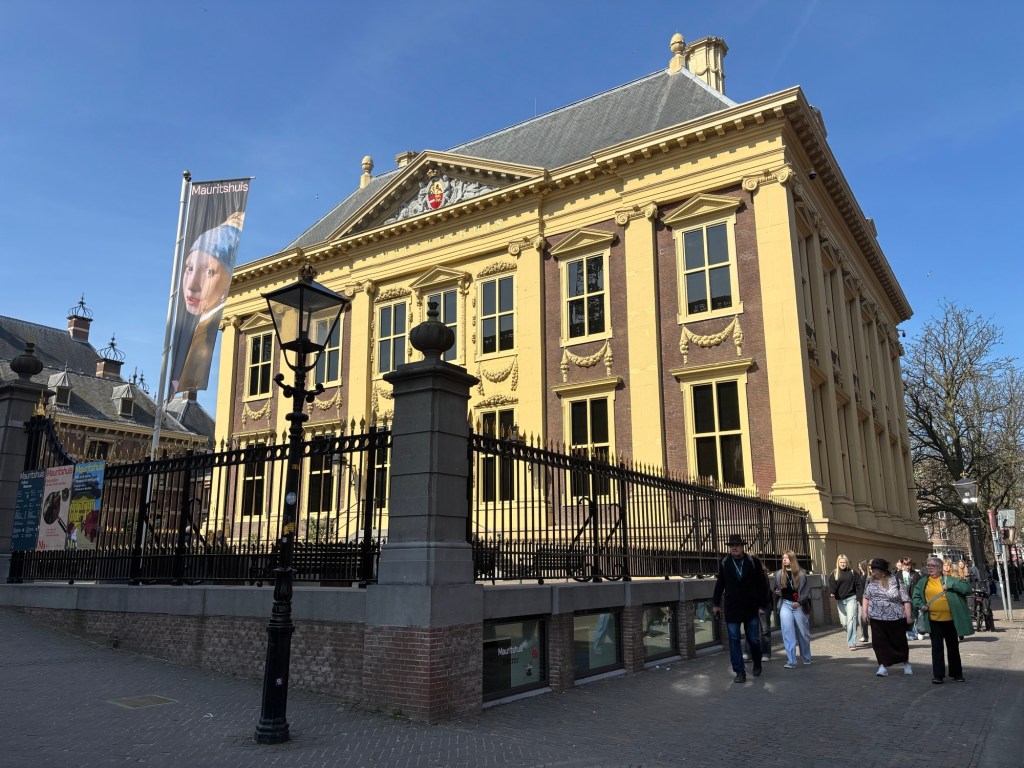
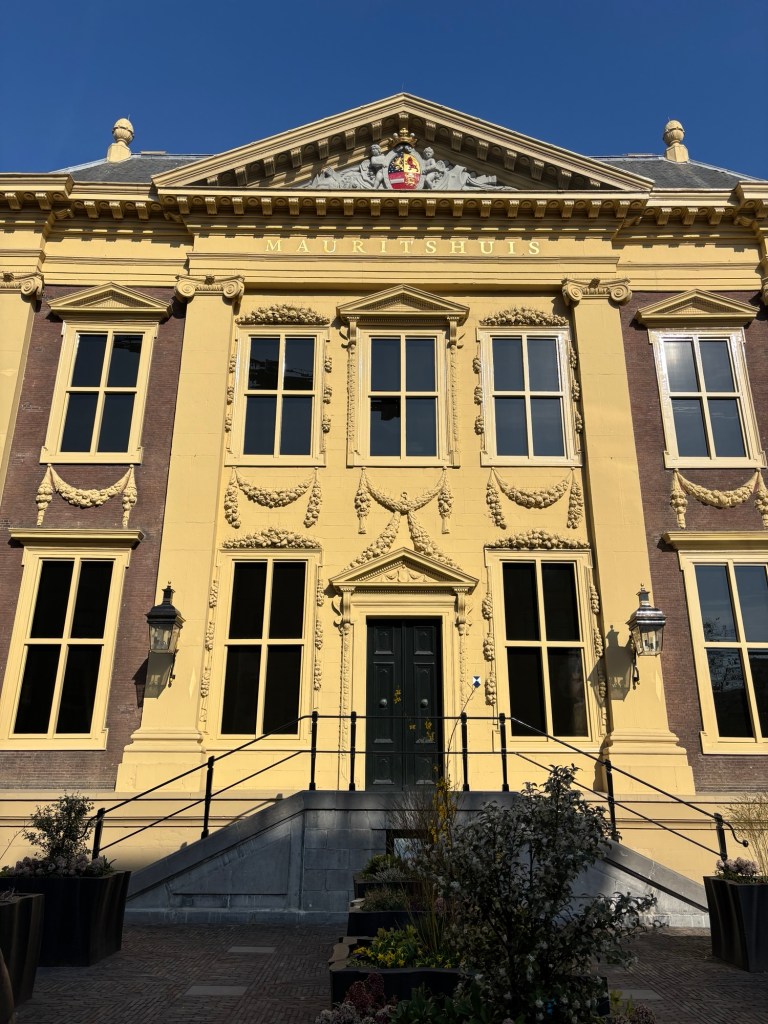
On our second last day in Amsterdam, we visited Den Haag or The Hague to see my favourite painting, The Anatomy Lesson of Dr. Nicolaes Tulp by Rembrandt. It is on display at Mauritshuis, a gallery in the city centre. Painted in 1632, this portrait of Amsterdam surgeons was commissioned when Rembrandt was only 25 years old. I’ll write more about it later.
This is going to be a short post highlighting a couple of paintings in this gallery. As always, here is some context to start.
Museum Entrance
Museum Context
Today, the Mauritshuis is a small art gallery in The Hague. It was built in the 1600s for Count Johan Maurits of Nassau-Siegen. Hence the name, Mauritshuis. Similar to most extravagant buildings from this period, there is a strong link to slavery. Maurits’ income mostly came from trading in sugar and enslaved people. It recently came to light that he also privately traded enslaved people. It is important to know this history before stepping inside. It makes you a more informed and aware visitor.
In 1822, the building was transformed into a museum, housing some of the most significant Dutch paintings.
Although the mansion is large, it wasn’t large enough to keep up with growing visitor demands. In 1987, an extension was built allowing the shop, cafe, education rooms, and temporary exhibition space to move into a connected building. The mansion itself has a ticket desk on the ground floor and two floors of exhibitions.
The floors are quite small, only containing around six or seven rooms. However, each room is filled with paintings from Dutch masters such as Vermeer and Rembrandt. One room has a painting undergoing conservation treatment. It is set up so you can see the conservators at work.
Highlight 1: The Anatomy Lesson of Dr. Nicolaes Tulp by Rembrandt
The Anatomy Lesson of Dr Nicolaes Tulp
To me, this is the absolute highlight of the museum. I’ve only seen this painting online and in art books so I was shocked to see it is massive. I was very much expecting an A3 size but it almost fills an entire wall. What stands out in this painting is the use of shadows and light. Something that made Rembrandt particularly famous.
My favourite individual in the painting has to be the confused looking man at the back. The face of so many memes. I also enjoyed seeing the details in the dissection. The red vessels add some much needed colour to the rest of the painting.
The Anatomy Lesson of Dr Nicolaes Tulp
Highlight 2: Girl with a Pearl Earring by Johannes Vermeer
This has to be the treasure of the gallery. It is a stunning small portrait that captures so much expression. The pearl earring is almost lost in the shadow, but has just enough reflection to draw your attention. We visited as soon as the museum opened so luckily the crowd was quite sparse. We had lots of time to view and reflect on this artwork.
Girl with a Pearl Earring
Highlight 3: Portrait of Jane Seymour by Hans Holbein II
Seeing an original Hans Holbein portrait was also a significant highlight for me. I love how the frame itself has little inserts with the same colours as the main painting.
Jane Seymour
Highlight 4: Vanitas Still Life by Pieter Claesz
My final highlight is this Memento Mori still life by Claesz. The skull is positioned on top of books, looking at a pocket watch. As these types of paintings were meant to remind viewers that death is inevitable and our time is not infinite, this seems fitting.
Vanitas Still Life
Highlight 5: Arm Candle Holders
The unattached arms holding candles in one of the main rooms added a sort of eerie atmosphere to the museum.
Arm Candle Holder
Conclusion
If you have never visited the Rijksmuseum before then that should be at the top of your list. However, if you have some spare time, or a particular interest in these highlights, add Mauritshuis to your itinerary.
Yesterday we travelled to Leiden to visit Museum Corpus and the Rijksmuseum Boerhaave. Leiden is about a 40 minute train ride from Amsterdam Centraal making it a perfect location for a day trip. It is a beautiful historic city filled with museums and stunning heritage places. Right in the city centre is the Rijksmuseum Boerhaave, the national museum of science and medicine. If you are even slightly interested in medicine, I would strongly encourage you to visit. On display are some of the most fascinating exhibitions and objects you will ever see.
Museum Entrance
There is so much to cover in this post. I want to share how we spent our time in the museum and some highlights from each section. To begin, however, here is some museum context.
Context: Museum
The Rijksmuseum Boerhaave is located in the old buildings of the Caecilia Hospital. The hospital opened in 1600 and closed in 1852. After this time, the buildings were used as workhouses. After World War II, the buildings were purchased by the federal government and transformed into a museum. There are two floors of exhibitions to explore including a temporary exhibition space and an entire floor of permanent exhibitions.
The name Boerhaave has come from the Dutch physician Herman Boerhaave. He taught in the hospital during the 18th century and was a early supporter of clinical teaching or teaching students within the hospital. There are a few displays around the museum that tell his story.
Stop 1: Anatomical Theatre
Anatomical Theatre
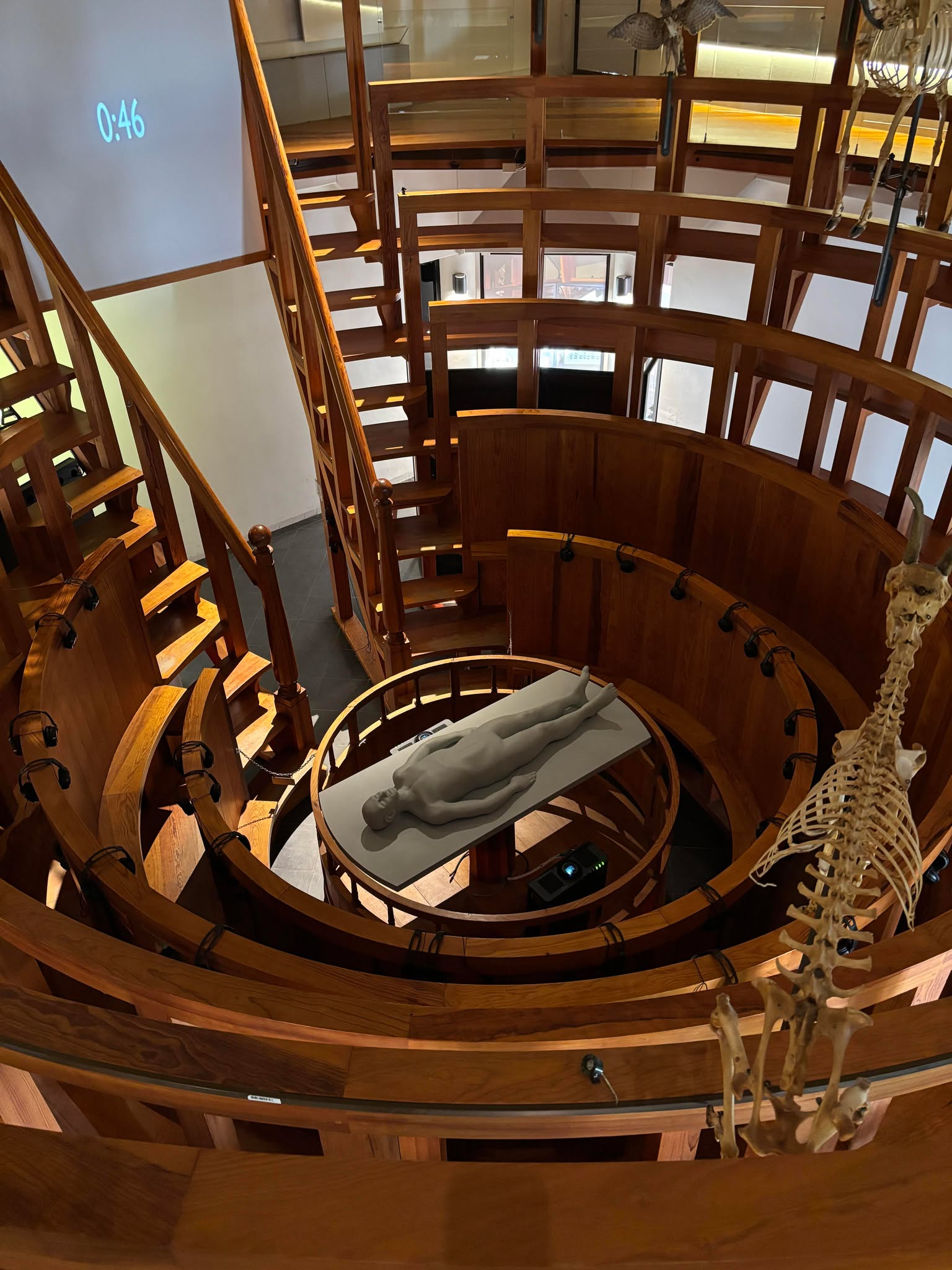
After paying the entrance fee, we walked around to the anatomical theatre for a seven-minute show. This is a reconstructed 14th century anatomical dissection theatre with a model body in the centre. Surrounding the theatre is a medical cabinet of curiosities, containing objects such as wax models of eye diseases, anatomical texts, medicinal jars, and taxidermy animals, to name a few.
Wax Eye Models
Through a series of light projections, the show highlights the history of science and pursuit of anatomical knowledge in the Netherlands. It is a quick introduction to the museum in quite an atmospheric environment. At various stages, the model body in the centre lights up to show the internal organs and blood vessels. I was disappointed that issues, such as the role of colonialism, were not mentioned. This would have added another layer to the presentation and kept it at the forefront of visitors’ minds.
Stop 2: Unseen – Inequality in Medicine
To say I enjoyed this exhibition is an understatement. Right from the start, the introductory panel clearly states the aim of the exhibition; to examine the gender bias in medicine and correct some assumptions and perceptions. There are two disclaimers on the panel. The first is that the language in the exhibition might not always include intersex people. The second warns visitors that there are human remains inside.
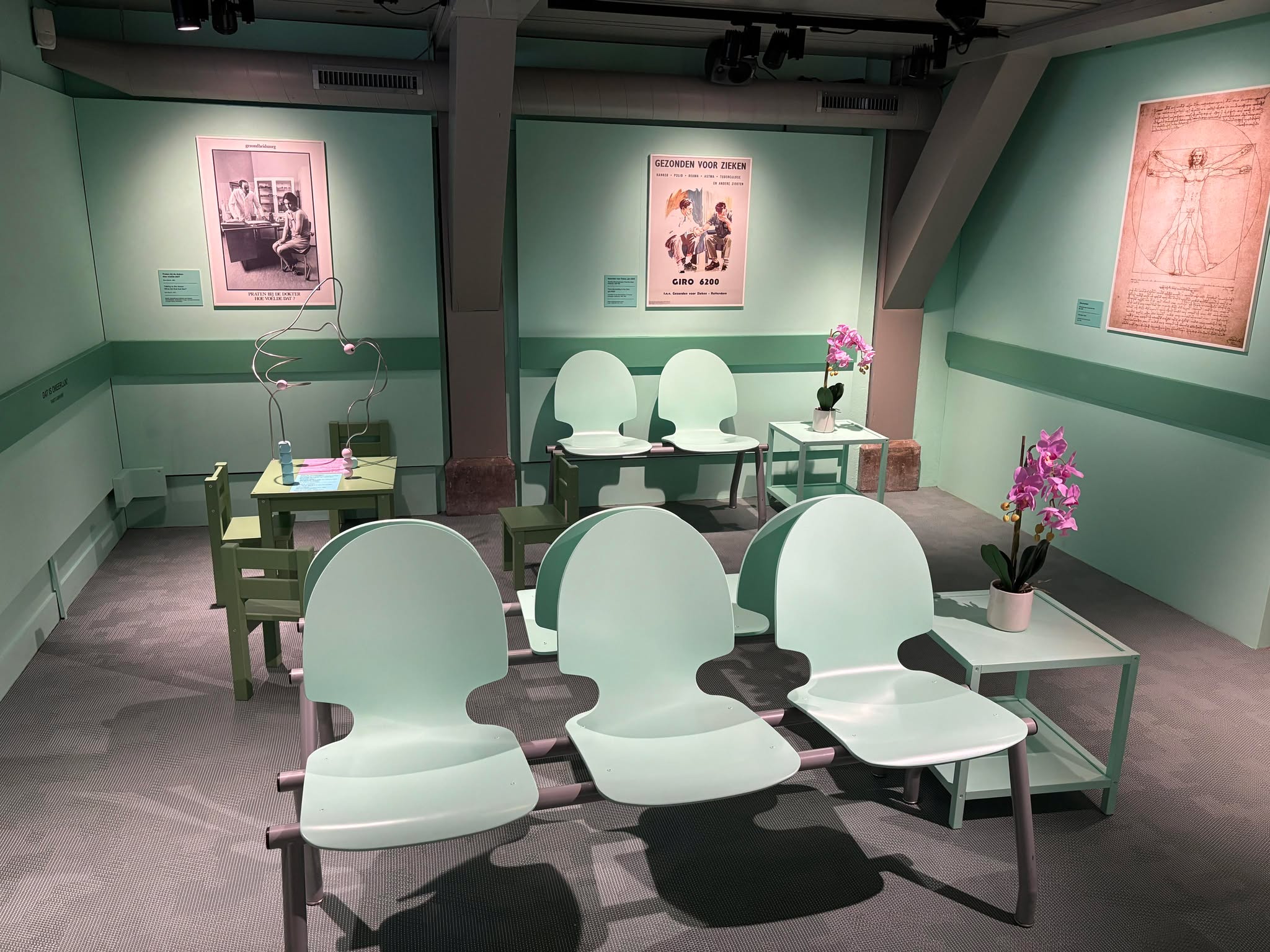
After reading the introductory panel, you enter a doctor’s waiting room. It looks exactly like a waiting room with chairs, an area for children to play, and some healthcare posters displayed on the walls. When you are ready, you can head into the main exhibition space to see the doctor. There are three separate themes and sections in the exhibition.
Waiting Room for Unseen
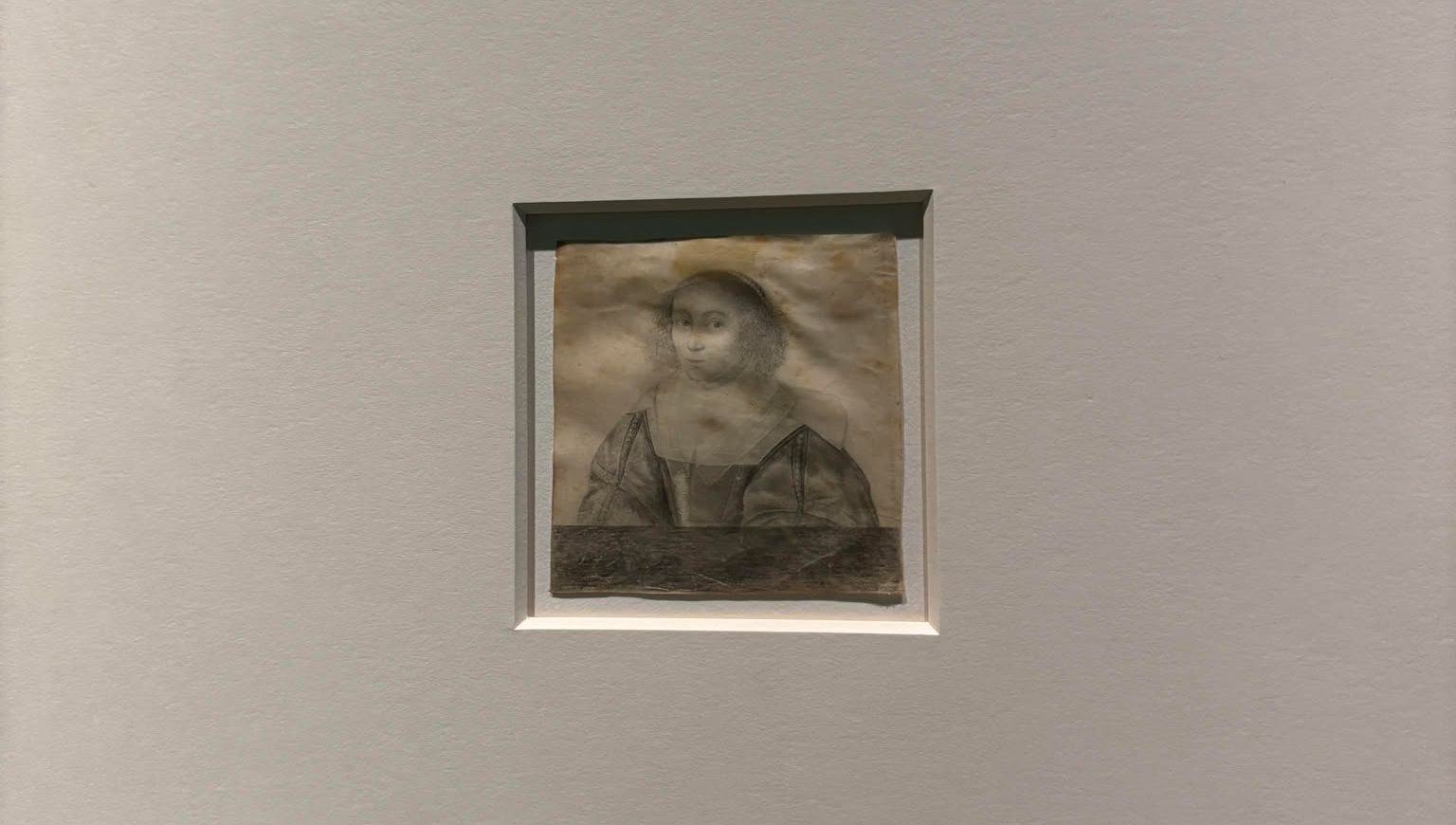
The first is titled unseen. It focuses on how the male body was the only one studied for centuries. There are a selection of texts and models on display including a fragment from a medieval manuscript dating back to between 1400 – 1500. A highlight object in this section is the self-portrait of Anna Maria van Schurman from circa 1630. Although she was allowed to attend medical classes in the 17th century, she had to sit behind a curtain, invisible to the male students. She attended the classes but was not allowed to graduate and become a doctor.
Anna Maria van Schurman
There are models of the female body on display with the point made that these were usually in the form of the anatomical Venus. A woman, laying in bed, pregnant and delicate. According to the object label for the small Venus figurine, it was a collector’s item for male doctors who wanted to show ‘authority over the pregnant body’.
Anatomical Venus
The second section is titled ignored. Here you learn all about how women and gender diverse people have been ignored by medicine and how this often leads to long-term suffering and incorrect diagnoses.
A highlight in this section is an interactive outline of a female body. You are asked to move a stethoscope around the body and listen to find six medical conditions. This, along with other objects in this section, draws visitors’ attention to the fact that women and gender diverse people are far less likely to receive a correct diagnosis when compared to males. This section also addresses intersectionality. For example, the fistula knife of Dr James Marion Sims is on display. He operated on enslaved women without anaesthetic in order to treat a fistula or opening between the vagina and bladder. Many Caucasian women at the time were provided anaesthetic for this procedure.
What is Wrong
The final section is titled rebellion. This is where authority is handed back to women and tells the story of how we are fighting for health equality. A highlight object in this section is the booklet by Aletta Jacobs published in 1900. This was sold for a small price to women with limited money so they could learn more about their bodies.
Aletta Jacobs Book
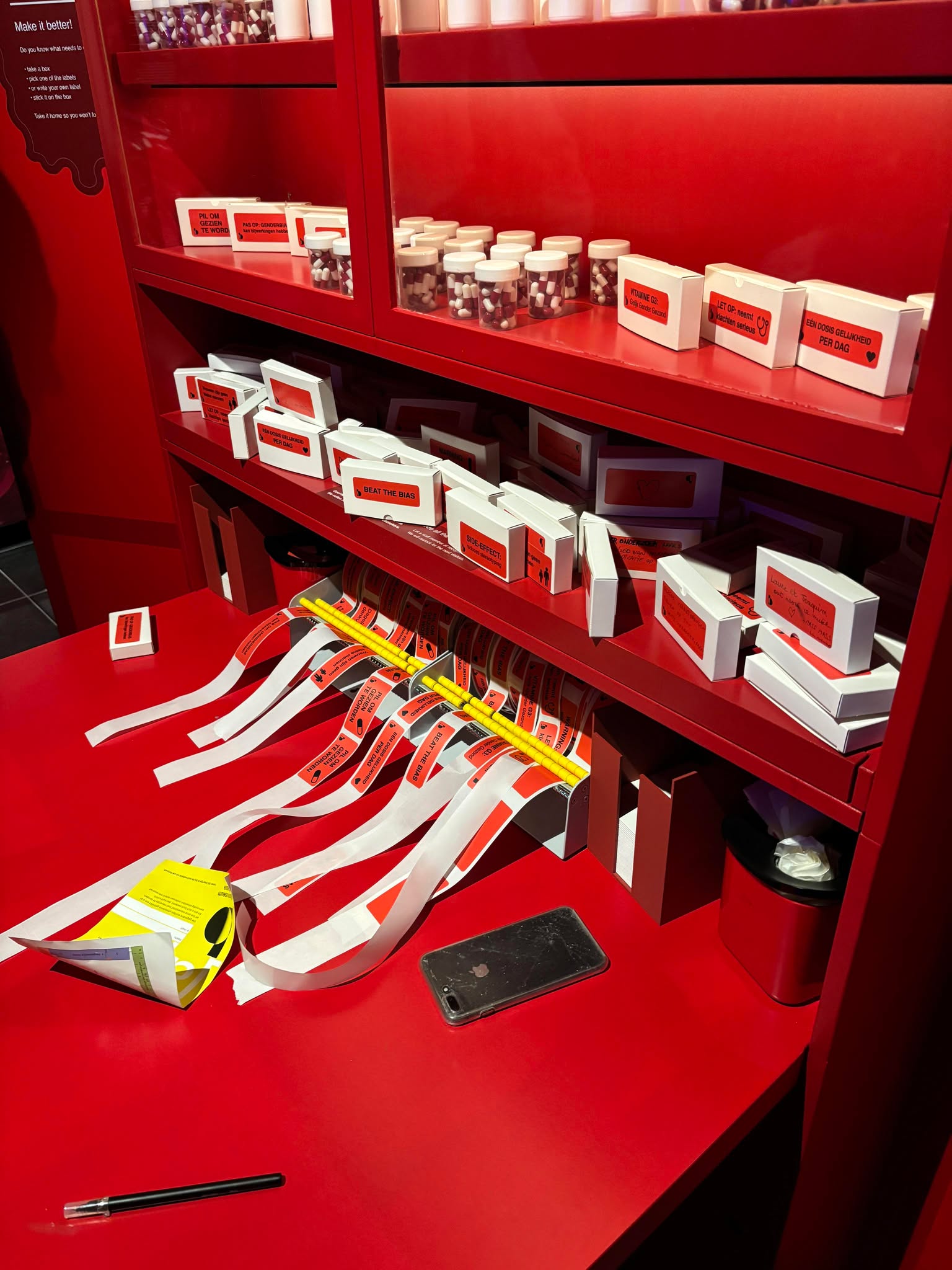
The interactive in this section was a standout for me. Here you can make your own medication box and add stickers with sayings such as ‘beat the bias’ and ‘women are not small men’. Such a powerful interactive and I saw so much engagement by visitors.
Medicine Box Creation Station
Stop 3: Permanent Display
After a break in the cafe, we headed to the top floor to view the permanent display. This covers themes such as the Golden Age, Sickness and Health, and Great Collections. We made it through three of the sections before visitor fatigue set in.
Golden Age
This exhibition covers the Golden Age of Dutch exploration and what contributions were made to science and medicine. There are objects on display such as an original Andreas Vesalius anatomical text from the 1500s.
Andreas Vesalius Book
About half-way through the exhibition there is a digital interactive that is truly a highlight. You lay your arm on a screen which activates the video. Lights are projected onto your arm to make it look as though it is being opened with a scalpel. As surgery is performed, your muscles and bones become exposed. Meanwhile, the screen is telling the story of Vesalius and his dissections at the university of Padua. It is an extremely effective interactive learning tool.
Surgery Interactive
Sickness and Health
This exhibition focuses on the advent of different medical specialities and how they advanced our knowledge of the human body. Similar to a couple of other medical museums we have visited, the exhibition uses patient beds as a way to separate different themes.
One of the themes is on childbirth and contains this obstetrical training manikin from the 18th century. It was used to train doctors who could use the model to practice birthing techniques. Recent study of such manikins has shown that many actually contain human bone material.
Obstetrical Training Manikin
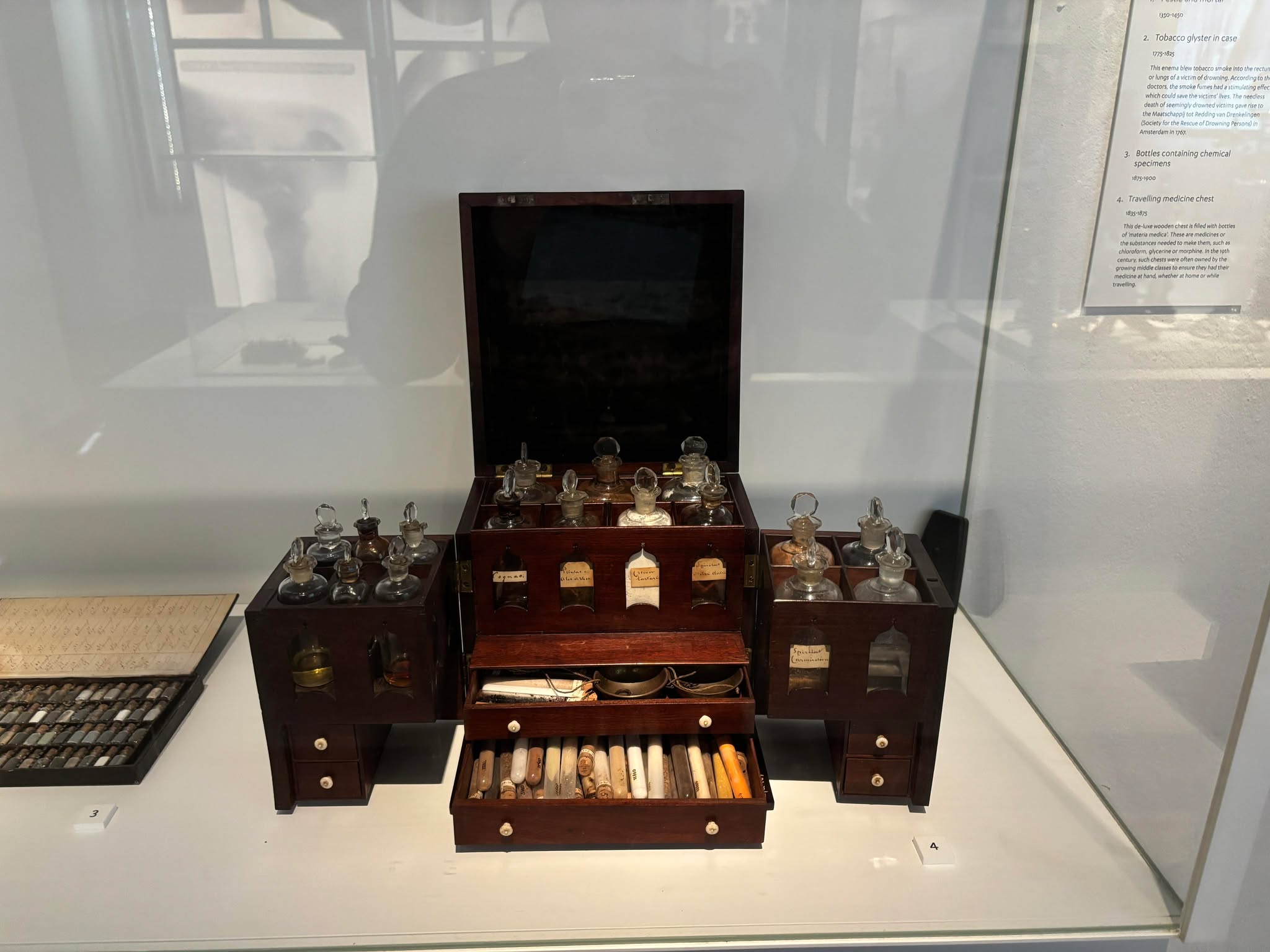
The next room covers the laboratory and how they were critical for studying the human body and, in particular, disease. One of the first objects you see in this space is a travelling medicine chest or materia medica. These compact chests had everything you needed for an in-home, 19th century first aid kit.
First Aid Kit
Great Collections
The final exhibition I want to cover contains some significant objects from the collection, each with an accompanying digital screen. The objects on display show the future of medicine and raise some critical ethical questions. You can engage with these questions on the digital screens.
For example, on display is an artificial kidney, or early dialysis machine, from the 1940s. The object label describes how the machine works and how it has saved so many lives. The digital screen discusses non-human donors and the ethics behind growing organs in animals or in a laboratory setting. You are asked, would you accept an organ that did not originate from a human?
Early Dialysis Machine
Conclusion
I have only really skimmed the surface of what is available in this museum. In total, we spent close to three hours here which is almost a record. I would like to revisit in the future and see what we missed. The temporary exhibition, Unseen, is on display until 8 March 2026.
We arrived in Amsterdam yesterday and have hit the ground running. This is my third time visiting Amsterdam, so I wanted to explore some more niche museums and sites. I am also so excited to finally see the tulip fields! Today, we visited two museums, one of which was Museum Vrolik, located within the Academisch Medisch Centrum (AMC). This is about a 45-minute metro ride from Amsterdam Centraal.
Similar to other museums with specimens, there is absolutely no photography. This is made clear at the entrance and also throughout the museum space. I really like how they speak about this on their website, encouraging visitors to become students of anatomy. By this they mean respecting the material on display by observing and learning. Not by sharing images and potentially causing distress.
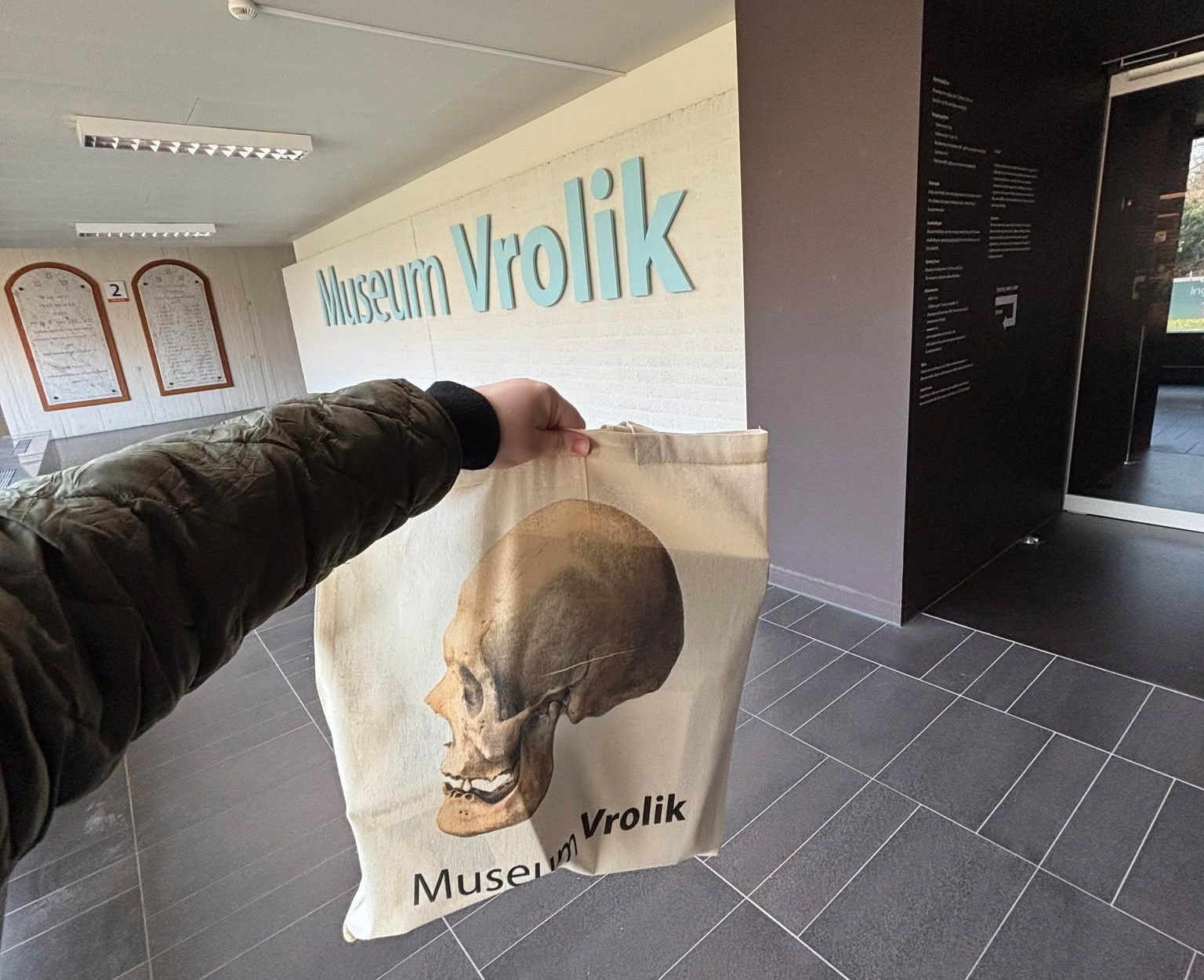
For this reason, I only have a couple of photographs to share (from outside the museum and of my amazing new tote bag).
Museum Entrance
Context: Museum
The museum’s website offers a comprehensive history including information on those who have contributed to the collection. For this post, I am going to summarise it here. The museum is named after Gerard (father) and Willem (son) Vrolik. Both were professors of anatomy in Amsterdam and collected anatomical as well as pathology specimens (human and animal) between the late 1700s and mid-1800s. As with so many of these early collections, it was initially stored at their private home.
The museum is transparent about this next section of their history. Skeletal specimens of colonial origin was also collected to understand race theories of the time. None of this collection is on display today. I can only imagine the many ethical and repatriation discussions happening behind closed doors. I will mention here that in 2018, Māori material was repatriated.
After Willem’s death in 1863, the collection was purchased by some rich Amsterdam citizens and donated to the precursor of the Amsterdam University. Over time, more anatomists contributed to the collection, acquiring specimens that reflected their various interests.
The museum was housed in different locations around the city centre before being moved to the University in 1984.
Context: Collection
The collection contains a standard array of preparations including potted specimens, wax models, plastinated specimens, and dried skeletons. What stood out to me is the extent of the skeletal collection. Not just human, but also animal.
The earliest contributor to the collection was Jacob Hovius, a physician from Amsterdam. He collected skeletons displaying pathological conditions, donating them to the guild of barber-surgeons in 1772. If you don’t know the history of surgery and barbers then I encourage you to stop reading here and go down that rabbit hole. His wooden cabinet of skeletal specimens is now housed within the museum.
There are some medical history objects on display surrounding the museum that I presume are also in the collection and not on loan. These consist of medical texts as well as medical devices and historical instruments.
Context: Display and Layout
Museum Sign
The museum consists of one large room filled with glass cabinets. As mentioned in the previous section, there are objects surrounding the museum but no specimens. Directly inside, on the right, is a small ticket desk and shop. After paying the entrance fee, you are free to explore.
At the front of the museum, on the left, is a section dedicated to animal material. There are some potted specimens as well as skeletal specimens to view. As you move around the perimeter, you come across some full adult human skeletons. Right at the back, on the left, is the Hovius display. As you move around the perimeter you then come to a reading area with books, chairs, and a table.
In the middle of the museum (and on the left hand perimeter wall) are a series of glass cabinets containing the various anatomical and pathology specimens. The glass cabinets are divided by body part or organ and, at times, themes. For example, there is a section on the arm rather than a section on the musculoskeletal system. This is a bit different to what I’ve seen so far. This is the first museum where body system classification is not primarily used.
Each cabinet has a laminated sheet where you can discover more about the specimens. I’ll speak about this later.
That essentially summarises the museum and its layout. It’s not a huge space and the specimens are displayed with not much room to spare. If this is your first pathology or anatomy museum, I suggest taking your time so to not become overwhelmed.
Highlight: Information Sheets Summary of Organ
Each glass case has a laminated sheet in English and Dutch where you can find more information. Take, for example, the cabinet on the brain. The sheet firstly outlines the function of the brain and how it fits into the entire body and body systems. At the top of the sheet is an outline of the specimens in that section with a corresponding number. So, if you’re looking at the fourth specimen along, you can find its outline on the sheet, get the number, and read what exactly the specimen is further down.
The summary of each organ adds context to the display and would be a fantastic initial read for anyone looking for a bit more baseline information. There is only one sheet in each language available, but I’m sure the front desk would be able to assist if needed.
Highlight: Digital Display
The Hovius wooden cabinet really dominates the space and is quite intimidating on first viewing. Rather than a sheet, the museum has opted for a digital label where you can select specimens in the cabinet to read more.
This works a lot better for this particular section because more information on the bones can be disseminated via the screen. I would be interested in learning if this kind of digital integration is something the museum wants to expand on in the future. It works really well within the space and can allow for the information to be edited and updated without needing to print new sheets.
Conclusion
It has really been fascinating to see how these collections are opening more to the public and grappling with providing information to a wider audience. At the end of my visit, I purchased the absolutely essential museum tote bag and the museum’s catalogue.
Museum Tote Bag
Despite it being quite heavy, I am going to find a way to safely transport the catalogue back to Australia. It has a great overview of the collection and its educational value.
Today we travelled from Berlin to Hamburg to visit the Medizinhistorisches Museum or Medical Historical Museum Hamburg. The train from Berlin to Hamburg takes approximately two hours and runs through some pleasant scenery. As well as having an amazing medical history museum, Hamburg is a great city to explore. Definitely worth a day trip at the very least.
Unlike the other two museums I’ve reviewed from this trip, the one in Hamburg has no pathology or anatomy specimens. It does have a range of moulages or wax models, but no human tissue on display. For this reason, photography without flash is allowed throughout the entire museum.
Context: Museum
The museum is part of the University Medical Center Hamburg-Eppendorf. This is a teaching hospital attached to the University of Hamburg. It’s also the largest hospital in Hamburg with just over 1 700 patient beds.
I tried looking for more information about the museum building and came across a post by Inga Marie – a tour guide from Hamburg. Thanks for the extra information. The building was constructed by architect Fritz Schumacher in the early 20th century. It was built for the pathology department and situated on the outskirts of the hospital. This was to prevent diseases spreading to other parts of the hospital. The original 1926 autopsy room still stands and is an absolute highlight of the museum.
Today, the building is home to the museum. It’s currently undergoing external renovations with scaffolding covering the entire building. Despite how things might look, the museum is still open.
Museum Entrance
Context: Collection
The collection focuses on the medical history of Hamburg but speaks to broader themes and topics. As mentioned earlier, only medical objects are on display, no specimens. The moulages are specimen-like wax models showing various diseases. Arguably, you can view these as specimens. But in terms of human tissue, there is none on display.
Their collection spans centuries and they are still collecting today. I am going to write about their contemporary collection later. The main objects on display are books and ledgers, photographs, medical devices, and medical instruments. There are a few textiles including a white lab coat from the 19th century. From what I can tell, the museum also receives loans from other institutions to supplement their exhibitions.
19th Century Lab Coat
Context: Display and Layout
There are three levels of exhibitions to explore. When you enter the museum, there is a small ticket desk. Behind the desk is the entry to the heritage rooms, including a hand washing room, teaching theatre, and autopsy room. The current exhibition in these three spaces displays objects and information surrounding pandemics.
On the next level are eight permanent exhibition rooms covering topics such as becoming a doctor, medicine and technology, the hospital, moulages, Nazi medicine, histology/pathology, disease outbreaks, and genetic diseases.
The final level is a temporary exhibition space. At the moment, there is an exhibition on Lenin – pathology, psychology, and propaganda. We didn’t spend much time on this level.
Highlight: Grappling with Difficult Histories
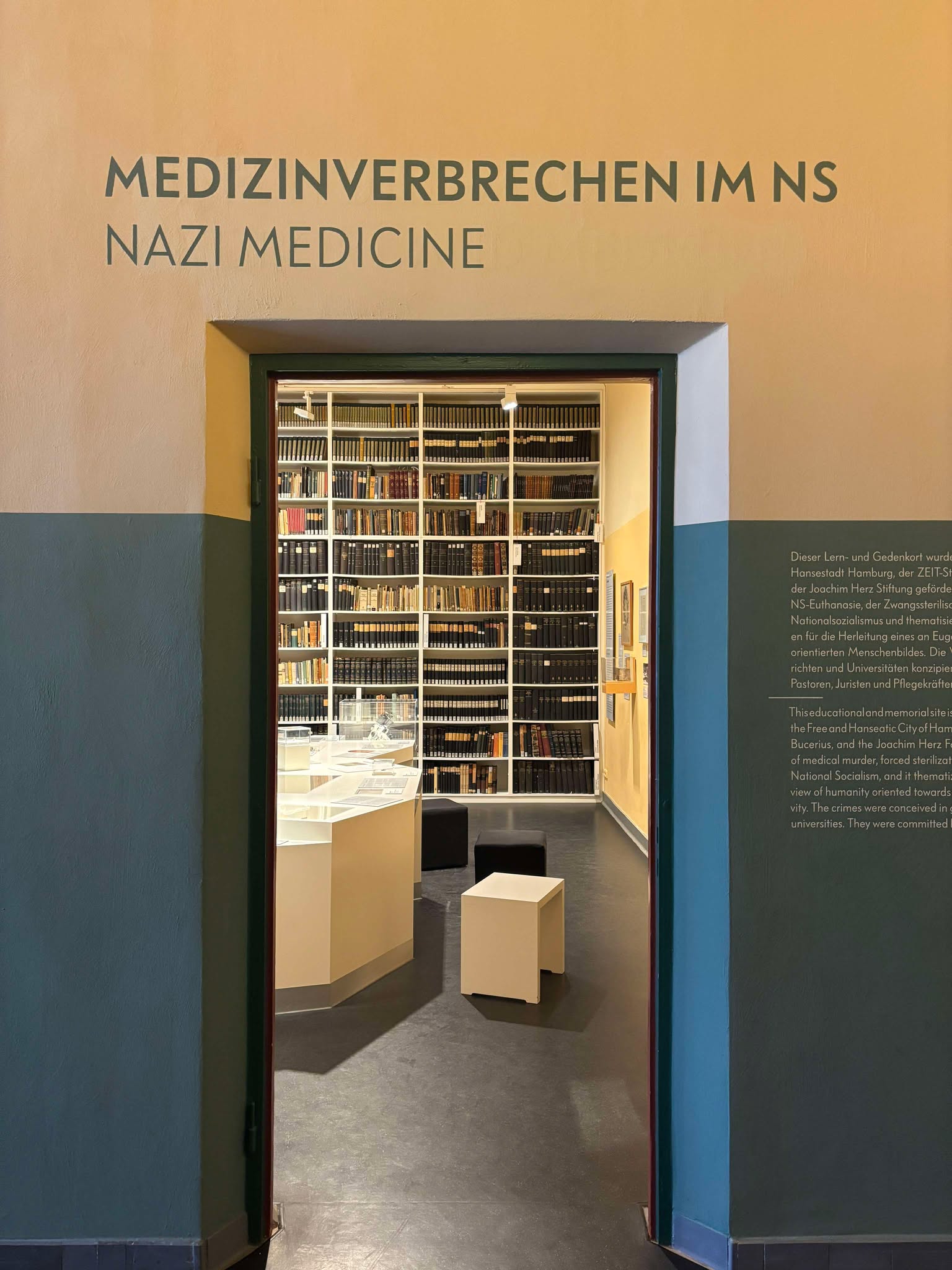
Located on the second level of the museum is one of the most confronting yet significant exhibitions covering Nazi medicine. Outside each of the eight rooms on this level is a thematic panel. For this particular room, the panel covers how patients from the hospital were victims of medical murder under National Socialism. How they end the panel is particularly powerful; reminding visitors that these crimes were “conceived in government bureaus, court-rooms, and universities. They were committed by doctors, pastors, nurses and lawyers.”
Nazi Medicine Display
Inside the room are a variety of objects and stories, respectfully displayed forming a thoughtful memorial. The history presented is transparent and highlights the victims and their experience. I felt so inspired by this room as it proves you can display difficult stories in an accessible and approachable way to best educate your visitors.
Highlight: Contemporary Collection Display
In the pandemic exhibition on the ground level there are a lot of objects relating to the Covid-19 pandemic. I want to share three highlight objects that really had an impact.
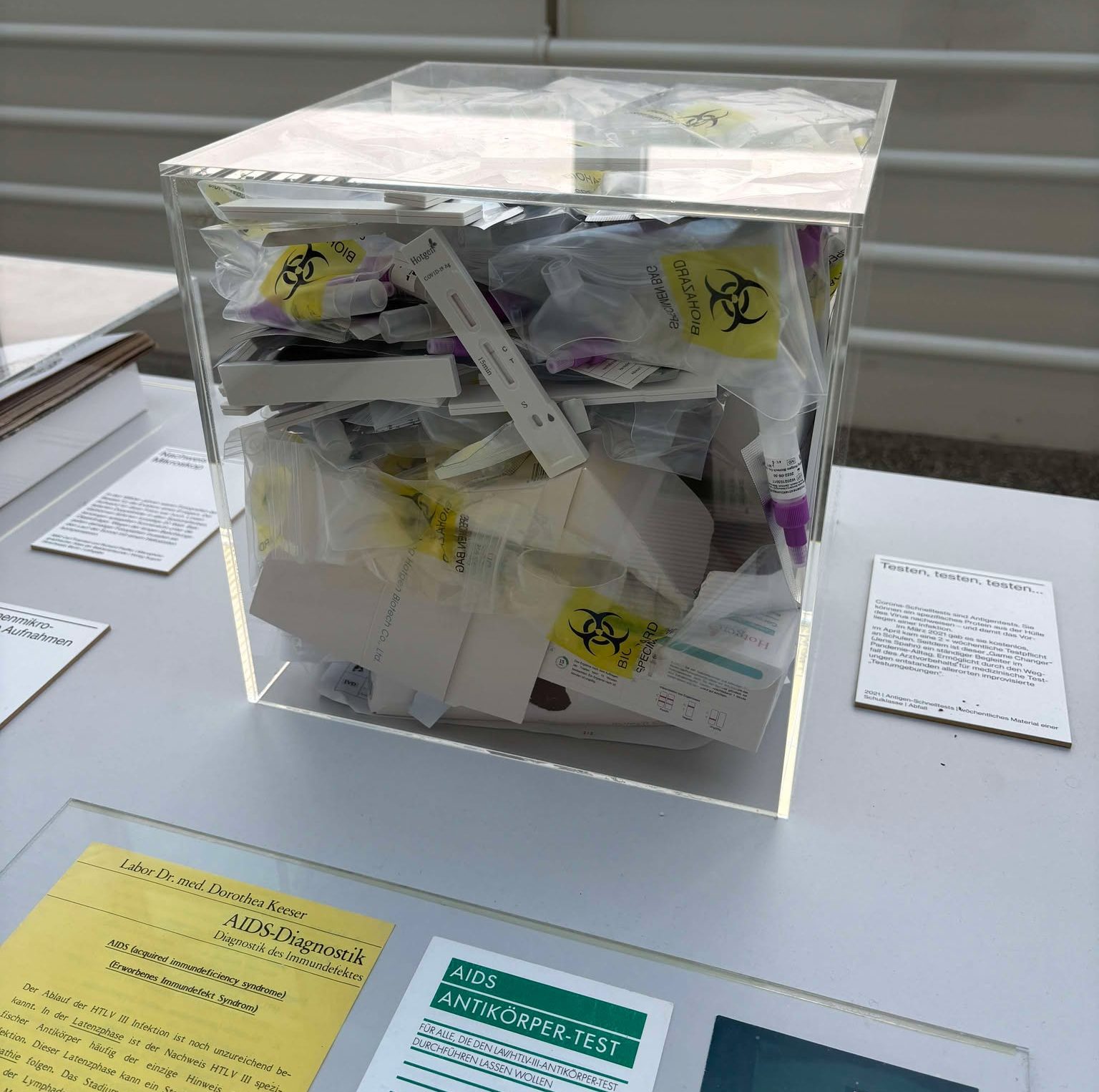
1. Covid-19 Tests
On one of the tables is a giant box filled with used Covid-19 tests. Seeing anything in a large number has an impact on me.
COVID-19 Tests
2. Vaccine Vials
These 426 Pfizer vials have been arranged to form the shape of Germany. I saw this as the vaccines giving hope to the country and a way through the lockdowns and isolation.
Vaccine Vials
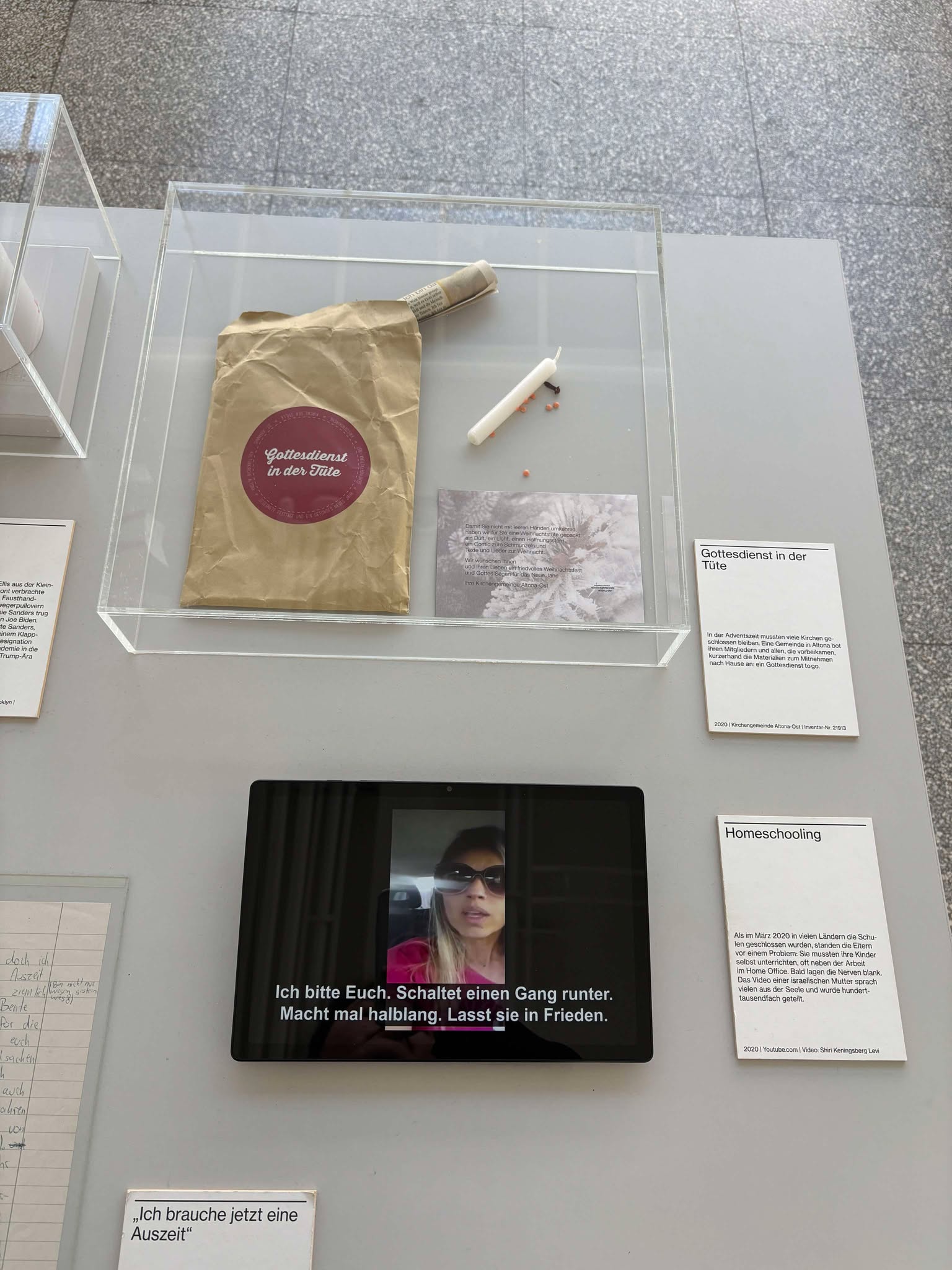
3. Homeschooling
I chose this particular digital element because it is a screen playing TikTok videos on homeschooling, created by Hamburg residents. Great to see how a digital collection can add to a display.
Homeschooling Display
I have read and seen so much about collecting Covid-19 stories. Seeing how another country has collected/displayed this history was definitely a highlight.
Highlight: Old and New
I cannot finish this blog post without mentioning the combination of old and new. The pandemic exhibition starts in the original wash room where doctors would prepare before performing an autopsy. Next to the original sinks are art installations and advertisements covering the importance of washing your hands to stop the spread of Covid-19.
Old Preparation Room
In the autopsy room, each table is a different theme that relates to pandemics. Laying over some of the autopsy tables is a clear Perspex sheet, supporting labels and some objects. Some of the tables have been left empty so you can see the original without obstruction. The blend of old and new is seamless and adds so much to the experience. Mixing heritage places with museum displays can work so well.
Historical Autopsy Room
Highlight: Object
My favourite object (or I should say, objects) in the museum is this wall of anatomical illustrations. I think they are from the 19th century (forgot to take a photograph of the label!). They are so well curated into a feature wall that grabs your attention. I adore old anatomical illustrations so these were the objects for me!
Anatomical Illustrations
Conclusion
I’m writing this blog post on the train ride home and, at this stage, I can honestly say this is in my top three medical museums I’ve visited. They have done an amazing job communicating such complex histories. I’m so glad we decided to spend the day in Hamburg and see this wonderful collection.
My experience at Med Uni Graz was truly incredible – a career highlight. The Department of Macroscopic and Clinical Anatomy team was so welcoming and taught me all about their teaching facilities and specimen collection. I have since left Graz and ventured on to Berlin.
My first medical museum post-Graz has been the Berliner Medizinhistroische Museum der Charité or Berlin Museum of Medical History. Not only do they have an extensive pathology specimen collection, but also a range of historical objects. Understandably, there are photography restrictions in the pathology specimen section, so I’ll only be sharing images of the historical objects.
Entrance to Museum
Context: Museum
I could write at length about the Charité Universitätsmedizin Berlin campus, where the museum is located. It is filled with these eerie-looking red brick buildings, each with its own rich history. For this post, I will focus on the museum. I am taking a tour of the campus on Saturday so watch this space.
Brain in Entrance
The museum’s website has a great section on the history of the building and the collection which I will summarise here. The pathology specimens were collected by Rudolf Virchow, a famous German physician who had a special interest in pathology. He amassed this significant collection not only to assist with medical teaching, but to increase the public’s access to knowledge on health and disease. By 1901, Virchow had collected approximately 23 000 specimens. All he needed now was a place to display them and use them in teaching.
In 1899, the museum opened and under Virchow, had three primary aims:
Encourage private study of specimens by medical students
Teach medical students
Teach the interested public.
Between 1914 and 1939, the museum closed to the public and was used exclusively for medical student teaching. While the collection grew to almost 35 000 specimens, only 1 800 remained at the end of World War II. In addition, the building was severely damaged by bombings. The museum and collection were unused for many decades. Fast forward to the fall of the Berlin Wall. The museum was rebuilt with the aim of becoming a collection for the public. It officially opened in 1998.
Context: Collection
Gallstone Collection
I’ve touched a bit on the pathology collection in the previous section but I wanted to add more context. When you visit the museum today, you can expect to see around 750 pathology and anatomy specimens. The majority are potted specimens but there are a few plastinated also on display.
The specimens are isolated to the second level of the museum, displayed in eight large glass cases. They are divided by body system with a section also on abnormal foetus development. Each system starts with a healthy specimen for context. There is a lot of text accompanying each specimen which is quite overwhelming. If you are interested in reading everything, take your time and have frequent rests to prevent visitor fatigue.
Throughout the rest of the museum are an assortment of medical history objects including Virchow’s work desk, wax moulages displaying a range of pathological conditions, an iron lung, and objects from patients admitted to the hospital.
Context: Displayand Layout
In total, there are three levels of exhibitions. The top level displays medical history objects spread across two rooms. One room focuses on the stories of individuals which I will talk about later. The other room traces the history of the hospital and the history of medical inventions such as X-rays and microscopes. Photography is allowed on this level. The next level down is where you will find the pathology and anatomy specimens, moulages, and objects relating to Virchow. The final level is reserved for temporary or travelling exhibitions.
Window Decal
Next to the museum’s entrance are the ruins of Virchow’s lecture theatre. These ruins have been stabilized and the room is now used for presentations, lectures, and events.
Highlight: Specimen Pot Decal
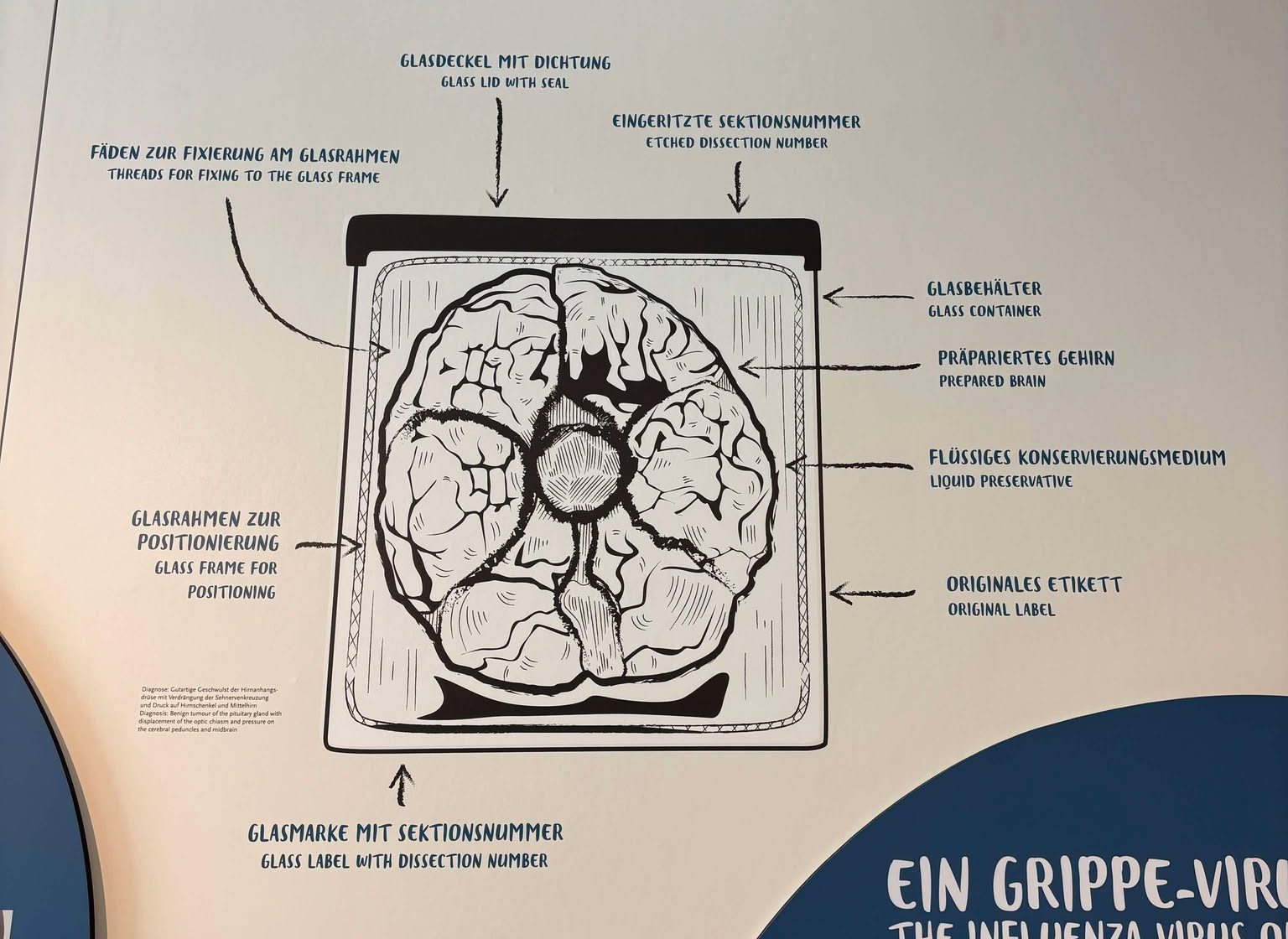
On the back wall inside the pathology specimen room, there is this incredible decal on the wall. I asked a security guard if I could take a photograph and they very kindly said yes. As you can see, this decal adds so much context to what you are viewing. For someone unfamiliar with potted specimens, I imagine it is a great reference point in understanding the preservation technique.
Anatomy of a Specimen Pot
Highlight: Stories
This one is quite general so I want to provide an example to illustrate. On the top floor of the museum, there is a room displaying patient stories. Running along both sides of the room are five patient stories – so ten in total. Each story is accompanied by a thematic panel, a small display case of personal objects, a large object, and a tall display case with objects to add historical and cultural context,
The example I want to share is the story of polio. The thematic panel tells the story of Hans G., a three-year old patient who suffered from what doctors initially thought was meningitis. As paralysis spread across his body, it became clear that he was suffering from polio. He was transferred to an iron lung for six days. He gradually regained some strength and underwent rehabilitation to re-learn how to walk.
On display next to the panel is Hans’ photo album with images of the hospital, his healthcare team, and his family. There is also a teddy bear that belonged to Hans. The large object in the middle is an iron lung. No matter how many times I see an iron lung, they still shock me. An absolutely enduring symbol of why vaccinations are needed and why they matter. The large display case contains objects relating to the development of a vaccine for polio. There are also some German health posters encouraging people to get the vaccine. The other side of the case has a panel on the disease itself and a leg splint used by a victim of polio for support.
Polio Patient PhotographsIron Lung Machine
This kind of story telling adds a sense of humanity to the museum. Specimens could have easily been included in these displays but I understand why they were not (photography, etc).
Conclusion
I am looking forward to learning more about the Charité campus on Saturday. When we visited the museum, there was a large school group on a guided tour which interrupted the flow of our visit and made everything quite cramped and crowded. If possible, visit on a weekend. It is a wonderful collection that tells some really significant stories. A definite if you find yourself in Berlin!
I am so excited to be in Europe for the next month visiting Austria, Germany, the Netherlands, and England. Next week, I’m travelling to Graz, Austria, for a one-week Erasmus mobility grant awarded by my university, The University of Queensland, and the Medical University of Graz. I will be joining the anatomy department in Graz to learn about their anatomy/pathology museum and medical teaching techniques. Also on this trip, I am taking the opportunity to visit as many anatomy and pathology museums as possible.
For each museum, I’m going to start with some context, followed by one or two highlights. Rather than a particular object or list of favourite objects, I want the highlights to be, for example, an effective interactive or a way in which an exhibition is displayed. If possible, I’ll also share a highlight object. The point of this is to keep a written record of my visits while also sharing these fascinating museums.
First on the list is the Pathologisch-Anatomische Sammlung im Narrenturm – the Pathology and Anatomy Collection in the Fool’s Tower, Vienna. I’ll note here that the museum prohibits photography. For this reason, there will only be a couple of images in this post of the outside of the museum and the introductory panel.
Narrenturm Building Sign
Context: Narrenturm Building
The building where the collection is housed and displayed was once the ‘Insane Asylum of Vienna’ hence the term ‘Fool’s Tower’. In the late 1700s, Emperor Joseph II commissioned and funded the building’s construction. In 1784, it opened as an asylum, the first institution in Europe exclusively built for patients requiring mental health treatment. This was treatment deemed necessary and appropriate at the time. It is a five-storey tower with approximately 28 cells per storey. A central corridor connects the cells together. While walking around, I thought it resembled something like a panopticon.
In the mid-1800s, the tower was deemed unsuitable to operate as a mental health facility. It closed in 1866 with all remaining patients transferred to nearby psychiatric hospitals. Between 1866 and 1971, the building mostly functioned as storage for supplies and accommodation for hospital workers. In 1971, it opened as the Federal Pathological-Anatomical Museum and became part of the Natural History Museum Vienna in 2012.
Narrenturm Building
Context: Collection
The pathology and anatomy collection dates back approximately 200 years with the first specimen acquired in the late 1700s. Today, there are more than 50 000 specimens cared for by the museum which is an unbelievably large number. During your visit, you see only a handful of these specimens. They are on display alongside wax moulages, historical objects, photographs, and models.
It’s hard to tell the exact extent of the collection, but from what we saw, every major organ is represented as well as a wide variety of diseases.
Context: Displayand Layout
Narrenturm Map
The museum is isolated to the ground floor of the tower and follows the circular layout. As you walk around, each cell contains a theme or body system. In total, there are nineteen displays covering the history of pathology, pathology today, body systems, and modern-day diseases. It is an effective way to organise the museum, providing a focus for each room and a clear narrative you can build upon.
At the entrance to each room is a context panel, in both German and English, stating the theme of the room and what is on display. Every room contains two display cases along the side walls and an interactive screen or larger object in the middle. The rooms did feel a little cramped when four or five visitors were inside, but we just paced ourselves and waited until the room was empty. There is seating outside most of the rooms.
At the end of the museum there is an art installation, special exhibition on moulages, and a gift shop. The shop sells museum-specific merchandise as well as texts relating to medicine and some anatomy-themed items.
Before discussing my two highlights, I want to mention that there is an emphasis on displaying these specimens without sensationalism. There is respect given to the specimens and they are really used to their full educational potential.
Highlight: Interactives
My first highlight is the types of interactives used in the museum and how they contribute to the overall visitor experience. There are two in particular I want to document.
1. Histology Touchscreen
In the room covering histology and histopathology there is an interactive screen where you can take a histology quiz. Using visual clues, you are asked to match close-up histology images to ones that have been zoomed out. Once you have correctly guessed the pair, you can learn more about the organ or disease. It is a simple but effective way to teach some basic histology.
2. Augmented Reality Station
In the middle of the musculoskeletal room there is a giant television and camera. When you stand in front of the screen, an augmented reality program projects different body systems onto your body. You can select to see your muscles, bones, nervous system, cardiovascular system, and digestive system. As you move around, you can see how the systems move with your body. It is such a great use of an interactive that is both fun and educational.
Highlight: Decal on the Walls in the Body Systems
Another highlight I want to mention is the decal on the back walls inside each body system room. As you step inside the room, you see an outline of the body with the relevant system highlighted. The main organ of that system has its own decal with some further information and major features labelled. This provides context for the specimens and diseases that you can refer back to at any stage of your visit.
Highlight: Specimen
There are so many fascinating specimens to explore that really shed light on how disease can affect the body. In the room covering infectious diseases there is a section of brain from an individual who died from Smallpox. I have read so much about Smallpox in my current role so to see a specimen showcasing the disease really had an impact.
Conclusion
I am so glad I had the opportunity to visit this museum and see one of the largest pathology/anatomy collections in the world. I would strongly recommend a visit if you feel comfortable viewing human specimens. It is open Wednesday to Saturday between 10am and 5pm. You can take a guided tour but I believe they are mostly in German.
I’ve spent the last week in Auckland attending the Australasian Institute of Anatomical Sciences conference. It was a fascinating conference, and I was grateful to have the opportunity to present on a current work project. I had a couple of free days before the conference so visited both the Auckland Art Gallery Toi o Tāmaki and Auckland War Memorial Museum. This post is going to focus on one exhibition currently on display at the gallery, titled Gothic Returns: Fuseli to Fomison.
Layout
The exhibition is along a corridor on the mezzanine level of the gallery. Mid-way through is the entrance to the international historical art display. I wish this exhibition had more room to breath. I understand maximising the use of space but it was extremely cramped. There were four other people in the exhibition with me and it was a bit of a struggle to see all the artworks. I also had to spend about half an hour ducking in and out of the historical art display just to let the crowd through.
Aim
The main introductory panel explores why the theme of gothic is on display. It also describes gothic as ‘almost virus-like’ in that it’s a theme that has evolved and developed over time. There have been consistent elements such as melancholia, ominous moods, and things that unsettle. How this is represented, however, has changed. The panel also contextualises the theme for Auckland, describing how gothic flourished in New Zealand in the 1990s. The gallery’s gothic collection is impressive, with both historic and contemporary works on display.
The aim of the exhibition is stated at the end of the panel: this exhibition ‘unites old with new, playfully inviting viewers to enter the ever-enticing dark side of the imagination.’ After spending some time viewing the artworks on display, I can confirm it does achieve this aim and has a good mix of mediums as well as gothic genres.
Highlight Artworks
As always, I want to share some highlights. This exhibition was right up my alley with everything from horror films to cemeteries represented. Even though it isn’t a large exhibition, it is definitely a case of quality over quantity.
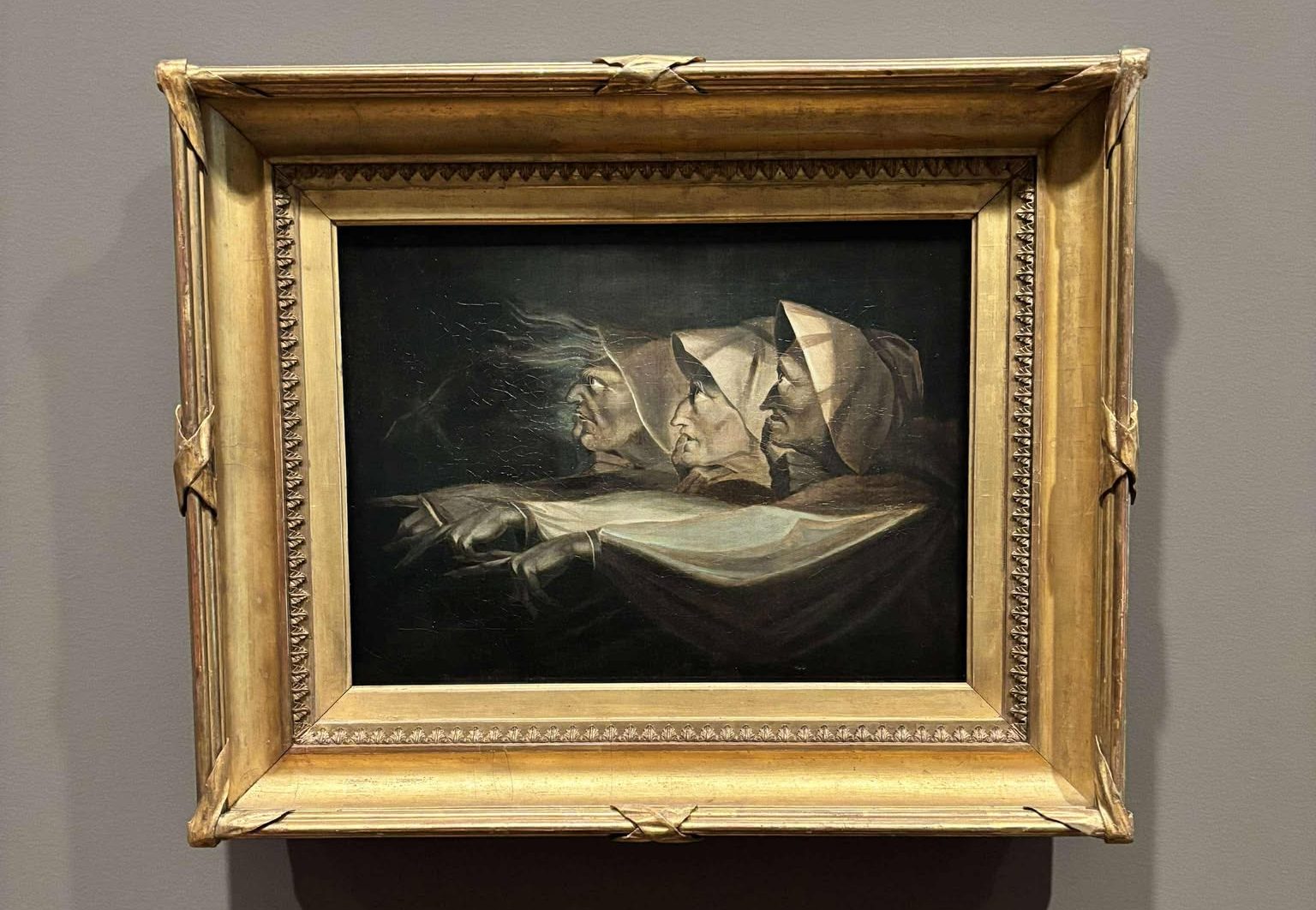
1. Henry Fuseli, Study for the Three Witches in Macbeth, circa. 1783, oil on canvas
Study for the Three Witches in Macbeth
One of the first works on display is a study on the three witches from Shakespeare’s play Macbeth. I adore this artwork and the atmosphere it conjures. The labels are (sigh, white text on a grey background) written using accessible language and don’t presume the reader has a degree in art history. For that reason, I really engaged with the labels. I learnt with this work, for example, that it was created in opposition to the Neoclassicism movement that was gripping Britain at the time. I had also never taken note of the death-head moth floating just above their hands. The use of light and shadows is what strikes me about this artwork and adds an ominous flare.
2. Peter Siddell, Tombstone Angel, 1975, acrylic on hardboard
Tombstone Angel
Opposite the three witches is this painting of Auckland cemetery by Peter Siddell. As a sidenote, I did spend time in this cemetery throughout the conference. The label for this artwork describes the scene as unsettling. Maybe I’ve spent too much time in cemeteries but to me, this doesn’t seem unsettling. Rather than being quiet and creepy, I see it as peaceful. It looks like a burial environment surrounded by nature and still cared for, as seen by the open door. The open door can look a bit creepy, but I actually see it as welcoming.
3. Tony Fomison, The Hand, 1970, oil on hessian on board
The Hand
As I’m writing this I’m becoming acutely aware of the lack of female artists on display, which is a shame. This work displays a disembodied hand, covered in light and shadows. It is meant to be reminiscent of a horror film prop. The hand gesture conveys either a warning to stop or someone asking for help. I selected this work as a highlight because it reminds me of the three witches study that plays with light and shadow.
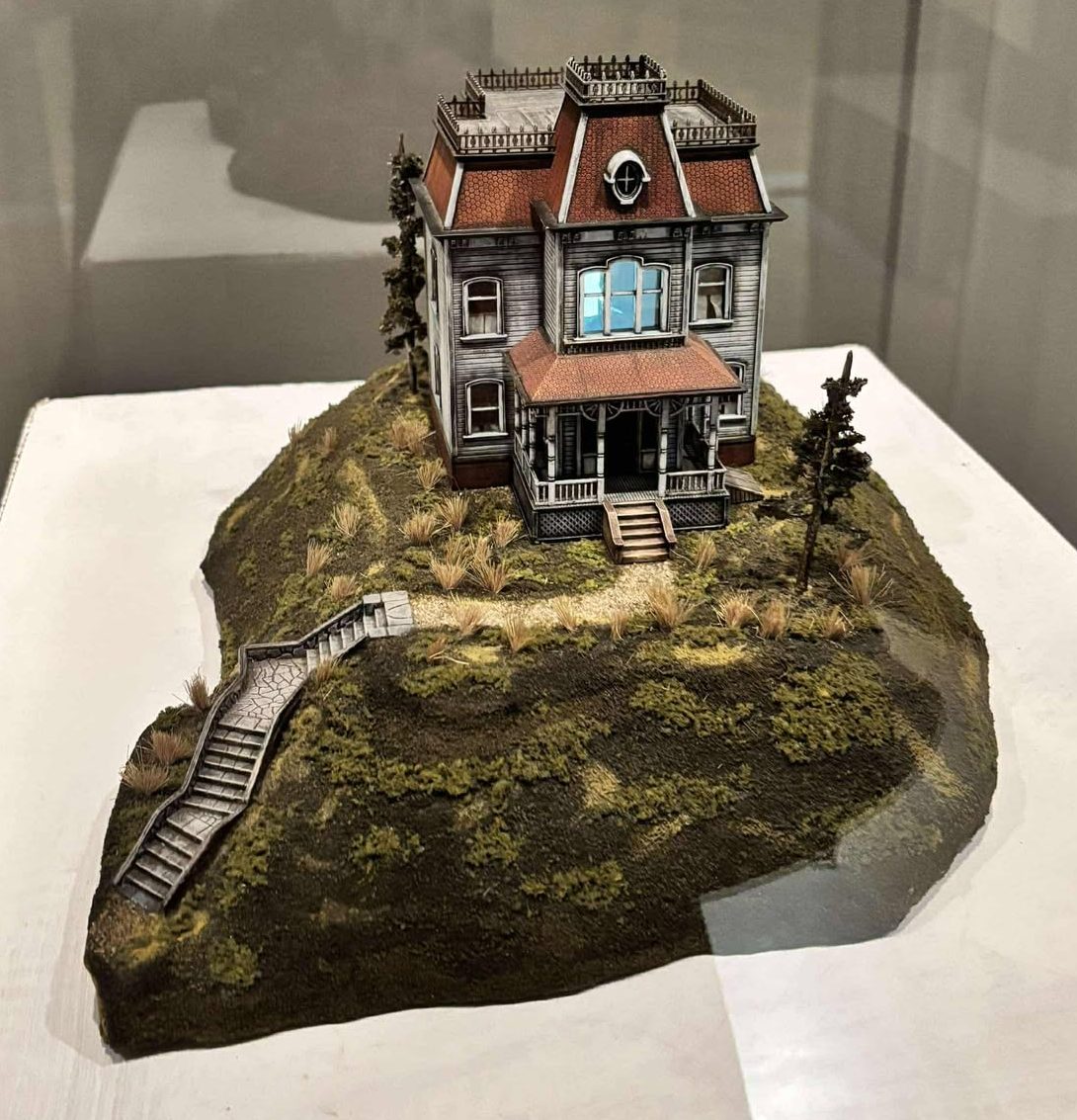
4. Ronnie van Hout, Psycho, 1999, house model
Psycho
This little model of the Victorian mansion from Psycho was my favourite artwork. On the surface it looks like a cool model, transporting you into the world of horror. Almost a Beetlejuice vibe. When you read the label, you learn that the artist was creating a metaphor for his tortured mind. In the upstairs window you can see him wielding a knife. Again, I would have missed this detail if I didn’t read the label.
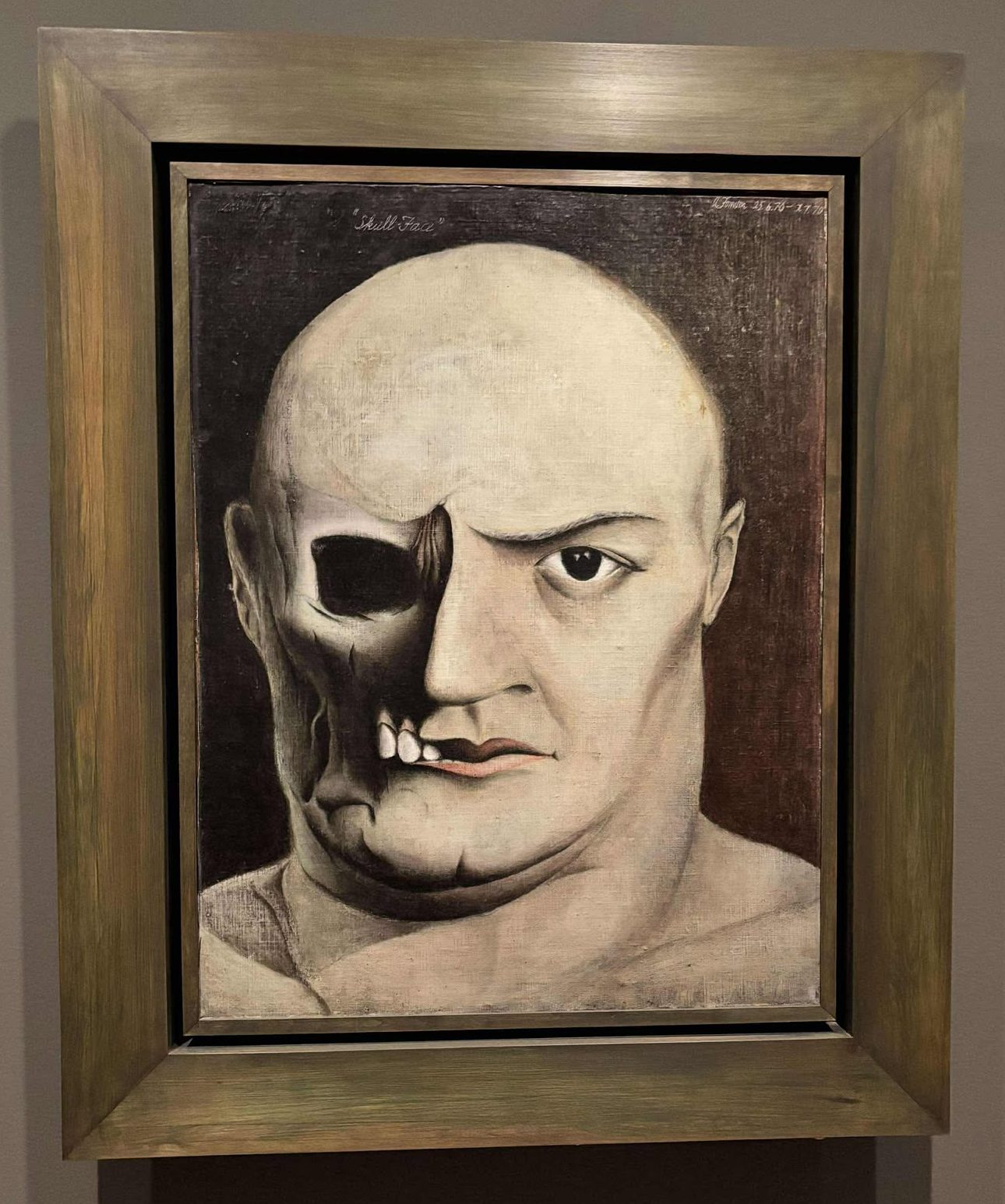
5. Tony Fomison, Skull Face 1970, oil on canvas board
Skull Face 1970
My final highlight artwork is this one by Tony Fomison. I selected it because both the work and label relate to the significance of art in the space of anatomy. Fomison used anatomical models to add that authenticity while dealing with themes of empathy and horror. I can definitely appreciate those while viewing this work.
Final Thoughts
To finish, I have two final thoughts. As I’ve said above, the lack of women artists in this space was disappointing to see. If it were a bigger exhibition space, I would have also enjoyed some different cultural perspectives on gothic. I also want to say that each time I come to New Zealand, I am impressed with how they integrate Māori language into their practice and culture. All of the exhibition labels in the gallery are written in both English and Māori.
Gothic Returns is on display until end of August, 2025. On the whole, the gallery is a fantastic free space to explore, open daily from 10am – 5pm.
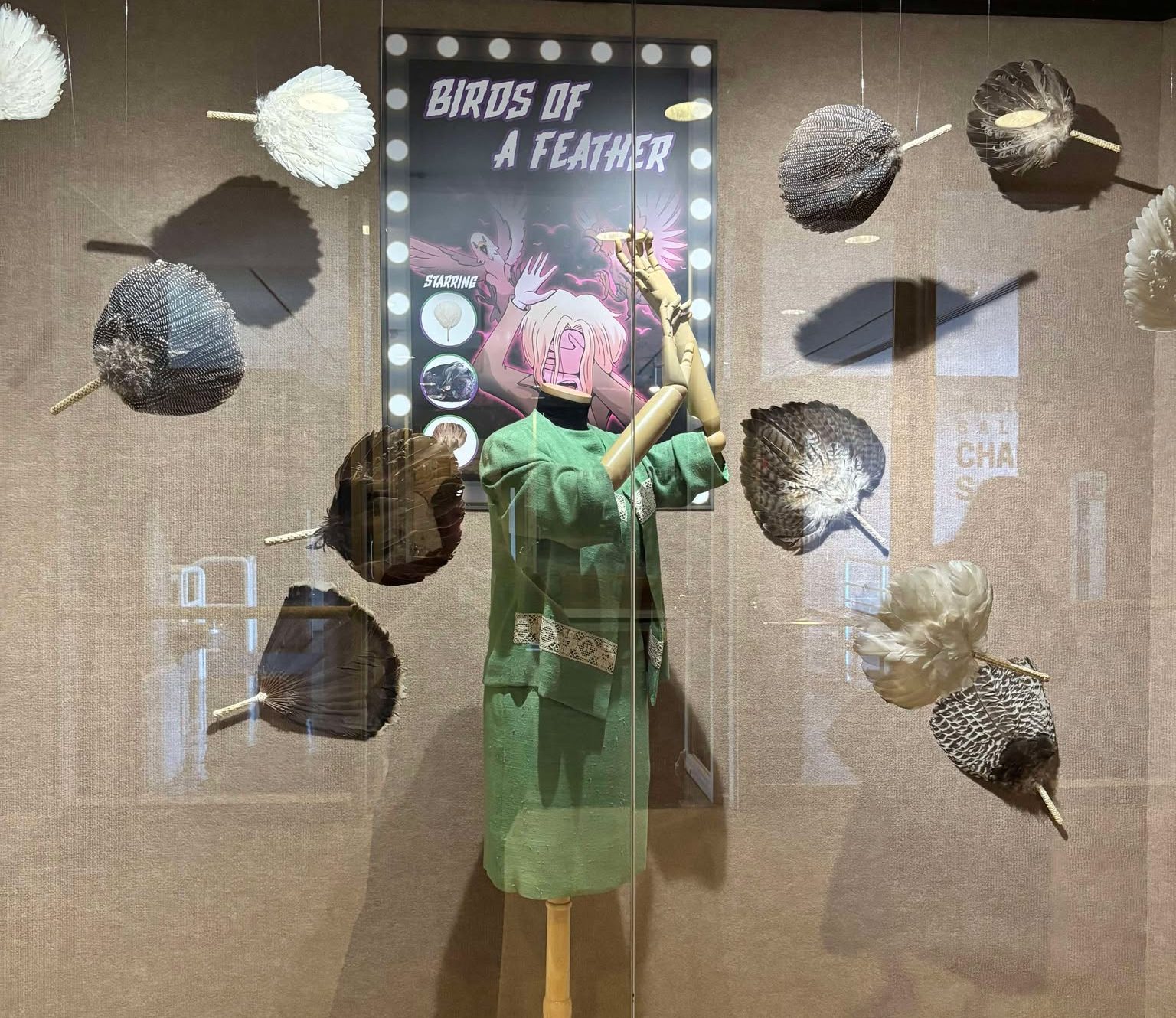
I finally have the time to write another blog post about our recent trip to America. The focus for this post will be the Charleston Museum – America’s first museum (according to them). The museum is a short walk from the city centre but also has a small car park if you are driving. It’s not a huge museum, but does have a good selection of objects to tell the story of Charleston. Rather than review the entire museum, I’ve settled on one exhibition I’m excited to share: Lovely and Lethal. I was immediately enthralled and spent almost our entire museum visit in this exhibition. As you’ll see throughout the post, the graphics are incredible and an interesting way to address some controversial and difficult topics. The aim of the exhibition is stated in the introductory panel, ‘are these pieces a la mode or just macabre? Discover the consequences of style.’ I’m going to go through each theme of the exhibition and share a highlight object.
Theme 1:Birds of a Feather
Birds of a Feather
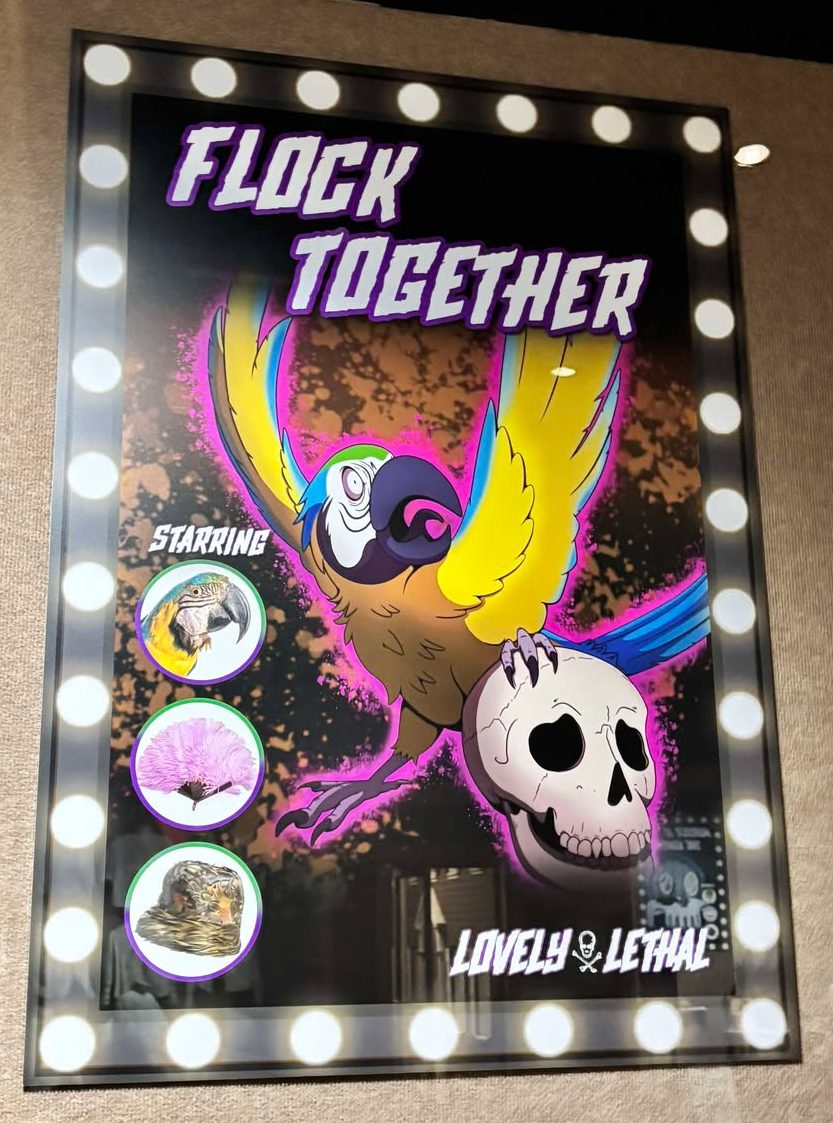
The first theme is titled Birds of a Feather and contains a selection of bird feather fans and hats. The display mimics a scene in Alfred Hitchcock’s The Birds when a flock of birds’ attack Annie Hayworth (played by Suzanne Pleshette). Here you will find the introductory panel that clearly lays out the three main exhibition themes: negative impacts of unregulated materials, workers in the fashion industry, and impact of fashion on the natural environment. As well as fashion objects from their collection, there are also a variety of taxidermy animals from their Natural History collection distributed throughout.
Each theme has a graphic-like poster, a thematic label, and individual labels if needed. For this theme, the bird feather objects have been selected as they represent all three themes. Many of these fans were treated with poisonous chemicals causing harm to both those who created them and those who used them. In addition, the demand for feathers directly caused the extinction of some species.
Theme 2:Arsenic and Old Lace
Arsenic and Old Lace
Following the exhibition to the left is the theme Arsenic and Old Lace. This theme focuses on Scheele’s Green invented in 1775. This shade was made so vibrant by the inclusion of arsenic. Those who worked with the dye and those who wore it experienced such symptoms as rashes, headaches and open sores. Eventually, exposure led to death. In front of you are a variety of Scheele Green objects to explore including some gloves, a bag, and a hat.
Arsenic and Old Lace
Theme 3: Pretty Poison
Pretty Poison
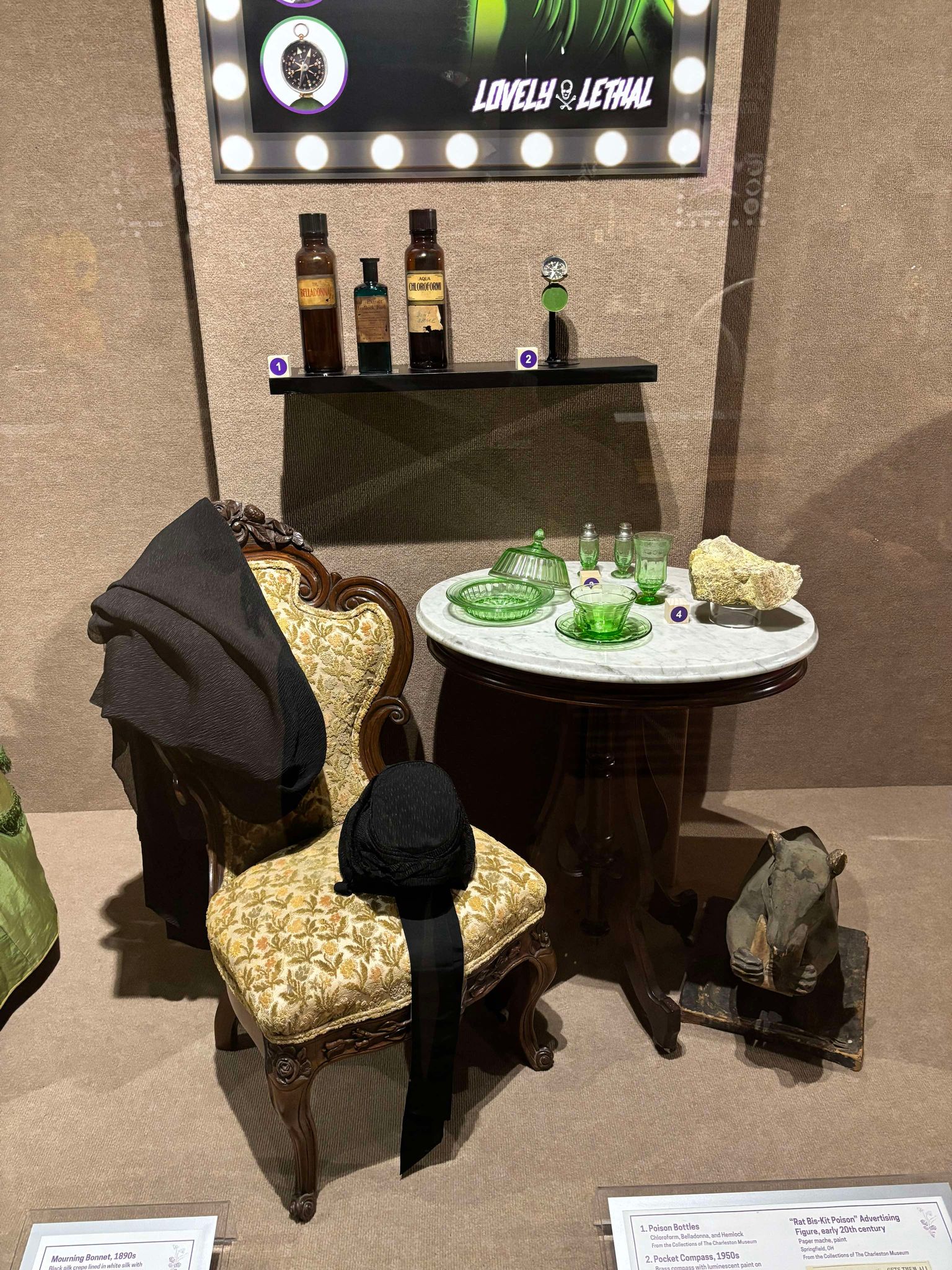
Pretty Poison expands on the theme of toxins by covering aniline dyes and radioactive poisoning. The thematic label also makes the point that this isn’t just a historical problem. In 2022, shops such as Shein were found to have excessive lead and phthalate in their clothing. Two highlight objects tell the story of how mourning the loss of a loved one might have also led to your death. Black mourning bonnets and veils created in the 19th century were a visual way to show you were in mourning. Many of these were dyed with an aniline dye, containing a high concentration of the chemical nitrobenzene. Unfortunately, this leads to cyanosis or lack of oxygen in the blood. At first, you would feel dizzy. Then, the lack of oxygenated blood causes gangrene or blackening of the extremities. Finally, it can cause death.
Pretty Poison
Theme 4: Bodies Bodies Bodies
Bodies Bodies Bodies
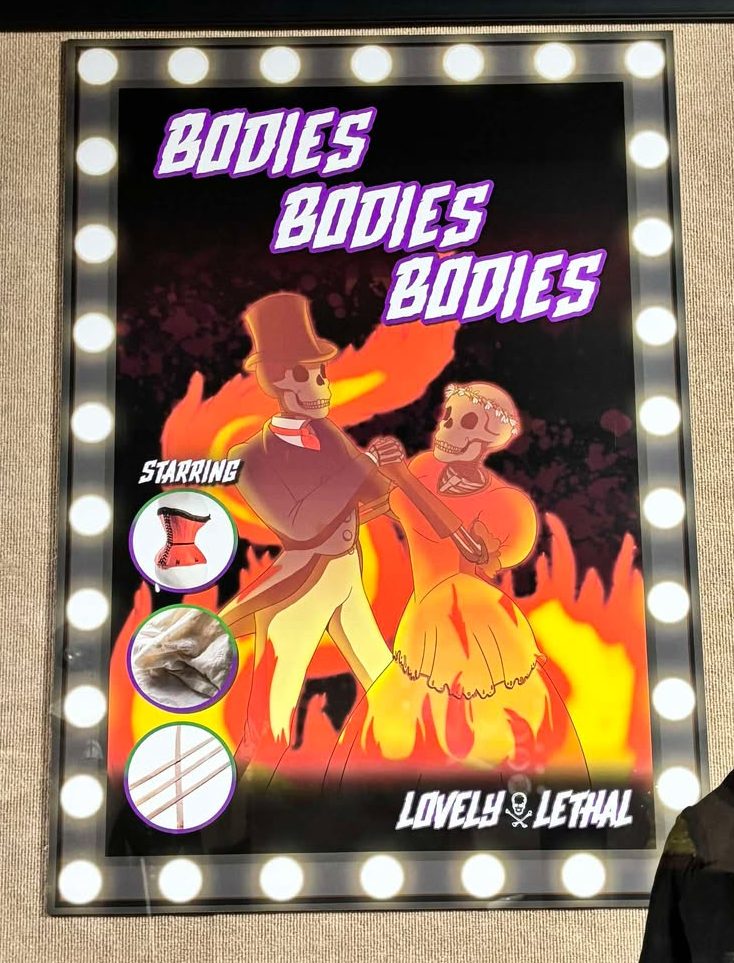
As well as being the name of a recently released fantastic horror film, this theme covers body modification and how we have compromised our health to fit a fashion and body ideal. A standout object in this section is the extreme red corset fitted over a skirt. Just looking at the corset is uncomfortable. There is also a stack of stiff starched collars that could literally choke their owners to death all for the sake of looking the part.
Bodies Bodies Bodies
Theme 5: Murder at the Vanities
Murder at the Vanities
You can see by now that the theme names are very clever. This theme is all about cosmetics and the ingredients within them that are dangerous. This theme also very importantly raises the issue of race. For example, there is pressure for Black women to fit the standard ideal of straight hair. Using hair relaxants loaded with chemicals, such as formaldehyde, is incredibly dangerous and currently these products are under review. On the vanity is a mirror made from ivorine, or a plastic developed as a substitute for ivory. It was known to spontaneously combust.
Murder at the Vanities
Theme 6: Crimes of Fashion: Workplaces
Crimes of Fashion: Workplaces
We are now heading into the second major overarching theme – workers in the fashion industry. Crimes of Fashion: Workplaces, touches on the Triangle Shirtwaist Factory fire. I highly recommend listening to the Disaster Area Podcast episode if you would like to learn more. Basically, these shirtwaists were all the fashion in the early 1900s. In 1911, a horrific fire broke out in the factory killing 146 employees who were mostly young Italian and Jewish immigrants. When the fire started, they tried to escape through the emergency exits but found they were locked to prevent anyone stealing and running. A complete disaster ensued that eventually led to some law reform surrounding workplace conditions. This theme also covers the story of the 2013 Rana Plaza factory collapse in Bangladesh. Highlighting how many corners can be cut when creating a safe work environment for textile industry workers just goes to show how some things never change.
Crimes of Fashion: Workplaces
Crimes of Fashion: Materials
This is more a sub-theme that focuses on materials hazardous to a textile worker. For example, mercury was used to soften fur to make hats in the 18th and 19th centuries. Today, those who sandblast jeans to create distressed denim can suffer from silicosis, the same condition those working with stone benchtops are also at risk of developing. It can cause inflammation and scarring in the lungs. What chemicals are used in manufacturing also pose a threat to the environment. Fast fashion is increasing the need to burn clothing so just think of how many toxins are released through this process. I forgot to pick a highlight object for this section so you can tell I was getting a bit fatigued.
Theme 8: Shell and Crossbones
Shell and Crossbones
This theme is all about ivory and how it was used in the 18th and 19th centuries for accessories, jewellery, and sewing supplies (amongst other things). As the thematic label points out, despite laws trying to ban not only ivory but other animal products too, there is still a black market. In this section you can see entire elephant tusks that would have been on display as home decor.
Shell and Crossbones
Theme 9: Wild Kingdom
Wild Kingdom
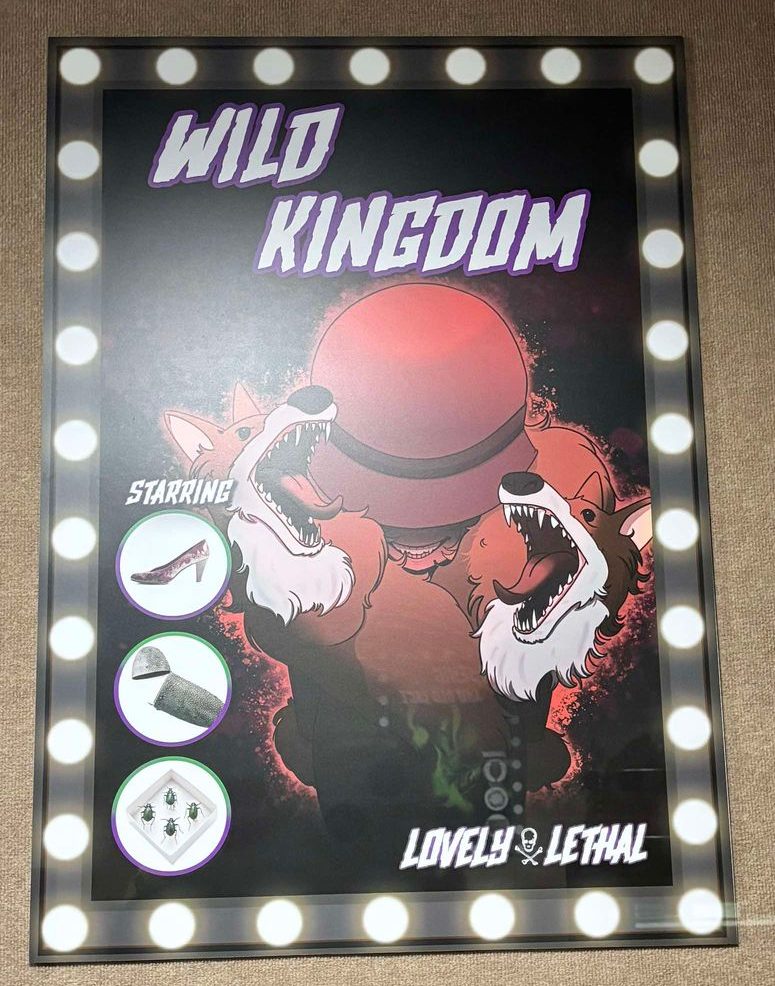
The second last theme, Wild Kingdom, highlights objects made from leather and fur. For a western audience, these items were usually the result of hunting. Then, animals were raised for the purpose of fur harvesting. The label does, however, point out that there are many First Nations and Indigenous peoples worldwide who sustainably continue to integrate fur, for example, into their clothing and cultural practice. In the image above, you can just see the edge of a leopard fur hat and collar.
Theme 10: Flock Together
Flock Together
The final theme is Flock Together. This links back to that first theme and makes the exhibition feel complete. A highlight object here is the coat lined with ostrich feathers.
One type of heritage place that has been at the top of our itinerary for almost every city we’ve visited is historic cemeteries and graveyards. I’m excited to write about the ones we have explored. As well as a bit of context, I’ll also share whether or not we did a tour, walked around on our own, etc. Before starting the list, I want to say there are many reasons to visit a cemetery. For me, they are peaceful green spaces where you can learn numerous stories that weave together to paint a picture of society and culture. The cemetery itself can tell you much about a city or town. I also enjoy the aesthetic of a cemetery and viewing all the architecture and statues. Two of the cemeteries on this list have been on my must-visit list for years – Sleepy Hollow and Bonaventure. I am going to start with the former.
1. Sleepy Hollow Cemetery – Sleepy Hollow
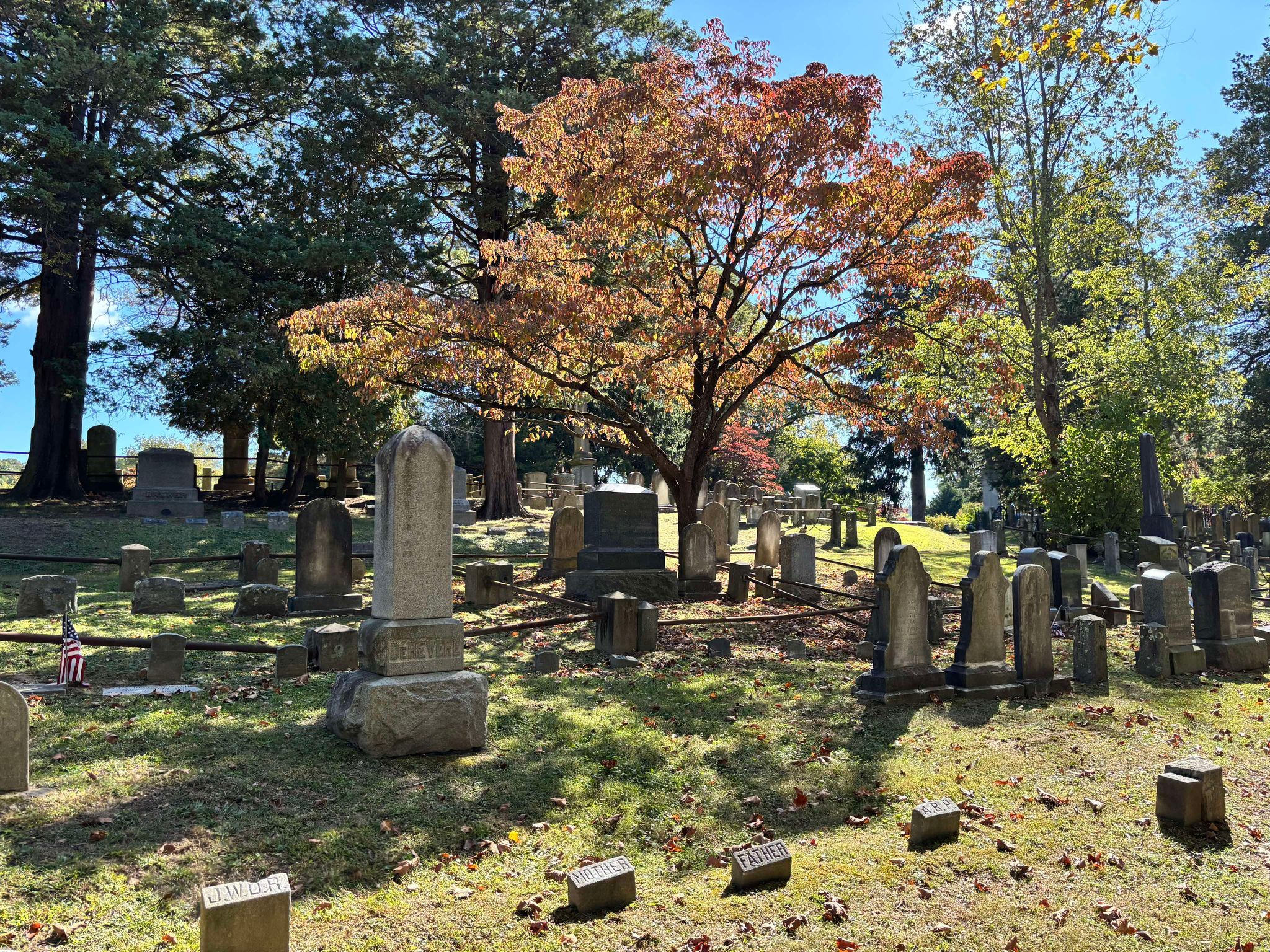
The first cemetery we visited was Sleepy Hollow Cemetery in the village of, no surprises here, Sleepy Hollow. You are likely to know this village from The Legend of Sleepy Hollow, a 1820 short story by Washington Irving. This story has been made into a film and is rife in popular culture – especially the image of the headless horseman. The cemetery opened on October 29, 1849, and was partly founded by Washington Irving who is buried within the grounds. Today, it stretches across 90 acres and has approximately 46 000 burials. As well as Irving, Sleepy Hollow Cemetery is the final resting place for Andrew Carnegie, Walter Chrysler, Elizabeth Arden, William Rockefeller, and Louisa May Alcott.
Sleepy Hollow Cemetery
If you are visiting in October or November, there are multiple ways to explore the cemetery. Daylight tours, night time lantern tours, and special interest tours run all throughout both months. We wanted to visit the cemetery early in the day, so opted to explore on our own. It is very well sign-posted and there are maps so you can easily make your way around. Below are a few photographs of the grounds including the grave of Irving.
Sleepy Hollow Cemetery is open between 8am and 4.30pm (Monday to Thursday), 8am – 4pm (Friday), and 8.30am – 4pm (Saturday and Sunday).
2. The Trinity Churchyard Graveyard – New York
Right near Wall Street in New York is Trinity Church. Surrounding this church are a number of graves with the oldest being that of Richard Churcher who died in 1681. Perhaps the most famous individuals buried here are Alexander Hamilton, Eliza Schuyler Hamilton, and Angelica Schuyler Church. We walked around the cemetery on our own to see these graves.
The Trinity Churchyard GraveyardThe Trinity Churchyard Graveyard
There are a couple of other cemeteries I’d like to see in New York so watch this space for future trips.
The Trinity Churchyard is open daily between 8.30am and 4pm.
3. Oakland Cemetery – Atlanta
Oakland Cemetery is located in Atlanta, Georgia and is the oldest public park in the city. A great way to see this cemetery is to join a 90-minute overview tour that introduces visitors to the sights, symbols and stories of Oakland. As an FYI, there are also multiple special interest tours available throughout the year. Our guide from the Historic Oakland Foundation, Gordon, shared some fantastic stories with us about those who are buried in the cemetery. As we travelled through the different cemetery sections we saw the graves of individuals such as Margaret Mitchell and Selena Sloan Butler.
Oakland CemeteryOakland Cemetery
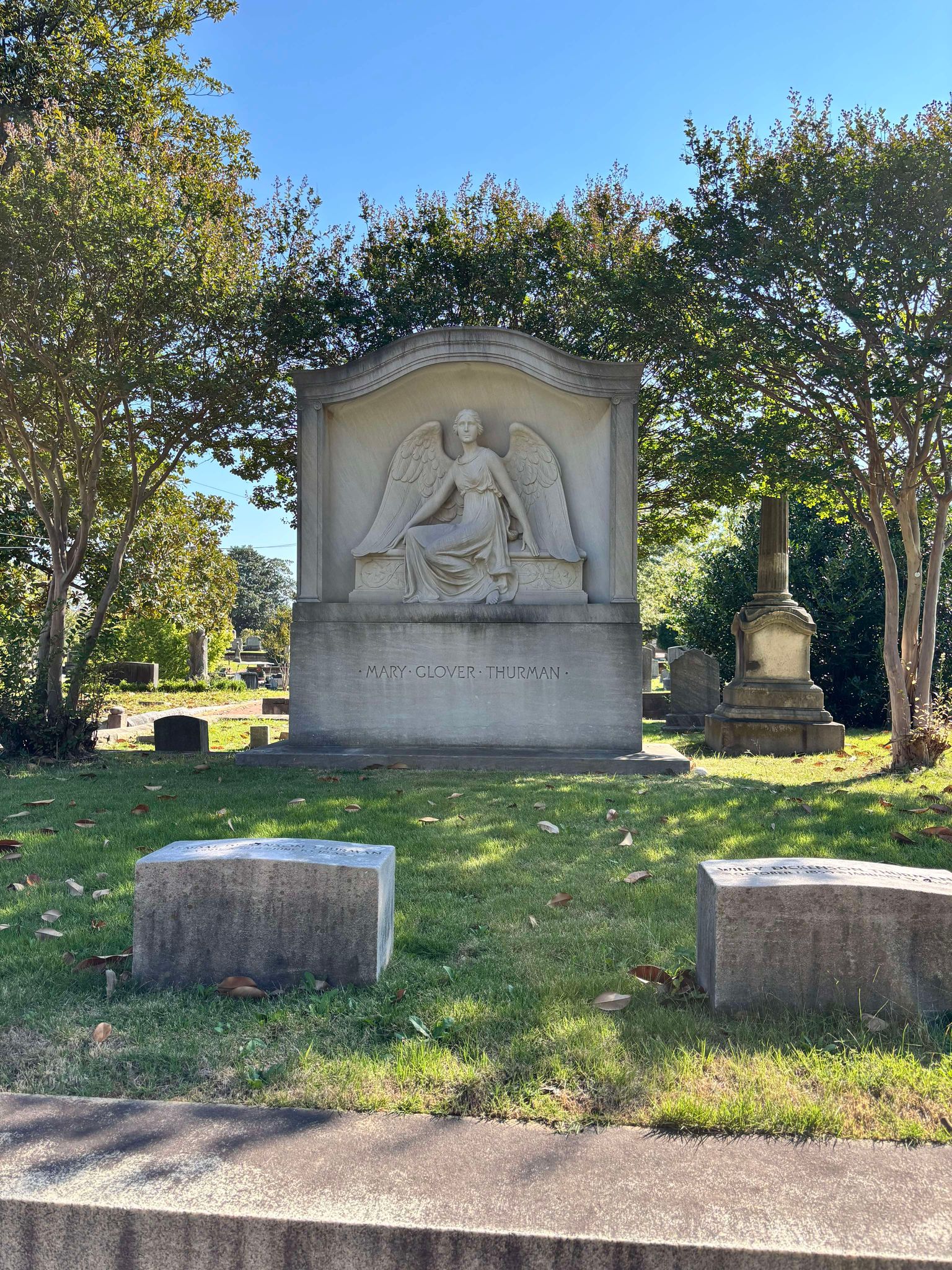
We were also able to see three impressive statues within the grounds. I’ll include photographs of them below. These are statues on the graves of (in order), Jasper Newton Smith (an Atlanta businessman), Mary Glover Thurman (considered the Angel of Atlanta for her charity work), and Mollie and Mary Lizzie Neal (Mary Lizzie died at age 22 and her mother died of grief five years later).
Oakland CemeteryOakland CemeteryOakland Cemetery
The cemetery is open dawn to dusk (6am to 8pm) every day of the year. You can explore the grounds on your own. I’d highly recommend visiting their gift shop.
4. Graveyards Around Charleston
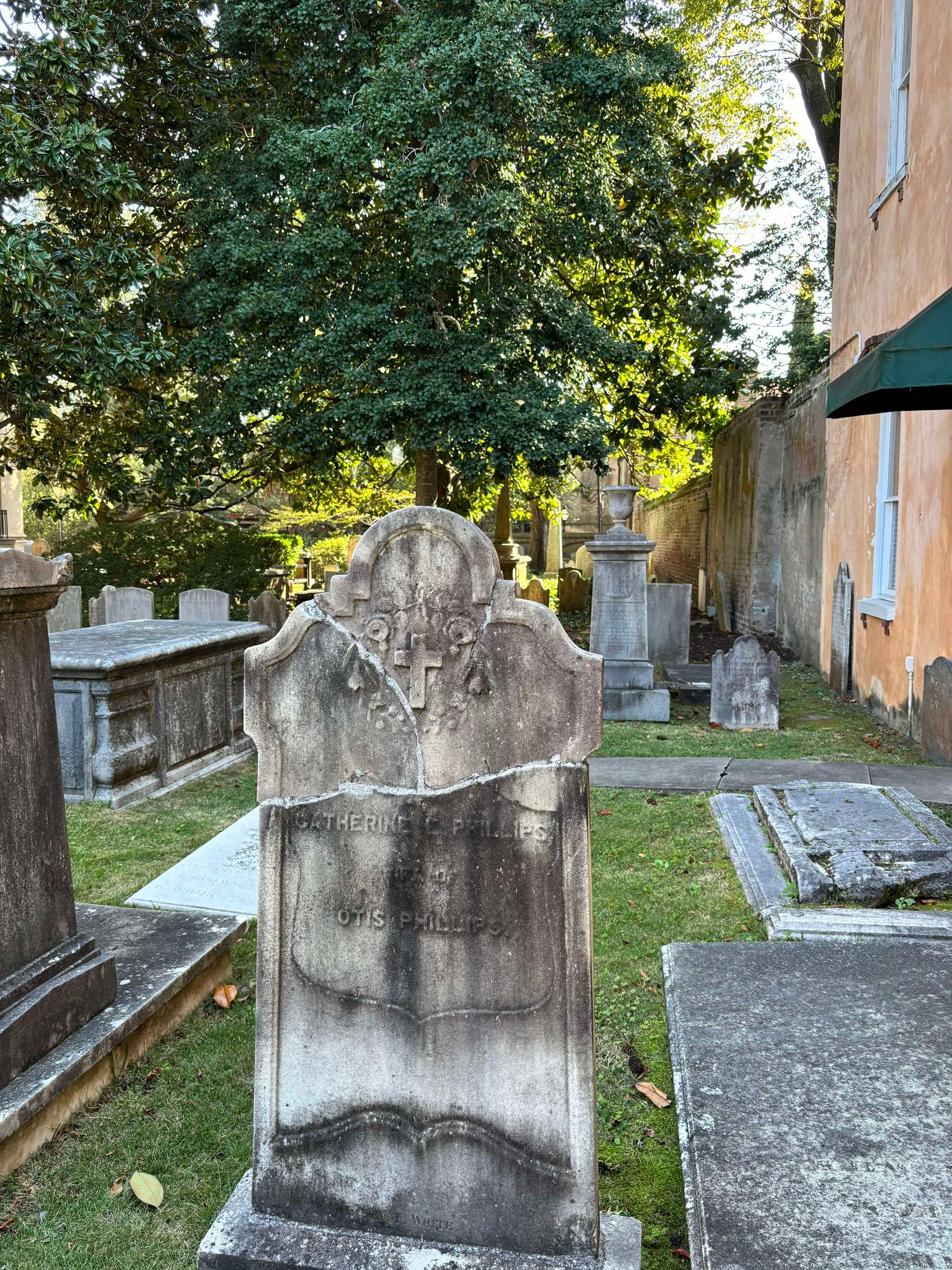
There are so many churches in Charleston and so many graveyards. Nearly every single church within the city has an attached graveyard. We went on a general walking tour of Charleston and passed by a few. I’m including photographs of (in order), French Huguenot Church, St Michael’s Church, and St Philip’s Church.
French Huguenot ChurchSt Michael’s ChurchSt Philip’s Church
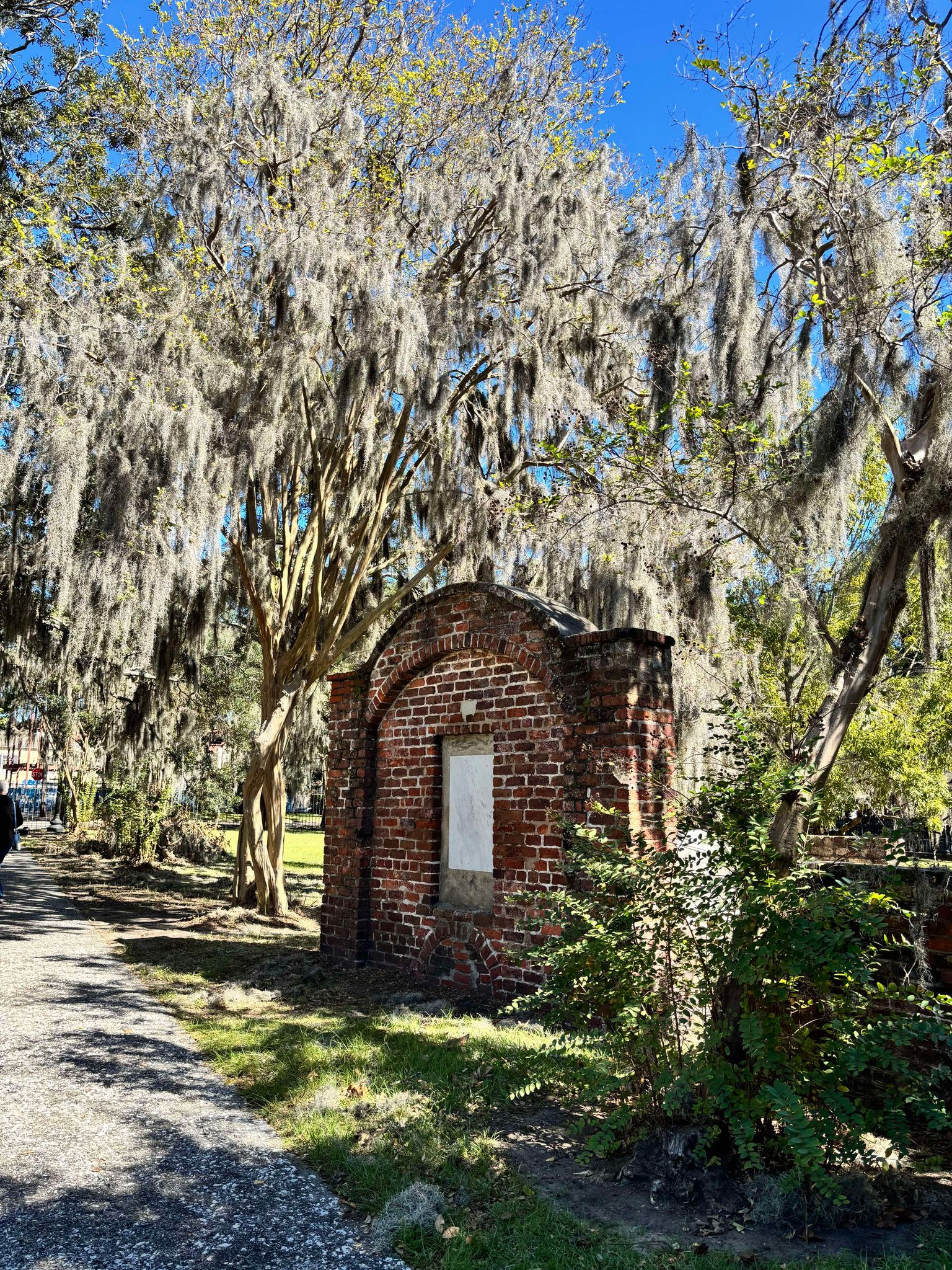
5. Colonial Park Cemetery – Savannah
The first cemetery we visited in Savannah was the Colonial Park Cemetery – right in the middle of the city. The cemetery opened in 1750 and was closed to new burials in 1853. In 1896, the cemetery re-opened as a city park. We walked through the cemetery on our own stopping to read the numerous historic signs that are distributed throughout. For example, there is a sign over the grave of James Wilde who died during a duel. Another historic marker worth mentioning is one dedicated to the victims of the Yellow Fever Epidemic of 1820. Approximately 700 Savannah residents died during this epidemic and the majority are buried in this cemetery.
Colonial Park CemeteryColonial Park Cemetery
Over one side of the cemetery are a number of headstones set into the wall dividing the cemetery from the building next door. Most of these burials are from the early 1800s.
Colonial Park Cemetery
The cemetery is open 8am to 5pm (November to March) and 8pm to 8pm (March to November).
6. Bonaventure Cemetery– Savannah
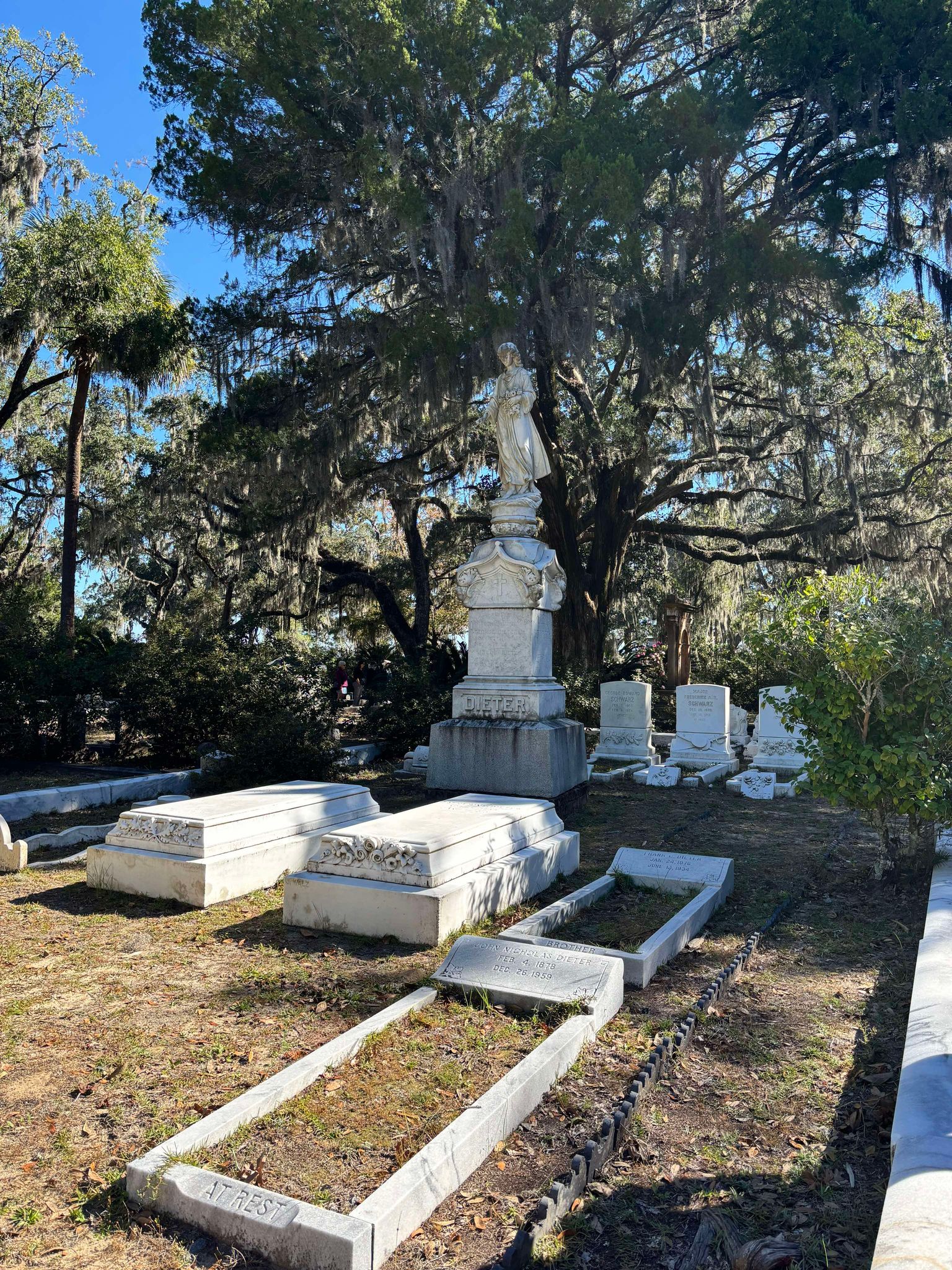
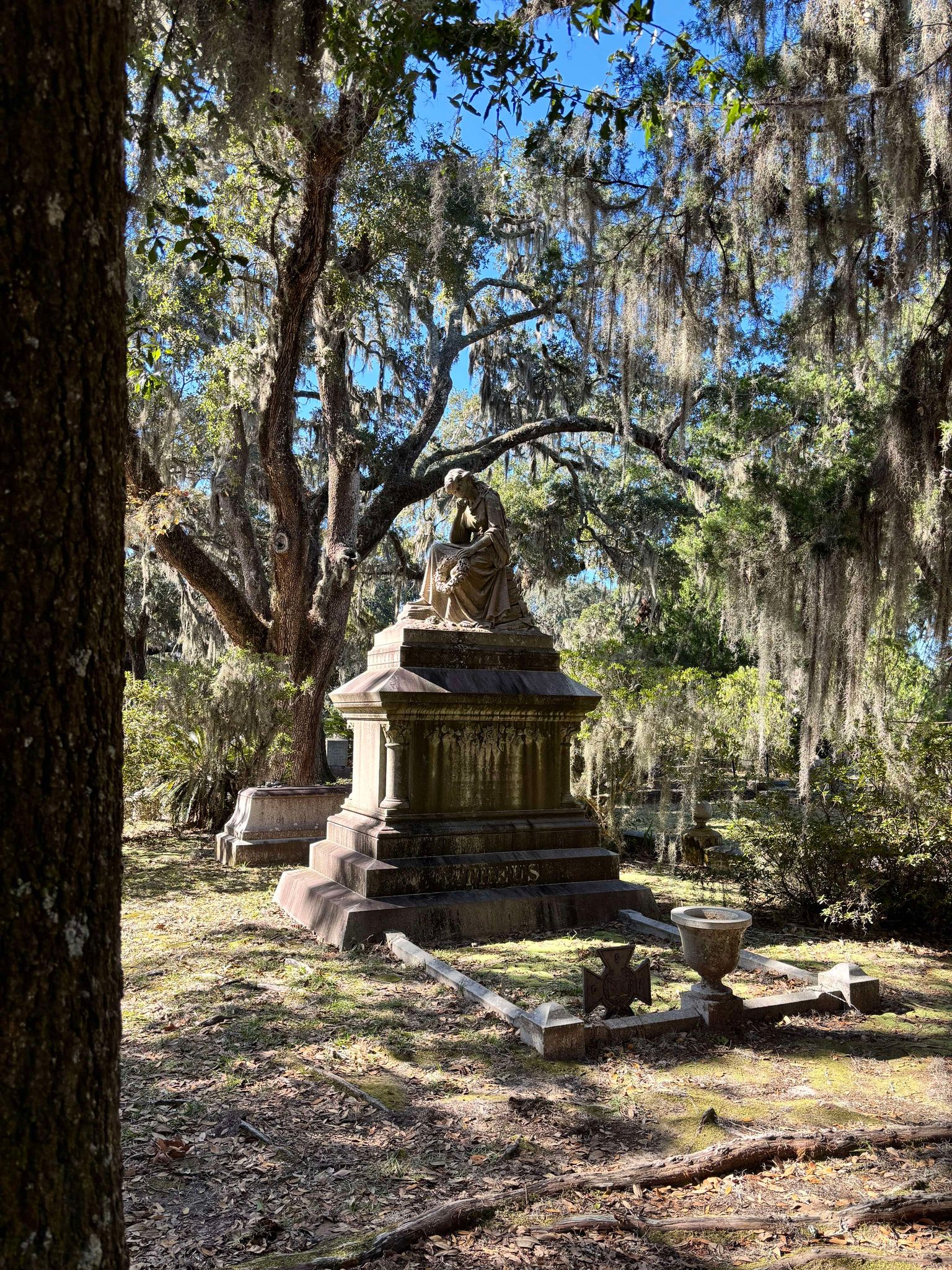
The final cemetery I’ll be reviewing is Bonaventure cemetery located a short drive from Savannah. This cemetery is particularly famous for its association with Midnight in the Garden of Good and Evil, a book by John Berendt. It is also a stunning cemetery – filled with Spanish Moss that creates a certain eeriness. We explored the cemetery on a two-hour guided tour with Shannon Scott Tours. Our guide, Jon, shared so many interesting stories not only about those who are buried in the cemetery but about cemetery traditions throughout time.
A real highlight for me was seeing an original bell next to the tomb of Charles F Mills. A string would have gone from the bell to the coffin so if someone was accidentally buried alive they could ring the bell and be rescued. We also visited a table memorial that would have been used in the Victorian era for a picnic. Remembering that cemeteries were major recreation spaces during this time (and are sort of becoming that again today).
Bonaventure CemeteryBonaventure Cemetery
I’d definitely go on a tour of this cemetery as it’s massive. If you do want to explore on your own, the cemetery is open 8am to 5pm daily.
I hope this blog will encourage you to go and explore a cemetery on your travels. I have a couple more blog posts in the works for this trip and will hopefully post soon.
The final museum I’d like to review in New York is the Tenement Museum. As well as the Gilder Center (American Museum of Natural History), Tenement Museum, Ellis Island, and New York Historical Society, we visited the Whitney Museum, Museum of Modern Art, Museum of the Dog, and the 9/11 Memorial Museum. I’m glad we got to visit so many museums in New York. I cannot wait to visit more in the future! This post will focus on the Tenement Museum. This museum is located in the Lower East Side and, according to their website, shares the stories of immigrants, migrants, and refugees who settled in New York. It achieves this through guided tours of recreated apartments that are situated across two tenement buildings.
The museum has a little something for everyone. If you enjoy house museums, social history, abandoned buildings, or even fascinating stories of New York’s past, you’ll enjoy your visit. The only way to explore the museum is on a guided tour. There are quite a few tours on offer that focus on different rooms and stories. As I read on many review sites – it’s impossible to pick a bad tour. We selected two tours – one for the morning and one for the afternoon. The following is an overview of both tours.
After the Famine: 1869
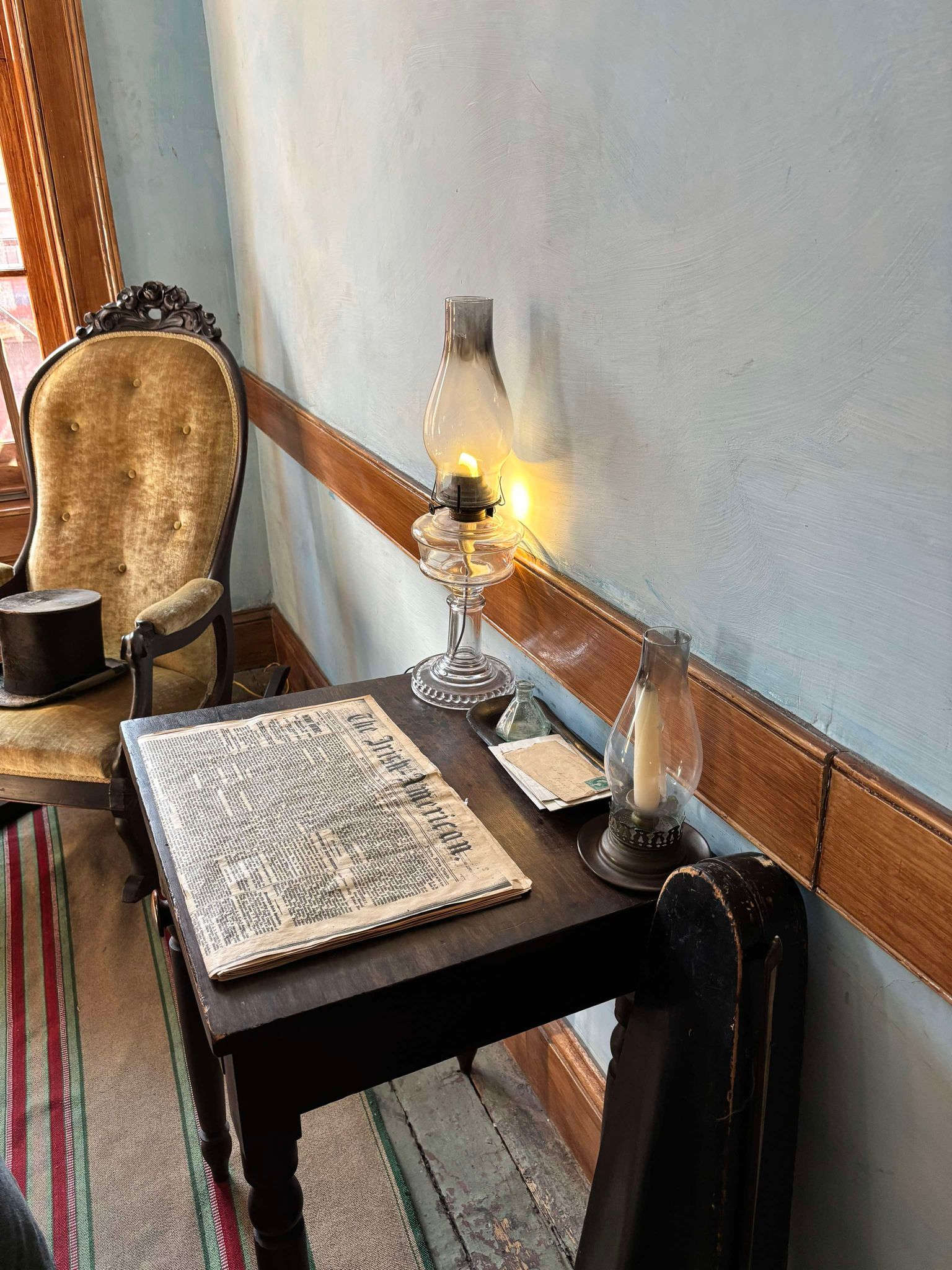
Our first tour of the day was After the Famine: 1869. On this tour, you hear the story of Joseph and Bridget Moore, Irish Catholic immigrants who moved to New York post-Civil War. Joseph and Bridget both came from farm/rural backgrounds and lived in Ireland during the Irish famine. It is assumed that they met after moving to New York. In the late 1860s they moved into a tenement building on 97 Orchard Street (now the museum).
The tour is jam-packed with information about the residents and their context. It also provides insight into how these stories were uncovered. When the museum purchased the tenement buildings, they had no idea who lived there and what history could be told. Uncovering these stories has taken massive amounts of research and community engagement.
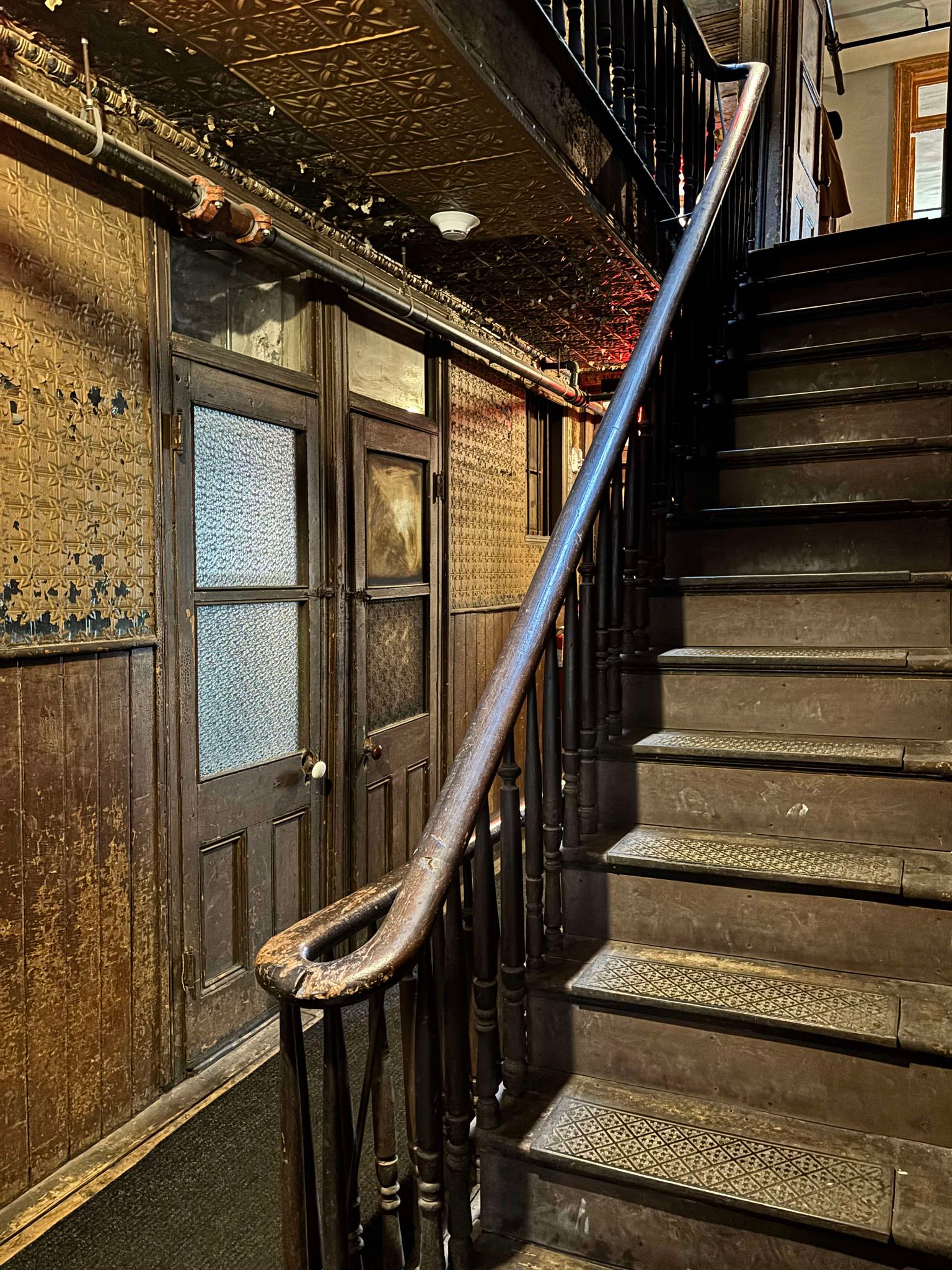
For this tour, you start by climbing approximately 68 stairs and heading into an abandoned-looking tenement apartment. Standing here, you get a real sense of the history of the building and how many stories can be found within its walls. For example, in the photograph below you can see the layers of wallpaper found in one room.
Layers of WallpaperHallway of Building
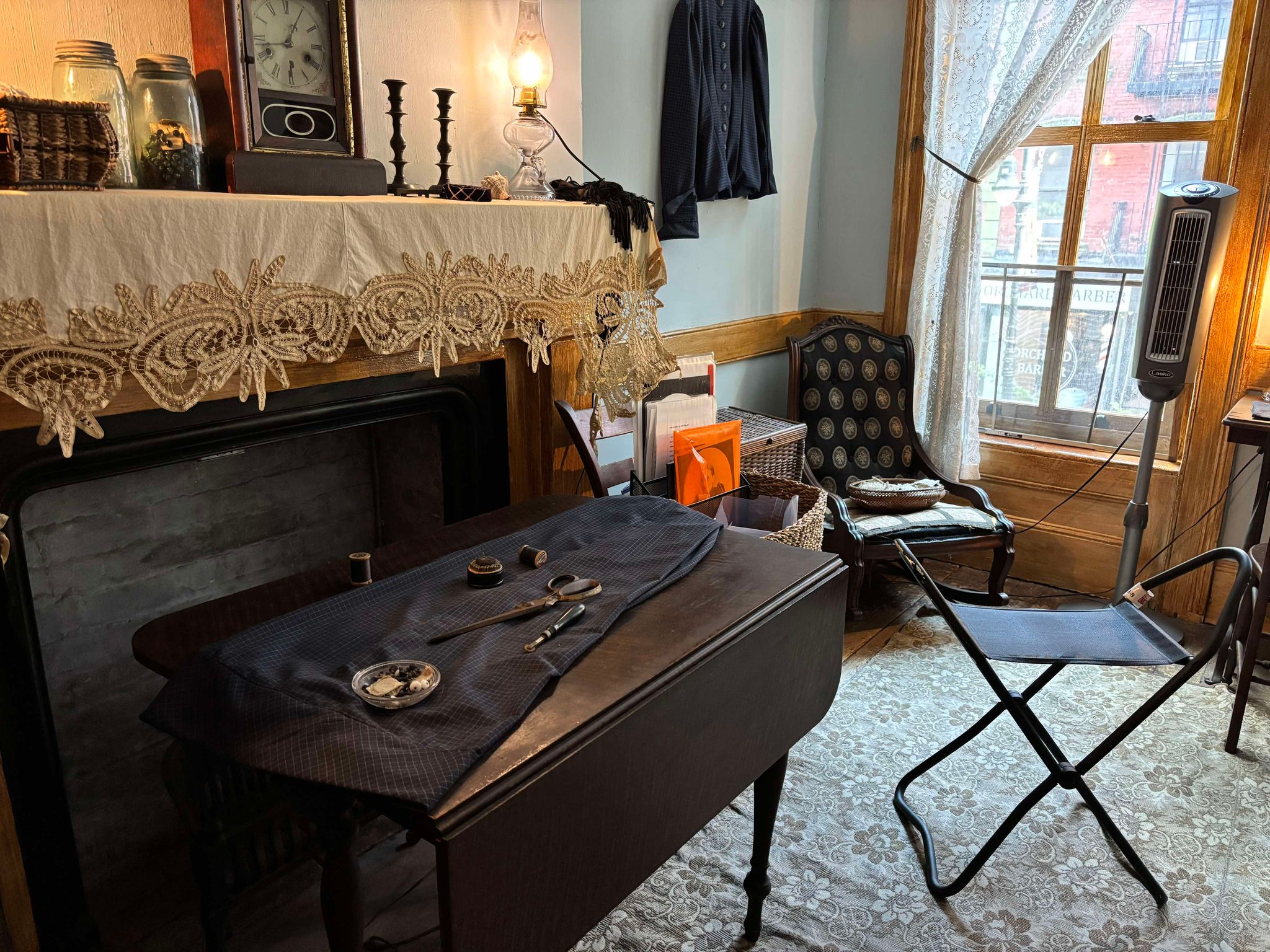
Before seeing the reconstructed apartment, we learnt about Irish immigration to New York and where the Moore family lived prior to this building. We then visited the Moore’s apartment and spent some time exploring the three rooms. One room was designated as a bedroom, one a kitchen, and one a living room. With up to nine residents per apartment, all rooms would have functioned as bedrooms. We continued to hear their story throughout. Finally, to conclude the tour, we discussed the Saint Patrick’s Day parade origins and how residents of New York viewed the Irish immigrants. Overall, a great tour to start our museum experience.
Our second tour of the day was 100 Years Apart. It poses the question, what do a 19th century German-Jewish immigrant family, and a 20th century Chinese immigrant family have in common? In short, more than you think. Throughout this tour you hear the stories of the Wong family and Gumpertz family. In both cases, the women thrived in the garment industry either being the sole contributors or major contributors to their family’s financial situation.
To start the tour, we visited the museum’s new building housing the garment shop of Mrs Wong. This is a very interactive space as you can hear stories direct from the family by activating sewing machines, toys, and cooking utensils. We had about half an hour in this room to explore.
Reconstructured Apartment
We then visited the original building to learn about Julius and Natalie Gumpertz. The Gumpertz family immigrated from modern-day Germany in the 1880s and lived in this building. During the Panic of 1873, Julius left the family, and Natalie was suddenly forced to provide for her three daughters. She started a garment shop and guided her family through financial hardship. This was my favourite story from the tour.
The Tenement Museum shares critical stories about New York’s past in an engaging and interactive way. You can book your tours online prior to visiting which will guarantee you a space. I’d recommend making a day of it and going on at least two tours. Plenty of delicious lunch options around! There is an accessible tour available that bypasses the stairs.
My next blog post is going to focus on all the historic cemeteries we have visited in New York, Atlanta, Charleston, and Savannah.