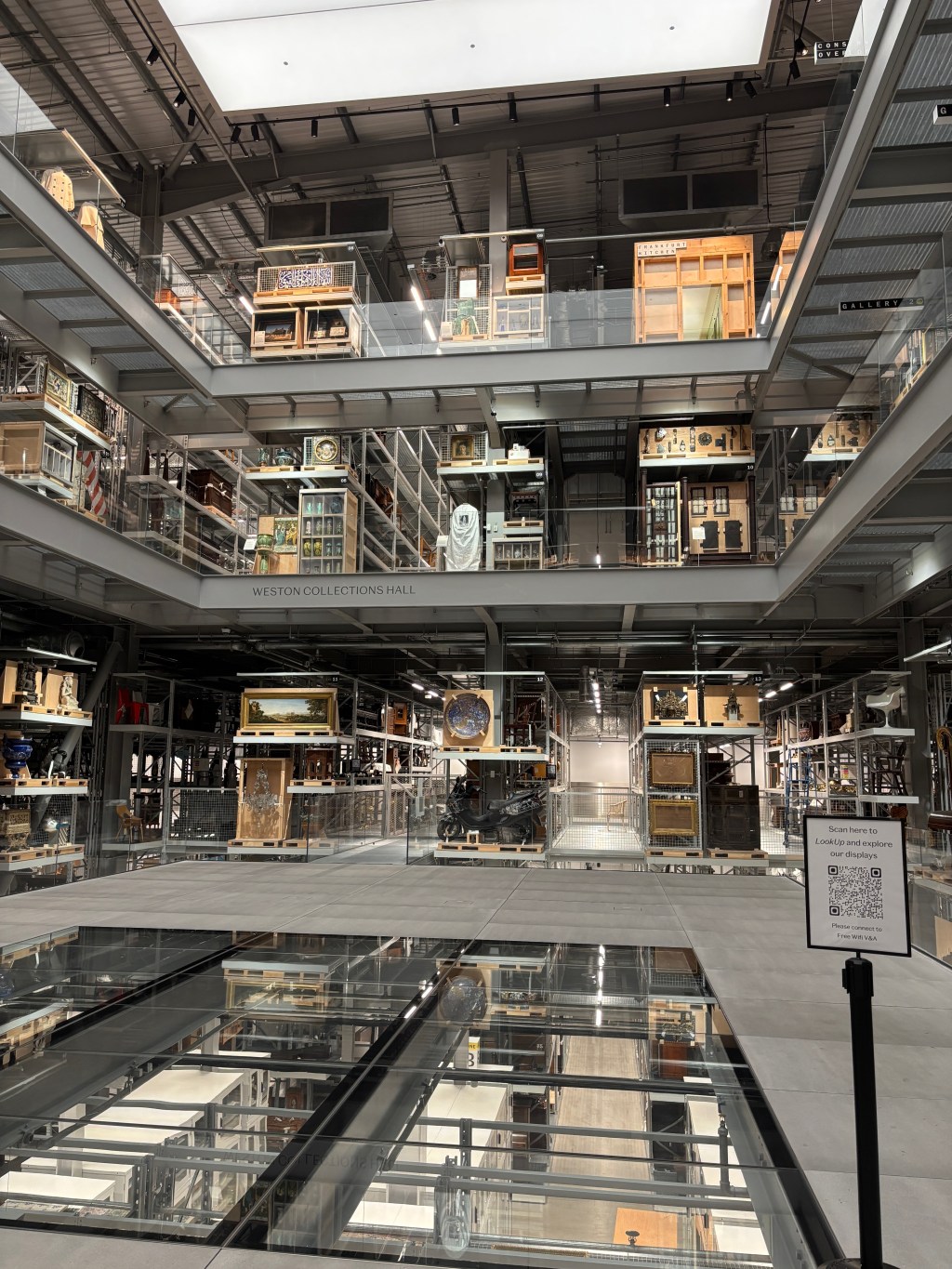
Next on my catch-up list is the Victoria and Albert (V&A) East Storehouse in London. You are likely to have seen this museum all over social media sites, especially Instagram. Before visiting, I had the expectation that it was going to be a visible storage facility displaying some, but not much, information. A space where you can order objects as you explore so you can engage that little bit deeper with the collection. While it is an impressive space that clearly had a lot of funding go into its design and build, there were a few areas where I felt a bit lost. Lost and overwhelmed. I’m going to focus on more of an overall picture of the museum. This will include some highlights and hopefully give you a sense of what to expect.
Pre-Visit
Before visiting the V&A East Storehouse, I recommend doing the following:
- Read their website
- Plan to visit early in the morning on a non-weekend day
- Don’t wear a dress/skirt as most of the floors are see-through grates
- Have a fully charged phone.
The reason for the first dot point is that the website does a pretty good job at setting expectations. For example, you can’t ‘order an object’ while you are onsite to view on the same day. You need to make an appointment at least two weeks in advance. Logistically, this makes sense. It was, however, not clear in initial museum marketing that this would be the case.
The website also contains some fantastic information on getting to the museum. It is not located in central London. You will need a solid plan to get there and back if you are staying around the city centre. It is also important to note that bags and coats are not allowed in the museum and need to be stored in available lockers (first-come, first-served). You are allowed to take your phone inside. Therefore, don’t visit with any valuables if it can be avoided.
Last, but not least, in terms of what stood out to me, there is no gift shop onsite and there is only a small cafe that serves drinks as well as a limited number of food items. Arrive with a full stomach.
For more information you can click on the link below which will take you to their main visitor information website:
V&A East Storehouse Information
I am trying to stress here that the more prepared you are for what to expect, the less frustration there will be when you arrive and start your experience. We had looked through the website prior to our visit so for the most part, nothing was a surprise.
Our Visit
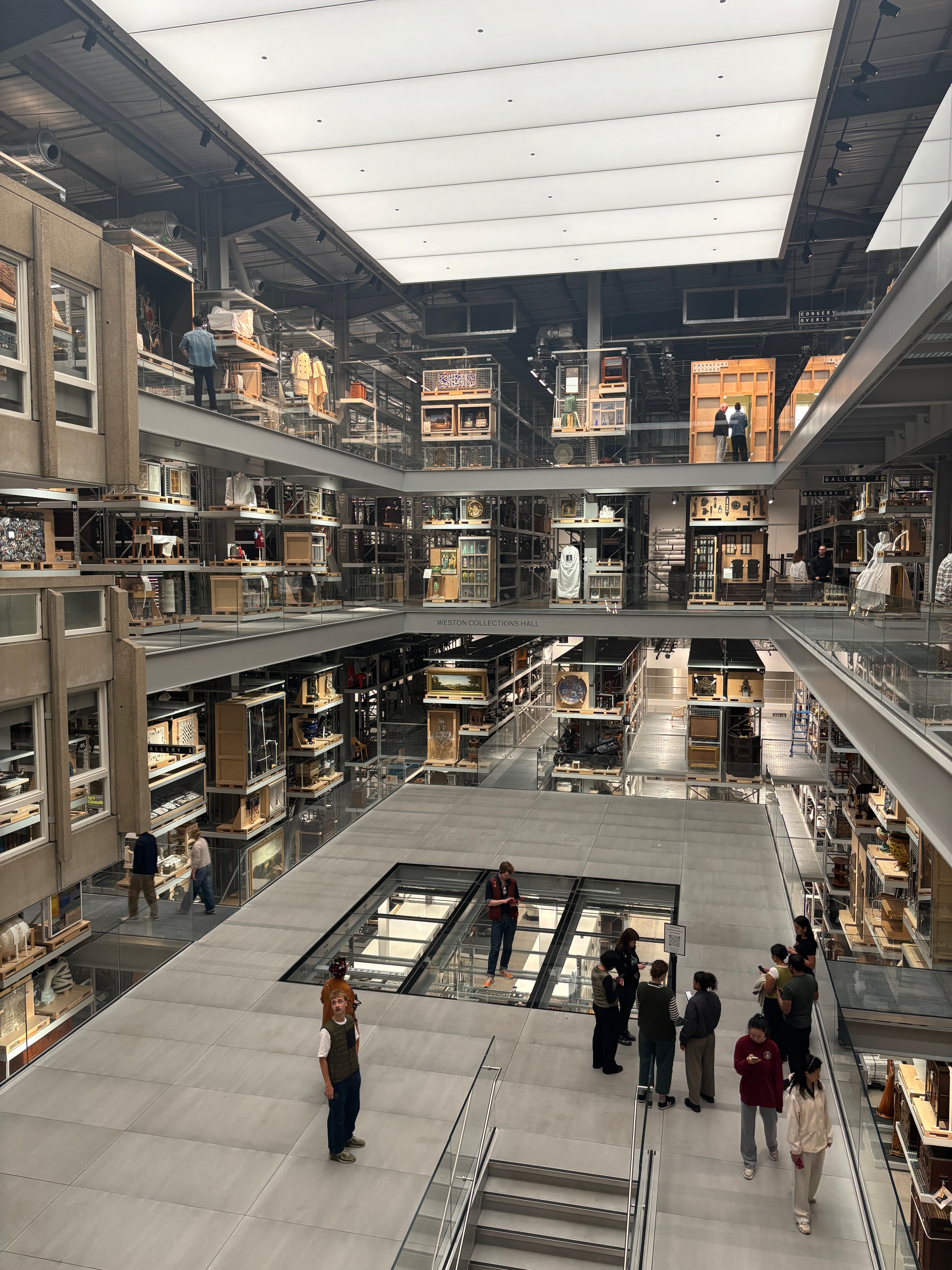
After securing our bags in a locker, we began our visit by walking up a set of stairs in the main entrance foyer and into the museum. As soon as you enter the museum, you are met with such an intense visual of the object storage. I say intense, because it is layers upon layers of interesting objects that can be overwhelming. This moment was interrupted by the need to connect to their Wi-Fi network so you could use your phone while exploring the collection. The Wi-Fi never really worked for me and my 5G was going in and out the entire time. We therefore didn’t engage too much with anything digital.

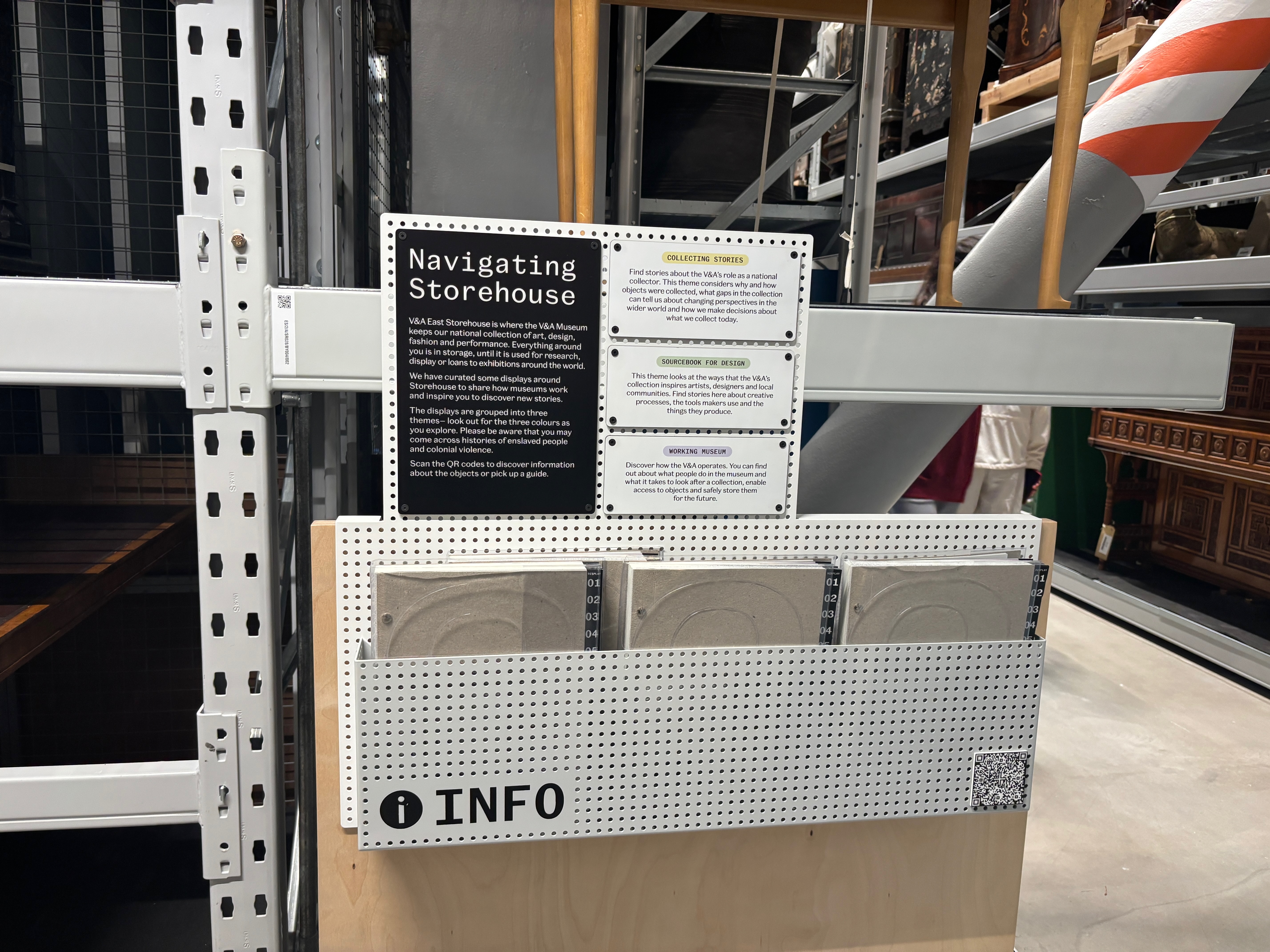
We decided to start at the top level (the third level) and work our way down. There are these information stands dotted around with guides relating to the visiting experience. I depended on these throughout my visit and couldn’t help but think how difficult it would be to get a guide when it was busy. Nevertheless, it is a great addition having helpful stations on how to structure and navigate your visit.
As we walked around each level, my vertigo caused by the see-through grate floors and glass barriers, started to ease. We spent our time exploring the objects we could see on display and engaging with the objects that had more information in the form of panels. Here are some general museum highlights:
1. Visitor Interaction
There are a few places in the museum where you can provide your opinion on a number of different topics. For example, tucked away on one of the levels is an interactive where you can add what you’d like to see the V&A collect in the future. Not only can you suggest an object to collect, but also answer the question of why? There are a few prompt answers such as ‘it relates to my heritage’ but you can also add your own.

Another interesting type of interactive is located to the edge of an aisle. The interactive poses a question for you to answer using a blue token. The example I have below asks the question ‘do you collect things from your childhood?’ Using the blue tokens, you can vote for one of four answers include ‘No. I look to the future.’ I found that the answers to these questions could be a bit strange by adding an extra sentence that might not exactly fit your answer. At this station I voted for ‘Yes. If it has meaning.’

2. Conservators at Work
On the third level of the museum, you can look into a conservator’s working space and see what they are doing. I would hate to be watched while I’m working. I don’t know how I’d feel if I was a conservator. These roles are usually away from the public so there might be a number who enjoy allowing the public to actually see what they do behind closed doors. They don’t have to work in this space and have access to other areas they can use depending on the type of work. There were no conservators in the space when we visited but I still enjoyed seeing all their different machines and equipment.

3. Exploring a Museum’s Role
Throughout the museum are some further insights into the role of museum staff and the broader role of a museum. One of these sections has a label on objects entering the V&A collection. This presents a glossary of terms for how museums acquire objects. For example, through bequest, long-term loans and purchased with funds. It’s great to have the lingo of museums accessible to the public. This can help with understanding a museum’s role and how an object might enter the museum. One obvious term that was not explored was ‘stolen’. I will get into this in the next highlight.

4. Difficult Conversations
I was pleased to see that there are a few labels that focus on stolen or looted objects. It’s a great step to bring some transparency to a complex and difficult issue. The sign on looted objects did mention the 1983 Heritage Act in the UK that prevents the returning of objects. Instead, the V&A is working with countries of origin on long-term loans for displays. It is a layered issue and having a label explaining why, is a first step in building some level of audience trust. There is, however, no voice included from those representing countries that or individuals who have had objects looted in the past. So, one small step in the right direction, but room for improvement.

Final Thoughts
Overall, I did enjoy spending time in this museum and challenging my ideas of what is an exhibition, what is display, and how a museum can build more trust with the public. We are nowhere near a destination with that last point, but it is important to raise and tackle these questions with transparency. I would recommend visiting if you want to see a lot of objects in the V&A’s collection and hopefully learn about a few of them. If you are not ok with heights, this one might be a challenge. I wouldn’t return for a second visit but I’m glad I got to experience a new way of doing and seeing in a museum.
 Curate Your Own Adventure
Leave a comment