
At the beginning of my last post, I mentioned that I have a list of museums and heritage places to discuss that I am slowly working my way through. Next on the list is the Bestattungsmuseum in Wien (Vienna) which we visited back in March. It completely slipped my mind to write a post about this museum at the time. It’s weird, because this is a museum that sits inside a cemetery, focusing on death and funerals. The rough translation of Bestattungsmsueum is Funeral Museum. Exploring a museum inside a cemetery is my idea of a perfect day out. This post will cover both Wiener Zentralfriedhof (Vienna Central Cemetery), and the museum.
We visited before heading to Graz for my one-week Erasmus program at their medical university. Originally, this was not part of our plans. In fact, I had no idea this museum existed until the day of our flight. The date we were going to fly to Vienna had to be changed due to the impending arrival of Cyclone Alfred. We decided it was safer to fly out a bit earlier and have a couple of extra days in Vienna. I had no idea how to fill these extra days so Googled ‘Death Attractions Vienna’. Expecting to find nothing, I was absolutely shocked when search results revealed the Bestattungsmuseum. How on earth have I never heard of this museum? Not only a museum focusing on death and funerals, but one that is inside the largest cemetery in Vienna and close to our hotel.
Wiener Zentralfriedhof (Vienna Central Cemetery)
Boasting a 4.7 on Google Reviews from just over 1 000 visitors, the Wiener Zentralfriedhof or Vienna Central Cemetery, is a stunning and huge cemetery about 20 mins (by public transport) from the city centre. To give you an idea of its size, there are four different tram stops for four separate entrance gates. Opening in 1874, the cemetery is approximately 2.5 square kilometers making it the second largest cemetery in all of Europe and about the same size as Vienna city centre. We caught tram 71 to Zentralfriedhof 2. Tor or Gate 2, which is the main entrance. It is also the closest entrance to see the famous graves and to visit the museum.
What we first noticed was the sheer scale of the cemetery. It is incredibly overwhelming. Luckily, just inside the gate, there is a cafe so you can drink coffee and eat cake while you plan your visit. There is also a small souvenir shop inside the gate that I will be talking about later.
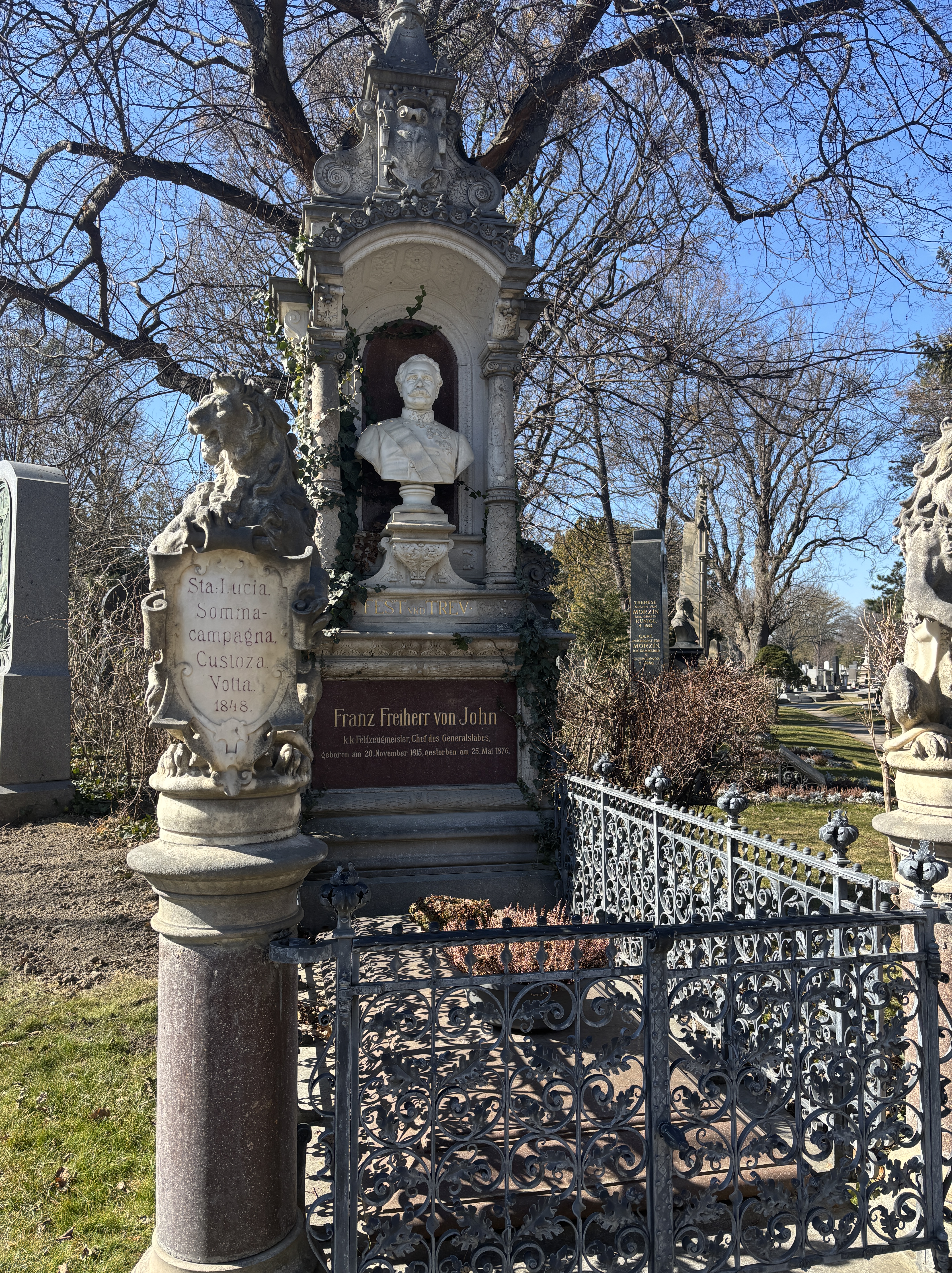
We decided, post-cake, to spend the cooler part of the day walking around the cemetery and then visit the museum. Since it was our first time exploring, we walked along the main road leading from the entrance gate to the Friedhofskirche zum Heiligen Karl Borromäus (St Charles Borromeo Cemetery Church). Along the way, we were struck by the artistry and architectural significance of the tombs, mausoleums and monuments. There is a small section which has the graves of composers such as Johannes Brahms, Franz Schubert and Ludwig van Beethoven. This area was quite busy for obvious reasons. I’m going to include a few photographs to give you a sense of the tombstones. There are, in total, approximately 330 000 tombs/mausoleums.


Bestattungsmuseum
After exploring the cemetery, we returned to the entrance gate to find the Bestattungsmuseum. It is located in the basement of Mortuary 2, a building that seamlessly blends in. While reading about the museum for this blog post, I kept seeing references to the special relationship Vienna residents have to death and how that has been part of their cultural understanding for centuries. Not a ‘we love death’ attitude, but an acceptance of death leading to a better appreciation of life. Culturally, I think where I live has a lot to learn from this relationship and how we can develop a healthier outlook on life and death. I think it is important to highlight this because some of what I will discuss will make a lot more sense in that context.

After entering the museum we were greeted by the museum’s mascot, Quiqui, a grim reaper. The word ‘quiqui’ is an old Viennese word meaning death. Right from the beginning of our visit I had an idea of what to expect – a place where death is not taboo, but an important and inevitable part of life. A part of life where we can have a mascot.

The entrance foyer has the ticket desk, a gift shop, and the start of the permanent exhibition pathway. I will definitely return to the gift shop later because it needs its own section. Once we had paid for our tickets, we started our journey through the history and culture of funerals and death in Vienna. There is a set pathway to follow through the museum that winds you around thirty different display themes and 250 objects. Object labels and panels are in both German and English. The following were highlight objects for me.
1. Bodice for a Mourning Dress (early 20th century)

I’ve selected this object because it is one of the most delicate and intricate in the museum. The relationship between clothing and mourning has always been of interest to me. This would have been worn under other clothing to add an additional layer of mourning wear.
2. Wall of Funeral Invitations
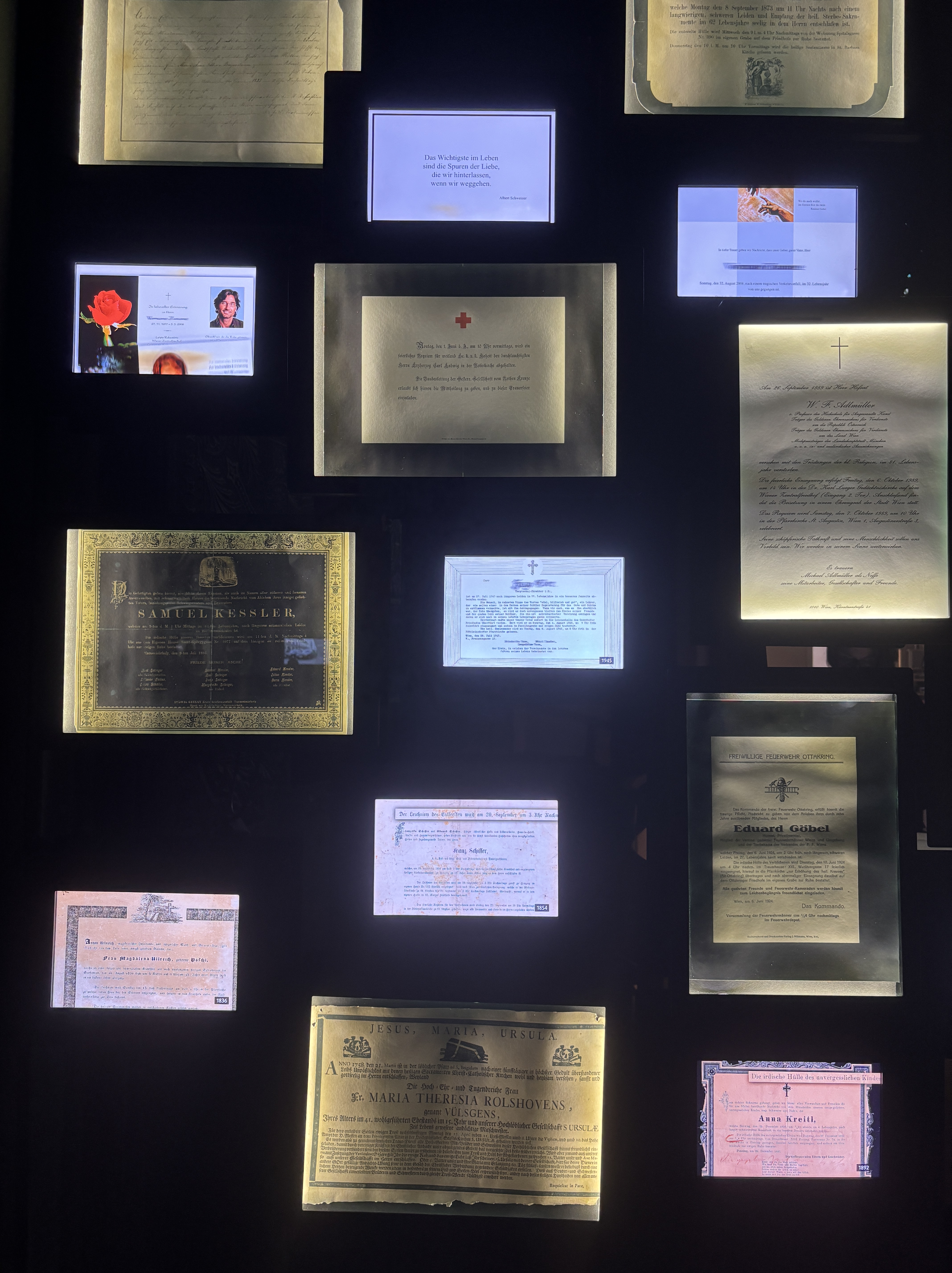
This display is a mix of old and new, digital and paper, funeral notices and invites. It explores how funeral invites have transformed over time and what has remained a constant. It adds some diverse personal stories to the museum.
3. Small Transport Van (early 20th century)
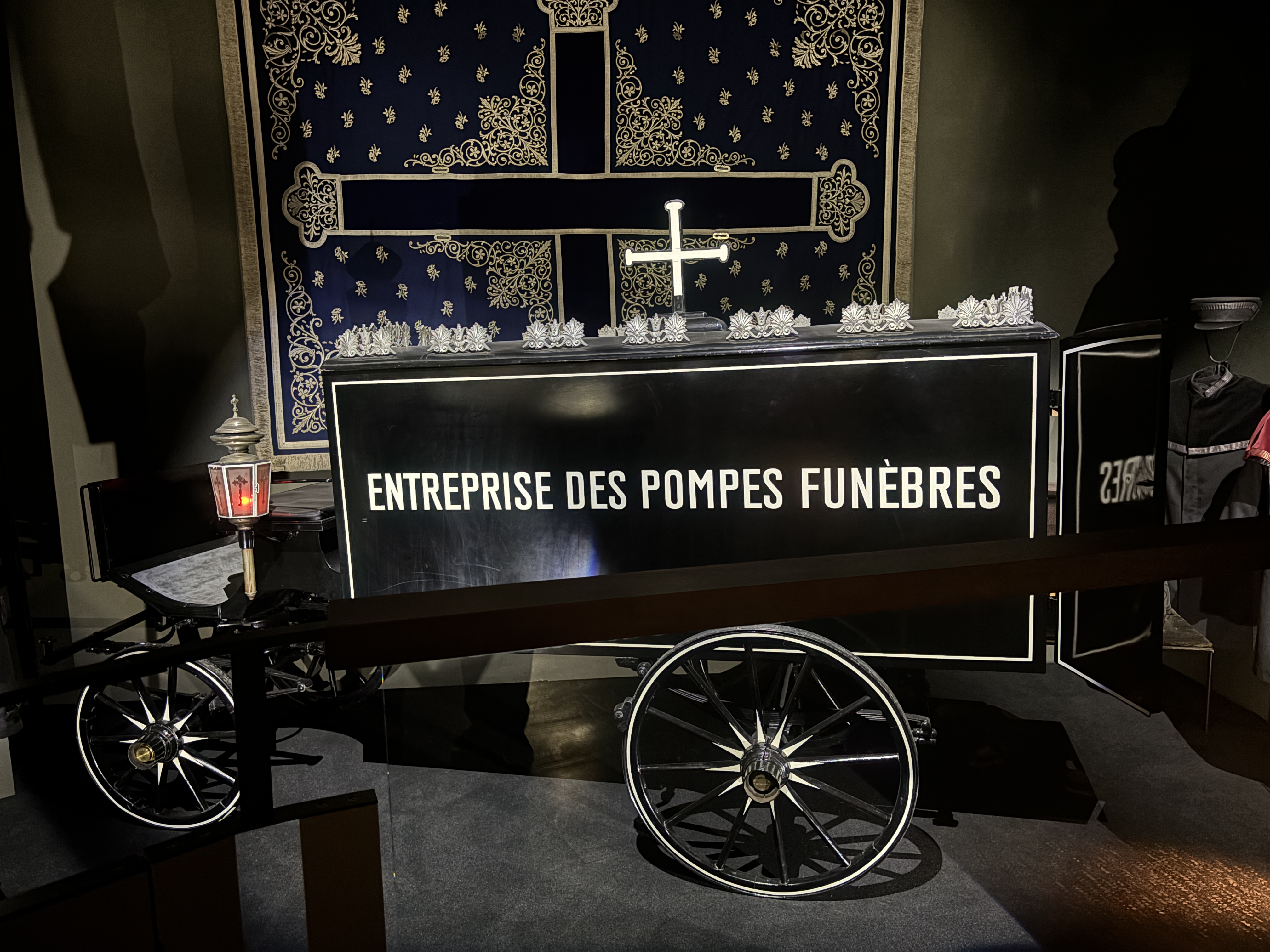
There are some large objects in the collection and this was one of my favourites. A small van, large enough to fit a coffin, used to transport the dead to the cemetery. It was created by Schustala & Co. Court Coach Factory and was a horse-drawn van.
4. Model Cars
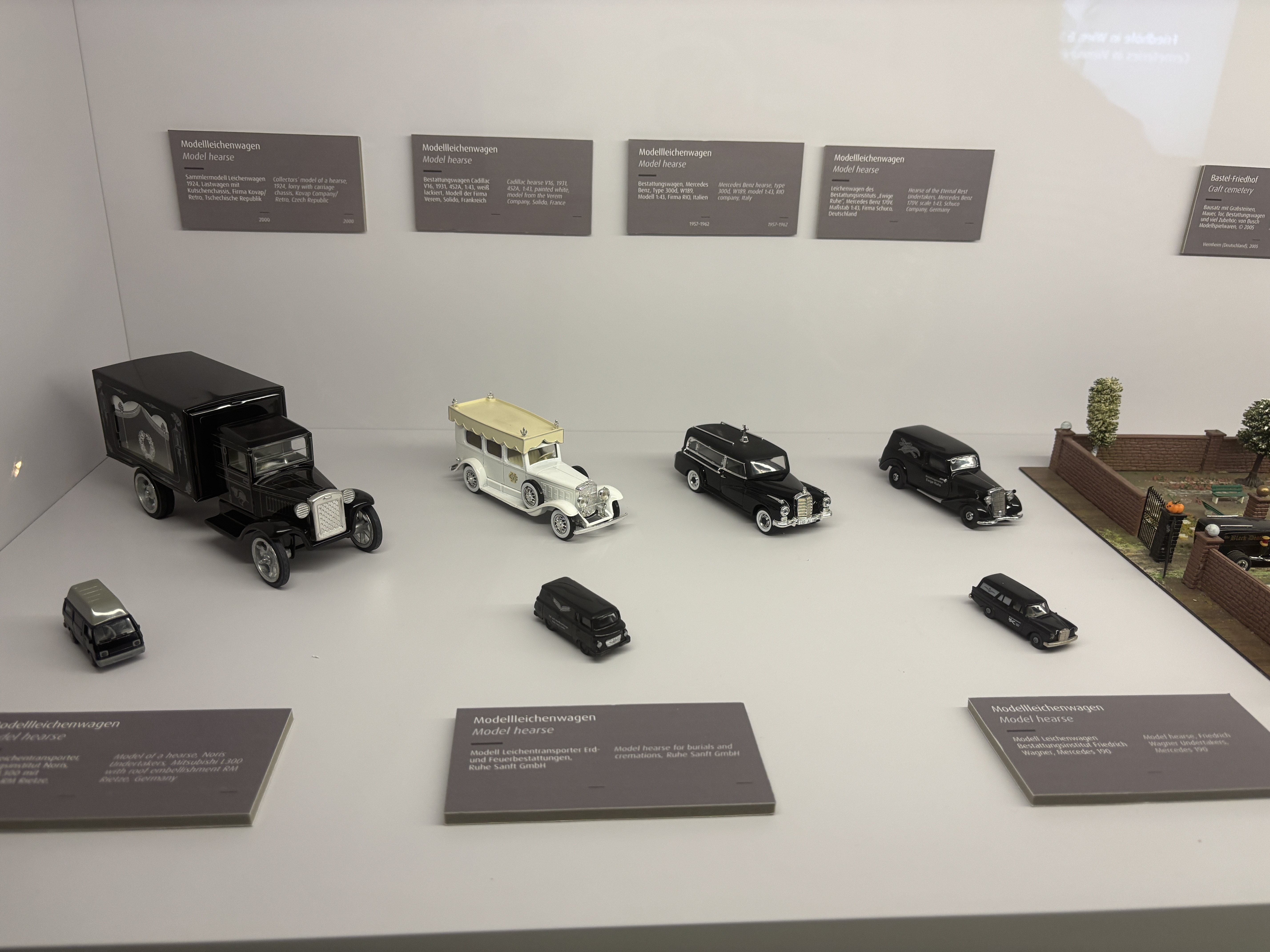
Miniature anything is going to be adorable so these miniature hearse cars made my favourites list.
5. The Coffin

Towards the middle of the museum there is a display focusing on coffins and what constitutes as a coffin. The variety they have on display reminds visitors that the expensive, antique-looking coffin is not the only option.
6. Coffin Chair

Inspired by the artwork, Perspective : Madame Recamier de David, this is a coffin chair. Instead of being horizontal for eternity, why not sit upright.
Gift Shops
I was not expecting there to be one, let alone two, gift shops attached to the museum and cemetery. In my travels, I have seen something similar at Oakland Cemetery in Atlanta and, to a lesser extent, Highgate Cemetery in London. Where Vienna differs, is the sheer quantity of specific themed items relating to both the museum and cemetery. It made me reflect on the idea of death-merchandise consumerism. Having learnt about the Viennese cultural attitude to death, this doesn’t surprise me. Money from these purchases goes to museum and cemetery maintenance. Could purchasing death-related merchandise and using said merchandise encourage conversations about death with others? Is the modern form of Memento Mori a t-shirt that reminds us we’re going to die? So many questions.
Museum: The museum gift shop had such a variety of merchandise. Everything from sunscreen with a little skeleton on the front to sunglasses that say ‘I see dead people’. The one certainty for me, I was going to leave with at least one Bestattungsmuseum-Lego collaborative set. I am only so strong. I ended up buying a tombstone and a historic funeral wagon.
Cemetery Gift Shop: At the entrance there is a small gift shop selling, amongst other things, t-shirts. I did purchase a t-shirt to wear at any and all future death-related conferences and presentations.
Conclusion
If you are visiting Vienna then I highly encourage a half-day trip to the cemetery. Entrance is free and it is a genuinely peaceful place to explore. I would love to return in winter and see the tombstones covered in snow. I feel very fortunate that we had the opportunity to visit and experience the Viennese relationship to death.
 Curate Your Own Adventure
Leave a comment