
We arrived in Amsterdam yesterday and have hit the ground running. This is my third time visiting Amsterdam, so I wanted to explore some more niche museums and sites. I am also so excited to finally see the tulip fields! Today, we visited two museums, one of which was Museum Vrolik, located within the Academisch Medisch Centrum (AMC). This is about a 45-minute metro ride from Amsterdam Centraal.
Similar to other museums with specimens, there is absolutely no photography. This is made clear at the entrance and also throughout the museum space. I really like how they speak about this on their website, encouraging visitors to become students of anatomy. By this they mean respecting the material on display by observing and learning. Not by sharing images and potentially causing distress.
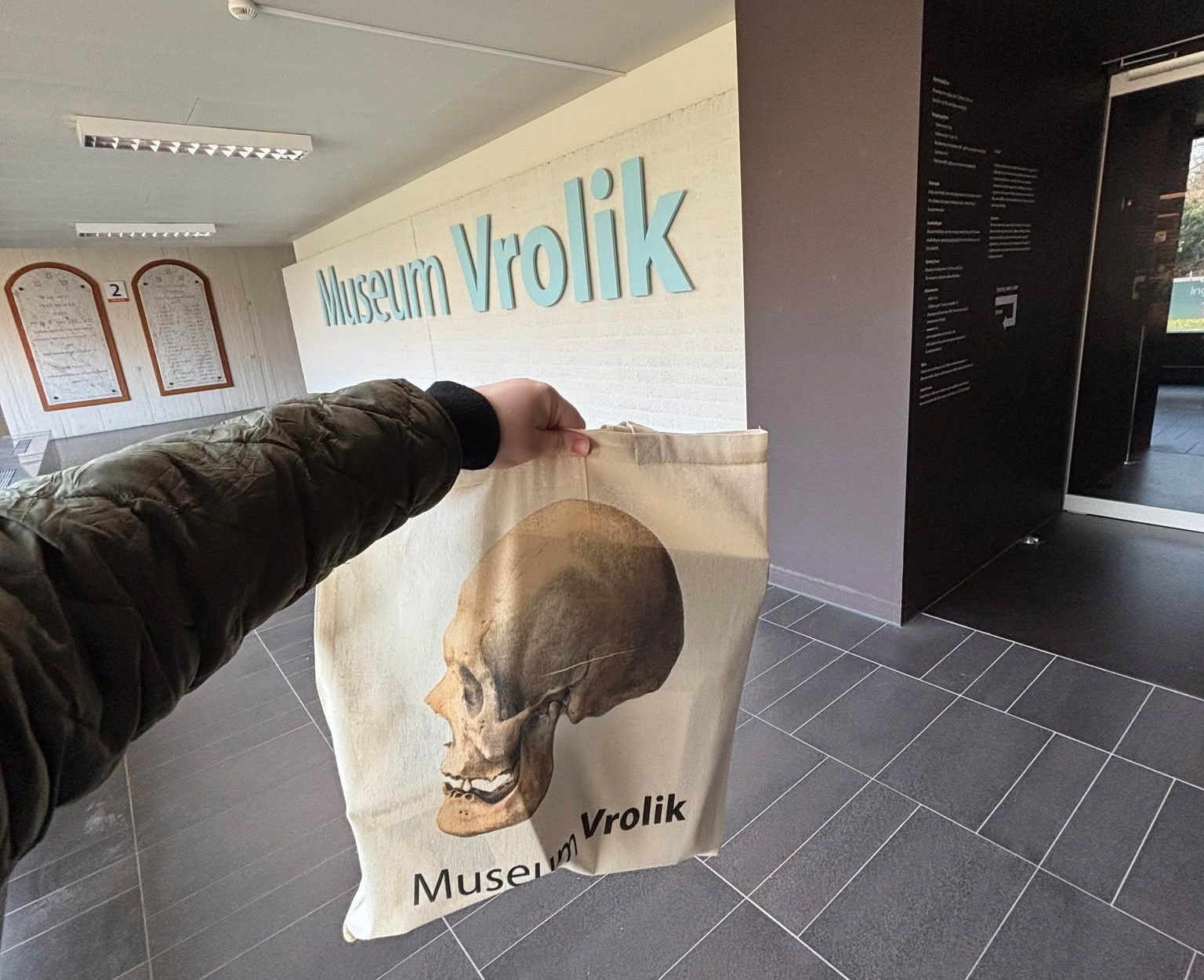
For this reason, I only have a couple of photographs to share (from outside the museum and of my amazing new tote bag).

Context: Museum
The museum’s website offers a comprehensive history including information on those who have contributed to the collection. For this post, I am going to summarise it here. The museum is named after Gerard (father) and Willem (son) Vrolik. Both were professors of anatomy in Amsterdam and collected anatomical as well as pathology specimens (human and animal) between the late 1700s and mid-1800s. As with so many of these early collections, it was initially stored at their private home.
The museum is transparent about this next section of their history. Skeletal specimens of colonial origin was also collected to understand race theories of the time. None of this collection is on display today. I can only imagine the many ethical and repatriation discussions happening behind closed doors. I will mention here that in 2018, Māori material was repatriated.
After Willem’s death in 1863, the collection was purchased by some rich Amsterdam citizens and donated to the precursor of the Amsterdam University. Over time, more anatomists contributed to the collection, acquiring specimens that reflected their various interests.
The museum was housed in different locations around the city centre before being moved to the University in 1984.
Context: Collection
The collection contains a standard array of preparations including potted specimens, wax models, plastinated specimens, and dried skeletons. What stood out to me is the extent of the skeletal collection. Not just human, but also animal.
The earliest contributor to the collection was Jacob Hovius, a physician from Amsterdam. He collected skeletons displaying pathological conditions, donating them to the guild of barber-surgeons in 1772. If you don’t know the history of surgery and barbers then I encourage you to stop reading here and go down that rabbit hole. His wooden cabinet of skeletal specimens is now housed within the museum.
There are some medical history objects on display surrounding the museum that I presume are also in the collection and not on loan. These consist of medical texts as well as medical devices and historical instruments.
Context: Display and Layout

The museum consists of one large room filled with glass cabinets. As mentioned in the previous section, there are objects surrounding the museum but no specimens. Directly inside, on the right, is a small ticket desk and shop. After paying the entrance fee, you are free to explore.
At the front of the museum, on the left, is a section dedicated to animal material. There are some potted specimens as well as skeletal specimens to view. As you move around the perimeter, you come across some full adult human skeletons. Right at the back, on the left, is the Hovius display. As you move around the perimeter you then come to a reading area with books, chairs, and a table.
In the middle of the museum (and on the left hand perimeter wall) are a series of glass cabinets containing the various anatomical and pathology specimens. The glass cabinets are divided by body part or organ and, at times, themes. For example, there is a section on the arm rather than a section on the musculoskeletal system. This is a bit different to what I’ve seen so far. This is the first museum where body system classification is not primarily used.
Each cabinet has a laminated sheet where you can discover more about the specimens. I’ll speak about this later.
That essentially summarises the museum and its layout. It’s not a huge space and the specimens are displayed with not much room to spare. If this is your first pathology or anatomy museum, I suggest taking your time so to not become overwhelmed.
Highlight: Information Sheets Summary of Organ
Each glass case has a laminated sheet in English and Dutch where you can find more information. Take, for example, the cabinet on the brain. The sheet firstly outlines the function of the brain and how it fits into the entire body and body systems. At the top of the sheet is an outline of the specimens in that section with a corresponding number. So, if you’re looking at the fourth specimen along, you can find its outline on the sheet, get the number, and read what exactly the specimen is further down.
The summary of each organ adds context to the display and would be a fantastic initial read for anyone looking for a bit more baseline information. There is only one sheet in each language available, but I’m sure the front desk would be able to assist if needed.
Highlight: Digital Display
The Hovius wooden cabinet really dominates the space and is quite intimidating on first viewing. Rather than a sheet, the museum has opted for a digital label where you can select specimens in the cabinet to read more.
This works a lot better for this particular section because more information on the bones can be disseminated via the screen. I would be interested in learning if this kind of digital integration is something the museum wants to expand on in the future. It works really well within the space and can allow for the information to be edited and updated without needing to print new sheets.
Conclusion
It has really been fascinating to see how these collections are opening more to the public and grappling with providing information to a wider audience. At the end of my visit, I purchased the absolutely essential museum tote bag and the museum’s catalogue.
Despite it being quite heavy, I am going to find a way to safely transport the catalogue back to Australia. It has a great overview of the collection and its educational value.


 Curate Your Own Adventure
Leave a comment