
I am so excited to be in Europe for the next month visiting Austria, Germany, the Netherlands, and England. Next week, I’m travelling to Graz, Austria, for a one-week Erasmus mobility grant awarded by my university, The University of Queensland, and the Medical University of Graz. I will be joining the anatomy department in Graz to learn about their anatomy/pathology museum and medical teaching techniques. Also on this trip, I am taking the opportunity to visit as many anatomy and pathology museums as possible.
For each museum, I’m going to start with some context, followed by one or two highlights. Rather than a particular object or list of favourite objects, I want the highlights to be, for example, an effective interactive or a way in which an exhibition is displayed. If possible, I’ll also share a highlight object. The point of this is to keep a written record of my visits while also sharing these fascinating museums.
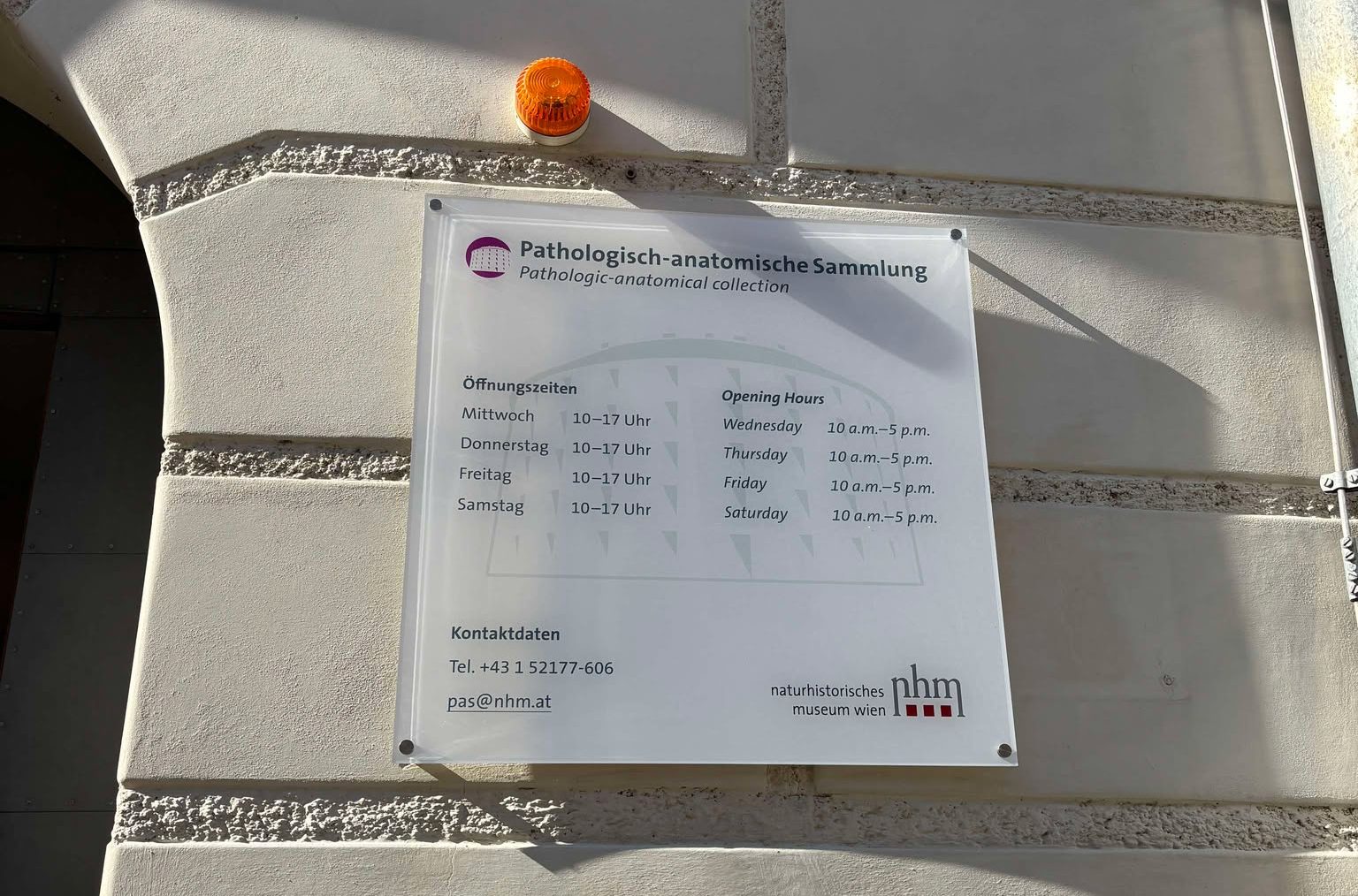
First on the list is the Pathologisch-Anatomische Sammlung im Narrenturm – the Pathology and Anatomy Collection in the Fool’s Tower, Vienna. I’ll note here that the museum prohibits photography. For this reason, there will only be a couple of images in this post of the outside of the museum and the introductory panel.
Context: Narrenturm Building
The building where the collection is housed and displayed was once the ‘Insane Asylum of Vienna’ hence the term ‘Fool’s Tower’. In the late 1700s, Emperor Joseph II commissioned and funded the building’s construction. In 1784, it opened as an asylum, the first institution in Europe exclusively built for patients requiring mental health treatment. This was treatment deemed necessary and appropriate at the time. It is a five-storey tower with approximately 28 cells per storey. A central corridor connects the cells together. While walking around, I thought it resembled something like a panopticon.
In the mid-1800s, the tower was deemed unsuitable to operate as a mental health facility. It closed in 1866 with all remaining patients transferred to nearby psychiatric hospitals. Between 1866 and 1971, the building mostly functioned as storage for supplies and accommodation for hospital workers. In 1971, it opened as the Federal Pathological-Anatomical Museum and became part of the Natural History Museum Vienna in 2012.

Context: Collection
The pathology and anatomy collection dates back approximately 200 years with the first specimen acquired in the late 1700s. Today, there are more than 50 000 specimens cared for by the museum which is an unbelievably large number. During your visit, you see only a handful of these specimens. They are on display alongside wax moulages, historical objects, photographs, and models.
It’s hard to tell the exact extent of the collection, but from what we saw, every major organ is represented as well as a wide variety of diseases.
Context: Display and Layout

The museum is isolated to the ground floor of the tower and follows the circular layout. As you walk around, each cell contains a theme or body system. In total, there are nineteen displays covering the history of pathology, pathology today, body systems, and modern-day diseases. It is an effective way to organise the museum, providing a focus for each room and a clear narrative you can build upon.
At the entrance to each room is a context panel, in both German and English, stating the theme of the room and what is on display. Every room contains two display cases along the side walls and an interactive screen or larger object in the middle. The rooms did feel a little cramped when four or five visitors were inside, but we just paced ourselves and waited until the room was empty. There is seating outside most of the rooms.
At the end of the museum there is an art installation, special exhibition on moulages, and a gift shop. The shop sells museum-specific merchandise as well as texts relating to medicine and some anatomy-themed items.
Before discussing my two highlights, I want to mention that there is an emphasis on displaying these specimens without sensationalism. There is respect given to the specimens and they are really used to their full educational potential.
Highlight: Interactives
My first highlight is the types of interactives used in the museum and how they contribute to the overall visitor experience. There are two in particular I want to document.
1. Histology Touchscreen
In the room covering histology and histopathology there is an interactive screen where you can take a histology quiz. Using visual clues, you are asked to match close-up histology images to ones that have been zoomed out. Once you have correctly guessed the pair, you can learn more about the organ or disease. It is a simple but effective way to teach some basic histology.
2. Augmented Reality Station
In the middle of the musculoskeletal room there is a giant television and camera. When you stand in front of the screen, an augmented reality program projects different body systems onto your body. You can select to see your muscles, bones, nervous system, cardiovascular system, and digestive system. As you move around, you can see how the systems move with your body. It is such a great use of an interactive that is both fun and educational.
Highlight: Decal on the Walls in the Body Systems
Another highlight I want to mention is the decal on the back walls inside each body system room. As you step inside the room, you see an outline of the body with the relevant system highlighted. The main organ of that system has its own decal with some further information and major features labelled. This provides context for the specimens and diseases that you can refer back to at any stage of your visit.
Highlight: Specimen
There are so many fascinating specimens to explore that really shed light on how disease can affect the body. In the room covering infectious diseases there is a section of brain from an individual who died from Smallpox. I have read so much about Smallpox in my current role so to see a specimen showcasing the disease really had an impact.
Conclusion
I am so glad I had the opportunity to visit this museum and see one of the largest pathology/anatomy collections in the world. I would strongly recommend a visit if you feel comfortable viewing human specimens. It is open Wednesday to Saturday between 10am and 5pm. You can take a guided tour but I believe they are mostly in German.
 Curate Your Own Adventure
Leave a comment