
I have travelled to Adelaide for a history of medicine conference. Overall, the conference was fantastic! Great to hear about the research taking place in this field and to present on a project happening in our museum. Yesterday, the conference finished around lunchtime so I took the opportunity to visit the Art Gallery of South Australia and see the new Frida and Diego exhibition. Fortunately, I had a friend at the conference who also wanted to visit. This had a huge impact on my experience as she spent longer in the exhibition than I would have on my own. In the end, this meant I read every panel and every artwork label which is definitely not something I normally do. Overall, I enjoyed the exhibition and the delightfully colourful display. As with so many posts, I am going to begin with an overview and then discuss my favourite artworks on display.

Exhibition Overview
I don’t think it’s possible to hold a Frida Kahlo exhibition without an accompanying rainbow of bright and bold colours. Every room in this exhibition is painted a striking colour which beautifully complements the artworks on display. You can tell that each colour has been carefully selected in order to help tell the exhibition’s story. For example, the second last room focuses on Kahlo’s health. The walls are painted black with black curtains separating some of the photographs. This is in stark contrast to the final room which welcomes you with extremely bright colours and a flower installation suspended from the roof. This is where you also see the first colour photographs of Kahlo so it really feels like you are being overwhelmed with colour.
Another positive is the pacing of the exhibition. Each room has a select number of artworks that seems to be the perfect number to further the exhibition’s story. There were only a couple of times I wanted to see more on display but that was because of the subject matter and my interest. I did not get visitor fatigue from this exhibition which was surprising considering I was reading everything!
My one criticism of the exhibition would have to be the labelling. Shocking, I know. However, I will say that the language used in this exhibition wasn’t as alienating as other exhibitions. There were just a couple of labels where my friend and I had to Google the meaning. Rather than the language being the primary issue, it was the text size and position of labels. At times they were positioned to the left of the artworks and other times to the right. This did lead to some confusion. Also, the font was super small and I felt nervous standing close to the artworks just so I could read the labels. This wasn’t an issue with the thematic labels which were very easy to read and to the point.
I am now going to highlight my favourite artworks in the exhibition in no particular order.
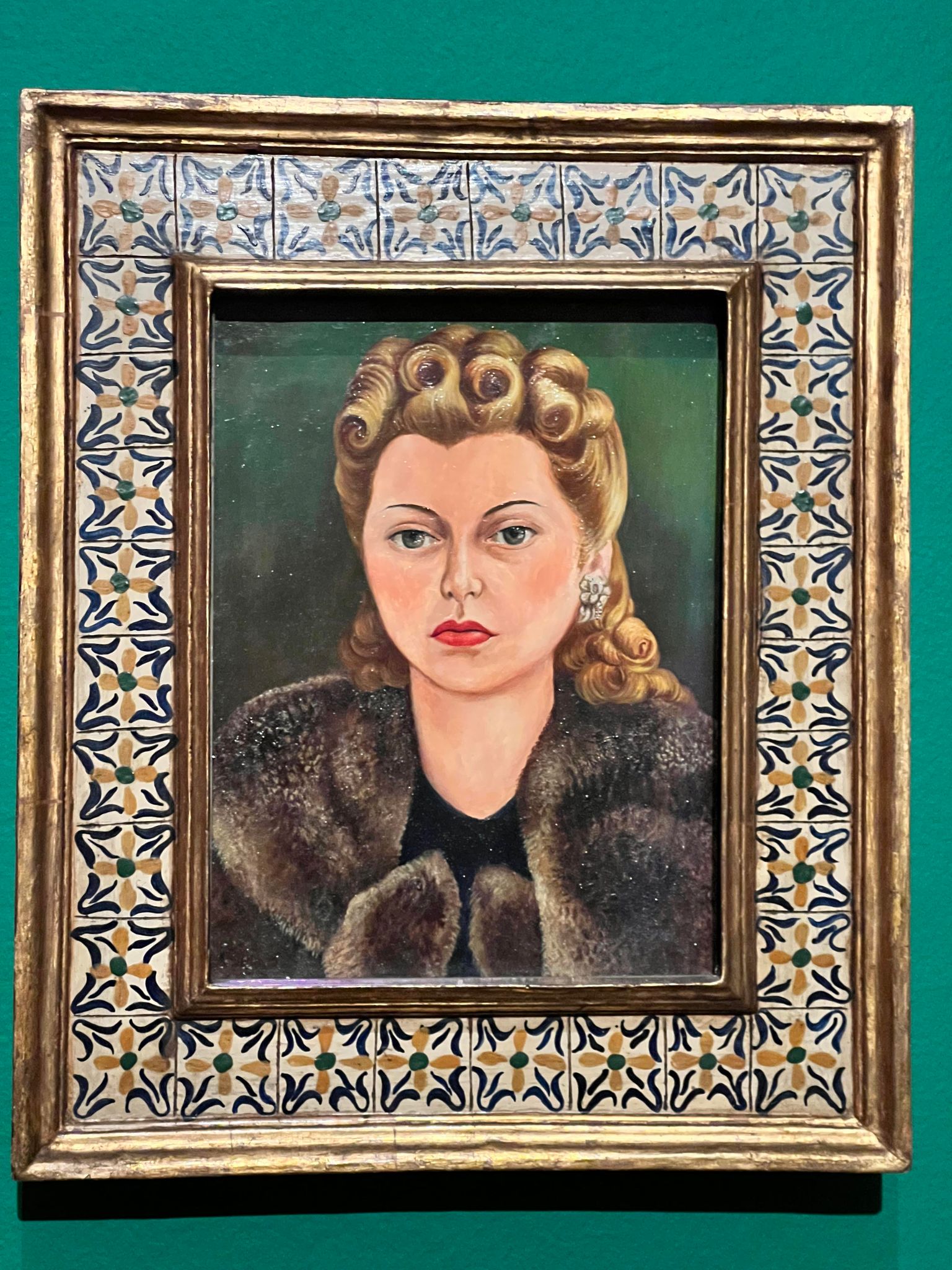
1. Portrait of Natasha Gelman, Friday Kahlo, 1943
This was one of my favourites in the exhibition mainly due to the frame. It looks like little individual tiles pasted around the portrait. Depicted is Natasha Gelman, an American art collector.
2. Self-Portrait with Monkeys, Frida Kahlo, 1943
As you can see in the photograph, this painting is displayed on a vibrant blue wall. This really accentuates the colours in the painting and made it stand out in the exhibition. The monkeys are a fun addition to the work and are believed to be included to reflect Kahlo’s developing role as a mentor for students.

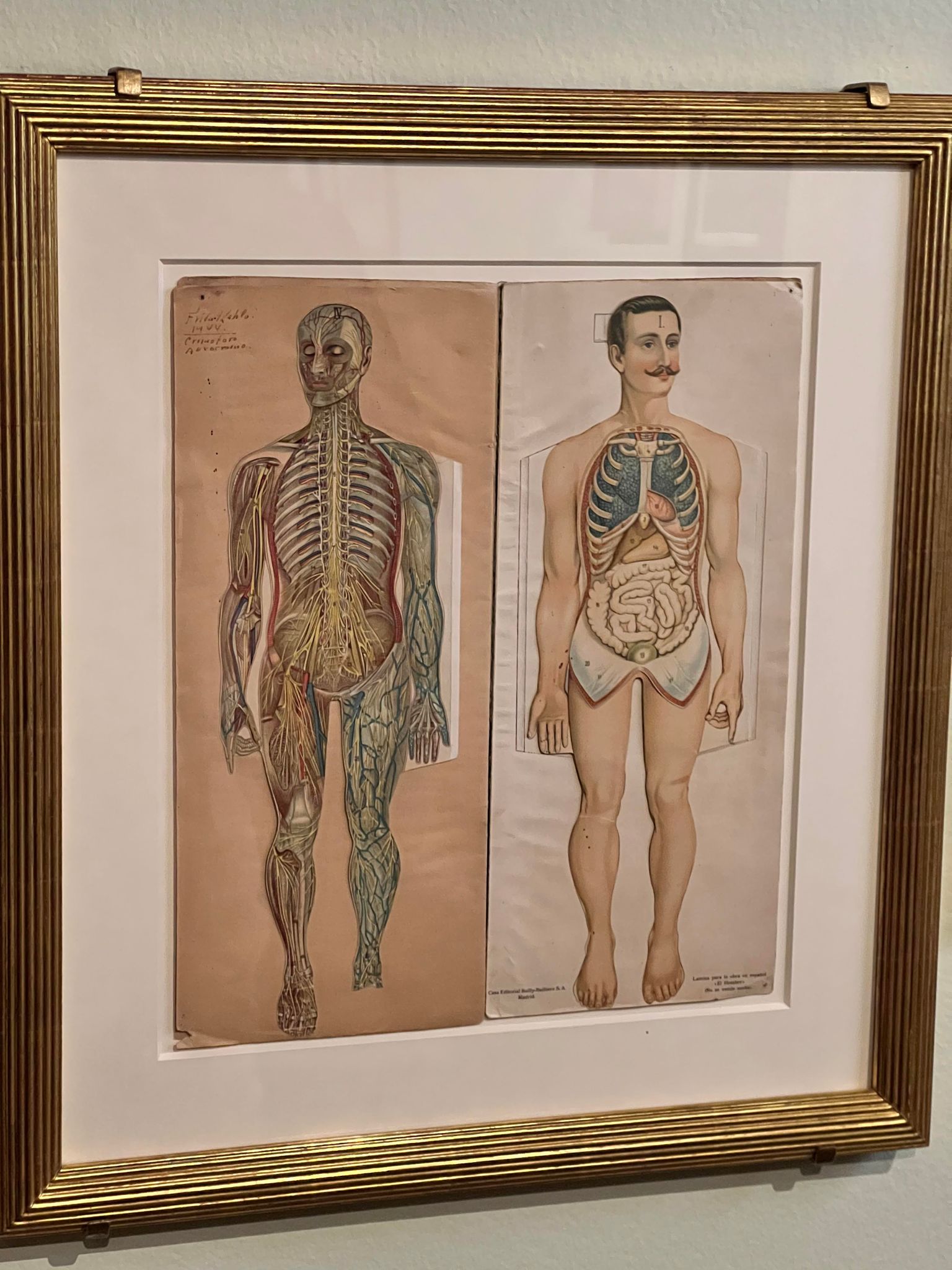
3. Anatomical Images
I forgot to take a photograph of this artwork’s label so I’m missing the context. I’ve included it, however, because these anatomy books and interactive pages are favourites of mine. If you zoom in, you can see that they once belonged to Kahlo. In the top left corner is written ‘Frida Kahlo, 1944’.
4. Clothing Room
Towards the end of the exhibition there is a room filled with Kahlo’s clothes. They are so bright and beautiful, representing traditional Mexican clothing and patterns. My favourite was the Tehuana dress photographed below (the one with large colourful flowers on a black background).

5. Diego on my Mind, Frida Kahlo, 1943
This is the featured artwork in the final room. It is quite famous, depicting Kahlo with a portrait of Diego on her forehead. There is still debate surrounding the meaning behind this artwork. According to the label, the roots sprouting from her flower crown could reflect new growth or depletion of energy.

Logistical Information
Frida and Diego: Love and Revolution is on display at the Art Gallery of South Australia until 17 September 2023. There is an additional fee to visit this exhibition. It is fully accessible. For further information, please follow the link: https://www.agsa.sa.gov.au/whats-on/exhibitions/frida-diego-love-revolution/.


 Curate Your Own Adventure
Leave a comment